
You followed a solid forex or XAUUSD signal… and still got stopped out by “normal” market noise.
If you’ve ever placed a fixed 20-pip stop on EUR/USD or a tight $5 stop on gold, you’ve felt this problem.
Markets don’t move in fixed pips.
They move in volatility.
Right now gold (XAUUSD) is trading around $2650 (+0.35% on the day), DXY is firm near 106.80, USD/JPY is around 149.50, and EUR/USD is near 1.0520.
That mix often creates sudden bursts of movement—especially during London and New York sessions, where our community focuses most of its execution.
This guide shows you how to convert any signal into a consistent, risk-managed trade using ATR-based stop loss and take profit, plus a simple position-sizing formula that keeps your risk stable no matter the pair.
TL;DR: ATR-Based SL/TP for Signals (Fast Takeaways)
- ATR (Average True Range) measures current volatility, so your stop adapts to “how much the market breathes.”
- Use ATR multiples (e.g., 1.2× ATR for SL, 2.4× ATR for TP) instead of fixed pips or dollars.
- Pick your timeframe based on your signal style: M15–H1 for intraday, H4 for swing.
- Risk stays consistent when you combine ATR stops with position sizing: Lot Size = Risk $ ÷ (SL distance × value per point).
- ATR helps reduce overtrading by giving you a “volatility filter”: if ATR spikes, you either size down or wait.
- Use the same workflow for XAUUSD, EUR/USD, GBP/USD, USD/JPY—only the pip/point value changes.
Why Fixed Stops Fail When Executing Forex and XAUUSD Signals
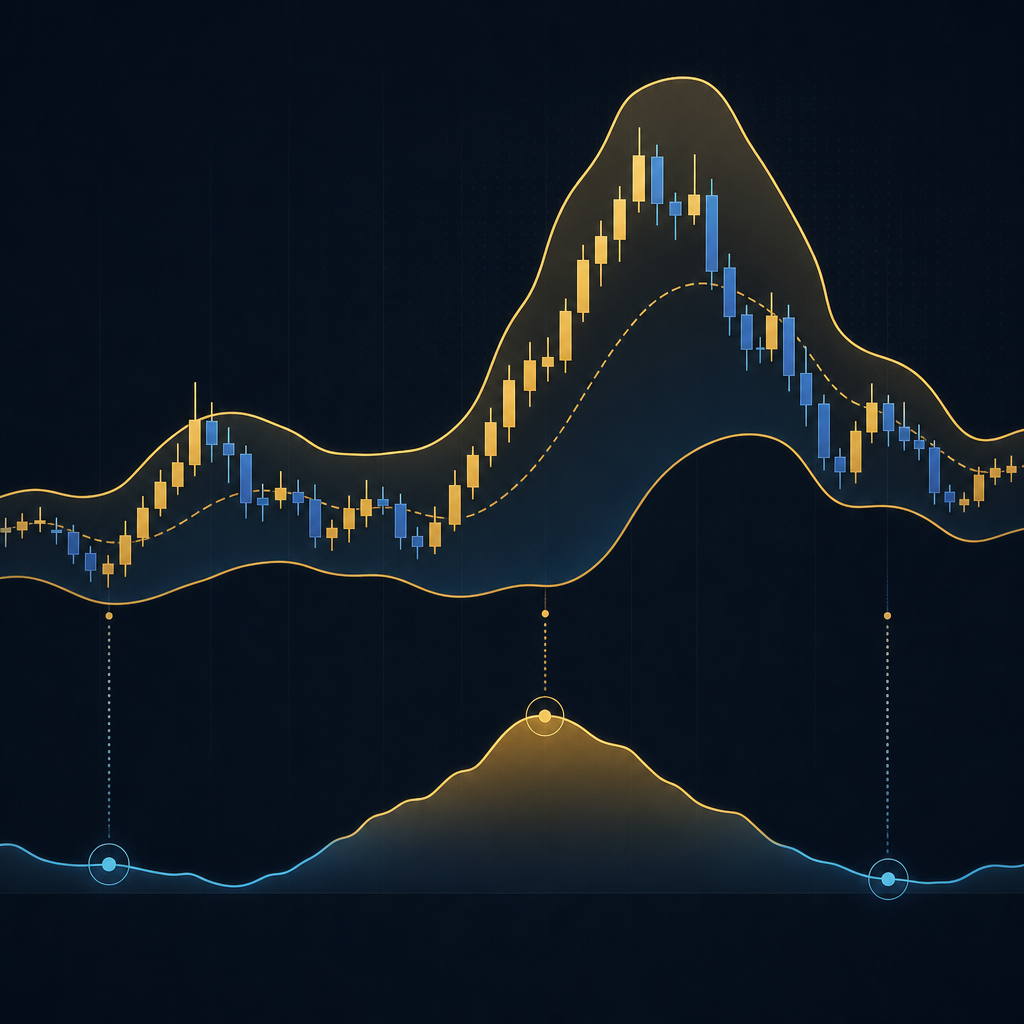
Most traders don’t lose because the signal is “bad.”
They lose because the execution is inconsistent.
A fixed stop loss is the most common inconsistency.
Example: you take an XAUUSD buy at $2652 with a fixed $8 stop because it “feels tight and safe.”
But in a normal New York session, gold can swing $12–$20 without changing its intraday bias.
So your trade gets stopped at $2644, then price continues to $2676 and hits what would’ve been your take profit.
That’s not a strategy failure.
That’s a volatility mismatch.
The hidden cost: inconsistent expectancy
Expectancy comes from repeating the same edge with the same risk framework.
If your stop is random—sometimes too tight, sometimes too wide—your R-multiples become random too.
And when your R-multiples are random, your psychology breaks.
You start moving stops, closing early, revenge trading, and doubling down.
Why this matters more right now (current market context)
With DXY around 106.80 and USD/JPY near 149.50, the market is sensitive to rate expectations and risk sentiment.
That sensitivity shows up as volatility clusters.
Gold around $2650 can whip $10–$15 in minutes on a single headline or data print.
EUR/USD at 1.0520 can look “quiet,” then suddenly move 35–60 pips in a London impulse.
GBP/USD near 1.2680 can spike on UK data, then mean-revert just as fast.
In these conditions, ATR-based stops are not a luxury.
They’re a practical way to stop getting taken out by noise.
Signals + execution = results
At United Kings, our premium Telegram signals come with clear Entry, SL, and TP levels and a community of 300K+ active traders.
But even with clean levels, your account grows when you execute consistently.
This article is the execution layer.
It helps you translate signals into a stable process you can repeat in London and NY sessions without overthinking.
What ATR Really Measures (And What It Doesn’t)
ATR stands for Average True Range.
It measures how much price typically moves per candle over a chosen lookback (often 14 periods).
It’s not a direction indicator.
It doesn’t tell you “buy” or “sell.”
It tells you the market’s current breathing room.
True Range in plain English
True Range accounts for three things:
- Current high minus current low
- Current high minus previous close
- Current low minus previous close
That matters because gaps and sharp opens can distort simple range calculations.
ATR smooths this over a lookback.
How ATR helps signal traders specifically
Signals often come with fixed SL/TP.
That’s useful, but volatility changes day to day.
ATR lets you answer two key questions before you execute:
- Is my stop outside normal noise? If not, you’re gambling on perfect timing.
- Is my take profit realistic for today’s volatility? If not, you’ll either miss targets or close early.
ATR timeframe = your trade horizon
If you trade an M15 signal but use an H4 ATR, your stop may become too wide.
If you trade a swing setup but use an M5 ATR, your stop will be too tight.
Match ATR to how long you plan to hold.
We’ll define a simple rule for that in the workflow section.
ATR is not a magic shield
ATR won’t protect you from major news spikes.
If CPI hits and gold rips $25 in 60 seconds, ATR won’t “predict” it.
But ATR does two valuable things:
- It keeps your normal-day stops logical.
- It forces you to size down when volatility expands.
That second point is the real edge.
ATR Stop Loss Forex Signals vs Fixed Pips: A Practical Comparison

Let’s compare the two approaches in the exact context signal traders face.
You receive a signal with an entry, and you want to place a stop and target that fits the market.
Fixed pips feels simple.
ATR feels “technical.”
But when you see the trade-offs, ATR becomes the simpler option long-term.
| Feature | Fixed Pip/$ SL/TP | ATR-Based SL/TP |
|---|---|---|
| Adapts to volatility | No (same stop in calm and chaos) | Yes (stop expands/contracts with market) |
| Consistency across pairs | Hard (20 pips means different things on different pairs) | Easier (ATR normalizes movement per instrument) |
| Stop placement logic | Often arbitrary (“I always use 15 pips”) | Contextual (“1.2× today’s typical range”) |
| Overtrading risk | Higher (tight stops cause frequent re-entries) | Lower (you respect volatility and wait for cleaner setups) |
| Works with position sizing | Yes, but can cause huge lot size swings when stop is too tight | Yes, naturally stabilizes risk because stop is realistic |
| Best use case | Very specific scalps with proven stats | Most signal execution (intraday + swing) |
A real EUR/USD scenario
EUR/USD is around 1.0520.
If you use a fixed 15-pip stop on a day where M15 ATR is 9 pips, that might be fine.
But if M15 ATR expands to 16–18 pips during London, your 15-pip stop becomes “inside noise.”
You’ll get clipped, then watch price move your way.
A real XAUUSD scenario
Gold at $2650 can have an M15 ATR of $4.5 in Asia, then $8.0 in New York.
If you always use a $10 stop, that’s 2.2× ATR in Asia (safe) and 1.25× ATR in NY (borderline).
Same stop.
Completely different meaning.
The ATR Workflow: Turn Any Signal Into a Consistent Trade (Step-by-Step)
This is the process you can run in under 60 seconds once you practice it.
It doesn’t matter if the signal is for XAUUSD, EUR/USD, GBP/USD, or USD/JPY.
The steps stay the same.
Step 1: Choose the execution timeframe that matches the signal
Use this simple mapping:
- Scalp signals (5–30 minutes hold): M5 or M15 ATR
- Intraday signals (1–6 hours hold): M15 or H1 ATR
- Swing signals (1–5 days hold): H4 ATR
If you’re unsure, default to H1 ATR for most forex and gold intraday signals.
It’s stable enough to avoid micro-noise, but responsive enough for session changes.
Step 2: Read the ATR value (use 14-period as your baseline)
Most platforms show ATR(14) by default.
Record the value in pips for forex, and in dollars for XAUUSD.
Example readings (realistic for current conditions):
- XAUUSD H1 ATR(14): $7.5
- EUR/USD H1 ATR(14): 0.0012 (12 pips)
- GBP/USD H1 ATR(14): 0.0016 (16 pips)
- USD/JPY H1 ATR(14): 0.55 (55 pips, where 1 pip = 0.01)
Step 3: Set your stop loss as an ATR multiple
Here are practical multipliers that work well for signal execution:
- Conservative (more room): SL = 1.5× ATR
- Balanced (default): SL = 1.2× ATR
- Aggressive (tight): SL = 1.0× ATR (only with strong structure)
For most traders, 1.2× ATR is the sweet spot.
It’s wide enough to avoid random spikes, but not so wide that your R:R becomes unrealistic.
Step 4: Set your take profit using the same language (R-multiples)
Once SL is set, TP becomes easy.
Pick your reward multiple:
- TP1: 2R (solid for intraday)
- TP2: 3R (best when trend is strong)
If your stop is 1.2× ATR, then:
- TP at 2R = 2 × SL distance = 2.4× ATR
- TP at 3R = 3 × SL distance = 3.6× ATR
Step 5: Calculate position size so risk stays constant
This is the part that changes everything for signal traders.
You stop “choosing lots.”
You start choosing risk.
Use this core formula:
Lot Size = Risk Amount ($) ÷ (Stop Distance in points/pips × Value per point/pip)
We’ll walk through examples for XAUUSD and major FX pairs next.
Step 6: Apply one execution rule to reduce overtrading
Here’s a simple filter:
- If ATR is 30% higher than its 20-day average for that timeframe, either size down or skip marginal signals.
This keeps you out of the worst “chop + spike” conditions.
It also stops you from forcing trades when the market is unstable.
ATR Take Profit XAUUSD: A Full Gold Example at $2650 (With Numbers)
Let’s build a complete trade plan from a realistic gold signal.
Assume XAUUSD is trading around $2650.
You get a buy signal near a pullback level during London, expecting continuation into New York.
Signal scenario
- Instrument: XAUUSD
- Entry: $2652.00
- Timeframe for execution: H1
- ATR(14) on H1: $7.50
Step 1: Set ATR-based stop loss
Use the balanced default: SL = 1.2 × ATR.
SL distance = 1.2 × $7.50 = $9.00.
So your stop goes at:
- Stop Loss: $2652.00 − $9.00 = $2643.00
That fits the guideline of typical gold SL distance ($10–$25) and respects current volatility.
Step 2: Set ATR-based take profit (2R and 3R)
Your risk per ounce (or per 1.00 lot equivalent) is $9.
So targets become:
- TP1 (2R): $2652.00 + (2 × $9.00) = $2670.00
- TP2 (3R): $2652.00 + (3 × $9.00) = $2679.00
Both targets sit comfortably inside the current gold example range ($2610–$2690).
They’re also realistic for a London-to-NY continuation day.
Step 3: Position sizing (simple, practical)
Let’s say your account is $5,000 and you risk 1% per trade.
Risk amount = $5,000 × 1% = $50.
Now we need the value per $1 move for your broker’s XAUUSD contract.
On many MT4/MT5 brokers, 1.00 lot on XAUUSD ≈ $1 per $0.01 move or $100 per $1 move.
But contract specs vary.
So here’s the safe approach: check “Symbol Specifications” and confirm tick value.
For a common setup where 1.00 lot = $100 per $1 move:
- Stop distance = $9.00
- Loss per 1.00 lot if stopped = $9.00 × $100 = $900
- To risk $50: Lot size = $50 ÷ $900 = 0.055 lots
Round to what your broker allows, e.g., 0.05 lots.
Now your stop is volatility-based, and your risk is controlled.
How this improves execution psychology
When your stop is “outside noise,” you don’t panic at every $3 dip.
When your lot size is correct, you don’t panic at your P/L fluctuations.
That’s how traders stop sabotaging good signals.
If you want signals designed for these session moves, see our dedicated premium XAUUSD gold signals and how we structure entries around London and NY liquidity.
ATR Stop Loss Forex Signals: EUR/USD, GBP/USD, USD/JPY Examples
Now let’s apply the exact same workflow to major pairs using today’s context.
We’ll keep it simple and execution-focused.
Same steps, different pip math.
Example 1: EUR/USD at 1.0520 (intraday)
- Pair: EUR/USD
- Entry: 1.0520 (buy)
- ATR(14) H1: 0.0012 (12 pips)
- SL multiple: 1.2×
SL distance = 12 pips × 1.2 = 14.4 pips (round to 15 pips).
- Stop Loss: 1.0520 − 0.0015 = 1.0505
- TP1 (2R): +30 pips → 1.0550
- TP2 (3R): +45 pips → 1.0565
Those targets are realistic if DXY softens from 106.80 or if EUR gets a risk-on push during NY.
Example 2: GBP/USD at 1.2680 (higher volatility)
- Pair: GBP/USD
- Entry: 1.2680 (sell)
- ATR(14) H1: 0.0016 (16 pips)
- SL multiple: 1.2×
SL distance = 16 × 1.2 = 19.2 pips (round to 20 pips).
- Stop Loss: 1.2680 + 0.0020 = 1.2700
- TP1 (2R): −40 pips → 1.2640
- TP2 (3R): −60 pips → 1.2620
Notice how the stop is wider than EUR/USD.
That’s not “less precise.”
That’s correct for GBP’s personality.
Example 3: USD/JPY at 149.50 (different pip convention)
- Pair: USD/JPY
- Entry: 149.50 (buy)
- ATR(14) H1: 0.55 (55 pips, where 1 pip = 0.01)
- SL multiple: 1.0× to 1.2× depending on structure
Assume balanced: 1.2×.
SL distance = 55 × 1.2 = 66 pips = 0.66 yen.
- Stop Loss: 149.50 − 0.66 = 148.84
- TP1 (2R): +1.32 → 150.82
- TP2 (3R): +1.98 → 151.48
USD/JPY can trend strongly when yields drive USD demand.
But it also snaps back hard on risk-off flows.
ATR keeps you from using “EUR-style” stops on a JPY pair.
If you’re new to signal execution, pair this guide with our beginner-friendly walkthrough on how to use forex signals on Telegram step-by-step.
The Simple Position-Sizing Formula (So Every Signal Risks the Same)
ATR-based stops are only half the system.
The other half is making sure your dollar risk stays constant.
Without position sizing, traders do this:
- They use 0.10 lots on everything.
- They take a 15-pip stop on EUR/USD and a $20 stop on gold.
- They accidentally risk 3× more on one trade than another.
That creates emotional decision-making.
And emotional decision-making destroys signal performance.
Choose a risk percentage (keep it boring)
For most retail traders using signals, these ranges are realistic:
- Beginner: 0.25%–0.5% per trade
- Intermediate: 0.5%–1% per trade
- Advanced (with proven stats): 1%–2% per trade
If you’re unsure, start at 0.5%.
You can always scale later.
The formula you actually need
Risk Amount ($) = Account Balance × Risk %
Position Size = Risk Amount ($) ÷ (Stop Distance × Value per pip/point)
That’s it.
The only “hard” part is knowing the value per pip/point.
How to get pip/point value without guessing
- On MT4/MT5: right-click symbol → Specification → find tick size and tick value.
- Or use your broker’s built-in “position size calculator.”
- Or place a tiny test order on demo and observe P/L per pip.
Do this once per instrument and write it down.
Then your execution becomes mechanical.
A quick EUR/USD sizing example
Account: $10,000.
Risk: 1% → $100.
Stop: 15 pips (from ATR method).
On a standard account, 1.00 lot EUR/USD ≈ $10 per pip.
Loss at stop for 1.00 lot = 15 × $10 = $150.
So position size = $100 ÷ $150 = 0.66 lots.
Round to 0.65 or 0.66 depending on your broker.
Why this improves long-term expectancy
When risk is constant, your results reflect your edge.
When risk is random, your results reflect your emotions.
Signals are an edge.
Position sizing is how you keep that edge measurable.
For deeper risk frameworks specifically for signal users, keep our risk playbook bookmarked: risk management strategies when using forex signals.
Picking ATR Multipliers That Fit Your Signal Style (Scalp vs Intraday vs Swing)
ATR multiples shouldn’t be one-size-fits-all.
Your stop must match two things:
- Volatility (ATR handles this)
- Trade idea invalidation (structure handles this)
Think of ATR as the “minimum breathing room.”
Then structure tells you where the idea is wrong.
Your stop should respect both.
Scalp-style signals (M5–M15 execution)
Scalps rely on precision and quick follow-through.
Stops are typically tighter, but still must be outside noise.
- SL: 1.0× to 1.2× ATR
- TP: 1.5R to 2R (you need higher win rate)
Example: XAUUSD M15 ATR = $4.0.
SL at 1.0× = $4 (often too tight for gold).
SL at 1.2× = $4.8 (more realistic), then TP at 2R = $9.6.
If your entry is $2650, TP around $2659.6.
That’s a realistic scalp target if liquidity is strong.
Intraday signals (H1 execution, London → NY)
This is where most signal traders live.
You want a stop that survives normal pullbacks, and a TP that fits a session move.
- SL: 1.2× to 1.5× ATR
- TP: 2R to 3R (depending on trend)
Gold at $2650 with H1 ATR $7.5: SL $9–$11.25.
TP at 2R: $18–$22.5.
That targets $2668–$2672.5 from a $2650 entry.
Again, realistic.
Swing signals (H4 execution)
Swing trades need room.
If you use intraday stops on swing ideas, you’ll get chopped.
- SL: 1.5× to 2.0× ATR
- TP: 2R to 4R (partial profits recommended)
On H4, gold ATR might be $18–$25 in active weeks.
That means SL could be $27–$50.
That’s fine if you size correctly.
The mistake is keeping the same lot size and “hoping.”
A simple rule to avoid over-optimization
If you don’t have backtests, use this default set:
- SL: 1.2× ATR
- TP: 2.4× ATR (2R)
- Risk: 0.5%–1%
Run it for 30 trades.
Then adjust one variable at a time.
How to Blend ATR With Structure (So Stops Aren’t Just “Math”)
ATR is powerful, but it’s not meant to be used blindly.
The best execution combines volatility and market structure.
That’s how you avoid placing a stop in a place that is technically “ATR-correct” but structurally stupid.
The two-step stop placement method
- Step A: Find the invalidation level (recent swing high/low, supply/demand zone edge, or key liquidity level).
- Step B: Ensure that level is at least 1.0×–1.2× ATR away from entry. If it’s closer, the trade is likely too early or too crowded.
In other words: structure chooses the “wrong” point.
ATR checks if you’re giving the market enough room to test that area.
XAUUSD example: structure + ATR
Gold is at $2650.
You buy $2652 because price reclaimed a London session level.
The obvious swing low is $2644.
That’s $8 away.
If H1 ATR is $7.5, then 1.2× ATR is $9.
Your swing low stop ($8) is inside the ATR-based breathing room.
So you either:
- Place stop at $2643 (ATR-based), even if it’s below the swing low, or
- Wait for a deeper entry so your structural stop naturally aligns with ATR.
This is how disciplined traders avoid “almost perfect” entries that fail by $1.
Forex example: EUR/USD liquidity sweep
EUR/USD at 1.0520 prints a sweep below 1.0510 and reclaims.
Your structural invalidation might be 1.0506.
That’s 14 pips from 1.0520.
If H1 ATR is 12 pips, 1.2× ATR is ~14–15 pips.
Perfect alignment.
Now your stop is both logical and volatility-aware.
Where ATR should not override structure
If structure demands a stop that is 2.5× ATR away, don’t force it smaller to “fit.”
Instead, reduce position size or skip the trade.
Signals are opportunities, not obligations.
If you want to get better at identifying zones that pair well with ATR stops, our blog hub is a good place to explore next: United Kings trading blog.
Execution Checklist: From Telegram Signal to Order Placement (No Guesswork)
Most traders don’t need more indicators.
They need a repeatable checklist.
Here’s a practical routine you can apply to any signal you take from our community.
Pre-trade checklist (60–90 seconds)
- 1) Confirm session: Is it London or New York? Liquidity is higher and moves are cleaner.
- 2) Check spread: Especially on XAUUSD. If spread is unusually wide, reduce size or wait.
- 3) Choose timeframe: M15/H1 for intraday, H4 for swing.
- 4) Read ATR(14): Write it down.
- 5) Choose SL multiple: Default 1.2×.
- 6) Place SL beyond structure: Swing point/zone + ATR breathing room.
- 7) Set TP at 2R or 3R: Prefer 2R if the day is choppy.
- 8) Calculate lot size: Risk $ ÷ (SL distance × value per point).
Trade management rules (keep it simple)
- Rule 1: Don’t move SL wider. If you do, you’re no longer trading your plan.
- Rule 2: Consider partial profits at 1R, then let the rest aim for 2R–3R.
- Rule 3: If ATR expands sharply after entry (news spike), accept that your plan may fail. Don’t “average down.”
A realistic management example on gold
You buy $2652 with SL $2643 and TP1 $2670.
Price reaches $2661 (1R).
You can:
- Close 30%–50% to pay yourself.
- Move SL to break-even only if structure supports it (not just because you’re up).
- Hold the remainder for $2670–$2679.
This reduces emotional pressure and helps you stay consistent.
If you want a full routine around signals (before, during, after), you’ll also like our process-based guide on building consistency—just avoid copying the same topic: start from the United Kings signals overview and explore the education sections linked there.
Common Mistakes With ATR Stops (And How to Fix Them)
ATR is simple, but traders still misuse it.
Here are the mistakes we see most often in signal communities, plus the fix.
Mistake 1: Using ATR from the wrong timeframe
If you scalp but use H4 ATR, your stop becomes huge.
Then you either reduce size so much that the trade feels pointless, or you over-risk.
Fix: Match ATR timeframe to hold time (M15/H1 for intraday).
Mistake 2: Treating ATR like a “stop distance generator” only
Some traders set SL = 1.2× ATR even if that places the stop in the middle of a demand zone.
That’s asking to be hunted.
Fix: Use structure first, ATR second.
Mistake 3: Not adjusting position size after changing SL
You widen your stop to match ATR but keep the same lot size.
Now you’re risking 2×–3× more than normal.
Fix: Your lot size must be recalculated every time SL changes.
Mistake 4: Setting unrealistic ATR take profits in low-volatility periods
If gold’s H1 ATR drops to $5 and you target $30, you’ll get frustrated.
You’ll close early and then feel “unlucky.”
Fix: Use R-multiples and check if the day’s range supports your target.
Mistake 5: Ignoring news risk
ATR is backward-looking.
It can’t anticipate an unexpected headline.
Fix: Know the calendar and be cautious around high-impact events.
For a survival framework on surprise moves, read: how gold signals react to unexpected news events.
How ATR-Based Risk Management Improves Signal Expectancy (And Reduces Overtrading)
Most traders think performance comes from “better entries.”
In reality, most performance comes from:
- Not getting stopped by noise
- Keeping risk consistent
- Letting winners reach planned targets
ATR-based SL/TP supports all three.
Expectancy in one line
Expectancy = (Win Rate × Avg Win) − (Loss Rate × Avg Loss)
Signals can improve your win rate.
But execution determines your average win and average loss.
Where traders sabotage signals
- They use stops that are too tight → more losses than necessary.
- They take profit too early → smaller average win.
- They increase lot sizes randomly → bigger average loss.
ATR + position sizing is the antidote.
Why ATR reduces overtrading
Overtrading is often a response to being stopped out repeatedly.
You feel the need to “get back in.”
ATR-based stops reduce unnecessary stop-outs.
Fewer stop-outs means fewer revenge trades.
And fewer revenge trades means your account curve smooths out.
Volatility filter = fewer low-quality trades
When ATR spikes, spreads often widen and wicks get longer.
That’s when traders blow accounts by forcing trades.
If you adopt a simple rule—“if ATR is unusually high, I size down or skip”—you automatically avoid many of the worst conditions.
How this fits United Kings execution style
United Kings focuses heavily on London and New York session trading, where volatility is best for clean follow-through.
ATR helps you quantify that session volatility instead of guessing.
It also helps you interpret our clear Entry/SL/TP levels with a risk framework that stays consistent across instruments.
To see how our forex setups are structured, explore our forex signals service and compare it with our XAUUSD gold signals depending on what you trade most.
Putting It All Together: A 7-Day Practice Plan (Demo First)
Knowledge doesn’t change your account.
Practice changes your account.
Here’s a simple 7-day plan to make ATR-based execution automatic.
Day 1: Set up your platform
- Add ATR(14) to M15, H1, and H4 charts.
- Find symbol specifications for XAUUSD and your main FX pairs.
- Write down tick values and pip values.
Day 2: Build your calculator template
- Create a note with: Account balance, risk %, risk $, ATR, SL multiple, SL distance, lot size.
- Or use a spreadsheet with those fields.
Day 3: Execute 3 demo trades using ATR stops
- One XAUUSD trade, one EUR/USD trade, one GBP/USD or USD/JPY trade.
- Use SL = 1.2× ATR and TP = 2R.
Day 4: Review “stop-out quality”
- Did you get stopped by noise or true invalidation?
- If noise, consider 1.5× ATR or better entry timing.
Day 5: Add partials (optional)
- Take 30%–50% at 1R.
- Let the rest run to 2R.
Day 6: Practice during London and NY sessions only
- Limit your trading window.
- This alone reduces overtrading dramatically.
Day 7: Lock your rules
- Choose one timeframe for ATR (H1 for intraday).
- Choose one SL multiple (1.2×).
- Choose one risk % (0.5% or 1%).
Then repeat for 30 trades before making changes.
This is how professionals build stable performance.
FAQ: ATR Stop Loss, ATR Take Profit, and Position Sizing
1) What ATR period should I use for forex and XAUUSD signals?
ATR(14) is the most common and works well for most traders.
Focus more on choosing the right timeframe (M15/H1/H4) than changing the period.
2) Is ATR-based stop loss better than using recent swing highs/lows?
They work best together.
Use structure (swing highs/lows, zones) to define invalidation, then use ATR to ensure you’re not placing the stop inside normal volatility.
3) How do I set ATR take profit on XAUUSD without making targets too far?
Use R-multiples instead of guessing.
If your SL is 1.2× ATR, then TP at 2R is 2.4× ATR.
Check if that fits the day’s expected range and session volatility.
4) What risk percentage should I use when copying trading signals?
If you’re new, start with 0.25%–0.5% per trade on demo or small size.
As you build consistency, consider 0.5%–1%.
Avoid increasing risk just because you had a winning streak.
5) Can ATR help during high-impact news events?
ATR can’t predict sudden news spikes because it’s based on past candles.
But it can warn you when volatility is already expanding.
For major events, reduce size, widen stops only if you also reduce lot size, or wait until after the release.
Risk Disclaimer (Read This Before You Trade)
Forex and gold (XAUUSD) trading involves significant risk and may not be suitable for all investors.
You can lose more than your initial deposit in some leveraged products.
All examples in this article are educational and use realistic market context, not guarantees.
Past performance does not guarantee future results.
If you’re a beginner, practice ATR-based stops and position sizing on a demo account before risking real capital.
Join United Kings: Premium Signals + Clean Execution (Your Next Step)
If you want a structured way to trade London and New York sessions with a serious community behind you, United Kings is built for that.
We provide premium Telegram signals for forex and gold with clear Entry, SL, and TP levels, plus educational guidance to help you execute like a pro.
Our community includes 300K+ active traders, and we focus on consistent processes—not hype.
- Explore the full service: United Kings premium trading signals
- Gold-focused traders: XAUUSD gold signals
- FX-focused traders: forex signals
Ready to join?
Check our 3 plans on the pricing page:
- Starter (3 Months): $299 (~$100/month)
- Best Value (1 Year): $599 ($50/month) with 50% savings + FREE ebook
- Unlimited (Lifetime): $999 (pay once, access forever)
You also get a 48-hour money-back guarantee for peace of mind.
And if you want to see the community flow and updates, join our Telegram here: United Kings official Telegram channel.
Your edge isn’t just the signal.
Your edge is executing the signal with volatility-aware stops and consistent risk.
Use ATR, size correctly, and let the math work over time.


