
You’ve got a signal. It says “XAUUSD Buy @ 2650, SL 2638, TP 2674.”
You can either trust it blindly… or you can validate it like a pro before you risk even $1.
This guide shows you exactly how to backtest forex signals and backtest XAUUSD signals inside MT5 Strategy Tester without coding. We’ll turn “Telegram-style alerts” into testable rules, run realistic multi-year tests on EURUSD and gold, and interpret the metrics that separate a robust edge from random luck.
TL;DR — The Practical Backtesting Checklist (No Coding)
- Convert alerts into rules: define entry trigger, SL/TP, time filter, and “one trade at a time.”
- Use MT5 Strategy Tester with real costs: spread, commission, and (for gold) realistic volatility assumptions.
- Test long enough: aim for 3–7 years and at least 200+ trades if you’re evaluating a day-trading style.
- Focus on 5 metrics: profit factor, max drawdown, expectancy, win rate, and average R-multiple.
- Filter weak signals fast: profit factor < 1.2, drawdown > 25–30%, or negative expectancy is a hard “no.”
- Validate forward: after backtesting, run a demo forward test for 2–4 weeks before going live.
Why Backtesting Signals Matters (Especially in Today’s Market)
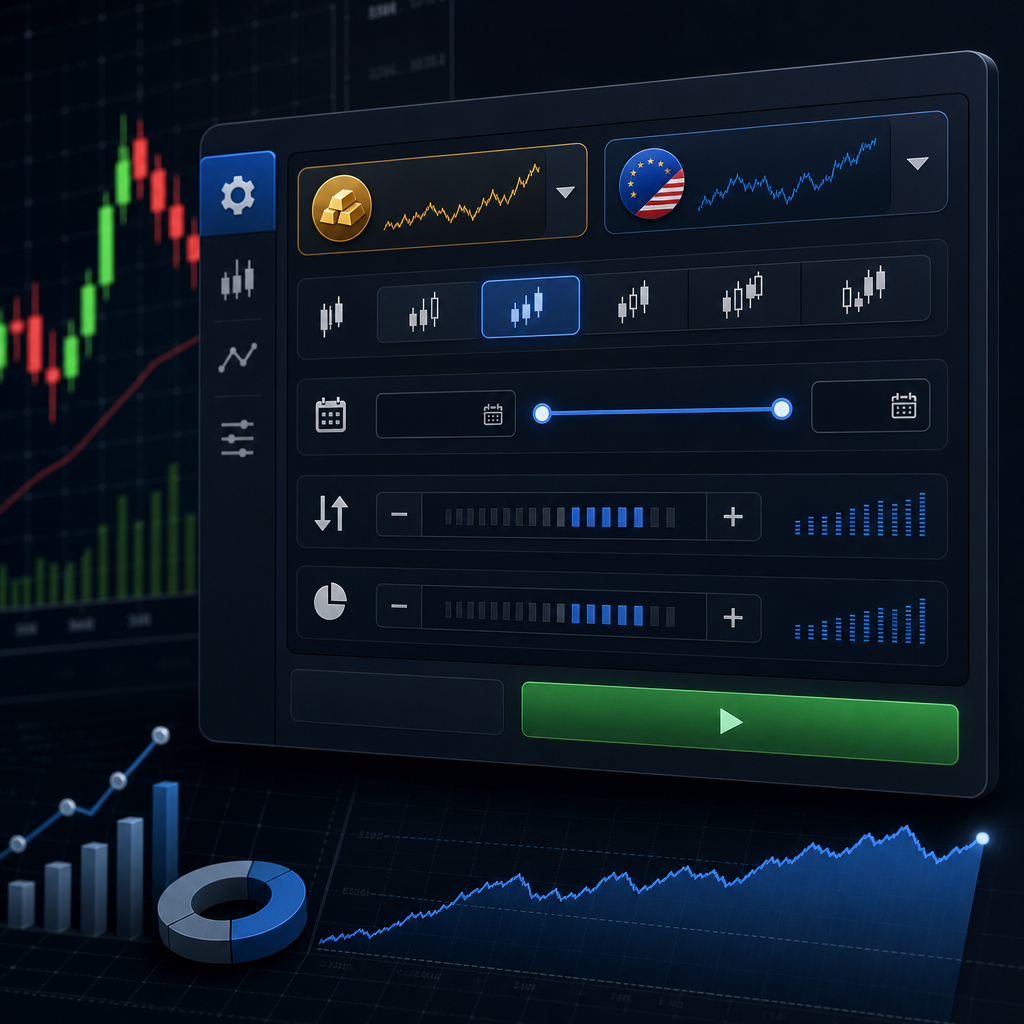
Right now, gold is trading around $2650 (+0.35% on the day). EUR/USD sits near 1.0520, GBP/USD around 1.2680, USD/JPY near 149.50, and DXY is elevated around 106.80.
That mix—firm dollar, sensitive rates narrative, and gold holding high levels—creates a market where signals can look amazing on screenshots and still perform poorly once spreads, slippage, and volatility hit.
Backtesting is how you answer the only question that matters: “If I took this type of signal consistently, would I have made money after costs, and could I survive the drawdowns?”
When traders skip backtesting, they usually fall into one of three traps:
- Recency bias: a provider has a hot week and you assume it’s skill.
- Cherry-picking: you remember the big wins and ignore the grind and losses.
- Cost blindness: spreads/commissions quietly turn a “profitable” idea into a break-even one.
Backtesting doesn’t guarantee future results. But it does something more valuable: it filters out weak edges and helps you size risk realistically.
At United Kings, we’re big on doing the work before you pay tuition to the market. Our community of 300K+ active traders uses signals as a decision framework: clear entry, SL, TP—then disciplined execution and risk control. If you’re new to evaluating providers, keep our checklist handy: forex signal provider checklist for beginners.
In this article, we’ll show you how to recreate that “professional evaluation” process in MT5, without writing a line of code.
What You Can (and Can’t) Backtest From a Signal Alert
Let’s be honest: most Telegram signals are not a full strategy description. They’re a trade idea with levels.
So to backtest properly, we need to separate what’s explicit from what’s assumed.
What you usually have in a signal
- Symbol (e.g., XAUUSD, EURUSD)
- Direction (Buy/Sell)
- Entry (market now, or a limit/stop level)
- Stop loss (e.g., gold SL $10–$25 away)
- Take profit(s) (often 1:2 or 1:3 RR)
- Sometimes: session timing (London/NY), “wait for confirmation,” or “break and retest”
What’s missing (and must be defined)
- Exact trigger: What does “confirmation” mean in rules?
- Order type: market, limit, stop? If limit, how far?
- Time filter: do we take trades only in London/NY?
- Trade management: partials, BE moves, trailing stops?
- Conflict rules: what if a new signal appears while a trade is open?
Here’s the key principle: you can backtest a signal only after you convert it into repeatable rules.
For example, take a realistic gold scenario near current levels:
- XAUUSD Buy at 2650.0
- SL at 2638.0 (risk = $12)
- TP at 2674.0 (reward = $24, a 1:2 RR)
That’s testable if we define how we enter 2650.0. Do we buy market when price touches 2650? Do we place a buy limit at 2650? Do we require a candle close above 2650 on M5?
The more “discretionary” the signal is, the more careful you must be. Otherwise, you’ll accidentally backtest your imagination instead of the signal.
If you want a practical way to align signals with your own confirmation, see: timing entries/exits using signals alongside price action.
MT5 Strategy Tester: What It Does, and the No-Coding Reality
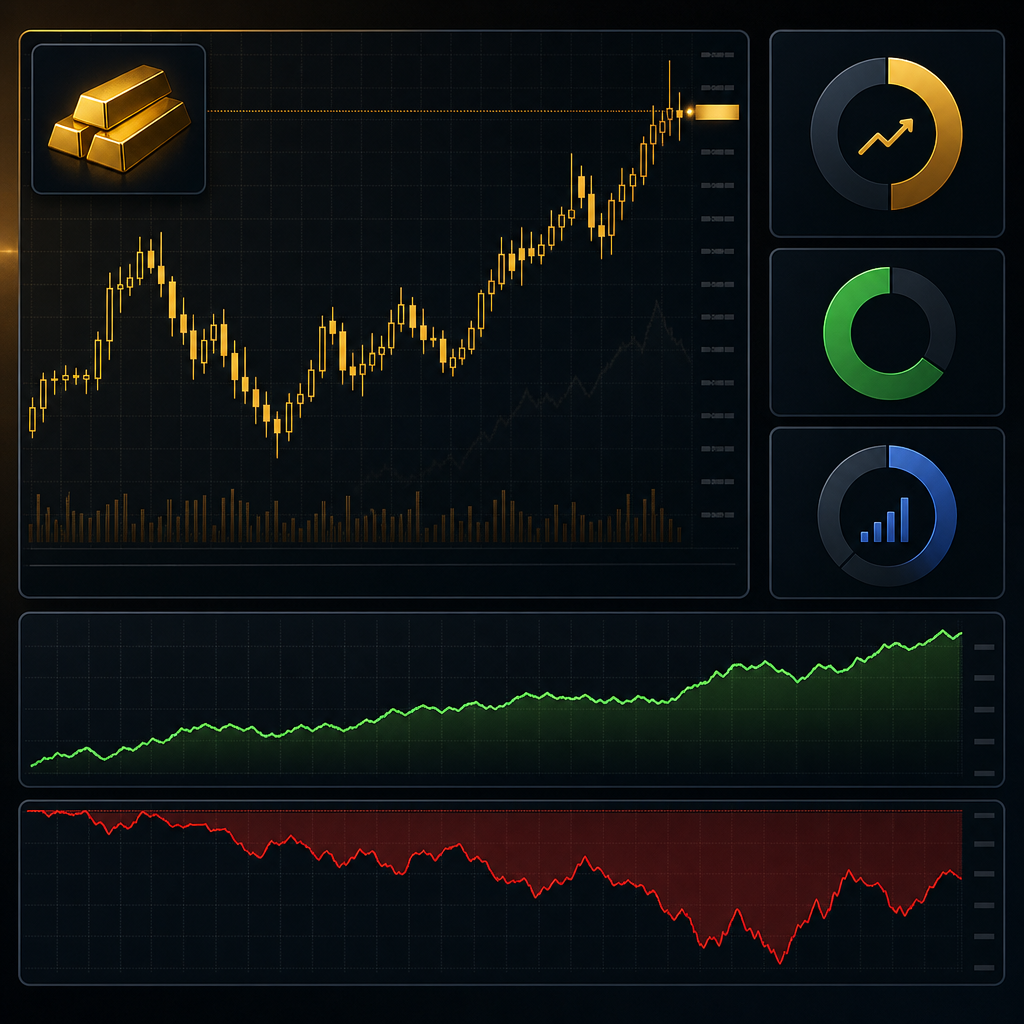
MT5 Strategy Tester is built to test Expert Advisors (EAs) and indicators. That’s the catch: to run a “true” automated backtest, MT5 needs rules in code.
So how do we backtest signals in MT5 with no coding?
We do it in one of three practical ways:
Option A (Best “No Code”): Use a rule-based EA builder
You use a visual builder (drag-and-drop conditions) to generate an EA file. You don’t write code, you just define rules. Then MT5 Strategy Tester can test it.
This is the closest to “real backtesting” without coding, because MT5 executes the rules consistently.
Option B (Semi-Manual): Replay + journal + export
You replay charts, take trades based on your signal rules, and log results. This is slower, but it’s still valid if you’re disciplined.
Option C (Hybrid): Test the “levels model” only
If your signals are mostly “entry/SL/TP levels,” you can backtest a simplified model: whenever price hits entry, assume fill; then measure whether SL or TP hit first. You can do this with tools/scripts without writing code, but it ignores real execution nuances.
In this guide, we’ll focus on Option A (visual EA builder + MT5 Strategy Tester) because it’s the most objective and scalable. We’ll also show you how to sanity-check with Option B so you don’t over-trust a single method.
One more important truth: backtesting is only as good as your assumptions. If you set spread to 0 and ignore commissions, you’re not backtesting—you’re daydreaming.
United Kings traders often use backtesting to decide how aggressively to follow our alerts on gold signals and forex signals, and whether to stick to London/NY sessions where our approach is most active.
Comparison Table: Backtesting Methods for Forex & Gold Signals
Before we build anything, pick the right testing approach for your goal (speed vs realism vs effort).
| Method | Best For | Pros | Cons | Recommended Use |
|---|---|---|---|---|
| MT5 Strategy Tester + visual EA builder | Objective testing of rule-based signals | Fast multi-year tests, consistent execution, rich metrics | Requires precise rules; builder may have limits | Primary method for filtering signals |
| Manual replay backtest | Discretionary confirmation (price action) | Matches how you really trade; includes human filters | Slow; easy to bias results | Validation and “reality check” |
| Level-hit model (entry/SL/TP only) | Quick evaluation of level-based alerts | Very fast; good for rough screening | Ignores spreads, slippage, intra-bar path | Early-stage screening only |
| Forward demo test | Live conditions validation | Real spreads, real slippage, real psychology | Takes time; limited sample size | Final step before real money |
We’ll build a clean, repeatable workflow: Rules → MT5 test → metrics filter → forward demo → scale.
Step 1: Convert Signals Into Testable Rules (The “Signal Rule Sheet”)
If you skip this step, your backtest will be vague and your results will be meaningless.
Your goal is to create a one-page “signal rule sheet” that a machine could execute.
The minimum viable rule set
- Market: XAUUSD and/or EURUSD
- Timeframe for decisions: M5 or M15 for intraday signals; H1 for swing
- Entry trigger: touch entry level, candle close, or break/retest
- Stop loss: fixed dollars for gold ($10–$25), fixed pips for FX (10–35 pips typical intraday)
- Take profit: fixed RR (1:2 or 1:3), or fixed levels
- Time filter: London + NY only (recommended for consistency)
- Max trades: one open trade per symbol
Example rule sheet (XAUUSD, realistic around $2650)
Setup type: Breakout continuation in London/NY.
- Symbol: XAUUSD
- Timeframe: M5
- Session filter: 07:00–17:00 London time (or broker time equivalent)
- Entry: Buy when an M5 candle closes above 2650.0 and the next candle trades at/above 2650.0
- SL: 12.0 dollars below entry (e.g., 2638.0)
- TP: 24.0 dollars above entry (e.g., 2674.0)
- Exit rule: SL or TP only (no trailing/partials for baseline test)
Why “no trailing/partials” at first? Because you want a baseline. If the baseline has no edge, fancy management usually won’t save it.
Example rule sheet (EURUSD, realistic around 1.0520)
- Symbol: EURUSD
- Timeframe: M15
- Entry: Sell when price breaks below 1.0520 by 5 pips and M15 closes below 1.0515
- SL: 20 pips
- TP: 40 pips (1:2 RR)
This is how you turn “EURUSD sell below 1.0520” into something testable.
If you want to build a full framework around signals (entries, risk, journaling), pair this guide with: risk management strategies when using forex signals.
Step 2: Prepare MT5 Data (Symbols, History, and “Bad Data” Traps)
Backtests fail quietly when your data is incomplete. You’ll see a clean report, but it’s built on gaps.
Before you open Strategy Tester, do a quick data hygiene pass.
2.1 Confirm your broker’s symbols and contract specs
Gold can be named XAUUSD, GOLD, XAUUSDm, etc. Contract size and tick value can differ.
In MT5:
- Open Market Watch → right-click → Symbols
- Find XAUUSD and EURUSD → click Show
- Right-click the symbol → Specification
Note the contract size, tick size, tick value, and swap/commission (if shown). This matters for realistic profit curves.
2.2 Download enough history (multi-year)
For an intraday signal style, you want at least 3 years of M5/M15 data. For swing styles, 5–10 years on H1/H4 is better.
In MT5:
- Go to Tools → History Center (or open a chart and scroll back to force downloads)
- Select the symbol and timeframe → Download
If your broker doesn’t provide deep M1/M5 history, your test might be limited. That doesn’t mean you can’t test, but you must acknowledge the limitation.
2.3 Avoid the “perfect fill” illusion
Gold around $2650 can move $3–$8 in minutes during NY data releases. If your backtest assumes instant fills at the exact level every time, you’ll overestimate performance.
We’ll handle this by:
- Setting realistic spread
- Including commission if your account type charges it
- Using a conservative execution model (and later, forward demo testing)
2.4 Pick a consistent “testing account” profile
Backtesting on a $100,000 balance and then trading a $500 account creates psychological and sizing mismatches.
Pick a balance close to your reality (e.g., $1,000, $5,000, $10,000). Use fixed % risk per trade later when you interpret drawdown.
Step 3: Set Up MT5 Strategy Tester for Realistic Costs (Spread, Commission, Slippage)
This is where most “backtest forex signals” attempts go wrong: costs are ignored or underestimated.
Costs matter more for:
- Scalping (small targets)
- Gold during volatile windows
- High-frequency signal streams (many trades)
3.1 Spread assumptions (practical numbers)
Spreads vary by broker and session. But for conservative testing, you can use typical “not-best-case” values.
- EURUSD: 0.8–1.5 pips (standard), 0.1–0.5 pips (raw + commission)
- XAUUSD: $0.20–$0.60 (tight), $0.60–$1.20 (wider/volatile)
If your gold target is $24 (e.g., 2650 → 2674), a $0.80 spread seems small. But across 200 trades, it adds up.
3.2 Commission (don’t guess—check your account)
Raw/ECN accounts often charge commission per lot. If your backtest ignores it, you inflate profit factor and expectancy.
In Strategy Tester, choose the account type/settings that reflect your real trading environment. If you can’t input commission directly, use a symbol/account that includes it, or adjust results conservatively.
3.3 Slippage: the “invisible killer”
MT5’s built-in tester can’t perfectly simulate real slippage across all brokers. That’s why we recommend:
- Testing with slightly worse spreads than your average
- Running a forward demo test after backtesting
For gold around $2650, assume that on fast moves you might slip $0.20–$0.80 depending on liquidity and news.
3.4 Time filters to match signal reality
If the signal provider focuses on London and NY sessions (like we do at United Kings), your backtest should reflect that. Otherwise you’ll include low-quality Asian chop that the strategy was never designed to trade.
Session filters alone can change drawdown dramatically, especially on XAUUSD.
If you’re following signals via Telegram and want a clean process for execution and tracking, this pairs well with: forex signals Telegram for beginners.
Step 4: Build a “No-Code” Testable Strategy (Using Visual Rules)
To use MT5 Strategy Tester, you need a strategy in EA form. The no-code way is to use a visual rule builder that outputs an EA for MT5.
We’re not naming a specific tool because the market changes, but most builders follow the same logic: IF conditions → THEN trade action.
4.1 Translate your rule sheet into conditions
Let’s use our gold example around $2650:
- Condition 1: Time is within London/NY window
- Condition 2: Close(M5, 1) > 2650.0
- Condition 3: Current price >= 2650.0 (to avoid “one-tick close” anomalies)
- Action: Open Buy with SL = 12.0, TP = 24.0
- Constraint: Only if no open position on XAUUSD
4.2 Keep the first version simple (baseline)
Many traders blow up their first backtest by adding 12 filters: RSI, MACD, ATR, news blocks, trailing, partials, BE rules, etc.
Start with a baseline that mirrors the signal’s core: entry + SL + TP + session filter.
Once you have baseline results, you can test improvements one at a time (so you know what actually helped).
4.3 Position sizing for testing
Use fixed lot size for comparing strategy quality across symbols, then later test with fixed % risk to understand equity swings.
Example starting point:
- EURUSD: 0.10 lots
- XAUUSD: 0.10 lots (check your broker’s margin requirements)
4.4 One trade at a time (very important for signals)
Signal followers rarely stack 5 trades on the same symbol unless the provider explicitly scales in.
So add a rule: do not open a new trade if one is already open. This prevents the backtest from “overtrading” and inflating results.
When you’re done, export/build the EA and install it in MT5 (usually by copying the file into the Experts folder and restarting MT5).
Step 5: Run a Multi-Year Backtest on EURUSD and XAUUSD (Exact Tester Settings)
Now we test. Your goal is not to “prove it works.” Your goal is to discover the truth, even if the truth is uncomfortable.
5.1 Open Strategy Tester and choose your EA
- View → Strategy Tester
- Select your EA (the one you built from rules)
- Choose Symbol: start with EURUSD
- Choose Timeframe: M15 (or your rule timeframe)
5.2 Date range: test different regimes
A good backtest includes different market regimes: trending, ranging, high inflation, central bank shocks, etc.
Practical recommendation:
- Minimum: 3 years
- Better: 5–7 years
If you can only test 12 months, you’re not measuring edge—you’re measuring a season.
5.3 Modeling and execution settings
Choose the most realistic modeling available in your MT5 environment. If you have access to tick data modeling, use it for intraday rules.
Then set:
- Deposit: use a realistic number (e.g., $5,000)
- Leverage: match your broker (e.g., 1:100)
- Spread: set to a realistic fixed value if possible (don’t use “current” if it’s unusually tight)
5.4 Repeat on XAUUSD with gold-specific realism
Switch symbol to XAUUSD and timeframe to M5 (if your rules are M5).
Gold is more volatile. Around $2650, a normal intraday swing can be $15–$35. That means:
- SLs of $10–$25 are common, but your entry must be precise
- News spikes can hit both TP and SL quickly depending on path
5.5 Run three variants (this is where pros differ)
Instead of one backtest, run three:
- Base case: average spread and standard commission
- Conservative case: 25–50% wider spread (simulates worse execution)
- Optimized session case: London/NY only vs all day
If the strategy only works in the base case, it’s fragile. If it survives the conservative case, it’s closer to tradable.
When you finish, export the report for each run and label it clearly: “EURUSD_M15_2019-2025_Base,” etc.
How to Interpret MT5 Backtest Metrics (Profit Factor, Drawdown, Expectancy)
Most traders look at net profit first. That’s a mistake.
Net profit can be high with insane drawdown, or with a handful of lucky trades. What you want is quality of edge and survivability.
6.1 Profit Factor (PF)
Profit Factor = Gross Profit / Gross Loss.
- PF < 1.0: losing strategy
- PF 1.1–1.2: weak edge (costs/slippage can kill it)
- PF 1.3–1.6: decent for many intraday systems
- PF 1.7+: strong, but verify it’s not overfit
For signal-following, PF matters because you’re paying “execution taxes” (spread/commission) on every trade. A thin PF often collapses live.
6.2 Max Drawdown (absolute and %)
Drawdown is the pain you must survive to reach the gains.
As a practical filter:
- < 15%: comfortable for many traders
- 15–25%: manageable with discipline and smaller risk
- 25–35%: hard psychologically; many quit at the worst time
- > 35%: usually unacceptable for signal copying unless returns are exceptional and risk is reduced
If your backtest shows 40% drawdown, it doesn’t mean “don’t trade it.” It means: your risk per trade is too high or the edge is unstable.
6.3 Expectancy (the “truth metric”)
Expectancy answers: How much do you expect to make per trade?
In R-multiples (recommended):
- Let 1R = your risk (e.g., gold SL $12)
- Winning trade at 1:2 RR = +2R
- Losing trade = -1R
If your win rate is 45% with 1:2 RR, expectancy is positive:
- 0.45 × 2R = 0.90R
- 0.55 × 1R = 0.55R
- Expectancy = +0.35R per trade (before costs)
Then subtract costs. If costs average 0.10R, you still have +0.25R.
6.4 Win rate is not the goal
A 70% win rate with 1:1 RR can be worse than a 45% win rate with 1:2 RR once costs and losing streaks show up.
Professional signal evaluation is about expectancy + drawdown + consistency, not win rate screenshots.
6.5 Equity curve shape (smooth beats spiky)
Look for:
- Long flat periods (strategy not suited to regime)
- One giant month carrying the whole year (fragile)
- Steady stair-step growth (healthier)
If you want to understand why some signals stay accurate across macro regimes, read: how central banks impact forex signal accuracy.
Filtering Out Weak Signals: A Simple “Pass/Fail” Scorecard
Once you have backtest reports, you need a ruthless filter. Otherwise you’ll rationalize mediocre performance.
Here’s a practical scorecard you can apply to any EURUSD or XAUUSD signal model.
7.1 The 6-metric scorecard
- Trade count: ideally 200+ (intraday) or 80+ (swing) for statistical confidence
- Profit Factor: target 1.3+ (minimum 1.2)
- Max drawdown: target < 25%
- Expectancy: positive after conservative costs
- Avg R: ideally > 0.2R per trade after costs
- Worst losing streak: can you psychologically and financially survive it?
7.2 A realistic gold example (around $2650)
Suppose your XAUUSD backtest shows:
- Trades: 310
- Win rate: 46%
- RR: 1:2 fixed
- PF: 1.42
- Max DD: 18%
- Worst streak: 7 losses
That’s tradable for many traders—if you size risk correctly. Seven losses in a row at 1% risk is -7%. That’s survivable.
7.3 A weak forex example (EURUSD around 1.0520)
Suppose EURUSD shows:
- Trades: 140
- Win rate: 58%
- RR: 1:1
- PF: 1.12
- Max DD: 27%
This looks “okay” to beginners because win rate is high. But PF 1.12 is thin. A slightly worse spread or a few weeks of chop can erase the edge.
7.4 The “fragility test”
Change one assumption and see if performance collapses:
- Increase spread by 30%
- Restrict to London/NY only
- Shift entry by 1–2 pips (FX) or $0.20 (gold)
If results swing from profitable to losing with tiny changes, the strategy is likely overfit or too dependent on perfect fills.
This is also why we emphasize execution discipline and session focus in our community on United Kings signals. A real edge should be robust enough to survive normal trading friction.
Common Backtesting Mistakes (That Make Bad Signals Look Good)
If you’ve ever seen a strategy with a perfect equity curve and 95% win rate, odds are you’re looking at one of these mistakes.
8.1 Over-optimizing parameters
Changing SL from $12 to $11.2 because it improves PF in 2023 is not “improvement.” It’s curve-fitting.
Fix: keep parameters anchored to market logic. For gold near $2650, SLs of $10–$25 make sense depending on timeframe. Don’t optimize to weird decimals.
8.2 Using unrealistic spreads
Testing XAUUSD with $0.05 spread is fantasy for most retail feeds. Your live performance will disappoint.
Fix: test conservative. If it still works, you can be confident.
8.3 Ignoring time-of-day effects
A strategy that trades 24 hours may look profitable, but the profits might come only from London/NY. The Asian session might be quietly bleeding.
Fix: segment results by session. If your tool can’t, run separate tests with time filters.
8.4 Not accounting for news volatility
Gold can jump from 2652 to 2664 in seconds on US data. If your strategy relies on tight stops, news spikes can distort results.
Fix: either add a “no-trade during major news” rule (hard without a calendar feed) or accept that backtest is optimistic and reduce risk.
8.5 Survivorship bias and short samples
Testing only the last 6 months (when your setup worked) is survivorship bias. Markets rotate.
Fix: multi-year testing and out-of-sample validation (next section).
8.6 Comparing strategies by net profit only
A strategy that makes $20,000 with 45% drawdown is not “better” than one that makes $12,000 with 12% drawdown—especially for signal followers and prop challenges.
If you want a structured trading-plan approach around daily alerts, read: building a trading plan around daily signal alerts.
Step 6: Do an Out-of-Sample Test (So You Don’t Fool Yourself)
Even with no coding, you can still do professional-grade validation by splitting data.
9.1 What “in-sample” and “out-of-sample” mean
- In-sample: the period you used to develop/choose rules (where you might unconsciously fit)
- Out-of-sample: a later period you did not touch while building rules
9.2 A simple split that works
If you’re testing 2019–2025:
- Use 2019–2023 as in-sample (build baseline rules)
- Use 2024–2025 as out-of-sample (validation)
9.3 What you want to see
Out-of-sample performance should be similar to in-sample, not perfect.
- PF might drop from 1.50 to 1.35 (acceptable)
- Drawdown might rise from 15% to 20% (acceptable)
- Expectancy should stay positive after costs
If out-of-sample collapses (PF 0.95, big drawdown), the “edge” was likely fitting noise.
9.4 Walk-forward mindset (even if you keep it simple)
You don’t need complex walk-forward optimization to be smarter than 90% of traders.
Just do this:
- Test 3–5 years
- Validate the last 12–18 months separately
- Then forward demo test for 2–4 weeks
This is exactly how you avoid falling in love with a signal that “worked perfectly” in one regime.
Step 7: Forward Test on Demo (The Missing Link Between Backtest and Live)
Backtesting is the lab. Forward testing is the real world.
Even a great MT5 report can’t fully replicate:
- Real-time spread widening
- Slippage during fast markets
- Your own execution speed and discipline
- Signal delivery delays (Telegram, notifications)
10.1 Set up a demo that matches your live account
Match:
- Broker
- Account type (raw vs standard)
- Leverage
- Lot sizing method
10.2 What to track (simple journal)
- Date/time and session (London/NY)
- Signal type and symbol
- Entry, SL, TP
- Spread at entry (especially for gold)
- Result in R (e.g., +2R, -1R)
- Notes: late entry? hesitation? news spike?
10.3 Minimum forward test length
For intraday signals, aim for:
- 2–4 weeks minimum, or
- 30–60 trades if the strategy trades frequently
10.4 The “execution gap” you must quantify
Compare backtest vs demo:
- If backtest expectancy is +0.30R but demo is +0.10R, you have an execution gap.
- That gap might be spreads, slippage, or late entries.
Once you know the gap, you can decide whether to reduce risk, tighten execution, or avoid certain times (like high-impact news).
For gold traders, also study how signals behave during surprises: how gold signals react to unexpected news.
How We Recommend Using Backtesting With United Kings Signals (Practical Workflow)
If you’re using a premium signal service, your job isn’t to “predict.” It’s to execute a proven process.
Here’s a workflow we recommend to new members who want confidence before scaling.
11.1 Start with one symbol and one session
Don’t backtest 12 pairs and gold at once. Start with either:
- XAUUSD (gold) during London/NY, or
- EURUSD during London/NY
This reduces variables and makes your learning curve faster.
11.2 Backtest the “signal style,” not one cherry-picked month
If the signal style is typically 1:2 RR with $10–$25 gold SLs, test that style across years. You’re validating the engine, not the last highlight reel.
11.3 Define your personal risk rules (before you trade)
Backtesting gives you the stats to set risk realistically. For example:
- If worst losing streak is 8 trades, risking 2% per trade means potential -16% downswing.
- If that would make you panic, drop to 0.5%–1% per trade.
11.4 Use the community for execution, not for “revenge trades”
United Kings is built around clarity: entries, SL, and TP—plus education so you understand why a setup makes sense.
If you want to see how our ecosystem is structured, explore:
11.5 Align your expectations with the real game
Even strong strategies have losing weeks. Backtesting teaches you what “normal” drawdown looks like so you don’t quit right before the recovery.
This is also why we emphasize psychology and process inside the community—because the edge is useless if you can’t follow it.
Want the fastest way to get signals and watch how experienced traders handle execution windows? Join our Telegram channel: United Kings Telegram signals updates.
FAQ: Backtesting Forex & Gold Signals in MT5
Can I backtest Telegram signals directly in MT5 Strategy Tester?
Not directly. Strategy Tester needs a rule-based EA. You must convert the signal style into rules (entry trigger, SL/TP, time filters) and test those rules.
What timeframe should I use to backtest XAUUSD signals?
Match the signal’s holding time. For intraday gold signals, M5 or M15 is common. For swing signals, H1 or H4 is more appropriate. The key is consistency across the test.
What is a “good” profit factor for backtested forex signals?
As a practical filter, aim for 1.3+ over a multi-year sample with realistic costs. Below 1.2 is often too thin once live spreads and slippage show up.
How many trades do I need for a reliable backtest?
More is better. For intraday systems, try to reach 200+ trades. For swing systems, 80–150 trades can be meaningful if the sample spans multiple years and regimes.
Why does my live/demo performance differ from the backtest?
Common reasons are slippage, spread widening, missed entries, different broker feeds, and trading during news spikes. That’s why a forward demo test is essential after backtesting.
Risk Disclaimer (Read Before You Trade)
Forex and gold trading involves significant risk and may not be suitable for all investors. Backtesting results are hypothetical and past performance does not guarantee future results. Spreads, slippage, commissions, execution speed, and market conditions can cause live results to differ materially. If you are a beginner, consider demo trading first and risk only capital you can afford to lose. Nothing in this article is financial advice.
Final Step: Join United Kings and Trade Signals With Confidence
If you’ve read this far, you’re already ahead of most traders—because you’re validating before you risk.
When you’re ready to apply a structured signal process in real time, join United Kings for premium Telegram signals in forex and gold, with clear Entry, SL, and TP levels and a community of 300K+ active traders.
We focus on high-opportunity windows in the London and New York sessions, and we share educational guidance alongside signals so you understand the “why,” not just the “what.”
Choose your plan (3 options)
- Starter: 3 Months — $299 (~$100/mo)
- Best Value: 1 Year — $599 (~$50/mo) + FREE ebook (50% savings)
- Unlimited: Lifetime — $999 (pay once, access forever)
See all plans on our pricing section: United Kings pricing (Starter, Best Value, Unlimited).
Get signals now
- Explore the full service: United Kings premium trading signals
- Gold specialists: XAUUSD gold signals
- Forex coverage: forex signals for major pairs
48-hour money-back guarantee included for peace of mind (terms apply). If you want the fastest start, join our Telegram now: https://t.me/unitedkings1.
Your next step: backtest one signal model this week, forward test it on demo next week, then scale only if the numbers—and your discipline—match.