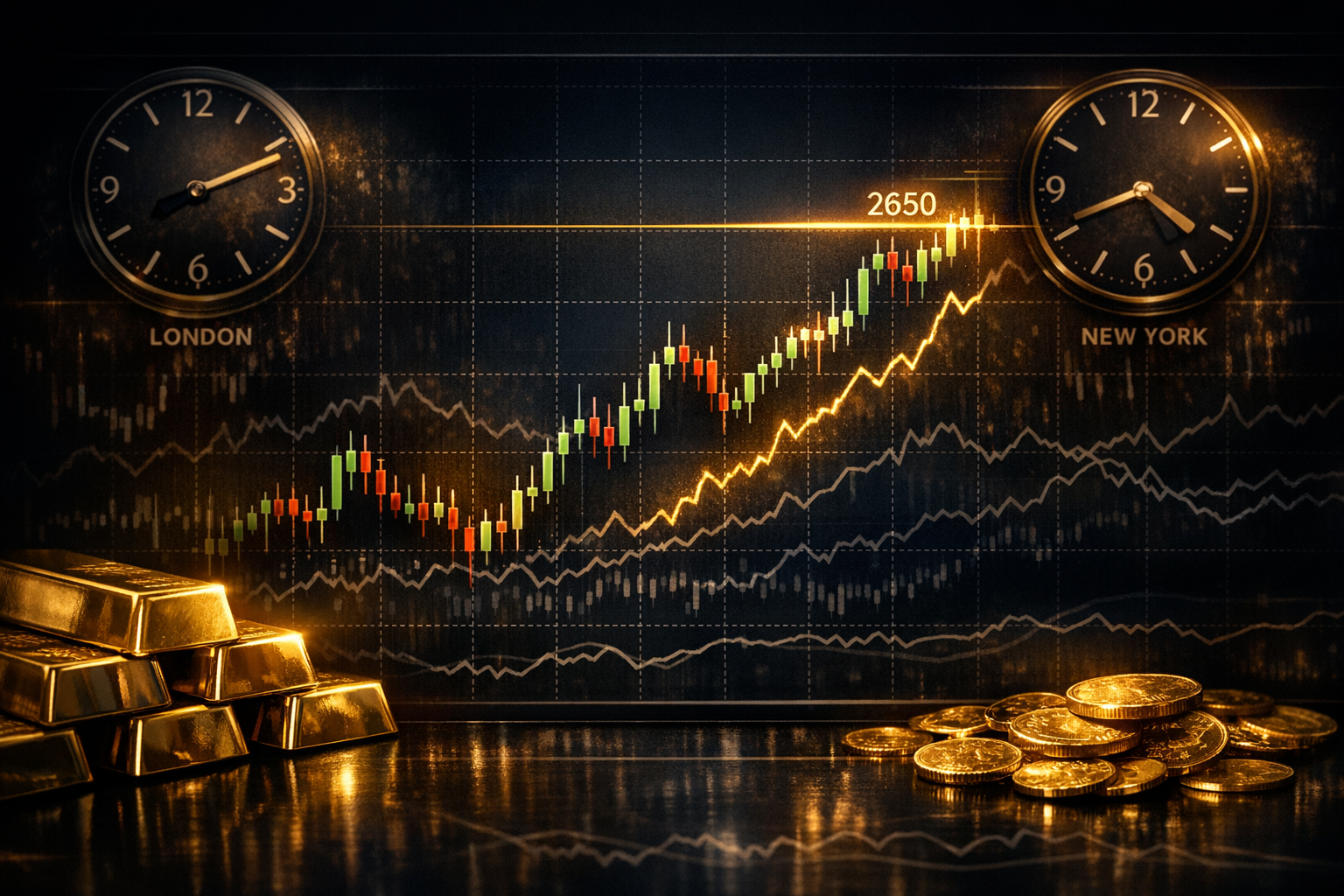
Gold is at $2650. EUR/USD is near 1.0520, USD/JPY is around 149.50, and DXY is pressing 106.80.
If you’ve ever watched XAUUSD move $15 in a few minutes and thought, “How do people trade this without getting wrecked?”, this xauusd trading guide is for you.
Gold trading can be clean, technical, and repeatable.
It can also be a volatility trap if you treat it like EUR/USD.
TL;DR: The fastest path to trading XAUUSD like a pro
- XAUUSD is a momentum + liquidity instrument: it respects levels, but it spikes hardest around news and session opens.
- Best trading windows are London open and the London–New York overlap; most clean moves happen when liquidity is deepest.
- Gold is highly sensitive to DXY, real yields, and risk sentiment; correlation shifts are normal—track the driver, not the myth.
- Use gold-specific risk rules: typical stops are $10–$25, and 1:2 to 1:3 R:R is realistic when volatility expands.
- Have 2–3 repeatable setups (break-and-retest, trend pullback, and range fade) instead of “trading everything.”
- Execution beats prediction: entries, SL, and TP must be pre-defined—this is why structured signals help.
What is XAUUSD and why gold trades differently than forex

XAUUSD is the price of gold quoted in US dollars.
In practical trading terms, you’re speculating on how many dollars it takes to buy one troy ounce of gold.
At the moment, we’re using a realistic market context around $2650, with gold up roughly +0.35% over 24 hours.
That doesn’t sound dramatic until you realize $2650 to $2670 is a $20 move.
On many broker contracts, that’s a meaningful P&L swing per lot.
Gold’s personality: trend bursts + violent mean reversion
Major FX pairs often “flow” in a smoother way.
Gold can trend beautifully, then snap back $8–$12 in minutes.
This is why beginners often place tight stops (like $3–$5) and get stopped out repeatedly.
Gold needs breathing room.
What drives gold (the short list that actually matters)
- US dollar (DXY): when the dollar strengthens, gold often faces headwinds. With DXY around 106.80, dollar strength is a real factor.
- Real yields: rising real yields can pressure gold; falling real yields often support it.
- Risk sentiment: fear bids gold; euphoria can rotate flows away from safety.
- Central bank demand and geopolitics: structural tailwinds can overpower short-term technicals.
- Liquidity windows: gold moves “best” when big players are active (London/NY).
Gold is not just a chart.
It’s a macro instrument that also respects technical levels when liquidity is present.
Gold vs major forex pairs: what changes for your trading plan
With EUR/USD at 1.0520 and GBP/USD at 1.2680, you might be used to smaller intraday ranges.
Gold’s intraday range can be $25–$45 on active days.
That means:
- Stops must be wider.
- Position sizing must be smaller.
- Targets can be larger (and hit faster).
If you want structured trade ideas with defined Entry/SL/TP, explore our premium gold signals and see how we frame gold trades around session timing and volatility.
Gold market fundamentals: the forces behind XAUUSD price
To trade gold profitably, you don’t need a PhD in macro.
You do need a simple “driver map” so you’re not confused when price ignores your RSI divergence.
Gold can and will override technical signals when the macro driver is dominant.
Dollar strength (DXY) and why 106.80 matters
Gold is priced in dollars.
When the dollar strengthens broadly, gold often becomes more expensive for non-USD buyers, which can reduce demand at the margin.
With DXY around 106.80, the market is telling you USD demand is firm.
In that environment, bullish gold trades often need one of two things:
- Risk-off flows strong enough to overwhelm USD strength, or
- Yields/real yields falling, making non-yielding gold more attractive.
This is why you’ll sometimes see gold rise even as DXY rises.
Drivers can conflict, and the “winner” changes by week.
Rates, yields, and the hidden engine of gold volatility
Gold doesn’t pay interest.
So when bond yields rise, holding gold can feel less attractive versus holding yield-bearing assets.
But the key is real yields (nominal yields minus inflation expectations).
When real yields fall, gold tends to benefit.
When real yields rise, gold can struggle—unless fear or central bank buying dominates.
Geopolitics and safe-haven demand
Gold is a “trust asset.”
In uncertain geopolitical periods, buyers pay up for safety, and technical resistance levels can break with ease.
This is where traders get trapped shorting “overbought” conditions.
Gold can stay overbought longer than your margin can stay solvent.
Central banks and structural demand
Central bank gold purchases can create a powerful long-term bid.
That doesn’t mean price only goes up.
It means dips may be bought more aggressively than traders expect.
If you want to understand how news shocks can change the behavior of gold signals, keep this resource bookmarked: how gold signals react to unexpected news events.
XAUUSD trading sessions: best times to trade gold (and when to avoid it)
The fastest way to improve your gold trading is to stop trading it at the worst times.
XAUUSD is technically tradable nearly 24 hours a day.
But it is not equally tradable all day.
The 3 session windows that matter most
- London open: liquidity and directionality often increase quickly.
- London–New York overlap: typically the highest volume window; breakouts and trend continuations are common.
- New York open: US flows and US data can create the day’s main move.
United Kings focuses heavily on London and NY session trading because that’s where gold setups are most reliable and spreads/slippage are generally better.
When gold is most dangerous (especially for beginners)
Two times regularly cause unnecessary losses:
- Thin liquidity hours (late Asia / pre-London): price can drift, then spike on small orders.
- Right before major US news: spreads can widen and stop hunts become more common.
Yes, you can trade news.
But if you’re still learning how to trade gold, the smarter move is to wait for the post-news structure.
A practical session plan you can copy
Here’s a simple routine that works well for many traders:
- 60 minutes before London: mark Asia high/low and yesterday’s high/low.
- London open: wait for a break of Asia range, then look for a retest entry.
- NY overlap: trade continuation setups only if structure supports it.
- After NY lunch: reduce activity; many days become choppy.
If you want a broader breakdown of session behavior across markets, our blog hub is a good place to explore next: United Kings trading education blog.
Gold correlations: DXY, USD/JPY, EUR/USD, and risk sentiment (how to actually use them)
Correlation is a tool, not a rule.
Gold can be negatively correlated with the dollar, until it isn’t.
Your job is to use correlations to build context, not to force trades.
Gold vs DXY (106.80): the most watched relationship
In many regimes, gold and DXY move inversely.
So if DXY is pushing higher and holding above intraday support, gold longs may need extra confirmation.
But if gold is rising anyway, that’s information.
It can signal strong safe-haven demand or a yield-driven move overpowering FX flows.
Gold vs USD/JPY (149.50): a risk proxy with a twist
USD/JPY near 149.50 often reflects yield differentials and risk appetite.
When USD/JPY is ripping higher on rising yields, gold can face pressure.
When USD/JPY drops sharply (risk-off), gold can catch a bid.
But be careful: sometimes USD/JPY moves for Japan-specific reasons, and gold doesn’t care.
Gold vs EUR/USD (1.0520) and GBP/USD (1.2680)
EUR/USD and GBP/USD are heavily USD-driven.
If EUR/USD is selling off while DXY rises, that’s a classic USD-strength tape.
In that scenario, gold rallies are more likely to be pullbacks unless a separate driver supports them.
How to use correlation without overthinking (step-by-step)
- Step 1: Identify the day’s driver: USD strength, yields, or risk-off?
- Step 2: Check if gold is aligned with that driver or diverging.
- Step 3: If aligned, trade trend setups. If diverging, trade smaller or wait.
- Step 4: Confirm on price action at key levels (not indicators alone).
We go deeper on this topic in our dedicated correlation resource: gold correlation trading with DXY, yields, and risk sentiment.
XAUUSD technical analysis basics: levels, structure, and volatility
Gold technical analysis works best when you keep it simple.
Most profitable gold traders are not using 12 indicators.
They’re reading structure, levels, and volatility.
Support and resistance: the “real” gold levels traders respect
In our current context, gold is around $2650.
So realistic reference zones might look like:
- Support zone: $2638–$2642 (intraday demand area)
- Deeper support: $2615–$2620 (swing support / liquidity pool)
- Resistance zone: $2668–$2672 (prior high / supply)
- Higher resistance: $2685–$2690 (range top / breakout trigger)
These aren’t magical numbers.
They’re areas where orders tend to cluster because traders anchor to prior highs/lows.
Market structure: trend, range, or transition?
Before you place any trade, label the environment:
- Uptrend: higher highs and higher lows; buy pullbacks.
- Downtrend: lower highs and lower lows; sell rallies.
- Range: mean reversion dominates; fade extremes.
- Transition: choppy; trade smaller or wait.
Most losses happen in transition phases when traders keep using trend rules in a range (or range rules in a trend).
Volatility: why ATR matters more than you think
Gold’s volatility expands and contracts.
That changes how far your stop should be and what a “normal” target looks like.
A practical rule:
- If gold is moving $20–$30 easily during London/NY, a $15–$25 stop may be reasonable.
- If gold is dead and moving $6–$10, you either tighten your plan or avoid trading.
Volatility tells you whether your strategy has room to work.
Core XAUUSD strategies (repeatable setups with real price examples)
This is where most “gold trading” content fails.
It either stays theoretical, or it gives a random strategy with no execution rules.
Below are three setups we see work consistently when paired with session timing and risk discipline.
Strategy 1: Break-and-retest (London/NY favorite)
Idea: trade the retest after price breaks a key level with momentum.
Best time: London open or NY overlap.
Why it works: gold often grabs liquidity beyond a level, then retests before continuation.
Example (bullish):
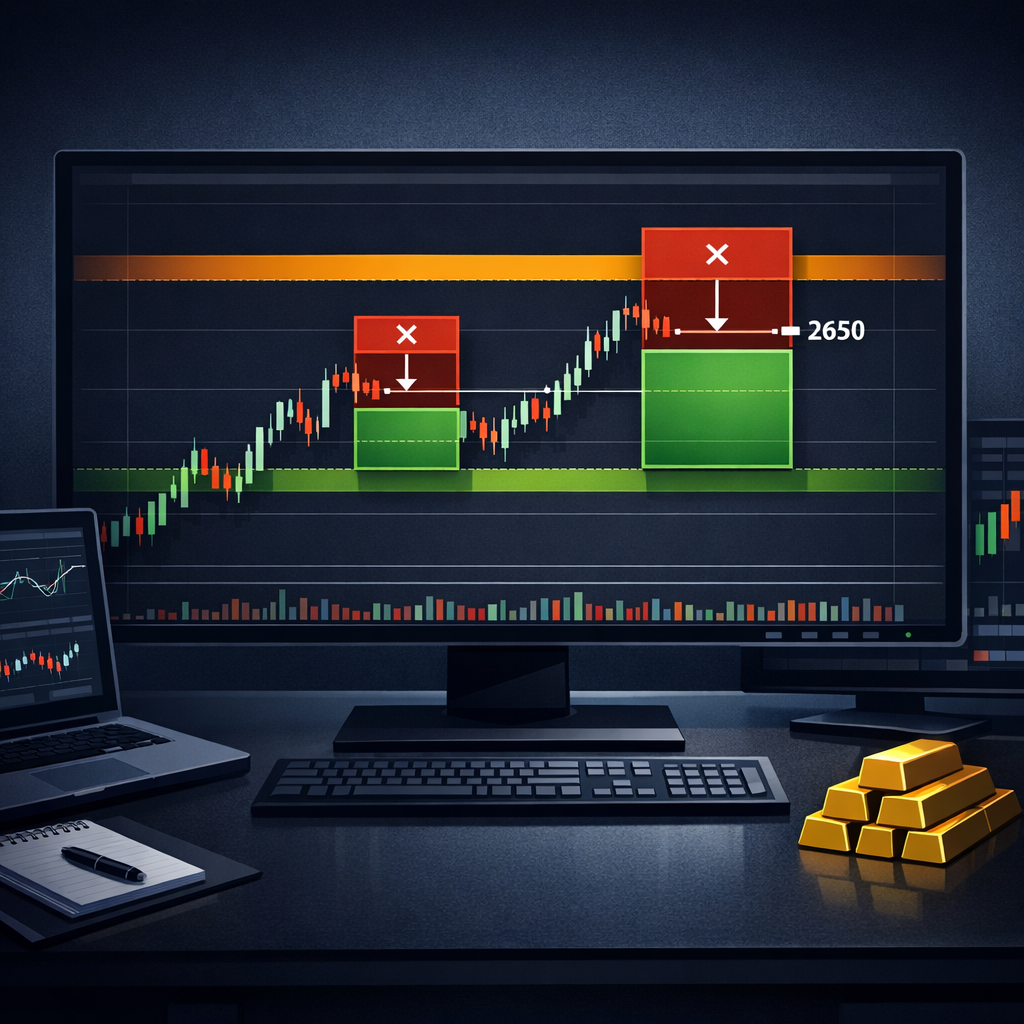
- Price breaks above $2668 and closes strong.
- Wait for a pullback to $2666–$2668.
- Entry: $2667
- Stop loss: $2652 (risk $15)
- Take profit 1 (1:2): $2697 (reward $30)
- Take profit 2 (1:3): $2712 (reward $45) — only if volatility supports extension
Notice the stop is not $3.
Gold needs space, especially when DXY and yields are active drivers.
Strategy 2: Trend pullback (structure + patience)
Idea: trade with the trend after a controlled pullback into support/resistance.
Best time: London session continuation, or NY if trend remains intact.
Example (bearish):
- Gold makes a lower low below $2640, then forms a lower high at $2656.
- Entry: sell $2654–$2656 on rejection.
- Stop loss: $2674 (risk $18–$20)
- Take profit (1:2): $2616 (reward ~$38)
This setup gets even cleaner if DXY is strong and EUR/USD is heavy (risk-off or USD bid).
Strategy 3: Range fade (mean reversion with strict rules)
Idea: when gold is ranging, sell the top and buy the bottom with confirmation.
Best time: pre-London to early London, or slower NY days.
Example:
- Range defined: $2630 support and $2670 resistance.
- Price taps $2670–$2672 and shows rejection.
- Entry: sell $2669
- Stop loss: $2684 (risk $15)
- Take profit (1:2): $2639 (reward $30)
Range trading fails when you ignore regime change.
If price starts closing outside the range with momentum, stop fading and switch to break-and-retest logic.
XAUUSD risk management: position sizing, stops, and realistic expectations
Gold rewards discipline and punishes ego.
Most traders don’t blow accounts because they can’t find entries.
They blow accounts because their risk per trade is too high for gold’s volatility.
The gold risk rule that keeps you in the game
A solid starting point is risking 0.5% to 1% per trade.
If you’re new to gold, start at 0.25% to 0.5%.
Gold can move $10 fast.
You want to survive normal noise.
How to set stops on XAUUSD (not random, not emotional)
Use structure first, volatility second.
- Structure: place your stop beyond the level that invalidates your idea (prior swing high/low).
- Volatility: ensure the stop is not inside “normal” candle noise for that session.
In our current price band ($2610–$2690), a typical intraday stop might be $10–$25.
Tighter stops can work, but they require extremely precise entries and calm markets.
Targeting: why 1:2 is a sweet spot for gold
Gold can deliver 1:3 trades.
But forcing 1:3 in a choppy regime is a common mistake.
A practical approach:
- Take partial profit at 1:1 or 1:1.5.
- Move stop to reduce risk only after structure confirms.
- Let the remainder aim for 1:2 or 1:3 when volatility expands.
Risk management when following signals (step-by-step)
- Step 1: Confirm your account risk limit (0.5%–1%).
- Step 2: Use the provided SL distance to calculate lot size.
- Step 3: Don’t “improve” the signal by tightening stops randomly.
- Step 4: Journal the result and execution quality, not just profit.
For a deeper framework, read our risk-focused guide: risk management strategies when using trading signals.
Choosing your timeframe and building a simple XAUUSD trading plan
One reason traders struggle with gold is timeframe mismatch.
They analyze on the 4H, enter on the 1M, panic on the 5M, and exit based on feelings.
A plan fixes that.
Timeframe selection (simple and effective)
- Swing traders: bias on Daily/4H, execution on 1H/15M.
- Intraday traders: bias on 4H/1H, execution on 15M/5M.
- Scalpers: bias on 1H/15M, execution on 1M/5M (hard mode).
If you’re new, avoid pure scalping.
Gold scalping is where overtrading lives.
A complete XAUUSD trading plan (template)
Here’s a practical plan you can adopt today:
- Market hours: trade only London open + NY overlap.
- Setups: break-and-retest, trend pullback, range fade (only if range is clear).
- Risk: 0.5% per trade, max 2 trades per session.
- Stops: $12–$22 based on structure.
- Targets: partial at 1:1, main at 1:2, runner at 1:3 in strong trends.
- Rules: no trades 10 minutes before major US news; wait for post-news structure.
This is “boring.”
Boring is profitable.
Where signals fit into a plan (and where they don’t)
Signals are not a substitute for risk control.
Signals are a substitute for analysis time and decision fatigue.
If you want to integrate signals properly, start with our main hub: United Kings premium trading signals.
Indicators for gold: what helps, what hurts, and how to combine them
Indicators are tools.
They should support your decision, not make it for you.
Gold reacts well to a few simple tools because it trends and mean-reverts in clear regimes.
Best “supporting” indicators for XAUUSD
- ATR (Average True Range): helps size stops and targets to current volatility.
- Moving averages (20/50 EMA): helps define trend and dynamic pullback zones.
- RSI (14): useful for momentum confirmation and divergence in ranges (not as a standalone buy/sell).
- Volume proxies (if your platform offers): helps spot breakout participation.
A clean indicator stack (minimal and practical)
If you want a simple chart setup:
- 20 EMA and 50 EMA
- ATR (14)
- RSI (14) optional
Then trade price action at levels.
Don’t add more indicators until you can explain exactly what problem the new tool solves.
Common indicator mistakes in gold trading
- Over-relying on “overbought/oversold” during strong trends.
- Ignoring session liquidity and blaming indicators for chop.
- Using fixed stops regardless of volatility (a $7 stop is not always “tight,” it can be “wrong”).
If you want a balanced approach where analysis is done for you and execution is clear, our XAUUSD signal service provides structured entries with SL/TP so you can focus on discipline.
Comparing gold trading styles: scalping vs intraday vs swing (which fits you?)
Gold can be traded in multiple styles.
The “best” style is the one you can execute consistently with your schedule and psychology.
Below is a practical comparison you can use to decide.
| Style | Typical Hold Time | Best Sessions | Typical Stop (Gold) | Typical Target | Who It Fits |
|---|---|---|---|---|---|
| Scalping | 1–15 minutes | London open, NY open | $5–$12 | $8–$25 | Very experienced, fast execution, low latency |
| Intraday | 30 minutes–6 hours | London, London–NY overlap | $10–$25 | $20–$60 | Most traders (best balance of speed + structure) |
| Swing | 1–10 days | All (entries often during London/NY) | $25–$80+ | $60–$200+ | Busy schedules, patient traders, macro-friendly |
How to choose in 60 seconds
- If you can’t watch charts during London/NY, consider swing trading.
- If you can watch 1–2 hours per day, intraday is ideal.
- If you feel addicted to action, avoid scalping until you’re consistently profitable.
Where United Kings signals fit best
Many members use our signals for intraday trading during the most liquid windows.
That includes gold and major FX pairs via forex signals when USD flows are driving everything.
Step-by-step: executing an XAUUSD trade like a professional (entry to exit)
Most traders don’t need a new strategy.
They need a better execution process.
Here’s a step-by-step workflow you can apply to any gold setup.
Step 1: Define the day’s context in 2 minutes
- Gold price: ~$2650
- DXY: ~106.80 (USD strong)
- USD/JPY: ~149.50 (watch yields/risk)
- Key levels: mark $2638–$2642 support, $2668–$2672 resistance, $2685–$2690 top
Now you know what would be “normal” and what would be “surprising.”
Step 2: Wait for price to come to your level
Pros don’t chase.
If your level is $2668 resistance, you wait for price to reach it.
No level, no trade.
Step 3: Choose your trigger (simple triggers only)
- Rejection candle at resistance/support
- Break-and-retest confirmation
- Structure shift on 5M/15M (higher low / lower high)
Triggers stop you from guessing.
Step 4: Place SL and TP before you enter
Example long from $2642 support:
- Entry: $2644
- SL: $2629 (risk $15)
- TP (1:2): $2674 (reward $30)
If you can’t place SL and TP, you’re not ready to enter.
Step 5: Manage the trade with rules (not emotions)
- If price hits +1R, consider partials or tighten only after structure confirms.
- If price returns to entry without progress, don’t panic-exit unless the setup is invalidated.
- If SL hits, you’re done. No revenge trade.
Step 6: Journal execution quality
Track whether you followed the plan.
Profit is a byproduct of good process repeated.
If you prefer to follow structured trade calls and focus on execution, our Telegram community posts clear Entry/SL/TP levels and education alongside them. You can also review our approach in our signals ecosystem, including what to look for in the best forex signals.
Mistakes that blow up gold accounts (and how to avoid them)
Gold doesn’t “hunt” you personally.
But it does punish predictable retail behavior.
Here are the mistakes we see most often—and the fixes that actually work.
Mistake 1: Oversizing because gold “moves fast”
Yes, gold moves fast.
That’s exactly why your lot size should be smaller than on EUR/USD.
Fix: risk a fixed percentage per trade, and accept that smaller size is professional.
Mistake 2: Stops that are too tight for the session
A $6 stop during NY open is often just a donation.
Fix: use structure + ATR logic, typically $10–$25 for intraday trades in active conditions.
Mistake 3: Trading every candle (overtrading)
Gold offers many “almost setups.”
Almost setups drain accounts slowly.
Fix: cap yourself at 1–2 trades per session and only trade at pre-marked levels.
Mistake 4: Fighting the macro driver
If DXY is trending hard and yields are pushing, gold can trend too—but usually with a clear narrative.
Fix: trade with the driver or reduce risk when drivers conflict.
Mistake 5: Holding through major news without a plan
Gold can gap and spike.
Fix: either exit before high-impact news or reduce exposure and widen logic-based stops.
If you’re still deciding whether a signal provider is worth it, this checklist helps you avoid the common traps: signals provider checklist for beginners.
United Kings approach: signals, education, and a gold-first trading routine
Most traders don’t fail because they lack information.
They fail because they lack structure, consistency, and feedback.
That’s what a serious trading community and a disciplined signal process can provide.
What you get with United Kings (practical value props)
- Premium Telegram signals for forex and gold with clear Entry, SL, and TP levels.
- A community of 300K+ active traders learning and executing together.
- A track record focus with an 85%+ win rate target through selective setups (no guarantee; market risk always applies).
- Signals designed around London and NY session liquidity.
- Educational content so you understand the “why,” not just the “what.”
- A 48-hour money-back guarantee so you can evaluate the service without long uncertainty.
How to join and follow signals without confusion
We keep it simple:
- Pick your market focus: gold signals or forex signals.
- Get the trade idea: Entry, SL, TP.
- Apply your risk percentage and execute.
- Review results and improve execution.
Pricing plans (3 options) and who each is for
Our plans are built for different commitment levels:
- Starter (3 Months): $299 (about $100/month) for traders who want to test the process.
- Best Value (1 Year): $599 (about $50/month) with 50% savings plus a FREE ebook.
- Unlimited (Lifetime): $999 pay once for ongoing access.
You can view details on our pricing page and choose the plan that matches your schedule and goals.
Where the community lives
Our main community channel is on Telegram.
Join here: United Kings official Telegram channel.
FAQ: XAUUSD trading guide (beginner to profitable)
1) Is XAUUSD harder to trade than forex pairs like EUR/USD?
XAUUSD is not “harder,” but it is different.
Gold is typically more volatile, so you need wider stops, smaller size, and stricter session discipline than you might use on EUR/USD.
2) What is a good stop loss for gold (XAUUSD)?
For many intraday setups, a realistic stop is often $10–$25 from entry, depending on structure and volatility.
In quieter conditions you may use less, and in high-volatility conditions you may need more.
3) What is the best time to trade gold?
The most reliable windows are usually London open and the London–New York overlap because liquidity is high and moves are cleaner.
4) How do I know if gold is trending or ranging?
Use market structure.
Higher highs/higher lows suggest an uptrend; lower highs/lower lows suggest a downtrend; repeated failures at the same boundaries suggest a range.
5) Should beginners use gold signals?
Signals can help beginners by providing structure (Entry/SL/TP), but beginners should still use demo trading first and keep risk small.
Signals don’t remove market risk; they help reduce decision errors and save analysis time.
Risk disclaimer (read before you trade)
Forex and gold trading involves significant risk and may not be suitable for all investors. You can lose more than your initial deposit depending on your broker and leverage. Past performance does not guarantee future results. Nothing in this article is financial advice. Consider practicing on a demo account first, use strict risk management, and only trade with money you can afford to lose.
Final step: trade XAUUSD with structure (and stop guessing)
If you’ve read this far, you already know the truth about gold: it rewards preparation and punishes impulsiveness.
So here’s the simplest upgrade you can make.
Get professional XAUUSD trade ideas with clear Entry, SL, and TP—and execute them with disciplined risk.
- Explore our full offering: United Kings premium signals
- Focus specifically on gold: XAUUSD gold signals
- Join the community now: United Kings on Telegram
When you’re ready, choose a plan on our pricing page (Starter 3 Months $299, Best Value 1 Year $599, or Lifetime $999) and start trading gold with a process you can repeat.
See you in the London session.