You open your chart and gold is at $2,650. It moved fast in the last hour, spreads widened, and someone in a group chat says “easy buy to $2,680.” You hesitate because you’ve been there before: you buy late, price snaps back $15, you panic-close, and then it runs without you.
If that sounds familiar, this xauusd trading guide is built for you. We’ll go from “what moves gold?” to specific setups, session timing, correlations, and the risk rules that separate random clicks from consistent execution.
TL;DR: The fast-track XAUUSD blueprint
- Gold (XAUUSD) is a volatility instrument. At $2,650 with DXY near 106.80, expect sharp $8–$25 intraday swings—plan your stop and position size before you enter.
- Trade the sessions, not your emotions. The best XAUUSD movement typically comes in the London and New York sessions, especially around U.S. data and Fed headlines.
- Use “levels + trigger” instead of predictions. Mark key zones (e.g., $2,640 / $2,660 / $2,675) and only enter after a clear trigger (break-retest, rejection, or sweep).
- Respect correlations. DXY strength often pressures gold; USD/JPY at 149.50 can signal broad USD momentum and risk sentiment shifts.
- Risk management is the strategy. For most retail accounts, 0.5%–1% risk per trade with $10–$25 stops is a sustainable baseline.
- Signals work best with a process. If you want clear Entry/SL/TP levels, session-based execution, and education, explore our premium gold signals and the broader United Kings signals.
What is XAUUSD, and why gold trades differently than forex

XAUUSD is the symbol for gold priced in U.S. dollars. When you trade XAUUSD, you’re trading the value of one troy ounce of gold quoted in USD. At the moment, gold is hovering around $2,650 with a mild 24-hour gain of about +0.35%.
Many traders approach gold like EUR/USD or GBP/USD. That’s a mistake. Gold behaves like a hybrid between a currency pair and a macro “fear/real rates” asset. It can trend smoothly for hours, then spike $12 in two minutes on a headline.
In practice, gold is different because:
- Volatility is higher. A normal intraday move can be $15–$30. That’s the equivalent of 150–300 pips in many FX pairs.
- Stops must be wider. If you use a $5 stop because you’re used to tight EUR/USD scalps, you’ll get stopped repeatedly by noise.
- News sensitivity is extreme. CPI, NFP, Fed speakers, and geopolitical headlines can instantly change flows.
- Liquidity clusters around sessions. Gold can be sleepy in Asia, then “wake up” in London and explode in New York.
Gold also attracts two very different crowds: long-term macro investors and short-term speculators. That mix creates common patterns: stop hunts around round numbers (like $2,650), sharp reversals after liquidity sweeps, and trend days when momentum feeds on itself.
One more key point: you’re not trading “gold the metal.” You’re trading a derivative price offered by your broker (spot CFD or futures-linked pricing). That means spreads, swaps, and execution quality matter more than beginners expect.
If you want to trade XAUUSD like a professional, your edge comes from combining market context (rates, USD, risk sentiment) with repeatable technical triggers and strict risk rules.
What moves gold: fundamentals that actually matter (and what to ignore)
Gold headlines are everywhere. The problem is most headlines are noise. To trade gold profitably, you need a short list of drivers you respect every day, plus a simple way to translate them into bias and risk control.
Here are the fundamentals that consistently move XAUUSD:
1) The U.S. dollar (DXY) and USD liquidity
Gold is priced in USD, so a stronger dollar often pushes gold down, while a weaker dollar often supports gold. Right now, the Dollar Index (DXY) is around 106.80, which is relatively firm. That doesn’t mean gold must fall, but it does mean gold rallies can be more “work” and may require stronger catalysts.
Practical takeaway: if DXY is breaking higher intraday and gold is trying to rally, you should demand cleaner bullish triggers and consider taking profits faster.
2) Real yields and rate expectations (Fed path)
Gold competes with yield. When traders expect higher real rates, gold often struggles. When rate cuts are priced in, gold tends to find a bid. You don’t need a PhD in bonds—just track the market’s “higher for longer” vs “cuts coming” narrative.
Practical takeaway: on weeks packed with Fed speakers or CPI, gold can shift from trend to chop quickly. That’s not bad—if you’re prepared.
3) Risk sentiment and safe-haven flows
Gold can behave as a safe haven, especially during geopolitical stress or equity sell-offs. But it’s not a perfect “risk-off = gold up” switch. Sometimes, in a panic, USD strength can dominate and gold can dip before rebounding.
Practical takeaway: if equities are dumping and USD/JPY is moving fast, expect gold to be volatile. Tight stops become expensive.
4) Central bank demand and longer-term positioning
Central bank buying has been a structural tailwind in recent years. This matters more for the big picture than for your 15-minute scalp, but it can explain why dips get bought aggressively.
Now, what should you ignore? Most “gold up because uncertainty” articles are backward explanations. Your job is to read the tape: price, levels, and reaction to data.
A clean approach is to define a daily bias with one sentence, like: “DXY firm at 106.80, USD/JPY 149.50, gold holding $2,640 support—bullish only above $2,660 with confirmation.” That’s tradable.
XAUUSD sessions and timing: when gold moves the most
If you trade gold at random hours, you’ll experience random outcomes. Gold’s personality changes by session, and aligning your strategy to the clock is one of the easiest upgrades you can make.
Asia session (roughly 00:00–06:00 GMT)
Asia can be range-bound unless there’s breaking news. You’ll often see gold respect clean support/resistance zones, but breakouts can fail more frequently due to thinner liquidity.
Best use: range trades and planning. Mark Asia high/low and wait for London to show its hand.
London session (roughly 07:00–12:00 GMT)
London is where gold often starts trending. Liquidity increases, and price tends to attack obvious levels. This is a prime window for break-retest trades and liquidity sweeps.
Example: gold trades between $2,642 and $2,655 in Asia. London opens, sweeps $2,642, snaps back above $2,645, then pushes toward $2,660. That sweep-and-reclaim is a classic long trigger.
New York session (roughly 13:00–21:00 GMT)
New York is where the biggest moves often happen, especially around U.S. data releases. Volatility can spike and spreads can widen for a few seconds to minutes depending on your broker.
Best use: continuation trades (if London set the trend) or reversal trades (if the market is overextended and data flips expectations).
The London–New York overlap (roughly 13:00–16:00 GMT)
This overlap is the “main event” for many gold traders. If you only have 1–2 hours per day, focus here. It’s also the window where many United Kings traders execute because our approach emphasizes London and NY session trading with clear levels and defined risk.
A simple timing rule that saves money: avoid entering 1–3 minutes before high-impact news unless you’re specifically trading the news with a plan. Gold can move $10 in a blink, and slippage is real.
If you want a structured routine, pair this section with our educational posts inside the United Kings blog and consider following the live trade plans shared in our gold signals.
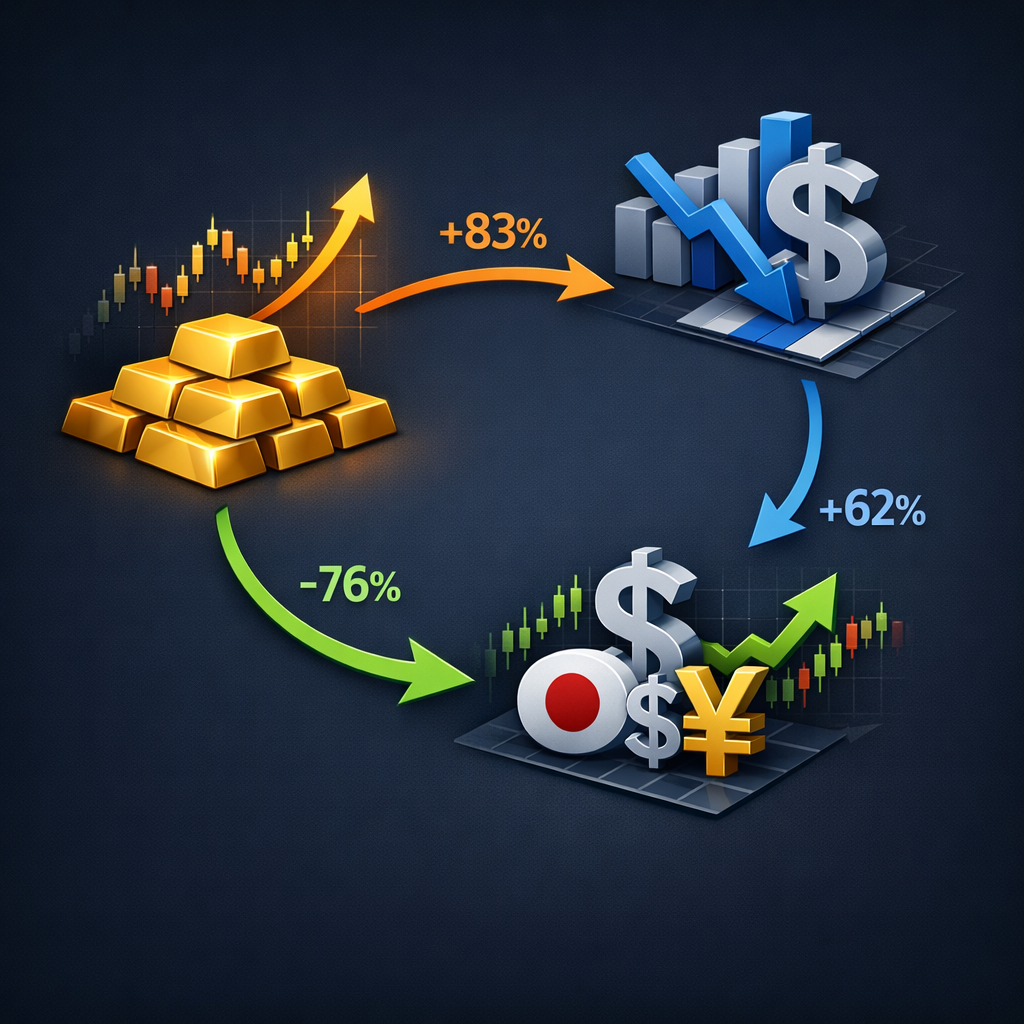
Gold correlations: DXY, EUR/USD, USD/JPY, and what they’re saying right now
Correlations won’t give you entries. They give you context. When your gold setup aligns with USD flows, it tends to follow through more cleanly. When it fights USD flows, you either need stronger confirmation or smaller expectations.
Gold vs DXY (Dollar Index)
The most watched relationship is gold vs the dollar. With DXY around 106.80, the dollar is not weak. That often creates a “cap” above gold unless gold has its own catalyst (risk-off, yields dropping, or strong technical breakout).
How to use it:
- If gold is breaking above $2,660 while DXY is falling, that’s supportive for longs.
- If gold is trying to break above $2,660 while DXY is ripping higher, expect fakeouts or smaller upside.
Gold vs EUR/USD and GBP/USD
EUR/USD at 1.0520 and GBP/USD at 1.2680 are useful because they reflect broad USD strength/weakness. If both are falling, USD is likely firm, which can pressure gold.
Practical example: if EUR/USD breaks down from 1.0520 to 1.0480 during New York, and gold is sitting at $2,655 failing to reclaim $2,660, that confluence often favors a gold pullback toward $2,645 or $2,635.
Gold vs USD/JPY (risk + rates proxy)
USD/JPY at 149.50 often reflects rate differentials and risk appetite. Sharp moves in USD/JPY can coincide with big gold candles, especially on yield-driven days.
How to use it:
- USD/JPY surging can signal USD momentum and higher yields—often a headwind for gold.
- USD/JPY dumping can signal risk-off or yield drops—often supportive for gold.
Correlation is not a rule—use it as a filter
Gold can rally with a strong dollar in certain regimes (for example, geopolitical risk or extreme inflation hedging). That’s why we use correlations as a trade quality filter, not a mechanical signal.
A simple “alignment checklist” before you click buy/sell:
- Is DXY supporting or opposing my direction?
- Are EUR/USD and GBP/USD confirming USD strength/weakness?
- Is USD/JPY stable or spiking (volatility warning)?
- Is there a high-impact event in the next 30 minutes?
When 3 out of 4 align, your gold setup tends to behave better. When 0 out of 4 align, you’re basically gambling.
XAUUSD chart basics: pip value, spreads, and why your broker settings matter
Before strategy, you need mechanics. Many traders lose money in gold not because their idea was wrong, but because their position size and stop distance didn’t match gold’s volatility.
What is a “pip” in XAUUSD?
Different brokers quote gold with different decimal formats. Many quote XAUUSD with two decimals (e.g., 2650.25). In that case, a $1.00 move is 100 “points” if you think in cents. Some traders still call $0.10 a “pip.” The naming doesn’t matter—what matters is you know how much you gain/lose per $1 move.
Rule: know your $ per $1 move for your lot size.
Spreads and execution
Gold spreads can be wider than EUR/USD, and they can expand during news. If your spread is $0.30 in calm markets but $1.20 during CPI, that changes your effective stop and risk.
Practical tip: if your strategy uses tight stops (like $6–$8), spreads and slippage can destroy it. For most retail traders, a more realistic stop range is $10–$25, depending on timeframe and volatility.
Swap/fees and holding trades
If you hold gold overnight, swaps can apply depending on your broker and account type. That matters for swing traders holding for days. If you’re primarily trading London/NY intraday, swaps are usually less important than spread and execution.
Timeframe selection for beginners
Gold moves fast. Beginners often jump to the 1-minute chart and get chopped. A better progression is:
- Bias: 4H and 1H (trend, key levels)
- Setup: 15M (structure, break/retest, sweeps)
- Entry trigger: 5M (confirmation candle, rejection, micro-structure)
This keeps you aligned with the larger move while still giving precise entries. It’s also how many signal-based traders execute: use higher timeframe context, then enter with a clear trigger.
If you’re combining self-analysis with guided levels, you’ll likely enjoy our gold signals service, where entries come with defined SL and TP so you’re not improvising mid-candle.
Step-by-step: a complete beginner workflow to trade gold without guessing
Most losing gold traders don’t lack indicators. They lack a workflow. Here’s a simple, repeatable routine you can follow daily, even if you only have 60–90 minutes.
Step 1: Start with market context (2 minutes)
Check where we are now: gold around $2,650, DXY near 106.80, USD/JPY around 149.50, EUR/USD 1.0520, GBP/USD 1.2680. Ask: is USD broadly strong or weak today?
Write one sentence bias: “Neutral-to-bullish above $2,660; bearish below $2,640 if USD stays firm.”
Step 2: Mark your levels (5 minutes)
On the 1H chart, mark:
- Yesterday’s high/low
- Asia session high/low
- Round numbers and obvious reaction zones (e.g., $2,640, $2,650, $2,660, $2,675)
Gold respects levels because liquidity pools there. Your job is not to predict; it’s to wait for price to show intent around these zones.
Step 3: Choose one setup type (not five)
Beginners should master one of these before adding more:
- Break and retest (trend continuation)
- Liquidity sweep and reversal (mean reversion)
- Pullback to moving average (structured trend entries)
Pick one for the week. Track it. Improve it.
Step 4: Define entry, stop, and take profit before you enter
Example long plan near current prices:
- Entry: $2,656 after a 5M close above $2,655 (reclaim trigger)
- Stop loss: $2,644 (risk $12)
- Take profit 1: $2,680 (reward $24, 1:2)
- Take profit 2: $2,692 (reward $36, 1:3) if volatility supports
Notice: the stop is not “where you feel pain.” It’s where the setup is invalidated.
Step 5: Manage the trade with rules, not vibes
Decide in advance:
- Will you take partial profits at 1R?
- Will you move stop to breakeven after 1R, or only after structure forms?
- What’s your maximum daily loss? (Example: 2R or 2%)
This is where most traders level up. If you want a guided version of this workflow with trade-ready levels, our signals are built around clear Entry/SL/TP and session timing.
Core XAUUSD strategy #1: Breakout + retest (the “clean continuation” trade)
The breakout + retest is one of the most reliable ways to trade gold when it’s trending. Gold trends hard when it trends, and this setup helps you avoid buying the top of the breakout candle.
When it works best
- London or New York session opens
- DXY is stable or moving in your favor
- Gold is breaking a well-defined range (Asia high/low, prior day high/low)
How to trade it (step-by-step)
1) Identify the range. Example: Asia range is $2,642–$2,655.
2) Wait for a real break. Not a wick. Look for a 15M close above $2,655, ideally with strong body.
3) Wait for the retest. Price pulls back to $2,655–$2,652 and holds.
4) Use a trigger candle. On 5M, look for a bullish engulfing, strong rejection wick, or micro higher-low.
5) Place stop where the idea is invalid. Commonly below the retest low or below the broken level by a buffer.
Realistic example using today’s context
- Entry: Buy $2,657 on retest confirmation
- Stop: $2,645 (risk $12)
- TP: $2,681 (reward $24, 1:2)
Why these numbers? $2,681 is a plausible intraday extension in a market trading around $2,650 with normal volatility. It’s also far enough to avoid getting clipped by noise.
Common mistakes
- Chasing the breakout candle. Gold loves to spike and retrace $6–$10.
- Stop too tight. A $6 stop is often just “spread + wiggle room.”
- No plan for fakeouts. If price closes back inside the range, the setup is invalid.
This strategy pairs well with a signal service because the levels are clear and the logic is repeatable. If you prefer to follow structured calls, our premium gold signals are designed around high-probability continuation and reversal zones during London/NY.
Core XAUUSD strategy #2: Liquidity sweep + reversal (the “stop-hunt” setup)
If you’ve ever been stopped out to the exact dollar and then watched price rocket in your direction, you’ve met liquidity. Gold is one of the best markets for trading liquidity sweeps because it regularly hunts obvious highs/lows.
What is a liquidity sweep?
A liquidity sweep happens when price briefly breaks a known level (like Asia low or previous day low), triggers stops and breakout orders, then quickly reverses back inside the range. That reversal often becomes the real move.
When it works best
- At obvious levels: yesterday’s high/low, Asia high/low, round numbers like $2,650
- During London open or NY open, when liquidity floods in
- When the sweep aligns with a higher timeframe support/resistance zone
How to trade it (step-by-step)
1) Mark the target level. Example: Asia low at $2,642.
2) Wait for the sweep. Price wicks to $2,639–$2,640 and immediately rejects.
3) Demand confirmation. A 5M close back above $2,642, or a strong bullish engulfing.
4) Enter on reclaim or on pullback. Conservative traders enter after reclaim; aggressive traders enter on the rejection candle.
5) Stop placement. Below the sweep low with buffer, typically $10–$20 depending on volatility.
Example near current ranges
- Entry: Buy $2,646 after reclaim of $2,642 and a higher-low on 5M
- Stop: $2,633 (risk $13)
- TP1: $2,672 (reward $26, 1:2)
- TP2: $2,685 (reward $39, 1:3) if NY momentum continues
This is a “market maker” style concept, but you don’t need complex tools. You need patience and confirmation. The sweep is the trap; the reclaim is the invitation.
How to avoid getting trapped
- Don’t buy just because price touched support. Wait for reclaim.
- Don’t assume every wick is a sweep. Look for fast rejection and follow-through.
- Be careful during major U.S. news. Sweeps can turn into real breaks.
If you like this style but struggle to identify the “right” levels, that’s exactly what a professional signal plan provides: pre-marked zones, defined invalidation, and realistic targets. You can see how we structure it inside our gold signals and educational resources.
Core XAUUSD strategy #3: Trend + pullback (moving averages and structure, not magic)
Some traders hate indicators. Others overuse them. For gold, a simple moving average can be useful—not as a signal, but as a pullback framework when the market is trending.
Why pullbacks matter in gold
Gold often moves in “impulses” and “breathers.” If you buy the impulse, you’re late. If you wait for the pullback, you can place a logical stop and target a continuation.
A simple trend template
- Use 1H to define trend: higher highs/higher lows (bull) or lower highs/lower lows (bear).
- Use a 20 EMA or 50 EMA on 15M as a pullback zone (not a holy line).
- Enter only when pullback aligns with a prior structure level.
Step-by-step execution
1) Confirm trend. Example: price is holding above $2,640 and printing higher lows toward $2,660.
2) Wait for pullback. Price drops from $2,662 to $2,652, tagging the 20 EMA and prior resistance turned support.
3) Trigger. On 5M, look for a rejection wick or a bullish engulfing candle off $2,652–$2,650.
4) Stop. Under the pullback low, typically $10–$20 away depending on structure.
5) Target. Prior high first (e.g., $2,662), then extension (e.g., $2,675).
Example setup
- Entry: Buy $2,653 after 5M rejection
- Stop: $2,641 (risk $12)
- TP: $2,677 (reward $24, 1:2)
This is not flashy. That’s the point. Gold rewards boring consistency when you align with the trend and avoid emotional entries.
When to avoid the pullback strategy
- When the market is in a tight range and EMAs are flat (chop).
- Right before major U.S. data (you may get wicked both ways).
- When price is extremely extended and due for mean reversion.
Many United Kings members combine this approach with signal guidance: we provide levels and structure, and you execute with a pullback trigger during London/NY. If you want that blend, start with United Kings signals and focus on gold via XAUUSD trade ideas.
XAUUSD risk management: position sizing, stops, and realistic expectations
Gold can make your month in a day—and it can also take your month in a day if you oversize. This section is the difference between “I had a good trade” and “I have a profitable system.”
Choose a fixed risk per trade
A strong baseline is 0.5%–1% of your account per trade. If you’re new, start at 0.25%–0.5%. Gold’s volatility will test your psychology, and smaller risk keeps you in the game long enough to learn.
Stop loss distance: why $10–$25 is common
With gold around $2,650, intraday noise can easily be $5–$8. If your stop is inside that noise, you’re not managing risk—you’re donating spreads.
Typical stop placement examples:
- Scalp (5M trigger, 15M structure): $10–$15 stop
- Intraday swing (15M–1H): $15–$25 stop
Risk-to-reward: keep it simple and measurable
Gold offers clean opportunities for 1:2 and sometimes 1:3 when volatility expands. If you risk $12, aim for $24 (1:2) as your default.
Example:
- Buy $2,656
- SL $2,644 (risk $12)
- TP $2,680 (reward $24)
That’s a plan you can repeat and track.
Daily loss limits (how pros avoid death spirals)
Gold can trigger revenge trading because it moves fast. Set a daily rule:
- Max daily loss: 2R (or 2%)
- After hitting it, stop trading for the day.
This one rule can save your account.
Signals + risk management: the right way to use them
A premium signal is not a license to oversize. It’s a structured trade idea. At United Kings, we emphasize clear Entry/SL/TP and disciplined execution, but you still control risk.
If you want more on this topic, read our dedicated risk guide: risk management strategies when using forex signals. The principles apply directly to gold.
Choosing a style: scalping vs intraday vs swing trading XAUUSD
Gold can be traded many ways, but not every style fits every personality. Your goal is to choose a style that matches your schedule, your patience, and your tolerance for drawdowns.
Here’s a practical comparison to help you decide.
| Style | Typical Hold Time | Typical Stop (Gold) | Best Sessions | Pros | Cons |
|---|---|---|---|---|---|
| Scalping | 1–20 minutes | $8–$15 | London/NY overlap | Many opportunities; quick feedback | Spread/slippage sensitive; emotionally intense |
| Intraday | 30 minutes–6 hours | $12–$25 | London + New York | Best balance of noise vs opportunity | Requires patience; must avoid overtrading |
| Swing | 1–10 days | $25–$80+ | All (macro-driven) | Less screen time; captures big moves | Swap/rollover; larger drawdowns; macro risk |
Which style is best for most traders?
For most retail traders, intraday trading during London and New York is the sweet spot. You avoid the worst noise, you still get strong movement, and your stops can be logical ($12–$25) without being massive.
How to match style to your schedule
- If you can trade 60–120 minutes/day: focus on London open or NY overlap.
- If you have a full-time job: consider swing trades with alerts and fewer decisions.
- If you love fast execution: scalp, but accept higher costs and stricter discipline.
United Kings is optimized for the highest-liquidity windows. That’s why our community focuses on London and NY session trading with actionable levels.
If you want to diversify beyond gold later, you can also explore our forex signals (majors like EUR/USD and GBP/USD) and even crypto signals—but XAUUSD remains the flagship for many traders because of its clean movement and opportunity.
Advanced tools for XAUUSD: ATR, volume logic, and multi-timeframe confluence
Once you can execute the basics, you can add “pro-level” filters that improve trade selection. The goal is not complexity. The goal is better timing and fewer low-quality trades.
ATR (Average True Range) for stop and target calibration
ATR tells you how much gold typically moves over a period. If 14-period ATR on the 1H is $18, then a $7 stop is probably too tight for an intraday trade.
How to use ATR simply:
- Set stop around 0.6–1.0x of your entry timeframe ATR (adjust to structure).
- Set TP around 1.2–2.0x of ATR if the day is trending.
Example: if 1H ATR is $18, a $12–$20 stop is reasonable. Your 1:2 target becomes $24–$40, which matches realistic gold movement.
“Volume” in spot gold: what you can and can’t trust
Spot CFD volume is broker-specific. It’s not centralized like futures. Still, volume spikes on your platform can help identify “activity moments” (breakouts, sweeps, news reactions).
Use volume as a confirmation tool, not a standalone signal:
- Breakout with rising volume = more credible.
- Breakout on low activity = more likely to fake.
Multi-timeframe confluence (the simplest edge enhancer)
Confluence is when multiple reasons support the same trade. For example:
- 1H trend is bullish (higher lows).
- 15M pulls back to support at $2,650.
- 5M prints a sweep below $2,650 and reclaims.
- DXY is stalling or dipping.
That’s a high-quality long idea. Compare that to “price is going up, so I buy.” One is a plan; the other is hope.
News-aware technicals
Gold is extremely sensitive to U.S. data. Your advanced edge is knowing when to reduce size or wait. If CPI is in 20 minutes, you don’t need a new trade unless you specifically trade news volatility.
For a practical survival framework around headlines, pair this guide with: how gold signals react to unexpected news events.
How to use gold signals responsibly (and why most traders misuse them)
Signals can be a shortcut to structure, but only if you treat them like a professional. Most traders misuse signals in three ways: oversizing, cherry-picking, and ignoring the stop.
What a premium signal should include
A usable XAUUSD signal should have:
- Entry (exact price or zone)
- Stop loss (clear invalidation)
- Take profit levels (TP1/TP2/TP3 where appropriate)
- Context (session, trend, key level)
That’s how we structure United Kings calls. Our community is built around clarity, not vague “buy now” messages. Traders join because they want a repeatable process and a team environment.
The right way to execute a signal (step-by-step)
1) Check timing. Is it London/NY? Is there major news in 5 minutes?
2) Check spread. If spread is unusually wide, wait.
3) Calculate position size. Risk a fixed % based on the signal’s stop distance.
4) Place the trade with SL/TP immediately. No “I’ll add it later.”
5) Don’t improvise. If you want to manage actively, do it with rules (partials at 1R, etc.).
Why traders fail even with good signals
- They take 5 trades at once and blow correlation risk.
- They move stops because “it will come back.”
- They enter late after price already moved $10–$15.
Signals are not magic. They’re a decision framework. If you want to see what “structured signals + education” looks like, start with our Forex signals Telegram beginners guide (the execution principles apply to gold too), and then focus on XAUUSD via our gold signals page.
And if you want to meet the team behind the analysis, you can learn more on our About United Kings page.
United Kings XAUUSD approach: sessions, clarity, and consistency
There are many ways to trade gold. Our approach at United Kings is built for real life: you want clear levels, realistic targets, and a community that keeps you disciplined.
What we focus on (and why it works)
- London and New York sessions. We prioritize the hours where liquidity and follow-through are strongest.
- Clean technical levels. Break-retests, sweeps, and structure are repeatable.
- Clear Entry, SL, and TP. No vague calls. You know your risk before you enter.
- Education alongside signals. We want you to understand the “why,” not just copy trades.
Community matters more than people think
Trading is lonely when you do it in silence. It’s also easier to break rules when nobody sees you. A large, active community creates accountability and shared learning.
United Kings has a 300K+ active trader community across our channels. That size matters because you see how different traders manage the same setup: some take TP1 quickly, others hold for TP2 based on structure.
Win rate and expectations
We’re known for a historically strong performance profile (often referenced as 85%+ win rate in our community). But you should treat any performance metric responsibly: past performance does not guarantee future results, and your results depend on execution, broker conditions, and risk.
The real edge is consistency: taking high-quality setups, risking small, and compounding over time instead of trying to double an account in a week.
How to get our gold trade ideas
You can explore our full ecosystem here:
- United Kings premium trading signals (all markets)
- Gold (XAUUSD) signals (our flagship)
- Forex signals (majors like EUR/USD, GBP/USD)
And if you want the fastest way to receive updates, join our Telegram: United Kings Telegram channel.
FAQ: XAUUSD trading questions beginners ask every day
1) What is the best time to trade XAUUSD?
The most consistent movement usually comes during the London session and the New York session, especially the overlap. Asia can work for ranges, but breakouts often have less follow-through.
2) How much should my stop loss be on gold?
For many intraday setups, a typical stop is $10–$25 from entry, depending on volatility and structure. The stop should sit at the point where your idea is invalidated, not at a random number.
3) Is gold harder to trade than forex pairs like EUR/USD?
Gold is often more volatile than major FX pairs, so it can feel harder at first. But it can also be cleaner because it respects key levels and trends strongly during active sessions.
4) How do DXY and USD/JPY affect gold?
DXY strength often pressures gold, while DXY weakness can support gold. USD/JPY can reflect broader USD momentum and yield/risk sentiment shifts. Use them as context filters, not as entry signals.
5) Should beginners use gold signals or learn first?
Beginners can use signals responsibly if they start small, use a demo first, and follow strict risk rules. The best outcome is combining signals with education so you learn the logic behind each trade.
Risk disclaimer (read this before you trade)
Trading forex and gold (XAUUSD) involves significant risk and is not suitable for all investors. You can lose some or all of your capital. Past performance does not guarantee future results. Signals and educational content are provided for informational purposes and do not constitute financial advice. If you are new, consider demo trading first and always use a stop loss with appropriate position sizing.
Ready to trade XAUUSD with a plan (not guesswork)?
If you want structured XAUUSD trade ideas with clear Entry, SL, and TP, delivered during the most active sessions, join the United Kings community.
We offer three plans to fit your goals: Starter (3 Months: $299), Best Value (1 Year: $599 with 50% savings + FREE ebook), and Unlimited (Lifetime: $999 pay once). You can review them on our pricing page.
48-hour money-back guarantee included for peace of mind.
Start here: explore United Kings Gold Signals, browse all premium trading signals, and join our Telegram for updates: https://t.me/unitedkings1.
Trade gold like a professional: process first, profits second.