
Trading psychology is the silent reason most signal followers lose money—even when the signals are good.
You’ve probably lived this: Gold (XAUUSD) is around $2650, the signal says “Buy,” and within minutes price dips to $2642.
Your heart rate spikes, you close early, and then gold rallies to $2674 without you.
Or worse: you revenge-trade the next setup, widen the stop, and turn a controlled -$12 move into a -$35 disaster.
This article is a deep, practical guide to the real job of a signal follower: executing someone else’s edge with your own discipline.
TL;DR — The psychology rules that make signal trading work
- Signals don’t fail—execution fails. Most losses come from early exits, late entries, over-risking, and “one more trade” behavior.
- Your #1 goal is consistency, not excitement. A boring routine beats emotional intensity every time.
- Risk is psychological oxygen. If you risk too much, you cannot think clearly; if you size correctly, you can follow the plan.
- One system, one playbook. Decide your entry method (market/limit), max slippage, and rules for misses—before the signal arrives.
- Track process, not just P&L. Journal whether you followed Entry/SL/TP exactly; that’s how you build trust in the method.
- Use sessions strategically. Most emotional mistakes happen outside London/NY when spreads, liquidity, and patience are worse.
Why “good signals” still lose: the uncomfortable truth
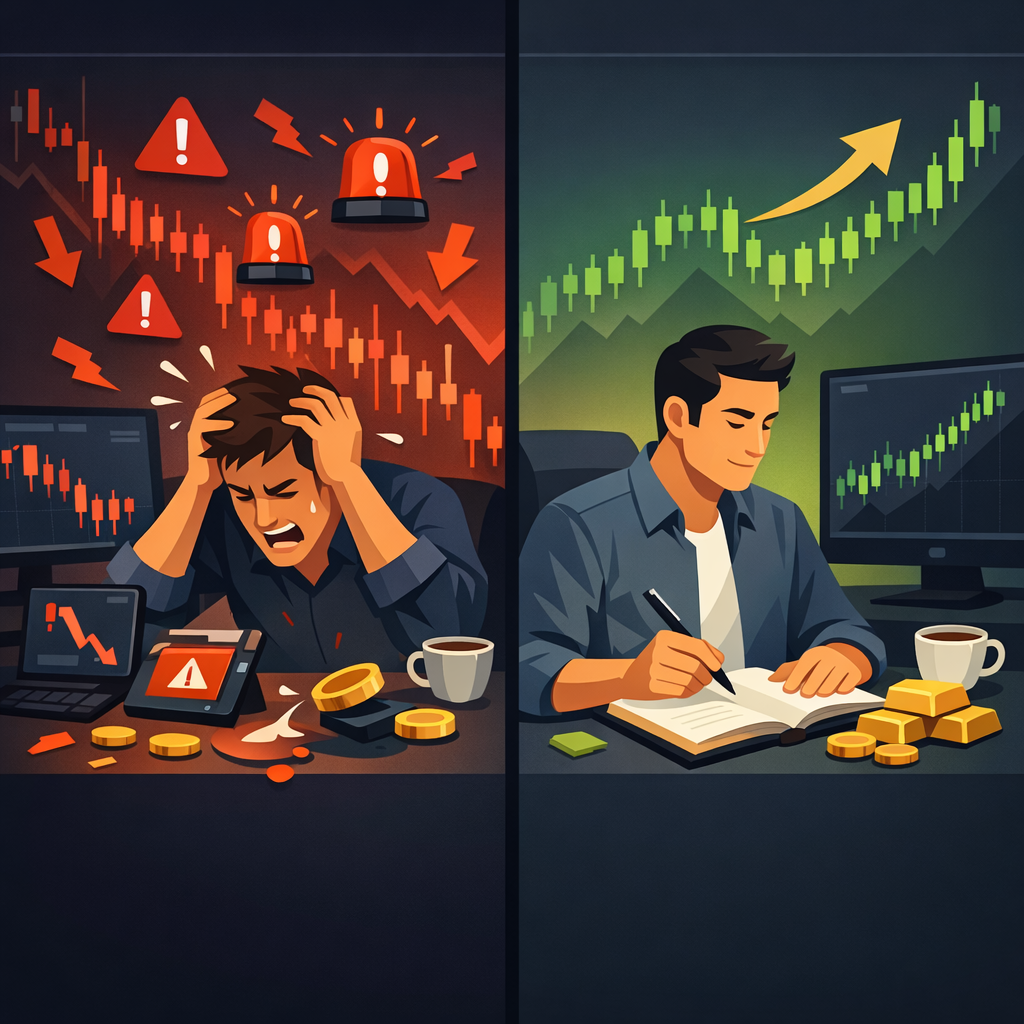
Let’s start with a reality most traders avoid: you can subscribe to an excellent service and still fail.
That’s because the signal is only one part of the performance equation.
The other part is you—your decisions between the moment the message arrives and the moment the trade is closed.
In signal trading, the psychological traps are amplified.
You’re not just battling the market; you’re battling your interpretation of someone else’s conviction.
When the trade goes against you, you don’t just feel fear—you feel doubt, confusion, and sometimes even resentment.
Here’s the core problem: most followers treat signals like a “profit delivery service.”
They expect a straight line, but real trading is a distribution of outcomes.
Even a strong strategy can have a string of losses.
For example, imagine three XAUUSD trades in a row:
- Buy $2652, SL $2640 (-$12), TP $2676 (+$24) → hits SL
- Buy $2648, SL $2636 (-$12), TP $2672 (+$24) → hits SL
- Buy $2650, SL $2638 (-$12), TP $2674 (+$24) → hits TP
Net result: -12 -12 +24 = break-even before costs.
Many followers quit after the first two losses and miss the third trade that restores expectancy.
This is why forex psychology and signal psychology are inseparable from results.
If you can’t handle variance, you can’t harvest edge.
Another uncomfortable truth: a lot of followers change the trade.
They enter late after price moves 20–40 pips, or $8–$15 on gold.
Then the stop loss is effectively tighter, and the same “valid” signal becomes a worse trade.
At United Kings, our community is built around structured execution—clear Entry, SL, and TP levels, plus education alongside signals.
But even with premium guidance, your outcome depends on whether you follow the plan like a professional or improvise like a gambler.
If you’re new to signal-based trading, it’s worth reading our beginner-friendly guide on how to use Forex signals on Telegram without common mistakes.
Then come back here and commit to the psychological upgrades that actually move your equity curve.
The 7 psychological mistakes that destroy signal followers
Most signal followers don’t fail because they’re “bad at trading.”
They fail because they repeat a small set of predictable emotional errors.
When you name these behaviors, you can finally manage them.
1) Entering late (FOMO entry)
Gold is $2650, a buy signal comes, and you hesitate.
Two minutes later it’s $2658 and you “can’t miss it.”
Now your stop is closer in real terms, and you’ve destroyed your risk-to-reward.
2) Closing early (fear exit)
You take +$6 on a trade designed for +$24.
Then you watch it hit TP without you, and your brain learns a toxic lesson: “I always exit too early.”
That frustration often triggers the next mistake: revenge trading.
3) Moving the stop loss (ego protection)
This is the fastest way to turn a strategy into random outcomes.
If your SL is $12 away (e.g., $2652 buy with SL $2640), moving it to $2630 is not “giving it room.”
It’s refusing to pay the cost of information.
4) Overleveraging after a win (hot-hand fallacy)
You catch a clean move on EUR/USD from 1.0520 to 1.0560.
You feel “in sync” with the market and double risk on the next trade.
This is how one loss erases a week of progress.
5) Signal-hopping (lack of identity)
One week you follow gold signals, the next week GBP/USD, then crypto.
There’s no stable sample size, so you never build trust in a process.
If you want variety, structure it—don’t chase it.
6) Confusing analysis with execution
Many followers obsess over “why” the signal exists.
They add indicators, read 12 opinions, and then freeze.
The signal is already an analysis output; your job is to execute it cleanly.
7) Trading to feel something
This is the hidden addiction.
Some traders don’t want profits—they want stimulation.
Signals become a casino notification system.
If any of these hit home, you’re not alone.
They’re common because they’re human.
The solution is not “more willpower.” It’s better structure.
Signal trading vs self-directed trading: a psychology comparison
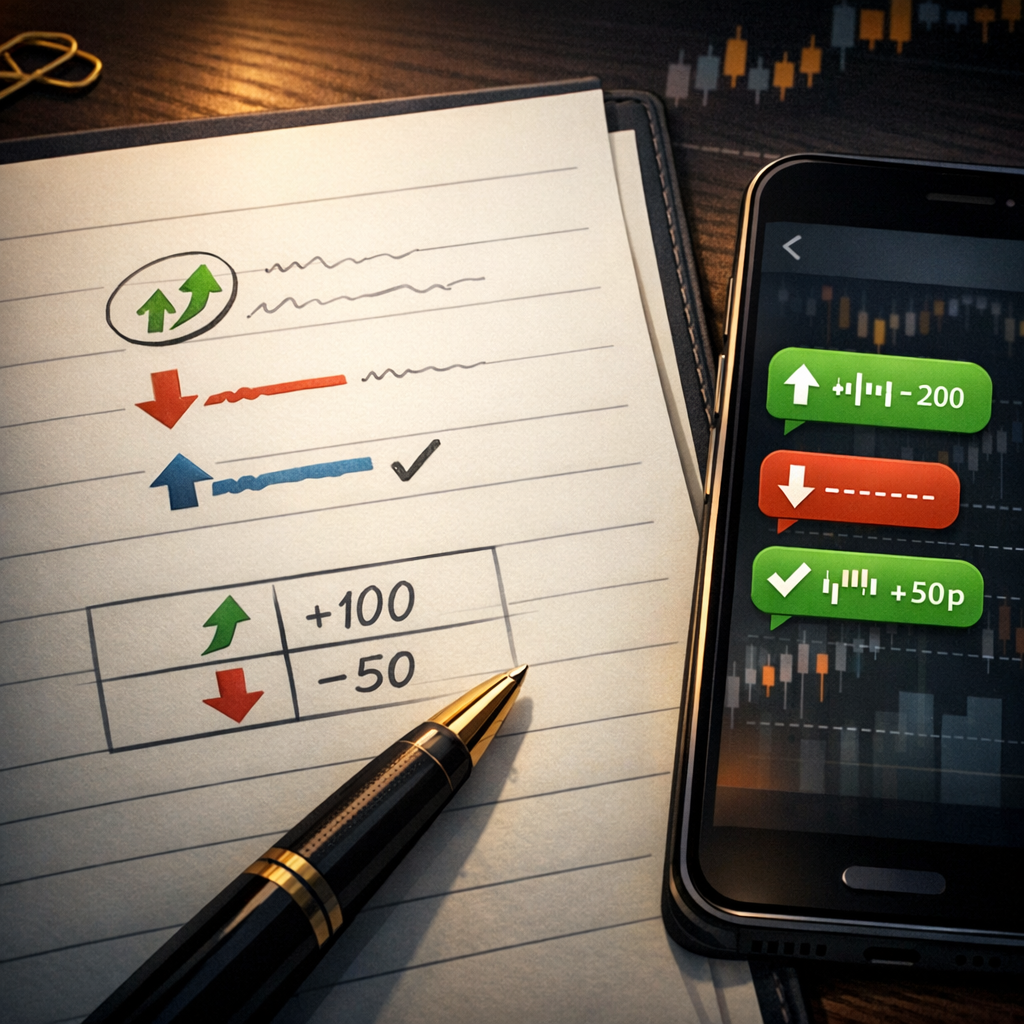
Signal followers face a unique mental environment.
You’re outsourcing analysis, but you still carry the emotional weight of execution and risk.
That creates a mismatch: you feel responsible for outcomes, but you don’t feel ownership of the logic.
Here’s a clear comparison to help you see what you’re actually managing.
| Factor | Signal Trading (Follower) | Self-Directed Trading |
|---|---|---|
| Primary job | Execution, risk control, discipline | Analysis + execution + risk control |
| Main psychological pain | Doubt, impatience, “Should I trust this?” | Overthinking, analysis paralysis, ego attachment |
| Biggest common mistake | Changing Entry/SL/TP | Changing strategy mid-trade |
| What builds confidence | Following rules consistently over 30–50 trades | Backtesting + forward testing + consistent execution |
| Risk of “guru dependency” | High (if you don’t build your own process) | Low (but risk of isolation is higher) |
| Best path to mastery | Execution playbook + journaling + position sizing | System development + journaling + position sizing |
The win condition for a signal follower is simple to state and hard to live:
Do the same correct thing, even when your emotions beg you to do something else.
That’s why a premium provider matters.
Clear entries, logical stops, and realistic targets reduce decision fatigue.
You can explore our full signal coverage at United Kings Signals, including dedicated channels for Gold (XAUUSD) signals and Forex signals.
Risk management is psychology management (especially on XAUUSD)
If you want a single lever that improves your trading mindset fast, it’s position sizing.
Most emotional blowups are not “mental weakness.”
They’re a math problem: you risked too much, so your brain panicked.
Gold is a perfect example because it can move quickly.
With XAUUSD around $2650 and volatility elevated, a $10–$25 swing can happen during London or New York in minutes.
If your stop is $12 and you’re risking 5% of your account, every tick feels like a threat.
When risk is too high, three things happen:
- You watch every candle and lose objectivity.
- You interfere with the trade (early exit, moved SL, re-entry).
- You start trading outcomes instead of probabilities.
When risk is appropriate, your psychology stabilizes.
You can let the trade breathe to the stop or target without personal drama.
A practical sizing rule for signal followers
Pick a fixed risk per trade, usually 0.5% to 1% for most followers.
Then size the lot based on the stop distance provided in the signal.
Example (Gold):
- Account: $5,000
- Risk per trade: 1% = $50
- Signal: Buy $2652, SL $2640 (risk = $12)
Your position size should be whatever makes a $12 move equal about $50 loss.
Now your brain can tolerate normal pullbacks without forcing you to “do something.”
Example (EUR/USD):
- EUR/USD around 1.0520
- Stop distance: 25 pips
- Risk: $50
Again, size so that 25 pips equals $50.
You’re not trying to be brave; you’re trying to be consistent.
If you want a deeper, step-by-step framework built specifically for signal users, keep our risk guide bookmarked: risk management strategies when using forex signals.
When followers tell us “I get nervous,” we usually find one of two things:
- They’re risking too much per trade.
- They’re stacking too many correlated trades (e.g., USD pairs + gold exposure together).
Fix those, and 50% of the psychology problem disappears.
The discipline stack: build habits that make you follow signals
Discipline isn’t a personality trait.
It’s a stack of small behaviors that make the right action easier than the wrong one.
If you rely on motivation, you’ll fail the moment you’re tired, stressed, or distracted.
Here’s the discipline stack we recommend for signal followers.
It’s simple, but it’s not easy—and that’s the point.
Habit 1: Pre-commit to your execution rules
Decide these before you take any trade:
- Max risk per trade (0.5%–1% is common).
- Max trades per day (2–4 is enough for most).
- Allowed entry slippage (e.g., gold: max $2–$3 from entry; FX: max 2–5 pips).
- What you do if you miss entry (no chasing; wait for a pullback or skip).
Habit 2: Trade only when you can execute
Signals are not a reason to trade while driving, in meetings, or half-asleep.
If you can’t place Entry/SL/TP correctly, you’re not trading—you’re guessing.
This is why we emphasize London and NY sessions: liquidity is better and execution is cleaner.
Habit 3: Use a checklist (yes, like a pilot)
A checklist reduces emotional improvisation.
Before placing a trade, confirm:
- Lot size matches your % risk and stop distance.
- SL is placed immediately (never “I’ll add it later”).
- TP is placed (or partial plan is written).
- You are not already overexposed to USD (DXY around 106.80 means USD themes can dominate).
Habit 4: Journal “process,” not predictions
Your journal should answer:
- Did I enter at the signal price (or within my slippage rule)?
- Did I keep the original SL?
- Did I respect the TP or management plan?
- What emotion was present (fear, FOMO, boredom)?
When you measure process, your mindset improves.
When you only measure money, your emotions take over.
If you want more structure around selecting and sticking with a provider, our beginner checklist helps: forex trading signals provider checklist.
Emotional triggers: fear, greed, boredom, and the “Telegram effect”
Signal trading adds a unique emotional amplifier: constant notifications.
Every ping can create urgency, even when the setup is calm and planned.
This is what we call the “Telegram effect.”
Let’s break down the four emotional triggers that ruin most followers—and how to handle them.
Fear: “What if this one is the loss?”
Fear shows up as early exits and hesitation.
It’s often strongest after a losing streak, even if the strategy is still valid.
The antidote is not reassurance; it’s position sizing and repetition.
Try this: reduce risk by 50% for the next 10 trades.
Not forever—just long enough to rebuild execution confidence.
When you can follow rules at smaller size, scaling becomes logical instead of emotional.
Greed: “I need to make more today”
Greed usually appears after a win or after seeing others post profits.
It pushes you to add random trades, increase lot size, or hold beyond TP.
Remember: your job is not to catch every pip.
Your job is to execute an edge repeatedly.
Boredom: “Nothing is happening, I’ll force something”
Boredom is deadly because it feels harmless.
It leads to low-quality trades, especially during slow hours or choppy consolidation.
Gold can range between $2645 and $2660 for hours; that’s not an invitation to scalp randomly.
Create a boredom protocol:
- If no A+ signal, you do not trade.
- You review journal entries or watch one educational lesson.
- You step away from the screen for 20 minutes.
Social pressure: “Everyone else is in”
With a large community, social proof is powerful.
United Kings has 300K+ active traders, and that energy can be motivating.
But if you trade to fit in, you’ll break rules to avoid feeling left out.
Use the community as accountability, not as a trigger.
Your only comparison is your checklist.
If you want to see how Telegram-based signal workflows should look for beginners, review our curated guide: best Telegram channels for gold trading signals.
A step-by-step execution system for following signals like a pro
Professional execution is not complicated.
It’s a repeatable sequence you follow every single time.
Here’s a step-by-step system designed specifically for signal followers.
Step 1: Read the entire signal before touching the chart
Most mistakes happen because traders act on the first line.
Read Entry, SL, TP, and any notes about session or news.
If you don’t understand it, you skip it—no improvisation.
Step 2: Check the market environment in 30 seconds
You don’t need deep analysis, just context.
- DXY around 106.80 suggests USD strength themes can dominate.
- USD/JPY near 149.50 can signal risk sentiment and yield pressure.
- EUR/USD near 1.0520 and GBP/USD near 1.2680 can be sensitive to US data.
This quick scan prevents you from trading blindly into obvious event risk.
Step 3: Confirm you can enter within your slippage rule
If the signal says Buy XAUUSD $2652 and price is $2663, that’s not the same trade.
Late entries create frustration and “bad luck” narratives.
Either wait for a pullback or skip.
Step 4: Calculate lot size from SL distance
This is non-negotiable.
Lot size is not a feeling; it’s arithmetic.
If your stop is $15 and your risk is $30, size so $15 equals $30.
Step 5: Place the trade with SL and TP immediately
Never place a trade “naked.”
In fast gold moves, price can spike $8–$12 quickly.
Without an SL, you’re one news candle away from panic.
Step 6: Set an alert and walk away
Staring at price invites interference.
If your plan is SL $2640 and TP $2676, you don’t need to watch every $1 fluctuation.
Let the plan work.
Step 7: Post-trade review in two minutes
Win or lose, record:
- Did you follow the plan?
- Did you change anything mid-trade?
- What emotion showed up?
This turns experience into skill.
This is also why we emphasize clarity in our Telegram delivery.
If you want to follow signals in real-time with a structured community, you can join our official channel here: United Kings Telegram signals channel.
Building a profitable trading mindset: patience, probability, and identity
The best trading mindset is not “I will win today.”
It’s “I will execute my edge today.”
This shift sounds small, but it changes everything.
Profitable traders think in probabilities.
They accept that any single trade can lose, even if it’s a great setup.
They don’t need certainty; they need consistency.
Patience is a skill, not a virtue
Patience means waiting for the right entry and letting the trade reach a logical outcome.
For gold between $2610 and $2690, it’s normal to see $6–$10 pullbacks before continuation.
If you interpret every pullback as failure, you’ll never hold winners.
Probability thinking: stop judging yourself by one trade
One trade is noise.
Ten trades is a sample.
Fifty trades is data.
If you change behavior after every outcome, you’re reacting to randomness.
Identity: become “the trader who follows rules”
Identity is the deepest layer of psychology.
If you see yourself as impulsive, you’ll trade impulsively.
If you see yourself as disciplined, you’ll protect that identity by following your checklist.
Try a simple identity statement before each session:
- “I am the trader who risks small, follows the plan, and lets probability work.”
This isn’t motivational fluff.
It’s a cue that interrupts emotional autopilot.
And yes—community helps identity.
When you’re surrounded by structured traders, discipline becomes normal.
That’s one reason United Kings focuses on education alongside signals, not just entries.
Real market scenarios: how psychology plays out on Gold and major FX
Let’s make this real with scenarios tied to current market levels.
We’ll use realistic moves given gold around $2650 and DXY near 106.80.
Scenario A: Gold pullback triggers fear
Signal: Buy XAUUSD $2654, SL $2642 (risk $12), TP $2678 (reward $24).
You enter correctly, then price drops to $2646.
You’re down $8 and you feel the urge to close.
What disciplined execution looks like:
- You do nothing because the trade is behaving normally.
- You remind yourself the plan already priced in $12 of adverse movement.
- You let the market decide between SL and TP.
What emotional execution looks like:
- You close at $2646 for -$8.
- Gold rebounds to $2662, you re-buy late.
- Then a shakeout hits $2650 and you close again.
Same signal, different psychology, different outcome.
Scenario B: EUR/USD “missed entry” creates FOMO
EUR/USD is around 1.0520.
Signal calls for a sell at 1.0518 with SL 1.0543 (25 pips) and TP 1.0468 (50 pips).
You see it late at 1.0505 and sell anyway.
Now your stop is effectively 38 pips away from your entry.
Your risk is bigger than planned, and you’re more likely to interfere.
The fix is simple: if you miss it, you miss it.
Scenario C: GBP/USD confidence after a win turns into over-risk
GBP/USD is near 1.2680.
You win a clean 40-pip move and feel unstoppable.
You double lot size on the next signal.
Then the next trade loses the planned 25–35 pips.
Instead of being a normal loss, it becomes an emotional event.
This is how traders spiral.
Scenario D: USD/JPY and DXY create “headline anxiety”
USD/JPY near 149.50 can move sharply on yield headlines.
When USD themes dominate, gold can whip both directions.
If you’re not prepared, you’ll micromanage every candle.
The mindset shift: volatility is not a threat; it’s the environment.
You respond with smaller size and wider emotional tolerance, not with random decisions.
If news spikes are a recurring problem for you, keep this survival guide handy: how gold signals react to unexpected news events.
How to evaluate your performance: the “Follower Scorecard”
Most followers track only P&L.
That’s like judging a pilot only by whether the flight had turbulence.
You need a scorecard that measures execution quality.
Here’s a simple “Follower Scorecard” you can use starting today.
Score each trade 0 or 1 point for each item.
- Entry discipline: Entered within allowed slippage (0/1)
- Stop discipline: SL placed immediately and not moved (0/1)
- Target discipline: TP placed or management plan followed (0/1)
- Risk discipline: Correct lot size for % risk (0/1)
- Emotion discipline: No revenge trade after outcome (0/1)
Max score: 5/5 per trade.
Your goal: average 4.5+ over 30 trades.
If you can do that, profitability becomes much more likely because you are finally letting the edge express itself.
What to do with the scorecard data
After 30 trades, look for patterns.
- If Entry discipline is low, create a “missed trade” rule and stick to it.
- If Stop discipline is low, reduce risk until you stop interfering.
- If Emotion discipline is low, add a mandatory 20-minute cooldown after any loss.
This is how you turn psychology into something measurable.
And what you measure, you can improve.
It also helps you judge any provider fairly.
If your score is 3/5, don’t blame the signals yet.
Fix execution first, then evaluate results.
If you’re still deciding which service fits you, you can also compare features in our updated overview: best forex signals (features and what to look for).
How to succeed with signals long-term: routines, boundaries, and growth
Long-term success is not built on one perfect trade.
It’s built on routines that protect you from yourself.
This is where most followers either mature—or churn forever.
Routine 1: Trade the same hours consistently
When you trade random hours, you get random performance.
We prefer London and New York sessions because liquidity is higher and spreads are typically better.
That doesn’t guarantee wins, but it improves execution conditions.
Routine 2: Set weekly risk limits
Daily limits are good, weekly limits are better.
Example:
- Max risk per day: 2% (e.g., two 1% trades)
- Max risk per week: 5%
If you hit the weekly limit, you stop and review.
This prevents emotional spirals from turning into account damage.
Routine 3: Build a “no-trade” list
Write down the situations where you historically make bad decisions.
- After a fight or stressful day
- When you’re tired or rushed
- When you’re trying to “make back” a loss
- During major news if you can’t monitor execution
Signals are opportunities, not obligations.
Routine 4: Upgrade from follower to informed follower
You don’t need to become a full analyst.
But you should understand basics: why gold reacts to yields, why DXY strength matters, and why sessions change behavior.
This reduces anxiety because the market stops feeling random.
Routine 5: Use the right channel for the right instrument
Many traders mix instruments without understanding volatility differences.
If you want to focus, keep it simple:
- Gold-focused traders: follow XAUUSD gold signals
- FX-focused traders: follow major forex pair signals
- If you diversify, do it intentionally (not impulsively), including optional crypto signals
Long-term success with signals is less about “finding the perfect provider” and more about becoming the kind of trader who can use any good provider correctly.
That’s trading psychology in action.
FAQ: Trading psychology for signal followers
Why do I lose even when the signal hits TP later?
Usually because you exited early, entered late, or changed the stop loss.
Signals are designed with a specific entry and risk profile.
If you alter that, you’re no longer trading the same setup.
How many trades should I follow before judging a signal service?
Aim for at least 30–50 trades with consistent execution rules.
Anything less is often randomness.
Also track your process score, not just P&L.
What risk per trade is best for beginners following signals?
Many beginners do best at 0.5% risk per trade, sometimes 1% once consistent.
If you feel anxious during normal pullbacks, your risk is likely too high.
Consider demo trading until execution is stable.
Should I copy every signal that comes in?
No.
Follow signals only when you can execute properly and within your risk limits.
Skipping a trade is always allowed; breaking rules is not.
How do I stop revenge trading after a loss?
Create a hard rule: after any loss, take a 20-minute cooldown.
During that time, you journal the trade and confirm your next trade will be sized correctly.
Revenge trading is rarely about strategy—it’s about emotional regulation.
Risk disclaimer (please read)
Forex and gold trading involves significant risk and may not be suitable for all investors.
Past performance is not indicative of future results, and no signal provider can guarantee profits.
Always use stop losses, manage position size carefully, and consider practicing on a demo account if you’re a beginner.
You are responsible for your own trading decisions and risk exposure.
Ready to follow signals with discipline (not emotion)? Join United Kings
If you’re serious about upgrading your trading psychology, the fastest path is a structured environment.
United Kings delivers premium Telegram signals for forex and gold with clear Entry, SL, and TP levels, plus education to help you execute like a pro.
We’re proud to support a community of 300K+ active traders focused on London and NY session opportunities.
Explore all offerings on our signals page and choose the track that fits you: gold signals or forex signals.
When you’re ready, review our 3 pricing plans:
- Starter (3 Months): $299 (~$100/mo)
- Best Value (1 Year): $599 ($50/mo, 50% savings + FREE ebook)
- Unlimited (Lifetime): $499 (pay once, access forever)
You can also join our official Telegram now to get plugged into the live flow: United Kings on Telegram.
Build the mindset first. Then let the signals do their job—through your disciplined execution.


