Forex Signals Telegram for Beginners: A Step‑by‑Step Guide That Actually Makes Sense
Picture this: you wake up, check Telegram, and your phone is full of forex and gold signals…
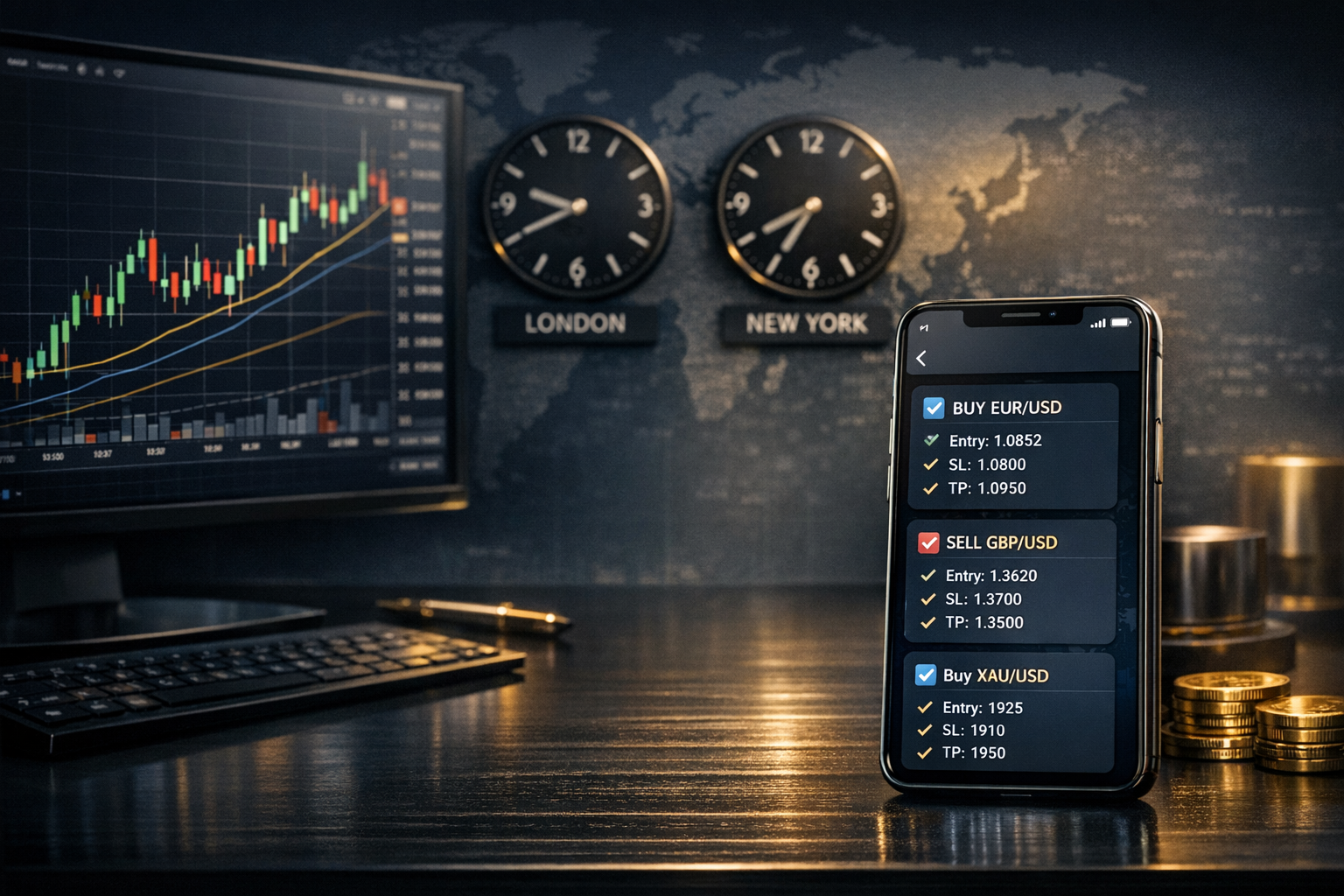
You're half asleep, London session is about to kick off, and you see stuff like:
- "BUY XAUUSD now!!"
- "EURUSD SELL – sniper entry"
- "TP 1, 2, 3, partials, runner, breakeven…"
You enter one or two trades, don't really know why, and by New York close your account is either randomly up… or randomly wrecked.
Sound familiar?
That's exactly where most beginners start with
forex signals Telegram for beginners. Drowning in signals. No structure. No plan. Just vibes. I've been there. I've also tested more signal groups than I care to admit. Some legit. A lot trash. A few like United Kings that actually treat it like a trading business, not a lottery. If you want a proper checklist for what to look for in a provider, this guide from forex signals Telegram for beginners is honestly a solid starting point. This post is the guide I wish I had when I first joined my first gold/forex signals Telegram channel. Step‑by‑step. No hype. No "get rich in 2 weeks" nonsense. You'll learn: - How to choose and set up Telegram signals the right way - How to read and execute a signal without panicking - How to use signals to learn, not just copy - How to avoid blowing your account following the wrong peopleWhy forex signals on Telegram matter right now
The markets in 2025 aren't the same beast they were a few years ago.
Gold at $4,190.12? That alone tells you volatility is insane. A simple $25–$40 move in XAUUSD is nothing now. That's amazing if you're on the right side. Brutal if you're not.
Most newer traders I know are:
- Working a job
- Trading part‑time
- Relying heavily on signals in London and NY sessions because they don't have time to chart every pair
So Telegram becomes their "shortcut" into the market. But here's the thing:
A shortcut only helps if you know where the road is going.
If you just follow random gold and forex signals on Telegram, you're basically gambling with leverage. When you follow a structured team like United Kings that trades gold and majors with a consistent method, the game changes. You start building a process instead of guessing.
Let's walk through that process step‑by‑step.
Step‑by‑Step: How to Use Forex Signals Telegram for Beginners Without Blowing Up
-
Step 1: Pick ONE serious signal provider, not ten random groups
Most beginners join 10+ free Telegram channels and end up with:
- Conflicting EURUSD signals
- Three different gold directions at the same time
- No clue who actually knows what they're doing
I've noticed the traders who grow fastest usually stick to:
- 1 main premium or structured provider (like a team such as United Kings)
- Maybe 1 extra free channel for market ideas only, not for entries
What you want in a good provider:
- Clear risk per trade (e.g. 1–2%)
- Proper SL, TP1, TP2, TP3, not "no SL, we hedge" nonsense
- Regular gold and forex pairs, not random exotics all day
- History of results that isn't obviously Photoshopped or cherry‑picked
-
Step 2: Set up your Telegram and MT4/MT5 so signals are actually usable
Sounds basic, but tech setup is where lots of beginners leak money. You see the signal at 09:05 London, but you enter at 09:18 after price has already moved 40–50 pips.
Do this:
- Turn on Telegram notifications for your main signals channel only
- Mute all the noise channels so you don't get distracted
- Have MT4/MT5 logged in and ready on your phone and/or desktop
- Keep your broker app open during your main trading session (London or NY)
And set your time expectations. If your provider mostly trades London gold breakouts, be present around:
- London open: 08:00–10:00 London time
- New York continuation: 13:00–16:00 London / 08:00–11:00 NY
-
Step 3: Learn how to actually read a signal before you risk $1
Here's a realistic XAUUSD example based on current price around $4,190.12:
Gold (XAUUSD) – London Session Buy Setup
Entry Zone: $4,175 – $4,180
Stop Loss: $4,163
TP1: $4,200
TP2: $4,215
TP3: $4,225All those numbers are in a tight $4,140–$4,240 band, because that's where price is actually moving right now. Not that old $1,900 stuff from 2023.
Here's what each line means in practice:
- Entry Zone: Where you're allowed to enter. You don't chase above $4,180 in this example.
- Stop Loss: $4,163 is your invalidation. If price tags it, you're out. No "hope and pray".
- TP1/TP2/TP3: Staggered targets. You can secure partial profits at each level.
What I tell newer traders is: if you don't understand every line of the signal, don't trade it yet. Ask questions. Watch. Learn.
Pro tip: Screenshot the signal and your executed trade. Compare them after. Did you enter inside the zone? Did you respect the SL? That review habit will save you thousands over time. -
Step 4: Calculate risk and lot size before tapping "Buy"
This is where most beginners blow up. The signal is fine, the risk is fine… but the lot size is insane.
Example using that same gold setup:
- Account size: $1,000
- Risk per trade: 1% ($10)
- Entry: $4,178
- Stop Loss: $4,163
- Risk distance: $15
Rough idea:
- If 1.00 lot on gold = ~$1 per $1 move (depends on broker), then:
- $15 move against you ≈ $15 loss per 1.00 lot
To risk about $10 on a $15 stop:
- Lot size ≈ 0.66 (since 0.66 × $15 ≈ $9.90)
Don't get stuck on the exact math; get stuck on this principle:
Your risk must be fixed. Your lot size changes, not your stop loss. Pro tip: Use a position size calculator app. Set it up once with your broker specs and just plug in: account balance, risk %, entry, and SL. It'll spit out the lot size for you. No guessing, no over‑leveraging. -
Step 5: Execute the signal like a robot, not like a gambler
Execution rules I follow when trading gold/forex signals from a team like United Kings:
- If price is inside the entry zone → OK to enter.
- If price has already moved more than 50–60% of the way to TP1 → I skip it.
- If spread is crazy during Asian session on gold (e.g. very wide) → I often wait for London.
For the earlier example:
- Entry Zone: $4,175 – $4,180
- TP1: $4,200
If price is already at $4,195 when you see the signal, it's too late. You've got only $5 room to TP1 but still $15 risk to SL. That's a terrible risk‑reward.
Pro tip: Create a simple personal rule: "If price is beyond the entry zone, I don't chase. Ever." You'll feel FOMO at first, but long term that one rule will protect your account more than any magic indicator. -
Step 6: Manage the trade with clear rules (not vibes)
Good providers often guide you:
- "Secure partials at TP1, move SL to entry"
- "Close 50% at TP2, leave runner to TP3"
Using our example:
- Price hits $4,200 (TP1) → you close 50% of the position, move SL to $4,178 (breakeven).
- Price pushes to $4,215 (TP2) → maybe close another 30%, trail SL under last swing.
Now worst case, if gold reverses from $4,215 to $4,163 later, you've already banked profit and your remaining risk is usually locked at breakeven or better.
Pro tip: Decide before the trade how you'll manage TP1/TP2/TP3. Don't improvise mid‑trade. Emotional decisions mid‑candle are usually bad ones. -
Step 7: Journal every signal you take (and skip)
This is what most Telegram signal chasers never do. They just hop group to group, hunting for that "perfect" channel.
Basic journal columns:
- Pair (e.g. XAUUSD)
- Session (London, NY, Asian)
- Direction (Buy/Sell)
- Entry, SL, TP
- Result (Win/Loss/BE)
- Did you follow the rules? (Yes/No)
After 30–50 trades, patterns jump out:
- Maybe London gold signals perform way better than NY for you
- Maybe you keep losing on trades you enter late
- Maybe your provider nails direction but you exit too early
Real‑world example: Applying a gold signal step by step
Let's run a full scenario so you see how this looks for real, using current gold conditions around $4,190.12.
Scenario: London Session Buy on XAUUSD

Your signals provider (say, a structured team like United Kings) drops this at 08:10 London:
XAUUSD – London Buy Idea
Asian held $4,165–$4,185 range, looking for breakout continuation.
Entry Zone: $4,185 – $4,190
Stop Loss: $4,170
TP1: $4,205
TP2: $4,220
TP3: $4,235

All prices are inside that $4,140–$4,240 bracket, aligned with live conditions.
Here's how you'd walk it:
- Check price – Gold is trading at $4,187 when you see the signal. That's inside the entry zone. Good.
- Calculate risk – You've got:
- Entry: $4,187
- SL: $4,170 → risk = $17
On a $2,000 account, risking 1% ($20), your lot size should roughly risk $20 on a $17 move.
- Place trade – You set:
- Buy at market: $4,187
- SL: $4,170
- TP1: $4,205 | TP2: $4,220 | TP3: $4,235
- London push – During the first hour of London, gold pumps to $4,206. TP1 hits.
- You close 50% at $4,205–$4,206
- Move SL to $4,187 (breakeven) on the remaining half
- NY session volatility – NY open pushes price up to $4,220 (TP2), then wicks back to $4,190 before heading higher.
- At TP2, you close another 30%
- Trail SL under a 15‑minute swing low, maybe around $4,195
- Outcome – Even if price never reaches TP3 ($4,235) and stops you out at $4,195 on the runner, you've already banked solid profit following your plan.
You didn't just "copy a signal". You:
- Understood the range ($4,165–$4,185 Asian, $4,185–$4,205 London breakout)
- Managed risk per trade
- Executed according to clear rules
That's how
forex signals Telegram for beginners becomes a learning engine instead of a donation machine.Risk reality check: What can go wrong with Telegram forex & gold signals
I'm going to be blunt: signals can help you, but they can also destroy you if you treat them like a lottery ticket.
Common blow‑up patterns I've seen:
- Over‑leveraging gold – Running 2–5 lots on a tiny account, forgetting that gold at $4,190 moves fast. A $25 spike is now normal intraday.
- Chasing missed entries – Entering longs at $4,203 when the zone was $4,185–$4,190, then wondering why your R:R is trash.
- Martingale habits – Doubling lot size after each loss, usually pushed by shady channels that flex "100% win streaks".
- No diversification of learning – Only copying signals, never understanding why. When the provider hits a drawdown, you're lost.
On top of that, markets can just be brutal. News spikes in NY session, sudden liquidity grabs, spreads widening in Asian session – all of that can turn a clean signal into a loss.
Standard risk disclaimer: Forex and CFD trading (including gold) involves substantial risk of loss and is not suitable for all investors. You can lose part or all of your invested capital. Past performance of any signal provider (including reputable teams like United Kings) is not indicative of future results. Always trade with money you can afford to lose and use proper risk management. What most traders miss is this: The signal isn't the edge by itself. Your risk management + discipline + the provider's consistency = your real edge.What to do next: Turning signals into a real trading plan
Here's how I'd structure the next 30 days if I were starting fresh with
forex signals Telegram for beginners and wanted to take it seriously:- Days 1–3 – Choose one main signals provider (checklists like the one from United Kings signals help a lot).
- Days 4–7 – Paper trade or demo:
- Follow every signal
- Mark entries and exits on charts
- Start your journal
- Weeks 2–3 – Trade tiny real risk (0.25–0.5% per trade):
- Stick to London and NY sessions where spreads and volatility make sense
- Focus on 1–2 pairs, often gold + 1 major
- Week 4 – Review:
- How many trades did you follow correctly?
- Are your main losses from bad signals or bad execution?
- Does the provider have a clear edge, or are you just break‑even?
If after a month you see:
- Consistent signals
- Clear explanations
- Manageable drawdowns
- And you're following your risk rules
Then you can slowly scale from 0.5% to 1–2% risk per trade.
If not, you tweak or switch. You're building a system, not marrying a channel.
Pro tip: Treat even the best premium forex signals like training wheels. Use them, learn from them, but gradually build your own understanding so you're not dependent forever.Quick‑reference checklist: Forex Signals Telegram for Beginners
- ✅ Pick one serious provider (e.g. a structured team like United Kings) – avoid signal hopping
- ✅ Set Telegram + MT4/MT5 up properly with notifications only for your main channel
- ✅ Understand each part of the signal (Entry, SL, TP1–TP3) before risking money
- ✅ Use a position size calculator – fix risk %, adjust lot size
- ✅ Never chase price outside the entry zone
- ✅ Follow clear rules for partials and moving SL to breakeven
- ✅ Journal every trade – session, pair, result, and whether you followed rules
- ✅ Start with demo or tiny risk for at least 2–4 weeks
- ✅ Accept that losing trades are normal – avoid martingale or revenge trading
- ✅ Keep learning the "why" behind each signal so you grow beyond copy‑paste
If you build around those points,
forex signals Telegram for beginners can be a powerful shortcut into understanding live markets instead of just a shortcut into margin‑call territory. Want a structured way to audit any provider you're considering, or just sanity‑check the one you're with now? Use this premium forex signals provider checklist from United Kings as your filter before you put real money on the line.FAQ: Forex Signals Telegram for Beginners
Are Telegram forex and gold signals good for complete beginners?
Yes, but only if you treat them as an educational tool, not a "get rich" scheme. Start on demo or with very small risk, follow a serious provider (not hype groups), and use each signal to learn why that entry, that SL, and those TPs were chosen.
How many signals per day should a beginner follow?
For most newer traders, 1–3 quality signals per day is plenty. I'd rather see you follow one clean London gold setup properly than chase 10 random entries across London and NY with no plan.
Should I only trade gold signals, or mix gold and forex pairs?
If your provider (like United Kings) specializes in gold and a couple of major pairs, that's usually ideal. Gold is volatile around $4,190, so it can provide enough setups by itself. Adding 1–2 majors like EURUSD or GBPUSD is fine, but don't overload yourself with 8 pairs.
What account size do I need to start using signals?
You can start learning with any size, even $100–$200, as long as you keep risk per trade tiny (0.5–1%). The key is building discipline and process. The same rules you use on a $200 account are what you'll use on a $2,000 or $20,000 account later.