
You followed a “perfect” signal… and still lost money.
It happens more often than most traders admit.
Not because the signal was “bad,” but because risk management for signal traders is different from risk management for discretionary traders.
When you follow signals, your edge comes from execution speed, consistency, and discipline.
And discipline starts with one thing: forex risk management that’s so clear you can follow it on your worst day.
TL;DR: The complete risk framework (bookmark this)
- Risk per trade: 0.25%–1.00% is the sustainable range for most signal followers; beginners should start at 0.25%–0.50%.
- Position sizing is non-negotiable: calculate lot size from stop-loss distance, not from “how confident you feel.”
- Portfolio risk matters more than one trade: cap total open risk (e.g., 2%–4%) and avoid stacking correlated positions.
- Drawdown rules protect your account: daily loss limit, weekly loss limit, and a “cool-off” rule after a losing streak.
- Recovery is a process, not revenge: reduce risk after drawdown and only scale back up after a defined performance window.
- Signals + education wins long-term: use a journal, track slippage/spread, and follow a checklist—especially during London/NY volatility.
Why signal traders need a different risk management model

Signal traders often copy entries, stops, and take-profits.
That’s good, but it creates a hidden problem: you may outsource the “trade idea,” yet you still own the risk.
Your broker, your leverage, your spreads, your execution speed, your psychology.
So your results can differ from the provider even if you copy the exact levels.
Let’s anchor this in today’s market context.
Gold (XAUUSD) is around $2650 with a modest +0.35% 24h change.
EUR/USD is near 1.0520, GBP/USD 1.2680, USD/JPY 149.50, and DXY around 106.80.
This is the type of environment where moves can look “calm,” then suddenly spike in London or New York.
Signal followers typically face five unique risk challenges:
- Execution drift: you enter a few pips late, spreads widen, or your stop gets placed incorrectly.
- Overconfidence stacking: you take every signal at full size because “the win rate is high.”
- Correlation traps: you’re effectively taking the same USD trade 3–5 times across pairs.
- Drawdown panic: you increase risk to “make it back” after losses.
- Inconsistent sizing: you risk $50 one trade and $300 the next with no rule.
The solution is a framework that assumes signals are probabilities, not certainties.
Even an 85% win-rate system can have losing streaks.
We’ll build a framework that survives those streaks.
If you’re new to signal trading, start by understanding how a serious provider structures entries and levels.
Our overview on how forex signals work on Telegram for beginners pairs well with this risk framework.
The core rule: define your risk unit (R) before you copy a signal
Professional risk management starts with a “risk unit,” often called R.
1R is the amount you lose if the stop loss is hit.
Everything else—lot size, daily limits, scaling—comes from that.
Choose a risk-per-trade range that fits signal trading
For most signal followers, a sustainable range is:
- Conservative: 0.25% per trade
- Balanced: 0.50% per trade
- Assertive: 1.00% per trade
Above 1% per trade, drawdowns get emotionally violent.
That’s where most signal traders break their rules.
Example: set R for a $5,000 account
- 0.25% risk = $12.50 per trade
- 0.50% risk = $25.00 per trade
- 1.00% risk = $50.00 per trade
Now you can follow a signal without guessing.
You simply size the position so the stop equals your R.
Why this matters more for XAUUSD
Gold can move $5–$15 in minutes during NY data.
In the $2610–$2690 zone, that’s normal volatility, not “crazy.”
If you size randomly, a normal swing becomes a portfolio event.
At United Kings, our signals typically include clear Entry, SL, TP levels.
Your job is to translate that into consistent R.
That’s how you make performance repeatable, not lucky.
Position sizing forex: the step-by-step method signal traders should use
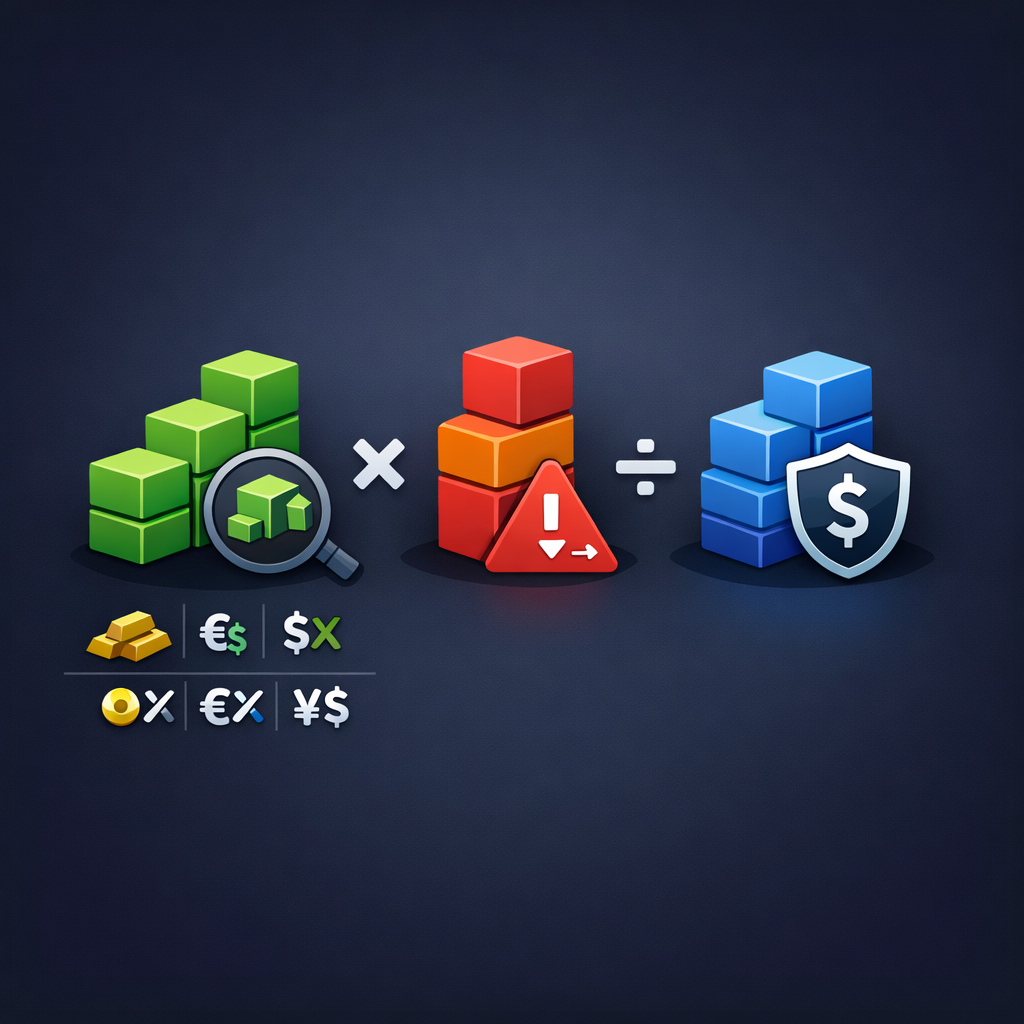
Position sizing is where most signal traders either become consistent… or blow up slowly.
The mistake is sizing based on “lots I usually trade.”
The correct method is sizing based on stop-loss distance.
Step-by-step: the sizing workflow (copy/paste into your notes)
- Decide risk per trade (your R): e.g., 0.50%.
- Calculate $ risk: Account equity × R.
- Measure stop distance in pips (FX) or dollars (gold).
- Convert to $ per pip / $ per $1 move based on instrument and lot size.
- Compute lot size so that SL hit equals your $ risk.
- Check total open risk across all trades (portfolio cap).
Gold (XAUUSD) sizing example using today’s levels
Assume XAUUSD is at $2650.
A signal says: Buy 2650, SL 2638 (a $12 stop), TP 2674 (a $24 target, 1:2 RR).
If your account is $10,000 and you risk 0.50%:
- $ risk = $10,000 × 0.50% = $50
- Stop distance = $12
- You need position size where $12 move = $50 loss.
On many brokers, 1.00 lot of XAUUSD is roughly $100 per $1 move.
So a $12 stop at 1 lot risks about $1,200, which is far too high.
To risk $50, you’d size around: $50 / ($12 × $100) = 0.041 lots.
Rounded: 0.04 lots (or 0.05 if your broker forces steps).
EUR/USD sizing example
EUR/USD is around 1.0520.
Signal: Sell 1.0520, SL 1.0550 (30 pips), TP 1.0460 (60 pips, 1:2).
Account: $10,000, risk 0.50% = $50.
If 1 standard lot is ~$10 per pip, then 30 pips risks ~$300 per lot.
Lot size = $50 / $300 = 0.16 lots (approx).
That’s the entire game.
Not prediction. Not hype. Math and repetition.
If you want to see how we structure trades across instruments, explore our live offering on the United Kings signals page.
Risk-to-reward and expectancy: why 1:2 beats “high win rate” thinking
Many signal traders obsess over win rate.
Win rate matters, but it’s only one part of expectancy.
Expectancy answers: how much do you make per trade over 100 trades?
The expectancy formula (simple version)
- Expectancy = (Win% × Avg Win) − (Loss% × Avg Loss)
If you risk 1R and target 2R, your average win can be 2R.
Even with a 45% win rate, you can be profitable.
Scenario A: 70% win rate, but poor RR
- Win% = 70%
- Avg win = 0.6R
- Loss% = 30%
- Avg loss = 1.0R
Expectancy = 0.70×0.6 − 0.30×1.0 = 0.42 − 0.30 = +0.12R.
Profitable, but fragile.
Scenario B: 55% win rate, but clean 1:2 RR
- Win% = 55%
- Avg win = 2.0R
- Loss% = 45%
- Avg loss = 1.0R
Expectancy = 0.55×2.0 − 0.45×1.0 = 1.10 − 0.45 = +0.65R.
That’s a different league.
This is why your job as a signal follower is to protect R and let winners reach targets.
The fastest way to destroy expectancy is:
- moving SL further away (increasing loss beyond 1R),
- closing early (reducing average win),
- or revenge trading after a loss streak.
Gold example: respecting the plan in a $2610–$2690 range
Imagine gold is choppy between $2638 and $2668 during London.
You take a buy at $2642 with SL $2630 (−$12) and TP $2666 (+$24).
Price goes to $2652, then pulls back to $2644.
The common mistake is to panic-close at +$2 to “secure profit.”
You just turned a 2R system into a 0.2R system.
We publish educational context alongside our premium signals so you understand why levels matter.
If gold is your main instrument, see our dedicated gold signals service and compare it with FX on forex signals.
Portfolio risk management: control total exposure and correlation
Most traders think “I only risk 1% per trade, so I’m safe.”
But if you open five trades at once, you might be risking 5%.
And if those five trades are all USD-driven, you’re basically taking one big bet.
Set a total open risk cap (simple and effective)
Choose a maximum total risk across all open positions.
- Conservative: 1.5%–2% total open risk
- Balanced: 2%–3% total open risk
- Aggressive: 3%–4% total open risk
If you risk 0.5% per trade and cap total at 2%, you can hold 4 trades max.
If a new signal comes, you either skip it or reduce size across positions.
Correlation: the silent account killer
With DXY around 106.80, USD strength/weakness can dominate.
These trades can be highly correlated:
- Short EUR/USD and short GBP/USD (both often move with USD)
- Long USD/JPY and short XAUUSD (risk-on USD dynamics can pressure gold)
- Multiple USD pairs in the same direction during data week
Correlation isn’t always stable, but it’s stable enough to hurt you.
A practical “correlation budget” rule
Use buckets:
- USD bucket: total risk across USD-driven trades max 1.5%–2%
- Gold bucket: max 1%–1.5% (gold can spike)
- Crypto bucket: max 0.5%–1% (if you trade it)
This keeps you from accidentally putting 4% risk on a single macro theme.
If you also follow crypto ideas, keep them separated and capped.
United Kings offers crypto signals, but the risk profile is different from FX and gold.
Drawdown management: daily limits, weekly limits, and “stop trading” rules
Drawdowns don’t blow accounts.
Behavior during drawdowns blows accounts.
Your goal is to build rules that prevent you from making emotional decisions.
The three drawdown limits every signal trader should have
- Per-trade risk: your R (0.25%–1%)
- Daily loss limit: typically 2R–3R
- Weekly loss limit: typically 5R–8R
When you hit a limit, you stop trading.
Not “stop trading unless a great signal comes.”
Stop means stop.
Example: a clean rule set for a 0.5% risk trader
- Risk per trade: 0.5%
- Daily loss limit: 1.5% (3 losses)
- Weekly loss limit: 3.5% (7 losses)
This is not about being timid.
This is about staying in the game long enough for the edge to play out.
What about “but the next trade could win it back”?
Yes, it could.
And it could also lose and push you into tilt.
Signal trading is a volume game over months, not a rescue mission today.
Use a “cool-off” rule after consecutive losses
Signals can hit a rough patch during regime changes.
Markets shift from trend to range, or volatility spikes around central bank weeks.
Add this rule:
- After 3 consecutive losses, reduce risk by 50% for the next 5 trades.
- After 5 consecutive losses, pause for 24 hours and review execution.
This keeps your account stable while you recalibrate.
Unexpected volatility is a major drawdown trigger, especially in gold.
For a survival mindset around sudden spikes, read how gold signals react to unexpected news events.
Execution risk: spreads, slippage, and why your entry won’t match the screenshot
Two traders can copy the same signal and get different results.
That’s not theory—it’s execution.
Execution risk is the gap between the “model trade” and your real fill.
Where execution risk hits signal traders hardest
- Spread expansion: common during NY open, news minutes, and rollover.
- Slippage: market orders fill worse than expected in fast moves.
- Stop placement errors: wrong side of the level, wrong decimal, wrong instrument.
- Latency: you see the signal late, or Telegram notifications lag.
Gold example: the $2–$4 slip that changes your risk
Suppose a buy signal is at $2650 with SL $2638 (risk $12).
You enter at $2653 due to slippage.
If you keep SL at $2638, your risk becomes $15.
That’s a 25% increase in risk without you “choosing” it.
Signal traders need a rule for this:
- If slippage increases stop distance by more than 15%, reduce lot size or skip the trade.
- If spread is abnormal (e.g., gold spread doubles), wait for normalization.
Use limit orders when appropriate (but don’t force them)
Limit orders can reduce slippage.
But they can also cause missed trades.
So decide in advance:
- For breakout signals, market execution may be necessary.
- For pullback signals, limits often work well.
Build an “entry tolerance” rule
Define how far from entry you’re allowed to be.
- EUR/USD: 1–3 pips tolerance (normal conditions)
- GBP/USD: 2–5 pips tolerance
- USD/JPY: 2–6 pips tolerance
- XAUUSD: $0.50–$2.00 tolerance depending on volatility
If you’re outside tolerance, don’t chase.
Wait for the next setup.
A comparison table: common risk models signal traders use (and what actually works)
Not all risk approaches are equal.
Some feel good in the moment but create long-term instability.
Here’s a clear comparison you can use to choose your model.
| Risk Model | How it works | Pros | Cons | Best for |
|---|---|---|---|---|
| Fixed Lot | Same lot size on every signal | Simple | Risk varies wildly with SL size; dangerous on gold | Almost nobody (only micro accounts with tiny lots) |
| Fixed % per Trade | Risk 0.25%–1% each trade; size adjusts to SL | Stable, scalable, professional | Requires calculation discipline | Most signal traders |
| Volatility-Adjusted % | Lower risk when ATR/news volatility rises | Handles regime shifts well | Needs ATR awareness and rules | Intermediate signal traders |
| Martingale / Doubling | Increase size after losses to recover fast | Fast recovery in short streaks | Account-ending drawdowns; psychologically addictive | Not recommended |
| Anti-Martingale | Increase size after wins, reduce after losses | Rides hot streaks, reduces drawdown | Needs strict rules to avoid overconfidence | Advanced, disciplined traders |
If you take only one lesson from this table, make it this:
Fixed % per trade is the baseline for signal traders.
Everything else is a variation you earn the right to use after consistency.
Recovery strategies after drawdown: how to come back without blowing up
Every trader eventually hits a drawdown.
The question is whether you treat it as a data problem or an ego problem.
Signal traders often treat it as an urgency problem.
That’s where damage compounds.
First: define “drawdown tiers” and actions
Use a tiered plan with automatic responses.
- Tier 1 (−2% to −4%): keep trading, but review execution and spreads.
- Tier 2 (−5% to −8%): cut risk per trade by 50% for next 10 trades.
- Tier 3 (−9% to −12%): pause 24–72 hours, trade demo or smallest size, rebuild rhythm.
- Tier 4 (−13%+): stop, audit everything (broker, sizing, psychology), and restart with a new baseline.
This removes decision-making when emotions are loud.
Second: rebuild with a “proof window”
After Tier 2 or Tier 3, don’t jump back to full risk after one win.
Instead, set a proof window:
- Trade 10 signals at half risk.
- If you finish positive (or at least stable), return to normal risk.
- If you finish negative, extend the window and reduce exposure.
Third: avoid the recovery trap of overtrading
When you’re down, you start seeing “opportunities” everywhere.
You take lower-quality signals, you chase entries, you widen stops.
So add a simple throttle:
- Max trades per day: 2–4 (depending on your plan)
- Max trades per session: 1–2 during London or NY
Gold-specific recovery note
Gold around $2650 can look smooth, then spike $10–$20 on headlines.
During recovery, prioritize clean setups and avoid trading right into high-impact events.
That’s not fear.
That’s professionalism.
Signal trader psychology: the discipline checklist that prevents “one bad day”
Most risk failures are psychological failures disguised as strategy.
You don’t need more indicators.
You need fewer decisions under stress.
The 60-second pre-trade checklist (use it every time)
- Is this within my total open risk cap?
- Is the entry within tolerance? (pips or $)
- Did I size using stop distance?
- Is there a major news event in the next 30–60 minutes?
- Am I calm? If not, reduce size or skip.
The three “signal trader lies” to stop believing
- “This one is guaranteed.” No trade is guaranteed, even with strong confluence.
- “I’ll just add a little more.” Adding without rules is how drawdowns accelerate.
- “I deserve to make it back today.” The market does not pay salaries.
Use journaling for signal trading (yes, even if you copy trades)
Your journal isn’t to prove you’re smart.
It’s to identify execution leaks:
- Average slippage on XAUUSD entries
- How often you miss TPs by closing early
- Whether you break rules after 2 losses
- Which sessions you perform best (London vs NY)
We focus heavily on London and New York session trading because that’s where liquidity and follow-through are strongest.
But those sessions also punish sloppy risk.
That’s why psychology and process matter as much as the signal itself.
Building your personal risk plan around a signal provider (template included)
Signals are not a substitute for a plan.
Signals are an input into your plan.
So you need a one-page risk policy you can follow without thinking.
Your one-page risk policy (fill this in)
- Account equity: ________
- Risk per trade (R): ________% (recommended 0.25%–0.50% if new)
- Total open risk cap: ________% (recommended 2%–3%)
- Daily loss limit: ________R (recommended 2–3R)
- Weekly loss limit: ________R (recommended 5–8R)
- Max trades/day: ________
- Entry tolerance: FX ________ pips; Gold ________ $
- After 3 losses: reduce risk to ________% for ________ trades
- News rule: no new trades ________ minutes before high-impact events
How to integrate this with real signals (practical workflow)
- Receive signal on Telegram.
- Check your open risk and correlation buckets.
- Confirm entry tolerance (don’t chase).
- Calculate lot size from SL distance and your R.
- Place order with exact SL/TP.
- Journal execution quality (slippage, spread, emotions).
This workflow makes you “boring.”
Boring is profitable.
If you want a deeper checklist for choosing and using providers, pair this guide with our internal resource: forex signal provider checklist for beginners.
Risk management across instruments: gold vs majors vs JPY pairs
Not all instruments deserve the same risk settings.
Signal traders who treat every market the same usually learn the hard way.
XAUUSD (Gold): respect the spike risk
Gold at $2650 can move $10–$25 quickly during NY headlines.
Stops are often $10–$25 away for a reason.
So your sizing must be smaller compared to FX.
Practical gold rules for signal followers:
- Use slightly lower risk for gold than FX (e.g., 0.25%–0.50%).
- Avoid moving SL wider “to give it room.”
- Be cautious around US data; spreads and wicks can expand.
EUR/USD and GBP/USD: tighter spreads, cleaner sizing
Majors usually have tighter spreads and more predictable execution.
That makes them ideal for consistent position sizing forex rules.
But correlation can bite you if you short both at once in a USD surge.
USD/JPY: headline sensitivity and sudden jumps
USD/JPY around 149.50 can be sensitive to rates and intervention rhetoric.
JPY pairs can gap or spike, especially in thin liquidity.
So keep your tolerance and risk rules strict.
Use volatility-adjusted risk when markets get “fast”
When DXY is trending strongly (like around 106.80), cross-market moves can accelerate.
In those regimes, consider reducing R by 25%.
That single adjustment can save weeks of recovery time.
How United Kings traders apply this framework with Telegram signals
Let’s make this real.
You’re in our community, you receive a gold signal during London.
You want to execute like a pro, not like a gambler.
A realistic execution scenario (gold)
Market: XAUUSD near $2650.
Signal idea: Buy 2648, SL 2636 (−$12), TP1 2672 (+$24), TP2 2684 (+$36).
Your account: $7,500.
Your rule: 0.5% risk per trade.
- $ risk = $7,500 × 0.5% = $37.50
- Stop distance = $12
- Approx lot size (if $100 per $1 for 1 lot): 37.5 / (12×100) = 0.031 lots
You place the trade at ~0.03 lots with SL and TP set instantly.
If TP1 hits, you can optionally secure partial profit while keeping expectancy alive.
A realistic execution scenario (EUR/USD)
Market: EUR/USD near 1.0520.
Signal idea: Sell 1.0520, SL 1.0545 (25 pips), TP 1.0470 (50 pips).
Account: $7,500, risk 0.5% = $37.50.
At ~$10/pip per standard lot, 25 pips ≈ $250 per lot.
Lot size ≈ 37.5/250 = 0.15 lots.
Why our community structure matters for risk
Risk management is easier when you’re not alone.
United Kings has a community of 300K+ active traders, which creates shared discipline.
We also focus on education alongside signals, so you learn the “why,” not only the “what.”
If you want to see how we present trades and manage levels, start with our overview of Telegram channels for gold trading signals and compare providers objectively.
FAQ: Risk management for signal traders
What is the best risk per trade for beginners following signals?
For beginners, 0.25%–0.50% per trade is the safest range.
It keeps drawdowns manageable while you learn execution, spreads, and discipline.
How many signals should I take per day?
A practical cap is 2–4 trades per day.
If you find yourself taking more, it’s often overtrading or chasing.
Should I move the stop loss if price goes against me?
As a signal follower, avoid widening stops.
Widening SL changes the trade’s math and breaks your R system.
If you adjust anything, do it by rule (like trailing after TP1), not emotion.
How do I handle slippage when copying Telegram signals?
Use an entry tolerance rule and re-calculate lot size if your entry is worse.
If slippage increases stop distance by more than ~15%, reduce size or skip.
Can I follow forex, gold, and crypto signals at the same time?
Yes, but only with a portfolio risk cap and separate “risk buckets.”
Crypto volatility is usually higher, so allocate less risk to it.
Risk disclaimer (read this before you trade)
Trading forex and gold involves significant risk and may not be suitable for all investors.
Signals and examples in this article are for educational purposes and do not guarantee profits.
Past performance is not indicative of future results. You can lose more than your initial deposit with leverage.
If you are new, start on a demo account and use small risk until you can follow rules consistently.
Join United Kings: premium signals with a risk-first mindset
If you want signals that are designed to be executed with discipline, we’ve built United Kings for that.
We provide premium Telegram signals for forex and gold with clear Entry, SL, and TP levels, and we focus on London and NY session opportunities.
You also get education, community support, and a process you can follow.
Start here: explore our full offering on UnitedKings.net and see the services on premium trading signals.
If gold is your main focus, go straight to United Kings gold signals.
For currencies, review United Kings forex signals.
Ready to join the community now?
- Join our Telegram: United Kings official Telegram channel
- Choose a plan on United Kings pricing: Starter (3 Months $299), Best Value (1 Year $599 + FREE ebook), or Unlimited (Lifetime $499)
- Trade with confidence: 48-hour money-back guarantee (terms apply)
Your next step is simple: stop guessing your lot size, stop stacking correlated trades, and start treating risk like the strategy.
When you do, signals become a tool—not a gamble.


