
You’re about to pay for signals—or risk real money on them. But one question should come first: Can you verify the performance yourself?
If you’ve ever seen a “90% win rate” screenshot and felt both excited and suspicious, you’re thinking like a professional.
In this guide, we’ll show you how to backtest forex signals and backtest XAUUSD signals inside MT5 using a practical checklist that separates real edge from marketing.
TL;DR: MT5 Backtesting Checklist (Read This First)
- Backtest the signal rules, not the screenshots. Recreate entries, SL, and TP in MT5 with the same session timing and execution assumptions.
- Use realistic trading costs. Add spreads, commissions, and slippage (e.g., 0.5–2.0 pips on majors; $0.20–$1.50 on XAUUSD depending on broker and volatility).
- Measure expectancy, not just win rate. A 55% win rate can outperform 80% if average R is higher and drawdowns are controlled.
- Split results by regime. Trending vs ranging periods can completely change outcomes (especially for gold around key zones like $2610–$2690).
- Watch for curve-fitting red flags. Perfect equity curves, tiny stop losses, and “one magic setting” across all pairs are warning signs.
- Decide with a go/no-go scorecard. If it fails on costs, slippage, and regime tests, don’t fund it—paper trade it first.
Why Backtesting Signal Providers Is Non-Negotiable (Especially in 2026 Markets)

Right now, gold (XAUUSD) is trading near $2650 (+0.35% on the day), with EUR/USD around 1.0520, GBP/USD near 1.2680, USD/JPY around 149.50, and DXY near 106.80.
That mix matters because it hints at a market where the dollar is firm, yields can shift fast, and gold volatility can spike around data or geopolitics.
In these conditions, a signal that “worked last month” can fail this month if it relied on a single regime.
The uncomfortable truth: most signal results are presented in the best possible light
Many providers post only winners, cherry-pick sessions, or ignore execution costs.
Some track results on demo or with unrealistic spreads, then sell the “win rate” as if it’s live-tradable.
Backtesting is how you turn marketing into measurable edge
A proper backtest doesn’t guarantee future profits.
But it does answer the questions that actually matter: Is there an edge after costs? How deep are drawdowns? Does it fail in ranges? Does it depend on perfect fills?
Signals are not a strategy unless you can define the rules
When a provider sends “Buy XAUUSD 2652, SL 2639, TP 2678,” that’s a tradable instruction.
Backtesting is simply repeating that instruction across history and measuring outcomes with consistent assumptions.
If you’re comparing providers, also review our broader vetting guide: forex trading signals provider checklist.
What You Can (and Can’t) Backtest: Manual Signals vs Automated Systems
Before you open MT5, you need to be clear about what type of “signals” you’re testing.
Not all signals can be backtested the same way, and confusion here is where most traders waste hours.
Three common signal formats (and how to test them)
- Exact levels signals: Entry, SL, TP are provided. These are the easiest to backtest because the rules are explicit.
- Zone-based signals: “Buy 2648–2652, SL below 2638, TP 2675.” You must define a consistent entry rule (e.g., first touch, mid-zone, candle close).
- Discretionary commentary: “Gold bullish, look for longs.” This is not a backtestable signal unless the provider also defines triggers.
Manual backtesting vs MT5 Strategy Tester
MT5’s Strategy Tester is built for automated strategies (EAs).
But you can still backtest signals in MT5 in two practical ways: manual replay-style testing or semi-automated logging using scripts/templates.
Here’s the decision point: if your provider sends discrete trades with levels, manual backtesting is usually faster and more honest.
If the provider’s logic can be coded, Strategy Tester becomes powerful for thousands of trades and regime splits.
Comparison: the backtesting approaches that actually work
| Method | Best For | Pros | Cons | Recommended Use |
|---|---|---|---|---|
| Manual backtest in MT5 (chart scrolling + logging) | Telegram signals with Entry/SL/TP | Realistic, quick to start, exposes discretion | Time-consuming for large samples | 50–200 trades validation |
| Spreadsheet backtest (from signal history) | Providers with full signal archive | Fast, easy metrics | May ignore intraday fill reality | Cross-check claims vs your execution |
| MT5 Strategy Tester (EA-coded rules) | Rule-based strategies | Huge sample, parameter testing, regime splits | Easy to curve-fit, needs coding | Robustness testing after manual validation |
If you’re new to Telegram-based execution, pair this article with: how forex signals on Telegram work for beginners.
MT5 Setup for Accurate Signal Backtests (Data, Spreads, Sessions, and Time Zones)
Most “bad backtests” aren’t bad because the trader is lazy.
They’re bad because MT5 defaults can quietly distort results.
Step-by-step: prepare MT5 like a tester, not a casual chart viewer
- Confirm symbol specs: Right-click the symbol → “Specification.” Note contract size, tick size, and typical spread for XAUUSD and your forex pairs.
- Download sufficient history: Tools → History Center. Pull M1 data if possible, even if you test on M15/H1.
- Fix your time zone mapping: Signals are often sent in London/NY session terms. Your broker server time may differ by 2–7 hours.
- Set sessions you will trade: If a provider focuses on London and NY (we do), your backtest should ignore Asian-session-only fills unless you would actually take them.
- Record costs assumptions: Spread, commission, and slippage should be written at the top of your log before you start.
Realistic spreads and slippage: what to assume in today’s conditions
With DXY around 106.80 and USD/JPY near 149.50, liquidity can be strong during NY, but gold can still whip around data.
For backtesting, you want conservative assumptions that survive reality.
- EUR/USD: assume 0.6–1.2 pips all-in during liquid hours (spread+commission equivalent).
- GBP/USD: assume 0.8–1.6 pips all-in.
- USD/JPY: assume 0.7–1.5 pips all-in.
- XAUUSD: assume $0.30–$1.20 typical, and up to $1.50–$2.50 around news spikes.
Slippage is not “optional.”
If your signal uses tight stops—like $10 on gold—$0.80 slippage can materially change win rate.
One rule that keeps you honest
If the backtest only works with perfect entries and zero slippage, it’s not a strategy.
It’s a screenshot.
For a deeper framework on controlling risk once you start trading signals, bookmark: risk management strategies when using forex signals.
The Practical Checklist: How to Backtest Forex & XAUUSD Signals in MT5 (Manual Method)
This is the method most traders should use first.
It’s fast to start, requires no coding, and reveals whether the provider’s trade structure is stable across different weeks.
What you need before you start
- At least 50 signals (100+ is better) with Entry, SL, TP, and timestamp.
- MT5 with history loaded for the tested period.
- A trade log template (spreadsheet or journal).
- Your assumptions written down: spread, slippage, session filter, and whether you allow partials/BE moves.
Step-by-step: recreate each signal like a neutral auditor
- Go to the timestamp: Find the candle where the signal was released. Don’t “peek” forward.
- Mark the entry level: If it’s a market entry, assume you get filled at entry + costs (worse fill). If it’s a limit, assume realistic fill rules (first touch vs candle close).
- Apply spread and slippage: Example on XAUUSD: Buy at 2650.00 becomes 2650.70 with $0.70 costs. Your SL and TP should reflect execution reality.
- Place SL/TP exactly: Example: Buy 2650.00, SL 2638.00 (12 dollars risk), TP 2674.00 (24 dollars reward = 1:2).
- Scroll forward candle by candle: Stop at the first hit: SL or TP. If both are touched in the same candle, use a conservative rule (assume SL hit first unless your data granularity proves otherwise).
- Log the outcome: Record R-multiple, max adverse excursion (MAE), and max favorable excursion (MFE) if possible.
A realistic XAUUSD example in the current price zone
Gold is near $2650.
Let’s say the signal is: Sell XAUUSD 2662, SL 2676 (14 dollars), TP 2634 (28 dollars, 1:2).
In your backtest, you might apply $0.80 costs, meaning effective entry is 2661.20 (or 2662.80 depending on direction and broker model) and the stop/target interaction changes slightly.
What to do with “management” signals (BE, partial closes)
If the provider frequently moves SL to breakeven or takes partial profit, you must define a consistent rule.
Otherwise, you’ll unintentionally curve-fit by choosing the best management after seeing the outcome.
- Conservative rule: Ignore management and test fixed SL/TP first.
- Second pass: Add management rules only if they’re clearly defined (e.g., “move to BE at +10 pips” or “partial at 1R”).
This is exactly how we recommend validating any provider before joining a premium room.
It’s also how many traders validate our track record before subscribing to United Kings premium signals.
Using MT5 Strategy Tester for Signals (When Rules Can Be Coded)
If your signal provider has consistent, rule-based entries (for example: “London breakout of Asian range with ATR stop”), you can code it as an EA and use the MT5 Strategy Tester for signals.
This can generate thousands of trades, which helps you understand robustness.
When Strategy Tester is appropriate (and when it’s a trap)
Use Strategy Tester if the entry/exit rules can be written as logic without “human interpretation.”
Avoid it if the provider’s edge depends on discretionary context like “tone of price action” unless you can objectively define it.
Step-by-step: a clean Strategy Tester workflow
- Define rules in plain English: Entry trigger, stop method, target method, time filter, and invalidation conditions.
- Code the EA with zero optimization first: One fixed parameter set.
- Select modeling quality: Prefer real ticks if possible, or at least 1-minute OHLC with tick simulation.
- Set costs: Commission and spread. If your broker offers variable spread, consider worst-case spreads during news windows.
- Run out-of-sample tests: Example: train on 2023–2024, test on 2025–2026.
- Stress test slippage: Add a slippage parameter and rerun. A real edge survives 1–2 pips (majors) and $0.50–$1.50 (gold) slippage.
How to interpret Strategy Tester outputs like a pro
Don’t get hypnotized by “Net Profit.”
Focus on: max drawdown, profit factor, expected payoff, and stability across years.
- Profit factor: 1.2 can be tradable with low drawdown; 1.8+ is strong if stable.
- Expected payoff: Should remain positive after costs and slippage.
- Trade distribution: Avoid systems where 80% of profit comes from 2 trades.
Gold-specific note: XAUUSD needs regime and volatility filters
Gold around $2650 can trend hard when real yields shift, then chop for days in a $15–$25 box.
If your coded logic doesn’t separate those regimes, the tester may show attractive averages that hide ugly streaks.
If you primarily trade gold, explore our dedicated service page for what a structured gold plan looks like: premium XAUUSD gold signals.
How to Log Trades Correctly: The Signal Backtest Journal That Catches Lies
Your backtest is only as good as your log.
If you don’t record execution assumptions and context, you’ll “remember” the best version later.
Minimum columns for a serious signal backtest log
- Date/time (and time zone): Include broker server time and the signal timestamp.
- Pair/symbol: EURUSD, GBPUSD, USDJPY, XAUUSD.
- Direction: Buy/Sell.
- Entry / SL / TP: Use the exact levels.
- Spread + slippage assumption: e.g., 1.0 pip majors; $0.80 gold.
- Outcome: TP, SL, BE, partial (if rules exist).
- R-multiple: +2R, -1R, +0.3R, etc.
- MAE/MFE: Optional but powerful for refining whether stops are too tight.
- Market regime tag: Trending, ranging, news spike, post-news mean reversion.
Example: a clean gold signal log entry (realistic numbers)
Symbol: XAUUSD
Signal: Buy 2646.00, SL 2633.00 (13), TP 2672.00 (26) = 1:2 RR
Costs: $0.90 assumed
Result: TP hit, +2R
MAE: -$6.20 before moving up
Regime: Trending (post-break above prior day high)
Why R-multiples beat pips for comparing forex vs gold
A 25-pip win on EUR/USD is not “bigger” than a $12 move on gold.
R-multiple standardizes performance based on risk.
Example: Risk 15 pips on EUR/USD and win 30 pips = +2R.
Risk $12 on gold and win $24 = +2R.
Make your log auditable
If you ever want to compare providers, you need apples-to-apples assumptions.
Write the assumptions once, then never change them mid-sample.
For more on journaling methods that improve decision-making, see our related resource hub at United Kings blog.
Win Rate vs Expectancy: The Metrics That Actually Verify Performance
Most traders ask, “What’s the win rate?”
Professionals ask, “What’s the expectancy after costs, and what drawdown do I have to survive to earn it?”
The four numbers you must calculate
- Win rate: winners / total trades.
- Average win (in R): mean R of winning trades.
- Average loss (in R): mean R of losing trades (usually near -1R if fixed SL).
- Expectancy: (Win% × AvgWin) − (Loss% × AvgLoss).
A realistic expectancy example (forex signals)
Suppose you backtest 100 EUR/USD signals.
You get 58 winners, 42 losers.
Average win is +1.6R (because some hit 2R, some hit 1R), average loss is -1.0R.
Expectancy = (0.58 × 1.6) − (0.42 × 1.0) = 0.928 − 0.42 = +0.508R per trade.
At +0.5R per trade, even 10 trades per week can be meaningful.
But only if drawdown is tolerable.
Why high win rate can be a red flag
A signal with 85–90% win rate might be using tiny targets and huge stops.
That can “look” good until one loss wipes out 10–20 winners.
In gold, it’s common to see: win $6 repeatedly, then lose $60 once.
That’s not edge. That’s hidden tail risk.
Drawdown and losing streak math (the part most providers don’t show)
Even a strong strategy can have streaks.
At 55% win rate, a 6-loss streak is not rare across a year.
So you need to measure:
- Max consecutive losses in your backtest.
- Max drawdown in R and in % of account (based on your position sizing).
- Recovery factor (profit / drawdown).
Gold example: expectancy can flip with costs
Imagine XAUUSD signals average +1.2R wins and -1R losses with a 54% win rate.
Expectancy = (0.54×1.2) − (0.46×1.0) = 0.648 − 0.46 = +0.188R.
If your costs and slippage reduce average win by 0.15R, you’re near flat.
This is why we insist on realistic assumptions before trusting any performance claim.
Trending vs Ranging: How to Split Backtests by Market Regime (Gold & Forex)
One of the biggest reasons traders get disappointed after subscribing to signals is simple.
They backtested (or observed) during a trend, then traded live during a range.
Why regime matters more for XAUUSD around key bands
Gold near $2650 often reacts violently around round numbers and prior highs/lows.
A breakout system can thrive when gold expands from $2630 to $2680.
That same system can bleed when gold chops between $2642 and $2660 for two days.
Simple regime classification you can actually use
You don’t need a PhD model.
Use a rule you can repeat:
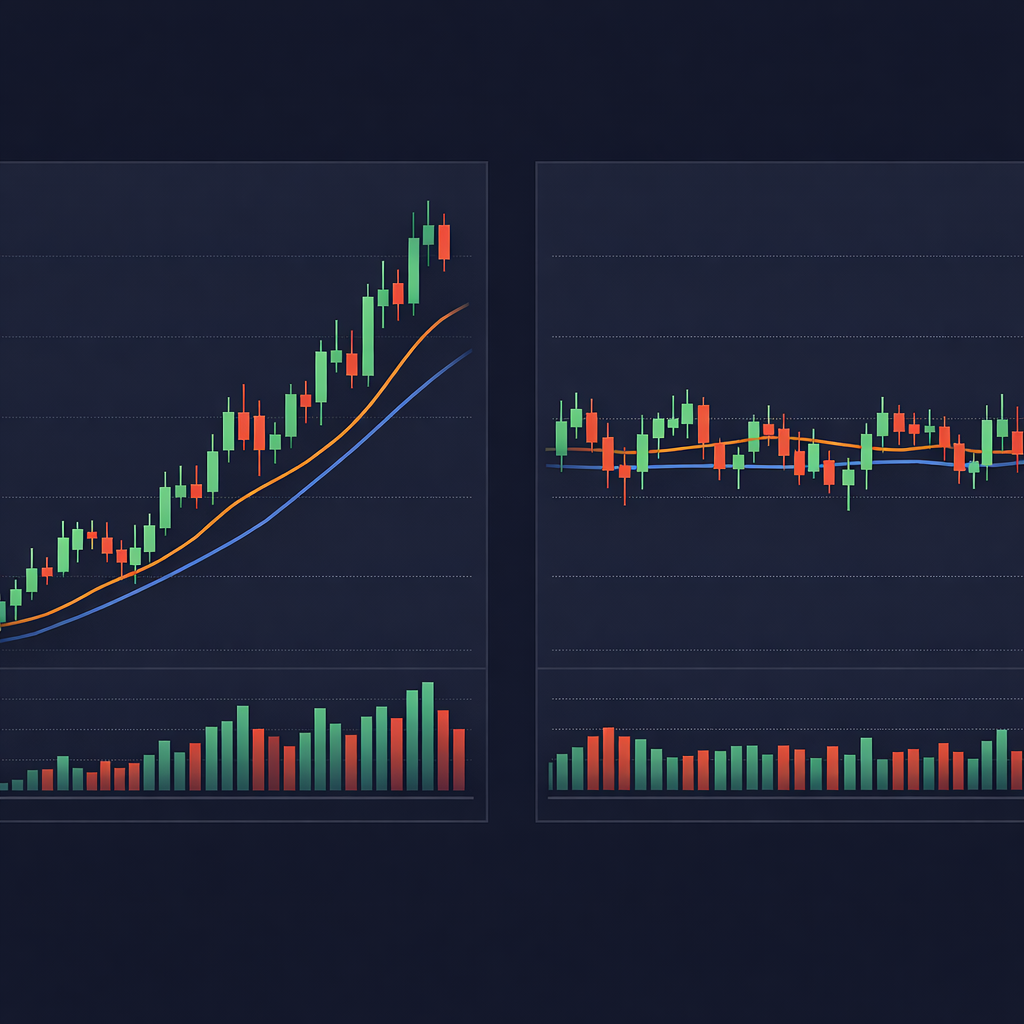
- Trending: Price above/below 50 EMA and making higher highs/lows (or lower highs/lows) on H1/H4.
- Ranging: Price crossing the 50 EMA frequently, with repeated rejections of the same support/resistance.
- News-volatility: One or more candles with unusually large range (e.g., 2× ATR) around CPI/FOMC/NFP.
Step-by-step: how to split your backtest sample
- Tag each trade with a regime label at entry.
- Calculate win rate and expectancy per regime.
- Compare average MAE in ranges vs trends.
- Decide whether you should filter trades (or size down) in the weak regime.
A realistic insight you might discover
Many momentum-style forex signals do well in London/NY overlap when EUR/USD is moving cleanly.
They underperform when EUR/USD is stuck near 1.0520 with DXY stable near 106.80.
Similarly, gold signals can shine when XAUUSD breaks $2665 and runs to $2685.
They struggle when gold is mean-reverting between $2648 and $2658.
What to do with this information (the pro move)
Don’t throw the provider away immediately.
Instead, create rules like:
- Trade full size only in trending regimes.
- Half size in ranges or require confirmation (e.g., break-and-retest).
- Avoid entries 2 minutes before high-impact news.
If you trade gold around news often, also read: how gold signals react to unexpected news events.
Spreads, Slippage, and Execution: The “Hidden Tax” That Destroys Signal Backtests
Execution is where retail backtests go to die.
Especially for gold, where a $0.80 spread can turn a clean 1R win into a scratch.
Where traders underestimate costs
- Assuming fixed spreads when spreads widen during NY open or news.
- Ignoring slippage on stop orders and fast markets.
- Not accounting for commissions on raw spread accounts.
- Testing limit fills unrealistically (assuming every touch fills perfectly).
Practical slippage assumptions (use these in your log)
These are not “rules.” They’re conservative testing inputs.
- Majors (EUR/USD, USD/JPY): 0.2–0.8 pips normal, 1.0–2.0 pips during spikes.
- GBP/USD: 0.4–1.2 pips normal, 1.5–3.0 pips during spikes.
- XAUUSD: $0.20–$0.80 normal, $1.00–$2.50 during spikes.
Gold example: how costs change the story
Signal: Buy XAUUSD 2651.00, SL 2639.00 (12), TP 2675.00 (24).
On paper, it’s a perfect 1:2.
If you assume $1.20 total friction on entry/exit, your effective R might drop by ~0.1–0.2R depending on fill and exit method.
Now imagine a strategy that averages only +0.2R expectancy.
Costs can push it negative.
Execution realism test: the “widen the spread” challenge
Take your backtest results and rerun the same sample with worse assumptions:
- Increase spreads by 30%.
- Add 1 pip slippage to forex stops.
- Add $0.80 slippage to gold stops.
If the edge disappears instantly, it’s fragile.
If it remains profitable (or at least positive expectancy), it’s likely robust.
Broker differences are real (and you must align them)
A provider may trade a raw-spread account with fast execution.
If you trade a wider-spread account, your results will diverge.
This is why serious traders backtest with their own broker’s typical costs.
Curve-Fitting Red Flags: How to Spot “Too Good to Be True” Signal Performance
Curve-fitting isn’t only an EA problem.
Signal providers can curve-fit manually too, by changing rules quietly or only showing the best periods.
Red flag #1: tiny stops on gold with huge win rates
If you see XAUUSD signals using $5–$7 stops consistently, be cautious.
At $2650, gold can move $5 in seconds around a data release.
A realistic gold stop for intraday trading is often $10–$25 from entry, depending on volatility and structure.
Red flag #2: performance that doesn’t change across regimes
If a provider claims the same win rate in trends, ranges, and news spikes, it’s suspicious.
Real strategies have “weather.”
Red flag #3: no losing streaks
Even excellent systems lose.
If a month of signals shows 2 losses total, demand a larger sample and execution proof.
Red flag #4: undefined entries (“market now”) without timestamp discipline
A message like “Buy gold now” without a clear level or time window is not auditable.
It allows the provider to claim the best possible fill after the fact.
Red flag #5: optimization disguised as “strategy evolution”
Strategies do evolve.
But if rules change every week, you can’t backtest it reliably.
How to counter curve-fitting with a robustness protocol
- Use out-of-sample periods: Test recent months you didn’t “watch live.”
- Randomize execution costs: Add variable slippage per trade.
- Check distribution: Look for a smooth spread of winners, not one jackpot trade.
- Demand clarity: Entry, SL, TP, and invalidation should be explicit.
When you want an example of structured, auditable signal formatting, compare against our public descriptions of forex signals and gold signals (clear Entry, SL, TP levels).
Turning Your Backtest Into a Go/No-Go Decision (Scorecard + Realistic Expectations)
A backtest isn’t a trophy.
It’s a decision tool that answers: Should I trade this live, demo it longer, or walk away?
Create a simple scorecard (0–2 points each)
- Rule clarity: Are entries and exits unambiguous?
- Expectancy after costs: Is it positive with conservative spreads/slippage?
- Drawdown: Is max drawdown survivable at 0.5–1.0% risk per trade?
- Regime stability: Does it hold up in both trends and ranges (or have clear filters)?
- Execution sensitivity: Does performance survive worse fills?
- Sample size: Do you have enough trades (ideally 100+)?
Interpretation:
- 10–12 points: Consider demo-to-live transition with small risk.
- 7–9 points: Demo trade longer, tighten assumptions, or reduce risk.
- 0–6 points: No-go until rules or evidence improves.
Set realistic expectations for signal performance
Even premium providers can’t win every week.
What you want is a repeatable process, disciplined risk, and an edge that survives costs.
A practical sizing example (so drawdown doesn’t break you)
Assume you risk 0.5% per trade.
If you hit a 7-loss streak (it happens), you’re down ~3.5% plus costs.
That’s recoverable without emotional damage.
If you risk 3% per trade, the same streak is ~21% down.
Most traders start making “revenge” decisions at that point.
Where United Kings fits in (and how to verify us)
United Kings is built for traders who want clear Entry, SL, TP signals and a community that trades primarily during London and NY sessions.
We also publish educational guidance alongside signals so you understand the “why,” not just the “what.”
If you want to explore what’s included, start here: United Kings signals overview and our community Telegram: United Kings Telegram channel.
FAQ: Backtesting Forex & XAUUSD Signals in MT5
1) How many trades do I need to backtest a signal provider?
Start with 50 trades to detect obvious issues.
Aim for 100–200 trades to evaluate expectancy, drawdown, and losing streaks with more confidence.
2) Can I backtest Telegram signals directly in MT5 Strategy Tester?
Not directly unless the signals follow rules you can code into an EA.
For most Telegram signals, the best approach is a manual MT5 backtest with a strict log and realistic execution assumptions.
3) What’s a good slippage assumption for XAUUSD backtests?
In normal liquidity, many traders assume $0.20–$0.80.
Around high-impact events, test with $1.00–$2.50 to see if the edge survives.
4) Is win rate the best way to judge signal quality?
No.
Use expectancy (in R), max drawdown, and regime stability.
A 55–60% win rate with +0.4R expectancy can outperform an 80% win rate system with occasional -6R losses.
5) What’s the biggest mistake traders make when backtesting signals?
Changing rules mid-backtest after seeing outcomes.
Lock your assumptions (costs, fills, management rules) before trade #1, and keep them consistent.
Risk Disclaimer (Read Before You Trade)
Forex and gold trading involves significant risk and may not be suitable for all investors. Past performance, backtests, and historical results do not guarantee future outcomes.
Spreads, slippage, liquidity, and news volatility can materially impact real results versus simulated testing.
If you’re a beginner, consider practicing on a demo account first and use strict risk controls (for example, risking 0.5%–1% per trade).
Ready to Trade Verified, Structured Signals? Join United Kings
If you want signals you can actually backtest and execute, we keep it simple: clear Entry, SL, TP levels, London/NY focus, and education alongside the trade.
We’re proud to support a community of 300K+ active traders and we aim for an 85%+ win rate with disciplined structure—while always emphasizing that results vary and risk is real.
Choose your plan (3 options)
- Starter (3 Months): $299 (~$100/mo)
- Best Value (1 Year): $599 ($50/mo) + FREE ebook (50% savings)
- Unlimited (Lifetime): $999 (pay once, access forever)
See full details and pick your plan here: United Kings pricing plans.
Want to see how we format signals and ask questions first? Join our Telegram: United Kings signals Telegram.
If you’re deciding between providers, also compare with our latest roundup: best forex signals (updated guide).
Bonus: We offer a 48-hour money-back guarantee so you can evaluate the service with confidence and clarity.