
Ever copied a forex trading signal that “should have worked,” only to watch your trade stop out while everyone else celebrates a win?
Most of the time, it’s not the signal. It’s the execution.
In today’s market—DXY around 106.80, EUR/USD near 1.0520, GBP/USD around 1.2680, USD/JPY at 149.50, and gold (XAUUSD) holding near $2650—small timing and sizing mistakes get punished quickly.
This guide is the professional playbook for forex signal execution. We’ll cover entries, position sizing, multiple take profits, trailing stops, and the execution errors that quietly destroy good strategies.
TL;DR: Professional Forex Signal Execution in 6 Rules
- Execute the signal like a process, not a guess: confirm symbol, session, spread, and news before clicking.
- Size the position first, not last: risk a fixed % (e.g., 0.5%–2%) based on stop-loss distance.
- Use the right order type: market orders for momentum; limit orders for pullbacks; stop orders for breakouts.
- Manage multiple TPs professionally: scale out, move SL to breakeven, and protect equity on TP1.
- Trailing stops should be rule-based: trail after structure breaks or after 1R, not because you “feel” like it.
- Track execution quality: slippage, missed entries, early exits, and overtrading are measurable and fixable.
What “Signal Execution” Really Means (And Why Pros Treat It Like a Skill)
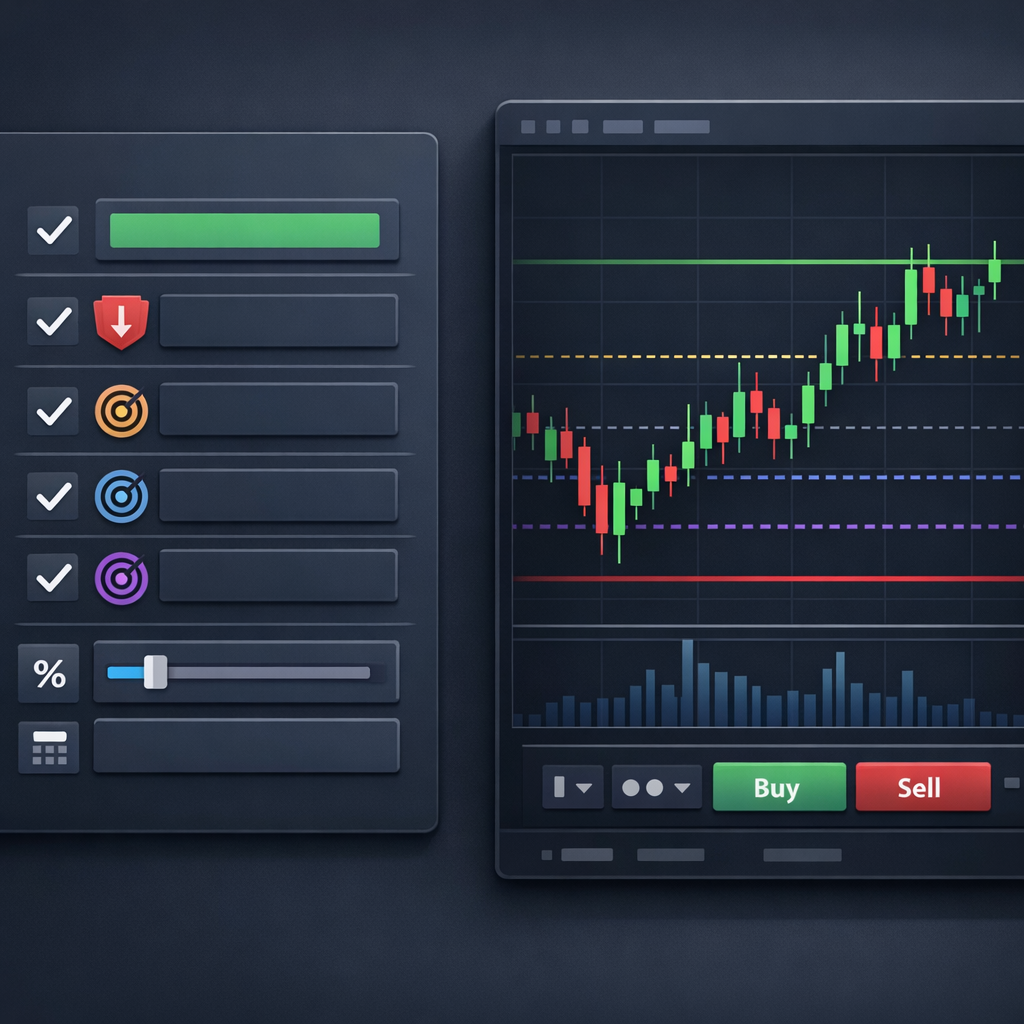
Most traders think signal execution is simply: “Signal posted → place trade.”
Professionals treat it differently. Execution is the set of decisions you make between seeing the signal and managing the position until it’s closed.
That includes entry timing, order type, position sizing, spread/slippage awareness, and trade management rules.
Two traders can copy the same EUR/USD sell signal at 1.0520 and get different outcomes.
Trader A enters late at 1.0512 due to hesitation, uses a bigger lot size to “make up for it,” and places the stop too tight.
Trader B executes immediately, sizes based on the stop distance, and manages TP1/TP2 with a plan.
Same signal. Different results.
In fast conditions—like when USD/JPY is hovering around 149.50 and reacting to rate expectations—execution errors become expensive.
Even gold at $2650 can move $10–$20 quickly during the London/NY overlap.
So the goal is not to “find perfect signals.” The goal is to become the trader who can execute any good signal consistently.
Why execution is the hidden edge in a signals-based strategy
Execution is where your real performance comes from, because it controls:
- Average entry price (late entries reduce edge).
- Average loss size (improper stops and oversizing inflate drawdowns).
- Average win size (taking profit too early kills expectancy).
- Win rate stability (inconsistent execution creates random results).
That’s why premium providers don’t just post entries. They teach execution habits.
At United Kings, our Telegram signals are structured with clear Entry, SL, and TP levels, designed for the London and New York sessions, and supported by education inside the community of 300K+ active traders.
If you’re new to the ecosystem, start by understanding what professional-grade signals look like on our forex signals page and how we structure setups across sessions.
Before You Enter: The 60-Second Pre-Trade Checklist Pros Never Skip
Professional execution starts before the entry.
You’re about to risk real money. A 60-second checklist prevents avoidable losses.
Most “bad trades” are simply trades taken under bad conditions: high spread, major news in 5 minutes, wrong symbol, or wrong order type.
The 60-second checklist (copy/paste this into your notes)
- 1) Symbol & quote check: Are you on EUR/USD (not EUR/JPY)? Is it the correct broker symbol (e.g., XAUUSD vs GOLD)?
- 2) Session check: Is this designed for London or NY? Liquidity matters for fills and follow-through.
- 3) Spread check: If spread is inflated, your entry and stop are effectively worse.
- 4) News check: Look 30–60 minutes ahead for high-impact events (CPI, NFP, FOMC, BOE).
- 5) Price location check: Is price still in the entry zone, or did it already run?
- 6) Risk check: Confirm the % you’ll risk and compute lot size from SL distance.
That’s it. One minute.
This checklist is especially important in the current environment where the dollar is firm (DXY 106.80), and majors can trend strongly and then snap back on headlines.
Real example: Gold execution with a spread trap
Let’s say a gold buy signal is posted near $2650 with SL $2638 (a $12 stop) and TP at $2674 (roughly 1:2 RR).
If your spread during a volatile moment widens from $0.30 to $1.20, you’re effectively entering worse and your stop is closer than you think.
Pros either wait for spread normalization or reduce size to compensate.
If you want a deeper guide on controlling downside while using signals, bookmark our resource on risk management strategies when using forex signals.
Choosing the Right Order Type: Market vs Limit vs Stop (And When Each Wins)
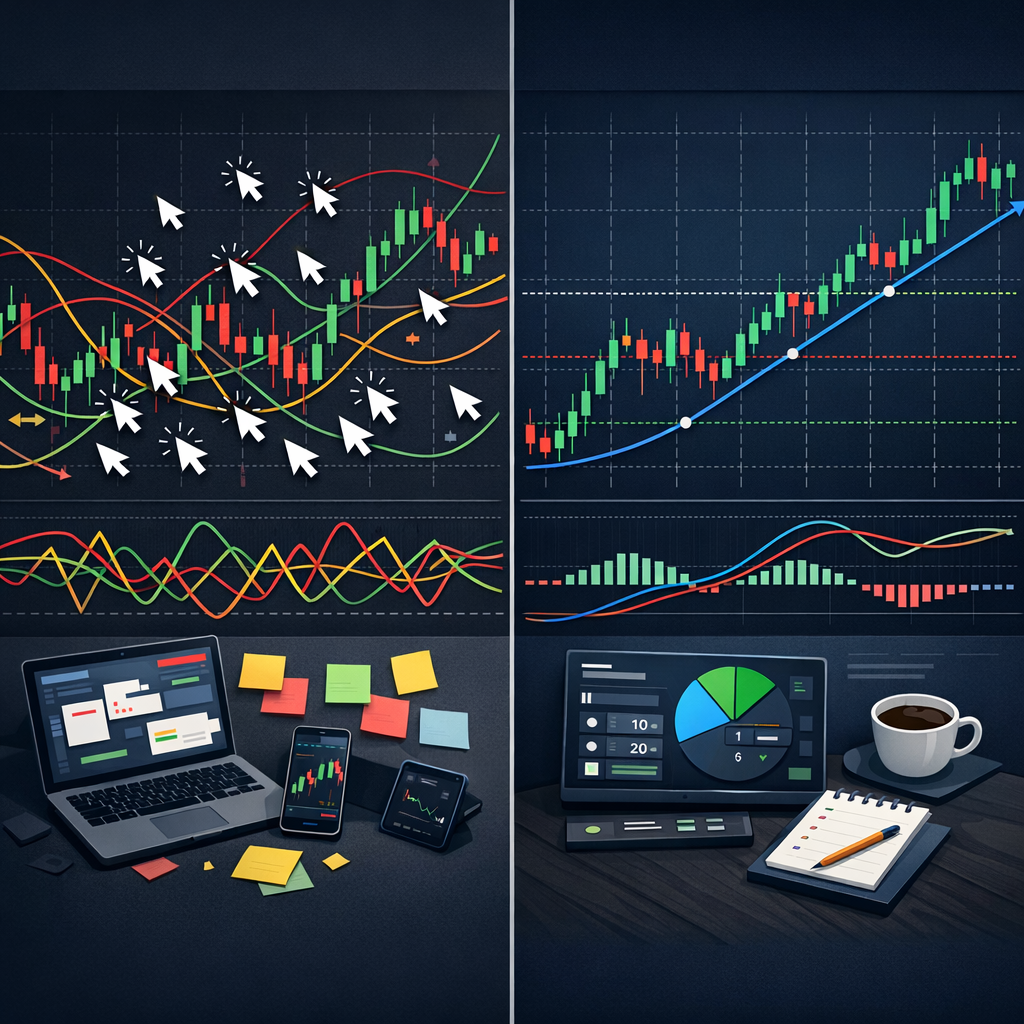
A common execution mistake is using the wrong order type.
Pros match the order type to the setup logic.
If the signal is momentum-based, a limit order can cause missed trades.
If the signal is pullback-based, a market order can give you a poor fill right before retracement.
Quick definitions (practical, not textbook)
- Market order: You enter now at the best available price. Best when the move is already starting.
- Limit order: You enter at a better price on a pullback. Best when the setup expects a retrace.
- Stop order: You enter only if price breaks a level. Best for breakouts and continuation patterns.
Comparison table: which order should you use to trade signals?
| Order Type | Best For | Main Advantage | Main Risk | Execution Tip |
|---|---|---|---|---|
| Market | Momentum entries, news continuation | You get in (no missed trade) | Slippage, worse fill in volatility | Use when price is within the entry zone and spread is normal |
| Limit | Pullbacks, retests, mean reversion | Better entry = smaller stop or higher RR | Missed fills if price runs without you | Place at a level, not “somewhere near” the level |
| Stop | Breakouts, range breaks, trend continuation | Confirms direction before entry | False breakouts and whipsaws | Put stop entry beyond structure, not directly on the line |
Signal execution example: EUR/USD trend continuation
EUR/USD is trading around 1.0520 while DXY stays firm at 106.80.
If the signal idea is “sell rallies” in a downtrend, a limit sell near a resistance zone (e.g., 1.0530–1.0540) often fits better than a market sell at 1.0520.
If the signal idea is “breakdown below support,” a sell stop below a key level (e.g., 1.0508) can confirm momentum.
Professional execution is simply aligning the order type with the setup’s logic.
Entry Timing: How Pros Avoid Late Entries, FOMO, and “Chasing” Signals
Late entries are one of the biggest silent killers in forex signal execution.
They reduce your reward-to-risk and increase the chance your stop gets hit by normal noise.
Professionals solve this with rules, not willpower.
The professional rule: define an “entry validity window”
Every signal should have an implicit or explicit validity window.
For example:
- Time validity: “Valid for the next 2 hours” (common in London/NY session trades).
- Price validity: “Valid only if price is within X pips of entry.”
If price runs 25–40 pips without you on GBP/USD, the trade’s profile changes.
Professionals do not “force” it. They wait for the next setup.
How to handle “price already moved” situations
Use one of these three pro responses:
- Plan A: Wait for pullback to the entry zone and use a limit order.
- Plan B: Reduce size if you must enter later, because your stop is effectively tighter.
- Plan C: Skip if RR drops below your minimum (many pros require at least 1:1.5 or 1:2).
Skipping is a skill. It’s not “missing money.” It’s avoiding negative expectancy.
Real scenario: GBP/USD chase vs planned entry
GBP/USD is around 1.2680.
You receive a buy signal at 1.2680 with SL 1.2645 (35 pips) and TP 1.2750 (70 pips), a clean 1:2 setup.
If you hesitate and enter at 1.2700, your stop is still 1.2645 (55 pips risk) but your TP is still 1.2750 (50 pips reward).
You turned a 1:2 trade into a sub-1:1 trade without realizing it.
Professional execution means you either wait for the pullback to 1.2680–1.2685 or you skip.
Position Sizing Like a Pro: The Exact Steps to Calculate Lots From SL
If you want to trade signals professionally, you must size positions from the stop-loss.
Not from your emotions. Not from your last win. Not from “I want $100 today.”
Position sizing is what keeps you in the game during normal losing streaks.
Step-by-step: the professional sizing method (fixed % risk)
- Step 1: Choose your risk per trade (commonly 0.5%–2%).
- Step 2: Measure stop distance in pips (forex) or dollars (gold).
- Step 3: Convert that stop distance into money per lot (depends on pair and account currency).
- Step 4: Lot size = (Risk $) / (Stop value per 1 lot).
This sounds technical, but it becomes automatic with repetition.
It also makes your results stable across pairs.
Example 1: EUR/USD position sizing (simple illustration)
Account balance: $5,000. Risk per trade: 1% ($50).
Signal: Sell EUR/USD at 1.0520, SL at 1.0550 (30 pips).
If 1 standard lot ≈ $10 per pip on EUR/USD, then 30 pips risk = $300 per lot.
Lot size = $50 / $300 = 0.17 lots (rounded).
That’s professional sizing: the stop defines the lot size.
Example 2: Gold (XAUUSD) sizing with realistic SL distance
Gold is around $2650.
Signal: Buy XAUUSD at $2650, SL $2638 (risk $12), TP $2674 (reward $24, 1:2).
If your broker’s gold contract is $1 move = $1 per 0.01 lot (varies), your platform will show the exact value.
The professional approach is the same: risk $ amount fixed, then calculate lot size to match a $12 stop.
Beginners often do the opposite: they choose a lot size first, then “hope” the SL holds.
When trading multiple signals: reduce risk, don’t stack it blindly
If you take EUR/USD and GBP/USD trades at the same time, you’re often doubling exposure to USD.
Pros manage correlation by reducing risk per trade when positions overlap.
For example, instead of risking 1% on each, risk 0.5% on each when both depend on USD weakness/strength.
This is one reason our community emphasizes structured risk education alongside signals on United Kings signals.
Managing Multiple Take Profits (TP1/TP2/TP3) Without Overcomplicating It
Multiple take profits are a professional tool, but only if you manage them with rules.
Without rules, scaling out becomes random and you end up taking profit too early.
The goal is simple: reduce risk early, then let winners run.
A clean, professional TP framework (works for most signal styles)
- TP1: Usually at 1R (same distance as SL). Purpose: pay yourself and reduce pressure.
- TP2: Usually at 2R. Purpose: capture the “expected” move.
- TP3: Optional runner for 3R+ when trend conditions support it.
R means your initial risk.
If your SL is 30 pips, then 1R = 30 pips, 2R = 60 pips, and so on.
Step-by-step: how to execute partial closes on MetaTrader (conceptually)
- Step 1: Split your position into multiple orders (e.g., three 0.10 lots instead of one 0.30 lot).
- Step 2: Assign TP1 to the first, TP2 to the second, TP3 to the third.
- Step 3: When TP1 hits, consider moving SL to breakeven (or to a structure level).
- Step 4: Let TP2/TP3 run without emotional interference.
This method is cleaner than trying to partial close a single order under stress.
Gold example with multiple TPs (realistic levels)
Gold is trading near $2650.
Buy at $2650, SL $2638 (risk $12).
- TP1: $2662 (+$12, 1R)
- TP2: $2674 (+$24, 2R)
- TP3: $2686 (+$36, 3R)
If TP1 hits during NY session momentum, you’ve reduced pressure and can manage the rest like a pro.
If price reverses after TP1, you often still walk away with a green trade or a small win.
The mistake to avoid: moving TP closer because you’re afraid
Many traders cut TP2 from 2R to 1.2R because they “don’t want it to reverse.”
That turns a profitable strategy into a mediocre one over time.
Professional execution respects the plan unless market structure changes materially.
Trailing Stops That Actually Make Sense: Structure-Based vs “Random” Trailing
Trailing stops are powerful, but most traders misuse them.
They trail too early, get stopped out by normal pullbacks, then watch price hit TP without them.
Professional trailing is rule-based and tied to structure.
Two trailing stop methods professionals use
- Method 1: 1R then trail — once price reaches 1R, move SL to breakeven or -0.2R, then trail after new highs/lows form.
- Method 2: Structure trail — move SL behind the last swing low (for buys) or swing high (for sells) after a break-and-retest.
Both methods avoid the “tight trail” problem.
USD/JPY example: why structure trailing matters
USD/JPY at 149.50 often reacts sharply to bond yields and BOJ headlines.
If you trail by a fixed 10 pips, you’ll get stopped out constantly.
A better approach is to trail behind structure, such as the last 15-minute swing low after continuation.
That keeps you in the trade during normal volatility.
Gold example: trailing after a clean push
Assume XAUUSD buys from $2650 push to $2662 (TP1).
After TP1, you move SL from $2638 to $2650 (breakeven).
If price then forms a higher low at $2656 and breaks $2665, you can trail SL to $2655–$2656.
This is not random. It’s based on visible structure.
Managing the Trade After Entry: Alerts, Adjustments, and When to Do Nothing
After you enter, your job is not to “babysit” every tick.
Your job is to manage risk, follow your plan, and avoid emotional interference.
Professionals rely on alerts and predefined actions.
Step-by-step: a professional post-entry routine
- Step 1: Immediately confirm SL and TP are placed correctly.
- Step 2: Set price alerts at key levels (entry, TP1, structure points).
- Step 3: Reduce screen time unless volatility demands attention.
- Step 4: Only adjust SL if your rules say so (e.g., after TP1 or after structure break).
When “do nothing” is the best execution decision
Many traders ruin trades by interfering during normal pullbacks.
For example, EUR/USD might sell from 1.0520 and pull back to 1.0526 before dropping to 1.0460 later.
If your SL is at 1.0550, that pullback is noise.
Professionals expect noise. They sized the trade to survive it.
When you should consider an adjustment
- Spread widens abnormally around rollover or news.
- Market structure breaks against you (not just a wick).
- High-impact news is imminent and you’re in profit with no protection.
If you want to understand how signals behave during surprises, read how gold signals react to unexpected news events (the principles apply to forex too).
Common Execution Mistakes (That Make Good Signals Look “Bad”)
Let’s call out the mistakes directly.
These are the patterns we see repeatedly from traders who say, “Signals don’t work.”
In most cases, the issue is execution inconsistency.
Mistake 1: Entering outside the zone
If a signal is designed for 1.0520–1.0530 and you enter at 1.0542, you’re trading a different setup.
Your stop and target no longer match the original risk profile.
Mistake 2: Changing the stop loss because it “feels too big”
Stops are placed where the setup is invalidated.
Cutting the SL from 30 pips to 15 pips without changing the strategy usually increases stop-outs.
Mistake 3: Overleveraging after a win
After a strong win on GBP/USD, traders often double size on the next trade.
That’s not confidence. That’s revenge trading in disguise.
Mistake 4: Taking profit too early
Closing at +10 pips on a trade designed for +60 pips destroys expectancy.
You’ll need an unrealistic win rate to stay profitable.
Mistake 5: Trading every signal on every pair
More trades is not more money.
More trades is often more correlation, more spread paid, and more emotional fatigue.
Professionals focus on the best sessions and the cleanest setups.
Mistake 6: Ignoring the platform mechanics (slippage, requotes, execution mode)
Execution quality depends on your broker, account type, and market conditions.
During volatility, a market order can fill worse than expected.
Pros account for this by reducing size, using limit orders where appropriate, and avoiding entries seconds before major data.
Step-by-Step: A Professional “Signal to Trade” Workflow You Can Copy Today
This is the practical workflow we want you to internalize.
It’s designed to be repeatable, even when you’re busy or emotional.
Save this section and treat it like your execution SOP (standard operating procedure).
Step 1: Read the signal like a pilot reads a checklist
- Pair and direction (e.g., EUR/USD sell).
- Entry (single price or zone).
- Stop loss level.
- Take profits (TP1/TP2/TP3 if provided).
- Any notes (session, confirmation, “wait for retest,” etc.).
Step 2: Check market context in 30 seconds
- DXY strength/weakness (currently around 106.80).
- Key pair levels (EUR/USD 1.0520, GBP/USD 1.2680, USD/JPY 149.50).
- Gold sentiment (XAUUSD $2650, mild positive 24h change).
- Upcoming news within 60 minutes.
Step 3: Choose the order type that matches the signal logic
- Momentum → market order (if within zone).
- Pullback → limit order (at the level).
- Breakout → stop order (beyond structure).
Step 4: Calculate position size from SL (non-negotiable)
Decide risk % first. Then compute lots.
If you don’t know your pip value, use your platform’s built-in calculator.
Step 5: Place the trade with SL and TPs immediately
Pros don’t enter and “add the stop later.”
That’s how accounts blow up during sudden spikes.
Step 6: Manage using rules (TP1 → protect, TP2 → execute, TP3 → trail)
- At TP1: consider breakeven or structure-based SL move.
- At TP2: take profit as planned.
- For runners: trail behind structure, not by emotion.
Step 7: Log execution quality, not just win/loss
Write down:
- Did you enter on time?
- Did you follow sizing rules?
- Did you move SL/TP without a rule?
- Was there slippage or spread issues?
This is how you improve fast.
How to Execute Signals Across Forex, Gold, and Crypto (Without Mixing Rules)
Many traders in our community trade more than one market.
That’s fine, but execution rules must adapt to each instrument’s behavior.
Forex majors, gold, and crypto move differently, especially around sessions and news.
Forex majors: cleaner structure, tighter spreads (most of the time)
EUR/USD and GBP/USD often respect technical levels well during London and NY.
Execution is usually about timing and not chasing.
Stops are typically measured in pips and placed beyond structure.
Gold (XAUUSD): faster spikes, bigger intraday ranges
Gold around $2650 can move $20 during a strong NY push.
That means your SL needs breathing room, often $10–$25 depending on setup.
It also means you must be more careful with market orders during fast candles.
If gold is your main focus, explore how we structure gold signals and how execution differs from majors.
Crypto: 24/7 markets and weekend risk
Crypto trades continuously, and spreads can widen during low-liquidity periods.
Execution must account for weekend volatility and sudden liquidations.
If you’re diversifying, keep crypto risk smaller until you’ve built consistent execution habits.
See our approach to risk-aware diversification on crypto signals.
The key rule: don’t copy-paste the same stop logic everywhere
A 20-pip stop might be normal on EUR/USD.
A $2 stop on gold is often too tight in current volatility.
Execution is instrument-specific, even if the signal format looks identical.
Execution Psychology: Staying Mechanical When P&L Starts Talking
You can know every execution rule and still break them when emotions hit.
That’s why professionals build systems that reduce decision-making under stress.
The goal is to be mechanical when your P&L starts talking to you.
The three emotional phases that ruin signal execution
- Before entry: hesitation, overthinking, fear of loss.
- During drawdown: moving SL, closing early, adding to losers.
- During profit: taking profit too early, trailing too tight, “protecting” too soon.
Professional fixes that actually work
- Pre-commitment: decide your risk, SL, and TP rules before entry.
- Reduce screen time: use alerts instead of staring at every candle.
- Standardize risk: fixed % risk makes losses feel normal, not personal.
- Use split orders: TP1/TP2/TP3 reduces the urge to micromanage.
A story you’ll recognize
A trader enters a clean EUR/USD sell at 1.0520.
Price moves against them to 1.0531, still far from the 1.0550 SL.
They panic, close for -11 pips, and minutes later price drops to 1.0480.
The signal “failed” in their mind, but execution failed in reality.
Professional execution accepts that trades breathe.
How United Kings Helps You Execute Signals Better (Not Just Receive Them)
Signals are only valuable if you can execute them consistently.
That’s why the best providers don’t act like “tipsters.” They act like a trading desk with structure.
United Kings is built around that philosophy.
What you get with United Kings signals
- Premium Telegram signals with clear Entry, SL, and TP levels.
- A community of 300K+ active traders sharing execution feedback and learning.
- A performance-driven approach targeting an 85%+ win rate (with the required reminder: results vary and depend on execution and market conditions).
- Focus on London and New York session opportunities where liquidity supports clean moves.
- Educational content to help you improve execution, not just copy trades.
- A 48-hour money-back guarantee so you can evaluate the service with confidence.
Where to start (recommended path)
- Explore the full ecosystem on our United Kings homepage.
- Review how our service is structured on the signals page.
- If you’re newer to Telegram-based trading, read our guide on Forex signals on Telegram for beginners.
- Join the live community and see how we communicate execution in real time via United Kings Telegram channel.
Pricing plans (3 options depending on your horizon)
- Starter (3 Months): $299 (~$100/mo)
- Best Value (1 Year): $599 ($50/mo) with 50% savings + FREE ebook
- Unlimited (Lifetime): $999 pay once, access forever
You can review and choose your plan on our pricing section.
FAQ: Forex Signal Execution (Professional Answers)
1) What is forex signal execution?
Forex signal execution is the full process of placing and managing a trade from a signal: selecting the correct order type, entering on time, sizing from the stop loss, and managing TP/SL according to rules.
2) Should I use market or limit orders when trading signals?
Use market orders for momentum setups when price is within the entry zone and spreads are normal. Use limit orders for pullback setups where the edge comes from a better entry. Use stop orders for breakouts to confirm direction.
3) How much should I risk per signal?
Many professional traders risk 0.5% to 2% per trade depending on experience and drawdown tolerance. Beginners should start smaller and practice on demo first, then scale slowly.
4) How do I manage multiple take profits without getting confused?
Split your position into 2–3 smaller orders, each with its own TP. A common structure is TP1 at 1R, TP2 at 2R, and TP3 as a runner with a structure-based trailing stop.
5) Why do I lose even when the signal “wins” for others?
Usually because of late entries, wrong order type, incorrect lot sizing, spread/slippage, or emotional interference like closing early or moving stop loss. Improving execution consistency often fixes this quickly.
Risk Disclaimer (Read Before You Trade)
Forex, gold (XAUUSD), and crypto trading involves significant risk and may not be suitable for all investors. You can lose some or all of your capital. Signals and examples provided are for educational purposes and do not constitute financial advice. Past performance does not guarantee future results. Always use stop losses, practice on a demo account if you are a beginner, and risk only what you can afford to lose.
Final CTA: Execute Like a Pro—With a Team Behind You
If you’ve been blaming signals, it’s time to upgrade what actually moves the needle: execution.
When you combine disciplined execution with a structured signal feed, your results become more consistent and your stress drops.
Join the United Kings community to get premium forex and gold setups with clear Entry, SL, and TP levels, plus execution guidance built for London and NY sessions.
- Join United Kings on Telegram and follow live signals
- Explore our premium forex signals
- See our gold (XAUUSD) signals approach
- Choose a plan: 3 Months ($299), 1 Year ($599), or Lifetime ($999)
Your next step is simple: stop trading signals like a gambler, and start executing them like a professional.