
You got a forex signal. The entry looks clean, the stop loss is defined, and the take profits are mapped out.
But here’s the uncomfortable truth: most traders don’t lose because the signal was “bad.” They lose because they executed it like an amateur—late entries, wrong lot sizes, moving stops emotionally, or closing too early.
This guide is about forex signal execution—the practical, step-by-step process of turning a signal into a professionally managed trade, in real market conditions like we’re seeing now (DXY ~106.80, EUR/USD ~1.0520, GBP/USD ~1.2680, USD/JPY ~149.50, and gold around $2650).
TL;DR: Professional Signal Execution in 60 Seconds
- Confirm the “type” of signal (market, limit, stop) and execute it the way it was designed—don’t improvise.
- Position size comes from your stop loss, not your feelings: risk a fixed % (often 0.5%–2%) and calculate lots from pip/point distance.
- Entry timing matters: during London/NY liquidity you get cleaner fills and fewer “random” spikes.
- Manage multiple take-profits like a pro: scale out, reduce risk, and let runners work with structure.
- Trailing stops are a tool, not a panic button: trail after structure breaks, not after every candle.
- Most execution mistakes are predictable: chasing price, widening SL, revenge re-entry, and ignoring spreads/news.
What “Forex Signal Execution” Actually Means (and Why It’s 80% of Results)
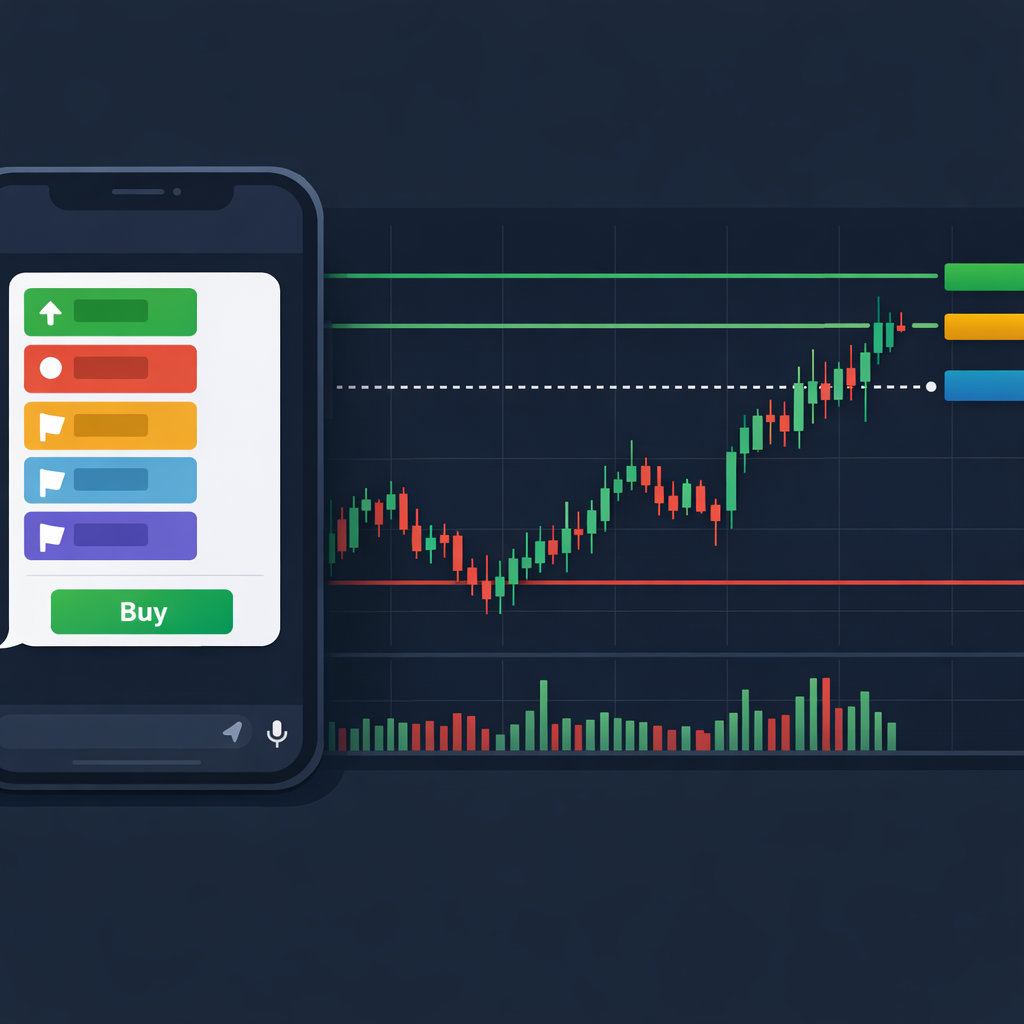
When traders ask “how to trade signals,” they often mean: “Where do I click buy or sell?”
Professional execution is different. It’s a repeatable workflow that protects you from the two killers of signal performance: slippage and behavior.
Execution is the bridge between a good idea and a real fill
A signal is a plan: entry, stop loss (SL), and take profit (TP). Execution is how you translate that plan into your broker’s reality—spread, volatility, your account size, and your platform’s order types.
In today’s conditions, with DXY holding around 106.80 and USD/JPY near 149.50, intraday volatility can expand quickly during US data. That means your fill quality matters more than usual.
Why two traders can take the same signal and get different outcomes
Trader A enters exactly at 1.0520 on EUR/USD with a 20-pip stop and a 1:2 target. Trader B hesitates, enters 12 pips late, keeps the same stop, and now the trade has a worse reward-to-risk ratio.
Even if price hits the original TP, Trader B’s profit is smaller. If price tags the stop first, Trader B loses the same as Trader A—or more if they sized incorrectly.
The professional mindset: “Process first, outcome second”
Professionals don’t judge a trade by whether it won. They judge it by whether it was executed correctly.
That’s also why a premium provider should deliver clear Entry, SL, and TP levels. At United Kings, our Telegram signals are designed to be executed systematically, not guessed.
If you want to see how our approach is structured across markets, start with our main signals hub: United Kings Signals.
Signal Types and Order Types: Market vs Limit vs Stop (Don’t Mix Them Up)
Most execution errors begin with a simple misunderstanding: the trader receives a signal, then uses the wrong order type.
A “Buy Limit” executed as a market order is no longer the same trade. The entry logic changes, the stop distance changes, and the probability profile changes.
The three signal types you’ll see most often
- Market execution: “Buy now” or “Sell now.” The edge is immediacy and momentum capture.
- Limit execution: “Buy Limit 1.0520” (entry below current price) or “Sell Limit 1.2680” (entry above current price). The edge is better price and reduced drawdown.
- Stop execution: “Buy Stop above resistance” or “Sell Stop below support.” The edge is confirmation and breakout continuation.
Why limit entries feel ‘hard’ (but are often superior)
Limit orders test your patience. Price may come close and then run without you.
Professionals accept that missing a trade is part of the model. If you chase, you convert a high-quality limit setup into a low-quality market chase.
Comparison table: order types and when to use them
| Signal / Order Type | Best For | Main Advantage | Main Risk | Execution Tip |
|---|---|---|---|---|
| Market | Momentum, news follow-through | Fast entry, less missed moves | Spread/slippage, emotional entries | Use during London/NY liquidity; avoid thin hours |
| Limit | Pullbacks, mean reversion, retests | Better price, tighter SL potential | Missed fills, partial fills | Place order immediately; don’t “wait for one more pip” |
| Stop | Breakouts, continuation after consolidation | Confirmation-based entries | False breakouts, stop hunts | Place beyond structure; size for wider SL if needed |
Real market examples using today’s levels
EUR/USD at 1.0520: If price is pulling back into a prior demand zone, a Buy Limit at 1.0520 makes sense. If price is already trading 1.0532, buying market is a different trade.
USD/JPY at 149.50: In a strong USD environment (DXY ~106.80), a Buy Stop above 149.80 might be a breakout continuation idea. But if spreads are wide or liquidity is thin, execution quality drops.
Step-by-Step: The Professional Signal Execution Checklist (Before You Place Any Trade)
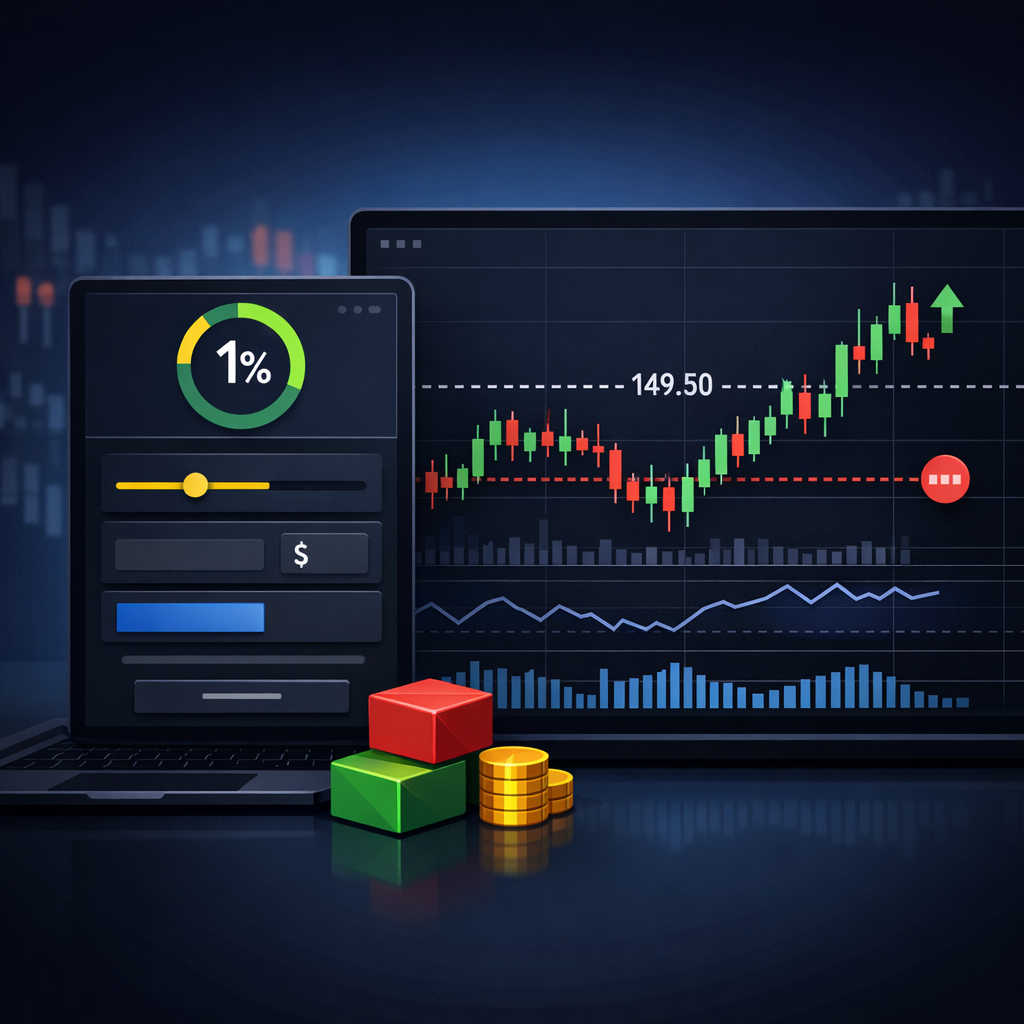
Professionals don’t “feel” their way into trades. They use a checklist.
This is the fastest way to reduce mistakes when you’re executing forex trading signals in real time, especially when your phone is buzzing and candles are moving fast.
Step 1: Identify the instrument and session context
Ask: are we in London, New York, or the dead zone between sessions?
EUR/USD and GBP/USD typically execute best during London and NY overlap. USD/JPY can move sharply during US data, and also during Asia, but spreads and “spiky” behavior can differ by broker.
Step 2: Confirm the signal format
- Entry price (or entry zone)
- Stop loss price (not “mental”)
- TP1, TP2, TP3 (or a single TP)
- Any notes: “wait for candle close,” “break and retest,” “scalp,” “swing”
Step 3: Check spread and execution conditions
If EUR/USD spread is typically 0.8–1.2 pips on your broker but suddenly it’s 2.5–3.0 pips, your entry is effectively worse.
That doesn’t always mean “don’t trade.” It means adjust expectations and avoid tight stops that can be hit by spread noise.
Step 4: Calculate position size from SL distance
This is where most signal followers fail. They pick a lot size first, then “hope.”
Professionals pick risk first (e.g., 1% of account), then compute lot size so the SL equals that risk.
For a deeper risk framework, keep our dedicated guide bookmarked: risk management strategies when using forex signals.
Step 5: Place the order exactly as designed
If it’s a limit signal, place a pending order immediately. If it’s a market signal, execute without “waiting for a better price” unless the provider explicitly allows an entry range.
Step 6: Set SL and TPs at placement (not later)
Set SL and TP in the same action. If you “plan” to set it after entry, you’ll eventually forget once—and that one time can be expensive.
Step 7: Screenshot and journal the execution
Pros track execution error. If you entered 6 pips late, record it. Over 50 trades, you’ll see whether execution is costing you more than the strategy itself.
Position Sizing Like a Pro: The Math Behind Consistent Results
If you want to execute signals professionally, position sizing is non-negotiable.
It’s the difference between a controlled 1% loss and a chaotic 6% loss because you “felt confident.”
Pick a fixed risk per trade (start conservative)
Many disciplined signal traders use 0.5% to 2% per trade depending on experience, drawdown tolerance, and how many trades they may hold simultaneously.
If you’re new, 0.5%–1% is usually enough to build consistency without emotional overload.
Position sizing formula (forex pairs)
Lot size ≈ (Account Risk in $) ÷ (Stop Loss in pips × Pip Value per lot).
Example: $2,000 account, risk 1% = $20. EUR/USD trade with 20-pip SL. Pip value on 1.00 standard lot ≈ $10/pip.
- Risk per pip on 1 lot = $10
- 20 pips would risk $200 on 1 lot
- To risk $20, you need 0.10 lots
Position sizing example using current market levels
EUR/USD at 1.0520: Suppose a signal says Buy 1.0520, SL 1.0500 (20 pips), TP 1.0560 (40 pips).
On a $5,000 account risking 1% ($50), your lot size would be roughly $50 ÷ (20 × $10) = 0.25 lots.
If you instead “round up” to 0.50 lots, you just doubled your risk to ~2% without meaning to.
How to size when you have multiple open trades
Professionals think in terms of total exposure, not single trades.
If you’re holding EUR/USD and GBP/USD simultaneously, your USD exposure might overlap. If DXY spikes from 106.80 to 107.20 on a surprise data release, both positions can be hit together.
- Rule of thumb: cap total open risk (e.g., 2%–4% across all trades).
- Reduce risk per trade when stacking correlated pairs.
Gold sizing note (because many signal traders also trade XAUUSD)
Gold at ~$2650 can move $10–$25 quickly during New York.
If a gold signal uses a $15 stop (e.g., Buy 2650, SL 2635), your lot size must reflect how your broker values XAUUSD per $1 move. This varies by contract specification.
That’s why execution pros always check the instrument’s contract size in MT4/MT5 before “copying” someone else’s lot size.
If you want gold-specific signals with clear levels built for London/NY execution, see: United Kings Gold Signals.
Entry Timing: How Professionals Avoid Late Entries and Bad Fills
Most traders think the entry is a single price. Professionals treat entry as a process.
When volatility is elevated—like when DXY is firm and markets are sensitive to rate expectations—price can jump 10–30 pips in seconds on majors. If you’re late, you’re not executing the signal anymore.
Three entry timing rules that protect signal performance
- Rule 1: Respect the entry window. If a signal is designed for 1.0520 and price is now 1.0540, the risk-reward is different.
- Rule 2: Don’t enter during spread spikes. News minutes, session opens, and low-liquidity moments can widen spreads.
- Rule 3: Use pending orders when the plan is price-specific. If a signal is a limit, place it and let the market come to you.
How to handle “price already moved” situations
This is where discipline separates pros from gamblers.
If you missed the entry by a small amount (say 3–5 pips on EUR/USD), execution may still be acceptable if the stop and target remain logical. If you missed by 10–20 pips, you’re often better skipping or waiting for a retest.
Example: GBP/USD around 1.2680
Imagine a Sell Limit at 1.2680 with SL at 1.2710 (30 pips) and TP at 1.2620 (60 pips). That’s 1:2.
If you chase at 1.2662 instead, your stop might still be 1.2710 (48 pips). Now your 60-pip target is barely 1:1.25. That’s not the same trade.
Example: XAUUSD around $2650 (execution reality)
Gold can print $3–$6 candles quickly. If a signal says Buy 2650 with SL 2638 and TP 2674 (risk $12, reward $24 = 1:2), but you enter at 2656, your risk becomes $18 for the same TP. Your R:R collapses.
Pro tip: pre-build templates in MT4/MT5
Create order templates with default SL/TP fields and risk calculator scripts. The goal is to reduce “typing under pressure,” which is where execution errors happen.
Managing Multiple Take Profits: TP1, TP2, TP3 Without Confusion
Multiple take-profits are one of the simplest ways to trade signals like a professional—because they solve a real psychological problem.
Most traders close too early because they want to “lock something.” Scaling out lets you lock something while still giving the trade room to perform.
Why multiple TPs exist in the first place
Markets don’t move in straight lines. EUR/USD can rally from 1.0520 to 1.0560, pull back to 1.0540, then continue to 1.0600.
If you close everything at the first target, you miss the trend leg. If you hold everything for TP3, you may psychologically crack during pullbacks.
Three common scaling models (choose one and stick to it)
- Model A: 50/30/20 — close 50% at TP1, 30% at TP2, 20% at TP3.
- Model B: 33/33/34 — equal partials, simple and consistent.
- Model C: 70/20/10 — aggressive de-risking for newer traders.
Step-by-step: executing a 3-TP signal
- Enter with full planned position size (based on SL risk).
- Set TP1, TP2, TP3 levels immediately (or use partial close orders if your platform supports it).
- When TP1 hits, close the planned portion.
- After TP1, reduce risk: either move SL to break-even (BE) or to a structure level.
- Let the remaining position run to TP2/TP3 with rules, not emotions.
Example: EUR/USD signal with scaling
Buy 1.0520, SL 1.0500 (20 pips). TP1 1.0540 (20 pips), TP2 1.0560 (40 pips), TP3 1.0580 (60 pips).
If you use Model A (50/30/20):
- At TP1, you bank partial profit and reduce stress.
- At TP2, you bank more and now the runner is “house money” psychologically.
- At TP3, you get paid for patience.
Common mistake: moving TP closer because you “see a wick”
One wick is not a reversal. Professionals use structure: prior highs/lows, session levels, and clean invalidation points.
If you want to build stronger execution habits around Telegram-based trading, our beginner-friendly walkthrough is useful even for intermediates: forex signals Telegram execution guide.
Stop Loss Management: Break-Even, Structure Stops, and When NOT to Touch SL
Stop loss management is where traders either become consistent—or become emotional.
The goal is simple: protect capital without choking the trade.
Three stop-loss styles used by professionals
- Fixed SL (hands-off): you set it and don’t touch it until TP or SL hits.
- Break-even SL: after price reaches a milestone (often TP1), you move SL to entry.
- Structure-based trailing: you move SL behind swing highs/lows or key levels.
The break-even trap (and how to avoid it)
Moving to break-even too early feels safe. But it often converts winners into scratch trades.
On GBP/USD, a normal pullback can be 15–25 pips even in a clean trend. If you move SL to BE after +10 pips, you’ll get stopped out repeatedly.
Rule-based BE approach (practical and repeatable)
- Only move to BE after price closes beyond a structure level (not just touches).
- Or move to BE after TP1 is secured (if the signal uses scaling).
- Or move SL to reduce risk (e.g., from -1R to -0.3R) instead of full BE.
Gold example with realistic distances
XAUUSD at ~$2650 can spike $8–$12 on a single NY candle.
If you Buy 2650, SL 2638, TP1 2674 (1:2), moving SL to 2650 after price hits 2656 is usually premature. A normal dip can tag you out before continuation.
A more professional approach is: secure partial at TP1, then trail under a clear higher low (for example, 2660 if structure supports it).
When you should not touch SL
- When you’re bored. Boredom is not a market signal.
- When the trade is near entry. Let it breathe; the setup needs space.
- When you’re trying to “avoid being wrong.” That’s ego management, not risk management.
Trailing Stops Done Right: How Pros Lock Profit Without Getting Wicked Out
Trailing stops are powerful, but most retail traders use them like a panic response.
Professionals trail based on market structure and volatility, not fear.
Two trailing methods that work in real execution
- Structure trail: move SL behind the last swing low (for buys) or swing high (for sells).
- ATR/volatility trail: trail by a multiple of average true range so normal noise doesn’t stop you out.
Step-by-step: structure trailing on EUR/USD
- Enter Buy at 1.0520 with SL 1.0500.
- Price pushes to 1.0560 and prints a higher low at 1.0542.
- After confirmation (candle close), move SL from 1.0500 to 1.0540 (below the higher low).
- Now you’re protected, but not overly tight.
Step-by-step: volatility trailing on gold (XAUUSD)
Gold at $2650 often has larger “noise” than majors. A $4 trail can be too tight.
If your average 15-minute range is $6, a professional trail might be $8–$12 depending on the setup. That keeps you in the trade while still locking profit as it trends.
The #1 trailing stop mistake: trailing too early
Trailing is most effective after the trade proves itself—after a breakout holds, after a retest, or after TP1.
Trailing from the first green candle is how you turn a strategy into death by a thousand wicks.
How to decide: fixed TP vs trailing runner
If the signal is designed with a fixed TP (based on a clear resistance/support), respect it.
If the signal includes a “runner” concept, trail the final portion only. That way you bank structured profits and still participate if a trend extends.
Execution Mistakes That Destroy Good Signals (and How to Fix Each One)
Let’s be blunt: most losses blamed on “bad signals” are execution errors.
Here are the most common ones I’ve seen over 16+ years, plus the fix you can implement today.
Mistake 1: Chasing price after missing entry
You see EUR/USD moving and you feel urgency. You buy 10–20 pips late.
Fix: define a maximum entry deviation (e.g., 3–5 pips for majors, larger for gold). If missed, wait for retest or skip.
Mistake 2: Using the same lot size on every trade
A 15-pip SL and a 45-pip SL cannot use the same lot size if your risk is consistent.
Fix: size from SL distance every time. No exceptions.
Mistake 3: Widening the stop loss
This is the fastest way to blow an account. It turns a planned 1R loss into a 2R–4R loss.
Fix: your SL is your invalidation. If it’s hit, the idea is wrong or the timing is wrong. Exit and reassess.
Mistake 4: Closing early because you “don’t want to lose profit”
You take +8 pips on a trade designed for +40 pips. Over time, expectancy collapses.
Fix: use partials. Let TP1 pay you, let the runner pay you big.
Mistake 5: Trading during red-folder news without a plan
Spreads widen, slippage increases, and stops get tagged in chaos.
Fix: know your calendar and your provider’s rules. If you want to understand how signals behave in surprise volatility, read: how signals react to unexpected news events.
Mistake 6: Overlapping correlated trades
Long EUR/USD and long GBP/USD is often a double bet against USD. If DXY spikes, both can lose together.
Fix: cap total USD exposure and reduce risk when stacking correlated positions.
Mistake 7: Re-entering immediately after a stop-out
That’s revenge trading disguised as “confidence.”
Fix: require a new trigger (fresh signal, new structure, or session reset). No impulse re-entries.
How to Execute Signals Across Forex vs Gold: What Changes (and What Doesn’t)
If you trade both forex pairs and XAUUSD, you already know they “feel” different.
Professionals don’t rely on feel. They adapt execution rules to the instrument’s volatility, spread behavior, and session personality.
What stays the same
- Risk-first sizing: your lot size is always derived from SL distance and chosen risk %.
- Respect the signal design: limit vs market vs stop matters everywhere.
- Journal execution error: late entries and manual mistakes show up in every market.
What changes on gold (XAUUSD) around $2650
Gold’s intraday swings are larger, and it can “fake” direction more aggressively—especially around US data.
Stops are often $10–$25 from entry for intraday signals. A $12 stop on gold is not “tight” the way a 12-pip stop can be on EUR/USD.
What changes on USD/JPY around 149.50
JPY pairs can trend strongly and then snap back quickly. Execution needs respect for volatility spikes.
Also, some brokers widen spreads noticeably on JPY pairs during transitions between sessions. That can turn a clean stop into a spread stop.
Practical execution framework by instrument
- EUR/USD (1.0520 area): tighter spreads, cleaner technical behavior; execution precision matters (pips add up).
- GBP/USD (1.2680 area): more volatile than EUR/USD; give trades more breathing room and avoid over-tight BE moves.
- USD/JPY (149.50 area): watch news sensitivity and session transitions; avoid impulsive chasing.
- XAUUSD (~$2650): size carefully, accept wider stops, and manage partials to reduce emotional pressure.
If you want a single place to access both forex and gold setups with clear execution notes, explore: United Kings Forex Signals and United Kings Gold Signals.
Step-by-Step Trade Management Workflow (From Alert to Exit)
Let’s turn everything into a single workflow you can follow every time.
This is how professional signal followers manage trades without second-guessing every candle.
Phase 1: When the signal arrives
- Read the full signal (Entry/SL/TPs + notes).
- Check current price vs entry (are you within acceptable deviation?).
- Check spread and session liquidity.
- Calculate lot size from SL distance and risk %.
- Place order (pending or market) with SL and TP attached.
Phase 2: After entry (first 5–15 minutes)
- Do nothing unless the setup is invalidated.
- Don’t move SL because of “noise.”
- If spreads normalize after entry, don’t retroactively panic.
Phase 3: At TP1 (or first milestone)
- Take partial profit if the plan includes it.
- Reduce risk: move SL to BE or to a structure level (rule-based).
- Decide management style for the remainder: fixed TP2/TP3 or trailing runner.
Phase 4: During pullbacks
Pullbacks are where discipline is tested.
If your SL is structure-based and still valid, you hold. If the market breaks structure, you exit. No “maybe.”
Phase 5: Exit and review
- Record entry accuracy (pips late/early).
- Record whether you followed the plan.
- Note any platform issues (slippage, requotes, spread spikes).
This is also why a real community helps. When you’re executing in real time, having thousands of traders seeing the same structure reduces impulsive decisions.
United Kings has 300K+ active traders in the community, and we focus heavily on London and New York session execution where fills are typically cleaner.
Choosing a Signal Provider vs Copying Random Trades: The Execution Difference
Execution gets easier when the signal is engineered for execution.
Execution gets harder when the “signal” is vague, late, or missing key levels.
What professional-grade signals include
- Exact entry (or a defined entry zone)
- Clear stop loss (price level, not “tight SL”)
- Multiple take profits or a clear exit plan
- Context notes (session, setup type, conditions)
- Updates when management changes (e.g., “SL to BE after TP1”)
Red flags that create execution chaos
- “Buy now” with no SL
- Editing signals after the fact
- Posting entries after the move already happened
- Encouraging martingale or revenge re-entries
- Sharing lot sizes instead of risk-based sizing guidance
How United Kings is built for execution
We focus on premium Telegram signals for forex and gold with clear Entry, SL, and TP levels, designed around the most liquid times of day.
Our goal is not to overwhelm you with noise. It’s to give you actionable setups you can execute with discipline.
If you’re evaluating providers, our checklist-style resource helps you compare objectively: forex signals provider checklist.
Where to start if you want curated signals + education
Explore the ecosystem from the top: UnitedKings.net, then choose your market focus via forex signals or gold signals.
And if you want the community feed where signals are delivered, join our Telegram: United Kings Telegram signals channel.
Putting It All Together: A Realistic Execution Scenario (London + NY)
Let’s walk through a realistic scenario using current market context.
This is the kind of “day in the life” execution story that shows you where mistakes happen—and how pros avoid them.
Scenario A: EUR/USD intraday signal during London
Market context: EUR/USD is trading around 1.0520 with DXY firm near 106.80. Volatility is moderate, but liquidity is strong in London.
Signal example:
- Buy Limit: 1.0520
- SL: 1.0500 (20 pips)
- TP1: 1.0540
- TP2: 1.0560
- TP3: 1.0580
Professional execution:
- You place the Buy Limit immediately. No waiting for 1.0518 “to be perfect.”
- You size at 1% risk. Your SL is fixed and accepted.
- When TP1 hits, you close partial and reduce risk (BE or structure).
- You let TP2/TP3 play out without micro-managing every tick.
Scenario B: Gold (XAUUSD) signal during New York volatility
Market context: Gold is around $2650, up about +0.35% on the day. NY session can bring fast $10–$20 swings.
Signal example:
- Buy: 2650
- SL: 2638 (risk $12)
- TP: 2674 (reward $24 = 1:2)
- Extended TP: 2686 (reward $36 = 1:3) for a runner portion
Professional execution:
- You check spread before entry because gold spreads can widen during data.
- You don’t move SL to BE after +$4. You wait for structure confirmation.
- If TP1 is hit, you secure partial and then manage the runner with a structure trail.
The key lesson
In both scenarios, the professional isn’t doing anything magical.
They’re simply executing the plan with consistency—especially when emotions try to take over.
FAQ: Forex Signal Execution (Professional Answers)
1) What’s the best way to execute forex trading signals: market or limit?
It depends on the setup. If the signal is designed as a pullback entry, use a limit. If it’s momentum-based, market execution may be appropriate. The key is: don’t change the order type unless the provider explicitly allows it.
2) How late is “too late” to enter a signal?
For majors like EUR/USD, being 3–5 pips late might still be workable if the SL/TP logic holds. Being 10–20 pips late often breaks the intended risk-reward. For gold near $2650, acceptable deviation can be wider, but the same principle applies: late entries reduce expectancy.
3) Should I move my stop loss to break-even every time?
No. Moving to BE too early is a common reason traders underperform. A better rule is to move to BE after TP1 or after a confirmed structure shift, not after a small favorable move.
4) How do I manage multiple take profits if my platform doesn’t support partial closes easily?
You can split your position into multiple smaller trades (e.g., three orders of equal size) and assign different TP levels to each. That mimics scaling out and keeps execution clean.
5) Can I copy the same lot size the signal provider uses?
You shouldn’t. Lot size must be based on your account size, risk tolerance, and broker contract specs. Copying lots is one of the fastest ways to accidentally over-leverage.
Risk Disclaimer (Read This Before You Trade)
Forex and gold trading involves significant risk and may not be suitable for all investors. You can lose some or all of your capital. Signals and educational content are provided for informational purposes only and do not constitute financial advice.
Past performance does not guarantee future results. Always use stop losses, apply disciplined position sizing, and consider practicing on a demo account before trading live—especially if you are a beginner.
Join United Kings: Execute Signals With Clarity, Community, and Structure
If you’re serious about improving your forex signal execution, you need two things: high-quality signals and a professional execution process.
United Kings delivers premium Telegram signals for forex and gold with clear Entry, SL, and TP levels, plus educational guidance to help you execute like a pro. We’re proud to support a community of 300K+ active traders focused on London and New York session opportunities.
Choose your plan (3 options)
- Starter: 3 Months – $299 (~$100/mo)
- Best Value: 1 Year – $599 ($50/mo, 50% savings) + FREE ebook
- Unlimited: Lifetime – $999 (pay once, access forever)
See all options on our pricing section: United Kings pricing plans.
Ready to receive signals and execute them with confidence? Join our Telegram now: United Kings premium signals on Telegram.
If you have questions before joining, you can also reach us via contact United Kings support or learn more about who we are on our About page.