
Ever copied a forex signal perfectly… and still lost money?
Not because the signal was “bad,” but because execution was late, sizing was off, or you managed the trade emotionally.
That’s the uncomfortable truth: signal quality matters, but forex signal execution is what separates consistent followers from the crowd that churns accounts.
In today’s market context—DXY around 106.80, EUR/USD near 1.0520, GBP/USD around 1.2680, USD/JPY near 149.50, and gold (XAUUSD) trading near $2650—volatility can be “quiet for hours” and then spike 30–80 pips on a single data headline.
If you want to trade like a professional, you need a repeatable process that works in calm conditions and during fast moves.
TL;DR: Professional forex signal execution in 6 bullets
- Confirm the signal type (market, limit, stop) and match it to the current spread/volatility before placing anything.
- Size by risk (e.g., 0.5%–1% per trade), not by “lot size you feel comfortable with.”
- Use a pre-entry checklist: session timing, news risk, spread, and whether price is within the entry zone.
- Manage multiple take-profits (TP1/TP2/TP3) with partial closes and a plan for moving stop loss to breakeven.
- Trail stops with rules (structure-based or ATR-based), not random “protect profit” impulses.
- Avoid execution killers: chasing, widening stops, overtrading, and ignoring correlated exposure (e.g., USD risk across pairs).
We’ll walk through the exact workflow pros use to execute signals with discipline, including entry timing, position sizing, managing multiple TPs, trailing stops, and the most common execution mistakes.
If you’re also looking for high-quality setups with clear Entry/SL/TP, explore our premium services at United Kings Signals and our dedicated Forex Signals page.
1) What “executing a signal professionally” actually means
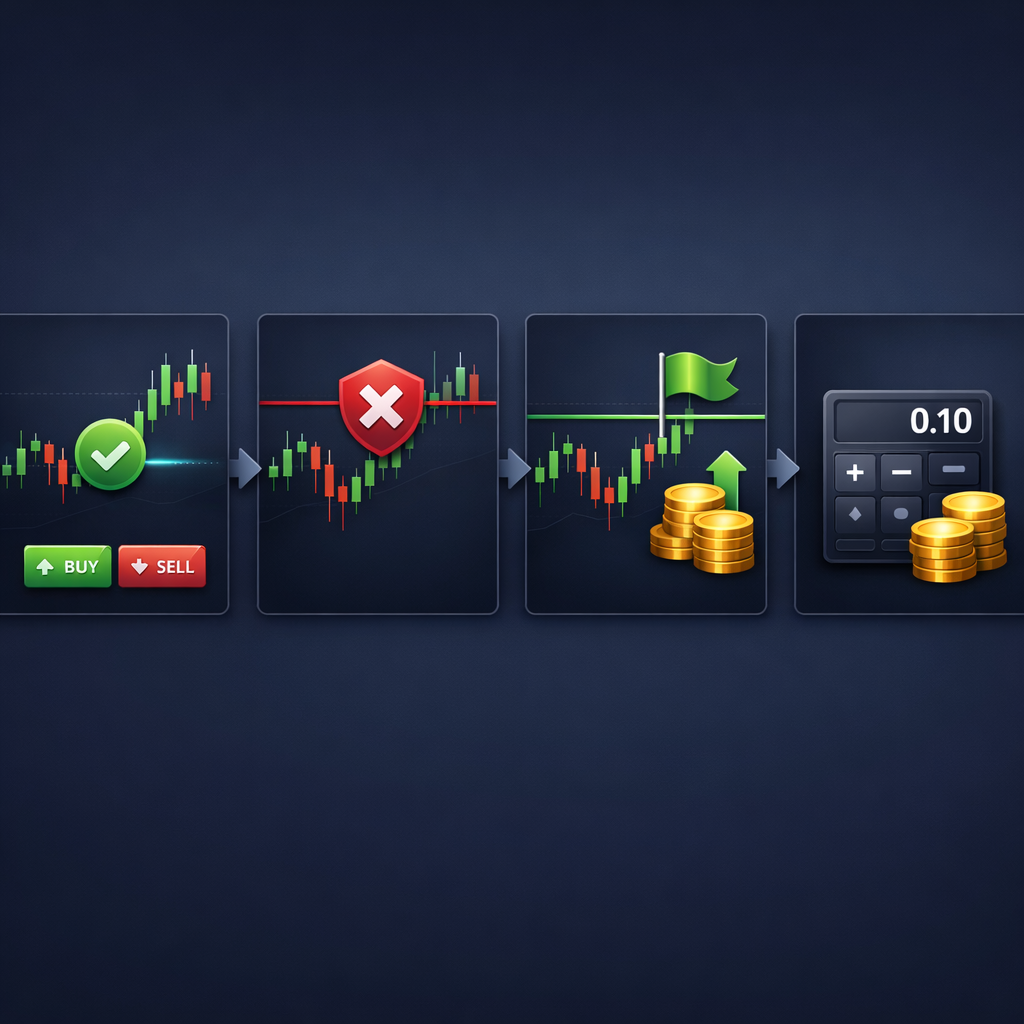
Most traders think execution is just pressing Buy or Sell.
Professionals treat execution as a system: preparation, order placement, risk control, and management rules that reduce human error.
When you follow a signal, you’re outsourcing analysis, not responsibility.
You still own the parts that decide your outcome: entry quality, slippage control, sizing, and how you manage the trade once price starts moving.
Professional execution has four pillars
- Precision: entering inside the intended zone, not after the move is already done.
- Consistency: the same risk model and trade management rules every time.
- Speed with control: fast enough to avoid missing the setup, but never rushed.
- Account protection: your downside is predefined and non-negotiable.
Here’s a simple example using current market levels.
Say you receive a EUR/USD buy signal near 1.0520 with SL at 1.0480 (40 pips) and TP at 1.0600 (80 pips), a clean 1:2 risk-reward.
If you enter at 1.0550 because you were late, your risk becomes 70 pips and your reward becomes 50 pips.
Same signal, totally different trade.
Why this matters more in 2026-style conditions
With DXY elevated around 106.80 and USD/JPY hovering near 149.50, the market is sensitive to rate expectations, bond yields, and sudden risk-off bursts.
That means spreads can widen around news, stop runs happen more often, and “good signals” can fail if you execute them like a hobbyist.
Professional execution is not about being perfect.
It’s about being repeatable—so your results reflect the strategy, not your mood.
2) Understand signal formats (and why most followers misread them)
Before you worry about entries and trailing stops, you need to correctly interpret the signal.
Misreading format is one of the fastest ways to sabotage a trade.
The three common order types in signals
- Market execution: “Buy now” or “Sell now.” You enter immediately at best available price.
- Limit order: “Buy limit at 1.0505” (price must dip to fill). This is for pullbacks.
- Stop order: “Buy stop at 1.0555” (price must break higher to fill). This is for breakouts.
Professional traders match the order type to market conditions.
In a choppy range, limits can be superior.
In a trending session (often London/NY overlap), stop orders can capture momentum cleanly.
Execution zone vs. “one exact price”
Many signals are designed with an entry zone, not a single pip-perfect number.
For example: “GBP/USD Sell 1.2680–1.2690, SL 1.2720, TP1 1.2640, TP2 1.2600.”
If you sell at 1.2662 because you panicked, you’re outside the intended zone and your stop distance changes.
Multiple TPs are not “optional decoration”
When a signal includes TP1/TP2/TP3, it’s giving you a trade management model.
Pros don’t randomly pick one TP based on greed.
They distribute exits to reduce variance and lock progress.
Common format confusion that costs money
- Confusing buy limit with buy stop: you place the wrong pending order and get filled in the worst spot.
- Ignoring “wait for retest”: you enter on the first spike and get wicked out.
- Not accounting for spread: your stop is “hit” on the platform even though the chart looks safe.
If you’re new, build a habit: read the signal twice, then place it.
And if you want a structured beginner-friendly breakdown of Telegram execution, pair this guide with our Forex Signals Telegram beginner guide.
3) The professional pre-trade checklist (the part most traders skip)

Professionals don’t execute signals from emotion.
They execute from a checklist.
Your checklist is what protects you on the days you’re tired, distracted, or trying to “make back” a loss.
Your 60-second execution checklist
- Session check: Are we in London, New York, or the overlap? Liquidity changes execution quality.
- News check: Any high-impact events in the next 30–60 minutes? (CPI, NFP, FOMC, BOE, ECB.)
- Spread check: Is spread normal? If EUR/USD is usually 0.8–1.2 pips and you see 2.5+, pause.
- Entry proximity: Are you inside the entry zone, or already late?
- Stop distance: Does the SL make sense relative to recent volatility?
- Correlations: Are you already exposed to USD in other positions?
In the current context, USD strength (DXY 106.80) can make EUR/USD and GBP/USD more sensitive to sudden dollar bids.
That’s why correlation awareness matters.
If you’re long EUR/USD and long GBP/USD at the same time, you’re effectively short USD twice.
“Am I late?” is the most important question
Late entries are the #1 reason signal followers underperform the signal provider’s track record.
Here’s a practical rule.
If price has moved more than 25%–35% of the SL distance away from the intended entry, you’re usually late.
Example: Signal SL is 40 pips.
If you’re 12–14 pips worse than the planned entry, your risk-reward is already damaged.
When skipping a signal is professional
Pros skip trades for three reasons.
- Spread is abnormal: execution cost is too high.
- News is imminent: the market becomes a coin flip.
- You’re overexposed: too many positions tied to the same driver.
Skipping is not fear.
Skipping is risk management.
If you want a dedicated framework for protecting your account while following signals, keep our risk management guide for signal users bookmarked.
4) Entry timing: how pros avoid chasing and still don’t miss trades
Entry timing is where most signal followers turn a good setup into a mediocre one.
Professionals solve this with structure: zones, triggers, and order selection.
Market order vs. pending order: a quick comparison
| Method | Best for | Main advantage | Main risk |
|---|---|---|---|
| Market execution | Fast momentum, breakout continuation | You’re in immediately | Slippage, worse entry if you hesitate |
| Limit order | Pullbacks, mean reversion, retests | Better price, improved R:R | May not fill, or fills during a deeper dip |
| Stop order | Breakouts with confirmation | Filters weak setups | False breakouts, spike fills |
Step-by-step: executing a signal entry like a pro
- Mark the entry zone on your chart (even if you don’t “do analysis”).
- Check spread and volatility in that moment.
- Choose the right order type: market if you must be in now, limit if pullback is expected, stop if breakout confirmation is required.
- Set SL and TP at the same time (no naked entries).
- Confirm lot size matches your risk model before you click Place.
Realistic execution examples using current levels
EUR/USD example: Price is 1.0520.
A signal says: “Buy 1.0515–1.0525, SL 1.0485, TP1 1.0560, TP2 1.0600.”
Professional execution: if price is 1.0522 with normal spread, you can market buy inside the zone.
If price is 1.0532, you’re outside the zone.
Pros either wait for a pullback limit at 1.0520–1.0525 or skip.
USD/JPY example: Price is 149.50.
A breakout signal might say: “Buy stop 149.70, SL 149.20, TP 150.70.”
Pros don’t pre-empt it at 149.50 “because it’s going up.”
They let the stop order confirm momentum, then manage the position.
The anti-chase rule
If you feel urgency, you’re probably chasing.
Professionals replace urgency with automation: pending orders, alerts, and predefined rules.
When your process is clean, your emotions have less room to interfere.
5) Position sizing for signal followers (the math that keeps you alive)
Most traders blow accounts with “good signals” because they size trades like gamblers.
Professional signal execution starts with one question: How much am I willing to lose if I’m wrong?
The professional baseline: risk per trade
Many disciplined traders risk 0.5% to 1% per trade.
Aggressive traders might go 1.5%–2%, but that’s usually for experienced operators with tight controls.
If you’re following signals, especially on Telegram, start smaller.
Your edge improves as your execution becomes consistent.
Step-by-step position sizing (simple and repeatable)
- Pick risk % (example: 1%).
- Calculate risk money: Account × risk %.
- Measure stop distance (in pips for FX).
- Compute lot size using your broker’s pip value (or a position size calculator).
Practical example: EUR/USD sizing
Account: $2,000.
Risk: 1% = $20.
Stop: 40 pips.
On EUR/USD, 0.01 lot is roughly $0.10/pip (varies by broker/account currency).
If $0.10/pip, then 40 pips risk = $4 per 0.01 lot.
$20 / $4 = 5 micro-lots = 0.05 lot.
That’s professional: your risk is controlled regardless of how confident you feel.
Practical example: GBP/USD sizing
GBP/USD near 1.2680 can move sharply in London.
Assume SL is 50 pips and you still risk $20.
If 0.01 lot ≈ $0.10/pip, then 50 pips risk = $5 per 0.01 lot.
$20 / $5 = 4 micro-lots = 0.04 lot.
Gold (XAUUSD) note: different contract sizing
Gold is not “pips like EUR/USD.”
On many brokers, 0.01 lot on XAUUSD can equal 1 oz, and a $1 move may equal $1 profit/loss.
So if you buy XAUUSD at $2650 with a $15 stop (SL at $2635), your risk per 0.01 lot could be about $15.
If your risk budget is $30, that’s about 0.02 lot.
Always verify your broker’s contract specs.
The “multiple trades” trap
Signal followers often take 3–5 trades at once.
If each is 2% risk, you can be down 10% in a bad hour.
Pros cap total open risk (for example, 2%–4% total across all open trades).
6) Managing multiple take profits (TP1/TP2/TP3) like institutions do
Multiple take profits are one of the most underused tools in signal execution.
They reduce the emotional pressure to “call the exact top” and help you stay in winners longer.
Professionals think in distributions, not single outcomes.
Why partial profits work psychologically and mathematically
Psychologically, TP1 pays you for being right.
That reduces the urge to micromanage.
Mathematically, partials can lower variance while still letting you capture big moves.
A clean TP model you can apply to most signals
- TP1: Close 30%–50% at 1R (equal to your stop size).
- TP2: Close 30%–40% at 2R.
- TP3: Let the remaining 10%–30% run with a trailing stop.
“R” is your risk unit.
If your stop is 40 pips, then 1R = 40 pips.
Example: EUR/USD with multiple TPs
Entry 1.0520, SL 1.0480 (40 pips risk).
TP1 at 1.0560 (40 pips = 1R).
TP2 at 1.0600 (80 pips = 2R).
Execution plan:
- At TP1: close 40% and move SL to breakeven (or to -10 pips if spread is an issue).
- At TP2: close another 40% and trail the rest under higher lows.
- Runner: aim for 1.0620–1.0650 if structure supports it, without forcing it.
Example: Gold (XAUUSD) with realistic levels and R:R
Gold is around $2650.
Signal: Buy $2648, SL $2633 (risk $15).
1:2 target = $2648 + $30 = $2678.
1:3 target = $2648 + $45 = $2693 (slightly above our guideline range, so you could cap TP3 around $2688–$2690 depending on liquidity and resistance).
A professional management plan:
- TP1 at $2663 (1R): take 40%, reduce stress.
- TP2 at $2678 (2R): take 40%, now you’re paid.
- TP3 at $2688–$2690: trail the remainder with structure or a volatility stop.
The biggest TP mistake: moving the goalposts
Followers often cancel TP2 because “it’s going to the moon.”
Then price reverses and they end up with nothing but regret.
Pros adjust targets only if market structure changes, not because of excitement.
If you want dedicated XAUUSD trade management and entries built around London/NY conditions, explore United Kings Gold Signals.
7) Trailing stops: how to protect profit without getting stopped too early
Trailing stops are powerful.
They’re also one of the easiest ways to ruin a good signal if you trail too tight.
Professional trailing is rule-based.
Two trailing stop methods professionals actually use
- Structure-based trailing: move SL below higher lows (for buys) or above lower highs (for sells).
- Volatility-based trailing: trail by ATR or a fixed multiple of average candle range.
Structure-based trailing (best for clean trends)
Let’s say GBP/USD sells from 1.2680 and drops to 1.2640 (TP1).
Price then forms a lower high at 1.2660 and continues down.
A professional might trail SL above that lower high, maybe 1.2665–1.2670, depending on spread and noise.
This gives the trade room to breathe while protecting profit.
Volatility-based trailing (best for noisy markets)
When USD/JPY is near 149.50, it can whip 20–40 pips quickly.
Trailing too close is basically volunteering to get stopped.
A simple volatility rule is: after TP1, trail at 1.5× ATR(14) on your trading timeframe.
If ATR is 18 pips, your trail distance is 27 pips.
That’s often enough to avoid random spikes.
Step-by-step: a trailing stop workflow that avoids chaos
- Do not trail before TP1 unless the signal explicitly says so.
- At TP1: reduce risk (partial close + SL to breakeven or improved SL).
- After TP2: trail using one method only (structure or volatility), not both.
- Never widen the stop once you’ve tightened it.
The “breakeven too early” problem
Moving SL to breakeven immediately after entry feels safe.
But it often guarantees death by noise.
Professionals earn breakeven by waiting for a meaningful move: TP1, a structure break, or a volatility expansion in their favor.
8) Executing signals across sessions: London, New York, and the overlap
Session timing is not a “nice to know.”
It’s part of execution.
The same signal can behave very differently depending on whether liquidity is high or thin.
How sessions change execution quality
- Asian session: often range-bound for EUR/USD and GBP/USD, with occasional JPY bursts.
- London session: strong volume and directional moves, especially on EUR and GBP pairs.
- New York session: follow-through or reversal depending on US data and risk sentiment.
- London–NY overlap: typically the highest liquidity window; many “clean” signal hits happen here.
United Kings focuses heavily on London and New York session trading because that’s where spreads are often tighter and moves are more decisive.
That doesn’t mean every trade wins.
It means the environment is more favorable for precise execution.
Practical session example with current levels
EUR/USD at 1.0520 during early Asia might drift 15–25 pips and do nothing.
The same pair during London can move 60–90 pips if EUR data or USD flows hit the tape.
If your signal is designed for London momentum and you execute it in low liquidity, you may get chopped out.
Gold session behavior (XAUUSD)
Gold at $2650 can be deceptively calm, then explode during US data.
Even a “normal” $10–$25 stop can be threatened if you enter right before a high-impact event.
Execution rule: if a major US release is within 15 minutes, professionals either reduce size, widen structure-based stops (only if the plan allows), or wait for the post-news candle to settle.
How to build a session-based execution habit
- Take signals mainly during the sessions the provider targets.
- Avoid “revenge trades” in dead hours.
- Use alerts and pending orders so you’re not staring at charts all day.
For deeper timing logic, you can browse more education in our United Kings blog and match your schedule to the session style you trade best.
9) Managing slippage, spreads, and broker execution (the hidden costs)
Two traders can follow the same signal and get different results.
The difference is often not skill.
It’s execution quality: spreads, slippage, and order handling.
Spreads: the “silent tax” on every signal
Spread is the difference between bid and ask.
If EUR/USD spread is 1.2 pips and your target is 20 pips, you’re giving up 6% of the move just to get in and out.
On a scalpy signal, that’s huge.
Slippage: why market orders can fill worse than expected
Slippage happens when price moves between your click and the broker fill.
It’s common around news or during fast breakouts.
On USD/JPY near 149.50, a 5–12 pip slippage event is not rare during sudden yield spikes.
Professional tactics to reduce execution costs
- Prefer pending orders when the signal allows (limits/stops).
- Avoid trading major news minutes unless the signal is explicitly news-based.
- Use a reputable broker with consistent spreads and fast execution.
- Don’t place stops “too obvious” in extremely tight ranges; allow for normal noise.
Stop placement: don’t “optimize” the signal into failure
A classic mistake is tightening the SL because it “looks too big.”
If the signal’s SL is based on structure, tightening it turns a high-probability setup into a coin flip.
Professional rule: if you don’t understand why the SL is there, you don’t have permission to move it.
When spreads widen: what pros do
If you see spread widening unexpectedly, professionals don’t panic-close.
They check whether it’s a temporary liquidity event (rollover, session change) or news-driven.
If it’s temporary, they avoid new entries and let the trade plan work.
10) Common execution mistakes (and the professional fix for each)
If you want to improve fast, stop looking for “better signals.”
Start eliminating execution mistakes that leak money.
Mistake #1: Entering late because you waited for “confirmation”
Confirmation after the move is often just chasing.
Fix: use pending orders at the zone, or set alerts and execute immediately when price enters the zone.
Mistake #2: Changing SL or TP mid-trade without a rule
This is emotional trading dressed as strategy.
Fix: predefine your only allowed adjustments (e.g., SL to BE at TP1, trail after TP2).
Mistake #3: Overleveraging because “the win rate is high”
Even an 85% win rate can experience losing streaks.
Fix: cap risk per trade and cap total open risk.
Mistake #4: Taking every signal without considering correlation
Three USD trades can equal one giant USD bet.
Fix: treat correlated trades as one exposure and reduce size across the basket.
Mistake #5: Moving to breakeven too early
You get “right,” then get stopped, then watch it hit TP without you.
Fix: move to breakeven only after structure confirms or after TP1.
Mistake #6: Not journaling execution
You can’t fix what you don’t measure.
Fix: track entry quality (pips from zone), whether you followed the plan, and whether spread/news affected the trade.
If you’re choosing a provider and want a due-diligence framework, use our forex signals provider checklist alongside this execution guide.
11) A complete step-by-step execution workflow (copy/paste process)
This is the “professional operating system” you can run daily.
It’s designed for signal followers who want consistency more than excitement.
Step 1: Set your daily risk limits
- Risk per trade: 0.5%–1% (beginners lean 0.5%).
- Total open risk cap: 2%–4%.
- Daily max loss: 2R–3R (if hit, stop trading).
Step 2: Prepare your platform
- One-click trading enabled (optional, only if you’re disciplined).
- Lot size calculator ready.
- Templates with ATR and session separators (optional).
Step 3: When a signal arrives, run the 60-second checklist
- Session.
- News in next 60 minutes.
- Spread normal?
- Price inside entry zone?
- Stop distance acceptable for your risk?
- Correlation exposure acceptable?
Step 4: Place the trade correctly
- Use the correct order type (market/limit/stop).
- Set SL and TP immediately.
- Confirm lot size equals your risk money.
Step 5: Manage the trade by milestones
- Before TP1: no emotional stop moves.
- At TP1: partial close + SL adjustment (breakeven or improved).
- At TP2: partial close + trailing stop rules.
- After TP2: let the runner breathe; don’t micromanage.
Step 6: Post-trade review (2 minutes)
- Did you enter within the zone?
- Did you follow the management plan?
- What was the spread and slippage?
- What will you do the same next time?
This workflow is boring.
That’s why it works.
12) How United Kings signals are designed to be executed (and how you should follow them)
A premium signal is only premium if it’s executable.
At United Kings, our focus is on clarity: Entry, Stop Loss, and Take Profit levels that are practical for real traders.
We also emphasize London and New York session opportunities because liquidity supports cleaner execution.
What you should expect from a professional signal message
- Instrument: EUR/USD, GBP/USD, USD/JPY, XAUUSD, etc.
- Direction: Buy or Sell.
- Entry: price or zone.
- SL: clear invalidation level.
- TPs: one or multiple targets.
- Notes: optional context like “wait for retest” or “avoid news.”
How to follow signals inside a large community
With a community of 300K+ active traders, you’ll see different opinions.
Professionals don’t debate every trade in real time.
They follow the plan, log results, and let the sample size do the talking.
Execution discipline beats “signal hopping”
Many traders jump between providers after two losses.
That’s rarely rational.
Even strong systems have drawdowns.
Your job is to execute consistently enough to measure the real edge.
Where to go next on UnitedKings.net
- Explore all services: United Kings Signals.
- Forex-only stream: Premium Forex Signals.
- Gold-focused setups: Premium Gold Signals.
- Want diversification beyond FX? See Crypto Signals (only if it fits your risk profile).
Pricing and plans (choose based on your time horizon)
We keep pricing simple with three plans:
- Starter (3 Months): $299 (~$100/month)
- Best Value (1 Year): $599 (~$50/month) with 50% savings + FREE ebook
- Unlimited (Lifetime): $999 pay once for ongoing access
You can review options on our pricing section and choose what matches your goals.
And yes, there’s a 48-hour money-back guarantee so you can evaluate the service fit.
FAQ: Forex signal execution
1) What is the best way to execute forex trading signals: market or pending orders?
It depends on the signal design.
If the signal is a breakout or momentum continuation, market or stop orders can fit.
If the signal expects a pullback, limit orders usually produce better entries and risk-reward.
2) How much should I risk per signal if I’m a beginner?
Most beginners should start at 0.25%–0.5% risk per trade until execution becomes consistent.
Use a demo first, then scale slowly on live.
3) Should I move my stop loss to breakeven after a few pips?
Usually no.
Moving to breakeven too early is a common reason traders get stopped out before the trade works.
A more professional trigger is TP1, a structure break, or a volatility expansion in your favor.
4) How do I manage multiple take profits if my broker doesn’t support partial closes easily?
Split your position into two or three smaller trades with the same entry and SL.
Assign different TPs to each position (TP1/TP2/TP3).
5) Why do my results differ from the signal provider’s results?
The usual reasons are late entries, different spreads, slippage, different broker feeds, and different trade management (taking profit early or moving stops).
Execution consistency closes that gap over time.
Risk Disclaimer: Forex and gold trading involves significant risk and may not be suitable for all investors. You can lose more than your initial deposit. Past performance does not guarantee future results. Signals and educational content are provided for informational purposes only and are not financial advice. If you’re new, practice on a demo account first and use strict risk management.
Ready to execute signals like a pro (instead of guessing)?
If you want clear, actionable trade ideas with Entry, SL, and TP levels—plus an execution-friendly approach focused on London and New York sessions—join the United Kings community.
Get started with our premium Telegram channel at United Kings on Telegram.
Then choose the plan that fits your goals via United Kings pricing (Starter 3 Months $299, Best Value 1 Year $599, or Unlimited Lifetime $999).
Your edge isn’t just the signal.
Your edge is executing it professionally—every single time.