You followed a forex signal perfectly… and still lost money.
Not because the analysis was wrong, but because the execution was sloppy.
That’s the uncomfortable truth most traders learn late: signals don’t fail you—your fills, sizing, timing, and management do.
In today’s market, execution matters more than ever.
DXY is hovering near 106.80, USD/JPY is around 149.50, EUR/USD is near 1.0520, and gold (XAUUSD) is trading around $2650 after a mild +0.35% day.
That mix often creates fast, spiky moves during London and New York sessions where a 1–2 pip delay (or a $3–$6 slip on gold) can change the entire trade outcome.
TL;DR: Professional Forex Signal Execution (Do This Every Time)
- Confirm the signal type (market vs limit vs stop) and execute only within the stated entry conditions.
- Calculate position size from your stop loss, not from “how confident you feel” (risk 0.5%–2% per trade).
- Plan multi-TP management before you enter (e.g., scale out at TP1, move SL to breakeven, trail to TP2/TP3).
- Respect sessions and news: execution around London open/NY open needs wider tolerance for spread and slippage.
- Log execution errors (late entry, wrong lot size, missed SL, emotional closure) and fix one leak at a time.
- Use a repeatable checklist so every signal becomes a process, not a gamble.
What “Forex Signal Execution” Really Means (And Why Pros Treat It Like a Skill)

Forex signal execution is the process of turning a signal into a real trade with correct timing, sizing, orders, and management.
It sounds basic, but it’s where most performance gaps come from.
A good signal usually includes four core components: entry, stop loss, take profit, and trade idea context.
Your job is to translate that into the right order type, the right lot size, and the right management plan.
Signals are “ideas.” Execution is “outcome.”
Two traders can take the same EUR/USD buy signal at 1.0520.
Trader A enters late at 1.0530, uses a random lot size, and panics at -12 pips.
Trader B waits for the entry condition, sizes properly, takes partial profit at TP1, and lets the rest run.
Same signal.
Completely different equity curve.
Execution errors that quietly destroy win rate
- Late entries: chasing price after the move already started.
- Wrong order type: using market when the signal was a limit, or vice versa.
- Oversizing: risking 5% because “this one looks certain.”
- Ignoring spread and slippage: especially around London/NY opens and high-impact news.
- Manual TP/SL mistakes: typing 1.520 instead of 1.0520 is more common than you think.
Professional traders don’t try to “feel” their way through these problems.
They build a system that makes correct execution the default.
If you’re new to signal-based trading, it helps to understand the full ecosystem: what signals are, how they’re generated, and how traders typically misuse them.
You can browse more education in our United Kings blog and compare execution-focused topics with our broader signal guides.
Signal Types and Order Selection: Market vs Limit vs Stop (Choose Correctly)
The fastest way to ruin a good setup is to use the wrong order type.
Professional execution starts with one question: Is this signal meant to be filled now, or at a better price?
Market order signals (instant execution)
A market order is used when the signal expects momentum continuation.
Example: USD/JPY is trading around 149.50 with strong USD momentum from DXY at 106.80.
A momentum signal might say “Buy now 149.50, SL 149.10, TP 150.30.”
Your job is to execute quickly, but intelligently.
That means checking spread, avoiding illiquid minutes, and ensuring the SL/TP are placed immediately.
Limit order signals (patience execution)
A limit order is used when the signal expects a pullback into a better entry.
Example: EUR/USD around 1.0520 may be trending down, but the signal wants a retracement sell at 1.0550.
Pros love limits because they improve average entry price.
But they also accept the trade might never fill.
Stop orders (breakout execution)
Stop orders are for breakouts: you want price to prove itself first.
Example: GBP/USD at 1.2680 compressing under resistance.
A buy stop at 1.2720 triggers only if the breakout actually happens.
Comparison table: which order fits which signal?
| Signal Style | Best Order Type | Strength | Main Risk | Pro Tip |
|---|---|---|---|---|
| Momentum continuation | Market | Fast participation | Slippage/spread at peaks | Execute during liquid session minutes (London/NY) |
| Pullback to structure | Limit | Better entry price | Missed trade if no retrace | Set alerts and let the order work |
| Breakout confirmation | Stop | Avoids “fake” break attempts | False breakouts in chop | Use logical SL beyond structure, not tight |
| Range scalps | Limit (often) | Precision entries | Spread costs if overtrading | Trade only when spread is stable |
When you receive signals from a provider, always identify what’s being implied.
At United Kings, our premium Telegram signals are designed to be clear: entry, SL, and TP levels are stated so you can match the correct order type.
To see what that looks like in practice, explore our forex signals and execution-ready formats.
Step-by-Step: The Professional Execution Checklist (Before You Click Buy/Sell)
If you want consistent results from signals, you need a repeatable checklist.
This is how professionals reduce “random errors” to near zero.
Step 1: Confirm the instrument and quote format
Sounds silly, but it’s a real mistake: trading EUR/JPY instead of EUR/USD because the symbols look similar.
Also confirm whether your broker shows 5-digit pricing (e.g., 1.05203) or 4-digit (1.0520).
Step 2: Check spread and current volatility
During London open and NY open, spreads can widen for seconds to minutes.
If EUR/USD spread is normally 0.8 pips but jumps to 2.5 pips, your “perfect” entry becomes worse instantly.
On gold (XAUUSD), this is even more dramatic.
With XAUUSD around $2650, a spread jump from $0.20 to $0.80 can distort tight stop strategies.
Step 3: Validate the entry condition
Was the signal “Buy at 1.0520” or “Buy if price closes above 1.0520”?
Those are not the same trade.
Step 4: Place SL first (mentally and technically)
Pros think in risk units, not profit fantasies.
If you can’t place the stop where the trade is invalidated, you shouldn’t take the trade.
Step 5: Calculate lot size from SL distance
This is where professional execution separates from gambling.
We’ll detail formulas in the next section, but the principle is simple: your stop loss decides your size.
Step 6: Set take profits and management rules
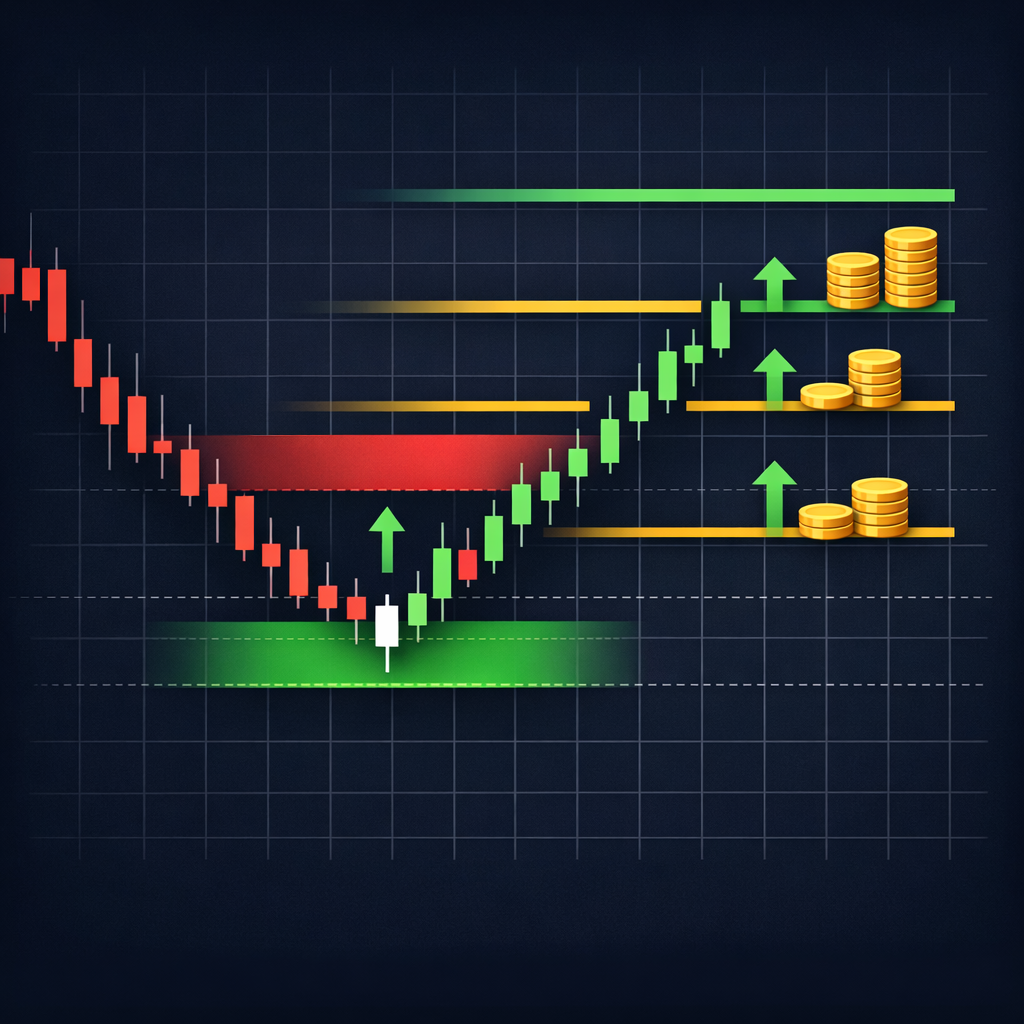
If the signal has TP1/TP2/TP3, decide your scale-out percentages before entry.
Example: 50% at TP1, 30% at TP2, 20% at TP3.
Step 7: Screenshot or journal the setup
This is how you build feedback loops.
If you don’t track execution quality, you can’t improve it.
Step 8: Execute and immediately verify
After you enter, confirm:
- Entry price is correct (or acceptable within tolerance).
- SL is placed correctly (not inverted, not missing).
- TP levels are correct and not fat-fingered.
If you want a deeper framework on selecting providers that make execution easier, pair this article with our forex signal provider checklist.
Position Sizing Like a Pro: The Only Way to Survive Signal Trading
Signals don’t protect you from drawdowns.
Position sizing does.
Most traders ask, “How many lots should I trade?”
Pros ask, “How much am I willing to lose if I’m wrong?”
The professional risk rule (simple and effective)
Risk a fixed percentage per trade.
For most signal traders, 0.5% to 2% is the realistic range.
If your account is $2,000:
- 0.5% risk = $10 per trade
- 1% risk = $20 per trade
- 2% risk = $40 per trade
Forex sizing example (EUR/USD)
Say EUR/USD is at 1.0520.
You take a sell signal at 1.0520 with SL at 1.0550 (30 pips risk).
If you risk $20 (1% of $2,000), then your $/pip needs to be:
$20 ÷ 30 pips = $0.67 per pip.
That’s roughly 0.07 lots on many brokers (depending on contract specs).
The exact lot size varies, but the method doesn’t.
Gold sizing example (XAUUSD)
Gold is at $2650.
You get a buy signal at $2650 with SL at $2635 (risk = $15).
If you risk $30, then size is:
$30 ÷ $15 = 2.0 (in “$1 per $1 move” units).
Depending on your broker, that might translate to 0.20 lots, 2 micro lots, or another denomination.
The pro takeaway: you size to keep the loss at $30 if SL hits.
Common sizing mistakes in signal execution
- Fixed lot size across all trades, ignoring different SL distances.
- Doubling after a loss to “get it back.”
- Oversizing gold because it “moves fast” (fast moves cut both ways).
- Not accounting for commission/spread when SL is tight.
If you want a full risk framework designed for signal users, we’ve mapped it out here: risk management strategies when using forex signals.
It pairs perfectly with the execution process you’re building now.
Entry Timing: How Pros Avoid Chasing and Still Get Filled
Timing is the silent killer of signal performance.
You can have the right direction and still get the wrong trade.
Define your “entry tolerance” in advance
Pros define a maximum acceptable deviation from the signal entry.
Example rules:
- Major pairs (EUR/USD, GBP/USD): max 2–5 pips away from entry.
- USD/JPY: max 3–7 pips away (it can move sharply near 149.50).
- XAUUSD: max $1–$3 away in normal conditions, $3–$6 in high volatility.
If price is outside tolerance, you don’t “force it.”
You wait for a pullback, or you skip.
Use session logic: London and NY are not the same as Asia
United Kings focuses heavily on London and New York session trading because liquidity is deeper and follow-through is more reliable.
But deeper liquidity also brings faster moves, stop runs, and sharper wicks.
A common scenario:
GBP/USD is at 1.2680 before London open.
At London open, it spikes to 1.2705, then returns to 1.2685.
The amateur buys the spike because they’re afraid of missing the trade.
The pro waits for the post-spike retest and enters closer to the planned level.
Execution technique: “alert-first” trading
Instead of staring at charts all day, set alerts around the entry zone.
Example: if EUR/USD sell limit is 1.0550, set an alert at 1.0545.
When the alert triggers, you shift into execution mode.
This reduces impulsive entries and improves fill quality.
What about gold (XAUUSD) around $2650?
Gold often “tests” levels aggressively.
In the $2610–$2690 environment, a $10 swing can happen quickly during NY data releases.
So pros avoid entering mid-wick.
They either:
- Use limit entries at structure (e.g., buy $2638–$2642 zone).
- Use confirmation entries after a clean break and retest (e.g., above $2660, retest $2656).
Execution is not about being fast.
It’s about being precise and repeatable.
Managing Multiple Take Profits (TP1/TP2/TP3) Without Sabotaging the Trade
Multi-TP signals are powerful because they let you get paid while still giving the trade room.
But they also create confusion if you don’t plan the sequence.
Why scaling out works psychologically
When you take partial profit at TP1, your brain relaxes.
That makes it easier to hold the remainder for TP2 or TP3.
Pros use scaling to reduce emotional decision-making.
They don’t want one candle to decide their mood for the day.
A clean, professional TP framework (simple to execute)
Here’s a structure you can copy:
- TP1: 1R (same distance as your stop). Close 40%–60%.
- TP2: 2R. Close 20%–40%.
- TP3: 3R (or trail). Close the remainder.
“R” means your initial risk.
If your SL is 30 pips, then 1R = 30 pips, 2R = 60 pips, 3R = 90 pips.
Forex example: EUR/USD with 1:2 risk-reward
Sell EUR/USD at 1.0520.
SL at 1.0550 (30 pips risk).
- TP1 (1R): 1.0490
- TP2 (2R): 1.0460
- TP3 (3R): 1.0430 (optional, if trend is strong)
If TP1 hits and you close 50%, you’ve banked profit.
Now you can move SL to breakeven or reduce risk (more on that next).
Gold example: XAUUSD around $2650 with 1:3 potential
Buy gold at $2650.
SL at $2635 (risk $15).
- TP1 (1R): $2665
- TP2 (2R): $2680
- TP3 (3R): $2695 (if volatility supports it)
Notice how these levels sit inside the realistic $2610–$2690 context.
That’s intentional: execution plans must fit current volatility, not fantasy targets.
Two mistakes that destroy multi-TP performance
- Closing everything at TP1 because the first profit feels “safe.”
- Moving SL too early and getting stopped out before TP2/TP3.
Multi-TP is a strategy.
If you change it mid-trade, you’re no longer executing a strategy—you’re improvising.
Trailing Stops and Breakeven Rules: Protect Profit Without Getting Wicked Out
Trailing stops are where many signal traders unintentionally sabotage good trades.
They trail too tight, get stopped, and then watch price hit TP2 without them.
Breakeven is a tool, not a religion
Moving SL to breakeven feels professional.
But if you do it at the wrong time, you turn winning trades into “scratch trades” repeatedly.
A practical breakeven rule:
- Move SL to breakeven only after TP1 is hit or after a clear structure break in your favor.
- Consider moving SL to breakeven + spread to avoid micro stop-outs.
Three trailing methods pros use
1) Structure trailing (best for price action)
Trail behind swing highs/lows on a chosen timeframe.
Example: on EUR/USD, trail above the last lower high in a downtrend.
2) ATR trailing (best for volatility adaptation)
Use a multiple of ATR (Average True Range).
If ATR on GBP/USD is 0.0012 (12 pips), a 2x ATR trail is 24 pips.
3) Step trailing (best for signal execution simplicity)
Move SL in “steps” after predefined milestones:
- After TP1: SL to BE
- After TP2: SL locks 1R profit
- Then trail behind last structure
Gold trailing example around $2650
Buy XAUUSD at $2650, SL $2635, TP1 $2665, TP2 $2680.
After TP1 hits, you move SL to $2650 (or $2651 to cover costs).
After TP2 hits, you trail below a logical swing low, for example $2670.
This gives gold room to fluctuate without stopping you out on a normal pullback.
The “too-tight trail” warning
Gold can wick $4–$8 and continue.
USD/JPY can spike 10–20 pips and continue.
So if you trail by $2 on gold or 5 pips on USD/JPY, you’re basically volunteering to get stopped.
A pro trail respects the instrument’s personality and current volatility.
Execution in Real Market Conditions: Spread, Slippage, and News Spikes
On paper, a signal looks clean.
In the real market, spreads widen, fills slip, and candles jump.
Right now, with DXY near 106.80 and USD/JPY around 149.50, USD sensitivity is high.
That means U.S. data can move multiple pairs at once.
Spread: the hidden cost you pay every trade
If EUR/USD spread is 1.2 pips and you scalp for 10 pips, spread is 12% of your target.
That’s huge.
During volatile minutes, spreads can widen enough to trigger SLs that “shouldn’t” have been hit.
Professionals factor this into execution.
Slippage: when your fill is worse than your click
Slippage happens more during:
- High-impact news (CPI, NFP, rate decisions)
- Session opens (London and NY)
- Thin liquidity (late Friday, holidays)
On gold near $2650, a fast move can slip you $1–$5 easily.
If your stop is only $10, that’s a big percentage of your risk.
Professional approach: “news-aware execution”
Pros don’t avoid news blindly.
They execute with rules:
- Don’t open new trades 2–5 minutes before major releases unless the strategy is designed for it.
- If already in profit, consider reducing exposure or locking partials.
- Use wider stops only if position size is reduced to keep risk constant.
Gold is particularly sensitive to surprise headlines and macro data.
If you trade XAUUSD signals, you should understand how gold behaves when news hits.
We covered these survival rules in depth here: how gold signals react to unexpected news events.
Execution tip: avoid “revenge re-entries” after slippage
A common scenario is getting slipped into a bad entry, then forcing another entry to “fix it.”
Professionals don’t do that.
If execution quality is compromised, the trade is compromised.
Sometimes the best execution decision is to stand down and wait for the next clean setup.
How to Execute Signals Across Multiple Pairs (Without Overexposure)
One of the biggest traps in signal trading is taking too many trades that are basically the same bet.
It feels diversified, but it’s often concentrated risk.
Correlation risk: the “hidden double trade”
If you sell EUR/USD and sell GBP/USD at the same time, you’re often making two USD-long bets.
With DXY at 106.80, USD strength can push both pairs down together.
If you risk 1% on each, you might be risking 2% on effectively one idea.
Professionals account for that.
A simple exposure model for signal traders
Use a “risk cap” per currency theme.
- Max 1%–2% total risk across all USD-long trades.
- Max 1%–2% total risk across all USD-short trades.
- Max 1% total risk across highly correlated pairs in the same direction.
Example:
You have $5,000 and risk 1% per trade ($50).
You receive:
- Sell EUR/USD
- Sell GBP/USD
- Buy USD/JPY
All three are USD-strength aligned.
A professional might take only two, or reduce each to 0.5% risk, keeping total USD exposure near 1%–1.5%.
Execution sequencing: which trade do you prioritize?
When multiple signals arrive, pros rank them by:
- Clarity of structure (clean levels, clean invalidation)
- Risk-reward (is 1:2 or 1:3 realistic?)
- Session alignment (London/NY momentum supports it?)
- Spread and liquidity (tight spreads, stable execution)
This is why execution is not just clicking buttons.
It’s decision-making under constraints.
If you want a structured stream of setups across instruments (forex, gold, and more), explore our main signals page and see how we organize trade details for fast execution.
Common Execution Mistakes (That Make Good Signals Look Bad)
If you’re serious about mastering how to trade signals, you need to treat mistakes like data.
Not like personal failure.
Mistake #1: Entering after the move (“FOMO execution”)
Price is supposed to enter at 1.0520.
You enter at 1.0532 because you’re afraid it won’t come back.
Now your stop is tighter than intended, your TP is closer, and the entire math changes.
Professionals either respect the level or skip the trade.
Mistake #2: Moving SL “just a little”
This one is deadly.
A signal SL is not a suggestion.
If you widen the SL without reducing lot size, you increase risk.
If you tighten SL to feel safe, you increase stop-outs.
Mistake #3: Not placing SL/TP immediately
Many traders enter first and “plan to add SL in a second.”
Then the market spikes.
On gold around $2650, a $6 candle can appear quickly.
That “second” can cost you more than your planned risk.
Mistake #4: Overtrading signals (too many trades, too little quality)
Signals feel like opportunities.
But every trade is also a risk event.
Pros don’t measure success by number of trades.
They measure it by quality of execution and risk-adjusted returns.
Mistake #5: Changing the plan mid-trade
Closing early because you’re up 12 pips.
Moving TP because you “think it can go further.”
Sometimes discretion is valid.
But if you do it randomly, you destroy the statistical edge the signal provider is trying to deliver.
A quick fix: grade your execution, not just your profit
After each trade, score yourself from 1–5 on:
- Entry accuracy
- Correct lot size
- SL/TP placement
- Management discipline
- Emotional control
Even a losing trade can be a “5/5 execution.”
That’s how professionals improve without spiraling emotionally.
Pro-Level Trade Management: Partial Closes, Re-Entries, and “Add-On” Rules
Once your execution basics are solid, trade management becomes your next lever.
This is where pros extract more from the same signal without increasing chaos.
Partial close mechanics (how to do it cleanly)
Let’s say you open 0.10 lots EUR/USD.
At TP1, you close 0.05 lots and keep 0.05 running.
This is simple, but you must decide in advance.
Otherwise you’ll close “whatever feels right,” which usually means closing too much too early.
Re-entry rules (when a second entry makes sense)
Re-entries are professional tools, but only with rules.
A valid re-entry usually requires:
- The original trade idea is still valid (structure intact).
- Price returns to a planned level (not random chasing).
- You treat it as a new trade with its own SL and sizing.
Example:
GBP/USD breaks above 1.2700, hits TP1 near 1.2720, then retests 1.2700.
A professional may re-enter on the retest with a tight invalidation, not at 1.2735 in excitement.
Add-on positions (pyramiding) without blowing risk
Pyramiding means adding to a winning trade.
It sounds aggressive, but pros do it with controlled risk.
Rule of thumb:
- Add only after the trade has moved in your favor and risk is reduced (e.g., SL at breakeven).
- The add-on size is smaller than the initial position.
- Total risk across the idea stays within your cap.
Gold example: scaling and add-on around $2650
Buy XAUUSD at $2650, SL $2635.
When price hits $2665 (TP1), you close 50% and move SL to $2651.
If price then consolidates and breaks above $2670 with momentum, you may add a smaller position with SL $2660.
Your original trade is protected, and the add-on is logically defined.
This is how professionals grow winners without turning one idea into a disaster.
If you trade gold signals regularly, you’ll also want to review our dedicated gold hub at United Kings gold signals for execution-friendly setups and education.
Execution Psychology: Staying Mechanical When the Market Gets Loud
The market is a pressure test.
Your execution system is only as good as your ability to follow it when you’re stressed.
The three emotional states that ruin signal execution
- FOMO: entering late because price is moving.
- Fear: closing early because you can’t tolerate normal pullbacks.
- Revenge: increasing risk after a loss to “get back to even.”
These emotions don’t make you a bad trader.
They make you human.
Professional solution: pre-commitment
Pros pre-commit to rules when calm.
Then they follow them when emotional.
Try this pre-commitment script before the session:
- I will risk a fixed % per trade.
- I will not chase entries outside tolerance.
- I will not move SL further away.
- I will follow the TP plan or accept the outcome.
Use “process goals,” not money goals
A money goal like “make $200 today” forces bad execution.
A process goal like “execute 3 trades perfectly” builds long-term performance.
Real scenario: the difference one decision makes
You take a USD/JPY buy at 149.50 with SL 149.10 (40 pips risk).
Price goes to 149.75 (+25 pips), then pulls back to 149.55.
The amateur closes at 149.55 because they “don’t want to lose profit.”
The pro holds because the plan targets 150.30 (80 pips = 2R) and the pullback is normal.
Over 50 trades, that difference is the difference between inconsistency and a trackable edge.
If you want a community environment that reinforces good habits, United Kings has 300K+ active traders sharing execution feedback daily.
Our primary channel is Telegram: United Kings Telegram trading community.
Putting It All Together: A Complete Signal Execution Workflow (Copy/Paste)
Let’s turn everything into one workflow you can follow every day.
This is the closest thing to “professional execution” you can systematize as a signal trader.
Phase 1: Pre-trade (60–120 seconds)
- Confirm instrument and direction.
- Identify order type (market/limit/stop).
- Check spread and session condition (London/NY vs thin market).
- Check for imminent high-impact news.
- Confirm entry tolerance (max deviation you accept).
Phase 2: Build the trade (60 seconds)
- Place SL where the idea is invalidated.
- Calculate lot size from SL distance and % risk.
- Set TP1/TP2/TP3 or a single TP with a trailing plan.
- Decide scale-out percentages (e.g., 50/30/20).
Phase 3: Execute (10 seconds)
- Place the order.
- Immediately verify entry, SL, and TP values.
- Set alerts at TP1 and near SL (optional).
Phase 4: Manage (ongoing, but minimal)
- At TP1: take partial, consider SL to breakeven (rule-based).
- At TP2: take partial, trail using structure or ATR.
- At invalidation: accept SL without negotiation.
Phase 5: Post-trade review (2 minutes)
- Log entry accuracy (within tolerance?).
- Log sizing accuracy (risk stayed constant?).
- Log management (followed plan?).
- Write one sentence: “What would I repeat or fix?”
If you do this consistently, your results will start to reflect the provider’s edge instead of your execution errors.
And if you’re using a premium provider with clear entries, SLs, and TPs, your job becomes even easier.
For traders who want a structured signal feed across categories, we also offer crypto coverage.
See our crypto signals page if you’re diversifying beyond forex (with proper risk caps).
FAQ: Forex Signal Execution Questions Traders Ask Every Week
1) What is forex signal execution in simple terms?
Forex signal execution is how you place and manage a trade based on a signal: choosing the right order type, entering at the right time, setting SL/TP correctly, and managing risk consistently.
2) Should I use market orders or limit orders for signals?
Use market orders for momentum signals that require immediate participation, and limit orders for pullback-based signals that aim for a better price. If the signal doesn’t specify, check whether it’s a continuation or retracement setup.
3) How much should I risk per signal trade?
Most professional-style signal traders risk 0.5%–2% per trade. The exact % depends on your experience, drawdown tolerance, and how many trades you may hold at once.
4) When should I move stop loss to breakeven?
A practical rule is to move SL to breakeven after TP1 is hit or after a clear structure break in your favor. Moving to breakeven too early often leads to unnecessary stop-outs.
5) Why do I lose even when the signal direction was correct?
Usually because of execution issues: late entry, wrong lot size, SL/TP errors, spread/slippage during volatile minutes, or closing early due to fear. Fixing execution often improves results without changing the signals.
Risk Disclaimer (Read This Before You Trade)
Forex and gold trading involves significant risk and may not be suitable for all investors.
Signals, analysis, and examples are for educational purposes and do not guarantee profits.
Past performance does not guarantee future results, and market conditions can change rapidly due to news, liquidity, and volatility.
If you’re a beginner, consider practicing on a demo account first and only trade with money you can afford to lose.
Ready to Execute Signals Like a Pro? Join United Kings
If you want to stop guessing and start executing with a professional framework, you need two things.
You need clear, execution-ready signals, and you need consistent risk rules that protect your account.
United Kings provides premium Telegram signals for forex and gold with clear Entry, SL, and TP levels, built for London and NY sessions.
We combine signals with education, and we’ve built a community of 300K+ active traders focused on disciplined execution.
Start here based on what you trade:
- Get United Kings forex signals for major pairs like EUR/USD, GBP/USD, and USD/JPY.
- Get United Kings gold signals for XAUUSD setups around key levels.
- Explore all United Kings signals in one place.
Choose a plan on our pricing page (3 options):
- Starter: 3 Months for $299 (~$100/mo)
- Best Value: 1 Year for $599 (~$50/mo) with 50% savings + FREE ebook
- Unlimited: Lifetime for $999 (pay once, access forever)
And if you want to see the community and signal format first, join our Telegram here: United Kings on Telegram.
Bonus confidence: we offer a 48-hour money-back guarantee so you can evaluate the service risk-free.
Your next step: stop trying to “be right.”
Start executing correctly—and let the edge show up over a series of trades.