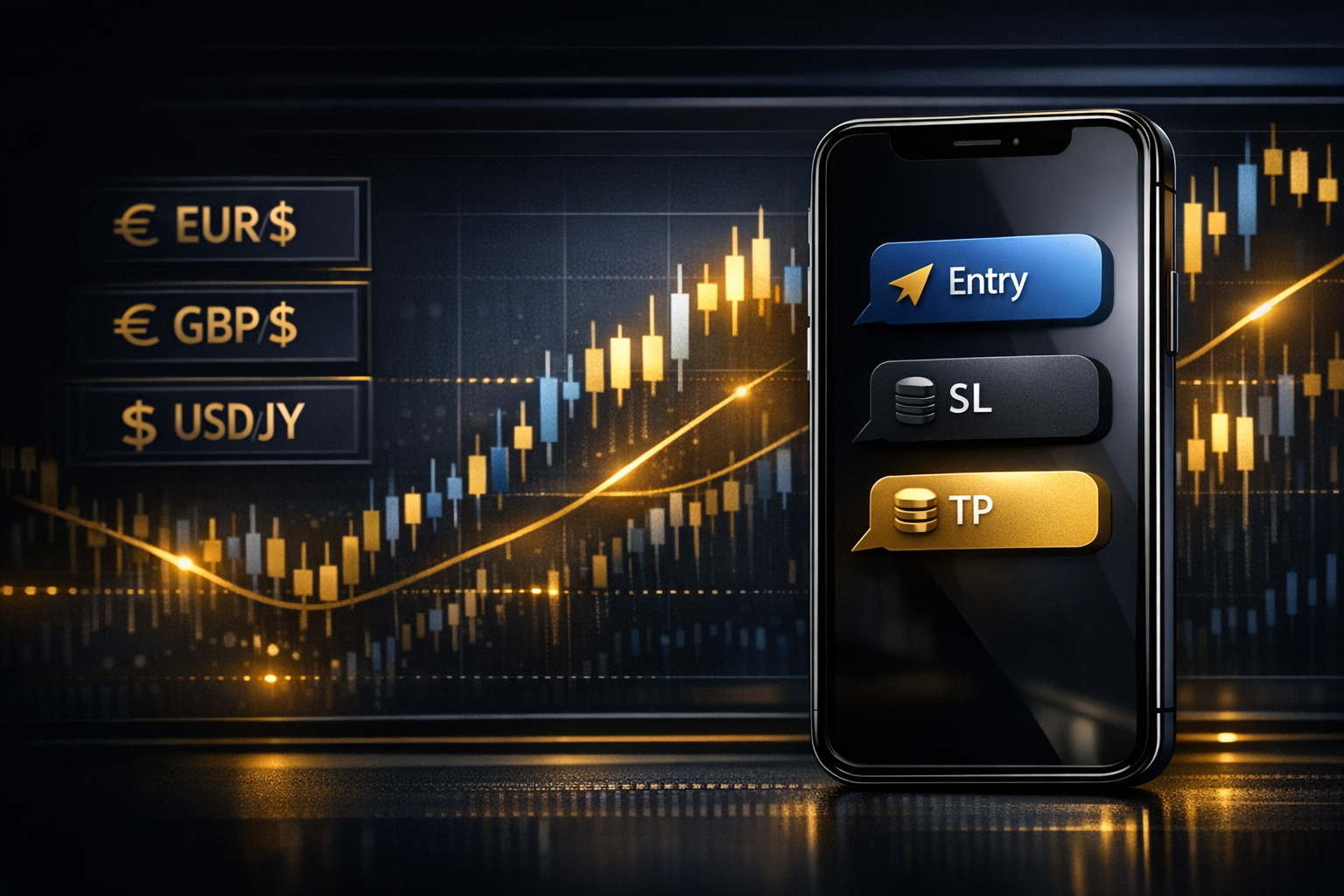
Ever copied a forex signal perfectly… and still ended up with a different result?
If you’ve been there, you’re not alone.
Forex signal execution is where most traders leak performance.
Not because the signal is “bad,” but because entries, spreads, sizing, and trade management are handled like a casual user instead of a professional operator.
In today’s market context—EUR/USD around 1.0520, GBP/USD near 1.2680, USD/JPY at 149.50, and DXY elevated around 106.80—execution details matter even more.
Volatility can spike quickly around session opens and news, and a 1–3 pip difference on entry can change your risk-to-reward and your psychology.
TL;DR: Professional Forex Signal Execution in 6 Takeaways
- Execution is a system: you need a repeatable checklist, not “gut feel.”
- Entry timing is everything: market vs limit orders, session timing, and spread conditions decide your fill quality.
- Position sizing beats prediction: risk a fixed % per trade, not a fixed lot size.
- Manage multiple TPs like a pro: scale out, move SL to break-even, and protect equity during volatility.
- Trailing stops are tools, not magic: trail based on structure (swings/ATR), not random pip counts.
- Avoid the “execution killers”: late entries, revenge trades, over-leverage, and ignoring spreads/news.
What “Forex Signal Execution” Really Means (And Why Pros Treat It Like a Job)
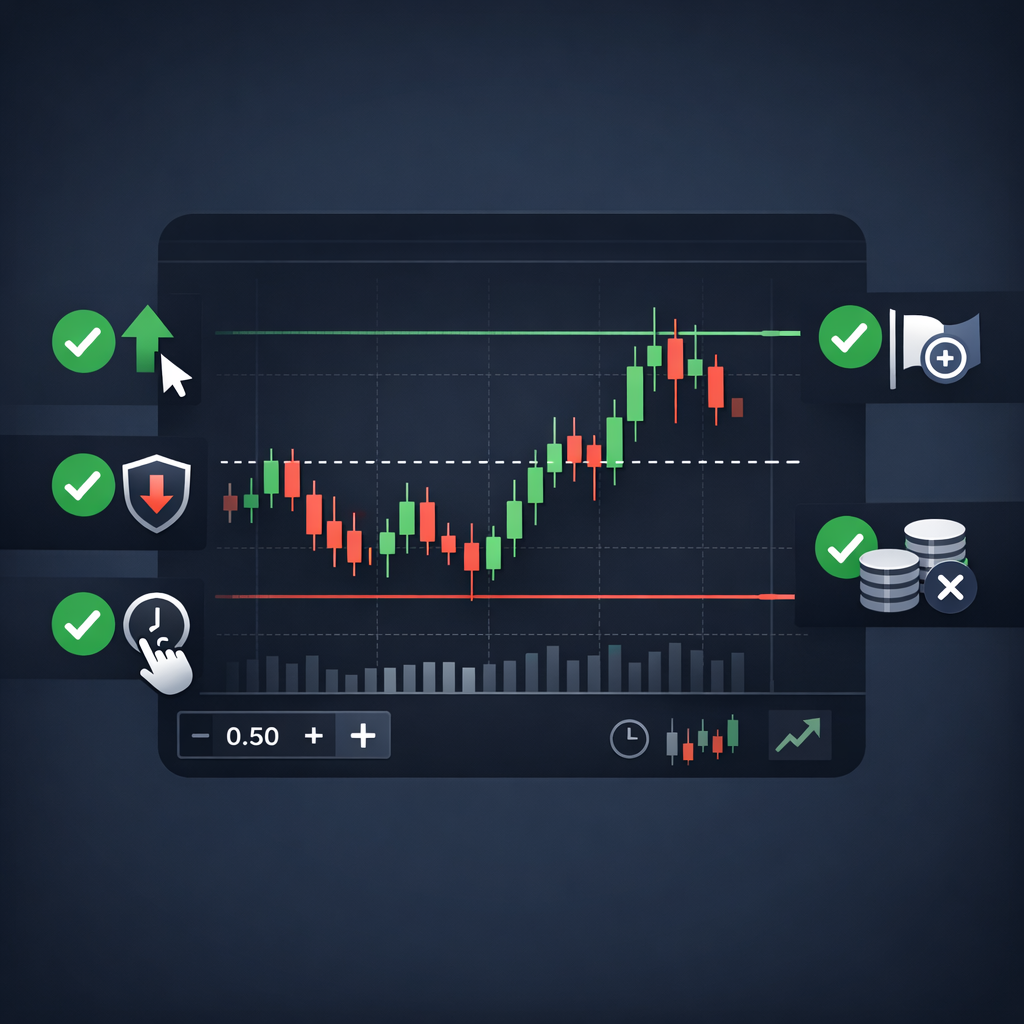
Most traders think signals are about direction.
Professionals know signals are about process.
Forex signal execution is the set of actions you take from the moment you receive a signal to the moment the trade is closed.
It includes the order type you choose, the price you accept, the size you use, how you split take profits, and how you react when price moves fast.
Two traders can receive the same signal and get two completely different outcomes.
One enters late, sizes too big, panics at -10 pips, and closes early.
The other enters at the planned level, risks 1%, takes partials, and lets the trade work.
Same signal.
Different execution.
Here’s the professional mindset shift: you’re not trying to win every trade.
You’re trying to execute your edge consistently so the probabilities play out over a series of trades.
That’s why at United Kings we focus on giving clear, structured alerts with Entry, Stop Loss, and Take Profit levels, built for the most liquid parts of the day—especially the London and New York sessions.
If you’re new to using Telegram alerts, our beginner-friendly guide to Forex signals on Telegram and how to follow them correctly will help you set the foundation.
But if you want professional-level outcomes, you need to go beyond “copy/paste.”
You need a repeatable execution framework.
Before You Place the Trade: The 60-Second Pre-Execution Checklist
Professionals don’t “wing it.”
They run a short checklist before every order.
This isn’t overthinking.
This is how you avoid the common execution mistakes that quietly destroy signal performance.
Step-by-step: Your pre-trade checklist
- 1) Confirm instrument and direction: EUR/USD buy vs sell sounds obvious, but mistakes happen when you’re rushing.
- 2) Check current spread: if EUR/USD spread is 0.8–1.2 pips it’s normal; if it’s 2.5–4.0 pips, execution quality drops.
- 3) Check session timing: London open and NY open bring liquidity, but also fast swings; avoid copying in the “dead zone.”
- 4) Check distance to entry: if price already moved 20–30% of the intended move, you’re likely late.
- 5) Validate stop size: your SL must match the signal; don’t shrink it to “feel safer.”
- 6) Calculate lot size: risk should be constant; lot size should change based on SL distance.
- 7) Set TP(s) and management rules: decide now, not mid-trade when emotions are high.
Let’s make this real.
Imagine you get a signal: EUR/USD SELL 1.0520, SL 1.0550, TP 1.0460.
That’s a 30-pip stop and 60-pip target (roughly 1:2 R:R).
If you enter at 1.0530 because you hesitated, your stop becomes 20 pips away but your planned SL is still 1.0550.
You just changed the trade without realizing it.
Now your risk per lot is different, your R:R is worse, and your psychology is fragile.
Pros treat that as a different trade.
They either re-calculate properly or they skip it.
If you want a deeper framework for choosing a provider and understanding what “good structure” looks like, use our forex signals provider checklist to benchmark quality and clarity.
Entry Timing: Market Orders vs Limit Orders (And When Each Is Professional)

Entry timing is where signal followers most often fail.
Not because they’re “bad traders,” but because they don’t understand the micro-differences between order types and market conditions.
When DXY is elevated near 106.80 and USD pairs like USD/JPY hover around 149.50, intraday momentum can be sharp.
That means a “few seconds late” can become “a few pips worse,” and that can be the difference between a clean TP and a frustrating stop-out.
Market order: the pro use-case
A market order is professional when:
- You’re entering during high liquidity (London/NY overlap).
- The signal is designed as a breakout continuation where missing the move is worse than a slightly worse fill.
- Spread is stable and you’re not near major news.
Example: GBP/USD is at 1.2680 and breaks a key intraday support.
A sell signal comes with momentum confirmation.
A market entry can be appropriate because the move may run 30–70 pips quickly.
Limit order: the pro use-case
A limit order is professional when:
- The signal is a pullback entry into a prior level (support/resistance).
- You want to reduce slippage and improve R:R.
- You’re trading mean reversion or retests after a breakout.
Example: EUR/USD sells off from 1.0520 to 1.0495, then retests 1.0515–1.0520.
A limit sell at 1.0518 can be cleaner than chasing at 1.0500.
The “late entry” rule professionals follow
Here’s a practical rule you can use immediately:
- If price is within 10–20% of the SL distance from the entry, you can often still execute with minimal distortion.
- If price is beyond that, you must either recalculate the trade or skip it.
Using the earlier EUR/USD example with a 30-pip SL:
- 10–20% of 30 pips = 3–6 pips.
- If you’re more than ~6 pips late, you’re no longer trading the same plan.
Professionals don’t force trades.
They protect their execution standards.
That’s how you keep the edge of forex trading signals intact over time.
Position Sizing Like a Pro: The Math That Keeps You in the Game
If you want one skill that separates professionals from amateurs, it’s position sizing.
Not indicators.
Not “market intuition.”
Just disciplined risk.
Most signal users pick a random lot size like 0.10 or 0.50 and hope it works.
Professionals pick a risk amount first, then calculate the lot size based on the stop loss.
Step-by-step: Fixed % risk model (professional standard)
- 1) Choose risk per trade: common professional range is 0.5% to 2% of account equity.
- 2) Measure stop loss distance: in pips for forex pairs.
- 3) Calculate pip value per lot: depends on pair and account currency.
- 4) Solve for lot size so that SL hit equals your chosen risk.
Let’s do a realistic example.
Account size: $2,000.
Risk per trade: 1% = $20.
Signal: EUR/USD sell 1.0520, SL 1.0550 (30 pips).
On EUR/USD, 1 standard lot is roughly $10 per pip.
So 30 pips on 1 lot ≈ $300 risk.
You only want $20 risk.
Lot size = $20 / $300 = 0.066 lots (rounded to 0.06 or 0.07 depending on broker).
This is what professionals do.
They don’t “feel” their lot size.
They calculate it.
Why this protects you when volatility spikes
When markets are jumpy—like when DXY is strong and USD/JPY is sensitive to rate expectations—stops can be wider.
If you keep the same lot size with a wider stop, your $ risk explodes.
That’s how traders blow accounts while thinking they’re “following signals.”
If you want a full framework on risk, including drawdown control and streak management, read our guide on risk management strategies when using forex signals.
Managing Multiple Take Profits: Scaling Out Without Killing Your R:R
Many professional signal traders don’t use a single take profit.
They use multiple TPs to reduce emotional pressure and lock in progress.
But there’s a right way and a wrong way.
The wrong way is taking profit too early on most of the position and leaving a tiny runner.
That feels good, but it often destroys expectancy.
A professional TP structure (simple and effective)
One of the most common professional structures is:
- TP1: at 1R (equal to your stop size), close 30–50%
- TP2: at 2R, close another 30–50%
- Runner: leave 10–20% to trail if the move extends
Example on EUR/USD:
Sell 1.0520, SL 1.0550 (30 pips).
- TP1 at 1.0490 (30 pips)
- TP2 at 1.0460 (60 pips)
- Runner target open (trail based on structure)
Where traders mess this up
- They move TP closer because they “just want a win.”
- They close too much at TP1 (like 80–90%), leaving no meaningful upside.
- They move SL to break-even too early and get tapped out before the real move.
A professional approach is to pair scaling with a rule.
For example: move SL to break-even only after price closes beyond a key level or after TP1 is hit and a retracement fails.
This prevents “death by break-even,” where you take dozens of tiny scratches and miss the big wins.
How to execute multiple TPs on your platform
- Option A: open multiple smaller positions (e.g., 0.03 + 0.02 + 0.01 lots) each with different TP levels.
- Option B: use partial close if your broker supports it, then adjust SL manually.
Professionals prefer Option A because it’s cleaner and reduces mistakes under pressure.
Trailing Stops That Actually Work: Structure-Based vs “Random Pip Trails”
Trailing stops are popular because they promise the dream outcome.
You catch a trend and ride it for huge pips.
But most traders trail incorrectly.
They use arbitrary numbers like “trail by 15 pips,” and then wonder why they get stopped out before the move continues.
Two professional trailing stop methods
- Structure trailing: trail behind swing highs/lows and key levels.
- Volatility trailing: trail using ATR (Average True Range) or a volatility proxy.
Structure trailing (best for price action traders)
If you’re short EUR/USD, you trail your stop above the most recent lower high.
That means you only exit when the market actually breaks structure.
This aligns your exit with the reason you’re in the trade.
ATR trailing (best for fast markets)
ATR trailing adapts to volatility.
When volatility expands, your trail widens to avoid noise.
When volatility contracts, your trail tightens to protect profits.
A common professional setting is 1.5x to 2.5x ATR, depending on timeframe.
When to start trailing (a practical rule)
- Start trailing after TP1 is hit or after price reaches 1.5R.
- Before that, let the trade breathe, especially during London/NY volatility bursts.
Trailing is not about maximizing every trade.
It’s about turning a portion of trades into outsized winners while keeping your downside controlled.
That’s how professionals build equity curves that trend upward instead of flatlining.
Execution in Fast Markets: Slippage, Spreads, and News Spikes
Even perfect signals can be executed poorly during fast conditions.
This is where many traders blame the provider, when the real issue is microstructure.
Spreads widen, price gaps, and your order fills a few pips away from the level you expected.
Three execution risks you must respect
- Spread widening: common around session opens, rollovers, and unexpected headlines.
- Slippage: your fill is worse than your requested price, especially on market orders.
- Latency: Telegram delay, platform lag, or slow manual entry can cost pips.
Practical rules to protect execution quality
- Avoid entering during major red-flag news unless the signal explicitly accounts for it.
- Prefer limit orders for pullback signals when spreads are unstable.
- Use a maximum slippage rule: if your fill is more than X pips worse, cancel or reduce size.
Let’s relate it to current conditions.
With DXY around 106.80, USD pairs can react sharply to rate expectations, Fed commentary, or surprise inflation prints.
USD/JPY at 149.50 can move 30–80 pips in minutes on a hot headline.
If you’re executing a signal in that environment, you need rules.
Not hope.
If you also trade gold alongside forex, it’s worth understanding how signals behave during sudden volatility.
Our article on how gold signals react to unexpected news events explains the survival mindset that applies to forex too.
Professional Execution for Gold Signals (XAUUSD): A Quick Cross-Market Lesson
This article is about forex, but professional signal execution is easier to understand when you see it across instruments.
Gold (XAUUSD) is the perfect example because it punishes sloppy execution.
Right now gold is around $2650.00 with a mild 24h gain of about +0.35%.
That’s not extreme, but gold can still swing $10–$25 quickly around session opens and headlines.
How professionals execute XAUUSD signals (example)
Assume a gold buy signal:
- Buy: 2648.00
- SL: 2635.00 (13 dollars risk)
- TP1: 2674.00 (26 dollars, 1:2)
- TP2: 2687.00 (39 dollars, 1:3)
Now watch what happens if you enter late at 2656.00.
Your SL at 2635.00 is now 21 dollars away, not 13.
Your risk increased by ~61% without changing anything else.
That’s the same mistake forex traders make when they chase EUR/USD by 8–12 pips on a 30-pip stop.
Gold teaches the “execution discipline” principle
- Enter at the level or don’t enter (unless you recalc the trade).
- Size to the stop, not to your feelings.
- Manage partials to reduce stress and protect equity.
If you want to trade gold with the same professional execution framework, explore our dedicated gold signals page and compare how we structure entries and targets for XAUUSD.
Even if you’re primarily a forex trader, cross-training on gold improves your discipline fast.
Comparison Table: Amateur vs Professional Signal Execution
When traders say “signals don’t work,” they often mean “my execution wasn’t professional.”
Use this table as a self-audit.
| Execution Area | Amateur Approach | Professional Approach |
|---|---|---|
| Entry | Chases price 5–20 pips late | Enters at planned level or skips/recalculates |
| Order Type | Always market orders | Chooses market vs limit based on setup and spread |
| Position Size | Fixed lot size (e.g., always 0.10) | Fixed % risk (e.g., 1%) based on SL distance |
| Stop Loss | Moves SL wider “to avoid stop-out” | Respects SL; exits quickly if invalidated |
| Take Profits | Closes early out of fear | Uses TP1/TP2 + runner with rules |
| Trade Management | Emotional decisions mid-trade | Pre-defined management plan; adjusts only with structure |
| News/Volatility | Enters during spikes, blames slippage | Avoids red news or uses appropriate order types and sizing |
| Consistency | Random behavior based on last trade | Checklist-driven execution over 50–100 trades |
Common Execution Mistakes (That Quietly Destroy Signal Performance)
Execution mistakes rarely feel dramatic.
They feel like “small adjustments.”
But those small adjustments compound into drawdowns.
Mistake #1: Entering late because you want confirmation
Waiting for “one more candle” is a common trap.
By the time you feel safe, the edge is often gone.
If the signal is designed for a level entry, treat it like a level entry.
Mistake #2: Moving the stop loss wider
This is the fastest way to break a system.
If EUR/USD was planned with a 30-pip SL and you widen to 50 pips, you just changed the strategy.
Now you need a different win rate to be profitable.
Mistake #3: Over-leveraging to “make the signal worth it”
Professionals don’t try to get rich on one trade.
They try to execute well for months.
Over-leverage makes you emotional, and emotional traders don’t execute signals well.
Mistake #4: Closing early because you can’t handle drawdown
Signals often experience normal pullbacks.
If your plan says SL is 30 pips, you must accept that price can go -10 to -20 pips against you.
If that feels unbearable, your size is too big.
Mistake #5: Trading every signal without a daily risk cap
Even strong providers can hit losing streaks.
Professionals use a daily loss limit (for example 2R or 3R).
When you hit it, you stop.
This single rule prevents “one bad day” from becoming “one blown week.”
At United Kings, we emphasize education alongside alerts so you learn to execute like a professional, not like a gambler.
Start with our main forex signals page to see how we structure trades for clarity and repeatability.
Step-by-Step: How to Execute a Signal From Telegram to Your Trading Platform
Let’s turn this into a practical workflow you can follow every day.
This is the “professional execution pipeline.”
It’s designed to reduce mistakes, speed up entries, and keep your risk consistent.
Step 1: Read the signal like a pilot reads a checklist
- Instrument (EUR/USD, GBP/USD, USD/JPY, etc.)
- Direction (Buy/Sell)
- Entry (market now vs limit price)
- Stop Loss (price level)
- Take Profit(s) (TP1/TP2/TP3 if provided)
Don’t assume.
Confirm.
Step 2: Check spread and current price distance
If spread is abnormally wide, execution quality is compromised.
If price is far from entry, you’re likely late.
Professionals don’t “hope it comes back.”
They wait for the level or skip.
Step 3: Calculate lot size based on your risk
Pick your risk first (e.g., 1% of equity).
Then calculate lot size based on SL distance.
This keeps your account stable across different market conditions.
Step 4: Place the trade with pre-set SL and TP
Always place the stop loss immediately.
Always place at least one take profit level immediately.
This prevents “I’ll add it later” mistakes, which often happen right before volatility hits.
Step 5: Set alerts for key events
- Alert when price reaches TP1
- Alert when price returns near entry (to prevent emotional exit)
- Alert when price nears SL (so you’re not surprised)
Step 6: Manage the trade only at decision points
Professionals don’t micromanage every tick.
They manage at pre-defined points: TP1, structure breaks, session transitions.
Step 7: Journal the execution, not just the outcome
Write down:
- Were you late or on time?
- Did spread affect you?
- Did you follow the plan for partials and SL moves?
- What would you improve next time?
This is how you turn how to trade signals into a professional skill instead of a guessing game.
Trading Psychology of Signal Execution: Discipline Beats “Motivation”
Signal execution is 50% mechanics and 50% psychology.
You can know the math and still sabotage yourself with emotional decisions.
The market doesn’t reward intensity.
It rewards consistency.
The three emotional states that ruin execution
- FOMO: you chase entries because you fear missing the move.
- Fear: you close early because you can’t tolerate normal pullbacks.
- Revenge: you increase size after a loss to “get it back.”
A professional mental model: “I execute, I don’t predict”
Professionals treat each trade as one event in a long series.
Your job is not to be right on this one trade.
Your job is to execute your edge cleanly.
Use a “rules-based” environment
Rules reduce emotion.
Here are rules you can adopt today:
- One trade, one risk unit: never change risk mid-trade.
- No SL widening: if invalidated, exit and reassess.
- Daily loss cap: stop after 2R–3R loss in a day.
- Session boundaries: avoid forcing trades in low liquidity hours.
If you want a broader view of signal quality and what separates premium providers from noise, bookmark our guide to the best forex signals (2025 edition).
It helps you align expectations with reality, which is a big part of psychology.
How Pros Handle Multiple Signals in One Day (Without Overtrading)
One of the most overlooked skills in signal execution is selectivity.
Even with a premium provider, taking every single alert can lead to overexposure.
Especially if multiple trades are correlated.
For example, EUR/USD and GBP/USD often move similarly against USD when DXY is trending.
If you take both at full risk, you might unknowingly double your USD exposure.
Professional rule: manage correlation risk
Here’s a simple approach:
- If you take one USD-short trade (e.g., EUR/USD buy), reduce risk on another similar USD-short setup (e.g., GBP/USD buy).
- Alternatively, pick the cleaner setup and skip the second.
Professional rule: cap total open risk
Pros often cap total open risk at 2%–4% across all trades.
So even if you risk 1% per trade, you might limit yourself to 2–3 simultaneous positions.
This prevents a sudden USD spike from hitting all your trades at once.
Professional rule: prioritize “A+ execution conditions”
If a signal arrives during:
- London open volatility burst
- NY open reversal window
- Major news hour
…you need higher standards.
If spreads are messy or price is far from entry, skip.
Missing one trade is nothing.
Breaking your execution rules is expensive.
This is also why many traders choose to focus on a couple of pairs they execute best.
For some, it’s EUR/USD and GBP/USD.
For others, it’s USD/JPY because they understand its relationship with yields and risk sentiment.
United Kings Execution Standards: What to Expect From Premium Signals
Not all signals are created equal.
And even great signals need to be structured for clean execution.
At United Kings, our premium Telegram signals are designed to be executable in real conditions.
That means clear levels, realistic stops, and targets that respect volatility.
What we provide (and why it matters)
- Clear Entry, SL, and TP levels: so you can execute without guessing.
- London and NY session focus: higher liquidity typically means cleaner fills and more reliable movement.
- Educational context: so you learn why the setup works and how to manage it.
- Community scale: 300K+ active traders sharing execution experiences and learning together.
- Performance focus: we aim for a strong historical performance profile (often cited as 85%+ win-rate), while always acknowledging that results vary and losses are part of trading.
Where to start inside the United Kings ecosystem
- Explore our full signal hub on United Kings signals.
- If you focus on currencies, see our forex signals service and how we format alerts.
- If you trade XAUUSD, review our gold signals approach to stops and targets.
Pricing plans (3 options)
We keep it simple with three plans available on our pricing page:
- Starter (3 Months): $299 (~$100/month)
- Best Value (1 Year): $599 (~$50/month) with 50% savings + FREE ebook
- Unlimited (Lifetime): $999 (pay once, access forever)
If you want to see who we are and how we operate, visit our About United Kings page.
If you have questions before joining, our contact page is open and we’ll point you to the best plan for your experience level.
FAQ: Forex Signal Execution (Professional Answers)
1) If price already moved, should I still enter the signal?
Only if the move is small relative to the stop loss.
A practical rule is: if you’re more than 10–20% of the SL distance late, either recalculate size and R:R or skip the trade.
2) Should I always move my stop loss to break-even at TP1?
Not always.
Break-even protects you, but moving it too early can cause frequent stop-outs from normal retracements.
Many professionals move to BE after TP1 and a structure confirmation (like a close beyond a level).
3) What risk per trade is best when following forex trading signals?
For most traders, 0.5% to 1% per trade is a strong starting range.
More aggressive traders might use 2%, but only with strict daily caps and proven discipline.
Beginners should practice on demo first.
4) Can I follow signals on multiple pairs in the same day?
Yes, but you must manage correlation and total open risk.
If EUR/USD and GBP/USD signals align, treat them as related exposure and reduce risk accordingly.
5) How do I reduce slippage when executing signals from Telegram?
Trade during liquid sessions, avoid major news minutes, prefer limit orders for pullback setups, and use a maximum slippage rule.
Also ensure your platform and internet are stable, and pre-set templates for faster order placement.
Risk Disclaimer (Read Before You Trade)
Forex and gold trading involves significant risk and is not suitable for every investor.
Signals and educational content are provided for informational purposes and do not constitute financial advice.
Past performance does not guarantee future results. You can lose some or all of your capital.
If you’re new, we strongly recommend practicing on a demo account first, using conservative risk (e.g., 0.5%–1% per trade), and only trading with money you can afford to lose.
Final CTA: Get Professional Execution + Premium Signals With United Kings
If you want to stop guessing and start executing like a professional, you need two things.
You need a clear execution framework (you now have it), and you need structured, actionable alerts built for real market conditions.
Join the United Kings community of 300K+ active traders and get premium Telegram signals with clear Entry, SL, and TP levels, focused on London and New York session opportunities.
- Start with our full service overview: United Kings premium signals
- Choose your track: Forex signals or Gold (XAUUSD) signals
- Pick a plan on our pricing page (Starter $299 / 1 Year $599 best value / Lifetime $999)
- Join our Telegram now: United Kings Telegram trading community
Bonus: We offer a 48-hour money-back guarantee so you can evaluate the service with confidence.
Execute with discipline, manage risk like a pro, and let the process work.