
Trading gold during FOMC can feel like trying to catch a falling knife… while someone is shaking your ladder.
You see XAUUSD sitting around $2650, spreads look normal, and then the rate decision hits. In seconds, price can jump $15–$35, wick both sides, and punish anyone who confused “volatility” with “opportunity.”
This guide is built for one goal: help you trade XAUUSD during FOMC with a repeatable, risk-controlled plan—using signals as a decision framework, not a gambling trigger.
TL;DR: The FOMC XAUUSD volatility plan (bookmark this)
- Don’t predict—prepare. FOMC gold moves are driven by the surprise vs expectations, plus Powell’s tone, not the headline alone.
- Expect spread + slippage. Around the release, spreads can widen and fills can slip—so reduce lot size and avoid tight stops.
- Two high-probability windows: (1) post-spike confirmation (safer), (2) NY continuation after the press conference (cleaner trends).
- Use multi-timeframe levels to filter fakeouts. Mark H4/D1 levels first, then use M15/M5 for confirmation.
- Risk control is the edge. For gold, consider $10–$25 stops with reduced position size and aim for 1:2 to 1:3 RR.
- Signals work best as a checklist. Only execute when the signal aligns with your FOMC rules: timing, spread, confirmation, and invalidation.
1) Why FOMC moves gold so violently (and why traders get trapped)
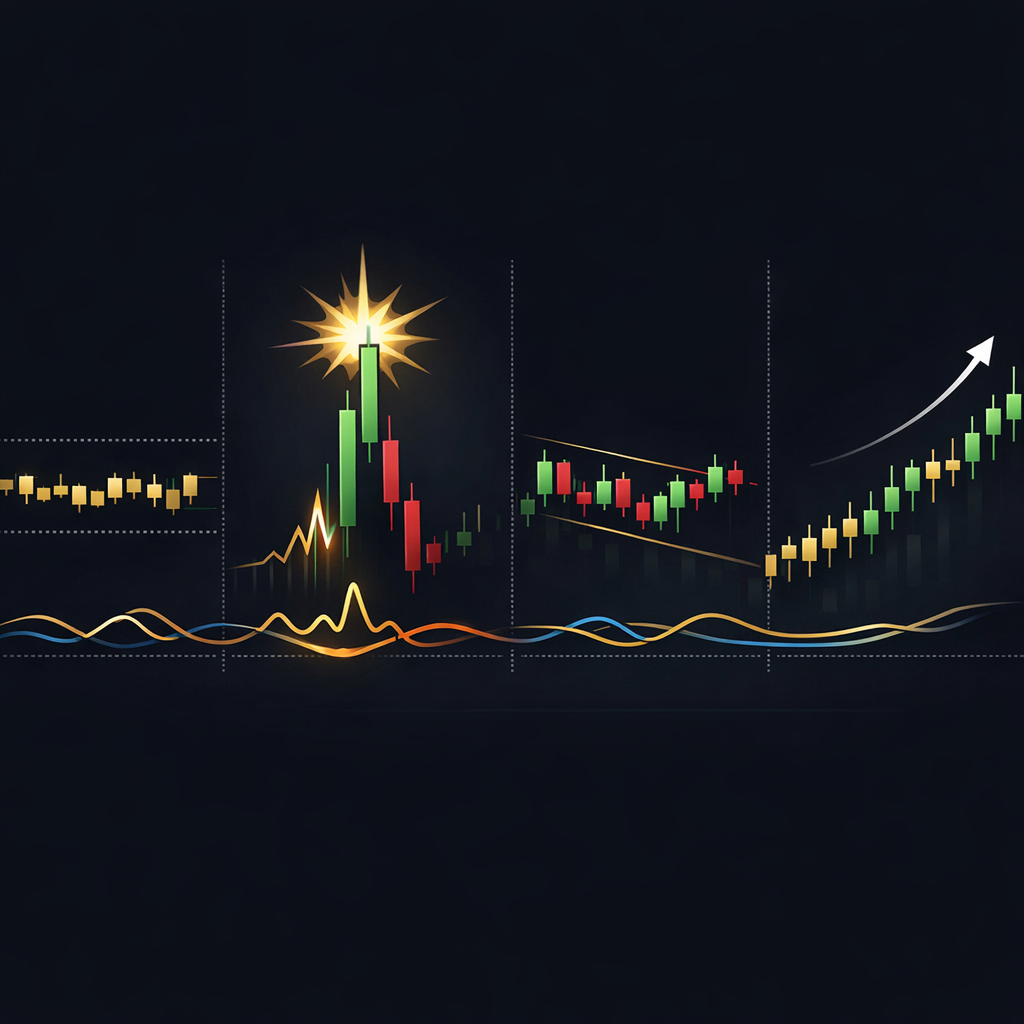
FOMC is not “just another news event.” It’s a liquidity shock plus a repricing event for rates, the dollar, and real yields—all of which feed directly into gold.
In today’s context, gold is hovering around $2650 (+0.35% on the day), while the DXY is ~106.80. EUR/USD sits near 1.0520, GBP/USD around 1.2680, and USD/JPY near 149.50. That matters because gold often reacts to a fast shift in the dollar and yields right after the statement.
Here’s the trap most traders fall into: they treat FOMC like a simple “rate up = gold down” equation. Sometimes that’s true. Often it’s not.
Gold can rally on a hike if the market was positioned for an even more hawkish path. Gold can dump on a pause if Powell signals “higher for longer.” And gold can whip both directions if the statement and press conference send mixed messages.
What actually drives XAUUSD during FOMC
- The surprise factor: statement vs consensus expectations.
- Forward guidance: dots, language changes, balance sheet tone.
- Real yields: gold hates rising real yields; loves falling real yields.
- DXY impulse: a sharp dollar bid/offer can slam gold instantly.
- Risk sentiment: if equities wobble, gold can catch safe-haven flows.
Now combine that with the microstructure problem: liquidity thins, spreads widen, and algorithms hunt stops. That’s why a “good idea” can still be a losing trade if your execution plan is weak.
The professional approach is simple: we don’t try to be first; we try to be right with controlled risk. That’s exactly where a structured XAUUSD news trading plan and disciplined signal execution shines.
2) The FOMC timeline: when gold is tradable (and when it’s not)
If you only remember one thing, remember this: during FOMC, timing is a risk tool. The same setup that works at 2:20 PM ET can be a disaster at 2:00 PM ET.
Let’s break the event into practical windows. We’ll assume the typical schedule: the statement drops, then the press conference follows. Even if exact times vary, the behavior is consistent.
Window A: 60–15 minutes before the statement (pre-positioning zone)
This is where price often compresses into a range. Gold might oscillate between, say, $2642 and $2656, creating a tight box that looks “breakout-ready.”
It is breakout-ready—but not necessarily in a tradable way. This is where you see stop clustering above highs and below lows, waiting to be swept.
What we do here is mark levels and plan. We do not force entries unless we have a specific pre-news strategy with reduced size and a clear invalidation.
Window B: 0–5 minutes after the statement (the spike zone)
This is where spreads can widen, slippage increases, and candles can print $10–$25 wicks in seconds. Many retail traders enter here because it feels like “action.”
Professionals often avoid this window unless they’re using very specific execution tactics. For most signal-based traders, this is the worst time to market-execute blindly.
Window C: 5–20 minutes after (the confirmation zone)
This is the first “tradable” window for many of our members. The market shows its hand. You can see whether the move is being accepted or rejected.
Gold might spike to $2672, then pull back to $2660. If it holds, that pullback becomes a structured entry opportunity with a logical stop.
Window D: press conference + 30–90 minutes (trend/continuation zone)
This is where the real move often forms. The first spike is emotion and positioning. The continuation is interpretation and repricing.
If Powell is clearly hawkish and DXY stays firm around 106.80+, gold may grind down from $2650 toward $2630 or $2618 in a cleaner structure than the initial spike.
Window E: late NY session (cleanup zone)
After the dust settles, gold can either range (mean reversion) or extend (trend day). This is where you can manage positions, trail stops, or take a second entry if structure allows.
3) Spreads, slippage, and execution: the hidden cost of “news trading”
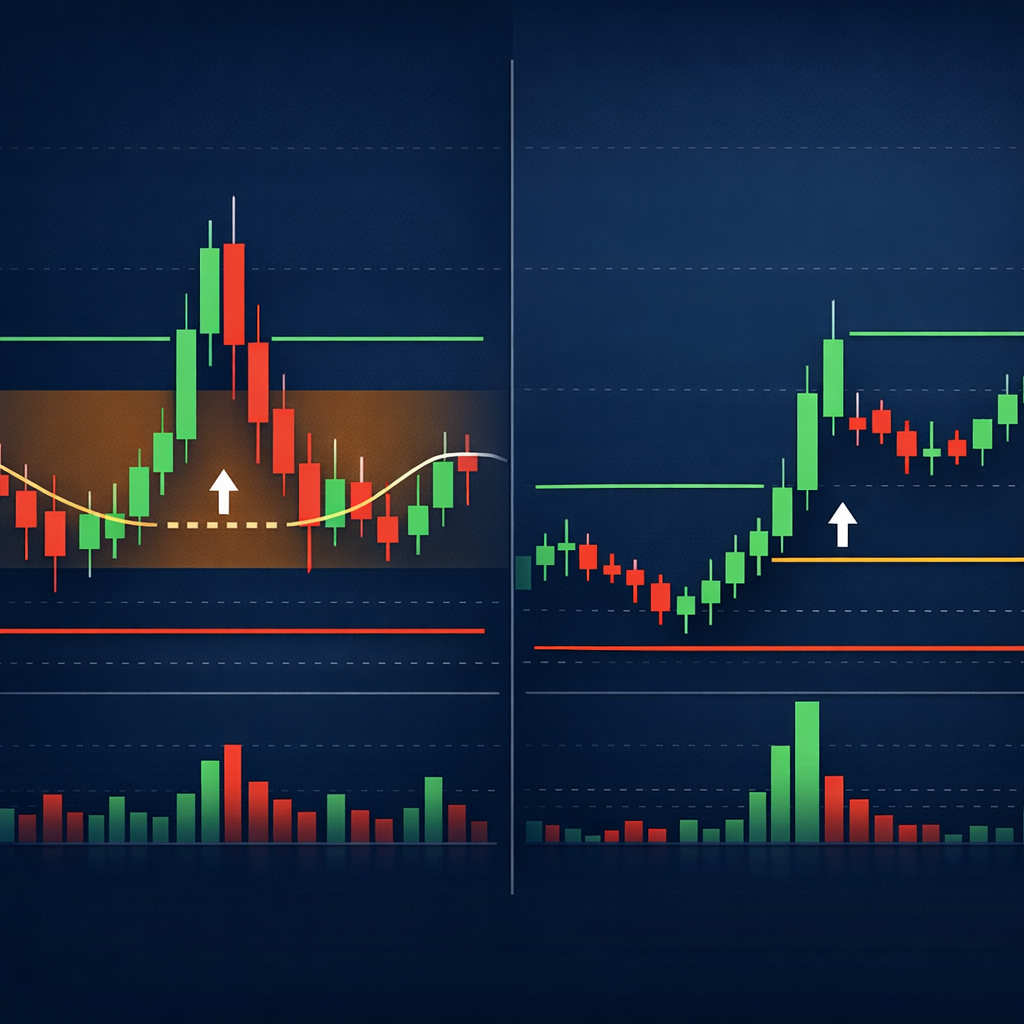
Most FOMC losses aren’t caused by a bad idea. They’re caused by bad execution conditions.
On normal days, you might see gold spreads that feel manageable. During FOMC, spreads can widen sharply and fills can slip—especially if you’re trading large size, using market orders, or placing stops too close.
That’s why we teach members to treat FOMC like a different instrument. Same symbol (XAUUSD), different behavior.
What to expect around FOMC (realistic)
- Spread widening: temporary expansion during the first minutes after release.
- Slippage: stop orders can fill worse than expected, especially during fast spikes.
- Wick hunts: both sides can get swept before direction is clear.
- Platform lag: some brokers widen margin requirements or slow execution.
Practical execution rules we use with signals
- No “instant chasing”: if price already moved $15+ in seconds, wait for a pullback or structure.
- Prefer limit entries on pullbacks when structure is clear, rather than panic market buys/sells.
- Use wider, logical stops (often $10–$25 on gold) and reduce lot size accordingly.
- Avoid stacking multiple trades during the spike. One clean execution beats three emotional clicks.
Comparison: three ways traders approach FOMC (and what it costs)
| Approach | When you enter | Pros | Cons | Best for |
|---|---|---|---|---|
| Pre-news breakout gamble | Minutes before statement | Early positioning, big RR if nailed | High fakeout risk, stop sweeps, unpredictable | Experienced traders with strict rules |
| Release spike chase | 0–2 minutes after statement | Feels exciting, “I caught the move” | Worst spreads/slippage, whipsaws, emotional entries | Generally not recommended |
| Post-news confirmation entry | 5–20 minutes after statement | Better structure, clearer invalidation, more consistent | May miss the first $10–$15 of the move | Signal traders and disciplined intraday traders |
If you’re using signals, the third approach is usually the best balance. It aligns with how high-quality signal providers operate: wait for confirmation, then execute with defined risk.
4) Pre-FOMC preparation: the 30-minute checklist that changes everything
FOMC winners don’t “wing it.” They prepare like it’s a scheduled volatility event—because it is.
Here’s a step-by-step checklist you can run in 30 minutes. It’s designed to work whether you trade manually or follow premium Telegram signals.
Step 1: Mark the higher-timeframe map (H4 + D1)
Before you look at M5 candles, anchor your bias to real levels. On gold, higher-timeframe levels act like magnets during FOMC.
- Identify the nearest D1 swing high/low around current price.
- Mark H4 supply/demand zones in the $2610–$2690 area.
- Highlight the prior day high/low and the current day open.
Example: if gold is at $2650, you might mark resistance at $2668–$2675 and support near $2632–$2625. Those become your “decision zones.”
Step 2: Check the dollar and one major FX pair
You don’t need to analyze everything. But you do need context.
- DXY ~106.80: is it trending or ranging?
- USD/JPY ~149.50: often reacts strongly to rate expectations.
- EUR/USD ~1.0520: risk tone and dollar strength proxy.
If DXY is pressing higher into the event and USD/JPY is bid, gold may be more vulnerable to downside on hawkish surprises. If DXY is soft, gold may squeeze higher on dovish hints.
Step 3: Decide your “FOMC mode” (choose one)
- Mode A (Conservative): trade only post-news confirmation.
- Mode B (Balanced): one small pre-news attempt + post-news confirmation only if conditions are clean.
- Mode C (Aggressive): advanced traders only; multiple tactics with strict max loss.
If you’re newer or you’re following signals, Mode A is usually best. You’ll avoid the worst execution window and still catch the real move.
Step 4: Set your risk cap for the whole event
This is the rule that prevents revenge trading.
- Decide your max loss for FOMC day (example: 1% of account).
- Split it into attempts (example: 0.5% + 0.5% max).
- If you hit the cap, you’re done—no exceptions.
Step 5: Prepare your signal execution plan
If you trade with United Kings, your signal will come with Entry, SL, and TP. Your job is to execute it intelligently.
- Confirm it aligns with your marked levels.
- Check spread before entering.
- Use the correct lot size for the wider stop.
If you’re new to signal execution mechanics, review our educational resources on the United Kings blog and the practical onboarding inside our signals hub.
5) The core XAUUSD FOMC strategy: post-spike confirmation entries (step-by-step)
If you want a repeatable gold signals FOMC strategy, this is the backbone. It’s designed to reduce the two biggest killers: fakeouts and bad fills.
The idea is simple: let the first spike happen, then trade the market’s acceptance or rejection of key levels.
Step-by-step: bullish confirmation play (example around $2650)
Scenario: Gold is at $2650 before the statement. The release triggers a spike to $2672, then price pulls back.
- Step 1 (Identify the impulse): wait for the first directional candle to close on M1/M5.
- Step 2 (Mark the spike high and pullback zone): spike high at $2672; pullback area $2660–$2662.
- Step 3 (Confirmation): look for M5 to hold above a key level (e.g., $2660) and print higher lows.
- Step 4 (Entry): buy on confirmation at $2662 (or a limit on retest if structure is clean).
- Step 5 (Stop loss): place SL below the pullback low, e.g., $2648 (risk: $14).
- Step 6 (Take profit): target 1:2 to 1:3 RR. With $14 risk: TP1 $2690 (approx 2R), TP2 could be managed/trailing if trend continues.
Notice what we avoided: buying the first candle at $2668–$2672 with a tight stop. That’s how traders get wicked out.
Step-by-step: bearish confirmation play (example around $2650)
Scenario: Gold spikes down from $2650 to $2628, then bounces.
- Step 1: let the spike print and stop hunting finish.
- Step 2: mark the breakdown level (e.g., $2640 was support pre-news).
- Step 3: wait for a pullback toward $2638–$2642.
- Step 4: enter sell after M5 rejection (lower high + bearish close).
- Step 5: SL above rejection high, e.g., $2655 (risk: $15–$17).
- Step 6: TP at 2R/3R. With $16 risk: TP1 $2606 is outside today’s guideline range, so a more realistic TP within context could be $2610–$2615 if liquidity is there, or TP1 $2620 for partials and trail remainder.
On FOMC, the cleanest trades often come from a broken level retest. That’s why we emphasize levels first, indicators second.
Where signals fit in this strategy
A high-quality signal gives you the structure: entry, SL, TP. Your FOMC playbook tells you when to execute it.
In United Kings, we focus heavily on London and New York session execution because that’s where liquidity and follow-through are most reliable. If you want dedicated gold trade ideas, start with our premium gold signals page.
6) Filtering false breakouts with multi-timeframe levels (the “anti-whipsaw” method)
FOMC creates the perfect environment for false breakouts. Price will often break a range, trigger breakout traders, then reverse hard.
Your defense is not a magical indicator. It’s multi-timeframe confluence plus a rule-based confirmation trigger.
The three-layer level system
- Layer 1 (D1/H4): major swing highs/lows and supply/demand zones.
- Layer 2 (H1/M15): session highs/lows, consolidation ranges, and key retests.
- Layer 3 (M5/M1): execution triggers (break + retest, rejection candles, structure shift).
Here’s how it plays out in real time.
Gold is at $2650. You marked H4 resistance at $2668–$2675. FOMC spikes price to $2674 then immediately dumps to $2658.
Many traders see “it hit $2674” and assume breakout. But your level map says: that was resistance. The spike was likely a liquidity grab.
Confirmation rules that reduce fakeouts
- Rule A: Don’t buy a breakout into H4/D1 resistance unless M15 closes above and holds.
- Rule B: If the spike breaks a level but closes back inside the range on M5, treat it as a fakeout until proven otherwise.
- Rule C: Prefer entries on the retest (pullback) rather than the first touch.
A practical fakeout filter example (numbers)
Pre-news range: $2642–$2656. FOMC spikes up to $2670 then drops back under $2656 within 3 minutes.
- If M5 closes back below $2656, we avoid long chasing.
- We wait for a pullback to $2654–$2656 and look for rejection.
- A sell entry at $2653, SL $2668 (risk $15), TP $2623 (2R) is a structured plan.
This is how you turn chaos into a checklist. It also makes signals easier to follow because you’re not reacting emotionally to every wick.
If you want a broader framework for handling risk across different signal types (including news days), keep our risk guide bookmarked: risk management strategies when using forex signals.
7) Risk management for FOMC gold trades: wider stops, smaller size, fewer trades
During FOMC, your edge is not “finding direction.” Your edge is surviving the volatility long enough to capitalize on direction once it’s clear.
That requires three adjustments: wider stops, reduced lot size, and fewer attempts.
1) Wider stops (but still logical)
Gold can print a $8–$12 wick in seconds during the release. If your stop is $6 away, you’re basically donating liquidity.
A realistic FOMC SL range for XAUUSD is often $10–$25, depending on your entry method and timeframe.
- Post-news confirmation trades: often $10–$18 stops.
- Press conference continuation trades: often $12–$25 stops.
The key is that the stop must be placed beyond a structure point: below a pullback low for longs, above a pullback high for shorts.
2) Smaller position size (the non-negotiable)
If your stop is bigger, your lot size must be smaller. That’s how you keep risk consistent.
Example: you normally risk 1% with a $10 stop. On FOMC you use a $20 stop. If you keep the same lot size, you just doubled your risk to 2%.
Professional rule: double the stop, halve the size (roughly). Your account doesn’t care about excitement. It cares about math.
3) Fewer trades (quality over quantity)
FOMC days tempt traders into overtrading because the candles are big. But big candles often come with big randomness.
- Plan for 1–2 trades max around the event.
- Only take the second trade if the first was executed correctly (not revenge).
- If spreads are abnormal, skip the event. Missing one day is not missing your career.
Partial profits and trailing stops (how to lock gains)
On gold, a common approach is:
- Take partial at 1R (risk amount).
- Move SL to breakeven only after structure confirms (not instantly).
- Let the remainder aim for 2R–3R or trail behind M15 swings.
Example: Buy $2662, SL $2648 ($14 risk). At $2676 (1R), take partial. If price holds above $2668, trail toward $2690 as the 2R target.
This is also why experienced signal providers share clear SL/TP levels. At United Kings, we aim for clarity and consistency, not hype—especially on news days.
8) Using signals around FOMC: how to execute like a pro (not a copier)
Signals can be a powerful tool during FOMC—if you treat them as a structured plan, not a command to click instantly.
At United Kings, our Telegram community is built around clear Entry, SL, and TP levels, with an emphasis on London and NY session trading. We also provide educational context so you understand the “why,” not just the “what.”
What a good FOMC signal should include
- Exact entry zone (not vague “buy now”).
- Stop loss that makes sense relative to volatility.
- Take profit targets with realistic RR (often 1:2 or 1:3).
- Timing guidance (e.g., “wait for M5 close above X”).
The “3-check” execution rule (simple and effective)
Before you place any trade during FOMC, run these checks:
- Check 1: Timing — Are we in the spike zone or confirmation zone?
- Check 2: Spread — Is spread acceptable for your stop size?
- Check 3: Level alignment — Does the signal align with your H4/D1 map?
If you fail any check, you either wait or skip. That’s how you avoid “perfect signal, terrible fill.”
Two practical ways to combine signals with the FOMC playbook
- Method A (Confirmation entry): Use the signal direction, but only enter after M5 confirms (break + hold + retest).
- Method B (Level-first execution): Use the signal’s entry zone only if it’s at a pre-marked level (e.g., H4 demand at $2630–$2635).
A realistic signal execution example
Signal: SELL XAUUSD 2648–2652, SL 2668, TP1 2620, TP2 2612.
FOMC spikes up to $2665 then drops. Price retests $2650 and prints an M5 bearish engulfing candle.
- You enter at $2649.
- Your SL at $2668 is $19 risk (appropriate for news volatility).
- TP1 at $2620 is $29 reward (~1.5R). TP2 at $2612 is $37 reward (~2R).
Could you get a better RR? Possibly. But on FOMC, execution quality and survival matter more than theoretical perfection.
If you’re still learning how Telegram signals work in real trading conditions, this beginner guide helps: how to use forex signals on Telegram (beginner-friendly).
9) Advanced FOMC tactics for XAUUSD: the “two-stage move” and NY continuation
Once you’ve mastered confirmation entries, you can start recognizing a common FOMC behavior: the two-stage move.
Stage 1 is the statement spike. Stage 2 is the press conference repricing. Gold often makes a big move, retraces, then trends again—sometimes in the same direction, sometimes reversing.
The two-stage move pattern (what it looks like)
- Stage 1: fast spike to a major level (liquidity grab).
- Stage 2: pullback and consolidation (market interprets).
- Stage 3: continuation or reversal (trend day begins).
Example: gold at $2650 spikes to $2678 on the statement, then drifts down to $2660. During the press conference, Powell sounds hawkish, DXY firms, and gold breaks $2660 and trends to $2635.
Traders who bought the spike got trapped. Traders who waited for Stage 3 got paid.
How to trade the NY continuation (step-by-step)
- Step 1: Identify the post-statement range (e.g., $2660–$2672).
- Step 2: Wait for a clean break on M15 with a strong close.
- Step 3: Enter on the retest of the broken range edge.
- Step 4: Place SL beyond the retest swing (often $15–$25).
- Step 5: Target the next H4 level (e.g., $2635, then $2620).
When to avoid advanced tactics
Skip these if:
- Spreads remain abnormal for too long.
- You already hit your daily risk cap.
- You can’t clearly define structure on M15/H1.
Advanced tactics are optional. Risk control is mandatory.
If you want to diversify beyond gold, we also cover majors with the same structured approach on our forex signals page, and multi-market access via United Kings signals.
10) Common FOMC gold mistakes (and the exact fixes)
Most traders don’t need a new strategy. They need to stop repeating the same three mistakes.
Mistake #1: Trading the statement like it’s a normal candle
On a regular day, a $6 candle on gold might be meaningful. On FOMC, it’s noise.
Fix: Treat the first 1–5 minutes as a “no judgment zone.” Let the market print the spike and show acceptance or rejection.
Mistake #2: Using normal-day stop losses
A $7 stop on FOMC is often a guaranteed stop-out, even if your direction is correct.
Fix: Use a volatility-appropriate SL (often $10–$25) and reduce size. Keep your account risk constant.
Mistake #3: Entering because the community is excited
Telegram can be a superpower, but it can also create FOMO. You see messages flying, someone posts profits, and you jump in late.
Fix: Follow your execution rule: timing, spread, level alignment. If you missed the move, you wait for the retest or you skip.
Mistake #4: Ignoring the press conference
Traders treat the statement as the whole event. Then Powell speaks and the market reverses.
Fix: Plan for two stages. If you trade the statement, you manage aggressively and don’t assume the move is “done.”
Mistake #5: Revenge trading after slippage
Slippage feels unfair. It triggers emotional decision-making.
Fix: Pre-define your max loss for the event. If execution is poor, reduce activity. The market will be here tomorrow.
For traders who want a deeper guide on surviving sudden volatility beyond FOMC, this is relevant reading: how gold signals react to unexpected news events.
11) Putting it all together: a complete XAUUSD news trading plan for FOMC day
Let’s turn everything into a single, repeatable plan you can follow each FOMC. Save this section and run it like a checklist.
Phase 1: 2–4 hours before (context + levels)
- Note current price: XAUUSD around $2650.
- Mark D1/H4 levels within $2610–$2690.
- Check DXY (~106.80) and USD/JPY (~149.50) for trend/range.
- Decide your mode (Conservative/Balanced/Aggressive).
Phase 2: 60–15 minutes before (set traps, not trades)
- Identify the pre-news range (example: $2642–$2656).
- Mark the range high/low and midpoint.
- Set alerts at key levels (e.g., $2656, $2642, $2668, $2632).
- Prepare lot sizing for a $15–$20 stop.
Phase 3: Statement release (protect capital)
- Avoid market orders in the first minute unless you’re highly experienced.
- Let the spike form. Record spike high/low.
- Watch spread behavior—if it’s extreme, wait longer.
Phase 4: Confirmation entry (your main trade)
- Wait for M5 structure: break + hold + retest, or rejection at a major level.
- Enter with the signal (or your plan) only when timing/spread/levels align.
- Use SL beyond structure (often $10–$25).
- Target 1:2 or 1:3 RR (example: $14 risk, $28–$42 reward).
Phase 5: Press conference continuation (optional second trade)
- Only if you’re below your risk cap and structure is clean on M15.
- Trade the breakout of the post-statement range with retest.
- Manage aggressively: partials at 1R, trail remainder.
Phase 6: Post-event review (how you improve fast)
- Screenshot entries and exits.
- Write 3 notes: What worked, what didn’t, what to change.
- Track whether you followed the checklist, not just P/L.
This is the difference between “I traded FOMC” and “I have an XAUUSD FOMC system.”
FAQ: Trading XAUUSD around FOMC with signals
1) Is it safe to trade gold during FOMC?
It can be traded, but it’s not “safe.” Volatility, spread widening, and slippage are real risks. If you’re a beginner, consider demo trading first and focus on post-news confirmation entries.
2) What is the best timeframe to trade XAUUSD during FOMC?
Use H4/D1 to mark major levels, M15 to read structure, and M5 for execution. M1 can be too noisy during the spike.
3) Should I trade before the FOMC release?
Most traders shouldn’t. Pre-news trades have a high fakeout rate. The more consistent approach is waiting 5–20 minutes for confirmation and then entering with a defined stop and target.
4) How wide should my stop loss be on gold during FOMC?
Many structured FOMC trades use $10–$25 stops depending on entry type and volatility. The key is to reduce lot size so your account risk stays constant.
5) Do United Kings signals work during FOMC?
Signals can be effective when executed with the right rules: timing, spread awareness, and confirmation. Past performance doesn’t guarantee future results, and you should always manage risk—especially on news events.
Risk Disclaimer: Forex and gold (XAUUSD) trading involves significant risk and may not be suitable for all investors. You can lose more than your initial deposit. Volatility during news events like FOMC can cause rapid losses, slippage, and widened spreads. Past performance is not indicative of future results. This article is for educational purposes only and does not constitute financial advice. If you are new, practice on a demo account before trading live.
Join United Kings: trade FOMC with a real plan (not guesswork)
If you want to trade FOMC with structure, you need two things: a volatility playbook and clear, actionable levels.
United Kings delivers premium Telegram signals for forex and gold with a focus on London and NY session execution, a community of 300K+ active traders, and an approach built around clarity: Entry, SL, TP—not hype.
- Explore our full access: United Kings premium signals
- Focused on gold? Start here: XAUUSD gold signals
- Trading majors too? See: forex signals
- Want to compare plans? View pricing (Starter 3 Months $299, Best Value 1 Year $599 with 50% savings + FREE ebook, Lifetime $999)
- Join the community on Telegram: United Kings official Telegram channel
We also back our service with a 48-hour money-back guarantee so you can evaluate the quality and structure with confidence.
Ready to trade XAUUSD around FOMC with a step-by-step plan and premium signal support? Join United Kings today and turn volatility into a controlled opportunity.