Ever followed a clean forex or gold signal… only to watch it spike 20–40 pips (or $15 on XAUUSD) in both directions in seconds?
That’s not “bad analysis.” That’s news impact—CPI, NFP, and FOMC turning a normal market into a stop-hunt machine.
In today’s market context, gold (XAUUSD) is trading around $2650 (+0.35% on the day), EUR/USD sits near 1.0520, GBP/USD near 1.2680, USD/JPY around 149.50, and DXY is elevated near 106.80.
When the dollar is firm and macro data is hot, the “first move” after news is often a trap.
This guide teaches a rule-based news filter for forex signals you can apply in 60 seconds before you place any trade.
TL;DR: The News-Impact Calendar Filter (CPI, NFP, FOMC)
- Use a no-trade window: typically 30 minutes before and 15–60 minutes after high-impact releases (CPI, NFP, FOMC).
- Check spreads + execution risk: if XAUUSD spread jumps or majors widen (e.g., EUR/USD from 0.8 to 2.5 pips), skip or reduce size.
- Delay entries until price reclaims structure: let the first spike print, then trade the retest with defined risk.
- Reduce risk if you must trade: cut position size to 25–50% and widen SL only if your RR stays ≥ 1:2.
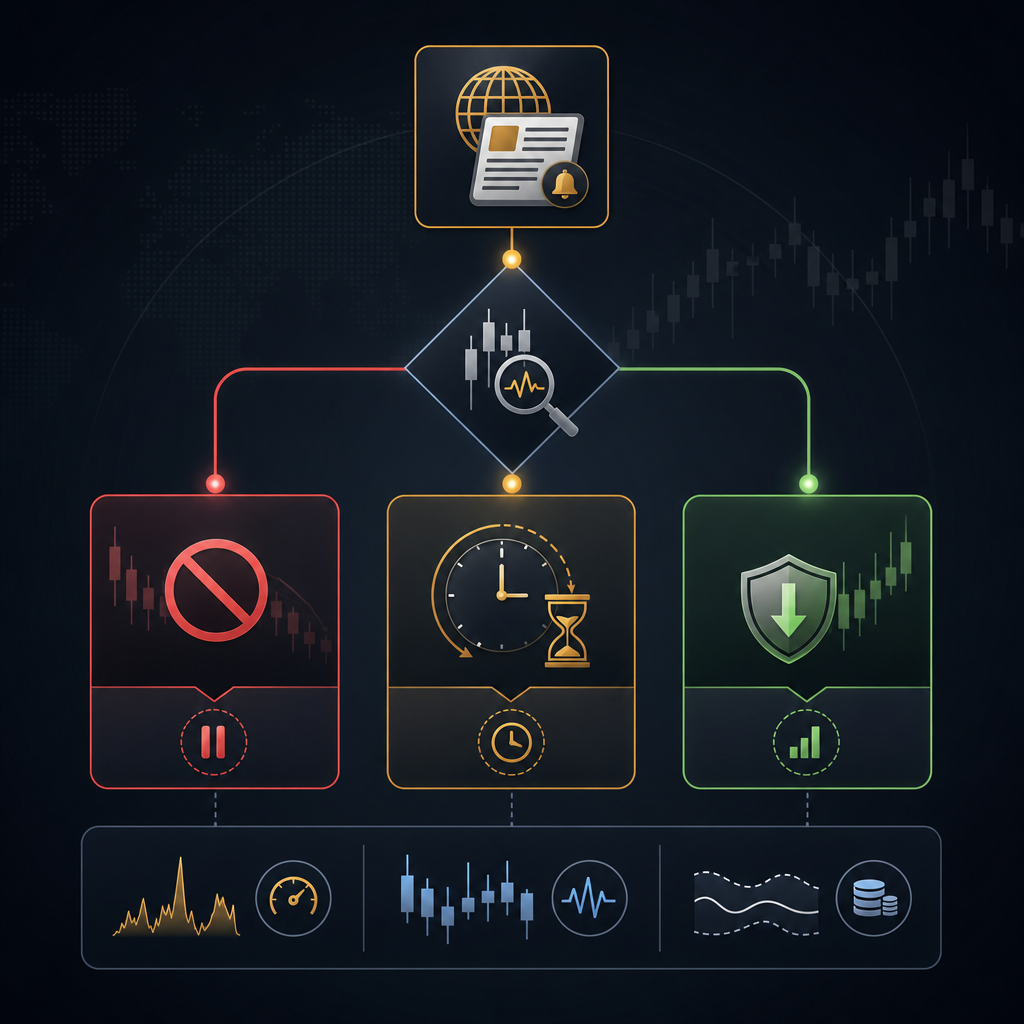
- Use a decision tree: skip, delay, or trade smaller based on time-to-news, volatility, and liquidity session.
- Goal: protect signal performance by avoiding whipsaws, slippage, and “random” stop-outs around macro events.
Why CPI, NFP, and FOMC Break “Good” Signals

Signals fail around major news for reasons that have nothing to do with the entry logic.
The issue is market microstructure: liquidity pulls, spreads widen, and price jumps through levels without trading there.
1) Liquidity disappears right when you need it most
Before CPI or NFP, many banks and liquidity providers reduce exposure.
That means your market order can fill worse than expected, and your stop can get slipped.
2) The “first move” is often engineered
High-impact releases frequently trigger a fast spike that grabs liquidity above/below obvious highs and lows.
On XAUUSD, it’s common to see a $10–$18 wick in seconds, then a full reversal.
3) Correlations tighten, then snap
With DXY around 106.80, gold and USD pairs can react violently to inflation surprises.
EUR/USD at 1.0520 might drop 30 pips instantly on a hot CPI, then retrace 70% as liquidity returns.
4) Your “normal” stop size becomes too small
A gold stop of $12 is reasonable in normal London/NY flow.
During FOMC statement + press conference, that same stop can be “noise.”
5) Spread and slippage turn a winning setup into a losing trade
Even if direction is correct, execution can ruin the trade.
Example: you buy XAUUSD at $2650 with a $15 SL and $30 TP (1:2).
If you get slipped $3–$5 on entry and $3 on stop, your effective risk balloons, and your RR collapses.
This is why professional signal users don’t just ask, “Is the setup valid?”
They ask, “Is the environment tradable right now?”
High-Impact News That Matters Most for XAUUSD and Majors
Not all “red folder” events hit the same.
For a practical filter, you want to focus on releases that reliably change rates expectations, real yields, and USD demand.
The Big Three: CPI, NFP, FOMC
- US CPI: drives inflation expectations → influences Fed path → moves DXY and real yields → hits XAUUSD hard.
- US NFP: labor strength affects growth + inflation expectations; often causes the sharpest initial whipsaw in FX.
- FOMC: statement, dot plot (when applicable), and press conference can create two waves of volatility.
Secondary events you should still filter
Depending on the week, these can be nearly as disruptive:
- PCE (Fed’s preferred inflation gauge)
- Retail Sales (growth impulse)
- ISM PMI (cycle signal)
- Fed Chair speeches (especially if markets are positioned one way)
- ECB/BoE decisions for EUR/USD and GBP/USD
Asset-specific sensitivity (quick map)
XAUUSD is extremely sensitive to anything that changes real yields and USD strength.
USD/JPY near 149.50 can be hypersensitive to US yields and risk sentiment, and can move 80–150 pips on big surprises.
EUR/USD and GBP/USD often move in two steps: spike, retrace, then trend once liquidity returns.
So the filter isn’t about avoiding news forever.
It’s about avoiding the worst 30–90 minutes when pricing is chaotic.
Comparison Table: Three Ways to Handle Signals Around News
Most traders fall into one of three approaches around CPI/NFP/FOMC.
Only one of them is consistently sustainable for signal followers.
| Approach | What You Do | Pros | Cons | Best For |
|---|---|---|---|---|
| Trade through news | Take signals normally even 1–5 minutes before releases | Catch big moves if direction is right | High slippage, spread spikes, random stop-outs, emotional decisions | Specialized news traders with fast execution |
| Hard no-trade window | Skip signals inside fixed time windows around red events | Protects equity curve, reduces whipsaws, improves consistency | You miss some legitimate breakouts | Signal followers and prop-style risk control |
| Conditional filter | Decide based on spread, volatility, and structure after release | Captures post-news trends with controlled risk | Requires discipline and a checklist | Intermediate traders optimizing performance |
This article gives you a blended method: a hard no-trade window for the most dangerous minutes, plus a conditional filter for re-entry after the dust settles.
The Core Framework: Your Rule-Based “No-Trade Window”
If you want to avoid whipsaws with signal trading, you need a simple rule you can follow even when you’re busy.
Here’s the framework we recommend for most traders using forex and gold signals.
Step 1: Identify “High Impact” events for your pairs
For XAUUSD and USD pairs, prioritize US CPI, NFP, and FOMC.
For EUR/USD, add ECB rate decisions and eurozone CPI.
For GBP/USD, add BoE decisions and UK CPI/Jobs.
Step 2: Apply the standard no-trade window
- CPI / NFP: No new trades 30 minutes before and 30 minutes after.
- FOMC statement: No new trades 60 minutes before and 30 minutes after.
- FOMC press conference: Treat as a second event—no new trades 15 minutes before and 15–30 minutes after.
These are baseline rules.
If spreads or volatility remain abnormal, extend the window.
Step 3: Manage existing positions before news
If you’re already in a trade and news is approaching, you have three choices:
- Close partial and reduce exposure.
- Move stop to reduce risk (only if structure supports it—don’t tighten into noise).
- Exit fully if the trade hasn’t moved and you’re near entry.
Example on XAUUSD:
You’re long from $2642, SL $2629 (13 risk), TP $2668 (26 reward, 1:2).
CPI is in 20 minutes and price is only at $2646.
Rule-based action: either take partial at $2646–$2648 and reduce size, or close and re-enter post-news.
Step 4: Resume trading only when conditions normalize
After the window ends, you still need a quick “tradable conditions” check:
- Spreads back near normal
- 1–2 candles close with smaller wicks
- Price respects a level (break + retest, or sweep + reclaim)
This framework is boring.
That’s why it works.
Volatility + Spread Checks: The Two Fastest Filters
News filtering isn’t only about time.
Sometimes the calendar is quiet, but liquidity is thin, spreads are wide, and price is jumpy.
Filter #1: Spread threshold rule
Create a “normal spread” baseline from your broker during London and NY sessions.
Then apply a hard rule: if spread is above X, you don’t take new signals.
- XAUUSD: if spread is consistently above your normal by 2x, skip.
- EUR/USD: if spread widens above 2.0 pips during liquid hours, skip.
- GBP/USD: if spread widens above 2.5–3.0 pips, skip.
- USD/JPY: if spread widens above 2.0–2.5 pips, skip.
Why so strict?
Because spread is a hidden cost that destroys RR over time, especially for tight-stop signal styles.
Filter #2: Volatility regime rule (simple candle test)
You don’t need complex ATR calculations to spot a danger zone.
Use a simple candle test on your trading timeframe (often M5–M15 for intraday signals):
- If the last 3 candles have unusually long wicks (e.g., XAUUSD wicks of $6–$10 on M5), stand down.
- If the last 15 minutes range is abnormally large (e.g., XAUUSD moves $18–$25 without structure), stand down.
- If EUR/USD prints a 15-minute candle of 25–40 pips and immediately retraces, stand down until it settles.
Realistic example in today’s context
Gold is around $2650.
Ten minutes before NFP, it spikes from $2648 to $2662 and back to $2646.
That’s a $16 up and $16 down in minutes.
Even the best entry logic can’t reliably survive that with a $10–$25 stop.
So the rule is simple: when spreads widen and wicks grow, your edge shrinks.
Filtering is not fear—it’s math.
The Decision Tree: Skip, Delay, or Reduce Risk (Practical Rules)
Most traders don’t fail because they lack a strategy.
They fail because they don’t have a decision process when conditions change.
Use this decision tree every time a signal arrives.
Step-by-step decision tree
- Is a high-impact event within the next 60 minutes?
- If yes: go to step 2.
- If no: go to step 4.
- Is it CPI, NFP, or FOMC?
- If yes: skip new entries inside the no-trade window.
- If no (secondary red event): go to step 3.
- Check spreads + recent wicks
- If spreads are elevated or wicks are large: skip.
- If spreads are normal and structure is clean: reduce risk (25–50%) or delay to a retest.
- Is this signal aligned with the session and liquidity?
- London/NY overlap: conditions usually best.
- Late NY / pre-Asia: be stricter with filters.
- Is the entry “at level” or “in the middle”?
- At level (support/resistance, sweep, retest): acceptable.
- In the middle of a range: delay or skip.
Concrete examples (signals + news)
Example A (Skip): You receive a buy signal on XAUUSD at $2651, SL $2638, TP $2677.
CPI releases in 18 minutes.
Rule: it’s inside the 30-minute no-trade window → skip.
Example B (Delay): EUR/USD sell signal at 1.0520, SL 1.0550, TP 1.0460.
NFP released 20 minutes ago and spreads are normalizing.
Rule: wait for a break + retest of 1.0520 or a lower-high to form → delay entry by 10–20 minutes.
Example C (Reduce risk): GBP/USD buy signal at 1.2680, SL 1.2645, TP 1.2750.
There’s a Fed speaker in 45 minutes (not FOMC), spreads are tight, London is active.
Rule: half risk and be ready to protect position before the speech.
With this tree, you stop debating and start executing rules.
How to Trade XAUUSD Around CPI, NFP, and FOMC Without Getting Shaken Out
If you trade gold signals, you already know the pain.
XAUUSD can respect a level perfectly for hours, then ignore it completely for 90 seconds after a release.
Understand gold’s “two-phase” news behavior
Gold often moves in two phases around US macro:
- Phase 1 (whipsaw): rapid spike to grab liquidity, wide spreads, poor fills.
- Phase 2 (real move): trend emerges after the market digests the data and reprices yields and USD.
Your job is to avoid Phase 1 and participate in Phase 2.
A practical post-news entry model (break-and-retest)
Let’s use realistic levels around today’s price.
Gold is at $2650 pre-CPI.
After CPI, it spikes down to $2632, then rallies to $2660.
Instead of chasing the spike, you wait for:
- A close above $2655–$2660 (reclaim)
- A retest into $2652–$2656 holding as support
- Then you enter long with defined risk
Example trade plan:
- Entry: $2655
- Stop loss: $2642 (13 risk)
- Take profit 1:2: $2681 (26 reward)
- Take profit 1:3: $2694 (39 reward, only if volatility supports)
This aligns with the guideline SL distance ($10–$25) and keeps RR healthy.
When to avoid gold completely (hard rules)
- If spreads are unstable for 30+ minutes after FOMC.
- If M5 candles show repeated $8–$12 wicks both ways.
- If price is trapped in a $20–$25 range with no structure (classic chop).
Why London and NY session timing matters
United Kings focuses heavily on London and NY session trading because that’s where liquidity is deepest.
But even in those sessions, CPI/NFP/FOMC can distort flow.
So the correct approach is: trade the session, filter the minutes.
If you want more gold-specific survival tactics for chaos, pair this guide with our article on how gold signals react to unexpected news events.
How to Filter Forex Signals on EUR/USD, GBP/USD, and USD/JPY During Red News
Forex whipsaws look smaller than gold, but the mechanics are identical.
Spreads widen, stops get slipped, and the first move often reverses.
EUR/USD (around 1.0520): what typically happens
EUR/USD is a liquidity monster, but CPI/NFP can still create 30–70 pip swings.
A classic pattern is a 25–35 pip spike, followed by a 60% retrace, then continuation.
Filter rule for EUR/USD:
- Inside no-trade window: skip new entries.
- After release: only trade if price forms a lower-high/higher-low and breaks structure.
Example: After NFP, EUR/USD dumps from 1.0520 to 1.0485, then bounces to 1.0510.
Instead of buying the bounce, wait for a break above 1.0510 and a retest holding 1.0505–1.0510.
GBP/USD (around 1.2680): more whip, less forgiveness
GBP/USD tends to whip harder than EUR/USD because it’s more sensitive to risk sentiment and positioning.
Stops that work in normal flow get tagged more easily during news.
Filter rule for GBP/USD:
- Be stricter on spread thresholds (Cable can widen fast).
- Prefer post-news retests over instant breakouts.
Example trade plan (post-news):
- Entry: 1.2685 after a reclaim
- SL: 1.2655 (30 pips)
- TP: 1.2745 (60 pips, 1:2)
USD/JPY (around 149.50): the yield-driven rocket
USD/JPY is often the cleanest expression of US yield moves.
That also means it can gap, spike, and run stops aggressively on CPI/FOMC.
Filter rule for USD/JPY:
- Avoid entries right before releases because slippage can be severe.
- After releases, wait for a 5–15 minute base and then trade the break with a retest.
Example: USD/JPY spikes from 149.50 to 150.20 on CPI, then retraces to 149.70.
Chasing at 150.10 is how traders get trapped.
Waiting for a base and retest gives you a defined invalidation point.
If you’re building your overall routine as a signal follower, our main hub at forex signals pairs well with this filter framework.
Position Sizing Adjustments: The “Reduce Risk” Playbook (25–50% Rule)
Sometimes you don’t want to fully skip.
Maybe the setup is A+ and you’re trading a post-news retest with structure.
This is where risk scaling protects your account without killing opportunity.
The 25–50% risk rule
When trading within 60–120 minutes after major news (or on days with multiple red events), reduce your normal risk per trade.
- If you normally risk 1.0% per trade, cut to 0.25%–0.50%.
- If you normally risk $100, cut to $25–$50.
This keeps you in the game if volatility returns unexpectedly.
Don’t widen stops blindly
A common mistake is widening SL “because news is volatile.”
That can be valid only if:
- Your entry is still at a meaningful level, not mid-range.
- Your take profit expands proportionally so RR stays ≥ 1:2.
- Your position size is reduced so $ risk stays constant.
Gold example:
Normal plan: Buy $2650, SL $2638 (12), TP $2674 (24).
Post-FOMC volatility: you consider SL $2632 (18).
To keep the same $ risk, you must reduce lot size by 33%.
Use partial profits more aggressively after news
Post-news trends can be fast, but reversals can be violent.
A practical rule:
- Take partial at 1R (risk amount).
- Move stop to reduce exposure only after structure confirms.
This is especially useful on XAUUSD where price can hit +$12 quickly, then retrace $10.
Connect sizing rules to your signal process
If you follow premium signals, your biggest edge is consistency.
Risk scaling makes your equity curve smoother, so you can follow the next signal without hesitation.
For a deeper foundation on sizing and protection, keep our guide bookmarked: risk management strategies when using forex signals.
Execution Rules That Save You: Orders, Slippage, and “Don’t Chase” Discipline
Even with a perfect calendar filter, execution mistakes can recreate the same problem.
So we need a few hard rules that protect you from yourself.
Rule 1: Don’t place market orders during the spike
During CPI/NFP/FOMC, the spread can jump and price can gap.
A market order becomes a blank check.
Instead:
- Wait for the first impulse to finish.
- Trade the retest with a limit order only if spreads normalize.
- Or use a stop order above/below structure after a base forms.
Rule 2: Don’t “improve” the signal entry by chasing
Chasing is when you see price move 10 pips (or $5) in your direction and you jump in late.
That usually places your stop exactly where the retest will go.
Gold example:
Signal idea: sell near $2660 with SL $2675, TP $2630.
Price drops to $2652 and you sell late.
Now your SL is too tight to survive the retest to $2660–$2663.
Rule 3: Add a “max slippage” tolerance (broker/platform dependent)
If your platform allows deviation settings, use them.
If not, your practical alternative is to avoid entries when spreads are unstable and only trade once price prints stable candles.
Rule 4: One trade per event, not five
News whipsaws invite revenge trading.
Set a rule: after CPI/NFP/FOMC, you’re allowed one attempt in the first hour.
If it fails, you wait for the next session setup.
Rule 5: Use session logic—London and NY are your friend, but news is still news
We love London and NY because liquidity is real.
But on news days, liquidity is selective.
So you combine session timing with the calendar filter to avoid the worst minutes.
If you’re building a full signal-following workflow, our resources at United Kings blog help you stack these rules into a repeatable routine.
A Simple Routine: How to Use a News Calendar to Filter Signals in 60 Seconds
You don’t need to stare at the calendar all day.
You need a fast routine you can repeat before every entry.
The 60-second pre-trade checklist
- Check the next 2 hours of news (focus on USD events if trading XAUUSD or USD pairs).
- Is CPI, NFP, or FOMC within your no-trade window?
- If yes: skip new entries.
- Check spreads on your platform.
- If spread is elevated: skip or reduce risk.
- Check last 15 minutes of candles.
- If wicks are large both sides: delay.
- Confirm structure.
- Only take entries near levels (break/retest, sweep/reclaim).
- Decide: skip, delay, or reduce risk using the decision tree.
How this protects your signal performance
Signals are probability tools.
Your job is to avoid conditions where probabilities are distorted by execution costs and random spikes.
Here’s the practical outcome:
- Fewer “unfair” stop-outs.
- More trades that behave normally (levels respected).
- Better emotional control, because you’re not reacting to chaos.
Where United Kings fits in
At United Kings, we focus on clean, session-based opportunities and provide clear Entry, SL, and TP levels.
Our community includes 300K+ active traders, and our approach is built for repeatability, not gambling.
If you’re exploring providers, compare your options with this checklist: forex trading signals provider checklist for beginners.
Common Mistakes Traders Make When Filtering News (And the Fix)
Most traders understand “news is risky.”
They still lose because they apply filters inconsistently.
Mistake 1: Only filtering the release minute
Whipsaws often happen before the release as positions get adjusted.
They also happen after the release when spreads normalize and the second wave hits.
Fix: use the full no-trade window, not just the timestamp.
Mistake 2: Thinking “I’ll just widen my stop”
Widening stops without reducing size increases dollar risk.
And if your TP doesn’t expand, your RR gets worse.
Fix: reduce size first, then adjust SL only if structure supports it.
Mistake 3: Ignoring spreads because the setup looks perfect
Spreads are part of the setup.
If spread doubles, your entry quality is worse even if the chart is identical.
Fix: apply a hard spread threshold rule.
Mistake 4: Overtrading post-news chop
After CPI/NFP, markets can range aggressively for 30–90 minutes.
Signal followers often take multiple trades trying to “catch the real move.”
Fix: one attempt per event in the first hour, then wait for a clean retest or session setup.
Mistake 5: Not aligning the filter with your signal style
Scalp-style signals with tight stops are more vulnerable to news.
Swing-style signals can sometimes tolerate releases if stops are wide and positions are sized small.
Fix: match no-trade windows and sizing rules to your timeframe.
If you want to sharpen your discipline around volatility, our post on psychology of following signals in volatile markets complements this filter perfectly.
Putting It All Together: A Weekly “News Filter Plan” for Signal Followers
Let’s make this operational.
Here’s how you run the filter like a pro across a typical week.
Step 1: Sunday prep (10 minutes)
- Open your economic calendar and mark CPI, NFP, FOMC, and any major central bank decisions.
- Write the release times in your local timezone.
- Decide your no-trade windows in advance.
Step 2: Daily pre-session check (2 minutes)
Before London open and before NY open, check the next 4 hours.
If a red event is coming, you already know how you’ll behave.
Step 3: During the session (follow the decision tree)
When a signal arrives, you run the 60-second checklist.
You don’t negotiate with it.
Step 4: After the event (trade the second move)
For XAUUSD around $2650, post-news opportunities often come from reclaiming key zones like $2640/$2650/$2660 and then trending toward $2675–$2690.
For EUR/USD around 1.0520, it might be a break below 1.0500, retest, and continuation toward 1.0460.
Step 5: Track “filtered vs unfiltered” performance
If you want proof the filter works, track two categories in your journal:
- Trades taken outside no-trade windows
- Trades taken inside or near news
Most traders are shocked how much of their drawdown comes from a handful of news-adjacent trades.
How premium signals fit into this plan
Premium signals give you structure: entry, SL, TP, and timing.
Your calendar filter protects that structure from the worst market conditions.
If you want to see how we organize our trading ecosystem, explore all United Kings signals and our dedicated gold signals page.
FAQ: Filtering Forex & Gold Signals with a News Calendar
1) Should I always avoid trading during CPI, NFP, and FOMC?
If you’re a signal follower, it’s usually wise to avoid initiating new trades inside a strict no-trade window.
You can still trade the post-news structure once spreads normalize and the market shows a clear break-and-retest.
2) What’s the best no-trade window for XAUUSD around CPI?
A practical baseline is 30 minutes before and 30 minutes after.
If gold prints repeated $8–$12 wicks on M5 or spreads remain wide, extend to 45–60 minutes after.
3) Can I keep a trade open through news if I’m already in profit?
Yes, but manage exposure.
Consider partial profits, reducing risk, or exiting if you’re near entry and the event is major.
4) How do I know if spreads are “too wide” for my broker?
Measure your normal spreads during London/NY for a few days.
If spreads are consistently 2x normal (or more), treat conditions as untradable for tight-stop signals.
5) Do United Kings signals account for news events?
We focus on London and NY session opportunities and provide clear Entry/SL/TP levels.
But your execution environment matters—your broker, spreads, and timing—so using this calendar filter is a smart layer of protection.
Risk Disclaimer (Read This Before You Trade)
Forex and gold trading involves significant risk and is not suitable for every investor.
Signals and educational content are not financial advice, and past performance does not guarantee future results.
High-impact news (CPI, NFP, FOMC) can cause extreme volatility, slippage, and losses beyond expected levels.
If you’re new, practice on a demo account first, and use strict risk management on every trade.
Join United Kings: Trade With Structure, Not Stress
If you want a premium signal experience built for real traders, United Kings delivers Telegram forex and gold signals with clear Entry, SL, and TP levels.
We’re proud to support a community of 300K+ active traders and aim for disciplined execution with an 85%+ win rate approach (no guarantees—market risk always applies).
Start here based on what you trade most:
- Premium XAUUSD gold signals for London/NY volatility
- Premium forex signals on major pairs
- Crypto signals if you diversify beyond FX/metals
Choose a plan that fits your commitment level on our pricing page:
- Starter (3 Months): $299 (~$100/mo)
- Best Value (1 Year): $599 (~$50/mo) with 50% savings + FREE ebook
- Unlimited (Lifetime): $999 pay once, access forever
Want the fastest access to the community and updates?
Join our Telegram here: United Kings official Telegram channel.
Bonus confidence: we offer a 48-hour money-back guarantee so you can evaluate the experience with peace of mind.
If you have questions before joining, visit our About United Kings page or reach out via contact.