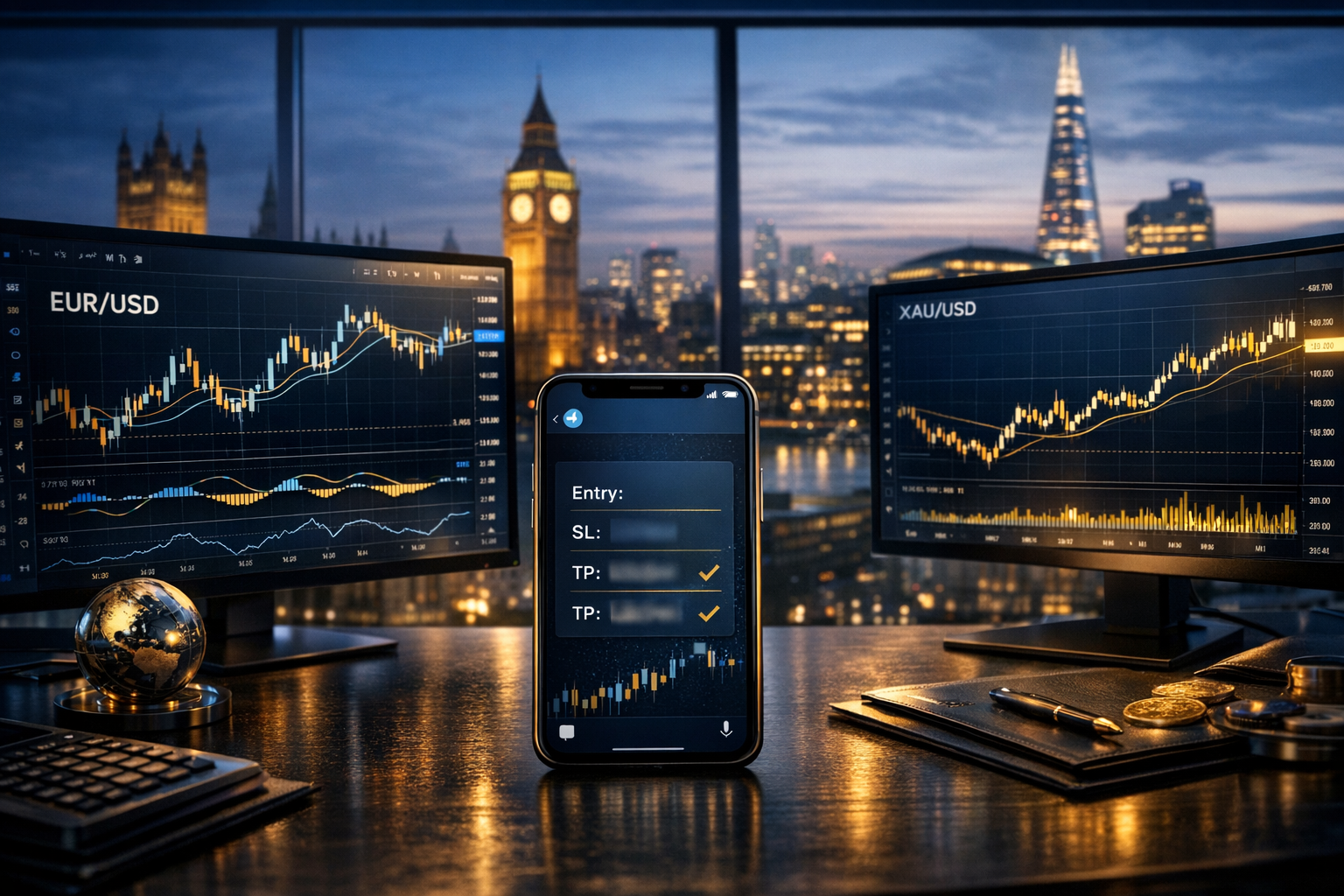
Ever copied a Telegram forex signal, watched price spike 15–30 pips against you, and closed it—only to see it hit take profit an hour later?
That painful pattern is why most traders say “signals don’t work,” when the real issue is execution. In 2025, the edge isn’t just the signal—it’s your process for following telegram forex signals with discipline, timing, and risk control.
This guide is built to be your complete playbook for forex signals telegram trading: how to set up correctly, how to execute like a pro, how to manage multiple signals, and how to avoid the most expensive Telegram mistakes.
TL;DR — The 2025 Telegram Forex Signals Playbook
- Choose execution over hype: the best telegram forex signals fail if you enter late, ignore SL, or oversize lots.
- Trade the right sessions: London and New York sessions usually deliver cleaner moves and better spreads than low-liquidity hours.
- Standardize risk: risk a fixed % per trade (commonly 0.5%–2%), and size lots from SL distance—never from “confidence.”
- Use a timing rule: if price is too far from entry, don’t chase—wait for a pullback or skip.
- Manage multiple signals with a cap: limit correlated exposure (e.g., EUR/USD + GBP/USD) and set a daily loss limit.
- Track outcomes: your results depend on your broker, slippage, spreads, and execution speed—log them weekly.
Why Telegram Forex Signals Dominate in 2025 (And What Changed)

Telegram is where most signal communities live because it’s fast, mobile-first, and built for real-time alerts. In 2025, speed matters more than ever because liquidity pockets can appear and disappear quickly, especially around data releases and session opens.
Right now, market conditions are a good example. The Dollar Index (DXY) is around 106.80, USD/JPY is near 149.50, EUR/USD sits around 1.0520, and GBP/USD is around 1.2680. Gold (XAUUSD) is trading near $2650 with a modest +0.35% 24h change.
That mix—firm USD, elevated yields, and gold holding high—creates frequent intraday rotations. Those rotations are tradable, but only if you execute properly and avoid emotional overrides.
Telegram’s real advantage: structured delivery
High-quality providers don’t just say “buy EURUSD.” They send a complete trade plan: entry, stop loss, take profit targets, and sometimes management rules (move SL to breakeven at +X pips, partial at TP1, etc.).
That structure is exactly what many retail traders lack. It turns trading from guessing into a repeatable routine.
What changed in 2025: execution penalties are higher
Spreads widen faster during news spikes, and slippage is more common on market orders. If your process is “see signal → rush in,” you’ll often enter at the worst possible price.
So the modern edge is: fast but not impulsive. You need rules for whether you can still take the trade, how to size it, and what to do if price is already moving.
Signals are a tool, not a substitute for skill
Think of signals like GPS. They can guide you, but if you ignore the road conditions, you still crash. Your job is to manage risk, avoid overexposure, and follow the plan precisely.
If you want a baseline on what a professional signal looks like, browse our signal ecosystem starting at United Kings Signals, then compare the specialization in Forex Signals and Gold Signals.
Telegram Forex Signals vs Forex Telegram Groups: Know What You Joined
Not every “forex telegram group” is a signals service. Many are chat rooms with opinions, screenshots, and hindsight wins. If you treat that like a signal feed, you’ll get inconsistent entries and inconsistent results.
In 2025, you should separate three categories: signal channels, community groups, and education hubs. The best providers combine all three, but they keep them organized so you don’t miss entries.
Comparison: What you should expect (and what to avoid)
| Feature | Premium Signal Channel | Free “Forex Telegram Group” | Copy-Trading / Social Feed |
|---|---|---|---|
| Trade format | Clear Entry / SL / TP, often multiple targets | Vague calls (“buy now”, “sell soon”) | Auto-copied trades, limited context |
| Execution timing | Planned around sessions and liquidity | Random timing, hype-driven | Instant copy, but slippage varies |
| Risk guidance | Risk rules, SL discipline, drawdown control | Often none, or “high leverage” culture | Depends on master trader, you still need limits |
| Transparency | Track record, trade history, post-analysis | Cherry-picked wins, deleted losses | Performance visible, but strategy unclear |
| Best for | Traders who want a repeatable process | Entertainment, networking (not execution) | Hands-off approach (still risky) |
The fastest way to identify “noise”
If the channel posts 20–50 signals a day, it’s usually noise. If it posts “VIP” upsells every hour, it’s marketing, not trading. If entries never include stop losses, it’s gambling.
Professional signals look boring. They repeat the same structure. They respect risk. They don’t need drama.
Where United Kings fits
United Kings is built as a premium Telegram-first service: clean trade formatting, London/NY session focus, and education alongside alerts. The community is large (300K+ active traders), but the signal stream stays structured so you can execute without confusion.
If you’re still evaluating providers, pair this guide with our due-diligence checklist: Forex trading signals provider checklist for beginners.
Setup in 2025: The Exact Telegram + Broker Stack You Need

Your setup determines whether you get clean entries or constant slippage and missed trades. Most losses signal-followers blame on “bad signals” are actually execution errors: wrong symbol, wrong lot size, wrong order type, or delayed entry.
Here’s the practical setup that works for most traders following telegram forex signals in 2025.
Step-by-step: build a signal-following workstation (mobile-first)
- Telegram notifications: enable notifications for the signal channel only. Mute general chat groups.
- Broker app + platform: use MT5 or a broker app with fast order entry. Log in before London open.
- Charting: keep TradingView or MT5 charts ready for EUR/USD, GBP/USD, USD/JPY, and XAUUSD.
- Economic calendar: know when CPI, NFP, and central bank events hit. News changes spreads and slippage.
- Lot size calculator: have a position sizing tool ready. If you calculate after entry, you’ll rush.
Symbol mapping: avoid the “wrong instrument” trap
One broker’s gold is XAUUSD, another might label it “GOLD” or “XAUUSDm.” One broker’s EUR/USD might have suffixes like “EURUSD.a.” If your provider says EUR/USD and you trade EURUSDm, that’s fine, but confirm pip value and spread behavior.
Do a one-time check: open a 1-lot position on demo and see how many dollars per pip you actually move. That single test prevents months of confusion.
Order types: the 2025 default should be pending orders
Market orders are convenient, but they’re vulnerable to slippage. If a signal provides an exact entry (e.g., “Sell EUR/USD 1.0520”), a sell limit or sell stop often creates cleaner execution—depending on whether the entry is above or below current price.
For example, if EUR/USD is at 1.0520 and the signal says “Buy 1.0510,” that’s a pullback entry. Place a buy limit at 1.0510. You avoid chasing and you keep your risk math intact.
Gold-specific setup: spreads and stops
Gold at ~$2650 can move $10–$20 quickly in active sessions. If your stop is $15 and spread widens, a sloppy entry can effectively cut your stop to $12 or $10 without you realizing.
So your gold setup should include: (1) a broker with stable XAUUSD spreads, (2) pending order usage when possible, and (3) strict lot sizing from stop distance.
If you want a dedicated Telegram channel selection for gold, use our guide: best Telegram channels for gold trading signals.
How to Read a Telegram Forex Signal Like a Professional (Not a Gambler)
A signal is a mini trading plan. Your job is to interpret it correctly and execute it exactly. The difference between a profitable follower and a frustrated follower is often one detail: they either respected the plan, or they “improved” it emotionally.
The standard signal format you should demand
- Pair: EUR/USD, GBP/USD, USD/JPY, XAUUSD, etc.
- Direction: Buy or Sell.
- Entry: a price or entry zone (e.g., 1.0520–1.0525).
- Stop Loss (SL): invalidation point (not a random number).
- Take Profit (TP): at least TP1, often TP2/TP3.
- Notes: session timing, partials, breakeven rules, news warnings.
Example (Forex): EUR/USD intraday plan
Assume EUR/USD is around 1.0520 with DXY at 106.80. A realistic intraday signal might look like:
- Buy EUR/USD: 1.0512
- SL: 1.0498 (14 pips risk)
- TP1: 1.0540 (28 pips, 1:2 RR)
- TP2: 1.0554 (42 pips, 1:3 RR)
Your job is not to ask, “Will it win?” Your job is to ask, “Can I execute this with clean risk?” If your spread is 1.2 pips and you enter 5 pips late, you just destroyed the trade’s math.
Example (Gold): XAUUSD with realistic 2025 volatility
Gold is around $2650. A clean risk-reward structure could be:
- Sell XAUUSD: 2662
- SL: 2678 (16 points / ~$16 risk)
- TP1: 2630 (32 points, 1:2 RR)
- TP2: 2614 (48 points, 1:3 RR)
Notice the stop is in the typical $10–$25 range. That’s not arbitrary. It’s designed to survive normal intraday noise while still keeping risk defined.
Two red flags inside the signal itself
- No stop loss: unacceptable. It turns your account into the stop loss.
- Massive stop with tiny target: e.g., 80 pips SL for 10 pips TP. That’s a negative expectancy structure.
If you want to go deeper into execution mechanics, pair this with our internal resource on professional execution: forex signals telegram for beginners guide.
Execution Timing: When to Enter, When to Wait, When to Skip
Timing is where most signal-followers leak money. They enter late because they’re at work, they chase because the candle is moving, or they hesitate because the last trade lost.
In 2025, you need a simple timing framework that makes decisions automatic.
Rule #1: Respect the entry, not the excitement
If the signal says “Buy 1.0512” and price is already 1.0530, you missed it. Entering anyway changes your stop distance, your RR, and the probability profile.
Use a “maximum deviation” rule. Many disciplined followers use:
- Forex: don’t enter if you’re more than 3–5 pips away from entry (depending on pair and spread).
- Gold: don’t enter if you’re more than $1.0–$2.5 away from entry (depending on volatility and spread).
If you’re beyond that, place a pending order at the original level or skip.
Rule #2: Trade the sessions that match the strategy
Most intraday signal systems are built around London and New York liquidity. That’s when EUR/USD and GBP/USD typically move cleanly and when USD/JPY reacts most reliably to US yields.
A practical schedule for many traders:
- London open window: first 90 minutes after London opens (breakouts, reversals).
- NY open window: first 2 hours of New York (continuations, US data reactions).
- London-NY overlap: often the highest liquidity and best follow-through.
Rule #3: Avoid the “spread trap” around red news
Even a great signal can fail if you enter during a spread spike. If USD/JPY is near 149.50 and US data hits, you can see rapid 20–40 pip whipsaws in seconds.
That doesn’t mean “never trade news.” It means you should know whether the signal is designed for it. If you’re a beginner, your default should be to avoid entering within 5–10 minutes of major releases unless your provider explicitly manages news volatility.
Step-by-step: a 30-second execution checklist
- Is price within my maximum deviation from entry?
- Is spread normal right now?
- Is there major news in the next 15 minutes?
- Did I calculate lot size from SL distance?
- Did I place SL and TP immediately (not “later”)?
When you do this every time, you stop making “random” mistakes. Your results become measurable and improvable.
Risk Management for Telegram Forex Signals (The Part That Makes You Money)
Signals can give you direction and levels. Risk management is what keeps you in the game long enough for the edge to play out.
In our experience, most followers blow up not because they lose, but because they lose too big. They double lots after a loss. They stack correlated trades. They move stop losses. Then one volatile day wipes weeks of gains.
Choose a fixed risk per trade (and stick to it)
A practical range for many retail accounts is 0.5% to 2% risk per trade. If you’re new, start at 0.5%–1% until you prove consistency.
Example: $2,000 account, 1% risk = $20 maximum loss. If your EUR/USD stop is 14 pips, your lot size must match a $20 loss at 14 pips.
Position sizing: the simple method you can actually follow
You don’t need complex math. You need a repeatable formula:
- Risk ($) = Account Balance × Risk %
- Lot Size = Risk ($) ÷ (SL in pips × $ per pip)
If you don’t know your $ per pip, test it on demo with your broker. Brokers differ by account currency and contract size.
Gold example with realistic stops
Gold is at ~$2650. You take a sell at 2662 with SL at 2678 (risk $16). If your account is $5,000 and you risk 1% ($50), your position size should be calibrated so that a $16 move equals about $50 loss.
That’s the difference between a controlled trade and an emotional one.
Daily loss limits: the underrated survival rule
Signals come in clusters. Some days are trending and clean. Other days are choppy and mean-reverting. If you keep trading through chop, you’ll death-by-a-thousand-cuts your account.
Set a daily max loss like:
- 2R per day (if you risk 1R per trade, stop after two full losses).
- Or 2% per day if you risk 1% per trade.
Never move SL further away
Moving SL further is how small losses become account damage. If the setup is invalidated, accept it. Your edge depends on small, controlled losses and larger wins.
For a dedicated deep dive, use our internal guide: risk management strategies when using forex signals.
Managing Multiple Telegram Forex Signals Without Overtrading
Following one signal at a time is simple. Following multiple signals is where discipline matters—because your real risk becomes the portfolio, not the individual trade.
In 2025, many traders follow forex plus gold, and sometimes crypto too. That can work, but only with exposure rules.
The correlation problem (why “two trades” can be one big bet)
EUR/USD and GBP/USD often move in the same direction because both are “USD on the right.” If DXY strengthens, both can drop together. So taking a sell on EUR/USD and a sell on GBP/USD is often doubling down on the same USD theme.
Similarly, gold can sometimes move inversely to USD, but not always. With gold around $2650 and DXY at 106.80, you can get days where both rise due to risk-off flows and yield dynamics. Don’t assume “gold hedges forex.”
Portfolio rules that keep you safe
- Max open risk: cap total open risk at 2%–4% of account (example: four 1% trades max).
- Correlation cap: treat EUR/USD + GBP/USD as one “USD basket.” Limit combined risk (e.g., 1% total).
- Session cap: don’t take every alert. Pick the best 1–3 setups per session.
- Revenge cap: after a loss, you must wait for the next session window or next A+ setup.
Step-by-step: a simple “signal queue” method
- When signals arrive, tag them by market: USD pairs, JPY pairs, gold.
- Check if you already have exposure in that basket.
- If yes, either reduce size on the new trade or skip it.
- Prioritize trades with clean RR (1:2 or better) and clear invalidation.
- Place pending orders if you can’t watch the chart.
What about crypto signals?
Crypto can be uncorrelated, but it’s usually more volatile. If you’re adding it, reduce risk per trade and avoid stacking risk across markets during major macro events.
If you want a separate stream, see United Kings Crypto Signals, but keep your rules consistent across all assets.
Trade Management: Breakeven, Partials, and Letting Winners Pay
Entry is only half the job. Trade management is where signal-followers either protect their equity or sabotage the system by micromanaging.
In 2025, with intraday volatility still sharp, you need management rules that are simple enough to follow under stress.
Breakeven: useful, but easy to misuse
Moving SL to breakeven too early is one of the most common reasons traders “never catch big wins.” Price often retests entry before trending.
A practical approach is to move to breakeven only after:
- Price reaches +1R (profit equal to your risk), or
- Price hits TP1 and you’ve taken partial profit.
Partials: a realistic way to reduce emotional pressure
If your signal includes TP1/TP2/TP3, consider taking partials. Example on GBP/USD around 1.2680:
- Risk 20 pips, TP1 at +20 pips (1R), TP2 at +40 pips (2R).
- Close 30%–50% at TP1, move SL to entry, let the rest target TP2.
This approach reduces the psychological load. You lock something in while still giving the trade room.
Gold management example with today’s levels
Suppose you buy XAUUSD at 2640, SL 2624 ($16 risk). TP1 at 2672 (1:2), TP2 at 2688 (approx 1:3).
If gold spikes to 2672 during NY, take partial and protect the rest. If you try to “hold all for TP2” every time, you’ll often give back gains during pullbacks.
Trailing stops: only if you understand structure
Trailing stops can work, but many traders trail too tight and get stopped out by normal noise. A better rule is structure-based: trail behind recent swing highs/lows, not a fixed pip count.
The one thing you should not do: close early out of fear
If your plan says TP is 40 pips and you close at 8 pips because it “feels good,” your win rate might look fine, but your expectancy collapses. Signals often rely on a few strong winners to pay for small losses.
How to Evaluate Telegram Forex Signals (So You Don’t Pay for Noise)
There are thousands of telegram forex signals channels. Many are marketing funnels. Some are outright scams. Your defense is a verification process that focuses on transparency and risk—not on screenshots.
What “quality” looks like in a signal provider
- Consistency of format: every signal includes Entry/SL/TP.
- Risk logic: stops and targets make sense (often 1:2 or 1:3).
- Session awareness: alerts align with London/NY liquidity.
- Post-trade review: wins and losses are both discussed.
- No pressure tactics: no “double your account today” language.
Be careful with “win rate” without context
A provider can show 90% wins by taking tiny profits and huge losses. What matters is the combination of:
- Win rate
- Average win vs average loss
- Max drawdown
- Consistency across months
At United Kings, we focus on clear levels and risk-defined trading. Our community references an 85%+ win-rate environment, but we still emphasize that past performance doesn’t guarantee future results and risk must be controlled on every trade.
Verification step-by-step (15 minutes that can save you months)
- Scroll back 2–4 weeks. Are losses visible or only wins?
- Check if signals include SL every time.
- Compare entry vs chart reality. Do entries make sense near support/resistance?
- Look for risk-reward structure (1:2+ is a strong sign).
- Test on demo for 2 weeks. Log slippage and results.
Use a benchmark list
To compare providers objectively, use a curated benchmark like our updated resource: best forex signals in November 2025. Even if you don’t choose from that list, it gives you evaluation criteria.
And if you want to understand the psychology traps that make followers fail even with good signals, browse the education hub via our blog and build a routine around it.
A Repeatable Daily Routine for Following Telegram Forex Signals
Consistency comes from routine. If you “check Telegram whenever,” you’ll enter late, miss stops, and overtrade. A professional signal-following routine is boring—and that’s why it works.
Pre-market (10 minutes)
- Check major levels on EUR/USD (1.0520 area), GBP/USD (1.2680), USD/JPY (149.50), and gold (2650).
- Note DXY (106.80) direction and whether it’s trending or ranging.
- Open the calendar and mark red news windows.
- Decide your max trades for the session (example: 3) and max daily loss (example: 2R).
London session execution (30–90 minutes of focus)
- When a signal arrives, apply the 30-second checklist (spread, deviation, news, lot size, SL/TP).
- Prefer pending orders if entry is not immediate.
- Don’t stack correlated trades unless your portfolio rules allow it.
Midday management (5 minutes)
- Move to breakeven only if rules are met (+1R or after partial).
- Reduce exposure before major US data if you don’t trade news.
New York session execution (30–90 minutes of focus)
NY often brings continuation or reversal. USD/JPY can react sharply to yields, and gold can move $10–$20 quickly. Stay strict on deviation rules to avoid chasing.
End-of-day review (10 minutes)
- Screenshot entries and outcomes.
- Log: entry slippage, spread, whether you followed rules.
- Write one sentence: “What did I do well?” and “What will I improve tomorrow?”
The compounding effect of routine
Signals are already a shortcut to structured setups. When you add routine, you remove randomness. Over weeks, that’s the difference between a trader who grows steadily and a trader who keeps resetting accounts.
Common Telegram Signal Mistakes (And How to Fix Them Fast)
Most signal-followers don’t need a new provider. They need to stop doing a few costly things repeatedly. Fix these, and your results usually improve immediately—even with the same signals.
Mistake #1: Chasing entries
You see “Buy EUR/USD 1.0512,” but price is already 1.0527. You enter anyway because you fear missing out. Then a pullback stops you out, and the original entry would have worked.
Fix: maximum deviation rule + pending orders. If you missed it, you missed it.
Mistake #2: Moving stop losses
This is the silent account killer. A planned $20 loss becomes $60 because you “gave it room.” On gold near $2650, “giving it room” can mean another $10–$20 against you in minutes.
Fix: pre-commit. SL is placed immediately and never widened. If you want a wider SL, you must reduce lot size first.
Mistake #3: Over-leveraging because the community is excited
Large groups create social pressure. When 300K people are watching a move, it feels like certainty. Markets don’t care.
Fix: your risk % stays the same whether you feel confident or scared. Confidence is not a variable in position sizing.
Mistake #4: Treating every alert as mandatory
Professional traders don’t take every setup. They take the best setups. Signals are opportunities, not obligations.
Fix: trade caps: max 3 trades per session, max 2 correlated exposures, max daily loss.
Mistake #5: Ignoring broker conditions
Two traders can take the same signal and get different results because one has lower spreads and faster execution. This matters on fast pairs like USD/JPY near 149.50 and on gold during NY volatility.
Fix: track your spread and slippage in your journal. If your broker is consistently poor, change it.
Scaling Up: From Demo to Live, From Small Size to Serious Size
Scaling is where many traders break their own system. They do well on demo or small size, then increase lots too fast and start interfering with trades emotionally.
In 2025, the best scaling plan is slow, rule-based, and boring.
Step-by-step scaling plan
- Demo phase (2–4 weeks): follow signals exactly. No “improvements.” Log every trade.
- Micro-live phase (4–8 weeks): risk 0.5% per trade. Focus on execution quality, not profit.
- Stabilization phase: only increase risk after 30+ trades with rule compliance above 90%.
- Scale phase: move from 0.5% to 1%, then to 1.5%, then to 2% only if drawdown stays controlled.
What “controlled drawdown” actually means
Even strong systems have losing streaks. If you risk 1% per trade, a 6-loss streak is -6%. That’s survivable. If you risk 5% per trade, the same streak is -30%, and your psychology collapses.
How to handle losing streaks without quitting
- Reduce risk by 50% after 3 consecutive losses.
- Stop trading for the day after hitting daily loss limit.
- Review whether losses came from rules or from execution mistakes.
Scaling with multiple markets (forex + gold)
If you trade both forex and gold, don’t scale both at once. Scale one market first. For example, keep XAUUSD at 0.5% risk while you move forex to 1%, then adjust later.
Where paid signals become cost-effective
Many traders hesitate on subscriptions, but the real question is whether the service improves your consistency and saves you from expensive mistakes. If a structured channel helps you avoid one oversized loss per month, it often pays for itself.
United Kings offers three plans on our pricing page: Starter (3 Months $299), Best Value (1 Year $599 with ~50% savings + FREE ebook), and Unlimited (Lifetime $999). Choose based on how serious your routine is, not on hype.
United Kings Method: How We Recommend You Follow Our Telegram Signals
Even the best signal is only as good as the follower’s process. So here’s the clean approach we recommend if you’re using United Kings as your primary telegram forex signals provider.
1) Start with one focus market, then expand
If you’re new, start with major pairs (EUR/USD, GBP/USD) before adding USD/JPY and gold. Majors typically have tighter spreads and smoother execution.
Then add gold when you’re comfortable with faster moves. Gold near $2650 can be very profitable, but it demands respect for stops and sizing.
2) Execute during London and NY sessions
We emphasize London and New York because that’s where liquidity supports cleaner technical moves. You’ll generally see better follow-through and fewer “dead hours” that grind sideways.
3) Use the same risk model on every trade
Our community often references an 85%+ win-rate environment, but we never want you to trade as if wins are guaranteed. Risk is defined trade-by-trade, and your account protection comes first.
4) Combine signals with education
Signals help you trade. Education helps you understand why trades work, which improves your discipline. If you want to learn the logic behind volatility reactions, especially for gold, read: how gold signals react to unexpected news events.
5) Use our Telegram channel as the execution hub
Keep Telegram clean: signals on, noise off. If you want to see how our community operates, join the official channel here: United Kings on Telegram.
Quick navigation
- Explore all services: UnitedKings.net home
- Start with the main hub: signals overview
- Forex specialization: forex signals
- Gold specialization: gold signals
- Questions or support: contact United Kings
FAQ: Telegram Forex Signals in 2025
Are Telegram forex signals legal?
In many regions, receiving trade ideas is legal, but regulations vary. You’re responsible for complying with your local laws and broker rules. Treat signals as educational trade ideas, not personal financial advice.
How many signals should I take per day?
Most traders do better with fewer, higher-quality trades. A practical range is 1–3 trades per session, with a daily loss limit (like 2R) to prevent overtrading.
What’s the best time to follow forex signals on Telegram?
For major pairs, the best liquidity is usually during the London and New York sessions and their overlap. That’s also when spreads are typically tighter and moves follow through more reliably.
Can I follow Telegram forex signals with a small account?
Yes, if you size correctly. Use micro lots and keep risk per trade small (0.5%–1%). The key is to survive normal losing streaks without blowing up.
Do I need to understand analysis if I’m using signals?
You don’t need to be an expert, but understanding basic concepts (sessions, spreads, risk-reward, news volatility) will dramatically improve your execution and discipline.
Risk Disclaimer (Read This Before You Trade)
Forex and gold trading involves significant risk and may not be suitable for all investors. You can lose some or all of your capital. Signals and educational content are provided for informational purposes only and do not constitute financial advice.
Past performance does not guarantee future results. Market conditions change, spreads and slippage vary by broker, and no signal provider can guarantee profits. If you are a beginner, consider practicing on a demo account before trading live and never risk money you cannot afford to lose.
Ready to Follow Telegram Forex Signals With a Pro Process?
If you want to stop guessing and start executing with structure, we built United Kings for exactly that. You get premium Telegram alerts with clear Entry, SL, and TP, session-focused trading (London/NY), and education to sharpen your decision-making.
Join the community of 300K+ active traders and follow a repeatable routine instead of random trades.
Start here: explore United Kings Signals, choose your plan on our pricing page (3 Months $299, 1 Year $599 with 50% savings + FREE ebook, or Lifetime $999), and then join the official channel on Telegram to receive the next setups in real time.
Your edge in 2025 isn’t more signals. It’s better execution, better risk, and a system you can follow every day.