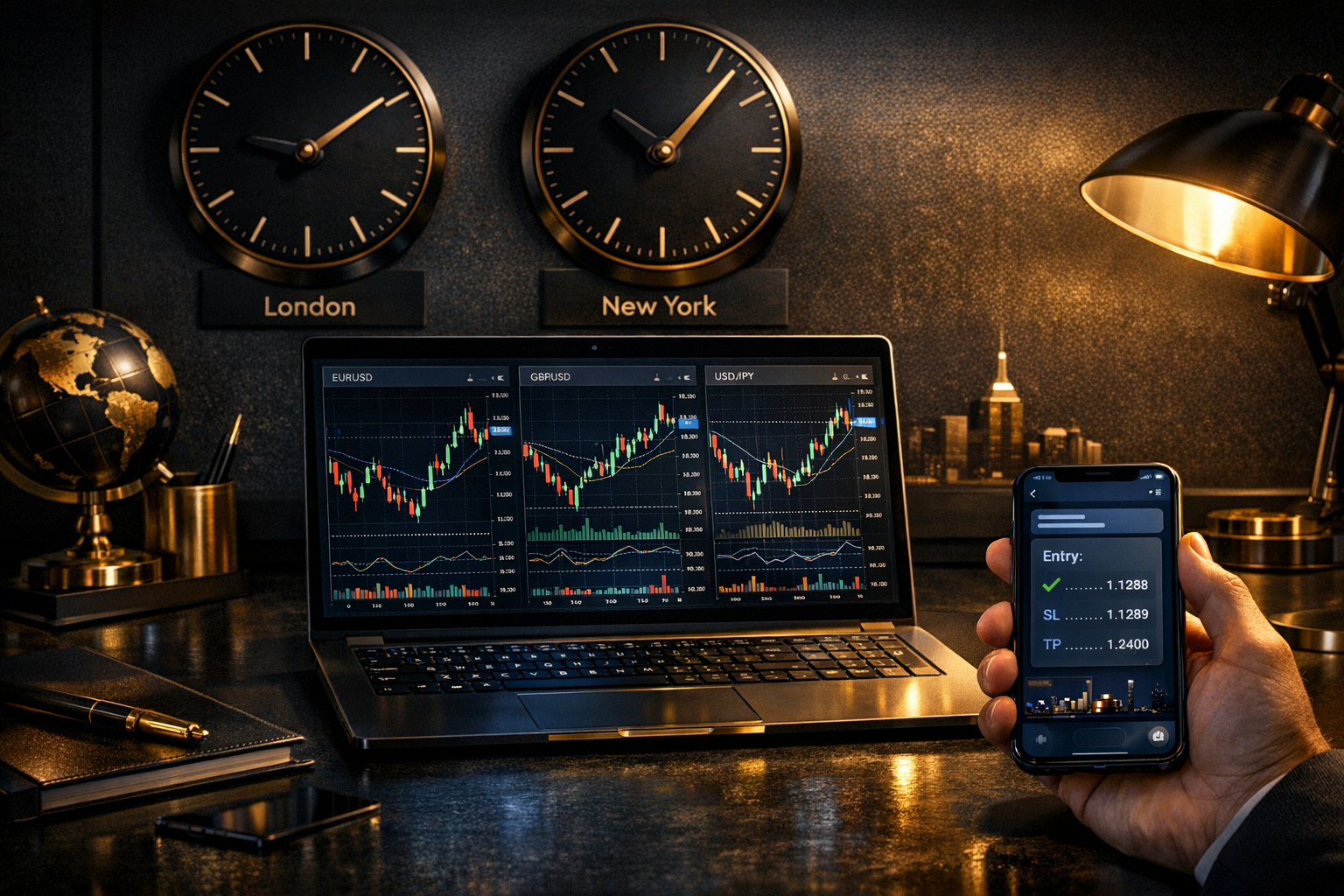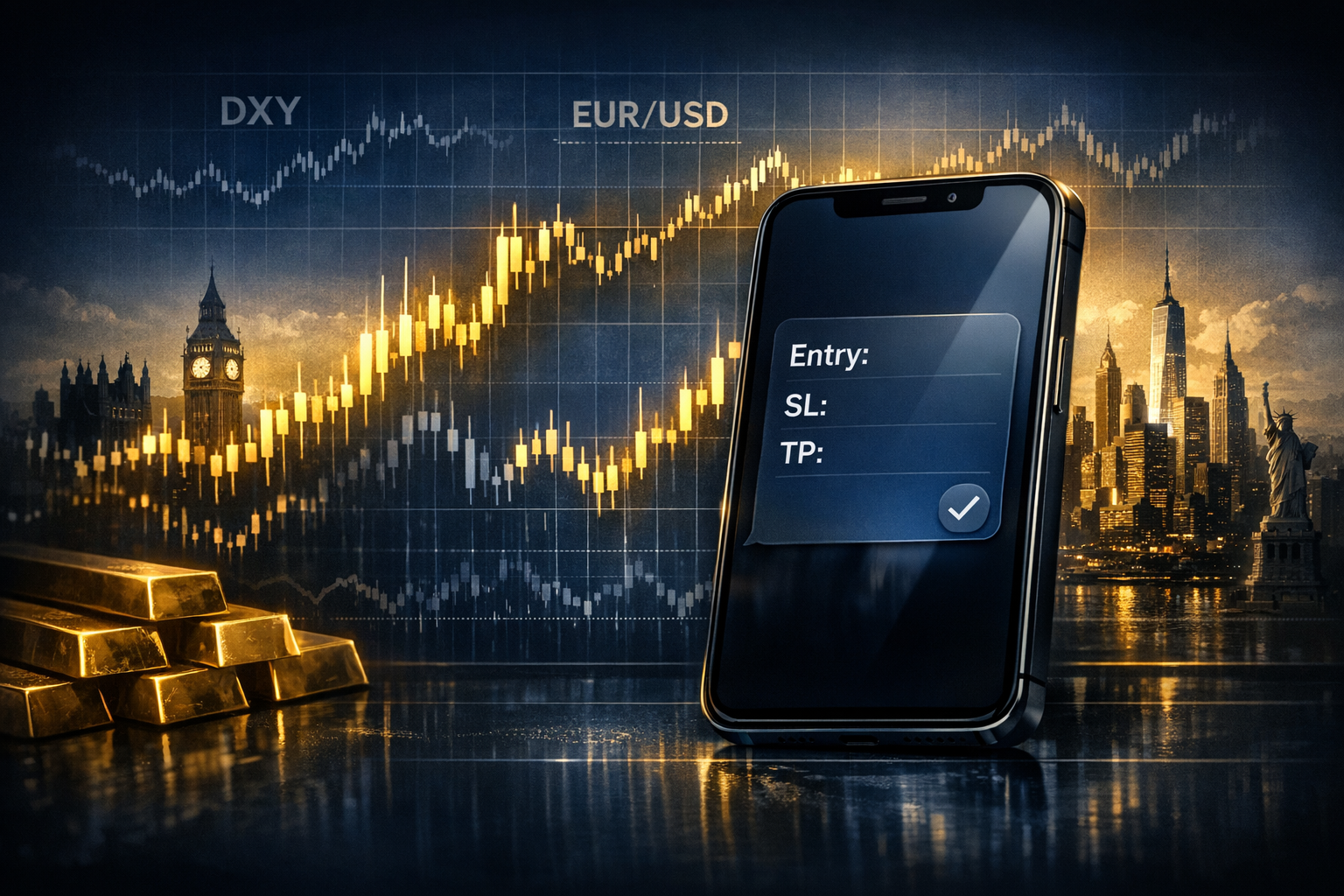
If you’ve ever opened Telegram, seen a “BUY EURUSD now” message, and felt your heart rate jump—this guide is for you.
In 2025, forex signals telegram channels are everywhere.
Some are professional, structured, and risk-aware.
Others are noise, hype, or worse—designed to push you into bad decisions.
This master guide is built to help you follow telegram forex signals like a pro: from setup and timing to managing multiple trades, avoiding common traps, and building a repeatable routine.
We’ll use realistic market context throughout: Gold (XAUUSD) around $2650, EUR/USD near 1.0520, GBP/USD around 1.2680, USD/JPY near 149.50, and DXY around 106.80.
TL;DR: The 2025 Telegram Forex Signals Playbook
- Execution beats prediction. Your results depend more on how you place trades (lot size, timing, SL discipline) than the signal itself.
- Use a “signal acceptance checklist.” Spread, session, news risk, and distance-to-SL must be checked in under 30 seconds.
- Standardize risk per trade. Most signal followers fail because they change lot size emotionally after wins/losses.
- Time matters. London and New York sessions typically offer cleaner liquidity and follow-through than late-Asia chop.
- Don’t overtrade multiple signals. Correlation (EUR/USD + GBP/USD) can double your risk without you realizing.
- Track your “copy quality.” Slippage, late entry, and partial fills can turn a good signal into a bad trade—measure it weekly.
What Telegram Forex Signals Are (and What They Aren’t) in 2025

Telegram forex signals are trade ideas delivered through Telegram messages.
They usually include pair, direction, entry, stop loss (SL), and one or more take profits (TPs).
In premium communities, you’ll also see context: session bias, key levels, and how to manage the trade after entry.
In 2025, the signal space has matured.
Many providers now standardize formatting, use multi-TP scaling, and publish weekly performance summaries.
At the same time, the number of low-quality forex telegram groups has exploded.
That’s why your edge as a follower is knowing what a signal can realistically do for you—and what it cannot.
A signal is not a magic button
A signal is a probabilistic trade plan.
Even a strong setup can lose if the market shifts, liquidity dries up, or a news headline hits.
If someone implies certainty, that’s a red flag.
A signal is only as good as your execution
Two traders can copy the same signal and get different results.
One enters 12 pips late, uses a wider spread broker, and moves SL emotionally.
The other enters on time, sizes correctly, and follows the plan.
Same signal.
Different outcomes.
Why Telegram became the “trading floor”
Telegram is fast, mobile-first, and built for communities.
It supports channels, groups, pinned messages, polls, and instant updates.
For active traders, speed matters.
When EUR/USD is hovering around 1.0520 and a breakout triggers, the difference between entry at 1.0521 and 1.0528 can be the difference between a clean win and a scratch.
Where United Kings fits
United Kings is a premium signals and education community built around London and New York session trading.
We share structured trade ideas with clear Entry, SL, and TP levels, plus guidance so you learn while you follow.
You can explore our full signals offering on the United Kings signals page and our dedicated forex signals service.
Choosing Telegram Forex Signals: A 2025 Quality Checklist
Most traders spend weeks hunting for “the best signal provider.”
Then they ignore the basics that actually determine results.
In 2025, choosing a provider is less about flashy screenshots and more about process quality.
Here’s the checklist we use internally when evaluating any signal stream.
1) Format consistency (non-negotiable)
A serious provider uses a consistent template.
You should instantly recognize: instrument, direction, entry, SL, TP1/TP2/TP3, and any management rules.
If messages are vague like “GU buy soon” without levels, skip it.
2) Risk clarity (not just win rate)
Win rate is easy to market.
Risk control is what keeps you in the game.
Look for signals that specify SL distance and realistic targets.
Example: if GBP/USD is around 1.2680, a scalp might risk 15–25 pips to target 30–60 pips (1:2).
For gold around $2650, a typical intraday structure might risk $10–$25 to target $20–$60.
3) Session logic (when signals are sent)
If most signals arrive during dead liquidity hours, expect chop.
London open and New York open are popular for a reason: volume and follow-through.
That’s also why United Kings focuses on those windows.
4) Transparency and education
Signals alone can make you dependent.
Signals + education make you better.
Look for explanations, charts, and post-trade reviews.
If you want a structured way to vet providers, use our checklist resource: forex signals provider checklist.
5) Community behavior
The group culture matters more than people realize.
If the chat is full of revenge-trading talk, “all-in” language, or aggressive shaming, it will leak into your decisions.
A professional community keeps the focus on process: entries, risk, and execution.
Quick comparison: Free vs Paid Telegram Forex Signals
| Feature | Free Telegram Signals | Premium Signals (e.g., United Kings) |
|---|---|---|
| Signal structure (Entry/SL/TP) | Often inconsistent or incomplete | Standardized format with clear levels |
| Risk management guidance | Rare | Position sizing + management rules included |
| Timing & sessions | Random, depends on admin availability | Planned focus on London/NY liquidity windows |
| Education & reviews | Minimal | Ongoing learning, recaps, and skill-building |
| Accountability | Low | Higher (reputation + paid retention) |
| Best for | Practice on demo, learning signal formats | Traders who want consistency and a process |
Step-by-Step Setup: Telegram + Broker + Charts (So You Don’t Miss Trades)

Your setup determines whether you copy signals cleanly or chase price.
Chasing price is the hidden tax of signal following.
In fast markets, that tax can be 5–20 pips on FX pairs and $1–$5 on gold.
Over a month, it can flip your expectancy.
Step 1: Configure Telegram for speed (and sanity)
Turn on notifications only for the signal channel.
Mute general chat if it distracts you.
Pin the channel and enable “preview” so you can see Entry/SL/TP on your lock screen.
Create a custom notification tone for signals so you recognize it instantly.
Step 2: Use a broker with predictable execution
Signal following is sensitive to spreads and slippage.
On EUR/USD near 1.0520, a 0.8 pip spread vs 2.0 pips is a real difference.
On USD/JPY near 149.50, wider spreads around news can turn a tight SL into a quick stop-out.
Choose a broker with stable spreads during London/NY and reliable market execution.
Step 3: Build a “one-screen” execution workspace
Ideally, you have Telegram and your trading platform visible at the same time.
On mobile, use split-screen if available.
On desktop, keep Telegram on the left and MT4/MT5 or TradingView on the right.
The goal is to reduce friction.
Step 4: Pre-load your most traded symbols
Create a watchlist: EUR/USD, GBP/USD, USD/JPY, XAU/USD, and DXY proxy if your platform offers it.
When a signal drops, you shouldn’t be searching symbols.
You should be executing.
Step 5: Set alerts at key levels
If a signal is “Buy limit” or “Sell limit,” set an alert at the entry level.
That prevents you from staring at the chart for hours.
It also reduces impulsive early entries.
Step 6: Create templates for SL/TP
Many platforms let you predefine order templates.
Use it.
If your typical risk is 0.5% per trade, build position sizing shortcuts so you don’t calculate under pressure.
If you’re new to the mechanics, you can also read our related beginner resource: forex signals Telegram beginner guide.
Execution Timing in 2025: London & NY Sessions, News, and Volatility
Timing is the difference between “copied the signal” and “copied the signal well.”
In 2025, volatility clusters around known catalysts: CPI, NFP, FOMC, BOE, ECB, and geopolitical headlines.
Liquidity also clusters around sessions.
That’s why professional signal execution is not just levels—it’s when.
London session: structure and breakout behavior
London often sets the day’s directional tone.
EUR/USD and GBP/USD tend to show cleaner range breaks after London open.
If EUR/USD is coiling around 1.0520 pre-London, a signal might target a 30–60 pip move once liquidity hits.
But if you enter late, that move can be half over before you’re in.
New York session: continuation or reversal
New York can extend London’s trend or fade it.
USD/JPY near 149.50 is especially sensitive to US yields and risk sentiment.
A signal during NY might be based on a US data release or bond move.
That means faster candles and more slippage risk.
The London-NY overlap: peak opportunity (and peak danger)
The overlap often brings the best volume.
It also brings the most aggressive stop hunts and false breaks.
Your job is to execute with rules, not emotion.
News timing rule (simple and effective)
If a high-impact event is within 15–30 minutes, be cautious.
Either wait for the release or reduce risk.
For example, gold at $2650 can spike $15–$25 in minutes around CPI.
That’s a normal move in a high-volatility environment.
DXY context: why it matters even if you don’t trade it
With DXY around 106.80, the dollar is relatively firm.
That can pressure EUR/USD near 1.0520 and influence gold’s ability to sustain rallies.
If your signal says “BUY XAUUSD,” you should still ask: is DXY breaking higher or stalling?
That one check can keep you out of low-quality trades.
How to Read a Telegram Signal Like a Trader (Not a Gambler)
Most followers treat signals like commands.
Professional followers treat them like structured trade plans.
The difference is subtle, but it shows up in your equity curve.
Signal types you’ll see most in 2025
- Market execution: “Buy now” or “Sell now” at current price.
- Limit orders: “Buy limit 1.0510” to catch a pullback.
- Stop orders: “Buy stop 1.0540” to confirm breakout momentum.
- Scaling plans: TP1/TP2/TP3 with partial closes.
Key fields to verify in 10 seconds
- Instrument: EUR/USD vs EUR/USDm (broker suffix) must match.
- Entry: Is it a zone or a single price?
- SL: Is it logical vs recent structure?
- TPs: Do they match a 1:2 or 1:3 risk-reward?
Example: A clean gold signal structure (realistic levels)
Let’s say XAU/USD is trading around $2650.
A structured intraday signal might look like this:
- BUY XAUUSD @ 2648.0
- SL @ 2636.0 (risk: $12)
- TP1 @ 2672.0 (reward: $24, 1:2)
- TP2 @ 2684.0 (reward: $36, 1:3)
Notice how the SL is within the typical $10–$25 band.
Notice how the targets respect the $2610–$2690 context.
Example: A clean EUR/USD signal structure (realistic levels)
With EUR/USD around 1.0520:
- SELL EURUSD @ 1.0522
- SL @ 1.0552 (30 pips)
- TP1 @ 1.0462 (60 pips, 1:2)
- TP2 @ 1.0432 (90 pips, 1:3)
If you enter at 1.0530 instead, your risk-reward changes.
You’re no longer copying the plan.
You’re improvising.
The “distance-to-SL” rule (protects you from late entries)
If price has moved more than 20–30% of the SL distance away from entry, you’re late.
Example: SL is 30 pips.
If you’re 10+ pips late, skip or wait for a pullback.
This one rule saves signal followers from death-by-a-thousand-chases.
Risk Management for Telegram Signals: The Only Way to Survive the Long Run
Most traders join signal channels to solve entries.
But entries are not the main problem.
Risk management is.
If you get risk wrong, even an excellent signal stream won’t save you.
Pick a fixed risk per trade (and keep it boring)
Choose a percentage that lets you survive a losing streak.
Many disciplined followers use 0.5% to 1% per trade.
If you’re new, 0.25%–0.5% is even better.
Why losing streak math matters
Even high-quality systems can hit 5–8 losses in a row.
That’s not failure.
That’s distribution.
If you risk 5% per trade, an 8-loss streak can be catastrophic.
If you risk 0.5%, it’s painful but survivable.
Position sizing example (gold)
Assume account: $5,000.
Risk per trade: 1% = $50.
Gold signal: entry 2648.0, SL 2636.0 (risk $12).
You size so that a $12 move equals $50 loss.
That means roughly $4.17 per $1 move exposure.
Your platform’s contract sizing differs, so calculate using your broker’s XAUUSD specification.
Position sizing example (EUR/USD)
Account: $5,000.
Risk: 0.5% = $25.
SL: 30 pips.
You size so 30 pips equals $25.
That’s about $0.83 per pip.
Again, your broker pip value depends on lot size and account currency.
Daily loss limit (the “circuit breaker”)
Signal followers blow accounts on bad days, not bad months.
Set a daily loss limit like 2R (two full-risk losses) and stop trading.
If you risk 1% per trade, that’s a 2% daily cap.
This prevents revenge trading after a sudden USD spike or a gold whipsaw.
Use correlation-aware risk
EUR/USD and GBP/USD often move together.
If you take both signals at full risk, you may be doubling exposure to the dollar.
Instead, split risk.
Example: if you normally risk 1%, do 0.5% on EUR/USD and 0.5% on GBP/USD when both are USD-driven.
For a deeper framework you can apply immediately, read: risk management strategies when using forex signals.
Managing Multiple Signals Without Overtrading (Portfolio Rules That Work)
In 2025, many Telegram channels send multiple signals per day.
That sounds like opportunity.
But for followers, it often becomes overtrading.
Overtrading is not just “too many trades.”
It’s too much risk concentration and too many decisions under pressure.
Rule 1: Define your max open risk
Max open risk is the total risk if all SLs hit.
A common professional cap is 2% to 4% open risk.
Example: If you risk 1% per trade, you can have 2–4 trades open.
If you’re trading gold and JPY pairs (both can move sharply), keep it tighter.
Rule 2: Categorize signals by “theme”
Many trades are the same idea in different clothing.
Examples of themes:
- USD strength theme: short EUR/USD, short GBP/USD, long USD/JPY.
- Risk-off theme: long gold, short equities, long JPY (sometimes).
- Mean reversion theme: fading extremes after a news spike.
If you take three trades from the same theme, you’re not diversified.
You’re leveraged.
Rule 3: One “A+” trade beats three “B” trades
Signal channels can tempt you to take everything.
Instead, choose the cleanest setup based on:
- Best risk-reward (1:2 minimum)
- Closest entry to level (low chase)
- Best session timing (London/NY)
- Least news risk in the next hour
Rule 4: Avoid stacking gold + USD trades blindly
Gold often moves inversely with the USD, but not always.
With DXY around 106.80, gold at $2650 can still rally if yields drop or risk-off flows hit.
But stacking long gold + short EUR/USD can become a “double USD bet.”
That’s fine if intentional.
It’s dangerous if accidental.
Rule 5: Use a simple trade journal tag system
Tag each trade: “London breakout,” “NY reversal,” “Gold scalp,” “News fade.”
After 20–30 trades, you’ll see which tags make money for you.
That’s how you personalize signals into a strategy.
Trade Management: Partial Profits, Break-Even, and When to Ignore the Noise
Most signal followers obsess over entries.
But trade management is where profits are protected and compounded.
In 2025, many premium providers use multi-target structures.
That helps reduce emotional decision-making.
TP1 is not “small thinking”—it’s risk control
Taking partial profit at TP1 can reduce pressure.
It also lets you hold TP2/TP3 without panic.
Example on gold:
- Buy 2648.0, SL 2636.0, TP1 2672.0, TP2 2684.0
- Close 50% at TP1 (+$24)
- Move SL to entry (optional rule-based)
- Let the rest aim for TP2 (+$36)
This converts one trade into a “paid opportunity.”
Break-even rules (use them carefully)
Break-even is a tool, not a religion.
If you move SL to entry too early, normal pullbacks stop you out.
A practical rule is: move to break-even only after price has moved at least 1R in your favor.
If your SL is 30 pips, wait for +30 pips before BE.
Trailing stops: good for trends, bad for chop
Trailing stops work best when the market is trending strongly.
They perform poorly in ranging conditions.
If GBP/USD is stuck around 1.2680 with 20–30 pip swings, a tight trail will get clipped repeatedly.
How to handle “update” messages in Telegram
Good channels will post updates: “Move SL to BE,” “Close 50%,” “Exit now.”
Your job is to follow the plan as written.
But you must also protect yourself from chaotic management.
If a provider constantly changes SL/TP without structure, it can be a sign of improvisation.
One simple rule to reduce stress
Decide your management approach before you enter.
Write it down:
- “I will take 50% at TP1.”
- “I will move SL to BE after 1R.”
- “I will not widen SL.”
When the chart starts moving fast, you’ll be glad you did.
Common Mistakes Signal Followers Make (and the Fixes That Actually Work)
Most losing signal followers are not “bad at trading.”
They’re inconsistent at execution.
Here are the most common mistakes we see—and the fixes that produce measurable improvement.
Mistake 1: Entering late (chasing)
Chasing happens when you see a signal, hesitate, then enter after price moves.
Fix: use the distance-to-SL rule.
If you’re too late, skip or wait for the pullback.
Mistake 2: Moving stop loss (especially widening)
Widening SL turns a planned loss into an emotional bet.
Fix: make “no SL widening” a hard rule.
If you can’t follow it, reduce lot size until you can.
Mistake 3: Increasing lot size after a win
This is the fastest way to give profits back.
Fix: fixed risk per trade for 30 trades minimum.
Then review performance and adjust slowly.
Mistake 4: Taking every signal (FOMO trading)
Too many trades creates decision fatigue.
Fix: cap daily trades or cap open risk.
Example: max 3 trades per day or max 3% open risk.
Mistake 5: Ignoring news risk
USD/JPY at 149.50 can jump 60–120 pips on surprises.
Gold at $2650 can spike $20 in minutes.
Fix: check the calendar before you copy.
If you trade gold actively, also study how signals behave around shocks using: how gold signals react to unexpected news events.
Mistake 6: Confusing a drawdown with a broken system
Even strong strategies have down weeks.
Fix: evaluate performance in batches of 30–50 trades, not 3 trades.
Track R-multiples (how many “R” you win/lose), not just win rate.
Building Your Weekly Routine: A Signal-Follower’s 2025 Operating System
If you want consistent results from Telegram signals, you need a routine.
Not a complicated one.
A repeatable one.
This is the operating system we recommend for most followers who trade London/NY sessions.
Monday: map the week’s risk events
Open your economic calendar and mark high-impact events.
List them in your notes: CPI, NFP, FOMC, BOE, ECB.
This tells you which days may require smaller risk or fewer trades.
Daily pre-session (10 minutes)
- Check DXY around 106.80: trending or ranging?
- Check EUR/USD near 1.0520 and GBP/USD near 1.2680: key support/resistance zones.
- Check USD/JPY near 149.50: sensitive to yields and headlines.
- Check gold near $2650: is volatility expanding or compressing?
- Decide your daily risk cap (example: 2R).
During session: the 30-second signal acceptance checklist
- Spread check: is it normal or inflated?
- News check: any high-impact release imminent?
- Entry quality: am I within acceptable distance?
- RR check: is it at least 1:2?
- Correlation check: do I already have similar exposure?
After session: 5-minute review
Screenshot your entry and exit.
Write one sentence: “Followed plan” or “Broke rule.”
That’s it.
This small habit compounds into discipline.
Weekly review (30 minutes)
Count your trades.
Calculate total R gained/lost.
Identify your top two mistakes.
Pick one rule to focus on next week.
Where to find ongoing analysis and education
Bookmark our United Kings blog for weekly trading education and market-focused guides.
If you also trade gold alongside FX, our gold signals service is built for XAUUSD volatility and clear risk parameters.
Maximizing Results with Premium Telegram Signals: Execution, Metrics, and Scaling Safely
Once your setup and risk rules are stable, you can focus on maximizing results.
This is where many traders finally turn “signals” into a performance engine.
But the key word is safely.
Measure “copy quality” (the metric most people ignore)
Copy quality is the gap between the posted entry and your actual fill.
Track it for 20 trades:
- Average pips late on FX
- Average $ late on gold
- How often you missed TP by a few pips due to spread
If your average slippage is high, fix the process before increasing risk.
Use R-multiples to evaluate performance
R = your initial risk.
If you risk 30 pips and make 60 pips, that’s +2R.
This normalizes performance across different pairs and SL sizes.
A signal stream that averages +0.3R per trade can be excellent over time.
Scaling: increase size only after consistency
Scaling should be boring and rule-based.
Example scaling plan:
- Trade 0.5% risk for 30 trades.
- If you are profitable and followed rules on 90%+ of trades, move to 0.75% risk.
- Repeat the evaluation every 30 trades.
This prevents “confidence spikes” from dictating your lot size.
How United Kings supports performance
In United Kings, our goal is not just to send trade ideas.
It’s to help you execute them with structure.
We provide premium Telegram signals for forex and gold with clear Entry, SL, and TP levels, and we focus heavily on London and NY session opportunities.
Our community includes 300K+ active traders, which creates a strong environment for learning and accountability.
For traders who want to diversify beyond FX and gold, we also offer crypto signals as an additional stream.
Pricing plans (3 options) and how to choose
You can review all options on our pricing page.
- Starter (3 Months): $299 (~$100/mo) for focused trial and routine building.
- Best Value (1 Year): $599 ($50/mo) with 50% savings + FREE ebook for structured learning.
- Unlimited (Lifetime): $999 pay once for long-term access.
We also offer a 48-hour money-back guarantee so you can evaluate fit and execution flow without long uncertainty.
FAQ: Telegram Forex Signals in 2025
Are Telegram forex signals legal to use?
In most regions, receiving trade ideas is legal.
But regulations vary by country, and providers must avoid offering unauthorized investment advice.
You are responsible for your own trading decisions and compliance with local laws.
What’s the best time to follow telegram forex signals?
Many traders see the best liquidity and follow-through during London and New York sessions.
That’s especially true for EUR/USD, GBP/USD, and gold.
However, always factor in high-impact news releases.
How many signals should I take per day?
There’s no perfect number.
A practical rule is to cap by open risk (example: 2%–4%) or by trade count (example: 1–3 trades/day).
Quality beats quantity.
Can I follow signals with a small account?
Yes, if your broker allows micro-lots and you keep risk small (0.25%–0.5%).
Avoid oversized positions on volatile instruments like XAU/USD where $10–$25 SLs are common.
Should beginners use demo before live?
Yes.
Demo trading helps you master execution speed, order types, and discipline without financial pressure.
Once you can follow rules consistently, move to small live risk.
Risk Disclaimer: Forex and gold trading involve significant risk and can result in the loss of your capital. Signals and educational content are provided for informational purposes only and do not constitute financial advice. Past performance is not indicative of future results. Never trade money you cannot afford to lose, and consider practicing on a demo account before trading live.
Join United Kings: Premium Telegram Forex & Gold Signals (Built for 2025)
If you want to stop guessing and start executing with structure, United Kings is built for you.
We deliver premium Telegram signals with clear Entry, SL, and TP levels, plus education to help you improve your decision-making over time.
Explore our services on United Kings forex signals and the full overview on all United Kings signals.
Then join our Telegram community directly here: United Kings official Telegram channel.
If you have questions before joining, visit contact United Kings and we’ll help you choose the right plan for your goals.
Ready to trade 2025 with a real process? Choose your plan on United Kings pricing (Starter 3 Months $299, Best Value 1 Year $599, Unlimited Lifetime $999) and start following signals with discipline, not emotion.