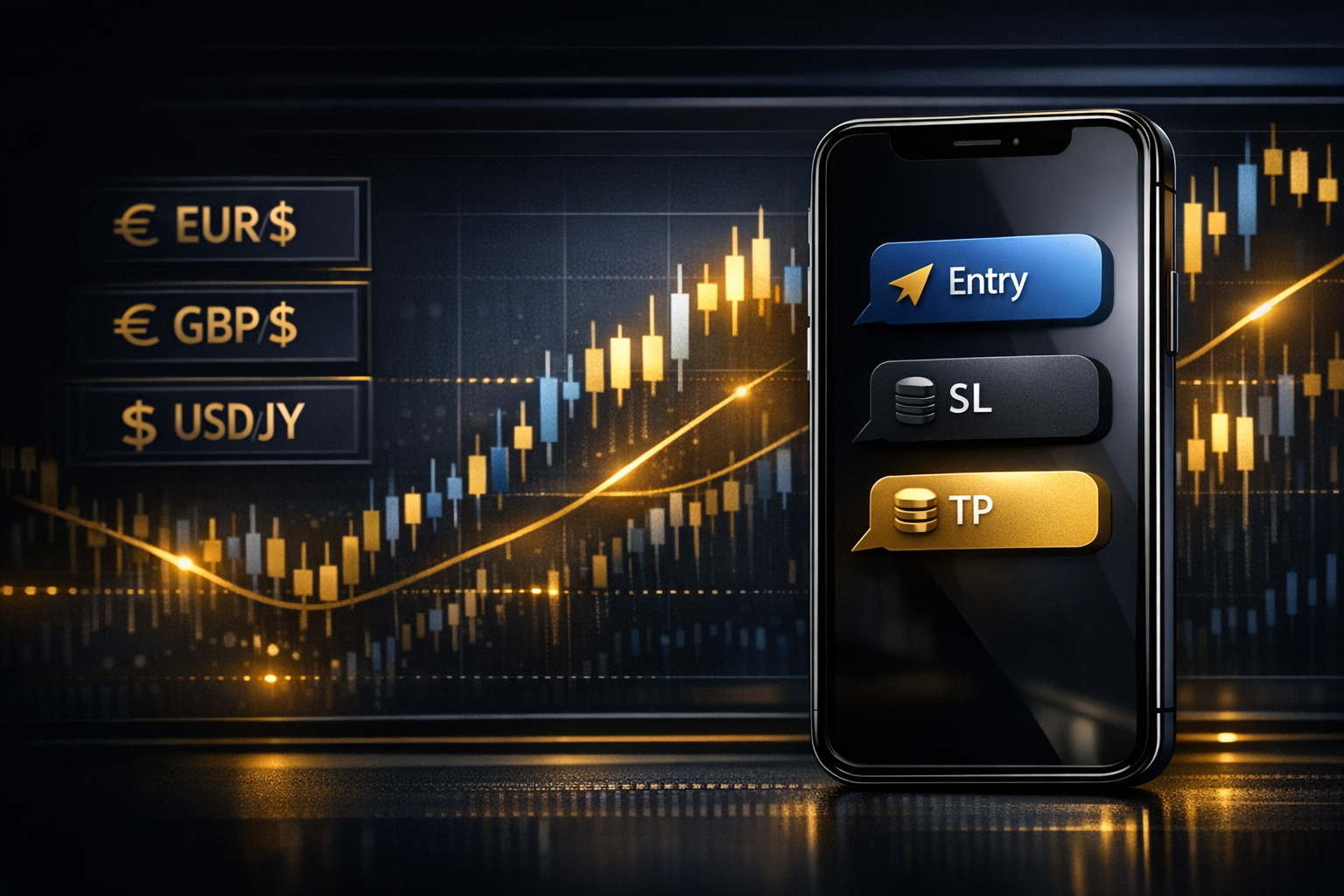
You open Telegram and see a new alert: “EUR/USD BUY 1.0520 | SL 1.0485 | TP1 1.0580 | TP2 1.0625.”
Your first thought is simple: Do I take it now… or wait? Your second thought is the one that decides your results: How do I follow signals like a professional in 2025—without overtrading, hesitating, or blowing risk?
This guide is built to answer that. If you’ve been searching for forex signals telegram strategies that actually work in real market conditions, you’re in the right place.
TL;DR: The 2025 Telegram Forex Signals Playbook
- Execution beats “accuracy”: even great Telegram forex signals fail if you enter late, ignore SL, or oversize.
- Trade the right hours: most clean moves happen in London and New York sessions, especially around liquidity windows.
- Standardize risk per trade: use 0.5%–1% risk, fixed rules, and avoid stacking correlated pairs.
- Use a pre-trade checklist: spread, news, entry distance, and R:R must be validated in under 60 seconds.
- Manage multiple signals like a portfolio: cap total exposure, group by USD risk, and prioritize A+ setups.
- Track results properly: measure execution quality, slippage, and adherence—not just win rate.
We’ll use realistic 2025 market context examples throughout: Gold (XAUUSD) $2650, EUR/USD 1.0520, GBP/USD 1.2680, USD/JPY 149.50, and DXY 106.80.
Why Telegram Forex Signals Still Dominate in 2025

Telegram remains the fastest distribution channel for retail trading signals because it solves one brutal problem: speed. Markets don’t wait for you to log into a dashboard, check email, or refresh an app.
In 2025, volatility is still shaped by the same forces—central bank guidance, inflation surprises, geopolitical risk, and liquidity squeezes—but the market’s reaction speed has increased. That’s why telegram forex signals are still popular: instant push notifications meet fast-moving price action.
But here’s the uncomfortable truth. Telegram doesn’t make signals better. Telegram makes distribution better. Your results depend on how you execute, manage risk, and filter noise.
Most traders fail with signals for predictable reasons:
- They treat signals like “tips” instead of a system.
- They enter late after a 10–25 pip move, killing the risk-reward.
- They move stop losses because “it will come back.”
- They join too many forex telegram groups and get decision fatigue.
- They risk 5% on one trade, then blame the provider.
The fix is not finding a magical channel. The fix is building a repeatable execution framework for signals.
That’s also why professional-grade providers publish signals with complete structure: Entry, SL, TP levels, plus context and updates. At United Kings, we focus on clean, actionable levels and session timing through our premium community on Telegram. You can explore our full signal ecosystem on the United Kings signals page.
In the next sections, we’ll build your 2025 strategy from the ground up: setup, timing, risk, multi-signal management, and performance tracking.
How Telegram Forex Signals Actually Work (And What a “Good Signal” Looks Like)
A signal is not a prediction. A signal is a trade plan. The best providers think in probabilities, not certainties.
In practical terms, a high-quality signal message should include:
- Instrument: EUR/USD, GBP/USD, USD/JPY, XAUUSD, etc.
- Direction: BUY or SELL.
- Entry plan: market entry or limit entry (sometimes with a range).
- Stop loss: invalidation level, not “pain tolerance.”
- Take profit targets: TP1/TP2 (and sometimes TP3) with logic.
- Notes: session timing, news caution, or key levels.
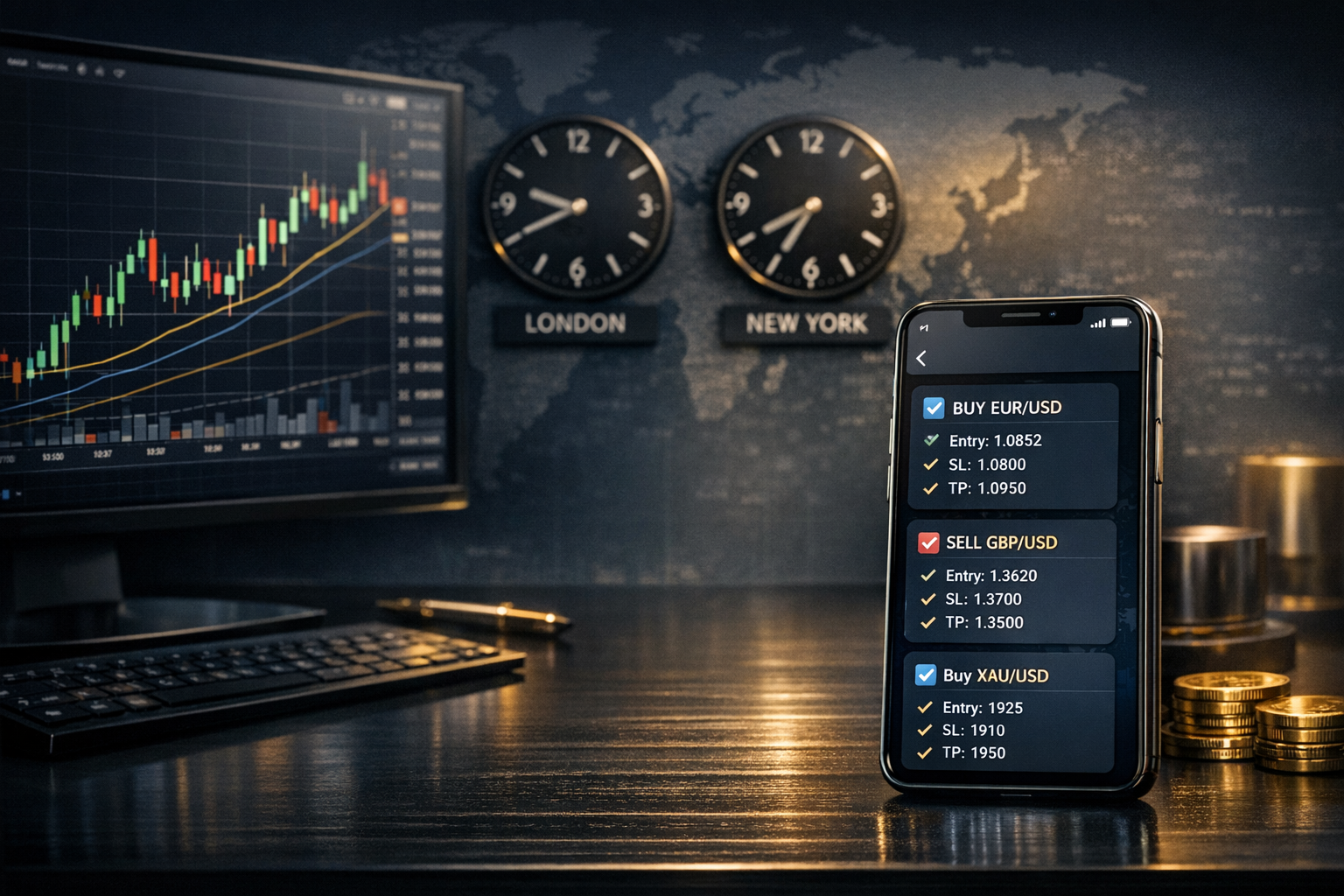
Let’s use a realistic example around today’s pricing. Suppose EUR/USD is trading at 1.0520 and the signal is:
- EUR/USD BUY 1.0520
- SL 1.0485 (35 pips)
- TP1 1.0580 (60 pips)
- TP2 1.0625 (105 pips)
This is already structured. It defines risk and reward clearly. If you enter at 1.0520, your R:R is about 1:1.7 to TP1 and 1:3 to TP2.
Now compare that to a “bad signal” you’ll see in random forex telegram groups:
- “EU buy now, going up big.”
- No stop loss.
- No invalidation.
- No target levels.
That’s not a signal. That’s a vibe.
Market Orders vs Limit Orders in Telegram Signals
In 2025, many providers use a mix of market and limit entries depending on volatility. Each has trade-offs.
- Market entry: faster, but you risk slippage and worse fills during spikes.
- Limit entry: better price, but you risk missing the trade if price doesn’t retrace.
For example, if GBP/USD is at 1.2680 and the provider wants a pullback entry, you might see: “SELL LIMIT 1.2705 | SL 1.2740 | TP 1.2635.” That’s a 35-pip risk for a 70-pip reward (1:2).
Gold Signals Inside Forex Channels (Why XAUUSD Is Different)
Many Telegram forex signals channels include gold because XAUUSD trades like a hybrid: part currency, part macro hedge, part momentum instrument.
At XAUUSD $2650, a typical intraday risk might be $10–$25. Example:
- XAUUSD SELL 2652
- SL 2668 (16 points)
- TP 2620 (32 points) = 1:2
If you also trade gold, you’ll want a dedicated feed. United Kings offers a focused stream via our premium gold signals alongside FX.
Choosing the Right Telegram Forex Signals Provider (A 2025 Checklist)
Most traders choose a provider the same way they choose a restaurant: they look at hype, screenshots, and follower count.
In 2025, that approach is expensive. A provider can show a 90% “win rate” by hiding losses, deleting messages, or using martingale sizing. You need a due-diligence checklist that protects you.
Here are the standards we recommend before you trust any channel with your money.
Provider Transparency Checklist
- Signals are timestamped and not edited after the fact.
- SL is always present (no “mental stop”).
- Clear TP logic (structure-based, not random numbers).
- Risk guidance (0.5%–2% per trade, not “all in”).
- Updates are consistent (breakeven moves, partials, invalidations).
If you’re new, you’ll benefit from a structured beginner resource like our Forex signals Telegram beginner guide, then come back here for the full 2025 strategy framework.
Signal Style Fit: Scalping vs Intraday vs Swing
One hidden reason traders fail is misalignment. You join a scalping channel but you work a 9–5. Or you join a swing channel but you can’t hold overnight drawdown.
Ask these questions:
- How many signals per day on average?
- What’s the typical SL size (pips) and TP size?
- Are trades designed for London/NY liquidity or Asia range?
- Do they trade news events or avoid them?
United Kings focuses heavily on London and New York sessions because that’s where spreads are tighter and follow-through is cleaner for most major pairs.
Comparison Table: Typical Telegram Signal Sources in 2025
| Source Type | Pros | Cons | Best For |
|---|---|---|---|
| Free public forex telegram groups | Easy access, lots of ideas | No accountability, inconsistent SL/TP, heavy spam | Learning market language (not execution) |
| Paid signal channels (general) | More structure, fewer spam messages | Quality varies wildly, marketing can be misleading | Intermediate traders with a risk plan |
| Broker “signals” plugins | Integrated into platform | Often generic, delayed, not session-optimized | Casual traders who want prompts |
| Premium Telegram signals + education (United Kings model) | Clear levels, updates, community support, education | Requires discipline and execution | Traders aiming for consistency in 2025 |
If you want a formal checklist to evaluate any provider, our signals provider checklist is a strong companion piece.
Step-by-Step Setup: Your Telegram + Broker + Charting Stack (Done in 20 Minutes)
If your setup is messy, your execution will be messy. In signals trading, seconds matter, especially during London open and major data releases.
Here’s a clean, repeatable setup that works whether you trade from a phone, laptop, or both.
Step 1: Configure Telegram for “Signal-First” Notifications
- Pin the signal channel to the top.
- Turn on notifications for the channel, but mute everything else.
- Use a unique notification sound for signals.
- Disable message previews if you trade in public spaces (privacy).
Your goal is to reduce noise. Too many traders join 10 forex telegram groups and end up paralyzed. One high-quality feed beats ten mediocre ones.
If you want direct access to the United Kings community feed, our official Telegram is: United Kings Telegram channel.
Step 2: Choose a Broker Setup That Won’t Sabotage You
Signals fail in real life for one non-obvious reason: execution costs. Spread, commission, and slippage can turn a 25-pip scalp into a breakeven grind.
Before you trade live signals, confirm:
- Average spread on EUR/USD and GBP/USD during London/NY.
- Gold (XAUUSD) spread during high volatility (it can widen fast).
- Whether your broker rejects orders or requotes during spikes.
- Lot size flexibility (micro lots help risk control).
Step 3: Build a “60-Second Chart Check” Template
You don’t need 12 indicators. You need a fast way to confirm context.
Use a simple template:
- Timeframes: 15M for entry behavior, 1H for structure, 4H for major levels.
- Tools: key support/resistance, session highs/lows, and a 20 EMA (optional).
- News filter: check the next 60 minutes for red-folder events.
Example: USD/JPY at 149.50 with DXY at 106.80. If a signal says “USD/JPY BUY,” your 60-second check asks: Is price above the last 1H swing high? Is there a major resistance at 149.80/150.00? Is there a US data release in 15 minutes?
Step 4: Pre-Set Order Templates (So You Don’t Misclick)
Create order presets in your platform:
- Default risk: 0.5% or 1% per trade.
- One-click partial close buttons (close 50% at TP1).
- Breakeven hotkey or quick SL modify.
When a signal hits, you should be able to execute in under a minute without mental math. That’s how you avoid late entries and emotional sizing.
Execution Timing in 2025: When to Enter Telegram Signals (And When to Pass)
Timing is the difference between “signals don’t work” and “signals work when I trade them correctly.” Most signals are designed around liquidity windows, not random moments.
In 2025, the cleanest intraday movement still clusters around:
- London open: roughly 07:00–10:00 London time.
- London–NY overlap: roughly 13:00–16:00 London time.
- NY open continuation: first 60–120 minutes after NY equities open.
This is why United Kings emphasizes London and New York session trading. Liquidity is thicker, spreads are typically tighter, and breakouts have more follow-through.
The “Entry Distance” Rule (The Most Important Signal Filter)
Here’s a rule you can apply instantly: don’t chase. If price has moved too far from the intended entry, your R:R collapses.
Example on EUR/USD:
- Signal: BUY 1.0520, SL 1.0485 (35 pips), TP1 1.0580 (60 pips).
- You see it late and price is already 1.0540.
If you buy at 1.0540 with the same SL (1.0485), your risk becomes 55 pips. Your TP1 reward becomes 40 pips. That’s less than 1:1. You just turned a good trade into a bad one.
A practical guideline:
- For intraday FX signals, avoid entries that are more than 20%–30% of the SL away from the intended entry.
So if SL is 35 pips, a late entry beyond ~7–10 pips should trigger caution. Either wait for a pullback, or skip.
How News Changes Timing (DXY, Yields, and Whipsaw Risk)
With DXY around 106.80, USD sensitivity can be high. That means EUR/USD and GBP/USD can whip 20–40 pips in minutes around US data.
When a high-impact event is near (CPI, NFP, FOMC), you have three options:
- Stand aside until the first spike settles.
- Reduce risk (e.g., half position size) if you must trade.
- Use limit entries at pre-defined levels instead of market chasing.
If you trade gold, the effect can be even sharper. XAUUSD at $2650 can jump $10–$20 quickly on surprise headlines. That’s why gold stops are often $10–$25 away for intraday trades, and why execution discipline matters.
Risk Management for Telegram Forex Signals: The Rules That Keep You in the Game
Signals don’t protect your account. Risk management does. In 16+ years of trading, the biggest difference between traders who last and traders who disappear is not entries—it’s position sizing, drawdown control, and consistency.
Let’s build a simple, professional risk framework for following signals.
Rule 1: Risk a Fixed Percentage (Not a Fixed Lot Size)
Your account changes. Volatility changes. Fixed lots are how people accidentally double their risk.
Use these guidelines:
- Beginner: 0.25%–0.5% per trade.
- Intermediate: 0.5%–1% per trade.
- Advanced: 1% per trade (rarely 2% and only with strict limits).
Example: $2,000 account, risk 1% = $20 risk. If EUR/USD SL is 35 pips, you size so that 35 pips equals $20. That’s it. No improvising.
Rule 2: Set a Daily Loss Limit (So One Day Doesn’t Wreck a Month)
Signals can cluster. Market conditions can shift. Some days are simply not your day.
A clean rule is:
- Daily stop: -2R (two full stop losses) or -2% (if risking 1% per trade).
If you hit the daily stop, you stop trading. No revenge trades. No “one more to make it back.”
Rule 3: Correlation Control (The Hidden Risk in Multiple Signals)
If you take EUR/USD buy and GBP/USD buy at the same time, you’re often taking two versions of USD weakness. If USD strengthens suddenly, both can lose together.
Same with USD/JPY and DXY strength. Same with gold and USD moves at times.
Practical correlation rules:
- Limit to one major USD-direction bet at a time.
- If you take two correlated trades, cut risk per trade (e.g., 0.5% each instead of 1%).
- Track your exposure by currency: USD, EUR, GBP, JPY.
If you want a deeper framework, keep our dedicated guide bookmarked: risk management strategies when using forex signals.
Rule 4: Never Move SL Further Away
Moving SL is how small losses become big losses. A signal’s SL is the invalidation point. If price hits it, the setup failed.
You can tighten SL. You can move to breakeven. But widening SL “to give it room” is a different trade than the one you agreed to take.
Managing Multiple Telegram Signals Without Overtrading (Portfolio Method)
In active Telegram channels, you might see several opportunities in a day. That’s a gift and a trap.
The trap is overtrading. The trap is stacking correlated exposure. The trap is taking B-grade setups because you’re bored.
To manage multiple signals like a pro, you need a portfolio approach.
Step 1: Create a Signal Priority Ladder (A, B, C)
Not all signals are equal. Even in a premium channel, conditions vary.
- A setups: aligned with 1H/4H structure, clean R:R (1:2+), good session timing, no major news in 30–60 minutes.
- B setups: decent structure but closer to resistance/support, or lower R:R.
- C setups: messy conditions, wide spreads, late entries, or high news risk.
Your rule can be simple: trade A setups at full risk, B setups at half risk, skip C setups.
Step 2: Cap Total Open Risk
Even if each trade risks 1%, three open trades can mean 3% exposure. That’s fine sometimes, but not always—especially if they’re correlated.
Professional guideline:
- Total open risk cap: 2%–3% across all positions.
If you already have 2% open risk and a new signal appears, you either skip it or replace a weaker position.
Step 3: Use Partial Profits to Reduce Stress
Many signal strategies scale out:
- Close 50% at TP1.
- Move SL to breakeven (or reduce risk).
- Let the rest run to TP2/TP3.
Example: GBP/USD SELL from 1.2700, SL 1.2735 (35 pips). TP1 at 1.2630 (70 pips). If TP1 hits, you’ve banked 2R on half the position. Now the trade can breathe.
Step 4: Separate Gold From FX Exposure
Gold can move differently than majors, but it can also become highly USD-sensitive. Treat it as its own risk bucket.
Example at XAUUSD 2650: if you’re already long EUR/USD and GBP/USD (USD weakness theme), adding a gold buy might triple down on the same macro bet. Reduce size or wait.
Execution Mechanics: How to Place Signal Trades Cleanly (Without Slippage and Mistakes)
Most “signal losses” are actually execution losses: wrong lot size, wrong entry, wrong symbol, or entering after price already moved.
Here’s a practical execution process you can run every time.
The 7-Step Signal Execution Checklist (Under 60 Seconds)
- Confirm symbol: EURUSD vs EURUSDm vs EURUSD.pro (broker naming matters).
- Check spread: if spread is unusually wide, wait.
- Check distance to entry: if late, don’t chase.
- Validate SL/TP placement: correct side of price, correct decimals.
- Position size by risk: calculate lots from % risk and SL pips.
- Place order: market or limit as specified.
- Screenshot/journal entry: record entry time and any deviation.
Example: Clean Gold Execution With Realistic Levels
Gold is at $2650. A signal says:
- XAUUSD BUY 2648
- SL 2633 (15 points risk)
- TP1 2678 (30 points reward, 1:2)
- TP2 2690 (42 points reward, ~1:2.8)
If you enter at 2656 because you were late, your risk becomes 23 points to the same SL, and TP1 becomes only 22 points. That’s roughly 1:1. You didn’t “follow the signal.” You changed it.
Common Execution Errors (And How to Prevent Them)
- Decimal mistakes: placing SL at 1.485 instead of 1.0485.
- Wrong direction: buying instead of selling during fast markets.
- Ignoring minimum stop distance: broker rejects the order.
- Trading during spread spikes: especially around rollover and news.
A simple fix is to use templates and double-check SL/TP before confirming. Speed matters, but accuracy matters more.
Maximizing Results: Journaling, Metrics, and “Execution Score” Tracking
If you don’t measure, you’ll guess. If you guess, you’ll blame signals when the real issue is you.
In 2025, traders have more data than ever. The edge comes from tracking the right metrics.
What to Track (Beyond Win Rate)
Win rate is a vanity metric without context. A 45% win rate with 1:3 R:R can outperform a 70% win rate with 1:1 R:R.
Track:
- R-multiple: profit or loss measured in “R” (your initial risk).
- Average R per trade: the single best performance metric.
- Max drawdown: peak-to-trough decline.
- Execution deviation: how far you entered from the signal entry.
- Rule adherence: did you follow SL, daily stop, and correlation rules?
Create an “Execution Score” (0–10) For Every Trade
This is a pro trick. Rate each trade execution:
- 10 = entered within acceptable distance, correct size, followed plan, managed partials.
- 5 = entered late or changed management.
- 0 = no SL, oversized, revenge trade.
After 30 trades, you’ll see the truth. If your average execution score is 6/10, changing providers won’t fix it. Improving execution will.
How to Review Weekly (30 Minutes, Not 3 Hours)
- List top 3 best trades and why they worked.
- List top 3 worst trades and what rule was broken.
- Adjust one rule only (example: reduce max open risk from 3% to 2%).
This is how you build consistency without drowning in analysis.
A Practical 2025 Routine for Following Telegram Forex Signals (London + NY Focus)
Routine is the difference between “I trade sometimes” and “I run a process.” Signals are most effective when your day is structured around the sessions that produce movement.
Here’s a routine you can adapt whether you’re full-time or part-time.
Pre-London (10–15 Minutes)
- Check DXY (currently around 106.80) and note trend direction.
- Mark key levels on EUR/USD (around 1.0520) and GBP/USD (around 1.2680).
- Check USD/JPY (around 149.50) for round-number magnet zones like 150.00.
- Scan the economic calendar for red-folder events.
Your goal is context, not prediction. You’re preparing to execute signals with confidence.
London Session Execution Window (60–120 Minutes)
- Prioritize the first 1–2 signals that align with structure.
- Skip late entries. Wait for pullbacks or new setups.
- Use partial profits to reduce exposure as volatility expands.
Midday Reset (5 Minutes)
Close your app for a moment. Check your open risk. If you’re down -2R, you’re done for the day.
This single habit prevents the most common account-killer: revenge trading after a loss.
New York Session Window (60–120 Minutes)
NY often provides continuation or reversal. If London trended strongly, NY can extend it. If London trapped breakout traders, NY can unwind it.
For gold at $2650, NY data can create sharp moves. A $12 spike up and $18 dump down is not rare on big surprises. That’s why SL discipline matters and why you should avoid overleveraging XAUUSD during news.
End-of-Day (10 Minutes)
- Log trades and execution score.
- Screenshot key charts.
- Write one sentence: “Tomorrow I will improve X.”
Small improvements compound faster than you think.
Advanced Tactics: Filtering Signals With Price Action and Market Context
Once you can execute cleanly, the next level is selective aggression. You don’t want more trades. You want better trades.
Here are advanced filters that work without overcomplicating your chart.
Filter 1: Trade With the Higher-Timeframe Bias
If EUR/USD is below a major 4H resistance and making lower highs, a random buy signal into that resistance is lower probability. You can still trade it, but reduce size or demand better R:R.
Conversely, if USD/JPY is holding above a 4H support and DXY is firm at 106.80, a buy signal with a tight SL can have tailwinds.
Filter 2: Respect “Obvious” Levels (Round Numbers and Session Highs/Lows)
In 2025, algorithms still react to the same obvious zones traders watch.
- EUR/USD: 1.0500, 1.0550, 1.0600
- GBP/USD: 1.2700, 1.2650
- USD/JPY: 150.00 is a major psychological level
- Gold: 2650, 2660, 2680 are common reaction zones
If a signal’s TP is directly into a major level, consider taking partial earlier or tightening management.
Filter 3: Volatility Regime Awareness (Tight vs Wide Days)
Some days EUR/USD moves 40 pips total. Other days it moves 120. Your expectations must match the day.
Gold at $2650 can be calm (range $6–$10) or explosive (range $25–$40). If volatility is high, you may need wider stops or smaller size. If volatility is low, you may need tighter targets and faster partials.
Filter 4: Avoid Signal Clashes
If you get “EUR/USD BUY” and “DXY BUY” style logic from different sources, you’re in conflict. One of your sources is wrong, or they trade different horizons.
This is why we recommend limiting your information diet. One premium channel plus your own context beats five conflicting feeds.
United Kings Method: How Our Telegram Forex Signals Are Designed to Be Followed
Signals should be simple to execute and hard to misunderstand. That’s the philosophy behind United Kings.
We publish premium Telegram signals for forex and gold with clear structure: Entry, SL, and TP levels, plus updates when conditions change. We also provide educational guidance so you understand the “why,” not just the “what.”
Our community is built for active traders who want to improve execution and discipline, not chase hype. We’re proud to support a global network of 300K+ active traders who share charts, feedback, and trade management ideas.
Where to Start Inside United Kings
- If you want an overview of everything we offer, start at our United Kings homepage.
- If you want direct access to our signal hub, visit United Kings forex signals and the broader signals page.
- If you trade gold alongside FX, our gold signals stream is built for XAUUSD volatility.
- If you also diversify into digital assets, we offer crypto signals (separate from FX execution style).
Pricing Plans (Pick the Plan That Matches Your Time Horizon)
We keep pricing simple with three options available on our pricing page:
- Starter (3 Months): $299 (about $100/month)
- Best Value (1 Year): $599 (about $50/month, 50% savings + FREE ebook)
- Unlimited (Lifetime): $999 (pay once, access forever)
We also offer a 48-hour money-back guarantee, so you can evaluate the experience with less pressure.
How to Get Help or Verify You’re in the Right Place
If you ever need assistance with onboarding, plan selection, or platform setup, you can reach us via our contact page or learn more about who we are on about United Kings.
FAQ: Telegram Forex Signals in 2025
1) Are Telegram forex signals worth it in 2025?
They can be, if you treat them as a structured trade plan and you execute with discipline. The biggest edge comes from correct sizing, not chasing entries, and respecting SL.
2) How many forex telegram groups should I join?
Ideally one primary premium channel plus one educational resource. Too many groups create conflicting bias, overtrading, and hesitation.
3) What risk per trade should I use when following signals?
Most traders should stay around 0.5%–1% per trade. Beginners often do best at 0.25%–0.5% while they build consistency and execution habits.
4) What if I miss the entry price from a Telegram signal?
Don’t chase. If the entry is too far away, wait for a pullback, look for a new setup, or skip the trade. Late entries destroy risk-reward.
5) Do I need to trade gold (XAUUSD) if I follow forex signals?
No. Gold is optional and can be more volatile. If you do trade it, use appropriate stops (often $10–$25 intraday) and reduce size if volatility is elevated around news.
Risk Disclaimer (Read This Before You Trade)
Forex and gold trading involves significant risk and may not be suitable for all investors. You can lose some or all of your capital. Signals and educational content are provided for informational purposes and do not constitute financial advice. Past performance is not indicative of future results. Always use stop losses, apply proper position sizing, and consider practicing on a demo account before trading live.
Join United Kings: Get Premium Telegram Forex & Gold Signals
If you’re ready to stop guessing and start following a structured process, join United Kings for premium Telegram signals with clear Entry, SL, and TP levels, session-focused execution, and a community of 300K+ active traders.
Start here: explore our premium signals and choose your plan on the United Kings pricing page (Starter 3 Months $299, Best Value 1 Year $599, Unlimited Lifetime $999).
And if you want direct access to the live Telegram feed, join our official channel here: United Kings on Telegram.
Your edge in 2025 won’t come from more signals. It will come from better execution, better risk, and a routine you can repeat every week.