Gold is at $2650. You open XAUUSD and see a 5-minute candle jump $6 in seconds, spreads widen, and your mind asks the same question every profitable gold trader once asked: “How do I trade this thing without getting chopped up?”
This xauusd trading guide is built to take you from “I know what gold is” to “I can execute a repeatable plan with defined risk.”
We’ll cover gold market fundamentals, session timing, correlations (DXY, yields, risk sentiment), and practical strategies with realistic prices around $2610–$2690 while XAUUSD trades near $2650.
TL;DR (read this first)
- XAUUSD moves differently than most FX pairs: it’s driven by USD, real yields, risk sentiment, and liquidity pockets around sessions.
- Best volatility windows are typically London open and the London–NY overlap; many clean moves start after liquidity is taken.
- Use gold-specific risk rules: think in dollars per ounce, not “pips,” and keep stops commonly $10–$25 from entry depending on setup.
- Correlations matter: DXY near 106.80 and USD/JPY near 149.50 can help you frame gold’s directional pressure.
- One strategy won’t save you: combine a market bias (macro + structure) with a trigger (price action) and a strict execution checklist.
- Signals work best with process: if you want guided entries/SL/TP, pair your plan with premium alerts like United Kings Gold Signals.
Gold trading vs forex majors (quick comparison)
| Feature | XAUUSD (Gold) | EUR/USD | GBP/USD | USD/JPY |
|---|---|---|---|---|
| Typical personality | Fast, impulsive, liquidity-driven | Smoother, macro-driven | Volatile, headline-sensitive | Yield-sensitive, trend-prone |
| Key drivers | USD, real yields, risk sentiment, geopolitics | ECB vs Fed expectations | BoE vs Fed + UK data | US yields + BoJ policy |
| Common stop distance | $10–$25 (setup-dependent) | 15–40 pips | 20–60 pips | 20–60 pips |
| Where beginners struggle | Overtrading noise, wide swings, news spikes | Chop during low volatility | Whipsaws and fakeouts | Sudden trend extensions |
| Best sessions | London + NY overlap | London | London + NY | Asia + NY |
1) What is XAUUSD and why gold trades the way it does
XAUUSD is the price of one troy ounce of gold quoted in US dollars.
When you “buy XAUUSD,” you’re effectively buying gold exposure while selling USD exposure.
That sounds simple, but gold is not a normal currency pair.
Gold is a financial asset, a risk hedge, and sometimes a panic button for markets.
That’s why gold can rally on inflation fears, fall on rising real yields, spike on geopolitical headlines, and still chop sideways for days when liquidity is thin.
Gold’s main drivers (the big four)
- The US dollar (DXY): With DXY around 106.80, gold often feels pressure because a stronger USD makes gold more expensive globally. It’s not a perfect inverse relationship, but it’s common.
- Real yields: Gold doesn’t pay interest. When real yields rise, holding gold has an “opportunity cost,” and price can soften.
- Risk sentiment: In risk-off moments, gold can act like a safe haven. But in some panics, USD liquidity demand can dominate and gold can dip first, then rally.
- Central banks + geopolitics: Reserve diversification, sanctions risk, and conflict headlines can create sudden repricing.
Why XAUUSD feels “wild” compared to EUR/USD
Gold is heavily traded by hedge funds, prop firms, and short-term speculators.
It also attracts breakout traders because it can move $20–$40 in a session when volatility expands.
At $2650, a $20 move is less than 1%.
But for a leveraged trader, it can be the difference between a clean 1:3 win and a margin call.
Gold “pips” vs dollars: stop thinking like forex
Many beginners try to translate gold into forex pips.
Instead, think in dollars per ounce.
If you buy at $2650 with a stop at $2635, your risk is $15 per ounce.
If your take profit is $2680, your reward is $30 per ounce.
That’s a clean 1:2 risk-reward profile.
This mindset change alone improves execution because you stop “eyeballing” volatility and start measuring it.
Where United Kings fits in
If you want your learning curve shortened, our team shares premium entries with clear Entry, SL, and TP levels inside United Kings Signals.
We focus heavily on London and NY sessions because that’s where gold most often delivers clean, tradable moves.
2) Gold market sessions: when XAUUSD is easiest (and hardest) to trade
Timing is not a “nice-to-have” in gold trading.
It’s the difference between getting a smooth continuation and getting wicked out by a liquidity sweep.
With gold near $2650 and a modest 24h change of +0.35%, volatility is present but not extreme.
That’s exactly the environment where session timing gives you an edge.
How sessions typically affect XAUUSD
- Asia session: Often range-bound unless there’s a major headline. Liquidity can be thinner, so stop hunts can feel random.
- London open: A frequent volatility expansion window. Many day highs/lows are set or attacked here.
- London–NY overlap: The most liquid period. Breakouts and trend days often confirm here.
- NY afternoon: Can fade into consolidation, but also can trend if a strong narrative is active.
A realistic day-in-the-life scenario
Imagine gold trades between $2642 and $2656 during Asia.
London opens, price quickly spikes to $2662, then dumps to $2640.
That move isn’t “random.”
It’s often a liquidity grab: stops above the Asian range get taken, then price reverses to rebalance.
Traders who chase the first spike get trapped.
Traders who wait for the sweep and reclaim can get a clean entry with defined risk.
Best times to trade gold (practical guidance)
- If you’re a beginner: focus on 1–2 hours after London open and the first half of the NY session.
- If you work a 9–5: trade the NY open window, but only if you have a rule-based plan.
- If you scalp: you need liquidity. Avoid dead hours unless you’re specifically range trading.
Session-based mistakes that cost real money
- Trading every candle during Asia because you’re bored.
- Placing tight stops ($5–$7) during London open volatility, then blaming manipulation.
- Ignoring news timing and getting hit by a $12 spike in 30 seconds.
How we trade sessions at United Kings
Inside our Gold Signals, we prioritize setups that align with session liquidity.
That means fewer “hope trades” and more trades built around structure breaks, retests, and clear invalidation.
If you want to see how a professional signal flow looks in real time, you can also join our Telegram community at United Kings Telegram channel.
3) Understanding XAUUSD volatility, spreads, and “stop hunt” behavior
XAUUSD volatility is not your enemy.
Unmeasured volatility is your enemy.
At $2650, gold can easily print a $8–$15 intraday swing even on “quiet” days.
On high-impact news days, $20–$40 is normal.
Why gold wicks are bigger than you expect
Gold is a magnet for liquidity.
Large players need counterparties to enter and exit.
Where do counterparties sit?
Above obvious highs and below obvious lows.
So price often runs those levels, triggers stops, fills bigger orders, and then returns to the true direction.
Spreads and execution: the hidden tax
Your broker’s spread on XAUUSD can widen during:
- London open and NY open
- Major US data (CPI, NFP, FOMC)
- Unexpected geopolitical headlines
If you scalp for $4 and your effective cost is $1.2–$2.0 round-trip, your edge disappears.
That’s why many profitable gold traders prefer $10–$25 stops with $20–$60 targets, rather than micro scalps.
ATR: a simple tool to stop guessing
The Average True Range (ATR) helps you quantify typical movement.
If the 14-period ATR on M15 is around $3.5, then a $6 stop is less than 2x ATR.
During London open, that can be too tight.
A more robust stop might be $12–$18 depending on structure.
A stop placement example near current prices
Let’s say gold breaks above $2658 and retests.
You buy at $2659.
A structural stop could go below the retest low at $2646 (risk: $13).
A 1:2 target would be $2685 (reward: $26).
A 1:3 target would be $2698 (reward: $39), which is slightly above our guideline range, so you might cap it near $2690 and trail the remainder.
The “stop hunt” myth vs reality
Most of what traders call stop hunts are simply:
- Liquidity seeking
- Session re-pricing
- News-driven spread expansion
The fix isn’t complaining.
The fix is trading a plan that expects wicks and uses invalidation beyond obvious levels.
4) Gold correlations: DXY, yields, USD/JPY, and risk sentiment (with today’s context)

If you want to trade gold like a professional, you need a “dashboard.”
At minimum, that dashboard includes DXY, US yields (especially real yields), and at least one risk proxy.
Right now, we’re working with:
- XAUUSD: $2650
- DXY: 106.80
- USD/JPY: 149.50
- EUR/USD: 1.0520
- GBP/USD: 1.2680
DXY vs Gold: the classic relationship (and its trap)
Often, when DXY rises, gold struggles.
But “often” is not “always.”
In risk-off events, USD and gold can rise together briefly as capital looks for safety.
So don’t trade gold purely off DXY direction.
Use DXY as a pressure gauge.
EUR/USD as a mirror for USD strength
EUR/USD at 1.0520 suggests USD is relatively firm.
If EUR/USD breaks down from 1.0520 to 1.0480 during NY, that can add headwind to gold longs.
If EUR/USD bounces and DXY softens, gold longs have more breathing room.
USD/JPY: why gold traders should care
USD/JPY at 149.50 is a “watch zone” because it reflects yield differentials and can influence broader USD flows.
If USD/JPY rips higher (say 149.50 → 150.20), it often implies rising US yields or risk-on USD demand.
That can coincide with gold pulling back from resistance (for example, $2668 → $2650).
Risk sentiment: when gold becomes emotional
Gold is sensitive to fear, but it’s also sensitive to forced liquidation.
In sudden equity selloffs, gold can dip first as traders raise cash, then rally as the hedge narrative returns.
This is why waiting for confirmation (structure + trigger) is so important.
Correlation-based trade filter (simple and effective)
- If DXY is making higher highs and EUR/USD is breaking down, be cautious with aggressive gold longs.
- If DXY is rejecting resistance and EUR/USD is reclaiming levels, gold longs become higher probability.
- If USD/JPY is accelerating, reduce position size on gold counter-trend trades.
For a deeper dive on this topic, pair this guide with our correlation-focused resource on the blog hub at UnitedKings.net/blog.
5) XAUUSD chart basics: structure, support/resistance, and clean price action
Indicators can help, but gold rewards traders who can read structure.
Structure is simply: where price made higher highs, higher lows, lower highs, and lower lows.
At $2650, you should already know the nearest “decision zones” before you even look for entries.
How to mark levels on gold (without clutter)
- Daily levels: previous day high/low and close.
- Session levels: Asian range high/low, London high/low.
- Swing levels: the last obvious impulse and its origin.
Example mapping around our current range:
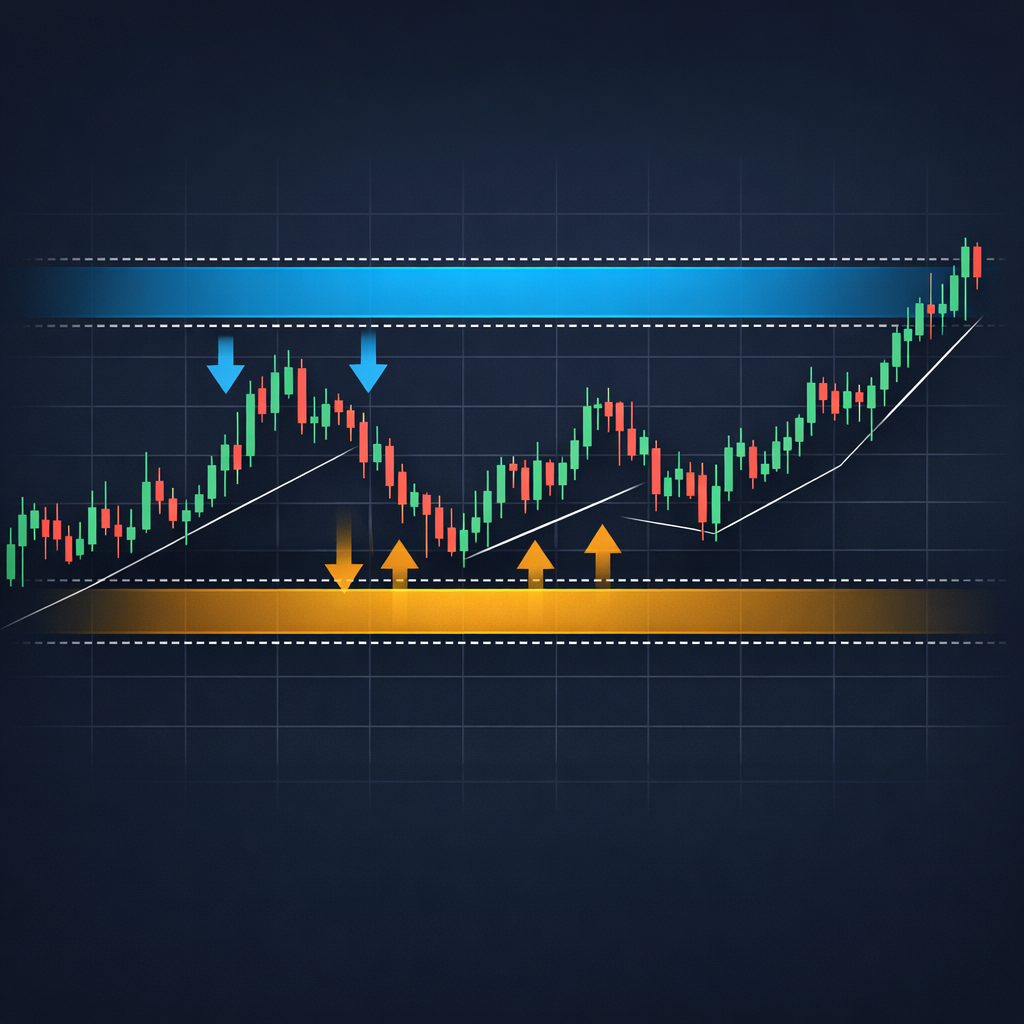
- Support zone: $2638–$2642 (recent reaction lows)
- Mid pivot: $2650 (psychological + intraday magnet)
- Resistance zone: $2668–$2675 (prior highs / supply reactions)
- Stretch resistance: $2688–$2690 (range ceiling)
Two price action triggers that work well on XAUUSD
- Break and retest: price breaks a key level with momentum, retests it, then continues.
- Liquidity sweep and reclaim: price runs stops beyond a high/low, then closes back inside the range and reverses.
Break and retest example (numbers you can visualize)
Gold consolidates under $2668 during London.
NY open pushes price to $2672 and closes M15 above $2668.
Price retests $2668, prints rejection, and you buy at $2670.
Stop loss below the retest wick at $2656 (risk: $14).
Take profit 1 at $2690 (reward: $20), and take profit 2 can be managed via trailing stop if momentum continues.
Liquidity sweep example (the trade many miss)
Asia high sits at $2656.
London spikes to $2661 then quickly drops back below $2656.
You wait for a close back under $2656 and sell at $2653.
Stop above the sweep high at $2666 (risk: $13).
Target the opposite side of the range near $2627 for a 1:2 move (reward: $26).
This is gold trading in a nutshell: patience, then precision.
6) The best XAUUSD strategies (scalping, day trading, and swing) with real setups
There isn’t one “best” XAUUSD strategy.
There is only the best strategy for your schedule, your temperament, and your risk tolerance.
Below are three practical approaches with examples around $2650.
Strategy A: Session range break (day trading)
Goal: trade the break of the Asian range during London or early NY.
Steps:
- Mark Asian high/low (e.g., high $2656, low $2641).
- Wait for London to take one side (liquidity sweep).
- Trade the reclaim back into range or the confirmed break with retest.
Example: London sweeps below $2641 to $2636, then closes back above $2641.
Buy at $2644.
Stop at $2631 (risk: $13).
Target at $2670 (reward: $26, 1:2).
Strategy B: Trend pullback with moving averages (structured, not lazy)
Goal: trade with the trend using a pullback entry.
Tools: 20 EMA + 50 EMA on M15 or H1, plus structure.
Rules:
- Only look for longs if price is above both EMAs and structure is making higher highs/higher lows.
- Enter on a pullback into the EMA zone after a bullish rejection candle.
- Stop goes below the pullback low, not “somewhere near.”
Example: Gold trends from $2638 to $2668, then pulls back to $2652 near the EMA zone.
Buy at $2654.
Stop at $2639 (risk: $15).
Target at $2684 (reward: $30, 1:2).
Strategy C: Swing trading the daily structure (for busy traders)
Goal: capture larger moves using H4/D1 structure with smaller position size.
Approach:
- Mark weekly and daily zones.
- Wait for price to reach a zone (e.g., $2688–$2690 resistance).
- Drop to H1 for trigger (break of structure or sweep/reclaim).
Example: Price tags $2689, prints a sweep above $2688, then closes H1 back below $2682.
Sell at $2680.
Stop at $2702 (risk: $22).
Target at $2636 (reward: $44, 1:2).
Which strategy should you start with?
- New to gold: Strategy A (range + liquidity) teaches discipline.
- Comfortable with trends: Strategy B keeps you aligned with momentum.
- Limited screen time: Strategy C reduces noise and overtrading.
Whichever you choose, don’t mix them mid-week.
Gold punishes inconsistency faster than EUR/USD ever will.
7) Step-by-step: how to build a complete XAUUSD trade plan (entry, SL, TP)
Most traders don’t fail because they lack a strategy.
They fail because they don’t have a complete trade plan.
A complete plan answers three questions before you click buy/sell:
- Why this direction?
- Where am I wrong (stop)?
- Where do I get paid (targets)?
Step 1: Define your market bias (15 minutes, not 15 seconds)
Use a top-down check:
- D1/H4 structure: trending or ranging?
- DXY: supportive or opposing?
- Session context: are we pre-London, London, or NY?
Example: Gold at $2650, DXY at 106.80, and price is below a local resistance at $2668.
Your bias might be “neutral-to-bearish until $2668 breaks and holds.”
Step 2: Identify your setup zone
Pick one zone that matters today.
For example:
- Support: $2638–$2642
- Resistance: $2668–$2675
If price is in the middle at $2650, you wait.
Waiting is a position.
Step 3: Choose your trigger (the moment you enter)
- Break and retest
- Sweep and reclaim
- Strong rejection candle at a level (with confirmation)
Example trigger: M15 closes above $2668 and retests it without losing it.
Step 4: Place a stop that makes sense for gold
Gold stops should be placed where your idea is invalidated.
Not where your account “hopes” it won’t go.
If you buy at $2670 after a retest, and the structure low is $2656, your stop below $2656 is logical.
A stop at $2666 is emotional.
Step 5: Set targets using risk-reward, not vibes
If your stop is $14, then:
- 1:2 target = $28 away
- 1:3 target = $42 away
Buy $2670 with $14 risk.
1:2 target is $2698, but if $2690 is major resistance, you can:
- Take partial at $2688–$2690
- Trail the remainder below higher lows
Step 6: Write your “if-then” rules
- If spread widens abnormally, then skip the entry.
- If price hits 1R, then consider moving stop to breakeven (only if structure supports it).
- If a major news event is 10 minutes away, then reduce size or wait.
This is how you trade gold like a business.
Not like a slot machine.
8) Risk management for XAUUSD: position sizing, leverage, and drawdown control
Gold rewards skill, but it also punishes sloppy risk.
You can be “right” on direction and still lose if your sizing is wrong.
This section is where profitable traders separate from gamblers.
Start with a fixed risk per trade
A common professional range is 0.5% to 1% risk per trade.
If your account is $2,000 and you risk 1%, that’s $20 risk.
If your stop is $10 on gold, you can only trade a size where $10 move equals $20 loss.
That’s the logic.
Gold position sizing (practical approach)
Different brokers quote gold differently (lot sizes vary), so use this process:
- Decide risk in dollars (e.g., $20).
- Measure stop distance (e.g., $15 from $2650 to $2635).
- Calculate size so that $15 move equals $20 loss.
If you don’t know your broker’s contract value, trade smaller until you do.
Gold is not forgiving when you “guess.”
Leverage: the silent account killer
High leverage makes small moves feel huge.
At $2650, a $15 adverse move is normal noise.
If that normal noise can wipe out 10% of your account, your leverage is too high.
Professional traders aim to survive the worst day, not maximize the best day.
Drawdown rules that keep you in the game
- Daily loss limit: stop trading after -2R or -3R.
- Weekly loss limit: reduce size after a losing streak.
- No revenge trading: one extra trade after a loss is how accounts die.
Why “tight stops” often backfire on XAUUSD
Beginners love $5 stops because they look efficient.
But gold wicks can be $5–$8 even in normal conditions.
So you get stopped, price goes your way, and you re-enter worse.
That cycle is expensive.
Better solution: use a structural stop ($10–$25), then reduce lot size to keep risk constant.
Signals + risk management: the winning combination
Even the best signal is useless if you oversize it.
When you follow premium trades, pair them with a risk framework.
We publish educational guidance alongside trades, and you can also review our dedicated risk guide here: risk management strategies when using forex signals.
9) News and macro events that move gold (and how to trade them safely)
Gold is a macro instrument.
That means economic calendars matter more than most traders admit.
When XAUUSD is hovering around $2650, one CPI surprise can move it $25 in minutes.
The events that consistently impact XAUUSD
- US CPI / PCE: inflation expectations shift yields and USD pricing.
- FOMC rate decisions + Powell press conference: volatility spikes, whipsaws are common.
- Non-Farm Payrolls (NFP): USD volatility can spill into gold instantly.
- Geopolitical headlines: unpredictable, often gap-like behavior.
Two safe ways to handle news (choose one)
- News avoidance: stop opening new trades 15–30 minutes before high-impact events.
- News framework: trade only after the first spike settles and structure forms again.
Most beginners should choose avoidance.
There is no shame in skipping chaos.
Post-news structure: where the best trades often appear
A common pattern:
- News spikes gold from $2650 to $2666.
- Then it dumps to $2642.
- Then it reclaims $2650 and trends to $2680.
The trade isn’t the first spike.
The trade is the reclaim and continuation once liquidity has been cleared.
Practical “news day” rules for XAUUSD
- Widen your expectations: stops that worked yesterday may be too tight today.
- Reduce size: trade half risk if volatility is elevated.
- Demand confirmation: no blind limit orders into a data release.
If you want a survival-style playbook for these moments, read: how gold signals react to unexpected news events.
10) Using gold signals the right way: execution, journaling, and consistency
Signals don’t replace skill.
They replace guesswork.
The traders who benefit most from signals are the ones who execute them like professionals.
What a premium XAUUSD signal should include
- Entry price (or entry zone)
- Stop loss (clear invalidation)
- Take profits (TP1/TP2/TP3 or a plan)
- Context: why the trade exists (trend, level, session, news)
That’s exactly how we structure trades inside United Kings Gold Signals and our broader Forex Signals coverage for major pairs.
Step-by-step: how to execute a gold signal like a pro
- Check the session: is this a London/NY setup or a low-liquidity entry?
- Confirm spread: if spread is abnormally wide, wait.
- Set risk first: choose 0.5%–1% risk, then size accordingly.
- Place orders cleanly: entry, SL, TP in one workflow to avoid mistakes.
- Manage according to plan: don’t move SL randomly because of a wick.
- Journal the trade: screenshot before/after, note emotions, note execution quality.
Journaling: the fastest path to consistency
Journal these four fields only:
- Setup type (break/retest, sweep/reclaim, trend pullback)
- Session (Asia, London, NY)
- Risk (stop distance + % risk)
- Execution score (A/B/C)
After 30 trades, patterns become obvious.
You’ll see which session you trade best.
You’ll see whether your losses come from analysis or impulsiveness.
Where to start with United Kings
If you’re exploring signals, start at United Kings Signals and review our approach and coverage.
If you want a beginner-friendly Telegram walkthrough, read: forex signals Telegram for beginners guide.
And if you want to compare what “good” looks like in the industry, see: best forex signals (November 2025).
11) Common XAUUSD mistakes (and the fixes that actually work)
Gold doesn’t bankrupt traders because it’s “hard.”
It bankrupts traders because it magnifies bad habits.
Here are the mistakes we see constantly, and what to do instead.
Mistake #1: Trading gold like EUR/USD
Gold needs room.
If you use tiny stops and expect smooth price action, you’ll get stopped repeatedly.
Fix: use structural stops ($10–$25) and reduce size.
Mistake #2: Entering in the middle of the range
At $2650, if the day’s key levels are $2640 support and $2670 resistance, the middle is chop.
Fix: only trade at levels or after breaks/retests.
Mistake #3: Overtrading London open spikes
London open often creates fakeouts.
Fix: wait for the first liquidity sweep, then trade the reclaim or confirmed continuation.
Mistake #4: Moving stop loss because “it will come back”
Gold can trend $30 against you faster than you can rationalize it.
Fix: your stop is your business expense. If it’s hit, the idea was wrong.
Mistake #5: Ignoring correlation warnings
If DXY is ripping and USD/JPY is accelerating, your gold long is fighting macro pressure.
Fix: reduce size, tighten expectations, or wait for confirmation.
Mistake #6: No routine, no process
Random trading creates random results.
Fix: build a simple routine: levels → bias → session plan → execution → journal.
If you want help structuring that routine around signals, this resource is built for you: how to build a consistent trading routine around signals.
12) From beginner to profitable: a 30-day XAUUSD learning roadmap
Profitability is not a single breakthrough.
It’s a sequence of small skills stacked together.
Here’s a realistic 30-day roadmap you can follow while gold trades around $2650 and volatility remains healthy.
Week 1: Foundations (days 1–7)
- Learn contract specs on your broker (how XAUUSD lot sizing works).
- Mark daily highs/lows and Asian range every day.
- Trade demo only.
- Take screenshots of 10 clean break/retest moves and 10 sweep/reclaim moves.
Your goal is recognition, not profit.
Week 2: One setup, one session (days 8–14)
- Pick one setup: break/retest or sweep/reclaim.
- Pick one session: London open window or NY open window.
- Take 5–10 demo trades with fixed risk (0.5% or 1%).
Consistency beats variety.
Week 3: Add correlation filters (days 15–21)
- Add DXY direction and EUR/USD behavior as a filter.
- Track whether your best trades happen when USD pressure aligns with your bias.
- Practice skipping trades when conditions are mixed.
Skipping is a skill.
Week 4: Go live small + journal hard (days 22–30)
- Go live with micro risk (0.25%–0.5%) if you must, or stay demo if you’re still emotional.
- Journal every trade with an execution score.
- Review weekly: what did you do well, what did you repeat, what did you ignore?
Where signals can accelerate the roadmap
If you’re learning, signals can help you see what “A+ execution” looks like in real time.
United Kings provides premium Telegram signals with a historically strong win-rate profile (often cited at 85%+), but remember: no performance is guaranteed, and execution plus risk control still decide your results.
We also have a community of 300K+ active traders, which helps you stay consistent when your motivation dips.
To explore the full ecosystem (forex, gold, and more), start from UnitedKings.net and choose your focus.
FAQ: XAUUSD trading guide (most asked questions)
1) What is the best timeframe to trade XAUUSD?
For most traders, M15 to H1 offers the best balance between noise and opportunity.
Scalpers use M1–M5 but must handle spreads and fast execution.
Swing traders prefer H4–D1 to avoid intraday chop.
2) How much should my stop loss be on gold?
It depends on structure and volatility, but many clean gold setups use $10–$25 stops.
The key is to keep your account risk fixed and adjust lot size accordingly.
3) Is gold easier or harder than forex majors?
Gold is often harder for beginners because it moves fast and hunts liquidity.
But it can be easier to trade once you respect sessions, structure, and risk rules.
4) What moves gold the most right now?
The biggest drivers are typically USD strength (DXY), real yields, and risk sentiment.
With DXY around 106.80 and USD/JPY near 149.50, USD pressure can matter a lot for gold’s follow-through.
5) Are gold signals worth it?
They can be, if you use them with proper risk management and consistent execution.
Signals are not a guarantee of profit, and results vary by trader, broker conditions, and discipline.
Risk disclaimer (read before you trade)
Trading forex and gold (XAUUSD) involves significant risk and may not be suitable for all investors.
You can lose more than your initial deposit if using leverage.
Past performance, including any stated win rates, is not a guarantee of future results.
If you’re new, we strongly recommend practicing on a demo account first and using strict position sizing.
Join United Kings: get premium XAUUSD signals with clear levels
If you’re serious about trading gold with structure and discipline, we’d love to trade with you.
United Kings provides premium Telegram signals for gold and forex with clear Entry, SL, and TP levels, plus educational guidance to help you improve your execution.
Choose the plan that fits your goals on our pricing page:
- Starter (3 Months): $299 (~$100/mo)
- Best Value (1 Year): $599 ($50/mo) with 50% savings + FREE ebook
- Unlimited (Lifetime): $999 (pay once)
Ready to receive gold setups during the London and NY sessions?
Join our community on Telegram: United Kings premium trading community.
If you have questions about which plan is best, contact us anytime via United Kings support or learn more about our team on about United Kings.