Gold just printed $2650 on XAUUSD, DXY is holding around 106.80, and you’re wondering the same thing most traders wonder at this stage: Is this the start of a bigger move… or a trap that will rip through my stop?
If you’ve ever bought gold at $2652, watched it dip to $2638, panicked, closed, and then watched it rally to $2680 without you—this xauusd trading guide is for you.
We’re going to build your gold trading skill from the ground up, then layer in the pro-level pieces: session timing, correlations, volatility behavior, and risk management that actually fits XAUUSD.
TL;DR (Read This First)
- XAUUSD is a volatility instrument: treat it like one with wider stops ($10–$25 typical) and smaller position sizes.
- Best movement often comes in London + New York, especially during the overlap when liquidity and momentum align.
- Gold is heavily influenced by DXY and real yields: DXY at 106.80 matters, and so do rate expectations.
- Use levels + confirmation: plan trades around $2610–$2690 zones and wait for structure breaks, not hope.
- Target 1:2 to 1:3 RR: e.g., risk $15 to aim $30–$45, and stop “moving SL because it feels right.”
- Signals help, but process wins: if you use signals, you still need execution rules and risk controls.
What Makes XAUUSD (Gold) Different From Forex Pairs?

Gold trading looks like forex on your platform, but it behaves differently under pressure.
EUR/USD at 1.0520 can drift 20–40 pips in a calm hour and still be “normal.”
XAUUSD can move $8–$15 in minutes, pause, then extend another $12 without warning.
Gold is a macro asset wearing a technical mask
Gold is priced in dollars, but it’s not “just another USD pair.”
It’s a global store-of-value asset that reacts to inflation expectations, real yields, risk sentiment, and geopolitics.
That’s why you’ll see gold spike on a single CPI surprise or a sudden risk-off headline.
Volatility and spread behavior are part of the strategy
On many brokers, XAUUSD spread is fine most of the day, then widens during news or low-liquidity moments.
If your stop is too tight—say $5—spread and noise can take you out even if you’re “right.”
This is why professional gold traders often think in zones, not single-price precision.
Gold respects levels… but it also hunts liquidity
Gold loves to tap obvious highs/lows, trigger stops, then reverse.
That doesn’t mean “manipulation” in a conspiracy sense.
It means liquidity sits at obvious points, and large flows seek it.
Gold vs major forex pairs (practical comparison)
| Feature | XAUUSD (Gold) | EUR/USD | GBP/USD | USD/JPY |
|---|---|---|---|---|
| Typical intraday volatility | High (often $15–$35 range) | Medium (30–80 pips) | Medium-High (50–120 pips) | Medium (40–100 pips) |
| Best trading sessions | London & NY (overlap is prime) | London | London & NY | Tokyo + NY data |
| News sensitivity | Very high (CPI, NFP, Fed) | High | High | High (rates/yields) |
| Stop-loss style | Wider ($10–$25 common) | Tighter (10–30 pips) | Medium (15–40 pips) | Medium (20–50 pips) |
| Common trader mistake | Oversizing and revenge trading | Overtrading chop | Trading emotions in spikes | Fighting trends driven by yields |
If you treat gold like EUR/USD with a slightly bigger spread, you’ll usually pay for it.
If you respect gold’s rhythm, it becomes one of the cleanest instruments to trade.
Gold Market Fundamentals: What Actually Moves XAUUSD?
To trade gold profitably, you don’t need a PhD in macro.
You do need a simple “cause-and-effect” model you can apply every week.
1) The US dollar (DXY) and gold’s pricing mechanism
Gold is priced in USD, so a stronger dollar often pressures gold.
Right now, DXY around 106.80 is not a small detail.
If DXY pushes higher, gold rallies can become slower and more corrective.
2) Real yields and rate expectations
Gold doesn’t pay interest.
So when real yields rise, holding gold has a bigger opportunity cost.
When markets price rate cuts or inflation risk, gold tends to breathe easier.
3) Risk-on vs risk-off flows
Gold can behave like a safe haven, especially during shocks.
But it’s not always “risk-off only.”
Sometimes gold rises with stocks when liquidity is abundant and the dollar is soft.
4) Central bank demand and long-term bids
Central banks have been meaningful buyers in recent years.
This creates a structural bid that can support dips.
It doesn’t mean price only goes up, but it can change how deep pullbacks go.
5) Key data releases that frequently move XAUUSD
- US CPI / PCE: inflation expectations and rate pricing.
- NFP (jobs): dollar and yields volatility.
- FOMC: guidance, dot plot, press conference tone.
- US Retail Sales / ISM: growth expectations.
- Geopolitics: sudden risk-off spikes and gaps.
Here’s a real-world scenario.
Gold is trading $2650, DXY is 106.80, and CPI is due in 30 minutes.
If CPI prints hot, you can see gold dump $20 fast (e.g., $2650 → $2630) before you can “think.”
This is why we plan news behavior, not react emotionally.
If you want a deeper look at how signals and setups behave around surprises, read our guide on how gold signals react to unexpected news events.
XAUUSD Session Timing: When Gold Moves (and When It Traps)
Most traders lose on gold not because their strategy is terrible.
They lose because they trade the right idea at the wrong time.
Asia session: range-building and stop hunts
During Tokyo/Asia hours, gold often ranges and prints messy wicks.
It can still trend, but the probability of “fake breaks” is higher.
This is where many beginners get chopped trying to scalp $3–$5 moves.
London session: structure and directional intent
London often brings the first real directional push.
Liquidity increases, and yesterday’s levels matter again.
If gold is sitting near $2650 at London open, watch how it reacts to nearby zones like $2642, $2630, and $2665.
New York session: momentum, reversals, and the “real move”
New York adds US flows, US data, and bond market influence.
This is where gold can trend hard or reverse sharply.
Many of the cleanest trades come from the London–NY overlap.
Practical timing framework (simple and effective)
- Pre-London (30–60 min): mark Asia high/low, yesterday high/low, and key round numbers.
- London open: wait 10–15 minutes for the first stop run, then look for confirmation.
- Overlap: trade continuation if structure is clean, or trade reversal only after a clear failure pattern.
- Late NY: reduce activity; spreads and randomness can increase.
Example: London breakout vs London trap
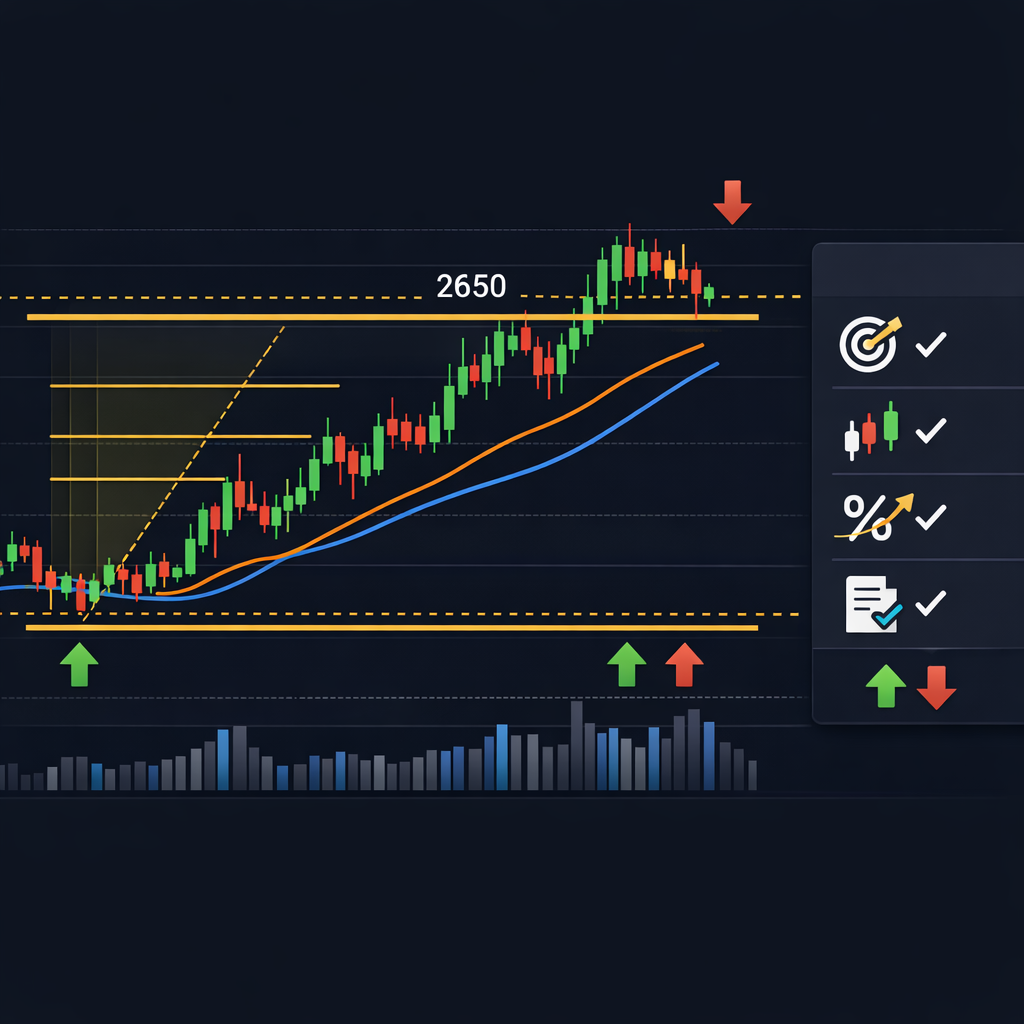
Let’s say Asia range is $2642–$2656 and price is $2650 now.
Breakout case: London pushes to $2658, pulls back to $2652, then reclaims $2658 with strong candles.
A structured entry could be $2659 with SL $2647 (risk $12) and TP $2683 (reward $24, 1:2).
Trap case: London spikes to $2658, instantly wicks, and closes back under $2652.
That’s not a buy signal.
That’s a warning that liquidity above the range was collected.
United Kings focuses heavily on London and NY session execution because that’s where gold offers the cleanest “signal-to-noise” ratio.
If you want to see how we structure entries with clear SL/TP, explore United Kings Gold Signals and compare it with our broader premium trading signals coverage.
XAUUSD Correlations: DXY, Yields, EUR/USD, and Risk Sentiment
Correlation is not a magic button.
But it’s a powerful filter that keeps you out of low-quality trades.
Gold and DXY: the classic inverse relationship (with exceptions)
When the dollar rises, gold often falls.
When the dollar falls, gold often rises.
But “often” is not “always,” especially during crisis moments when both can rise on safety demand.
Right now, with DXY ~106.80, you want to ask a simple question before buying gold at $2650.
Is DXY rejecting resistance and turning down? If not, your gold long may need faster profit-taking and tighter expectations.
Gold and real yields: the hidden driver
Many traders watch only the dollar and ignore yields.
But gold often reacts first to rate expectations.
If yields are rising, gold rallies can become “sell-the-rip” opportunities.
Gold and EUR/USD (and why EUR/USD at 1.0520 matters)
EUR/USD is the biggest weight in DXY.
If EUR/USD is heavy around 1.0520 and can’t push higher, that can indirectly support DXY strength.
That doesn’t force gold to drop, but it adds friction to upside continuation.
Gold and USD/JPY (149.50) as a risk proxy
USD/JPY around 149.50 often reflects yield dynamics and risk appetite.
Fast USD/JPY rallies can signal rising yields, which can pressure gold.
Fast USD/JPY drops can signal risk-off or intervention fear, which can lift gold.
A simple correlation checklist before every XAUUSD trade
- Is DXY trending or ranging? Is it breaking a key level?
- Is EUR/USD supporting dollar weakness (bullish EUR/USD) or not?
- Is USD/JPY accelerating (yields up) or stalling (yields stable/down)?
- Is it a risk-on day (stocks bid) or risk-off day (flight to safety)?
When correlation aligns, your gold trade has “wind at its back.”
When correlation fights you, you can still trade—but you must reduce size, tighten rules, or wait for better confirmation.
If you trade multiple instruments, our Forex Signals and gold coverage are designed to help you see these cross-market clues in real time.
Core Technical Foundations: Levels, Structure, and Volatility (XAUUSD)
Gold technicals are simple when you stop chasing indicators.
The base is levels + structure + volatility.
Step 1: Mark the levels that matter (not 50 lines)
Start with higher timeframes (H4/D1) and mark:
- Previous day high/low
- Asia range high/low
- Weekly open (often acts like a magnet)
- Round numbers (e.g., $2650, $2660, $2680)
- Major swing points inside $2610–$2690
In the current context, $2650 is a psychological pivot.
Levels like $2630–$2635 and $2665–$2670 often act as decision zones in this band.
Step 2: Define market structure in one sentence
Ask: are we making higher highs and higher lows (bullish), or lower highs and lower lows (bearish)?
If you can’t answer quickly, you’re likely in chop.
In chop, your best trade is often no trade.
Step 3: Use volatility to set realistic stops and targets
A $10 stop on gold can be “tight” depending on the hour.
A $25 stop can be “normal” during NY data.
Your stop should fit the structure, then your position size should fit the stop.
High-probability price action patterns for XAUUSD
- Break and retest: price breaks $2658, retests $2658–$2655, then continues.
- Failure swing: price breaks above $2665, fails, closes back below $2660, then sells to $2640.
- Liquidity sweep + reversal: price spikes to take stops above a prior high, then reverses with strong bearish candles.
- Trend pullback: in an uptrend, buy pullbacks into prior demand zones with confirmation.
Example: clean structure trade (1:3 RR)
Assume gold forms higher lows and reclaims $2650 after a dip.
You wait for a break above $2660, then a retest holds at $2656.
Entry: $2657. SL: $2644 (risk $13). TP: $2696 (reward $39, 1:3).
Notice what’s missing: guessing.
You’re reacting to structure, not predicting it.
If you want to build a more systematic process around this, you can combine it with the execution discipline we teach in our educational content on United Kings Blog.
Beginner XAUUSD Strategy: The “3-Box” Method (Simple, Repeatable)
If you’re new, your goal is not to catch every move.
Your goal is to trade one repeatable setup with controlled risk.
What is the 3-Box method?
You create three zones (boxes) each day:
- Box 1: Asia range (high/low from Asia hours)
- Box 2: London expansion (first directional push and its retest zone)
- Box 3: NY continuation or reversal zone (key level where NY decides)
Step-by-step rules (beginner-friendly)
- Mark Asia high/low. Example: $2642 low and $2656 high.
- Wait for London to break one side of the range.
- Do not enter on the first spike. Wait for a retest.
- Enter only after confirmation: a strong close back in the breakout direction, or a clear rejection wick at the retest.
- Place SL beyond structure, usually $10–$20 away depending on the setup.
- Target 1:2 minimum. Move to breakeven only after structure supports it.
Long example (range break + retest)
Asia high is $2656.
London breaks to $2662, then pulls back to $2656 and holds.
Entry: $2658. SL: $2646 (risk $12). TP1: $2682 (1:2). TP2: $2694 (near 1:3).
Short example (false break / liquidity sweep)
Asia low is $2642.
London breaks below to $2638, then instantly reclaims $2642 and fails again at $2640.
That’s a clue of a trap.
Entry: $2639. SL: $2652 (risk $13). TP: $2613 (reward $26, 1:2).
Why this works (and why beginners like it)
It forces patience.
It anchors your decisions to session behavior, not random candles.
And it gives you a clear “no trade” condition: if London doesn’t break cleanly, you don’t force it.
If you prefer to follow structured trade calls while you learn, our XAUUSD-focused gold signals are posted with clear Entry, SL, and TP so you can compare your analysis with a professional plan.
Intermediate XAUUSD Strategy: Trend + Pullback Entries (The Pro Workhorse)
Once you can stop overtrading, the next step is learning to trade with the trend.
Gold trends can be generous, but they punish late entries.
Define the trend (without overcomplicating it)
Use a simple structure rule on H1/H4:
- Uptrend: higher highs + higher lows, price holds above key demand zones.
- Downtrend: lower highs + lower lows, price rejects supply zones.
- Range: mixed structure, repeated wicks, no follow-through.
The pullback entry model
You wait for an impulse move, then a controlled pullback into a level.
You enter on confirmation that the pullback is ending.
Step-by-step: trend + pullback on XAUUSD
- Identify the trend on H1/H4.
- Mark the last impulsive leg (e.g., $2625 → $2665).
- Mark the pullback zone (often 38.2%–61.8% retracement, or prior structure like $2650).
- Wait for confirmation: bullish engulfing, break of a minor lower high, or reclaim of a key level.
- Place SL below the pullback low, typically $12–$25 depending on volatility.
- Target the prior high first, then an extension for 1:2 or 1:3.
Example: buying a pullback into $2650
Gold rallies from $2628 to $2668, then pulls back to $2650.
You see sellers fail to close below $2648, then price reclaims $2655.
Entry: $2656. SL: $2641 (risk $15). TP: $2686 (reward $30, 1:2).
How to avoid the “pullback that becomes a reversal”
This is where many intermediate traders get hurt.
They buy every dip because “trend,” then the trend breaks.
Use two filters:
- Structure filter: if the pullback breaks the last higher low and closes below it, step aside.
- Correlation filter: if DXY is breaking higher while you’re trying to buy gold, demand stronger confirmation.
Gold is forgiving when you trade with momentum.
It’s brutal when you average down into a trend break.
Advanced XAUUSD Strategy: Breakouts, Fakeouts, and Liquidity Sweeps
Advanced gold trading is mostly about one thing: understanding where other traders place stops.
Gold doesn’t move randomly—it often moves toward liquidity.
Breakouts that work vs breakouts that fail
A breakout that works usually has:
- Clear consolidation (tight range)
- Strong close beyond the level (not just a wick)
- Retest that holds (buyers/sellers defend)
- Session timing alignment (London/NY)
A breakout that fails usually has:
- A spike into a level with immediate rejection
- No follow-through volume (thin liquidity)
- It happens right before major news
- It occurs in the “dead zone” between sessions
Liquidity sweep reversal (classic XAUUSD)
Imagine gold has a visible high at $2668 from earlier in the day.
Price grinds up and spikes to $2672, triggering breakout buys.
Then it closes back below $2668 and prints a strong bearish candle.
A structured short could look like:
- Entry: $2666 (after the reclaim failure)
- SL: $2682 (risk $16)
- TP: $2634 (reward $32, 1:2)
Continuation breakout (the “retest is your friend” rule)
Gold consolidates between $2648 and $2656.
NY opens and breaks $2656 with strong candles, then retests $2656 and holds.
Entry: $2658. SL: $2646 (risk $12). TP: $2682 (reward $24, 1:2).
Advanced execution tip: scale-outs and partials
Gold moves fast, so scaling out can protect you from reversals.
One practical model:
- Take 50% at 1:1 (reduce stress)
- Move SL to breakeven only after structure confirms
- Let the remaining 50% run to 1:2 or 1:3
This avoids the common pain of watching a trade go +$18, then reverse and stop you out for -$15.
You don’t need to “predict” the top—you need a plan for both outcomes.
Risk Management for XAUUSD: Position Sizing, Stops, and Survival Rules
Gold rewards skill, but it demands respect.
If you get risk management right, you can be wrong often and still grow.
The #1 XAUUSD risk mistake: oversizing
Because gold moves $10 quickly, traders try to “make it worth it” by increasing lot size.
That’s how accounts blow up.
Your size must be based on your stop distance, not your emotions.
Simple position sizing formula (works on any broker)
Decide your risk per trade as a % of your account.
For beginners, we like 0.5% to 1%.
Example:
- Account: $2,000
- Risk: 1% = $20
- Gold stop: $15 (e.g., entry $2655, SL $2640)
- Your position size must be small enough that a $15 move equals ~$20 loss.
Your platform will calculate this differently depending on contract size.
The principle stays the same: risk is fixed, stop is structural, size adapts.
Stop-loss placement: structure first, numbers second
A good gold stop is usually beyond:
- A swing high/low
- A clear support/resistance zone
- The opposite side of a breakout range
A bad gold stop is usually:
- Exactly $5 away because “tight is good”
- Placed on an obvious level where everyone else is stopped
- Moved wider after entry because you don’t want to be wrong
Daily loss limits (the rule that saves careers)
Gold can trigger revenge trading because it moves fast.
Set a daily max loss like 2R (two full-risk losses) and stop for the day.
If you risk $20 per trade, your daily max is $40.
Risk-to-reward: why 1:2 is a gold standard for gold
Gold gives clean extensions when it runs.
So aiming 1:2 or 1:3 is realistic when your entry is structured.
For deeper work on this topic, see our risk management strategies guide and apply the same discipline to XAUUSD.
One more truth: consistency comes from boring rules
Most profitable gold traders aren’t “geniuses.”
They’re consistent with the same rules when they’re up and when they’re down.
Building Your Daily XAUUSD Trading Plan (Checklist + Routine)
Profitability usually isn’t a secret strategy.
It’s a repeatable routine that reduces mistakes.
Your pre-market checklist (10 minutes)
- Mark yesterday high/low and today’s Asia range.
- Note current price (around $2650) and nearest key zones ($2630, $2665, $2685).
- Check DXY (around 106.80) and whether it’s trending.
- Check EUR/USD (1.0520), GBP/USD (1.2680), USD/JPY (149.50) for risk tone.
- List today’s high-impact events (CPI, NFP, FOMC, etc.).
- Decide your max trades and max daily loss.
Your execution checklist (before you click buy/sell)
- Is this trade happening in London/NY, or am I forcing it?
- Is there a clear level and a clear reason for entry?
- Is my stop beyond structure (not inside noise)?
- Is my RR at least 1:2?
- Does correlation support the trade or fight it?
- Is my position size correct for the stop distance?
Your post-trade routine (where the edge compounds)
Take a screenshot of entry and exit.
Write one sentence: “I followed my rules” or “I broke rule X.”
That simple honesty builds skill faster than any indicator.
Signals + routine: how to use both without becoming dependent
If you follow signals, your job is execution and risk control.
That means you still use a checklist.
To learn how to evaluate providers properly, use our signals provider checklist for beginners.
And if you want a place to discuss trades live, join our community on Telegram at United Kings official Telegram channel.
Common XAUUSD Mistakes (and How Profitable Traders Fix Them)
Gold exposes bad habits quickly.
The good news is that most mistakes are predictable—and fixable.
Mistake 1: Trading gold like a slot machine
Random entries, random exits, and “maybe it will bounce.”
Fix: trade only at levels and only during your chosen sessions.
Mistake 2: Tight stops and emotional re-entries
You buy $2650 with a $4 stop, get stopped at $2646, then re-buy at $2654.
Fix: place stops beyond structure and reduce size.
Mistake 3: Holding through major news without a plan
If you don’t know how CPI can move gold $20 in 60 seconds, you’ll learn the hard way.
Fix: either flatten before major news or reduce risk and accept volatility.
Mistake 4: Moving SL wider “just this once”
This is how one trade becomes an account-damaging event.
Fix: pre-define “invalidation.” If invalidated, you’re out.
Mistake 5: Overtrading after a win (the sneaky one)
You catch a $30 move and feel unstoppable.
Then you give it back in three impulsive trades.
Fix: cap your trades per session and stop after hitting your daily goal.
A quick story (realistic, and common)
A trader buys gold at $2658 in NY, risks $15, targets $2688.
Price goes to $2674, then pulls back to $2662.
They panic, close, then watch it hit $2688 an hour later.
The problem wasn’t the analysis.
The problem was not having a plan for pullbacks inside a valid trend.
That’s why our United Kings approach combines education + execution-ready signals, not signals alone.
How United Kings Traders Approach XAUUSD (Process, Not Hype)
Let’s be clear: nobody can guarantee profits in gold.
What we can do is stack probability with structure, timing, and disciplined risk.
Our operating environment: London and New York
We focus on the sessions where gold is most tradable.
That means fewer trades, higher intention, and clearer follow-through.
What a “complete” gold signal should include
Whether you trade with us or anyone else, your signal should be executable.
- Entry (exact or zone)
- Stop loss (clear invalidation)
- Take profit (one or multiple targets)
- Context (trend, level, session, and news awareness)
Why our community matters
Trading alone is where discipline breaks.
In an active community, you see other traders follow the plan when you feel like improvising.
United Kings has a 300K+ active trader community, and that shared structure is a real edge.
Where to start on UnitedKings.net
- Explore our full signals offering: United Kings Premium Signals
- Focused gold coverage: Gold (XAUUSD) Signals
- Forex opportunities alongside gold: Forex Signals
- Want diversification beyond FX/metals? See: Crypto Signals
Pricing plans (3 options, clear value)
We keep pricing simple so you pick what fits your horizon:
- Starter (3 Months): $299 (about $100/month)
- Best Value (1 Year): $599 (about $50/month) + FREE ebook
- Unlimited (Lifetime): $999 pay once, access forever
You can review the three plans anytime on our pricing page.
We also offer a 48-hour money-back guarantee so you can evaluate the service with less pressure.
FAQ: XAUUSD Trading Guide (Gold Trading Questions)
1) What is the best timeframe to trade XAUUSD?
Most traders do best using H1/H4 for structure and 5M/15M for entries.
If you’re a beginner, avoid ultra-low timeframes until you can follow rules under pressure.
2) How much should my stop loss be on gold?
It depends on structure and volatility, but many intraday setups use $10–$25.
Place SL beyond a swing level, then adjust position size so your account risk stays fixed.
3) When is the best time to trade gold?
London and New York sessions are typically best, especially the overlap.
Asia can be tradable, but it often ranges and produces more fakeouts.
4) Is gold trading good for beginners?
Gold can be beginner-friendly if you trade small size and follow strict risk rules.
It becomes dangerous when beginners oversize or trade news without a plan.
5) Can I trade XAUUSD using signals?
Yes, but you still need execution discipline.
Use signals with clear Entry/SL/TP, and keep your risk per trade consistent.
Risk Disclaimer (Read Before You Trade)
Forex and gold trading involves significant risk and is not suitable for every investor. You can lose some or all of your capital. Past performance does not guarantee future results. Nothing in this article is financial advice; it is educational information only. If you’re new, practice on a demo account first and use strict risk management before trading live.
Final Step: Turn This XAUUSD Guide Into Daily Execution
Reading a complete guide feels good.
But profitability comes from what you do at $2650 when price is moving and your emotions show up.
If you want structured help—clear entries, stops, and targets—while you build your own skill, join the United Kings community.
We deliver premium Telegram signals for forex and gold with a disciplined approach built around London and NY sessions, plus educational support to help you grow into an independent trader.
Join United Kings now:
- Start with our full service: United Kings Premium Signals
- Trade gold specifically: Gold (XAUUSD) Signals
- See plans and choose your tier: Starter, Best Value, or Lifetime pricing
- Get updates and community access on Telegram: United Kings Telegram channel
Your next trade doesn’t need to be perfect. It needs to be planned, sized correctly, and executed with discipline.