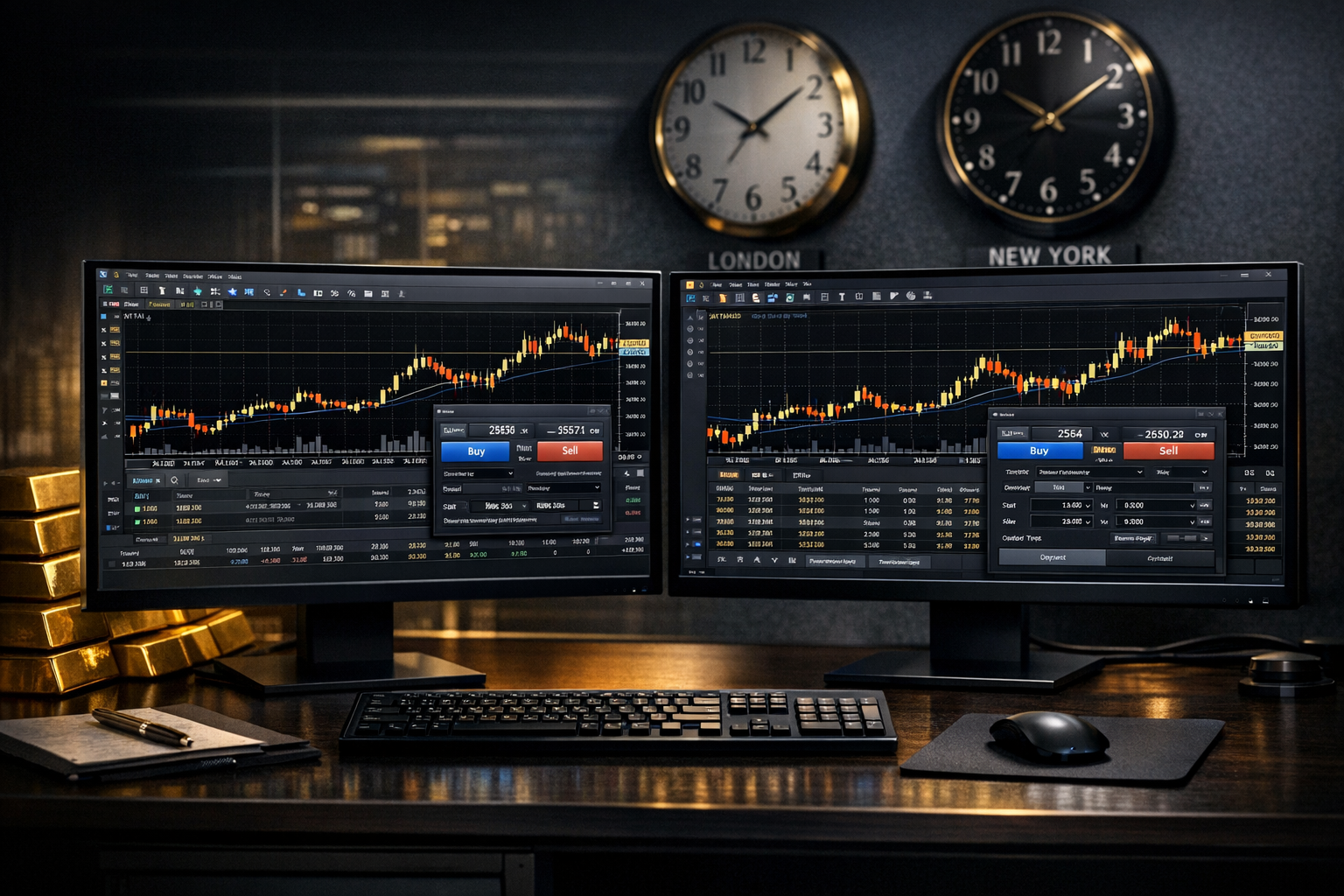
Gold is at $2650.00 and it feels like it can move $20 in the time it takes you to make coffee.
If you’ve ever entered XAUUSD, watched it spike, hit your stop by $1, then run straight to your take profit without you… this xauusd trading guide is for you.
We’re going to turn gold from “random volatility” into a market you can read, plan, and execute with confidence.
TL;DR: The quickest way to trade XAUUSD smarter
- Gold (XAUUSD) is a volatility product. Plan for $10–$25 stops and targets built around 1:2 to 1:3 R:R, not “hope.”
- Sessions matter more on gold than most pairs. The London open and NY open are where clean moves and liquidity often appear.
- DXY (106.80) is your compass. Gold often moves inversely to the dollar, but correlations can flip during risk events.
- Use levels + confirmation. Gold respects key zones (e.g., 2610–2690 range) and reacts sharply to liquidity sweeps.
- Risk management is the edge. A consistent 0.5%–1% risk per trade beats “big wins” followed by blowups.
- Signals work best with structure. If you want entries, SL, and TP mapped out, combine your plan with premium guidance like United Kings gold signals.
Why XAUUSD moves the way it moves (and why it feels different)

Gold is not “just another forex pair.”
XAUUSD is a hybrid market that trades like a currency during macro cycles, like a commodity during supply-demand narratives, and like a risk hedge during geopolitical stress.
That’s why you’ll see gold rally even when the chart “looks overbought.”
And it’s why you’ll see gold dump $30 while the news headline looks bullish.
Gold’s main drivers (in plain English)
At a high level, gold moves based on the market’s pricing of real yields, USD strength, risk sentiment, and central bank demand.
Right now, the market context matters.
With XAUUSD around $2650 (+0.35% over 24h) and the DXY at 106.80, we’re in a zone where gold can still trend, but pullbacks can be sharp.
- USD strength (DXY): Often inverse to gold. If DXY pushes higher, gold can struggle.
- Rates and real yields: Higher yields can pressure gold, but in risk-off moments gold can rise anyway.
- Risk sentiment: When markets panic, gold can act like insurance.
- Liquidity conditions: Gold loves to run stops above/below obvious highs/lows.
Why gold “hunts stops” more than you expect
Gold is heavily traded by institutions, funds, and algorithmic systems.
Those players need liquidity.
Liquidity often sits where retail traders place stops: above recent highs, below recent lows, and around clean round numbers like 2650 or 2600.
So the market will frequently sweep a level (for example, spike from 2642 to 2656), trigger stops, then reverse back into the real direction.
In this guide, we’ll show you how to plan for that instead of being a victim of it.
XAUUSD vs forex pairs: what to expect (volatility, spreads, behavior)
If you treat gold like EUR/USD, you’ll overtrade, under-size stops, and get chopped.
Gold can move 300–800 pips (depending on broker quote format) in a normal session.
That’s why a “tight” stop on gold can be a trap unless it’s backed by structure.
Practical differences you must respect
- Wider effective range: A normal intraday swing can be $15–$30.
- News sensitivity: CPI, NFP, FOMC can cause $20–$50 spikes.
- Session-driven moves: London/NY often provide the cleanest liquidity.
- False breaks: More frequent than on major FX pairs.
Comparison table: XAUUSD vs major FX pairs (realistic expectations)
| Market | Typical intraday behavior | Stop size (common) | Best sessions | Common mistake |
|---|---|---|---|---|
| XAUUSD (Gold) | $15–$30 swings, frequent liquidity sweeps | $10–$25 | London + NY overlap | Stops too tight, chasing spikes |
| EUR/USD (1.0520) | Smoother, more technical in ranges | 15–40 pips | London open, NY data releases | Over-leveraging around news |
| GBP/USD (1.2680) | Sharper than EUR/USD, whippy | 25–60 pips | London session | Trading every move without plan |
| USD/JPY (149.50) | Trend bursts, sensitive to yields/BoJ | 20–60 pips | Tokyo + NY | Ignoring intervention risk |
Notice what stands out.
Gold’s stop size is bigger in dollars, but the opportunity is also bigger if you plan trades with 1:2 or 1:3 risk-reward.
How to read XAUUSD like a pro: structure, zones, and liquidity

If you want to become profitable on gold, your chart work must become simpler, not more complicated.
Gold rewards traders who can identify where price should react, and who can wait for confirmation.
Step 1: Mark your higher-timeframe bias (15 minutes)
Start with H4 and H1.
Ask one question: are we making higher highs/higher lows (bullish), lower highs/lower lows (bearish), or ranging?
With gold around $2650, a common scenario is a bullish trend with sharp pullbacks into demand zones.
That means you don’t want to short every spike just because RSI looks high.
Step 2: Draw zones, not lines
Gold doesn’t respect a single price to the dollar.
It respects areas where orders cluster.
For example, instead of drawing a line at 2635.00, mark a zone like 2632–2638.
Then watch how price behaves inside that zone.
Step 3: Identify liquidity pools
Liquidity pools are obvious highs and lows.
On gold, they matter because price often sweeps them before moving.
- Buy-side liquidity: resting buy stops above highs.
- Sell-side liquidity: resting sell stops below lows.
Example: gold makes a clean Asian range between 2640 and 2652.
London opens and spikes to 2658 (sweeping highs), then drops back below 2652.
That “failure” often becomes a high-probability short setup toward 2642 or 2635.
Step 4: Use confirmation triggers (don’t guess)
Confirmation can be simple price action.
- Break and retest: price breaks a zone, retests, then continues.
- Engulfing candle at a key level: especially on M15/M5 during London/NY.
- Shift in market structure: a lower low after a sweep can confirm bearish intent.
This is the difference between “I think gold will drop” and “gold showed me it’s dropping.”
Best times to trade gold: session timing that actually matters
Gold trades 24 hours, but it does not move the same way all day.
If you trade XAUUSD at random hours, you’ll often enter during low-liquidity chop.
Then you’ll get wicked out when the real session begins.
London session: where the day often forms
London is where liquidity ramps up and the market often sets the day’s direction.
Common London behaviors:
- Breakout from Asian range.
- Stop sweep above/below Asia highs/lows.
- Trend continuation if the higher timeframe is aligned.
Example: Asian session holds 2638–2650.
London sweeps below to 2632, then reclaims 2638 with a strong bullish candle.
A long entry near 2640 with SL at 2628 ($12 risk) targets 2664 (1:2) and 2676 (1:3).
New York session: acceleration and reversals
New York can either continue London’s move or completely reverse it.
This is especially true when US data hits.
With DXY at 106.80, a surprise hawkish data print can spike the dollar and slam gold quickly.
That’s why NY requires tighter execution rules.
London–NY overlap: the “sweet spot” for many traders
This overlap often provides the best combination of liquidity and follow-through.
It’s where many of our traders focus when following United Kings signals, because spreads are typically more stable and moves are cleaner.
Want a deeper session playbook?
We have a dedicated breakdown on timing and behavior patterns.
Read it alongside this guide: our market education posts and your daily execution will feel far less random.
Gold correlations you must know: DXY, USD/JPY, and risk sentiment
Gold is technical, but it’s also macro.
If you ignore correlations, you’ll take perfect-looking setups right into a macro headwind.
XAUUSD and DXY (106.80): the most useful relationship
Most of the time, gold and the dollar index move inversely.
That means:
- If DXY breaks up and holds, gold longs become harder.
- If DXY breaks down, gold often finds a bid.
Example scenario: DXY pushes from 106.80 to 107.10 during NY.
Gold fails to reclaim 2660 and prints a lower high at 2656.
That alignment increases the probability of a drop toward 2638 or 2625.
XAUUSD and USD/JPY (149.50): yields proxy in disguise
USD/JPY often reflects yield dynamics.
When USD/JPY is trending higher, it can signal rising yields, which can pressure gold.
But this is not a perfect rule.
During risk-off events, USD/JPY can fall while gold rises sharply.
Gold and EUR/USD (1.0520), GBP/USD (1.2680)
These pairs help you read USD strength across the board.
If EUR/USD and GBP/USD are both selling off, that’s broad USD demand.
Gold longs in that moment need stronger technical confirmation and more conservative targets.
Correlation is context, not a signal
Here’s the right mindset.
Correlations don’t tell you to buy or sell.
They tell you whether your trade is swimming with the current or against it.
If you want a structured way to handle risk around correlation and multi-signal days, our guide on position control is essential: risk management strategies when using trading signals.
Beginner XAUUSD strategy: levels + rejection (simple, repeatable)
Beginners don’t need five indicators.
You need a repeatable process that keeps you from chasing candles.
This “levels + rejection” approach is one of the fastest ways to build discipline on gold.
The setup in one sentence
Trade a reaction at a higher-timeframe level after price shows rejection and structure shift.
Step-by-step execution
- Mark a key zone on H1/H4 (previous swing high/low, daily open, or clear supply/demand).
- Wait for price to touch the zone during London or NY.
- Look for rejection (wick + strong close away from the level).
- Confirm with structure (break of a minor high/low on M15/M5).
- Place SL beyond the wick (commonly $10–$25 depending on volatility).
- Target 1:2 first, then scale to 1:3 if momentum supports.
Realistic example (within current market levels)
Gold trades up to 2668, a prior supply zone from earlier in the week.
It prints a rejection wick to 2672 but closes back below 2665 on M15.
You wait for a break below 2660, then a retest into 2660–2662.
- Entry: 2661
- Stop loss: 2676 (risk $15)
- TP1 (1:2): 2631
- TP2 (1:3): 2616
This is not about predicting.
It’s about letting gold show its hand, then executing with defined risk.
What makes this strategy work on gold
- Gold reacts aggressively at real zones.
- Stop placement is logical (beyond the sweep).
- Risk-reward is built in from the start.
If you prefer having these levels mapped daily with entry/SL/TP provided, that’s exactly what our premium gold signals are designed for.
Intermediate XAUUSD strategy: trend continuation with pullback structure
Once you stop trying to catch every top and bottom, gold becomes easier.
The intermediate skill is learning to join trends on pullbacks without entering too early.
This is where many traders go from breakeven to consistent.
What a healthy gold uptrend looks like
In an uptrend, gold will often:
- Push impulsively (fast candles).
- Pull back slowly (overlapping candles).
- Respect prior demand zones.
With gold around 2650, imagine the market previously rallied from 2615 to 2680.
A pullback toward 2640–2635 can be a “buy-the-dip” area if structure remains bullish.
Step-by-step: pullback continuation entry
- Confirm trend on H1 (higher highs/higher lows).
- Mark pullback zone (previous breakout area, demand, or 50% of impulse leg).
- Wait for pullback to slow (smaller candles, decreasing momentum).
- Enter on break of pullback structure (M15 higher low + break of minor high).
- Stop below the pullback low (typically $12–$20).
- Target previous high first, then extension (1:2 to 1:3).
Example trade plan (trend continuation)
Gold is bullish on H1 and pulls back from 2678 into demand at 2642–2646.
Price prints a higher low at 2644 and breaks above 2652.
- Entry: 2653
- Stop loss: 2638 (risk $15)
- TP1 (1:2): 2683
- TP2 (1:3): 2698 (note: if your guideline cap is 2690, you can instead trail and aim 2688–2690)
In current conditions, you can cap TP2 inside 2688–2690 if that’s the nearest liquidity pool.
Common mistakes (and fixes)
- Mistake: Buying the first red candle in an uptrend. Fix: Wait for structure shift.
- Mistake: Stops inside the zone. Fix: Place SL beyond the pullback low.
- Mistake: Taking profits too early. Fix: Scale out at 1:2, trail remainder.
Advanced XAUUSD strategy: liquidity sweep + reversal (the “stop-hunt” play)
This is the strategy that explains most “why did it reverse there?” moments.
Gold frequently runs a known high/low to grab liquidity, then reverses with momentum.
Advanced traders don’t complain about this behavior.
They build a plan around it.
What you’re looking for
- A clearly visible high/low (yesterday’s high, Asian high, weekly swing).
- A sweep (price breaks it briefly).
- A failure (price closes back inside the range).
- Confirmation (structure shift on M15/M5).
Why the sweep matters
When price takes an obvious high, it triggers buy stops.
That provides liquidity for larger players to sell into.
When price then fails to hold above the level, it signals the move was more about liquidity than real demand.
Step-by-step execution (with realistic numbers)
- Identify an Asian high near 2655.
- London opens and spikes to 2666.
- Wait for M15 close back below 2655.
- Enter on a retest of 2654–2656 with bearish confirmation.
- SL above the sweep high (commonly $12–$20).
- Target the opposite side of the range and then extension.
- Entry: 2655
- Stop loss: 2670 (risk $15)
- TP1 (1:2): 2625
- TP2 (1:3): 2610
When not to use this strategy
Don’t fade a sweep blindly when the higher timeframe trend is strong and fundamentals support it.
Example: if gold is breaking to new highs on a risk-off shock, sweeps can continue and your reversal gets steamrolled.
In those cases, use the trend continuation model instead.
If unexpected headlines are a problem for your execution, study how professional signal teams adapt in real time: how gold signals react to unexpected news events.
Indicators for XAUUSD: what helps vs what distracts
Indicators are tools, not a trading plan.
On gold, too many indicators will lag and confuse you because price can move $10 in a single candle.
Still, a few indicators can add structure and consistency.
Best “support” indicators for gold traders
- ATR (Average True Range): Helps size stops and targets based on current volatility.
- 200 EMA (H1/H4): A trend filter. Not magic, but useful for bias.
- Volume (if reliable): Can help confirm breakouts and reversals.
How to use ATR for realistic stops
Let’s say gold’s H1 ATR is around $8 in current conditions.
A stop of $3 is asking to get clipped.
A stop of $12–$18 might be more realistic depending on the setup and session.
Then you build targets using 1:2 or 1:3.
Simple trend filter example
If price is above the H1 200 EMA and structure is bullish, prioritize longs.
If price is below and making lower highs, prioritize shorts.
This one rule reduces “random trades” dramatically.
Indicators to be careful with on XAUUSD
- RSI overbought/oversold as a reversal signal: Gold can stay overbought for days in a trend.
- MACD crossovers on low timeframes: Often late during fast moves.
- Too many oscillators: They all tell the same story with different math.
Your edge comes from levels, liquidity, sessions, and risk.
Indicators should support that, not replace it.
Risk management for XAUUSD: position sizing, stops, and drawdown control
Gold can make you feel like a genius.
Then it can erase a week of gains in one revenge trade.
Risk management is not a boring add-on in gold trading.
It’s the main strategy.
Rule #1: risk a fixed percentage, not a fixed lot size
Most blowups happen because traders keep the same lot size while volatility changes.
In gold, volatility changes fast.
A clean approach:
- Beginner: 0.25%–0.5% risk per trade.
- Intermediate: 0.5%–1% risk per trade.
- Advanced (only with consistency): 1% max in most conditions.
Rule #2: place stops where your idea is invalid
Stops shouldn’t be based on pain tolerance.
They should be based on market structure.
Example: if you’re shorting a sweep failure at 2665, your idea is invalid if price reclaims and holds above the sweep high (say 2672–2676).
So your stop belongs there, not $5 away because you want a bigger lot.
Rule #3: build a “max daily loss” rule
Gold punishes emotional spirals.
Create a simple circuit breaker:
- Max daily loss: 2R (e.g., two full stop-outs).
- Max weekly loss: 5R.
- If hit, stop trading and review.
Rule #4: scale out to reduce psychological pressure
A practical method:
- Take 50% off at 1:1 or 1:1.5.
- Move stop to breakeven only after structure supports it (not instantly).
- Let the rest target 1:2 to 1:3.
This keeps you in the game during volatile swings around 2650.
If you want a deeper framework built specifically for signal-following and multi-trade days, bookmark this: risk management strategies when using forex signals.
Step-by-step: your daily XAUUSD trading routine (15 minutes to clarity)
Most traders don’t lose because they lack strategy.
They lose because they lack a routine.
Gold rewards preparation, especially around London and New York.
Your pre-market checklist
- Check the big picture: Is gold trending or ranging on H4/H1?
- Mark key levels: yesterday’s high/low, Asian high/low, obvious swing points.
- Note current price: around $2650. Identify nearest liquidity zones (e.g., 2635, 2668, 2685).
- Check USD context: DXY at 106.80, USD/JPY at 149.50. Are they pushing or stalling?
- Scan the calendar: CPI, NFP, FOMC, Fed speakers. If high-impact news is near, reduce risk.
Your execution rules (keep them simple)
- Only trade at levels (no mid-range gambling).
- Only trade with confirmation (rejection + structure shift).
- Only trade 1–3 setups per session (quality over quantity).
- Always define SL and TP before entry.
Your post-trade review (this is where growth happens)
After the session, log:
- Entry, SL, TP, result in R.
- Session (London/NY), reason for entry.
- Screenshot of the setup.
- One improvement for next time.
If you do this for 30 days, your pattern recognition will jump.
And your impulsive trades will drop.
Using XAUUSD signals the right way (and how United Kings structures them)
Signals don’t replace your responsibility.
They replace guesswork.
The best way to use signals is to combine them with a clear risk framework and session awareness.
What a premium signal should include
A real trading signal is not “buy gold now.”
It should include:
- Entry price (or entry zone).
- Stop loss (clear invalidation).
- Take profit levels (TP1/TP2/TP3).
- Trade idea context (trend, level, session).
How United Kings traders typically execute signals
Inside our community, we focus heavily on London and NY session opportunities.
That’s where gold tends to offer cleaner liquidity and better follow-through.
We also pair signals with education so you understand why a setup exists, not just where to click.
- Premium Telegram signals for forex and gold.
- Clear Entry, SL, and TP levels.
- An experienced team with a tracked approach (no “magic”).
- A large community of 300K+ active traders learning and executing together.
Where to start (links that matter)
- If gold is your focus, start here: United Kings Gold Signals.
- If you trade multiple markets, explore: all United Kings signals.
- For FX diversification: premium forex signals.
- If you also follow digital assets: crypto signals.
- To join the live channel: United Kings Telegram trading room.
Pricing plans (3 options, choose your pace)
We keep it simple with three plans available on United Kings pricing:
- Starter (3 Months): $299 (~$100/mo).
- Best Value (1 Year): $599 (~$50/mo) with 50% savings + FREE ebook.
- Unlimited (Lifetime): $999 pay once, access forever.
There’s also a 48-hour money-back guarantee, so you can evaluate the experience with less pressure.
Mistakes that keep XAUUSD traders stuck (and how to fix them fast)
Gold doesn’t “hate you.”
But it will punish the same mistakes repeatedly until you change your process.
Mistake #1: trading gold like it’s EUR/USD
Gold needs space.
If you use $5 stops in a market that routinely swings $15–$30, you’re not being “precise.”
You’re being predictable liquidity.
Fix: Use structure-based stops, often $10–$25, and size your lot accordingly.
Mistake #2: entering in the middle of the range
Mid-range entries create bad R:R and emotional management problems.
Fix: Only trade at pre-marked zones (previous highs/lows, demand/supply, session extremes).
Mistake #3: revenge trading after a stop-out
Gold stop-outs feel personal because the moves are fast.
Fix: Use a max daily loss rule (2R) and walk away when hit.
Mistake #4: ignoring the calendar
Gold can move $30+ on CPI or NFP with slippage.
Fix: Reduce risk before major releases, or wait for post-news structure.
Mistake #5: no journaling, no feedback loop
If you don’t track trades, you can’t improve.
Fix: Log every trade in R, screenshot it, and review weekly.
If you want more education like this, explore the learning hub on United Kings blog and build your system step by step.
FAQ: XAUUSD trading guide questions traders ask every week
1) What is XAUUSD and why is it called “gold vs USD”?
XAUUSD is the symbol for gold priced in US dollars.
If XAUUSD is 2650, it means one ounce of gold is trading around $2650.
2) What is a good stop loss size for gold?
In current volatility, many structured trades use $10–$25 stops depending on the setup and session.
The correct stop is where your idea is invalid, then you adjust lot size to match your risk.
3) What is the best time to trade XAUUSD?
Many traders prefer London open, New York open, and especially the London–NY overlap.
That’s where liquidity is strongest and follow-through is often cleaner.
4) Does gold always move opposite to the dollar (DXY)?
No.
Gold often has an inverse relationship with DXY, but during risk events or unique macro regimes, correlations can weaken or flip.
5) Can beginners trade gold profitably?
Yes, but beginners should start on a demo account, use small risk (0.25%–0.5%), and focus on simple setups at key levels.
Consistency comes from process, not from “finding the perfect indicator.”
Risk disclaimer (read this before you trade)
Trading forex and gold (XAUUSD) involves significant risk and may not be suitable for all investors.
You can lose some or all of your capital, especially when using leverage.
Signals, analysis, and educational content are provided for informational purposes only and are not financial advice.
Past performance does not guarantee future results. If you’re new, consider practicing on a demo account before trading live.
Ready to trade XAUUSD with structure (not stress)? Join United Kings
If you want to stop guessing and start executing with a clear plan, we’ve built United Kings for exactly that.
You’ll get premium Telegram signals for gold and forex with clear Entry, SL, and TP, plus education to help you grow into an independent trader.
Explore our services here: United Kings Signals and specifically for gold: United Kings Gold Signals.
Choose a plan on United Kings pricing (Starter $299 / 1 Year $599 Best Value / Lifetime $999), and join the live community on Telegram: United Kings official Telegram channel.
Trade smart. Manage risk. Let’s build consistency—one clean XAUUSD setup at a time.