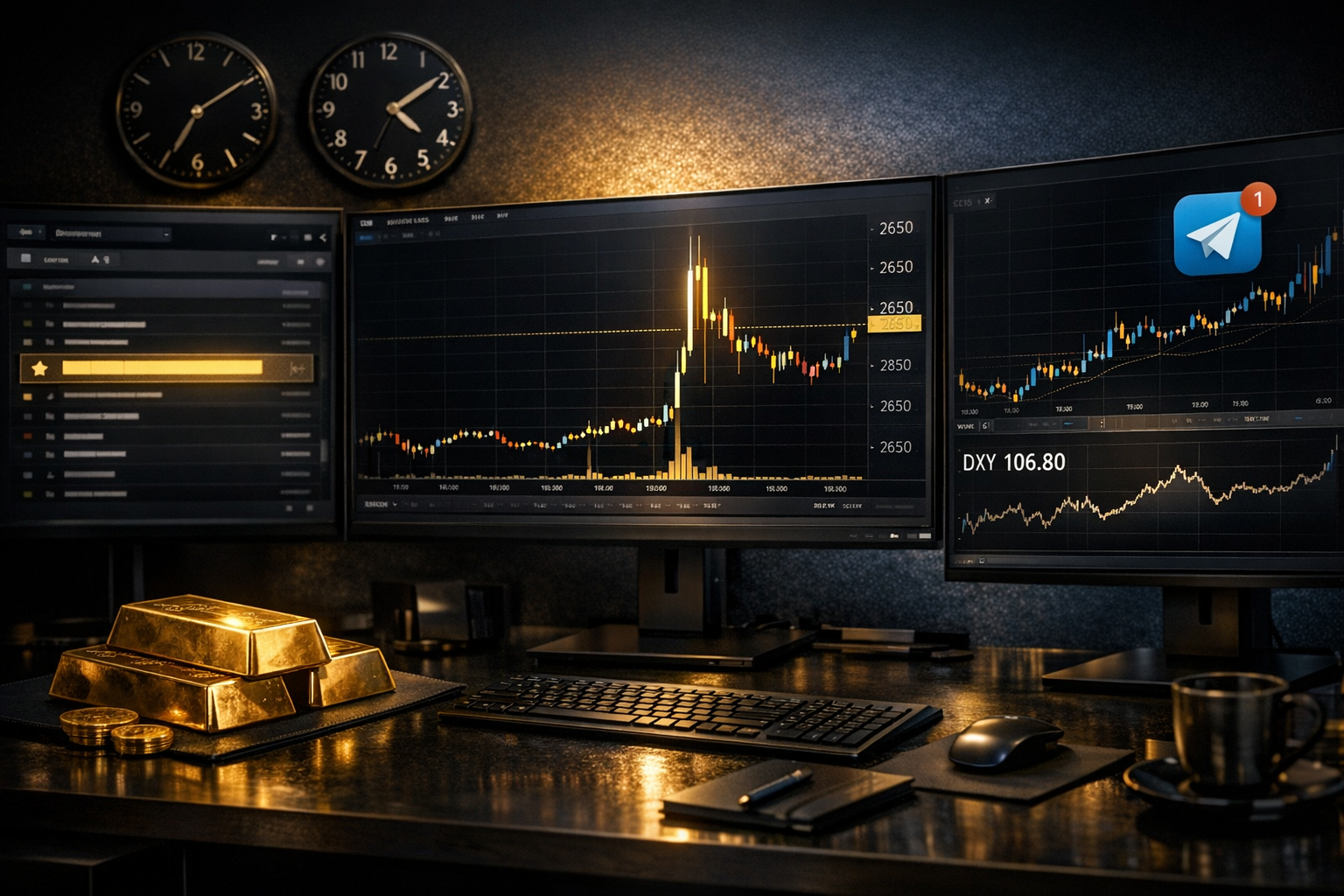
Ever feel like gold (XAUUSD) moves “for no reason”—then rips $20 in five minutes right after you place a trade?
You’re not imagining it. Gold is one of the most liquid, news-sensitive, and emotionally traded instruments on the planet.
In this xauusd trading guide, we’ll turn that chaos into a repeatable process. You’ll learn how to trade gold from the ground up, and how to think about XAUUSD like a professional.
TL;DR — The 6 rules that make XAUUSD trading simpler
- Gold is a “macro + momentum” market. DXY, US yields, and risk sentiment often matter as much as chart patterns.
- Trade XAUUSD in the right hours. London and New York sessions typically offer the cleanest liquidity and follow-through.
- Use gold-appropriate risk. A typical XAUUSD stop is $10–$25; aim for 1:2 to 1:3 reward-to-risk.
- Know your levels before your entry. Mark weekly highs/lows, prior day range, and key round numbers like $2650, $2660, $2680.
- Respect correlations, don’t worship them. DXY at 106.80 and USD/JPY at 149.50 can help confirm, not predict.
- Consistency beats intensity. One A+ setup per day with strict sizing outperforms overtrading every time.
Why XAUUSD is different: what you’re really trading

When you trade XAUUSD, you’re trading the price of gold quoted in US dollars. That sounds simple.
In practice, you’re trading a global “stress barometer” that reacts to inflation expectations, real yields, geopolitics, and USD liquidity.
Gold’s personality in one sentence
Gold trends hard when macro pressure builds, and whipsaws violently when liquidity is thin.
That’s why XAUUSD can feel smooth for hours, then spike $15 on a headline, then retrace $12 like nothing happened.
Current context you should anchor to (realistic levels)
- XAUUSD: ~$2650.00 (+0.35% 24h)
- EUR/USD: 1.0520
- GBP/USD: 1.2680
- USD/JPY: 149.50
- DXY: 106.80
At these levels, gold is elevated and sensitive. Small shifts in yields or USD can create outsized intraday moves.
Gold is quoted in dollars—so USD is always in the room
If the dollar strengthens (DXY up), gold often faces headwinds. If the dollar weakens, gold often finds a bid.
But “often” isn’t “always.” Your job is to trade what price does, not what a correlation says it should do.
Gold’s volatility is a feature, not a bug
Gold’s daily range can be large enough to hit both sloppy stop losses and sloppy take profits in the same day.
Professional gold trading is mostly about structure + patience + risk control, not predicting every candle.
Gold market fundamentals: the drivers that actually move XAUUSD
If you want to become consistently profitable in gold trading, you need a simple mental model for fundamentals.
Not a PhD. Just the few levers that repeatedly matter.
1) Real yields and interest rate expectations
Gold doesn’t pay interest. So when real yields rise, gold can become less attractive.
When markets price in rate cuts or falling real yields, gold often benefits.
2) The US dollar (DXY) and global liquidity
DXY at 106.80 is relatively firm. That can limit gold upside unless there’s strong risk-off demand or a yield drop.
In practice, a sharp DXY pullback can act like fuel for XAUUSD breakouts.
3) Inflation expectations and “store of value” flows
Gold is often bought as a hedge when inflation feels sticky or unpredictable.
But gold can also fall during inflation spikes if the market believes the central bank will respond aggressively.
4) Geopolitics and risk sentiment
Gold can jump on geopolitical headlines because it’s a classic safe-haven asset.
These moves can be fast, and spreads can widen around breaking news.
5) Central bank demand and longer-term flows
Central banks can be meaningful buyers of gold over time. This tends to support longer-term structure.
For intraday traders, it matters less day-to-day, but it can explain why dips get aggressively bought in certain regimes.
How to use fundamentals without overcomplicating your chart
- Use fundamentals to define bias (bullish, bearish, neutral).
- Use technicals to define entries (where you can be wrong cheaply).
- Use risk rules to define survival (so one day doesn’t ruin your month).
If you want a signal-style approach that blends macro awareness with clean entries, that’s exactly how our team structures ideas in United Kings gold signals.
XAUUSD sessions and timing: when gold is easiest to trade

Timing is an edge in gold trading. The same setup can work beautifully at 9:30 NY time and fail miserably at 2:00 Asia time.
Why? Liquidity and participation.
Best sessions for XAUUSD (practical view)
- London session: Often sets the day’s directional tone and breaks Asian range.
- London–New York overlap: Typically the highest liquidity and best follow-through.
- New York open: Can produce decisive continuation or violent reversals.
What “good” gold volatility looks like
In a healthy intraday environment, gold might swing $8–$15 in a structured way.
That’s enough to build a 1:2 trade with a $10 stop and a $20 target.
What “bad” gold volatility looks like
Bad volatility is random spikes and instant retraces, often around data releases or thin liquidity.
If you see $12 candles with no structure, your best trade is often no trade.
Simple step-by-step: a session-based daily plan
- Before London: Mark prior day high/low, Asian high/low, and key round numbers (e.g., $2650, $2660, $2680).
- London first hour: Let the range form. Avoid chasing the first spike.
- London mid-session: Look for break-and-retest or rejection at your levels.
- NY open: Either trade continuation with tight invalidation, or stand aside if spreads widen.
- After NY lunch: Reduce activity. Many days turn choppy.
Our community focuses heavily on London and NY timing because that’s where gold gives the cleanest opportunities. If you want real-time alerts built around those windows, start with United Kings premium signals.
XAUUSD correlations: DXY, yields, EUR/USD, and USD/JPY (how to use them properly)
Correlations can help you avoid bad trades. They can also trick you into “analysis paralysis.”
Here’s the balanced approach: use correlations as a confirmation tool, not a trigger.
Gold vs DXY (Dollar Index)
Gold often moves inversely to DXY. With DXY around 106.80, a sudden push to 107.20 can pressure XAUUSD.
But if gold holds firm while DXY rises, that’s information. It may signal strong underlying demand.
Gold vs USD/JPY (risk and rate proxy)
USD/JPY at 149.50 often reflects yield differentials and risk appetite.
If USD/JPY is ripping higher (yen weaker), it can coincide with higher yields—often not great for gold.
Gold vs EUR/USD and GBP/USD
EUR/USD at 1.0520 and GBP/USD at 1.2680 are major USD pairs.
If both are rising (USD weakening), gold often finds support. If both are falling, gold rallies may struggle.
Correlation checklist (fast and usable)
- Gold bullish setup + DXY falling: Strong confirmation.
- Gold bullish setup + DXY rising: Reduce size or demand clearer price action.
- Gold bearish setup + yields rising: Strong confirmation.
- Gold bearish setup + USD/JPY falling hard: Be cautious (risk-off can lift gold).
One real scenario using today’s context
Imagine XAUUSD is at $2652 and prints a clean higher low above $2646.
If DXY slips from 106.80 to 106.55 while EUR/USD pushes from 1.0520 to 1.0550, that’s a supportive backdrop for a long continuation.
XAUUSD technical analysis basics: levels, structure, and clean charts
Gold rewards simple technical analysis. The more indicators you add, the easier it is to hesitate.
We want clarity: trend, key levels, and a trigger.
The 3 levels that matter most on gold
- Prior day high/low: Gold respects these like magnets and reversal zones.
- Asian range high/low: London often breaks it or traps traders around it.
- Round numbers: $2650, $2660, $2680 often act as decision points.
Market structure: higher highs/lows vs lower highs/lows
If gold is making higher highs and higher lows above $2635, you’re in a bullish structure.
In that environment, shorting every rally is a fast way to donate to the market.
Support/resistance on XAUUSD: how to draw it correctly
Think zones, not lines. Gold can overshoot by $1–$3 and still respect the level.
Mark a $2–$4 band around key highs/lows, then watch how price reacts inside it.
Two beginner-friendly tools (optional, not mandatory)
- 20 EMA: Helps visualize trend and pullbacks in trending days.
- ATR (Average True Range): Helps set realistic stops/targets based on current volatility.
Common technical mistakes in gold trading
- Placing stops too tight (e.g., $4) in a market that regularly wicks $6–$10.
- Entering in the middle of the range instead of at the edges.
- Ignoring session timing and trading thin hours with wide spreads.
- Moving stop loss “just a little more” until it becomes a disaster.
If you want a clean baseline for chart reading, pair this guide with the educational posts inside our trading blog and then practice on demo until your execution is automatic.
Core XAUUSD strategies (with realistic entries, SL/TP, and logic)
Strategies should be simple enough to execute under pressure. Gold will test your emotions.
Below are three XAUUSD strategy frameworks you can build into a complete plan.
Strategy 1: Break and retest (London/NY favorite)
Idea: Gold breaks a key level, pulls back to retest, then continues.
Example: Price breaks above $2660 during London, then retests $2660–$2658 and holds.
- Entry: Buy $2661 on bullish rejection (e.g., strong close back above $2660).
- Stop loss: $2649 (12 dollars risk).
- Take profit 1 (1:2): $2685 (24 dollars).
- Take profit 2 (1:3): $2697 (36 dollars) if volatility supports it.
Why it works: It forces you to trade with structure and define invalidation clearly.
Strategy 2: Range fade (Asian box into London)
Idea: Gold ranges in Asia, then London sweeps one side and reverses back into the range.
Example: Asian high $2658, Asian low $2644. London spikes to $2662 then fails.
- Entry: Sell $2657 after a failed breakout and close back below $2658.
- Stop loss: $2672 (15 dollars).
- Take profit (1:2): $2627 would be too far for our range; instead target the box mid and low realistically.
- Practical TP: TP1 $2642 (15 dollars), TP2 $2627 is unlikely intraday; better TP2 $2630–$2634 if momentum accelerates.
Note: Range fades require discipline. If price accepts above the range, you must exit.
Strategy 3: Trend pullback (20 EMA + structure)
Idea: In a strong trend, wait for a pullback to a level + EMA support, then enter with trend.
Example: Gold trends up from $2620 to $2668, then pulls back to $2652 near the 20 EMA and prior breakout zone.
- Entry: Buy $2654 after a bullish engulfing candle.
- Stop loss: $2640 (14 dollars).
- Take profit (1:2): $2682 (28 dollars).
Which strategy should you start with?
If you’re new, start with break and retest. It’s the easiest to backtest and the hardest to overthink.
If you want help spotting these setups live, you can follow our trade ideas inside XAUUSD gold signals—each signal includes Entry, SL, and TP levels.
Risk management for XAUUSD: position sizing, stops, and trade management
Gold can be extremely forgiving to good traders and brutally punishing to undisciplined ones.
Your edge is not just entries. It’s how you size, where you’re wrong, and how you manage winners.
Gold stop losses: why $10–$25 is a normal range
At $2650, gold can easily wick $6–$10 in minutes during active sessions.
That’s why many intraday setups use stops like $12, $15, or $20 depending on structure.
Step-by-step: calculate a position size (simple method)
- Decide risk per trade (many traders use 0.5% to 1% of account).
- Measure your stop in dollars (example: $15).
- Compute size so that a $15 move against you equals your chosen risk.
- Round down. Gold punishes “rounding up.”
Example: $10,000 account, risk 1% = $100. Stop = $15. Your size should be set so a $15 loss equals ~$100.
Your broker’s contract specs vary, so always confirm how much $1 move equals per lot on your platform.
Trade management that fits gold’s behavior
- Partial profits: Consider taking some profit at 1R (e.g., +$15) and letting the rest run.
- Move stop to breakeven carefully: Gold loves to retest. Moving too early can stop you out before the real move.
- Don’t widen stops: If invalidation is hit, exit. A “small” loss is a professional outcome.
How many trades per day on XAUUSD?
For most traders, 1–3 high-quality trades is plenty.
Gold overtrading usually shows up as revenge entries after a stop-out.
If you use signals, risk rules matter even more
Signals are not magic. They’re execution frameworks.
If you want a clear, structured approach, pair signal entries with strict sizing and a written plan. We also recommend reading our guide on risk management strategies when using signals.
Beginner-to-pro workflow: the exact process to trade XAUUSD like a professional
Most traders lose because they improvise daily. Professionals run a routine.
Here’s a workflow you can copy and use immediately.
Step 1: Build your “one-page” gold plan
- Markets: XAUUSD only (avoid distractions).
- Sessions: London + NY open only.
- Setups: Choose 1–2 (break-retest + pullback, for example).
- Risk: 0.5%–1% per trade, max 2 losses per day.
Step 2: Pre-market marking (10 minutes)
- Prior day high/low.
- Asian high/low.
- Weekly high/low (especially if price is near them).
- Round numbers around current price (at $2650: $2640, $2660, $2680).
Step 3: Define your bias, then wait
Bias is not a trade. Bias is a filter.
If gold is above $2650 and holding higher lows, your bias might be “buy dips” until structure breaks.
Step 4: Trigger only at your levels
Gold punishes mid-range entries. You want trades where you can be wrong fast.
That usually means entries near prior highs/lows, breakout zones, or trend pullback areas.
Step 5: Post-trade review (5 minutes)
- Did you follow the setup rules?
- Was the stop placed beyond structure?
- Did you trade the right session?
- Was it A+, A, B, or C quality?
Signals can accelerate this workflow
Many traders use signals to reduce decision fatigue and learn pattern recognition faster.
If you’re exploring that route, start with our educational resource Forex signals on Telegram for beginners and then apply the same discipline to gold.
XAUUSD vs forex pairs: what to trade, when, and why (comparison table)
Some traders do better focusing on gold. Others prefer majors like EUR/USD.
The key is matching the instrument to your temperament and schedule.
| Instrument | Typical Behavior | Best Session | Volatility Profile | Who It Fits |
|---|---|---|---|---|
| XAUUSD (Gold) | Fast moves, strong trends, sharp reversals | London + NY overlap | High (frequent $8–$20 swings) | Traders who like momentum and can follow rules |
| EUR/USD (1.0520) | Cleaner technicals, macro-driven trends | London | Medium | Traders who prefer smoother price action |
| GBP/USD (1.2680) | More spikes than EUR/USD, strong intraday moves | London + NY | Medium-high | Traders comfortable with volatility but not gold-level |
| USD/JPY (149.50) | Yield-sensitive, can trend persistently | Tokyo + NY | Medium | Traders who track rates and macro themes |
If you want to diversify beyond gold, our forex signals cover major pairs with the same structured Entry/SL/TP format.
Advanced XAUUSD tactics: liquidity, traps, and “why your stop gets hit”
Once you’ve mastered the basics, the next leap is understanding liquidity behavior.
This is where many traders go from “random results” to “I know what the market is trying to do.”
Liquidity sweeps (stop hunts) are often just business
Gold frequently sweeps a prior high/low by $1–$4, then reverses.
That’s not personal. It’s how liquidity is collected before a move.
How to avoid being the liquidity
- Don’t put stops exactly on obvious highs/lows.
- Use structure-based invalidation (beyond the zone).
- Wait for confirmation after the sweep (close back inside range, rejection wick, shift in structure).
Compression and expansion: gold’s favorite rhythm
Gold often compresses into a tight range, then expands violently.
If you learn to spot compression near a key level (like $2660), you can prepare for a breakout or a fakeout.
Example: a classic trap near $2650
Price trades $2648–$2652 for an hour. Then it spikes to $2658, triggering breakout buys.
Within minutes it closes back below $2652 and drops to $2642.
The lesson: breakout without acceptance is often a trap. Wait for retest and hold.
Advanced entry refinement (simple)
- Use a higher timeframe level (H1/H4) for context.
- Use a lower timeframe trigger (M5/M15) for entry timing.
- Keep the stop where the idea is invalid, not where it “feels comfortable.”
News, economic calendar, and event risk: trading gold without blowing up
Gold is extremely sensitive to US data and central bank messaging.
Even if you’re a technical trader, you must respect the calendar.
High-impact events that move XAUUSD
- FOMC rate decisions and Powell press conferences
- US CPI and inflation-related surprises
- NFP (Non-Farm Payrolls)
- US GDP and major growth surprises
- Geopolitical headlines (often unscheduled)
Practical rules for trading gold around news
- Reduce size or stay flat 5–15 minutes before high-impact releases.
- Avoid tight stops during the first spike; spreads and slippage can increase.
- Wait for the second move: often the first spike is a liquidity grab.
A realistic example around volatility
Gold at $2650 can jump to $2665 and back to $2652 within two minutes on CPI.
If your stop is $6, it’s likely to get tagged even if your direction is right.
Use a “news mode” playbook
Have a rule: either you trade news with a specific strategy, or you don’t trade it at all.
If you want to see how professional signal desks adapt during surprises, read how gold signals react to unexpected news events.
Trading psychology for gold: discipline, patience, and avoiding revenge trades
Gold doesn’t just test your strategy. It tests your identity.
A $15 wick can make you feel “unlucky,” and that emotion can trigger the next bad decision.
The 3 psychological traps in XAUUSD trading
- Chasing: Buying $2668 because you missed $2655.
- Revenge trading: Doubling size after a stop-out to “get it back.”
- Overconfidence: Increasing risk after a win streak without changing the plan.
A simple “two-loss rule” that saves accounts
If you take two losses in a day, stop trading.
Gold can shift regime intraday. What worked at London open may fail at NY open.
Confidence comes from process, not PnL
Track your execution: did you enter at your level, with your stop, in your session?
If yes, you’re building the skill—even if the trade loses.
How our community helps traders stay consistent
One underrated benefit of a serious trading community is reducing impulsive behavior.
United Kings has 300K+ active traders and a structured signal format, which can keep you anchored when gold gets wild. You can learn more about us on our About United Kings page.
Using XAUUSD signals responsibly: how to copy trades like a pro
Signals can be powerful if you treat them as a system, not a shortcut.
The goal is clean execution and consistent risk—especially in gold.
What a high-quality gold signal should include
- Entry price (or entry zone)
- Stop loss (clear invalidation)
- Take profit levels (TP1/TP2/TP3)
- Context (session, setup type, key level)
How United Kings structures signals
We focus on London and NY session opportunities with clear levels.
Our premium Telegram signals are built around a historically strong performance profile (85%+ win rate reported across tracked periods), but we never present this as a guarantee.
Step-by-step: copying a gold signal safely
- Check the session: Is liquidity active or is it a thin hour?
- Check your spread: Don’t enter if your broker spread is abnormal.
- Set SL and TP immediately: No “I’ll add it later.”
- Use fixed risk: Same % risk each trade, not “feel-based.”
- Log the trade: Screenshot and note if you followed rules.
Where to start
- Explore our full signal hub: United Kings trading signals
- Gold-specific room: XAUUSD gold signals
- Forex diversification: major forex signals
Choosing your plan: cost, value, and what you actually get
If you’re serious about trading gold, consistency matters more than “finding the perfect indicator.”
Many traders choose a premium signal service to combine trade ideas with education and community support.
United Kings pricing (3 plans)
- Starter: 3 Months — $299 (~$100/month)
- Best Value: 1 Year — $599 (~$50/month) with 50% savings + FREE ebook
- Unlimited: Lifetime — $999 (pay once, access forever)
You can review the plans on our United Kings pricing page and choose what matches your timeline.
48-hour money-back guarantee
We offer a 48-hour money-back guarantee so you can evaluate fit and execution style with confidence.
If you have questions before joining, reach out via United Kings contact.
Telegram access and community
Most traders want speed and clarity. That’s why our primary delivery is Telegram.
Join the official channel here: United Kings Telegram community.
FAQ — XAUUSD trading guide (gold trading questions)
1) What is the best timeframe to trade XAUUSD?
For most traders, use H1/H4 for key levels and trend context, then M5/M15 for entries. This balances clarity and precision.
2) How much does gold move in a day?
It varies by regime. In active periods, intraday swings of $15–$30 are common. On quieter days it may be $8–$15.
3) What is a good stop loss for XAUUSD?
Many intraday trades use stops of $10–$25, placed beyond structure. The “right” stop is the one that invalidates your setup, not the smallest possible number.
4) Is gold easier to trade than forex?
Gold is often more volatile than majors like EUR/USD, which can create opportunity but also increases the penalty for mistakes. Many traders find forex smoother, and gold more lucrative once disciplined.
5) Can I trade XAUUSD using signals?
Yes, but you still need risk management and a routine. Use fixed risk per trade, follow the entry/SL/TP exactly, and avoid trading during thin liquidity or major news unless the plan allows it.
Risk disclaimer (read this before you trade)
Trading forex and gold (XAUUSD) involves significant risk and may not be suitable for all investors. You can lose some or all of your capital. Past performance, win rates, or historical results do not guarantee future outcomes. Signals and educational content are for informational purposes and are not financial advice. If you’re a beginner, we strongly recommend practicing on a demo account before risking real money, and using strict risk management on every trade.
Final CTA: trade XAUUSD with a plan—and a team behind you
If you’ve read this far, you already know the truth: gold rewards preparation and punishes improvisation.
When you’re ready to stop guessing and start executing, join United Kings for premium Telegram signals with clear Entry, SL, and TP levels—built for London and New York session trading and supported by a community of 300K+ active traders.
- Start here: Get United Kings XAUUSD gold signals
- Or explore all markets: See all United Kings signals
- Choose your plan: View Starter, Best Value, and Lifetime pricing
- Join Telegram now: https://t.me/unitedkings1
Your next step: pick one strategy from this guide, trade it on demo for 20 sessions, then scale slowly with strict risk. We’ll be here when you want real-time execution support.