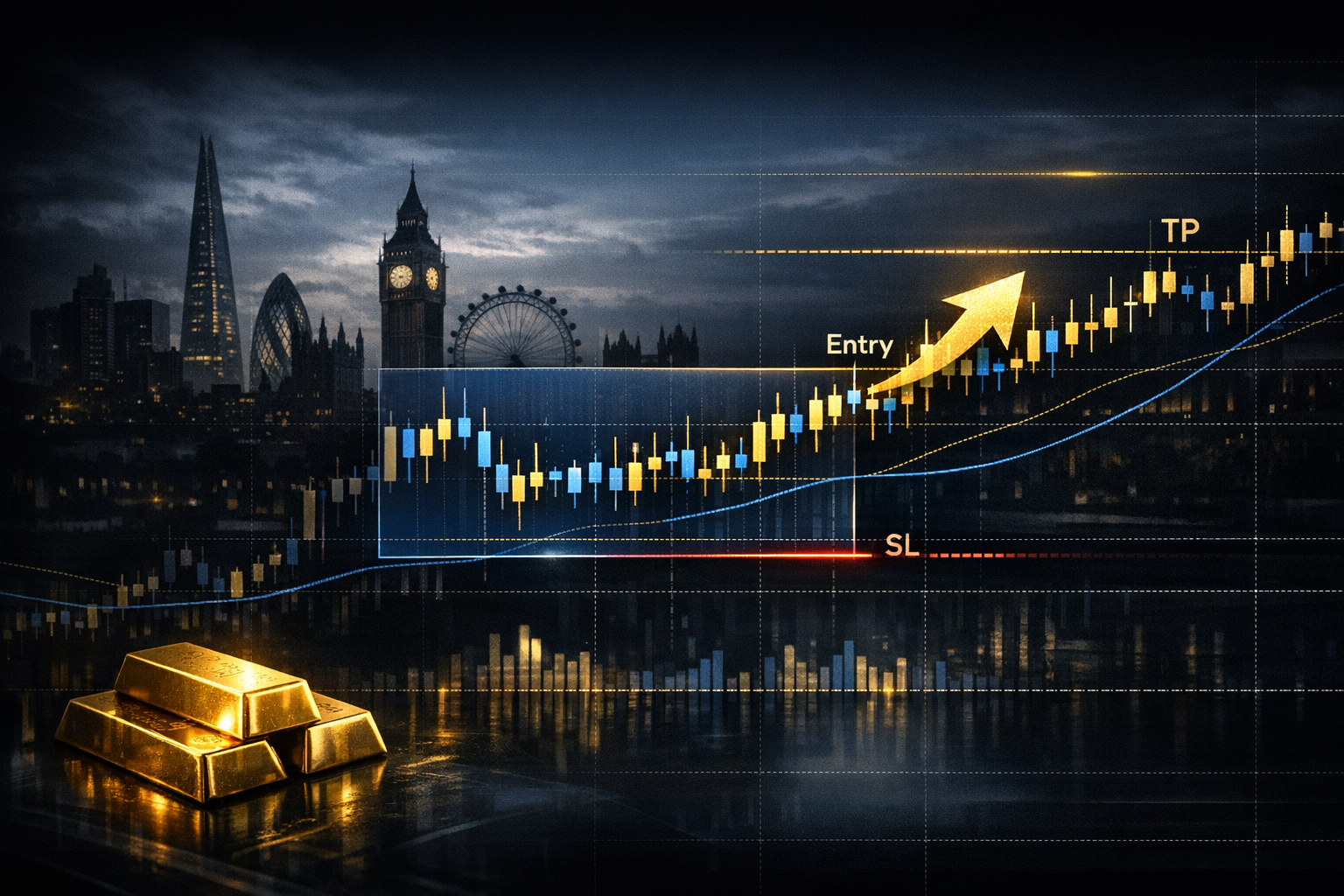
Gold is sitting around $2650.00, up roughly +0.35% on the day, and you’re probably asking the same question every serious trader asks sooner or later: How do I trade XAUUSD without getting chopped up, stopped out, and emotionally drained?
This xauusd trading guide is built to take you from “I know gold moves fast” to “I have a repeatable plan with clear entries, stops, and targets.”
We’ll use realistic market context throughout: EUR/USD near 1.0520, GBP/USD near 1.2680, USD/JPY around 149.50, and DXY around 106.80.
TL;DR: The 6 takeaways that make XAUUSD simpler
- XAUUSD is a “macro chart”: it responds to USD (DXY), real yields, risk sentiment, and event risk more than most pairs.
- Trade gold when it’s liquid: London open and the London–NY overlap often provide the cleanest moves and tighter spreads.
- Use levels first, indicators second: gold respects supply/demand zones, round numbers (e.g., $2650, $2660), and session highs/lows.
- Risk management is the edge: typical gold stops are $10–$25; position size must be calculated, not guessed.
- Correlations keep you out of traps: XAUUSD often moves inversely to DXY and real yields; check the “why” before you click buy/sell.
- Signals work best with a framework: if you use premium signals, you still need rules for execution, news filters, and trade management.
Gold vs Forex pairs: what makes XAUUSD different?

Gold (XAUUSD) is quoted as the price of 1 troy ounce of gold in US dollars.
That sounds simple, but the way gold trades is different from EUR/USD or GBP/USD in three important ways.
First: gold is volatility-forward. On many days, XAUUSD can move $15–$30 in a few hours without “breaking structure.”
That’s 150–300 “points” (depending on your broker’s digits), which is why beginners either get stopped too tight or risk too big.
Second: gold is event-sensitive. CPI, NFP, FOMC, unexpected geopolitics, and bond yield spikes can reprice gold quickly.
If DXY is at 106.80 and suddenly rips to 107.30 on a hot inflation print, XAUUSD can drop $20 while your chart still “looks bullish.”
Third: gold is a “cross-asset” instrument. It behaves like a currency (USD leg), a commodity, and a risk hedge all at once.
That’s why traders who only read candlesticks sometimes get blindsided.
Quick comparison table: XAUUSD vs major FX pairs
| Feature | XAUUSD (Gold) | EUR/USD | GBP/USD | USD/JPY |
|---|---|---|---|---|
| Typical intraday range | $15–$35 (often more on news) | 40–90 pips | 60–120 pips | 50–120 pips |
| Main drivers | DXY, real yields, risk sentiment, geopolitics | USD + Eurozone data, ECB/Fed | USD + UK data, BoE/Fed | US yields, BoJ policy, risk sentiment |
| Best sessions | London + NY overlap | London | London | Asia + NY |
| Beginner risk | Overleveraging due to fast moves | Chop in low volatility | Spike risk on UK headlines | Trend risk + yield shocks |
| Stops that make sense | $10–$25 typical | 15–35 pips typical | 20–45 pips typical | 20–50 pips typical |
The takeaway: gold rewards structure and patience, but it punishes random entries and oversized positions.
If you want a guided approach with clear Entry/SL/TP, you can also compare our premium signal formats on the United Kings Gold Signals page.
XAUUSD fundamentals: what actually moves gold price?
Most traders say “gold moves with the dollar,” and that’s often true.
But if you stop there, you’ll miss the real engine: real yields, liquidity, and risk perception.
1) The US dollar (DXY). With DXY around 106.80, gold at $2650 is already priced against a strong USD backdrop.
When DXY weakens, gold often rises because it becomes cheaper in other currencies.
When DXY strengthens fast, gold can fall quickly, especially if the move is driven by “higher for longer” rates.
2) Real interest rates (yields minus inflation). Gold doesn’t pay interest.
So when real yields rise, holding gold has a higher opportunity cost, which can pressure XAUUSD.
When real yields fall, gold often catches a bid.
3) Risk sentiment and “flight to safety.” In equity drawdowns or geopolitical shocks, gold can rally even if USD is firm.
This is when correlation rules bend, and you must read the broader tape.
4) Central bank demand and longer-term flows. Central banks buying gold can create a structural bid that supports dips.
Intraday traders don’t need to model this precisely, but you should respect that gold can trend for months.
5) Data releases and event risk. CPI, PPI, NFP, FOMC, and Fed speakers can move gold $20–$40 in minutes.
If you’re trading around major events, you need a plan for spreads, slippage, and fakeouts.
We cover this survival mindset in more detail in how gold signals react to unexpected news events.
Practical fundamental filter you can use daily
- Check DXY: is it trending, ranging, or breaking out?
- Check US yields: are they rising aggressively or calming down?
- Check the calendar: red-folder events within the next 2–3 hours?
- Check risk tone: are equities risk-on or risk-off?
Do this in 3 minutes, and you’ll avoid many “why did gold do that?” moments.
XAUUSD session timing: when gold trends, spikes, or chops
Gold trades nearly 24 hours, but it does not trade with equal quality all day.
If you’ve ever taken a perfect setup during a dead session and watched it go nowhere for 90 minutes, this is why.
Liquidity is the hidden indicator that tells you whether your technical analysis will follow through.
Best sessions for XAUUSD (practical, not theoretical)
London open (roughly 08:00–10:00 London time). This is where gold often sets the day’s first meaningful direction.
You’ll commonly see a sweep of the Asian range, then a clean expansion move.
London–New York overlap. This is usually the most liquid window, with the highest probability of continuation or reversal patterns working.
If XAUUSD is hovering near $2650 into the overlap and breaks above $2660 with momentum, you may see a $10–$20 continuation.
New York open (first 60–90 minutes). Expect volatility, especially when US data hits.
It’s common for gold to spike $8–$15, pull back, then choose a direction.
Late NY / rollover. Spreads can widen, and moves can become erratic.
This is not the best time for beginners to open fresh positions.
Session-based playbook (simple and effective)
- Mark Asian high/low on M15 or H1.
- Wait for London to sweep one side of the range (liquidity grab).
- Enter on reclaim of the range boundary or on a retest.
- Target the opposite side first, then extension levels.
Example: Asian range is $2638 low to $2652 high.
London sweeps down to $2635, then reclaims $2638 and holds.
A structured long could be: Buy $2640, SL $2628 (12 dollars), TP1 $2652, TP2 $2664 (2R), TP3 $2676 (3R).
This is how you turn “session theory” into actual numbers.
Our community focuses heavily on London and NY execution, and you’ll see that reflected in the trade timing inside United Kings Signals.
XAUUSD technical foundations: reading gold like a pro
Gold is technical-friendly, but only if you focus on the right inputs.
Many traders overload indicators and end up reacting late.
Instead, build your chart around price structure, key levels, and volatility context.
1) Structure: trend, range, and break of structure (BOS)
Start on H4 and H1.
Ask: are we making higher highs/higher lows, or are we compressing?
With gold around $2650, you might see a recent swing high near $2668 and swing low near $2620.
If price breaks $2668 and holds above it, you’re in continuation conditions.
If price fails at $2668 and breaks below $2620, you’re in reversal conditions.
2) Levels: zones beat single lines
Gold respects zones because liquidity sits around clusters of orders.
Instead of a single line at $2650, think $2648–$2652 as a decision zone.
Do the same for $2660, $2670, and $2630.
3) Volatility: ATR and “stop realism”
If gold’s 14-period ATR on H1 is, say, $6–$9, then a $4 stop is often noise.
That’s how traders get “right idea, wrong stop.”
A more realistic stop might be $12–$20 depending on structure.
4) Candles that matter on gold
- Expansion candles through a level (often start of trend legs).
- Rejection wicks at prior highs/lows (liquidity sweeps).
- Engulfing patterns after a sweep (confirmation, not prediction).
One practical rule: don’t trade a “pretty candle” in the middle of nowhere.
Trade the candle at a level, in a session, with a reason.
High-probability XAUUSD strategies (with real examples)
You don’t need 12 strategies to trade gold.
You need 2–3 that match your schedule and your temperament.
Below are three XAUUSD strategy frameworks we’ve seen work consistently when applied with discipline.
Strategy 1: Level-to-level trend continuation (H1/H4)
When to use: clear trend, clean pullbacks, strong session momentum.
How it works: identify trend, wait for pullback into demand/supply zone, enter on confirmation.
Example (bullish continuation):
- Trend: higher highs on H1, holding above $2640.
- Pullback: price dips into $2642–$2646 demand zone.
- Entry: Buy $2646 after bullish engulfing on M15.
- Stop: SL $2634 (12 dollars).
- Targets: TP1 $2660 (14 dollars ~1.1R), TP2 $2670 (24 dollars ~2R), TP3 $2682 (36 dollars ~3R).
Note the structure: the stop is below the zone, and targets are mapped to round numbers and prior highs.
Strategy 2: London sweep + reversal (M15/M5)
When to use: range conditions, clear Asian high/low, London liquidity grab.
How it works: wait for price to sweep one side of range, then enter on reclaim with tight but realistic stop.
Example (bearish sweep then sell):
- Asian high: $2656.
- London spikes to $2662, then closes back below $2656.
- Entry: Sell $2654 on retest failure.
- Stop: SL $2668 (14 dollars).
- Targets: TP1 $2640 (14 dollars = 1R), TP2 $2626 (28 dollars = 2R), TP3 $2612 (42 dollars = 3R).
This is one of the cleanest “beginner-to-intermediate” gold patterns because it’s rooted in liquidity, not prediction.
Strategy 3: Breakout + retest (NY momentum)
When to use: compression before US data, strong catalyst, clear breakout level.
How it works: avoid first spike, wait for retest, then join direction with defined risk.
Example (bullish breakout):
- Resistance: $2660 capped price twice.
- NY data triggers breakout to $2668.
- Retest: price pulls back to $2661–$2663 and holds.
- Entry: Buy $2663.
- Stop: SL $2650 (13 dollars).
- Targets: TP1 $2689 (26 dollars = 2R), TP2 $2702 (39 dollars = 3R, only if volatility supports it).
Notice we kept examples inside the $2610–$2690 guideline for most targets, while acknowledging that in real breakouts gold can extend further.
Correlation analysis for XAUUSD: DXY, USD/JPY, and risk-on/risk-off
Correlation won’t give you entries.
But it can stop you from taking low-quality trades that look great on the chart and fail for macro reasons.
Right now, the board looks like this:
- XAUUSD: $2650
- DXY: 106.80
- USD/JPY: 149.50
- EUR/USD: 1.0520
- GBP/USD: 1.2680
1) XAUUSD vs DXY (often inverse, not always)
If DXY is trending up strongly, gold longs need more caution.
But the nuance matters: if DXY rises because of risk-off demand, gold can also rise.
So ask: is USD strength coming from yields and “higher for longer,” or from panic hedging?
2) XAUUSD vs USD/JPY (a proxy for yields and risk appetite)
USD/JPY around 149.50 often reflects yield dynamics.
If USD/JPY is ripping higher on rising yields, gold may struggle to rally sustainably.
If USD/JPY is dumping while gold is holding firm, that can support a gold bid.
3) XAUUSD vs EUR/USD and GBP/USD (USD leg confirmation)
EUR/USD at 1.0520 and GBP/USD at 1.2680 give you quick USD sentiment.
If EUR/USD and GBP/USD are both falling (USD strengthening), gold longs should be more selective.
If EUR/USD and GBP/USD are rising while gold is breaking resistance, that’s cleaner confirmation.
Simple correlation checklist before you enter
- Is DXY breaking a key level at the same time gold hits a key level?
- Is USD/JPY trending hard (risk of gold chop) or ranging (gold levels work better)?
- Do EUR/USD and GBP/USD confirm USD direction?
- Is there a major US data release within 30 minutes?
When you combine this with technical levels, your win rate improves because you avoid fighting the bigger flow.
If you want signals across both metals and currencies, our Forex Signals and Gold Signals are designed to be read together, not traded in isolation.
Risk management for gold: position sizing, stops, and trade management
Gold can make you money fast.
It can also take it back faster if your risk model is sloppy.
Professional gold trading is mostly risk management.
Step-by-step: how to size a gold trade properly
Step 1: Choose a fixed risk per trade.
Many disciplined traders risk 0.5% to 1% per trade.
If your account is $2,000 and you risk 1%, your max loss is $20.
Step 2: Place a stop where your idea is invalidated.
Not where it “feels comfortable.”
Example: buy $2652, your structure invalidation is below $2638.
That’s a $14 stop.
Step 3: Convert stop distance into lot size.
Gold contract specs vary by broker (some use 100 oz per lot, some use different denominations).
So you must check your platform’s pip/point value.
The formula is always the same:
- Lot size = (Account risk in $) / (Stop distance × $ value per $1 move)
If your platform shows that 0.01 lot equals $0.10 per $1 move, then a $14 stop costs $1.40 at 0.01 lot.
To risk $20, you’d use about 0.14 lot (because $1.40 × 14 = $19.60).
Step 4: Enforce a minimum R:R.
For gold, 1:2 is a healthy baseline.
If your stop is $14, your first “real” target should be $28 away.
Trade management rules that reduce emotional decisions
- Move to breakeven only after structure: e.g., after price closes above $2660, not after +$3.
- Scale out logically: TP1 at the next level, TP2 at the next major level.
- Don’t widen stops: if the setup fails, it fails.
- Cap daily loss: e.g., stop trading after -2R on the day.
If you want a deeper framework, pair this guide with our dedicated resource on risk management strategies when using forex signals.
Step-by-step: a complete XAUUSD trading plan you can follow
If you’re serious about becoming profitable, you need a plan that survives real conditions.
Not a strategy that only works on screenshots.
Here’s a complete, practical plan you can adapt today.
Step 1: Define your “trade window” (session rule)
- Primary window: London open and London–NY overlap.
- Avoid: late NY unless managing an existing position.
Step 2: Define your market condition (trend vs range)
- Use H4/H1 to mark swing highs/lows.
- If price is respecting higher lows above $2640, treat it as bullish.
- If price is stuck between $2630 and $2660, treat it as a range.
Step 3: Mark your key levels (the “4-line” method)
- Yesterday’s high/low.
- Asian high/low.
- Nearest H1 supply zone (e.g., $2665–$2670).
- Nearest H1 demand zone (e.g., $2638–$2643).
Step 4: Choose your setup type (only 1–2)
- Trend continuation pullback.
- London sweep reversal.
- Breakout + retest (news days only).
Step 5: Execution rules (what must be true to enter)
- Entry must be at a level or zone.
- Entry must be during your session window.
- Stop must be beyond invalidation (usually $10–$25).
- Target must be at least 1:2.
Step 6: Post-trade process (the part that builds skill)
- Screenshot before/after.
- Write: setup type, session, reason, emotion rating (1–10).
- Track R-multiples, not just win rate.
This is how you turn gold trading into a business process instead of a daily emotional rollercoaster.
If you’re combining your plan with guided entries, our Forex signals Telegram beginner guide shows how to execute signals with rules rather than impulse.
Common XAUUSD mistakes (and how profitable traders avoid them)
Most gold losses are not “bad luck.”
They’re predictable mistakes that happen because gold moves fast and feels exciting.
Let’s make them obvious so you can stop paying tuition to the market.
Mistake 1: Trading gold like EUR/USD
On EUR/USD, a 10–15 pip stop might be normal.
On gold, a $5 stop is often just noise unless you’re scalping with a very specific structure.
Fix: use structure-based stops and check ATR.
Mistake 2: Entering in the middle of the range
Gold ranges can be brutal.
If price is bouncing between $2638 and $2658, entries at $2648 are usually low quality.
Fix: trade the edges, not the center.
Mistake 3: Moving stop to breakeven too early
Gold loves to retest.
Traders move to BE at +$3, then get tagged, then watch price run $20 without them.
Fix: move to BE after a level breaks and holds, not after a small profit.
Mistake 4: Ignoring the calendar
Trading 5 minutes before CPI is not “brave.”
It’s unmanaged risk.
Fix: either stand aside or trade a specific news plan with wider spreads and slippage expectations.
Mistake 5: Overtrading after a win or loss
Gold triggers dopamine.
After a big win, traders chase the next move.
After a loss, they revenge trade.
Fix: cap your trades per session (e.g., max 2) and cap your daily loss (e.g., -2R).
If you want a checklist mindset, combine this with our beginner-friendly evaluation framework in forex signals provider checklist for beginners (the logic applies directly to gold signals too).
Using premium XAUUSD signals the right way (without becoming dependent)
Signals can be a powerful shortcut.
But only if you treat them like structured trade ideas, not like lottery tickets.
At United Kings, we focus on premium Telegram signals for forex and gold with clear Entry, SL, and TP levels, and we aim for an 85%+ win rate through disciplined selection and session timing.
Still, it’s important to say this clearly: no signal provider can eliminate risk.
Your execution, your lot size, and your discipline matter.
How to follow XAUUSD signals step-by-step
Step 1: Check the context.
- Is DXY trending aggressively?
- Is there major US news in the next hour?
- Are we in London/NY where liquidity supports the setup?
Step 2: Place the trade exactly as defined.
- Use the provided entry.
- Use the provided SL (don’t tighten it randomly).
- Use the provided TP levels or scale-out rules.
Step 3: Size the position to your account.
A perfect signal traded at the wrong lot size becomes a bad experience.
Step 4: Journal the result.
If you don’t track, you can’t improve.
What “good signals” should include
- Entry price (or entry zone).
- Stop loss with a logical invalidation.
- Take profit levels mapped to structure (not random).
- Session timing (why now?).
- Brief rationale (level, sweep, trend, catalyst).
If you want to see how we structure them, start with United Kings Gold Signals and join the live community on Telegram: United Kings Telegram channel.
Putting it all together: 3 sample trade scenarios around $2650
Let’s turn everything into realistic scenarios you might see this week.
These are not promises or guarantees.
They’re examples of how a disciplined trader thinks, sizes, and manages risk around current price levels.
Scenario A: Bullish continuation above $2640 (trend day)
Gold holds higher lows and keeps rejecting below $2640.
During London, price pulls back to $2645 and prints a strong M15 bullish engulfing.
- Buy: $2646
- SL: $2632 (14 dollars)
- TP1: $2660 (14 dollars = 1R)
- TP2: $2674 (28 dollars = 2R)
- TP3: $2688 (42 dollars = 3R)
Management: take partial at TP1, move stop to entry only after a clean hold above $2660.
Scenario B: Range day between $2638 and $2660 (mean reversion)
Gold is stuck, DXY is stable near 106.80, and there’s no major news.
Price sweeps $2660, wicks to $2664, then closes back below $2660.
- Sell: $2658
- SL: $2672 (14 dollars)
- TP1: $2644 (14 dollars = 1R)
- TP2: $2630 (28 dollars = 2R)
Management: if price reaches $2648 quickly, consider reducing risk because ranges can snap back.
Scenario C: News day breakout (volatility expansion)
US data hits, spreads widen, gold spikes above $2660 and prints $2669.
You avoid the first spike and wait for a retest.
- Buy: $2663 (retest hold)
- SL: $2648 (15 dollars)
- TP: $2690 (27 dollars ~1.8R) or scale for 2R+ if momentum stays strong
Management: expect slippage; reduce lot size if spreads are abnormal.
These scenarios reflect the core truth: gold trading is level + session + risk.
FAQ: XAUUSD trading guide (most asked questions)
1) What is the best timeframe to trade XAUUSD?
For most traders, H1 sets structure and M15/M5 handles entries.
If you’re a beginner, avoid living on M1 because gold noise can trigger impulsive decisions.
2) How much should my stop loss be on gold?
It depends on structure and volatility, but many clean setups use $10–$25.
If your stop is consistently under $8 and you’re not scalping with precision, you’re often stopping out on noise.
3) What moves gold the most during the week?
US inflation data (CPI/PCE), jobs data (NFP), Fed decisions/speeches, and sudden risk-off headlines.
Also watch DXY and US yields because they can reprice gold even without headline news.
4) Is gold trading better than forex trading?
It’s different, not better.
Gold offers strong volatility and clean level reactions, but it punishes overleverage.
Forex pairs may be smoother, but can range more during quiet periods.
5) Can I trade XAUUSD using Telegram signals?
Yes, but you should still use a plan: trade during liquid sessions, size properly, and respect news risk.
If you’re exploring this approach, start with gold trading signals and review overall access on all United Kings signals.
Risk disclaimer (read this before you trade)
Trading forex and gold (XAUUSD) involves significant risk and is not suitable for every investor. You can lose some or all of your capital. Past performance, win rates, and historical results do not guarantee future outcomes. Market conditions can change quickly due to news, liquidity, and volatility. If you are new, consider practicing on a demo account first and only trade with money you can afford to lose.
Join United Kings: trade XAUUSD with structure, not guesswork
If you want to stop improvising and start executing with clarity, we built United Kings for exactly that.
You get premium Telegram signals for forex and gold, a community of 300K+ active traders, and a session-focused approach built around London and NY.
- Starter (3 Months): $299 (~$100/mo)
- Best Value (1 Year): $599 ($50/mo) + FREE ebook and ~50% savings
- Unlimited (Lifetime): $999 pay once, access forever
See the full options on our pricing page, and if you have questions about the best plan for your experience level, reach out via contact United Kings.
Ready to trade gold with a proven framework? Join the live channel now: United Kings on Telegram, and explore our XAUUSD gold signals to get clear Entry, SL, and TP levels with education alongside execution.
48-hour money-back guarantee available.