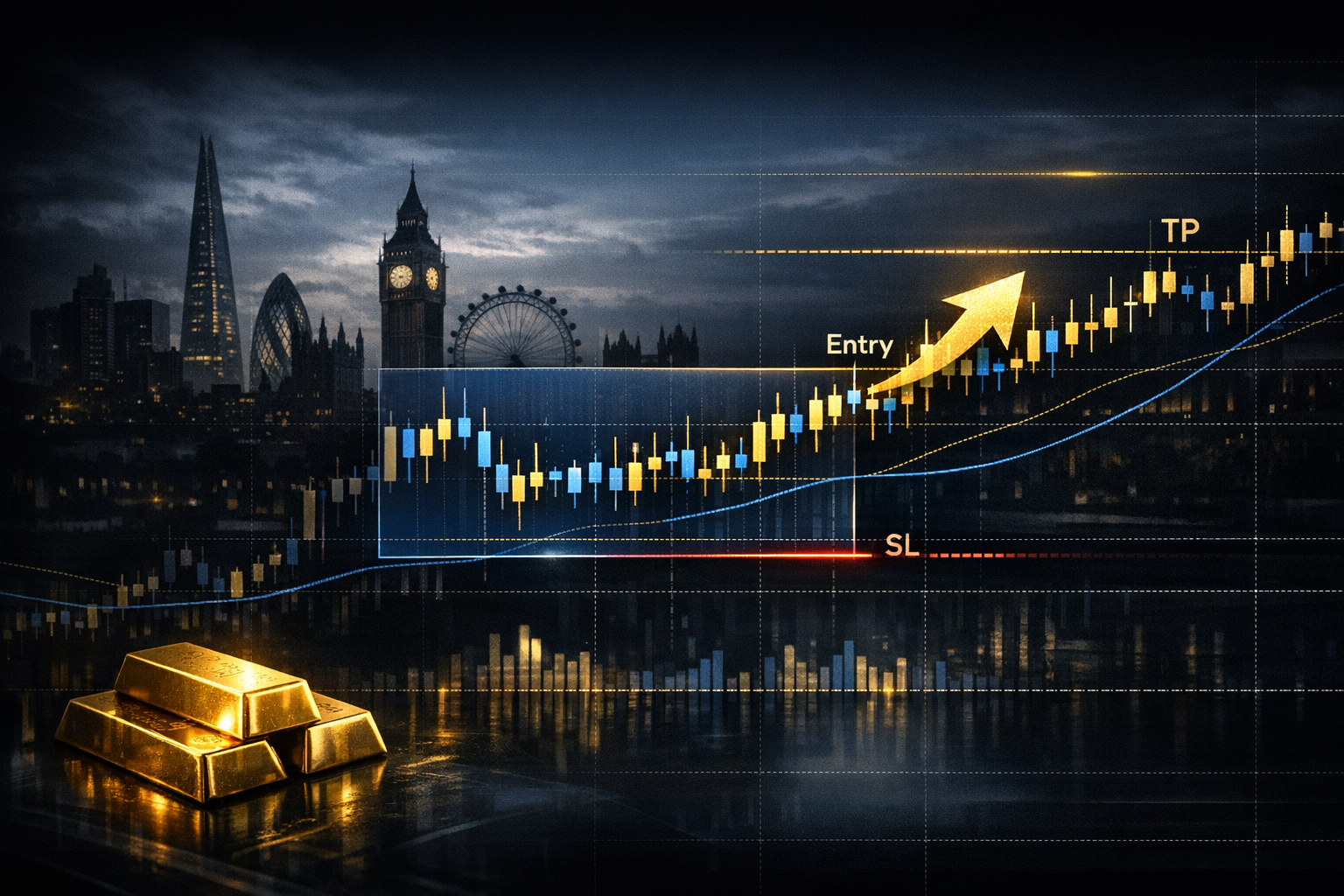
Gold at $2,650 and moving like a headline-driven beast—sound familiar?
You open XAUUSD, see a 15-minute candle rip $6 in seconds, and you wonder: is gold “too volatile” to trade… or is it the best market once you understand it?
This xauusd trading guide is designed to take you from “I don’t know where to start” to “I can plan, execute, and manage gold trades like a pro.”
TL;DR — The 6 things you must know to trade XAUUSD
- Gold (XAUUSD) is a macro-driven market: USD strength (DXY 106.80), yields, inflation expectations, and geopolitics matter.
- Best volatility windows are typically the London open and the London–New York overlap; plan around them, not against them.
- Risk management is everything: for gold, a common SL is $10–$25 from entry; aim for 1:2 to 1:3 R:R.
- Price action + levels beat “indicator soup”: build your plan around structure, liquidity, and confirmation.
- Correlations help you filter trades: DXY (106.80), USD/JPY (149.50), and yields can confirm or warn you.
- Consistency comes from process: a repeatable checklist, journaling, and controlled exposure—not random entries.
1) What is XAUUSD, and why gold moves the way it does

XAUUSD is the price of gold quoted in US dollars. When you trade XAUUSD, you’re speculating on whether gold’s value will rise or fall relative to USD.
At the moment, gold is trading around $2,650.00 (+0.35% on the day). That’s a realistic “high-value” environment where $10 moves can happen quickly during active sessions.
Here’s the mindset shift most traders need: gold isn’t just a commodity. In practice, it trades like a hybrid of currency, risk barometer, and macro hedge.
Gold is a “macro mirror”
Gold reacts to the same forces that move currencies—especially the USD. With DXY around 106.80, a small shift in USD strength can translate into meaningful XAUUSD volatility.
Gold also responds to real yields (inflation-adjusted interest rates). When yields rise, gold can struggle because it doesn’t pay interest. When yields fall, gold often finds support.
Gold is a “liquidity and emotion” market
Gold is one of the most traded markets globally. That liquidity attracts institutions—and where institutions trade, you’ll see liquidity hunts, stop runs, and sharp reversals.
Gold is also emotional: it reacts to war headlines, central bank surprises, and risk-off waves. That’s why you must learn to trade it with a plan, not with hope.
Why XAUUSD can feel harder than EUR/USD
Compare EUR/USD at 1.0520 to gold at $2,650. A “normal” intraday move on EUR/USD might be 30–70 pips. On gold, that can translate into $10–$25 swings—sometimes more around news.
That doesn’t make gold untradeable. It means your position sizing and stop placement must be gold-specific.
2) Gold market drivers: the fundamentals you actually need
You don’t need an economics degree to trade gold. But you do need a short list of drivers you check daily, so you stop getting blindsided.
Think of fundamentals as context. They don’t always tell you the exact entry, but they heavily influence whether your technical setup has tailwinds or headwinds.
The USD (DXY) and why it matters
Gold is priced in USD, so a stronger dollar often pressures gold. With DXY at 106.80, if DXY breaks higher on strong US data, gold can drop fast—even if your chart looked bullish.
Practical takeaway: before you buy XAUUSD, ask, “Is the USD strengthening right now?” If yes, your long needs stronger confirmation or tighter risk.
Interest rates, Fed expectations, and real yields
Gold often moves on shifts in rate expectations. Hawkish Fed pricing can push yields up and gold down. Dovish pricing can do the opposite.
You don’t need to predict the Fed. You need to know when the market is in a “rates-sensitive” mood. That usually shows up around FOMC weeks, CPI, and key labor data.
Inflation and the “store of value” narrative
Gold is often framed as an inflation hedge, but the relationship isn’t linear. What matters is whether inflation is rising and whether real yields are falling.
If inflation is hot but yields surge even more, gold can still drop. Always think in terms of real yield pressure.
Geopolitics and risk-off flows
Gold can spike when risk sentiment deteriorates. That’s why gold sometimes rallies even when the dollar is strong—fear can override typical correlations.
This is also why you must treat headline days differently: widen your expectations, reduce size, or wait for confirmation.
Central bank buying and longer-term flows
Central banks have been meaningful buyers of gold in recent years. This doesn’t always drive intraday trades, but it can support the bigger trend and make dips buyable in bullish regimes.
As a trader, your job is to align your intraday plan with the higher-timeframe environment.
3) XAUUSD sessions and timing: when gold is easiest to trade

If you only take one lesson from this guide, take this: gold is a timing market.
The same setup can fail at 2:00 a.m. server time and work perfectly at London open. Not because the setup changed—but because liquidity and participation changed.
The “three windows” that matter most
- Asian session: often range-bound, but can trend on major headlines. Good for patient range strategies.
- London open: volatility expands; breakouts and reversals become more reliable.
- New York open + London–NY overlap: typically the most liquid and explosive window; ideal for momentum and continuation trades.
United Kings focuses heavily on London and New York session trading because that’s where clean moves and follow-through happen most often.
What “good volatility” looks like on gold
At $2,650, a clean intraday move might be $12–$25. That’s enough for structured trades with a $10–$15 stop and a $20–$45 target.
Bad volatility is when price whips $8 up and $8 down with no structure. That’s common right before major data releases when liquidity providers pull orders.
A simple session playbook (beginner-friendly)
Use this routine for 20 trading days before you change anything:
- Mark Asia high/low on M15 or H1.
- Wait for London: does price sweep one side of the Asia range?
- Look for confirmation: rejection wick + structure shift on M5/M15.
- Enter on retest with a defined SL ($10–$20 typical).
- Scale or trail into NY if momentum continues.
This “range sweep → shift → retest” model is one of the most repeatable ways to trade gold without predicting.
When to avoid trading XAUUSD
- 5–10 minutes before high-impact US news (CPI, NFP, FOMC). Spreads can widen and slippage increases.
- After a huge impulsive candle ($15–$25 in minutes) with no pullback—chasing is expensive.
- When you’re emotionally “attached” to a direction because of a headline.
4) XAUUSD specs, pips, spreads, and what they mean for your trading
Many traders lose money on gold not because their analysis is wrong, but because they misunderstand the mechanics: contract size, pip value, spread behavior, and execution.
Gold is also broker-dependent. Your XAUUSD symbol might be XAUUSD, GOLD, or have suffixes. Always confirm the contract specs inside your platform.
Gold “pips” vs dollars: speak the same language as your platform
On many brokers, gold is quoted to 2 decimals (e.g., 2650.00). A move from 2650.00 to 2651.00 is $1.00.
Some platforms call 0.01 a “point,” others call 0.10 a “pipette.” Don’t get stuck on terminology. Focus on dollar distance from entry to SL/TP.
Typical spread and when it widens
During liquid hours, gold spreads can be tight. Around rollover, news, or thin liquidity, spreads widen.
That matters because a $0.30–$1.00 spread increase can distort tight stops. If your stop is only $5 away, a spread spike can knock you out before the move.
Why gold needs “breathing room”
Gold naturally wicks. If you place stops exactly at the obvious swing low, you’re volunteering to be the liquidity.
A practical approach is to place stops beyond structure with a buffer, often landing in the $10–$25 zone depending on timeframe and volatility.
Gold vs major forex pairs: a quick comparison
| Market | Typical intraday behavior | Best sessions | Common beginner mistake | Best edge type |
|---|---|---|---|---|
| XAUUSD (Gold) | $10–$25 swings can happen fast; headline spikes | London open, NY open, overlap | Stops too tight; chasing breakouts | Levels + liquidity + momentum confirmation |
| EUR/USD (1.0520) | Smoother flows; macro-driven | London, overlap | Overtrading small ranges | Trend/range systems + macro alignment |
| GBP/USD (1.2680) | More volatile than EUR/USD; sharp reversals | London, overlap | Ignoring news; oversized positions | Break-retest + session range plays |
| USD/JPY (149.50) | Yield-sensitive; can trend strongly | Asia, London, NY | Fighting the trend during yield moves | Trend continuation + yield confirmation |
Execution reality: slippage and partial fills
Gold can gap or spike around news. That can cause slippage, especially on market orders.
If you’re trading a strategy that requires precision, consider limit orders on pullbacks and avoid trading during the most chaotic minutes.
5) Charting XAUUSD the right way: levels, structure, and a clean toolkit
If your chart has 10 indicators, you’ll hesitate. If you hesitate, gold will move without you.
A clean gold chart is a decision-making tool. You should be able to answer in 10 seconds: trend, key levels, and where liquidity sits.
Timeframes that actually work for gold traders
- Daily (D1): defines the big bias and major zones.
- H4/H1: maps structure, ranges, and session levels.
- M15/M5: execution and confirmation.
If you’re a beginner, avoid going lower than M5. M1 gold can turn into emotional scalping fast.
How to draw levels on XAUUSD (step-by-step)
- Start on D1: mark the last 2–3 major swing highs and lows.
- Drop to H4: refine into zones (not single lines). Gold respects areas.
- Mark current range: in our context, pay attention to zones inside $2610–$2690.
- Add session levels: Asia high/low and previous day high/low.
- Stop: too many levels is as bad as none.
Structure: higher highs/lows vs ranges
Gold trends beautifully when it trends. But it also ranges for hours, then breaks violently.
Your job is to identify the regime:
- Trending: buy pullbacks in uptrends, sell rallies in downtrends.
- Ranging: fade extremes, take profits faster, and be cautious with breakouts.
A minimal indicator set (optional)
You can trade gold with pure price action. If you want indicators, keep them supportive:
- 200 EMA on H1/H4 for trend filter.
- ATR for volatility-based stops and targets.
- RSI only as a divergence tool, not as a buy/sell button.
Indicators should confirm what price already says. If they contradict price, trust price.
6) The core XAUUSD strategies (with realistic $2650 examples)
Most “xauusd strategy” content online is either too vague or too complex. You don’t need 12 setups. You need 2–3 that match gold’s personality.
Below are three strategies we’ve seen work across different market conditions, with examples using the current context around $2,650.
Strategy A: Breakout + retest (best for London/NY momentum)
Idea: Gold breaks a key level with volume/impulse, then retests the level. You enter on the retest with structure confirmation.
Example: Price consolidates under $2660 during Asia. London opens and breaks above $2660 to $2666.
- Entry: Buy retest at $2661–$2663 after an M5 higher low.
- Stop loss: $2650 (about $12–$13 risk).
- Take profit 1 (1:2): $2686 (~$24 gain).
- Take profit 2 (1:3): $2698 (~$36 gain; adjust if your broker’s feeds differ).
Execution rule: If the breakout candle is huge ($12+), don’t buy the top. Wait for the retest.
Strategy B: Liquidity sweep + reversal (best for ranges)
Idea: Gold sweeps a prior high/low (grabs stops), then snaps back into the range. You trade the reversal toward the other side.
Example: Yesterday’s high is $2672. During early London, price spikes to $2678 and immediately rejects.
- Entry: Sell at $2670–$2672 after an M5 bearish shift.
- Stop loss: $2685 ($13–$15 risk).
- Take profit (1:2): $2640 (~$30 gain).
- Take profit (1:3): $2628 (~$42 gain).
Confirmation rule: Don’t short just because it touched $2678. Wait for a shift: lower low + failed retest.
Strategy C: Trend pullback continuation (best when D1/H4 is directional)
Idea: In an uptrend, gold pulls back into a support zone (often near an EMA or prior structure), then continues.
Example: H4 is making higher highs/higher lows. Price pulls from $2668 down to a support zone around $2648–$2652.
- Entry: Buy at $2652 after M15 bullish engulfing.
- Stop loss: $2638 ($14 risk).
- Take profit (1:2): $2680 ($28 gain).
- Take profit (1:3): $2694 ($42 gain; within our $2690 guideline, you can cap at $2688–$2690 if needed).
Management rule: If price reaches 1R (here ~$14), consider moving SL to breakeven only after structure confirms—gold loves to retest.
7) Correlation analysis for XAUUSD: DXY, USD/JPY, and risk sentiment
Correlation won’t give you entries. It gives you filters.
When gold is at a decision point near $2,650, correlations can help you decide whether to press the trade, reduce risk, or stand aside.
Gold vs DXY (106.80): the classic inverse relationship
Often, when DXY rises, gold falls. But “often” is not “always.” The key is to watch who is driving the move.
- DXY up on strong US data: bearish gold pressure tends to be cleaner.
- DXY up on risk-off panic: gold can still rise as a safe haven.
Practical filter: if you’re about to buy gold and DXY is breaking above an intraday high with momentum, you either need a stronger technical confirmation or a smaller size.
Gold vs USD/JPY (149.50): a proxy for yields and risk appetite
USD/JPY is sensitive to US yields. When yields rise, USD/JPY often rises—and gold can struggle.
If USD/JPY is trending strongly upward and holding bids, be cautious with aggressive gold longs. If USD/JPY is rolling over while gold holds support, that’s often a better environment for longs.
Gold vs EUR/USD (1.0520) and GBP/USD (1.2680)
EUR/USD and GBP/USD are also USD-driven. When they rally (USD weakens), gold often benefits.
But don’t overdo it. Gold has its own flows. Use these pairs as a “USD temperature check,” not as a trigger.
Gold and risk sentiment: when correlations break
On major geopolitical shocks, gold can rally regardless of DXY. That’s correlation breakdown—normal.
On those days, your edge comes from execution and risk control, not from “predicting the news.” If you want to learn how signals behave when the unexpected hits, read our breakdown on how gold signals react to unexpected news events.
A simple correlation checklist (use before every trade)
- Is DXY making higher highs or lower lows right now?
- Is USD/JPY trending or reversing?
- Are EUR/USD and GBP/USD aligned with your gold idea?
- Is there a major data release in the next 30 minutes?
If 3 out of 4 confirm your trade, you press. If not, you reduce risk or wait.
8) Risk management for gold: position sizing, SL logic, and survival rules
This is the section that separates profitable gold traders from “almost” traders.
Gold rewards good risk management quickly—and punishes bad risk management even faster.
Pick a fixed risk model (and keep it boring)
Professional traders think in percentages, not emotions. A common model is risking 0.5% to 1% per trade.
If your account is $2,000 and you risk 1%, your max loss is $20. If your SL is $10 away, your position size must match that $20 risk.
Because brokers differ in contract size, the exact lot calculation depends on your platform. The principle is universal: lot size is a function of stop distance and risk, not your confidence.
Stop loss placement: structure first, dollars second
Beginners place SL where it “feels” safe. Gold finds that stop.
Instead, place SL:
- Beyond the invalidation point (the level that proves your idea wrong).
- Outside the noise (gold wicks; give it room).
- Typically in the $10–$25 range for intraday trades in current volatility.
Take profit logic: build 1:2 and 1:3 into your plan
If your SL is $15, your TP should be $30 (1:2) or $45 (1:3) unless structure suggests otherwise.
At $2,650, a $30 move is not unrealistic during London–NY overlap. But you must enter from a good location—not mid-range.
Trade management: partials and trailing (without self-sabotage)
A simple approach that works well on gold:
- Take partial profit at 1R only if volatility is high and structure is uncertain.
- Consider moving SL to breakeven after 1.5R or after a clear structure break in your favor.
- Trail behind swing lows/highs on M15, not every M1 candle.
The goal is to avoid the classic gold experience: “I moved to breakeven too early, got tapped out, then it ran $40.”
Daily loss limits: your anti-tilt firewall
Set a daily max loss (for example, 2R). If you hit it, you stop.
Gold can tempt revenge trading because it moves so fast. Your daily limit protects you from your worst self.
If you’re trading with signals, pair this with a structured approach like our guide on risk management strategies when using forex signals.
9) A step-by-step XAUUSD trading plan you can follow tomorrow
Most traders don’t need a new indicator. They need a repeatable routine.
Here’s a practical plan you can run daily around the current market (gold near $2,650; EUR/USD 1.0520; GBP/USD 1.2680; USD/JPY 149.50; DXY 106.80).
Step 1: Pre-market prep (10 minutes)
- Check economic calendar: mark red-flag events (CPI, NFP, FOMC).
- Note where gold is relative to your key zones: $2610–$2690 range guidance.
- Quick correlation scan: DXY, USD/JPY direction.
Step 2: Mark levels (5 minutes)
- Previous day high/low.
- Asia high/low.
- Nearest H1 supply/demand zone around current price (e.g., 2645–2652 support, 2668–2678 resistance).
Step 3: Choose your “play” (don’t force all plays)
Pick one of these based on context:
- Breakout + retest if price compresses near a key level into London/NY.
- Sweep + reversal if price is in a clear range and sweeps an extreme.
- Trend pullback if H4 is directional and pullback reaches support/resistance.
Step 4: Entry trigger (what must happen before you click buy/sell)
- A clear structure shift on M5/M15 (break + close).
- A retest that holds (no immediate reclaim against you).
- A stop that makes sense ($10–$25 typical), and a target that offers 1:2+.
Step 5: Execution and management
- Place entry, SL, TP immediately. No “mental stops.”
- Don’t watch every tick. Check at candle closes.
- Journal: screenshot entry, write why you took it, and how you managed it.
Step 6: Post-trade review (5 minutes)
Ask only three questions:
- Did I follow my rules?
- Was my entry location good (near level, not mid-range)?
- Was my risk consistent?
Profit is a byproduct of process. On gold, process is everything.
10) Common XAUUSD mistakes (and how profitable traders avoid them)
Gold doesn’t “hate you.” It just exposes weak habits faster than other markets.
Here are the mistakes we see most often—especially from traders who are switching from EUR/USD to gold because they want “faster money.”
Mistake 1: Trading gold like a slow pair
On EUR/USD, a 10-pip stop can sometimes work. On gold, a $3–$5 stop is often noise.
Fix: size down and give the trade room. A $15 stop with smaller lot size is usually healthier than a $5 stop with big size.
Mistake 2: Chasing breakouts after the candle already moved $10+
Gold loves to spike, pause, then retest. If you chase the spike, you buy the top and sell the bottom.
Fix: make “retest entry” your default. If there’s no retest, you missed it—move on.
Mistake 3: Ignoring the session
A setup at the London open is not the same as the same pattern during late Asia.
Fix: trade fewer hours, not more. Focus on the best 2–3 hours of the day and master them.
Mistake 4: Moving stop loss emotionally
Gold will test you. If you widen SL because you “feel” it will come back, you’re turning a planned loss into a random loss.
Fix: your SL is either correct (structure-based) or the trade is invalid. No negotiation.
Mistake 5: Overtrading after one win or one loss
Gold’s speed can make you feel like you must always be in a trade.
Fix: set a max number of trades per session (for example, 2). Quality beats quantity.
Mistake 6: Following signals without understanding execution
Even the best signal can lose if you enter late, use the wrong lot size, or ignore SL/TP.
If you want to sharpen execution, pair this guide with our forex signals Telegram guide for beginners and keep your process consistent.
11) Using gold signals responsibly: how to turn entries into a system
Signals are powerful when they fit into a disciplined framework. They’re dangerous when they become a substitute for thinking.
At United Kings, we focus on clear Entry, SL, and TP levels and a performance culture built around execution and risk control—not hype.
What “premium” gold signals should include
- Exact entry zone (not “buy now” with no context).
- Stop loss that matches structure and volatility.
- Take profits that reflect realistic R:R (1:2, 1:3).
- Session awareness (London/NY focus).
- Education: why the trade is valid, what invalidates it.
This is why many traders join our Gold Signals service and use it as both a trading tool and a learning tool.
Step-by-step: how to execute a gold signal like a professional
- Confirm the market: is gold near the level? Is spread normal?
- Check timing: are we close to major news? If yes, reduce size or wait.
- Set the order correctly: market vs limit. If price already moved far, wait for retest.
- Calculate lot size: risk a fixed % (0.5–1%).
- Place SL/TP immediately: no exceptions.
- Follow management rules: don’t freestyle mid-trade.
Signals + self-development: the fastest path for many traders
If you’re learning, you can combine signals with structured study. Use our blog as your curriculum, and focus on one strategy and one session.
If you trade forex alongside gold, our Forex Signals can help diversify opportunities without forcing trades on XAUUSD every day.
Community matters more than people admit
Trading alone is hard. You second-guess, you revenge trade, and you normalize bad habits.
Being around a serious community changes that. United Kings has 300K+ active traders sharing charts, execution feedback, and session structure.
If you want to see how our Telegram ecosystem works, you can join our official channel at United Kings Telegram trading community.
12) Putting it all together: your 30-day roadmap to profitable gold trading
You don’t become profitable by reading one guide. You become profitable by applying one guide consistently.
Here is a realistic 30-day roadmap that turns “information” into “skill,” using the exact concepts we covered.
Days 1–7: Build your foundation (no hero trades)
- Trade demo or micro size.
- Mark D1/H4 levels daily; focus on $2610–$2690 zones in this context.
- Trade only one session window (London or overlap).
- Journal every trade with screenshots.
Your goal is to stop improvising and start repeating.
Days 8–14: Choose one strategy and master execution
- Pick one: breakout-retest, sweep-reversal, or trend pullback.
- Define your SL rule (structure + $10–$25) and TP rule (1:2+).
- Track metrics: win rate, average R, and rule adherence.
A trader with 55% win rate and 1:2 average R can be profitable. A trader with 80% win rate but 1:0.7 R often isn’t.
Days 15–21: Add correlation filters
- Before each trade, record DXY direction and USD/JPY direction.
- Note when correlation breaks (risk-off days).
- Reduce size on high-impact news days.
This is where your trading becomes “professional.” You stop treating every candle as equal.
Days 22–30: Scale carefully and tighten your process
- If you’re consistent, scale risk slightly (e.g., from 0.5% to 0.75%).
- Introduce a daily loss limit (2R is a strong start).
- Stop trading outside your best window.
Most traders fail because they scale too early. Gold makes that mistake expensive.
Where United Kings fits in (if you want guidance + signals)
If you want a structured approach with trade ideas, entries, SL/TP, and education alongside it, explore our full United Kings premium trading signals.
For gold-specific setups, our XAUUSD Gold Signals are designed around London and New York volatility, with clean levels and risk-defined plans.
If you also want to trade other markets, we provide Crypto Signals as an optional diversification layer—useful when gold is choppy and crypto is trending.
FAQ: XAUUSD trading guide (beginner to advanced)
1) What is the best timeframe to trade XAUUSD?
For most traders, the best combination is H1/H4 for structure and M5/M15 for entries. Beginners should avoid M1 until they can execute calmly.
2) How much should my stop loss be on gold?
In current conditions around $2,650, many intraday traders use $10–$25 stops depending on volatility and structure. Your SL should sit beyond invalidation, not at an arbitrary number.
3) What is a good risk-reward ratio for gold trading?
A practical target is 1:2 as a baseline, with 1:3 on strong momentum days (often during the London–NY overlap). Don’t force 1:3 if structure doesn’t allow it.
4) Does gold always move opposite the dollar index (DXY)?
No. Gold often has an inverse relationship with DXY, but during risk-off shocks or major geopolitical events, gold can rise even if DXY is strong. Use correlation as a filter, not a rule.
5) Are gold signals worth it for beginners?
They can be—if you use them with strict risk management and treat them as a learning tool. The key is executing correctly (entry timing, lot sizing, SL/TP discipline) and not overtrading.
Risk disclaimer (read before you trade)
Trading forex and gold (XAUUSD) involves significant risk and may not be suitable for all investors. You can lose some or all of your capital. Past performance, win rates, or historical results do not guarantee future outcomes. Signals and educational content are provided for informational purposes only and are not financial advice. If you are new, we strongly recommend practicing on a demo account before trading live and using strict risk management on every position.
Join United Kings: trade XAUUSD with clear plans, not guesswork
If you’re serious about becoming consistent on gold, you don’t need more random strategies. You need high-quality setups, a repeatable process, and a community that trades the same sessions you do.
United Kings delivers premium Telegram signals for forex and gold with clear Entry, SL, and TP levels, an education-first approach, and a community of 300K+ active traders.
- Starter (3 Months): $299 (~$100/mo)
- Best Value (1 Year): $599 ($50/mo) — 50% savings + FREE ebook
- Unlimited (Lifetime): $999 (pay once)
See all three plans on our United Kings pricing page, and if you have questions, reach out via contact United Kings support.
Ready to trade gold with structure? Join our official Telegram now: United Kings signals on Telegram.
Remember: discipline first, profits second. We’ll help you build both.