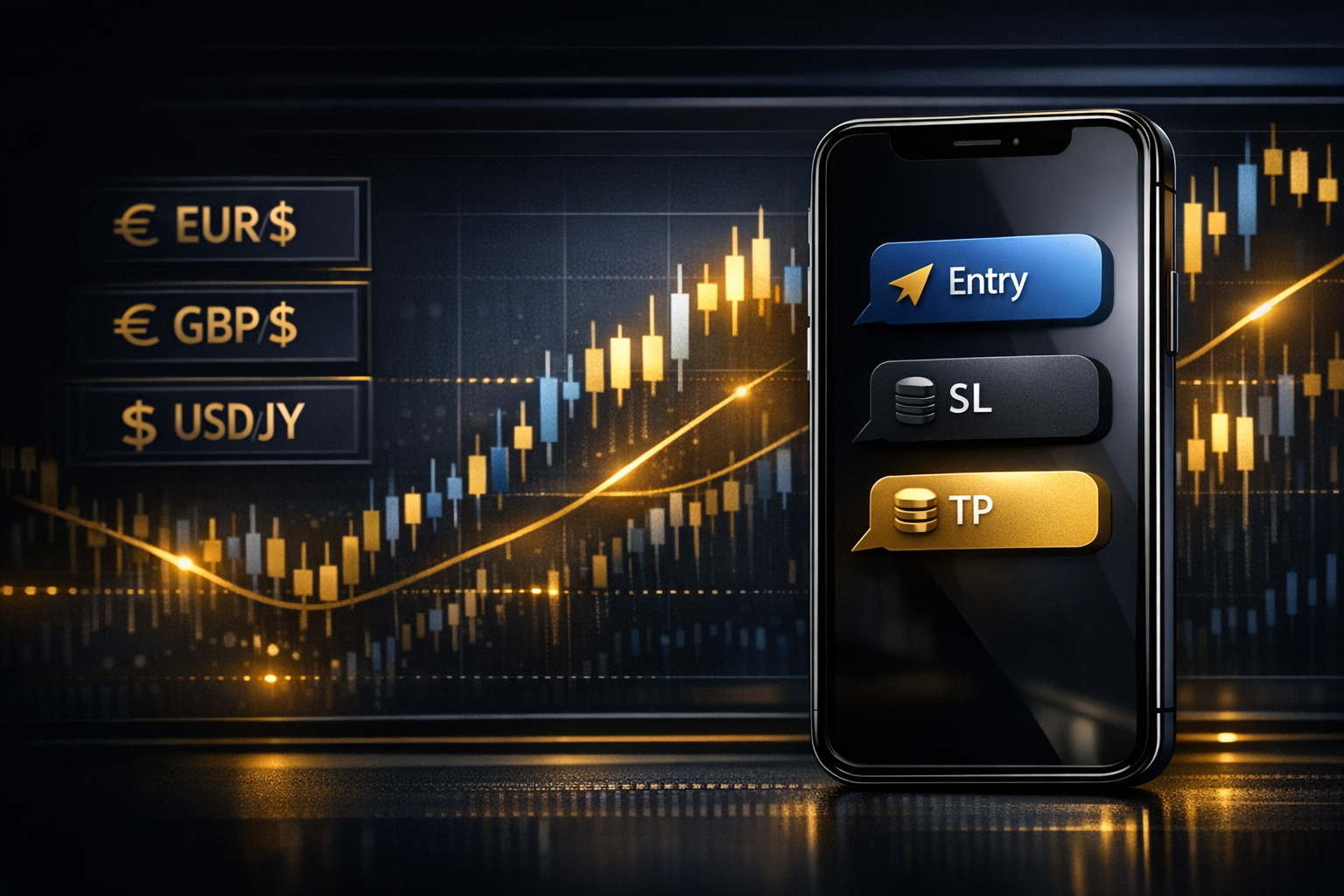
Ever copied a forex signal, hit “Buy,” and then watched price spike the other way in seconds?
If you’re new, that moment feels personal.
It’s not.
It’s usually a mix of timing, execution, and risk management—and beginners almost never get all three right on day one.
This forex signals guide is built to fix that.
We’ll walk through what signals are, how to use forex signals step-by-step, how to choose a provider, and how to manage risk so one bad trade doesn’t wipe your week.
We’ll also use realistic market context (EUR/USD 1.0520, GBP/USD 1.2680, USD/JPY 149.50, DXY 106.80, and Gold/XAUUSD around $2650) to keep examples practical.
TL;DR — Forex Signals for Beginners (Read This First)
- Signals don’t replace skill. They’re a structured trade idea (Entry, SL, TP), and your job is execution + risk control.
- Most beginner losses come from sizing and timing (late entries, widening stops, overleveraging), not from “bad signals.”
- Only follow signals that include Entry, Stop Loss, and Take Profit with clear invalidation logic.
- Risk 0.5%–1% per trade until you prove consistency over 50–100 trades.
- Choose providers with transparency and process (sessions traded, strategy type, track record methodology, risk rules).
- Use a checklist before every signal: spread, news, distance to entry, and your lot size.
1) What Forex Signals Are (And What They’re Not)
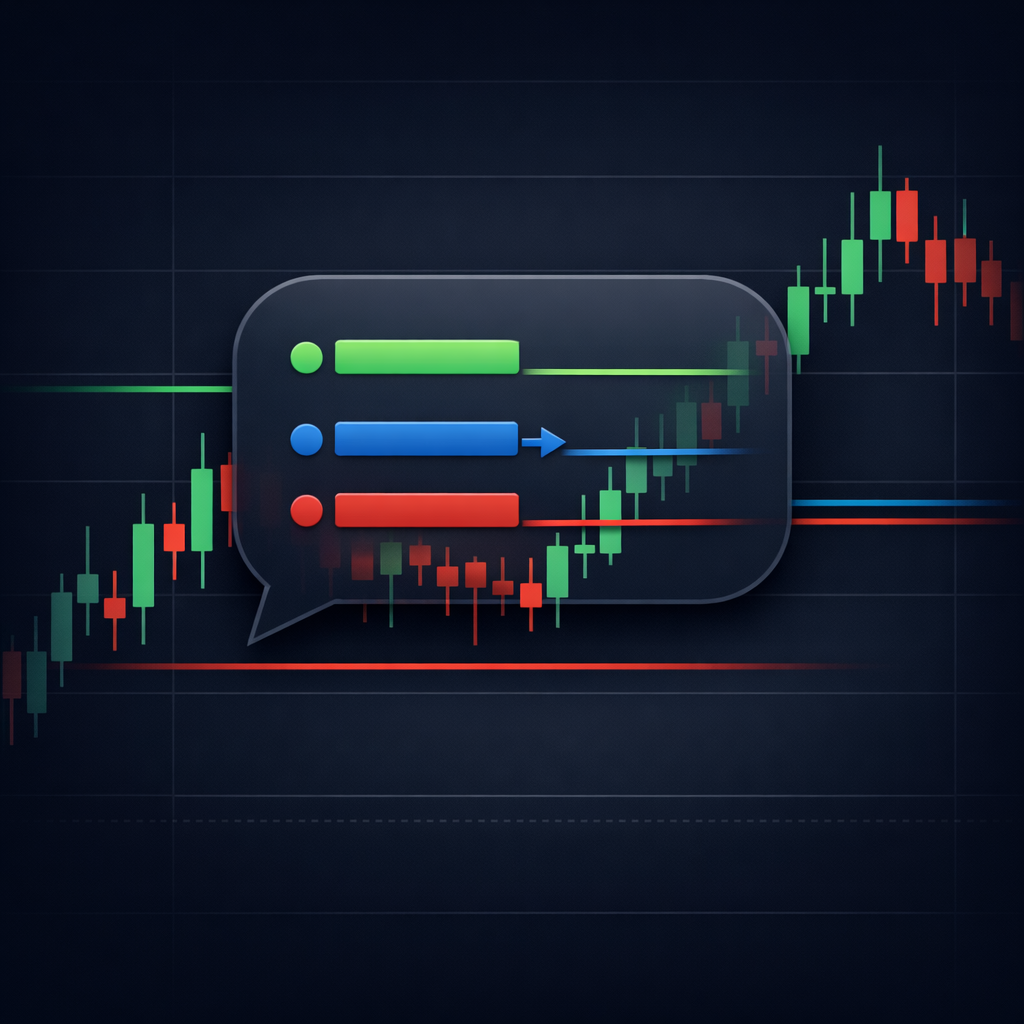
Forex signals are trade ideas shared by a trader, analyst, or system.
They typically include the pair, direction, entry price (or zone), stop loss, and one or more take-profit targets.
Some also include the reasoning: trend context, key levels, session timing, and news risk.
A beginner mistake is treating a signal like a “guarantee.”
In real markets, even high-quality setups fail.
That’s why professionals obsess over risk-to-reward and position sizing, not prediction.
What a “complete” signal looks like
- Instrument: EUR/USD, GBP/USD, USD/JPY, XAUUSD, etc.
- Direction: Buy or Sell
- Entry: exact price or zone (example: EUR/USD buy 1.0515–1.0525)
- Stop Loss: invalidation point (example: 1.0485)
- Take Profit: TP1/TP2/TP3 (example: 1.0575 / 1.0605)
- Notes: “London session only,” “avoid CPI,” “break-and-retest,” etc.
What signals are NOT
- Not a promise of profit or a “sure thing.”
- Not a substitute for learning spreads, slippage, and leverage.
- Not a reason to ignore economic calendars or open 10 trades at once.
Think of signals like a GPS.
A GPS can give you the best route, but you still have to drive, avoid accidents, and manage fuel.
In trading, your “fuel” is your account balance, and your “accidents” are oversized losses.
If you want to see how we structure our trade ideas across markets, explore our premium trading signals hub.
You’ll notice the difference between “Buy now!” hype and a real plan with defined risk.
2) The Types of Forex Signals Beginners Will Encounter
Not all signals are created equal.
As a beginner, you’ll see different styles, timeframes, and delivery methods.
Your goal is to match the signal type to your schedule, psychology, and broker conditions.
By timeframe: scalping, intraday, swing
Scalping signals aim for small moves (5–20 pips) and require fast execution.
They can work, but beginners often lose due to spread, slippage, and hesitation.
Intraday signals target moves within the day (20–80 pips), often around London and New York sessions.
This is the sweet spot for many beginners because timing is structured and stops can be reasonable.
Swing signals may run for days and target 100–400 pips.
They demand patience and the ability to hold through pullbacks and overnight swaps.
By strategy: trend, reversal, breakout, range
- Trend-following: “Buy dips in an uptrend.” Higher win-rate potential, but entries matter.
- Reversal/countertrend: “Sell at resistance.” Can be powerful, but needs strict invalidation.
- Breakout: “Buy above 1.0540 after consolidation.” Great in volatility, dangerous in fakeouts.
- Range: “Buy support, sell resistance.” Works until the range breaks.
By delivery: Telegram, apps, email, copy trading
Telegram is popular because it’s fast and simple.
But speed can also tempt you to rush.
That’s why you need a repeatable execution routine (we’ll build one later).
If you prefer Telegram-based delivery, our community runs live inside United Kings Telegram, where signals are posted with clear levels and session focus.
Beginner-friendly vs beginner-hostile signals
Beginner-friendly signals have:
- Clear entry (not “market now” without context)
- Realistic stop loss distance
- 1:2 or better reward potential
- Notes about news and session timing
Beginner-hostile signals usually look like:
- 10+ trades per hour
- No stop loss (or “mental SL”)
- Martingale recovery language (“we’ll double lot if it goes against”)
- Unverifiable results screenshots only
As a rule: the more “easy money” a provider promises, the more likely you’ll pay tuition to the market.
3) How to Choose a Forex Signal Provider (Beginner Checklist)
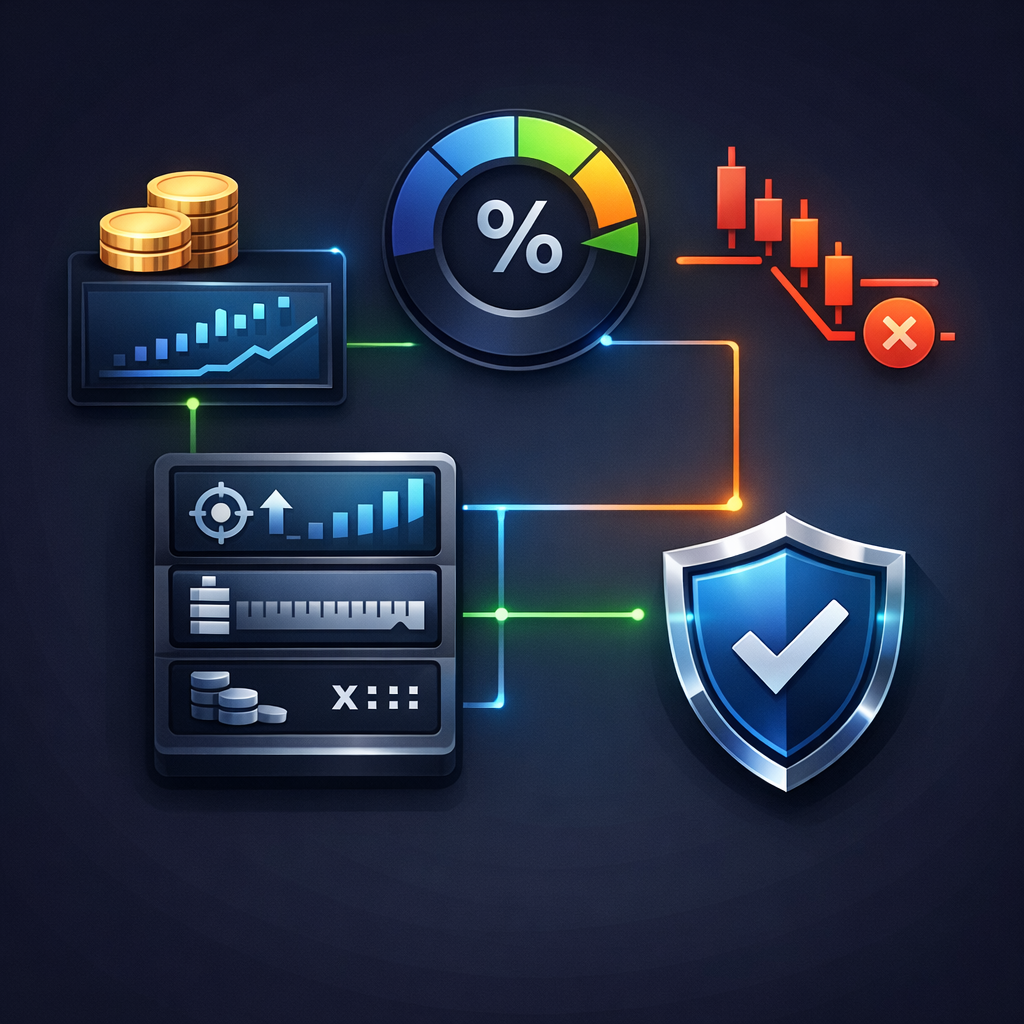
Choosing a provider is the highest-leverage decision you’ll make.
Beginners often choose based on hype, screenshots, or a friend’s referral.
Professionals choose based on process, risk controls, and consistency.
Before you subscribe anywhere, use a structured checklist.
We’ve also published a dedicated checklist you can bookmark: forex signals provider checklist for beginners.
What to verify (in plain English)
- Signal format: Do they always include Entry, SL, TP?
- Trading sessions: Are they active in London/NY when liquidity is high?
- Risk language: Do they talk about % risk and drawdowns, or only wins?
- Track record method: Is performance tracked consistently, or cherry-picked?
- Support: Do you get explanations, updates, and post-trade reviews?
Red flags beginners should not ignore
- No stop loss or “we never use SL.”
- Guaranteed returns or “100% win rate.”
- Pressure tactics like “only 10 spots left” every day.
- Martingale grids without clearly stating the risk.
- Unrealistic monthly targets with no mention of losing streaks.
Comparison table: common provider types
| Provider Type | Typical Signal Style | Pros | Cons | Best For |
|---|---|---|---|---|
| Telegram Analyst Team | Intraday + session-based | Fast updates, context, community learning | Requires you to execute manually | Beginners who want guidance + structure |
| EA/Auto Signals | Algorithmic entries | Emotion-free execution, consistent rules | Can fail in regime changes, broker sensitivity | Traders who understand testing + settings |
| Copy Trading | Mirrors another account | Hands-off, simple | Slippage, risk mismatch, little learning | Busy traders who accept less control |
| Social Media “Signal Gurus” | Random “buy/sell now” calls | Feels exciting | High risk of scams and poor risk controls | Honestly, nobody |
At United Kings, our focus is premium Telegram signals for forex and gold, built for the most liquid hours.
We combine signals with education so you’re not just copying—you’re progressing.
You can learn more about who we are on our About United Kings page.
4) How to Use Forex Signals Step-by-Step (Execution for Beginners)
Most beginners think the hard part is “finding the trade.”
In reality, the hard part is executing the trade exactly as planned.
Execution includes entry timing, order type, spread awareness, and not improvising under pressure.
Step 1: Read the signal like a pilot reads a checklist
Before you touch your platform, confirm:
- Pair and direction (e.g., EUR/USD Buy)
- Entry price or zone (e.g., 1.0515–1.0525)
- Stop loss (e.g., 1.0485)
- Take profit targets (e.g., 1.0575 and 1.0605)
- Any notes (session, news, “wait for retest”)
Step 2: Check spread and volatility in the moment
Spreads change.
During quiet periods EUR/USD might show 0.8–1.5 pips on many brokers, but around news it can jump to 3–10+ pips.
That difference can turn a good entry into a bad one.
Right now, with DXY around 106.80 and USD/JPY near 149.50, USD volatility can pick up quickly on U.S. data.
As a beginner, avoid entering within a few minutes of high-impact releases until you have experience.
Step 3: Choose the right order type
- Market order: you enter immediately. Best when the signal says “market now” and spreads are stable.
- Limit order: you enter at a better price (buy lower / sell higher). Best for pullback entries.
- Stop order: you enter only if price breaks a level. Best for breakouts.
Example: If EUR/USD is 1.0520 and the signal says “Buy 1.0515–1.0525,” a market entry is fine if you’re inside the zone.
If price is already 1.0540, you’re late.
Late entries are one of the biggest silent killers for beginners.
Step 4: Place SL and TP immediately (no exceptions)
Beginners often “add the stop later.”
That’s how accounts blow up.
Place the SL and TP at the moment you enter, or don’t enter.
Step 5: Manage the trade like a plan, not a feeling
If the signal includes TP1 and TP2, consider scaling out.
For example, close 50% at TP1 and move SL to breakeven if the strategy supports it.
But don’t invent management rules mid-trade because you feel nervous.
When multiple trades trigger at once, you need rules for exposure.
One simple rule: if EUR/USD and GBP/USD signals both trigger, remember they’re often positively correlated due to USD flows.
Two “separate” trades can behave like one oversized USD trade.
For deeper guidance on structured exposure control, visit our resource on risk management strategies when using forex signals.
5) Risk Management for Signal Followers (The Beginner Survival System)
If you only learn one thing from this guide, make it this:
Signals don’t save you from bad risk management.
Even a strong provider can hit a losing streak.
Your job is to survive it with your confidence and capital intact.
Start with risk per trade (not lot size)
Beginners ask, “What lot size should I use?”
Professionals ask, “How much am I willing to lose if I’m wrong?”
A conservative starting point is 0.5%–1% risk per trade.
On a $1,000 account:
- 0.5% risk = $5 per trade
- 1% risk = $10 per trade
Now connect that to the stop loss distance.
If a EUR/USD setup uses a 30-pip stop, and you risk $10, then your position size must match $10 / 30 pips.
Your platform or a position size calculator can do this quickly.
Use a maximum daily and weekly loss limit
Signals can tempt you to “keep firing.”
That’s how revenge trading sneaks in—especially after a loss.
Simple beginner rule set:
- Max daily loss: 2% of account
- Max weekly loss: 5% of account
- After hitting limit: stop trading and review
This rule is boring.
It also keeps you in the game long enough to become skilled.
Understand risk-to-reward (R:R) with real numbers
If your stop is 30 pips and your target is 60 pips, that’s 1:2.
You can be wrong more often than you think and still grow.
Example math:
- Win 4 trades at +2R = +8R
- Lose 6 trades at -1R = -6R
- Net = +2R (even with 40% win rate)
This is why good signals often aim for 1:2 or 1:3 when conditions allow.
It’s also why moving your stop wider “to avoid getting stopped” is usually a hidden way of destroying your edge.
Gold risk example (XAUUSD) using current context
Gold is around $2650 (+0.35% on the day), and it can move $10–$25 quickly during active sessions.
A realistic beginner-friendly gold signal might look like:
- XAUUSD Buy: 2648
- SL: 2636 (12 dollars risk)
- TP: 2672 (24 dollars reward) → 1:2
If you don’t size correctly, gold will humble you fast.
That’s why many beginners start with forex majors first, then add gold once execution is consistent.
If gold is part of your plan, our gold signals section breaks down how we approach XAUUSD with session timing and volatility awareness.
6) Understanding Signal Logic: The Minimum Technical Analysis You Need
You don’t need to become a chart wizard to use signals.
But you do need enough understanding to avoid the most common beginner mistake:
taking the right idea at the wrong location.
A signal is built on a thesis.
Your basic job is to confirm that the thesis is still valid when you enter.
Support and resistance: your “map”
Most signals are anchored to levels.
For example, EUR/USD at 1.0520 might be sitting near a prior support zone around 1.0500–1.0520.
A buy signal could be based on the idea that buyers defend that zone during London session.
If price already broke below 1.0500 and is accelerating, the “support hold” thesis may be invalid.
That’s why stop loss exists: it defines the point where the idea is wrong.
Trend context: don’t fight a freight train blindly
With DXY around 106.80, USD strength can pressure EUR/USD and GBP/USD.
If the broader trend is USD-bullish, countertrend buys on EUR/USD may need tighter management or stronger confirmation.
This doesn’t mean “never buy EUR/USD.”
It means you should understand that countertrend trades often require:
- Cleaner support
- Faster profit-taking
- Less tolerance for drawdown
Breakout vs fakeout: why beginners get trapped
Breakouts are exciting.
They’re also where the market loves to punish impatience.
A common scenario:
- EUR/USD consolidates under 1.0540
- Price spikes to 1.0545
- Beginners buy late
- Price snaps back to 1.0520, stopping them out
High-quality signals often specify confirmation like “break and close above,” or “break then retest.”
Those words matter.
They’re the difference between chasing and executing.
Indicators: use them for confirmation, not permission
Many beginners stack indicators until the chart looks like a dashboard.
Keep it simple.
One moving average for trend, and RSI for momentum extremes, is enough for most signal-followers.
The signal should drive the plan.
Indicators should help you avoid obvious bad timing, like buying directly into resistance with RSI already overextended.
7) Fundamental Drivers: News, Central Banks, and Why Signals Sometimes “Fail”
Forex is a macro market.
Even the best technical setup can get wrecked by a surprise headline.
Beginners often interpret that as “the signal was wrong.”
More accurately, the market regime changed in seconds.
Key drivers you must respect
- Central banks: Fed, ECB, BoE, BoJ rate decisions and guidance
- Inflation: CPI, PCE
- Jobs: NFP, unemployment rate, wage growth
- Risk sentiment: equities, credit stress, geopolitical shocks
With USD/JPY around 149.50, for example, traders stay alert for potential policy rhetoric and intervention risk.
That can create sudden spikes that ignore technical levels temporarily.
How to use a news filter as a beginner
You don’t need to predict the news.
You need a rule for when not to trade.
Beginner-friendly rules:
- Avoid opening new trades 10–15 minutes before red-folder news on the pair’s currency.
- If already in a trade, consider reducing risk or taking partial profits before major releases.
- Don’t widen stops during news to “give it room.” Reduce size instead next time.
Gold and news: why XAUUSD can move $20 fast
Gold at ~$2650 can react violently to yields, the dollar, and risk-off flows.
A small surprise in inflation expectations can move gold from 2650 to 2670 quickly.
That’s great when you’re positioned correctly, and painful when you’re oversized.
If you trade gold signals, you’ll benefit from understanding how signals behave during unexpected events.
We covered this survival skill here: how gold signals react to unexpected news events.
8) Building a Beginner Routine: From Signal Alert to Trade Journal
Consistency doesn’t come from finding “the perfect signal.”
It comes from doing the same high-quality process every day.
That process reduces emotional decisions, which is where beginners leak money.
Your daily signal-following routine (15–25 minutes)
1) Pre-session check (5 minutes)
- Open your economic calendar
- Note red-folder news for USD, EUR, GBP, JPY
- Check DXY (currently ~106.80) for USD trend tone
2) Platform readiness (3 minutes)
- Confirm spreads are normal
- Confirm your account leverage and margin
- Set default risk % (0.5%–1%)
3) When a signal arrives (5 minutes)
- Is price within entry zone?
- Is the stop logical and acceptable for your risk?
- Is there nearby support/resistance blocking the trade?
- Is major news imminent?
4) After execution (2 minutes)
- Screenshot chart at entry
- Record: pair, entry, SL, TP, lot size, reason
5) End of day review (5–10 minutes)
- Did you follow the signal rules exactly?
- Were you late? Did you move SL?
- Was the loss within plan?
The journal metrics that actually matter
Beginners track only win rate.
That’s incomplete.
Track these instead:
- R-multiple average: average win/loss in “R”
- Execution score: did you follow the plan (yes/no)?
- Late entry frequency: how often you entered outside the zone
- News violations: trades opened into red-folder events
If your execution score improves, profits usually follow.
If your execution score is poor, switching providers rarely fixes the real issue.
Community as a routine multiplier
One underrated advantage of a serious signal community is accountability.
When you see how experienced traders wait for levels and respect stops, you normalize good habits.
That’s one reason United Kings has grown into a 300K+ active trader community.
If you’re brand new, you may also like our beginner-focused resource: forex signals Telegram for beginners guide.
9) Realistic Trade Examples Using Current Market Context (Forex + Gold)
Let’s make this practical.
Below are realistic examples using today’s context: EUR/USD 1.0520, GBP/USD 1.2680, USD/JPY 149.50, DXY 106.80, and Gold near $2650.
These are educational examples to show structure, not promises of outcome.
Example A: EUR/USD intraday buy from support
Market context: EUR/USD is 1.0520, and price has respected 1.0500–1.0520 as a demand zone during London.
Signal structure:
- EUR/USD Buy: 1.0515–1.0525
- SL: 1.0485 (30 pips)
- TP1: 1.0575 (50–60 pips depending on fill)
- TP2: 1.0605 (80–90 pips)
Beginner execution note: If price is already 1.0550, you don’t “make it work.”
You either wait for a pullback or skip.
Skipping late entries is a skill that protects your equity curve.
Example B: GBP/USD sell into resistance with USD strength
Market context: GBP/USD is 1.2680 while DXY remains firm around 106.80.
A sell idea might be based on a rejection zone near 1.2720–1.2740.
- GBP/USD Sell: 1.2720
- SL: 1.2760 (40 pips)
- TP: 1.2640 (80 pips) → 1:2
Beginner execution note: GBP can spike during UK headlines.
If you see abnormal spread widening, step back.
Example C: USD/JPY breakout with volatility caution
Market context: USD/JPY at 149.50 can be sensitive to yield moves and policy commentary.
A breakout plan might be:
- USD/JPY Buy Stop: 149.80 (only if price breaks and holds)
- SL: 149.40 (40 pips)
- TP: 150.60 (80 pips) → 1:2
Beginner execution note: If there’s a risk of sudden intervention headlines, reduce size or avoid the pair that day.
No signal is worth a panic trade.
Example D: XAUUSD (Gold) momentum continuation
Market context: Gold around $2650, up modestly on the day.
If momentum is strong during NY session, a continuation setup could be:
- XAUUSD Buy: 2652
- SL: 2638 (14 dollars)
- TP: 2680 (28 dollars) → 1:2
Beginner execution note: Gold can slip $3–$6 on spread/slippage during fast moves.
That’s why you avoid “chasing” after a $10 candle.
If you want structured trade ideas across forex, gold, and more, you can review our dedicated pages for forex signals and gold signals.
10) Common Beginner Mistakes When Following Forex Signals (And Fixes)
Most losses beginners experience are preventable.
Not because trading is easy, but because mistakes are repetitive.
Fixing just two or three of these can change your results dramatically.
Mistake #1: Entering late (and pretending it’s the same trade)
If a signal says buy 1.0515–1.0525 and you enter 1.0540, your stop and target are now misaligned.
You’ve changed the risk-to-reward without admitting it.
Fix: Only enter inside the zone, or skip.
Mistake #2: Moving the stop loss wider
Beginners widen stops because being wrong feels bad.
But widening stops changes the math and increases drawdown risk.
Fix: Accept the planned loss, then review whether your entry timing was correct.
Mistake #3: Overleveraging because the provider has a high win rate
Even if a provider targets an 85%+ win rate, losses still happen.
And losses often cluster.
Fix: Cap risk at 0.5%–1% per trade until you have a statistically meaningful sample.
Mistake #4: Taking every signal on every pair
More trades doesn’t mean more profits.
It often means more correlation and more emotional decision-making.
Fix: Start with 1–2 pairs (like EUR/USD and GBP/USD) before expanding.
Mistake #5: Ignoring the session
Liquidity changes throughout the day.
London and New York sessions typically provide cleaner moves and tighter spreads.
Fix: Prioritize signals aligned with your active hours and the provider’s session focus.
Mistake #6: No journaling, no review
If you don’t track execution, you’ll repeat the same errors.
Fix: Journal at least: entry time, late/yes-no, SL moved/yes-no, result in R.
If you ever feel overwhelmed, reduce complexity.
Trade fewer signals, smaller size, and focus on perfect execution.
That’s how beginners become consistent.
11) Getting Started With United Kings Signals (What You Actually Receive)
Signal services vary widely.
Some are just raw entries posted without follow-up.
Others provide a complete ecosystem: clear levels, updates, education, and community support.
At United Kings, we position ourselves as a premium forex and gold signals provider with a strong focus on:
- Telegram delivery for speed and clarity
- Clear Entry, SL, TP levels so you always know the plan
- London and NY session trading where liquidity is strongest
- Educational context so you improve while you follow
- Community scale with 300K+ active traders
We also keep expectations realistic.
We aim for high-quality setups and disciplined execution, but we never claim guaranteed profits.
Trading is probabilistic.
Where to explore our signal categories
- All markets overview: United Kings signals
- Currencies: forex signals
- Metals: gold signals
- Digital assets (if you trade them): crypto signals
Pricing plans (3 options)
We keep pricing simple with three plans available on our pricing page:
- Starter (3 Months): $299 (~$100/month)
- Best Value (1 Year): $599 (~$50/month) with 50% savings + FREE ebook
- Unlimited (Lifetime): $999 (pay once, access forever)
Beginner onboarding: the smartest way to start
- Week 1: Demo trade signals to practice execution and order types.
- Week 2: Go live with micro risk (0.5% per trade) and strict limits.
- Week 3–4: Focus on one session (London or NY) and journal everything.
If you have questions before joining, our team is reachable via contact.
We’d rather help you start correctly than rush you into bad habits.
12) Consistency, Psychology, and the “Signal Dependency” Trap
Signals can accelerate your learning.
They can also create dependency if you never build your own decision framework.
The goal is not to follow signals forever like a robot.
The goal is to use signals as a structured training environment.
Why beginners spiral emotionally
Most beginners don’t fear losing money.
They fear being wrong.
That fear creates three behaviors:
- Cutting winners early
- Holding losers too long
- Overtrading after a loss
Signals can reduce decision fatigue, but they don’t remove emotions.
Only rules do.
A simple mindset shift that changes everything
Stop asking: “Will this signal win?”
Start asking: “Did I execute this signal correctly with controlled risk?”
If you execute correctly for 50–100 trades, your results become meaningful data.
Then you can adjust: pairs, sessions, risk %, and which signal types fit you best.
How to avoid dependency while using signals
- Study one concept per week (support/resistance, trend, news filters).
- Write a one-sentence thesis for each trade in your journal.
- Do weekly reviews and identify one execution flaw to fix.
- Practice “no trade” discipline when price is outside the entry zone.
Over time, you’ll notice something powerful.
You’ll start anticipating why a signal is being posted.
That’s when you move from “signal follower” to “developing trader.”
FAQ — Forex Signals for Beginners
1) Are forex signals good for beginners?
They can be, if the provider is transparent and you use strict risk management.
Signals help beginners learn structure (Entry, SL, TP), but they don’t remove the need for discipline and execution.
2) How many signals should a beginner take per day?
Usually 1–3 quality trades is enough.
More than that often leads to overexposure and emotional decisions, especially when pairs are correlated (like EUR/USD and GBP/USD).
3) What risk percentage should I use when copying signals?
A common beginner range is 0.5%–1% per trade.
If you’re still learning execution, start at 0.5% and increase only after consistent journaling over a meaningful sample.
4) Can I use forex signals on a small account like $100 or $200?
Yes, but you must use micro lots and accept slower growth.
The priority is survival and skill-building, not turning $200 into $20,000 quickly.
5) Should I demo trade signals first?
Yes—especially if you’re new to order types, spreads, and volatility.
Demo trading helps you practice execution without paying for mistakes in real money.
Risk Disclaimer: Forex and gold trading involves significant risk and may not be suitable for all investors. You can lose more than your initial deposit. Past performance does not guarantee future results. Signals and educational content are provided for informational purposes only and do not constitute financial advice. If you’re a beginner, consider starting on a demo account and use proper risk management at all times.
Ready to Start Using Forex Signals the Right Way?
If you want a structured, beginner-friendly environment with clear Entry/SL/TP levels, session-focused execution, and education alongside signals, join United Kings.
Explore our full United Kings signals offering, review the three plans on our pricing page (3 Months $299, 1 Year $599 with 50% savings + FREE ebook, Lifetime $999), and then get plugged into the community.
Join our Telegram now: United Kings premium signals on Telegram.
We also offer a 48-hour money-back guarantee, so you can evaluate the experience with confidence.