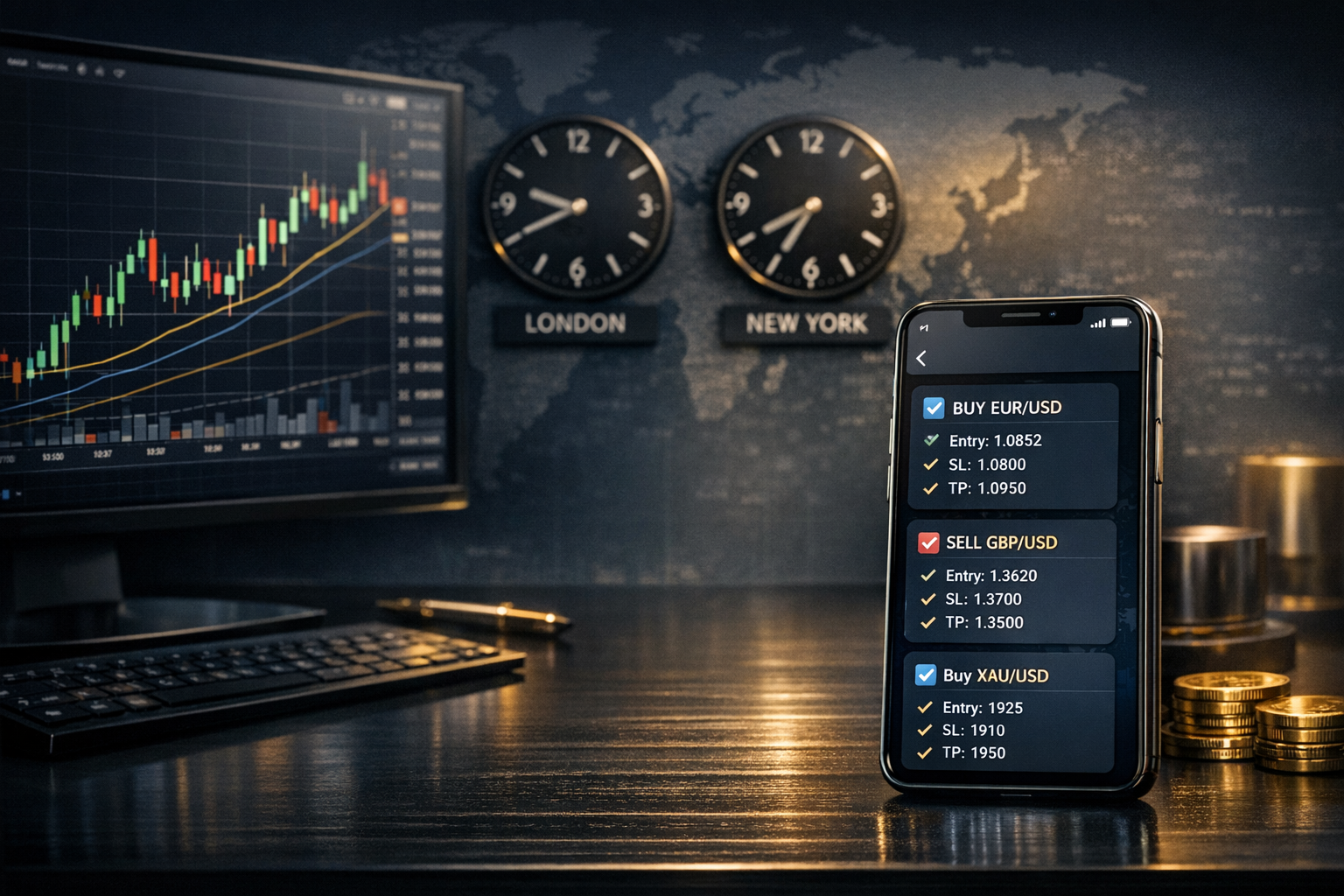
Forex signals for beginners can feel like a cheat code.
You open Telegram, see “EUR/USD Buy 1.0520, SL 1.0480, TP 1.0600,” and you think: “So… I just copy this and get paid?”
Sometimes it works. Sometimes the market slaps you in 10 minutes and you’re left confused, over-leveraged, and blaming the provider.
This guide is here to stop that cycle.
We’ll break down what forex signals really are, how to use forex signals step-by-step, what to check before you trust any provider, and how to protect your account with beginner-proof risk rules.
TL;DR — The Beginner’s Forex Signals Playbook
- A signal is not a guarantee. It’s a structured trade idea with Entry, Stop Loss, and Take Profit levels.
- Your results depend more on execution and risk than on the signal itself. Bad lot sizing can ruin a good signal.
- Choose providers with transparency: clear Entry/SL/TP, session focus, and consistent communication during volatility.
- Stick to 0.5%–1% risk per trade as a beginner. One week of over-leverage can erase months of progress.
- Use a repeatable routine: check spread, confirm session, place order correctly, manage partials, and journal every trade.
- Trade the market you’re in: today’s context (DXY ~106.80, EUR/USD ~1.0520, USD/JPY ~149.50, Gold ~2650) favors disciplined stops and patience.
1) What Forex Signals Are (And What They Are Not)
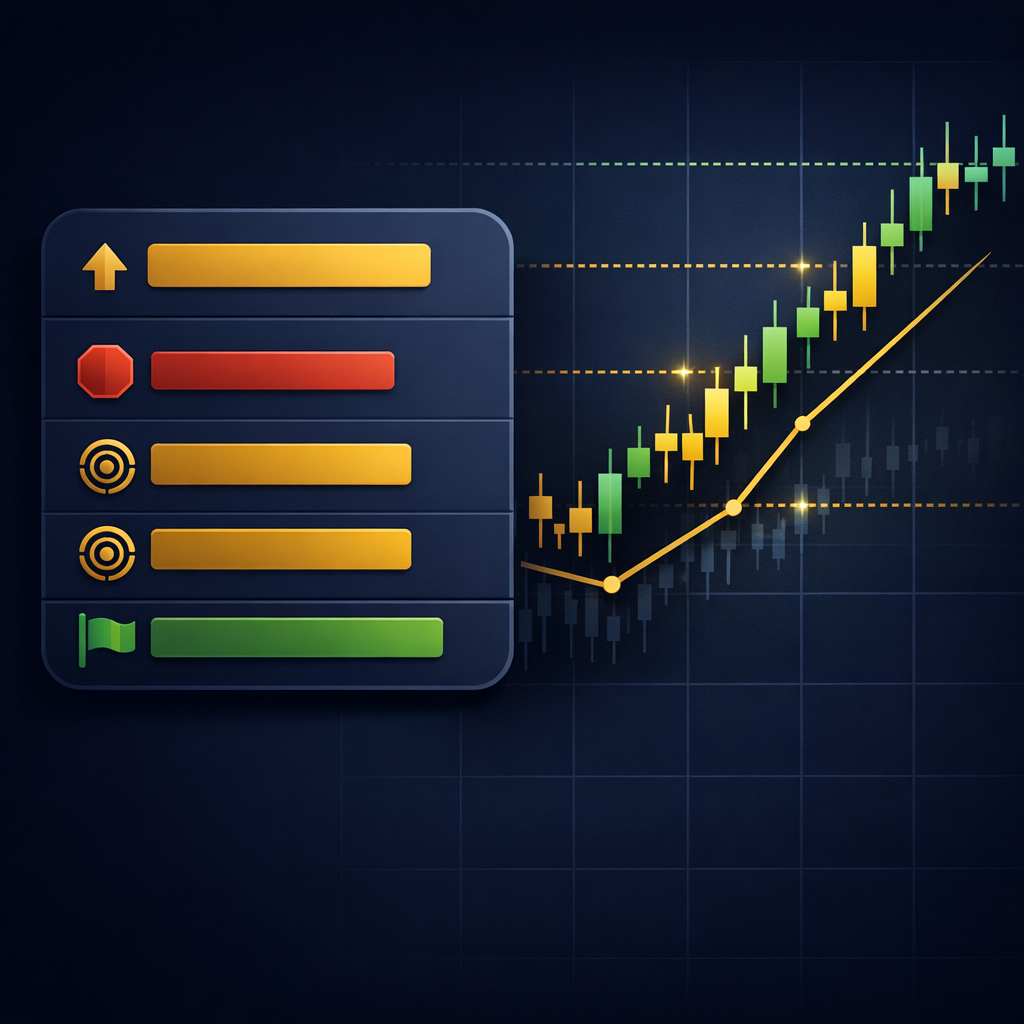
A forex signal is a trade instruction or trade idea designed to tell you what to trade, where to enter, where to exit if wrong, and where to take profit.
Most beginner-friendly signals include:
- Pair (EUR/USD, GBP/USD, USD/JPY, XAU/USD, etc.).
- Direction (Buy or Sell).
- Entry (market entry or limit entry).
- Stop Loss (SL) (your predefined loss point).
- Take Profit (TP) (one or multiple targets).
- Optional: timeframe bias, session timing, “break-even” instructions, and news warnings.
What a signal is not is a promise.
Markets move because of liquidity, macro data, central bank expectations, and positioning. Even the cleanest technical setup can fail if a surprise headline hits or if liquidity dries up.
Right now, the broader context matters. With DXY around 106.80, EUR/USD near 1.0520, and USD/JPY around 149.50, the USD remains a dominant driver. That can produce strong trends, but also sharp pullbacks that punish late entries.
Signals help you structure decisions. They don’t remove uncertainty.
Here’s the mindset shift that changes everything for beginners: you are not buying signals, you are buying a process.
A good provider gives you:
- Clear levels you can execute without guessing.
- A repeatable approach (sessions, instruments, risk logic).
- Updates when conditions change.
- Education so you learn the “why,” not only the “what.”
At United Kings, our focus is premium Telegram signals with clear Entry/SL/TP levels and an education-first approach. You can explore the ecosystem on our signals overview page.
2) How Forex Signals Are Generated: Technical, Fundamental, and Hybrid
To use signals confidently, you need a basic map of how providers create them.
Most high-quality providers fall into three styles: technical, fundamental, or hybrid.
Technical signals (chart-driven)
These come from price action and indicators.
Common inputs include:
- Support/resistance (previous highs/lows, supply/demand zones).
- Market structure (higher highs/higher lows vs lower highs/lower lows).
- Trend tools (moving averages, channels).
- Momentum (RSI, MACD, rate-of-change).
- Volatility (ATR-based stops, session range analysis).
A beginner mistake is thinking indicators “predict” price. They don’t. They describe what price is already doing.
Good technical signals are usually built around levels. Example conceptually: EUR/USD is at 1.0520 and reacts repeatedly at 1.0500. A provider might wait for a rejection and then send a sell with a stop above a swing high.
Fundamental signals (macro-driven)
These are based on interest rates, inflation, employment, and central bank expectations.
In today’s market, the USD’s strength (DXY near 106.80) often reflects relative yield expectations and risk sentiment. That can pressure EUR/USD and support USD/JPY, especially during risk-off flows.
Fundamental signals might also include gold (XAU/USD). With gold around $2650, small shifts in real yields or geopolitical risk can move price $15–$30 quickly.
Hybrid signals (what most pros use)
Hybrid signals combine macro bias with technical timing.
Example: a provider expects USD strength to persist but waits for a technical pullback to sell EUR/USD at a better price. That improves risk-reward and reduces emotional chasing.
This is one reason many premium services focus on London and New York sessions. Liquidity is higher, spreads are tighter, and technical levels tend to respect better.
If you want signals that cover both FX and metals, see our dedicated forex signals and gold signals pages. Beginners often start with one or two instruments, then expand.
3) Signal Formats Explained: Market, Limit, Stop, and “Zone” Entries
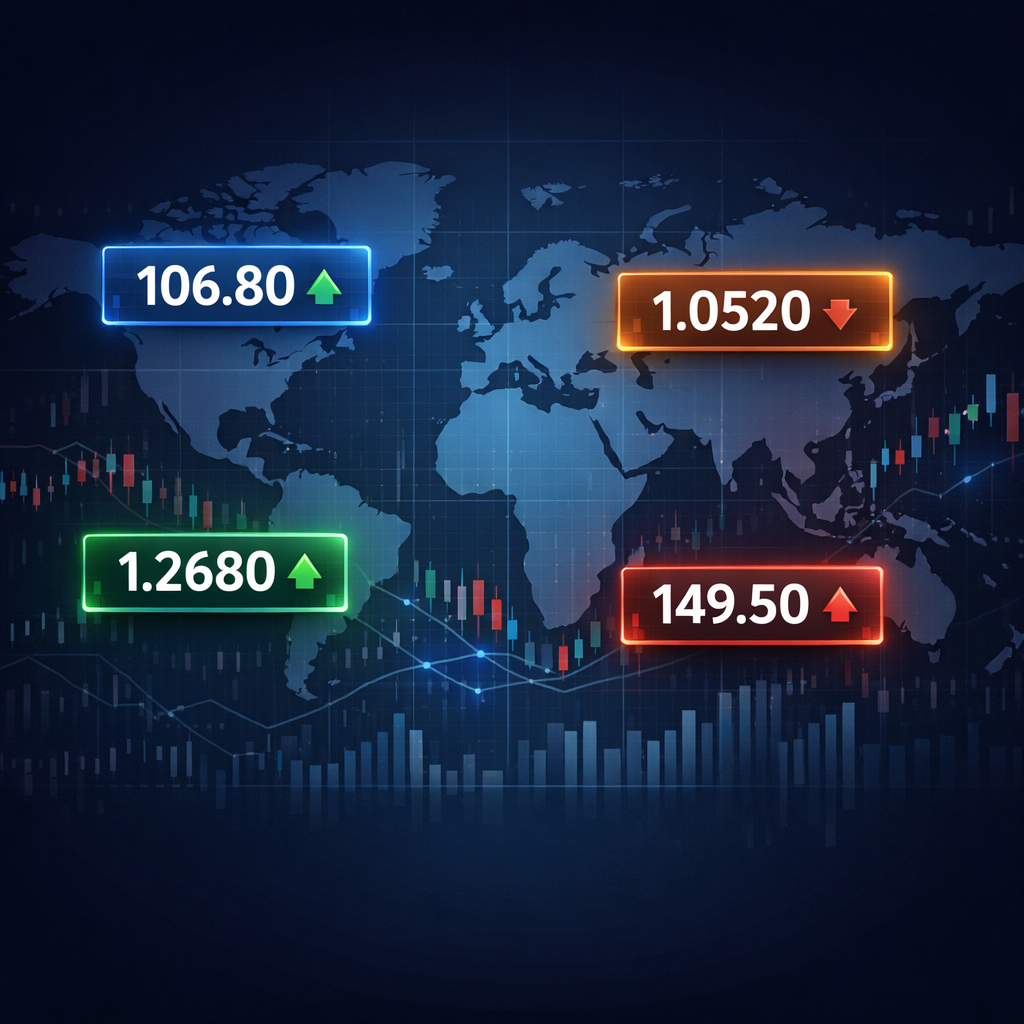
One reason beginners struggle is not the analysis—it’s the order type.
Let’s make signal formats simple and practical.
Market execution signals
These tell you to enter immediately at current price.
Example (illustrative): “GBP/USD Buy now 1.2680, SL 1.2645, TP 1.2750.”
Pros: simple, fast. Cons: slippage and spread can hurt entries during spikes.
Limit entry signals
These tell you to wait for a better price.
Example: “EUR/USD Sell Limit 1.0550, SL 1.0585, TP 1.0480.”
Pros: better risk-reward, less chasing. Cons: you might miss the trade if price never returns.
Stop entry signals
These enter only if price breaks a level, confirming momentum.
Example: “USD/JPY Buy Stop 150.10, SL 149.60, TP 151.10.”
Pros: aligns with breakout logic. Cons: false breakouts can trigger and reverse fast.
Entry zones (range entries)
Some providers give a zone like “Buy 1.0510–1.0525.”
This can be useful in volatile sessions, but beginners must know how to place orders. If you enter at the worst end of the zone with the same SL, your risk increases.
When gold is moving actively (like around $2650 with intraday swings), zones can be practical. A gold example within your guidelines could look like:
- XAU/USD Buy zone: 2642–2646
- SL: 2628 (about $14–$18 risk depending on fill)
- TP1: 2670
- TP2: 2685
Notice how the stop distance is realistic ($10–$25), and the targets aim for ~1:2 to ~1:3 reward-to-risk.
Beginner rule: if you don’t understand the order type in 10 seconds, don’t place it live. Put it on demo first and ask questions.
4) Choosing a Forex Signal Provider: The Beginner Checklist That Saves Accounts
Most beginners don’t lose because they chose “bad trades.”
They lose because they chose a provider with poor structure, unclear risk, and inconsistent communication.
Here’s what to evaluate before you pay for anything.
1) Clarity: Entry, SL, TP must be explicit
If a provider posts “Buy EUR/USD now, it’s going up,” that’s not a signal.
You need exact levels or a defined zone, plus a stop and at least one target.
2) Consistency: same style, same sessions
Beginners need routine. A provider who trades London/NY with a consistent approach is easier to follow than someone who posts random scalps at 3 a.m.
3) Risk logic: stops that make sense
Stops that are too tight get hit by normal noise. Stops that are too wide destroy your risk-to-reward.
In the current environment, EUR/USD can move 30–60 pips in a busy session. USD/JPY can swing 50–100 pips around risk sentiment. Your provider should reflect that reality.
4) Proof and transparency (without hype)
Be cautious with providers claiming “guaranteed daily profit.” That’s a red flag.
What you want instead is:
- Documented trade history (and losses included).
- Clear rules for break-even, partial closes, and invalidation.
- Reasonable expectations and risk warnings.
5) Community and support
Signals are easier when you can ask: “Do I enter if spread is high?” or “What if TP1 hits during news?”
United Kings is built around a large, active community (300K+ traders) and a premium Telegram workflow. If Telegram is your preferred format, you can join our official channel here: United Kings Telegram signals channel.
For a printable evaluation framework, use our beginner-focused checklist: forex signals provider checklist for beginners.
5) Comparison Table: Free vs Paid Signals vs Copy Trading (Beginner View)
Beginners usually start with free signals, then wonder why results are inconsistent.
Let’s compare your common options realistically.
| Option | Typical Cost | Pros | Cons | Best For |
|---|---|---|---|---|
| Free signals (social media) | $0 | Easy access, good for learning terminology | Often no SL/TP, inconsistent quality, heavy marketing, late entries | Absolute beginners on demo only |
| Paid Telegram signals | $50–$200+/mo | Clear levels, structured risk, updates, community support | Still requires execution discipline and proper sizing | Beginners who want a guided process |
| Copy trading / auto-copy | Performance fees or spreads | Hands-off execution, reduces manual mistakes | Less learning, risk of overexposure, dependence on one trader | Busy traders who still manage risk |
| DIY trading (no signals) | Time cost | Maximum control, maximum learning | Steep learning curve, emotional errors, slow feedback loop | Committed learners with time to study |
Paid signals are not “better” because they’re paid.
They’re better when they provide structure, transparency, and support you can actually execute.
If you want to see what our traders follow daily, start from our main UnitedKings.net homepage and explore the live signal categories.
6) How to Use Forex Signals Step-by-Step (Execution Workflow)
This is the section that turns “signals” into actual trading skill.
Use this workflow every single time. No exceptions.
Step 1: Identify the instrument and session
Ask: is this a London/NY idea or a quiet-session scalp?
Liquidity matters. EUR/USD and GBP/USD behave differently at 8:00 London time vs late Asia. USD/JPY can spike sharply when US yields move.
Step 2: Check spread and volatility
If EUR/USD spread is 0.8 pips, fine. If it’s 2.5 pips during a news spike, your entry is already worse.
For gold near $2650, spreads can widen around headlines. A $0.30–$0.60 spread is normal at many brokers, but $1.50+ during spikes changes the trade math.
Step 3: Confirm order type and set the correct levels
Market order? Limit? Stop?
Then set:
- Entry price (or pending level)
- Stop Loss (exact number)
- Take Profit(s)
If the signal has multiple targets, decide your plan before you enter. Example: close 50% at TP1, move SL to break-even, let the rest run to TP2.
Step 4: Calculate position size (lot size) before placing the trade
This is where beginners either become consistent… or blow accounts.
Choose a fixed risk per trade. As a beginner, 0.5% to 1% is a strong default.
Example: $1,000 account risking 1% = $10 risk per trade.
If your EUR/USD stop is 40 pips, you size the trade so 40 pips = $10 loss. That’s $0.25 per pip, roughly 0.025 lots on many brokers (varies by contract specs).
For gold, it’s even more critical. Example within your price range:
- XAU/USD Buy: 2648
- SL: 2636 (risk = $12)
- If your account risk is $12, your position size should be ~0.10 lot if $1 move = $10 on your broker (check contract size).
Do not guess. Use a position size calculator.
Step 5: Place the trade and screenshot it
Screenshot entry, SL, TP. This builds accountability and helps journaling.
Step 6: Manage the trade exactly as instructed
Beginners sabotage signals by taking profit too early or moving stop losses wider.
If you can’t follow the plan, reduce size until you can.
Step 7: Journal the result
Write: did you enter late? Was spread high? Did you move SL? Did you panic close?
Signals accelerate learning only if you capture feedback.
7) Risk Management for Beginners Using Forex Signals (Non-Negotiables)
If you master one thing, master this.
Signals can be excellent, but without risk control you can still lose money in a winning system.
The 1% rule (and when to use 0.5%)
For beginners, risking 1% per trade is usually enough to grow while surviving losing streaks.
If you’re trading gold (XAU/USD) around $2650 with $15–$25 stops, volatility can be sharp. Many beginners do better at 0.5% until they prove consistency.
Maximum daily loss limit
Set a hard stop for the day.
- Example: stop trading after -2% in a day.
- This prevents revenge trading after two quick losses.
Limit correlated exposure
EUR/USD and GBP/USD often move together because both are USD-quoted majors.
If you take two signals that both effectively short USD, you may be doubling risk without realizing it.
In today’s context with DXY near 106.80, USD momentum can dominate. If USD suddenly reverses, multiple trades can lose at once.
Keep leverage boring
Leverage is not a strategy. It’s a tool.
Beginners should avoid using “max lot size” just because the broker allows it. A 50-pip move on USD/JPY can happen fast. If you’re oversized, you won’t survive normal volatility.
Use realistic stop losses
Stops should be placed where the trade idea is invalidated, not where it “feels comfortable.”
Gold example: If you buy at 2652 because you expect a bounce from 2648–2650 support, a stop at 2649 is often too tight. A stop at 2638 might make more sense if structure breaks below.
For more depth, keep this bookmarked: risk management strategies when using forex signals.
8) Reading a Signal Like a Pro: Context, Confluence, and Timing
Beginners treat signals like commands. Professionals treat them like structured ideas that must fit the current environment.
Here’s how to “read between the lines” without overcomplicating it.
Context: where are we in the bigger move?
Ask: are we trending, ranging, or spiking?
With EUR/USD around 1.0520, many traders watch round numbers like 1.0500 and 1.0600. If price is stuck between them, range strategies work better than breakout chasing.
USD/JPY near 149.50 is also a psychologically sensitive area. Big figures like 150.00 often attract liquidity and sharp reactions.
Confluence: why this level?
Good signals usually align multiple factors:
- Support/resistance + trend direction
- Session timing (London/NY)
- Momentum confirmation
- News awareness (avoid entering seconds before high-impact releases)
If you don’t see the “why,” you can still take the trade. But you should reduce size until you build trust through repetition.
Timing: avoid the two beginner traps
- Entering late: You see a signal at 1.0520, but you enter at 1.0532 after it already moved 12 pips. Your stop is now effectively tighter.
- Entering during spikes: News candles can hit SL and TP in the same minute. If you don’t know the schedule, you’re gambling.
Gold makes this even more obvious. At $2650, a $20 candle can appear quickly around unexpected headlines. That’s why disciplined entries and stop logic matter.
If you trade gold signals specifically, you’ll also want to understand how signals behave during chaos. This article helps: how gold signals react to unexpected news events.
9) Building Consistency With Signals: Routine, Journaling, and Psychology
Signals can remove analysis paralysis, but they don’t remove emotions.
Most beginners struggle with three psychological patterns.
Pattern 1: “I’ll just increase lot size to recover”
This is the fastest path to account damage.
Instead, use a fixed risk model. If you lose 1%, the next trade is still 1%. Your confidence comes from process, not from one trade.
Pattern 2: Closing winners too early
Beginners often take +10 pips then watch the trade hit TP for +60 pips without them.
If your provider uses TP1/TP2, follow it. If not, you can use a simple rule: take partial at 1R (same distance as your stop), then let the rest target 2R or 3R.
Gold example:
- Buy 2646, SL 2634 (risk $12)
- At 2658 (+$12), take 50% off and move SL to 2646
- Let remaining portion aim for 2670 (+$24) or 2682 (+$36)
Pattern 3: Overtrading because signals feel “easy”
More trades does not mean more profit.
As a beginner, aim for:
- 1–3 trades per day max (or even per week if swing signals)
- Only the pairs you can track (start with EUR/USD, GBP/USD, USD/JPY)
- One metal (gold) only if you can handle volatility
Your weekly routine (simple and effective)
- Sunday: set risk parameters, review last week’s journal.
- Daily pre-session: check news calendar and spreads.
- After each trade: screenshot + note execution quality.
- Friday: calculate stats (win rate, average R, mistakes).
This routine turns signals into skill. Without it, you’re just clicking.
10) Realistic Trade Examples Using Today’s Market Context (EUR/USD, GBP/USD, USD/JPY, Gold)
Let’s connect everything to realistic examples around current pricing.
These are educational scenarios, not promises. Your broker pricing and spreads may differ.
Example A: EUR/USD range trade (around 1.0520)
Assume EUR/USD is ranging between 1.0500 support and 1.0560 resistance.
- Signal idea: Buy 1.0520
- SL: 1.0485 (35 pips)
- TP: 1.0590 (70 pips, ~1:2 RR)
Beginner execution note: if you enter at 1.0530 instead of 1.0520, your stop becomes 45 pips away (same SL), and your RR drops. Late entries silently kill performance.
Example B: GBP/USD momentum continuation (around 1.2680)
Assume GBP/USD is trending up after a pullback.
- Signal idea: Buy 1.2680
- SL: 1.2635 (45 pips)
- TP1: 1.2770 (90 pips, 1:2)
- TP2: 1.2815 (135 pips, 1:3)
Beginner management: take partial at TP1, move SL to break-even, let TP2 run only if market conditions remain supportive.
Example C: USD/JPY volatility-aware trade (around 149.50)
USD/JPY is sensitive to yields and risk sentiment. Around big figures, it can fake out.
- Signal idea: Sell 149.50
- SL: 150.10 (60 pips)
- TP: 148.30 (120 pips, 1:2)
Beginner note: do not widen stops on USD/JPY “because it always comes back.” That’s how drawdowns become disasters.
Example D: Gold (XAU/USD) structured trade around $2650
Gold is trading near $2650 with moderate intraday volatility.
- Signal idea: Buy 2652
- SL: 2638 (risk $14)
- TP1: 2680 (reward $28, 1:2)
- TP2: 2694 (reward $42, 1:3)
Beginner note: gold can spike $10 quickly. If you panic-close at +$6, you’re not following the system. Reduce lot size so you can hold the plan calmly.
11) Getting Started With United Kings Signals (Plans, Setup, and Best Practices)
If you want to use forex signals effectively as a beginner, your first goal is not “make money fast.”
Your first goal is execute correctly for 30 days.
United Kings is designed to make that easier by providing premium Telegram signals with clear Entry/SL/TP levels and a London/NY session focus.
Where to start
- Start with our forex signals if you want majors like EUR/USD, GBP/USD, and USD/JPY.
- Add gold signals once you understand volatility and position sizing.
- If you also follow digital assets, we have a separate category for crypto signals—but beginners should avoid trading everything at once.
Telegram setup (simple rules)
- Turn on notifications for the signal channel.
- Create a “pre-trade checklist” note on your phone: spread, news, order type, lot size.
- Use one broker account for signals only (clean tracking).
Choose a plan that fits your learning timeline
We offer 3 plans with different commitment levels:
- Starter (3 Months): $299 (~$100/mo)
- Best Value (1 Year): $599 (~$50/mo) with 50% savings + FREE ebook
- Unlimited (Lifetime): $999 (pay once)
You can review the options on our pricing page and choose based on how serious you are about building a routine.
Beginner best practice: demo first, then go micro
If you’re new, trade signals on demo for 1–2 weeks. Then go live with micro lots.
The goal is to prove you can follow Entry/SL/TP without emotional interference.
If you want a Telegram-first onboarding guide, this is useful: forex signals Telegram for beginners guide.
FAQ: Forex Signals for Beginners
1) Are forex signals good for beginners?
Yes, if they come with clear Entry/SL/TP and you use strict risk management. Signals can speed up learning by giving you structured examples to execute and journal.
2) How many signals should a beginner take per day?
Usually 1–3 maximum, depending on your schedule and emotional discipline. Quality execution beats quantity.
3) What risk percentage should I use when following signals?
Most beginners do best at 0.5%–1% risk per trade. If you’re trading volatile instruments like gold near $2650, start at 0.5% until consistent.
4) Do I need a lot of money to start using forex signals?
No, but you need enough to size trades properly. A small account can work if your broker supports micro lots and you keep risk small.
5) Can I follow forex and gold signals at the same time?
You can, but beginners should start with 1–2 pairs first. Add gold only after you can handle faster swings and you understand stop sizing.
Risk Disclaimer (Read Before You Trade)
Forex and gold trading involve significant risk and are not suitable for everyone. You can lose some or all of your capital. Signals are educational and informational and do not guarantee profits. Past performance does not guarantee future results. Always use a stop loss, manage position size, and consider demo trading before risking real money. If you’re unsure, seek independent financial advice.
Join United Kings: Trade With Structure, Not Guesswork
If you’re serious about learning how to use forex signals the right way, you need two things: a clear signal framework and disciplined risk rules.
That’s exactly what we build at United Kings—premium Telegram signals, clear Entry/SL/TP, London and NY session focus, and education alongside execution.
- Explore all categories on our signals page.
- Pick your plan on the United Kings pricing page (3 Months $299, 1 Year $599, Lifetime $999).
- Join the community on Telegram: United Kings official Telegram channel.
Remember: consistency is built one correctly executed trade at a time. We’ll help you do that—starting today.