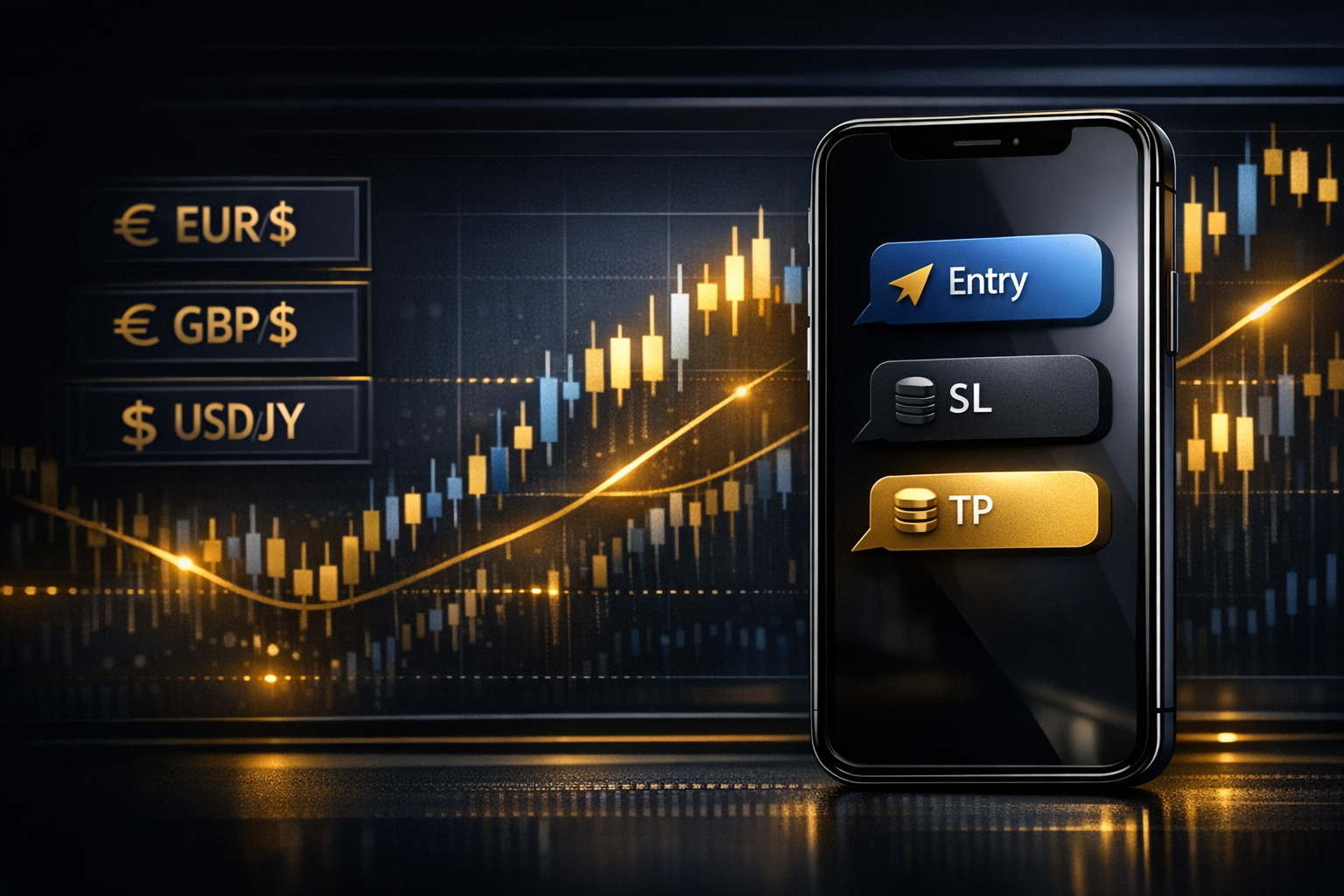
Ever copied a forex signal, watched price move 20–30 pips in your favor… and still ended up losing?
If you’re new to signals, that experience is more common than you think.
Most beginners don’t lose because “signals don’t work.” They lose because they don’t know how to use forex signals correctly—how to size the trade, place the order, handle spreads, avoid news traps, and stay consistent.
This is the definitive forex signals guide for beginners. We’ll break it down like a real trading playbook, with examples using current market context (EUR/USD ~1.0520, GBP/USD ~1.2680, USD/JPY ~149.50, DXY ~106.80, and gold XAUUSD around $2650).
TL;DR — Forex Signals for Beginners (Quick Takeaways)
- A signal is only “good” if you execute it correctly. Entry, SL, TP, position size, and timing matter more than hype.
- Risk 0.5%–1% per trade as a beginner. Signals don’t remove drawdowns—risk rules do.
- Use pending orders when possible to reduce slippage and emotional chasing.
- Track every signal you take (pair, session, entry type, result, mistakes). Consistency comes from review.
- Choose providers with transparency: clear SL/TP, session focus, realistic win rate claims, and educational guidance.
- Start on demo, then go small live. Your first goal is process mastery, not profit.
1) What Forex Signals Are (and What They Are Not)

Forex signals are trade ideas delivered to you in a structured format. A typical signal includes the instrument (like EUR/USD), direction (buy/sell), entry price, stop loss (SL), take profit (TP), and sometimes extra guidance like session timing or confirmation rules.
Think of a signal like a GPS route. It tells you where to go, but you still need to drive the car. If you speed, miss turns, or ignore road conditions (spread, volatility, news), you can still crash.
Signals come in different styles. Some are scalps (quick trades targeting 5–20 pips). Others are intraday (20–80 pips), and some are swing trades held for days.
Beginners often assume signals are “set and forget.” That’s not true. A signal is a plan. Execution quality determines whether the plan is followed.
What signals can do for beginners
- Reduce analysis paralysis. You don’t need to stare at charts all day.
- Teach structure. You learn what a proper entry/SL/TP looks like.
- Expose you to sessions. You start noticing London vs New York behavior.
- Build pattern recognition. Over time, you see repeated setups.
What signals cannot do (be honest with yourself)
- They can’t remove risk. Every trade can lose, even the best setup.
- They can’t fix over-leverage. If you risk 10% per trade, one bad streak can wipe you.
- They can’t guarantee fills. Spreads widen, slippage happens, and brokers differ.
- They can’t replace discipline. Revenge trading can destroy a month in one day.
This matters because the best “forex signals for beginners” are not the ones with the loudest marketing. They’re the ones that are easy to execute, risk-defined, and consistent over time.
2) The Different Types of Forex Signals (Manual, AI, Copy, VIP)
Signals differ by how they’re created and how you receive them. As a beginner, choosing the right type can save you months of confusion.
Let’s break down the main categories you’ll see in the real world.
Manual analyst signals
These are created by experienced traders using price action, market structure, support/resistance, and sometimes indicators. The best manual signals include context: “London session pullback,” “NY breakout,” or “DXY strength supports USD longs.”
Manual signals are often easier for beginners to understand because they come with reasoning. That reasoning becomes your education.
Algorithmic/AI-assisted signals
These are generated by models scanning markets for patterns and probabilities. AI can be powerful, but beginners should be cautious: a black-box signal with no clear SL logic can lead to blind trust.
AI is best when combined with human risk control and clear execution rules. If the provider can’t explain the risk framework, you’re basically gambling with a robot.
Copy trading signals
Copy trading means you automatically mirror another trader’s account. It feels “hands-free,” but beginners often don’t realize they’re also copying:
- Different broker spreads
- Different leverage and margin
- Different drawdown tolerance
- Different execution speed
Copy trading can work, but it can also hide risk until it’s too late. If you’re learning, you want visibility and control.
Telegram VIP signals (most common today)
Telegram is popular because signals are fast, formatted, and community-driven. A professional Telegram signal should look like:
- Pair: GBPUSD
- Direction: Buy
- Entry: 1.2680–1.2690
- SL: 1.2645 (35 pips)
- TP1: 1.2740 (60 pips)
- TP2: 1.2790 (110 pips)
Notice how the trade is defined before it begins. That’s what you want.
Comparison table: which signal style fits a beginner?
| Signal Type | Best For | Main Risk | Beginner-Friendly? |
|---|---|---|---|
| Manual Analyst | Learning structure + context | Quality varies by analyst | High (if transparent) |
| AI/Algorithmic | Systematic pattern scanning | Black-box logic, unstable in news | Medium (needs strong risk rules) |
| Copy Trading | Hands-off execution | Hidden leverage + drawdown surprises | Medium-Low |
| Telegram VIP | Fast execution + community | Chasing entries, FOMO | High (with discipline) |
If you’re starting out, the sweet spot is usually clear Telegram signals + education. That’s why United Kings focuses on structured entries, SL/TP clarity, and session-based trading—especially London and New York.
3) How to Choose a Forex Signal Provider (Beginner Checklist)
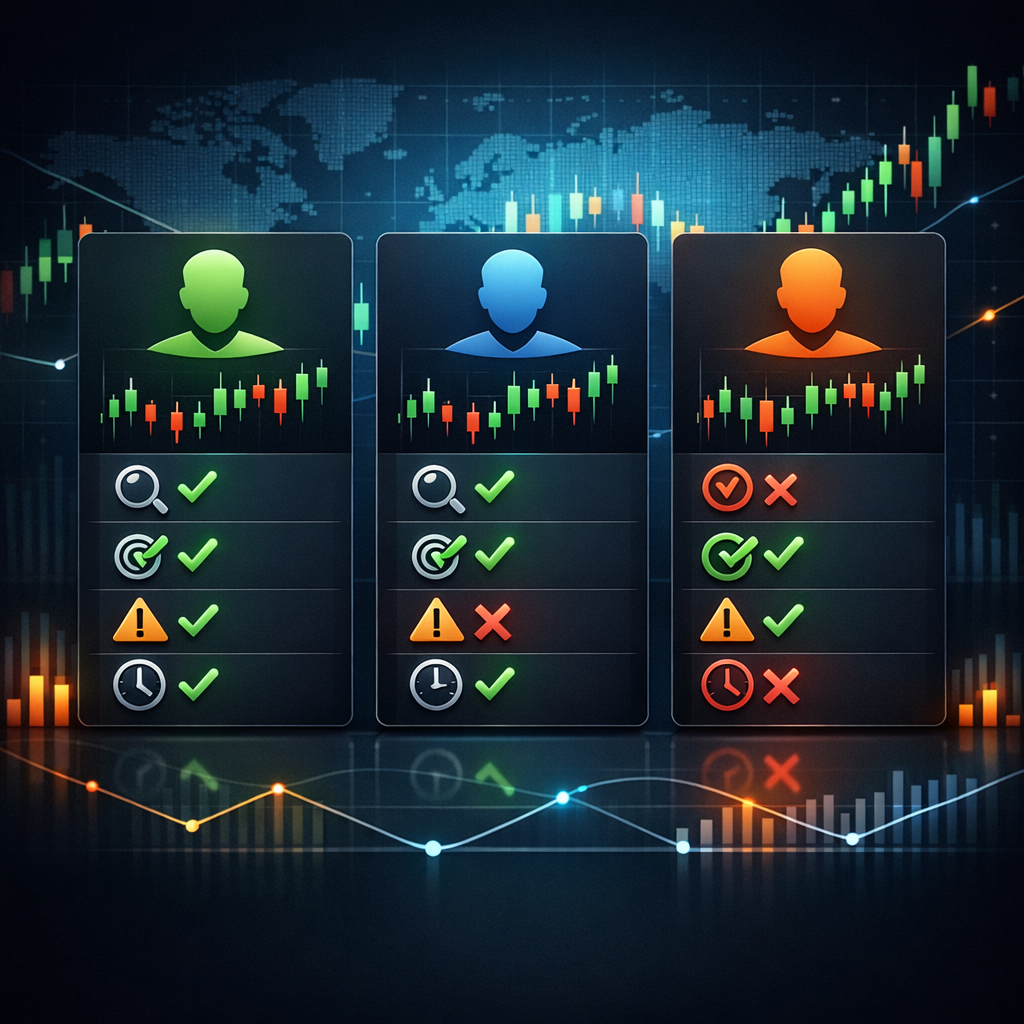
Choosing a provider is the most important decision you’ll make with signals. A beginner can succeed with average signals and great risk control. But even a skilled trader can struggle if the provider is vague, inconsistent, or manipulative.
Here’s the provider checklist we use internally, written in plain language.
1) Clarity: do they give full trade parameters?
A real signal includes Entry, Stop Loss, and Take Profit. If SL is missing, you’re being pushed into emotional decision-making.
Also watch for “open-ended” messages like “Buy now, trust me.” That’s not a signal. That’s a sales pitch.
2) Execution realism: do they account for spreads and volatility?
EUR/USD at 1.0520 might have a tight spread, but GBP/USD can widen around news. USD/JPY around 149.50 can spike fast if yields move. A professional provider acknowledges these realities.
For gold (XAUUSD) around $2650, volatility can be sharp during US data. A good gold signal will use realistic stops (often $10–$25) and target at least 1:2 reward.
3) Track record: do they show outcomes consistently?
Be careful with cherry-picked screenshots. Instead, look for consistent posting of wins and losses, plus how they handled drawdowns.
Also, any provider claiming “100% win rate” is either lying or martingaling (dangerous averaging down).
4) Risk framework: do they teach position sizing?
Signals without risk education create dependent traders. You want a provider that helps you understand how much to risk, not just where to enter.
United Kings emphasizes risk-based sizing and clear SL placement. If you want the deeper framework, our risk article is worth bookmarking: risk management strategies when using forex signals.
5) Session specialization: do they trade when markets move?
Signals posted randomly at illiquid times often lead to poor fills and slow price action. The highest-quality opportunities typically show up during:
- London session: trend continuation, breakouts, clean liquidity
- New York session: US data volatility, reversals, continuation moves
This is a core part of how we structure premium alerts in our forex signals and gold signals streams.
6) Community and support: can you ask questions?
Beginners need feedback loops. A community helps you see how other traders execute the same signal, where they got slipped, and what they did wrong.
United Kings has a large active community (300K+ traders) and prioritizes clarity so beginners don’t feel lost after the alert is posted.
If you want a provider vetting worksheet, you can also read our dedicated checklist post: forex trading signals provider checklist for beginners.
4) How to Use Forex Signals Step-by-Step (Execution Like a Pro)
Most beginners think the “signal” is the hard part. In reality, execution is where money is made or lost.
Here’s a step-by-step process you can follow for almost any signal, whether it’s EUR/USD, GBP/USD, USD/JPY, or gold.
Step 1: Confirm your broker conditions (spread + margin)
Before you place the trade, check the spread. If EUR/USD spread is 0.8 pips, fine. If it’s 3 pips during a quiet hour, your entry quality changes.
Also check margin. Beginners often open too large a lot size, then get forced to close during a small drawdown.
Step 2: Decide your risk per trade (not your lot size)
Pick a fixed percentage. Many beginners do best at 0.5%–1% per trade until they prove consistency.
Example: $1,000 account risking 1% = $10 risk per trade. That’s your anchor.
Step 3: Place the order the right way (market vs pending)
If the signal gives an entry zone like “Buy EUR/USD 1.0515–1.0525,” you have options:
- Market order: faster, but higher slippage risk
- Limit order: better price, but may miss fill
- Stop order: breakout confirmation, but can slip in volatility
As a beginner, pending orders help you avoid chasing. If EUR/USD is at 1.0520 and the signal says “Buy limit 1.0516,” you place it and let the market come to you.
Step 4: Set SL and TP immediately (no exceptions)
Never “add SL later.” That’s how small losses become account-ending events.
Example forex trade:
- Pair: GBP/USD
- Entry: 1.2680
- SL: 1.2645 (35 pips)
- TP: 1.2750 (70 pips, ~1:2 RR)
If you risk $10 and SL is 35 pips, your position size is about $10 / (35 pips * $0.10 per pip for 0.01 lot?)—pip values vary by broker and pair, so use the broker calculator. The principle stays the same: risk first, lot size second.
Step 5: Manage the trade with rules (not feelings)
Decide in advance:
- Will you move SL to breakeven at +1R?
- Will you take partial profits at TP1?
- Will you close early if the setup invalidates?
Signals work best when your management is consistent. Random management creates random results.
Step 6: Journal the execution (this is where beginners level up)
Write down: entry time, spread, whether you chased, whether you followed SL/TP, and what you felt. You’re not journaling for motivation. You’re journaling to remove repeated mistakes.
If you want a deeper execution framework, our beginner-friendly guide on Telegram execution is useful: forex signals Telegram for beginners guide.
5) Risk Management for Signal Traders (The Real “Edge”)
Beginners search for the perfect provider. Professionals search for the perfect risk model.
Here’s the truth: even with an 85% win rate, you can still blow an account if you risk too much per trade or average down without a plan.
The 3 risk rules beginners should not break
- Rule #1: Risk a fixed % per trade (0.5%–1% recommended early on).
- Rule #2: Never move SL further away “to give it room.” That’s denial, not strategy.
- Rule #3: Set a daily loss limit (like 2R). If hit, stop trading.
Understanding R-multiples (simple but powerful)
If your SL is 30 pips and you risk $10, that’s 1R. If you hit TP at 60 pips, that’s +2R. Thinking in R keeps you consistent across pairs.
It also stops you from comparing apples to oranges. A 15-pip win on EUR/USD can be better than a 40-pip win on GBP/JPY depending on risk and volatility.
Beginner position sizing example (EUR/USD)
Let’s say EUR/USD is 1.0520 and you receive:
- Sell EUR/USD: 1.0520
- SL: 1.0550 (30 pips)
- TP: 1.0460 (60 pips)
You risk 1% on a $2,000 account = $20. With a 30-pip SL, you size the position so 30 pips equals $20. That’s it. No guessing.
Gold (XAUUSD) risk example using current context
Gold is around $2650 (+0.35% on the day). Volatility can be sharp when DXY is firm (~106.80) and USD/JPY is elevated (~149.50), because rates and risk sentiment can shift fast.
Example signal structure:
- Buy XAUUSD: 2648
- SL: 2633 (15 dollars)
- TP: 2678 (30 dollars, ~1:2 RR)
If your broker values $1 move as $1 per 0.01 lot (varies), you calculate size so a $15 SL equals your chosen risk. Gold can move $10–$15 quickly around US releases, so beginners must keep size modest.
Why beginners should avoid martingale with signals
Some channels “recover” losses by doubling down. It can look like a high win rate—until the one trend day wipes months of gains.
As a beginner, your goal is survival and skill-building. If a provider encourages unlimited averaging, walk away.
For a more detailed framework, read our full risk guide: risk management strategies when using forex signals.
6) Reading the Market Context Behind Signals (So You Don’t Trade Blind)
Signals are strongest when they align with the broader market environment. Beginners don’t need to become macro experts, but you do need a few “context anchors” so you understand why a signal makes sense.
Right now, our context snapshot looks like this:
- DXY: ~106.80 (USD relatively strong)
- EUR/USD: ~1.0520 (pressure when USD is strong)
- GBP/USD: ~1.2680 (can move fast on UK data + risk sentiment)
- USD/JPY: ~149.50 (sensitive to yields + intervention talk)
- Gold (XAUUSD): ~$2650 (+0.35%) (reacts to yields, USD, and risk-off flows)
How DXY affects beginner signal decisions
When DXY is strong, USD pairs often trend more cleanly. That doesn’t mean “always buy USD,” but it does mean you should be cautious fading USD strength without a clear reversal setup.
Example: If you get a signal to buy EUR/USD at 1.0520 while DXY is rising, you want to know the reason. Is it a support bounce? A news-driven oversold move? A London liquidity sweep?
How USD/JPY context changes volatility
USD/JPY around 149.50 can be a “headline pair.” Comments from officials can create sudden 50–100 pip spikes. If your signal uses a tight 15–20 pip stop in USD/JPY during a sensitive period, execution risk increases.
As a beginner, you don’t need to predict intervention. You just need to respect that volatility can be abnormal and reduce size.
How gold (XAUUSD) context supports or conflicts with forex signals
Gold is not “just another pair.” It reacts to real yields, USD strength, and risk sentiment. With gold around $2650, a move to $2675 is realistic on a risk-off wave. A drop to $2625 can happen fast if yields spike and DXY pushes higher.
That’s why gold signals should be structured with realistic stops ($10–$25) and clear invalidation. If a provider uses a $5 stop in active conditions, you’ll get stopped out repeatedly.
Session context: why London and New York matter
Many beginners take signals at random times, then blame the provider. But the same setup behaves differently depending on liquidity.
- London open: breakouts, trend continuation, stop hunts
- NY open: US data spikes, reversals, strong follow-through
United Kings is built around these two sessions because that’s where the cleanest movement and best follow-through often show up.
If you want more market context content, explore our analysis library on the United Kings blog.
7) Common Beginner Mistakes When Following Forex Signals (and Fixes)
Let’s make this practical. Most beginners don’t fail because they chose the “wrong” signal. They fail because of predictable execution mistakes.
Here are the big ones—and how to fix them immediately.
Mistake #1: Entering late (chasing)
A signal says “Sell EUR/USD 1.0520,” but you enter at 1.0508 because you saw it moving and panicked. Now your SL/TP are distorted.
Fix: Use pending orders or skip the trade if entry is missed. Professional traders skip trades all the time.
Mistake #2: Moving the stop loss further away
This is the silent account killer. You tell yourself, “It will come back.” Sometimes it does. Eventually it won’t.
Fix: SL is the cost of doing business. If you can’t accept it, your size is too big.
Mistake #3: Overtrading after a win
Beginners often feel invincible after 2 wins. Then they take 5 random trades and give it back.
Fix: Cap your trades per day. For beginners, 1–3 high-quality trades is plenty.
Mistake #4: Ignoring news and volatility windows
USD pairs can spike around major US releases. Gold can jump $15 in minutes. If you enter right before news, you’re flipping a coin on slippage.
Fix: Know the calendar. If you’re unsure, wait for the first 5–15 minutes after the release.
Mistake #5: Mixing multiple providers
One channel says buy, another says sell. You end up hedged, confused, and emotional.
Fix: Commit to one structured approach for 30 trades. Then evaluate.
Mistake #6: Treating signals like entertainment
If you’re taking trades because you’re bored, you’re not trading—you’re seeking dopamine.
Fix: Trade only when your checklist is met: entry, SL/TP set, size calculated, session appropriate.
If you want to go deeper on avoiding bad services, we also recommend reading: why some forex signal services fail (mistakes to avoid).
8) Practical Examples: Executing Signals on EUR/USD, GBP/USD, USD/JPY, and Gold
Let’s turn theory into muscle memory. Below are realistic examples using the current market neighborhood (EUR/USD ~1.0520, GBP/USD ~1.2680, USD/JPY ~149.50, gold ~$2650).
These are not “promises.” They’re execution templates so you can practice correct behavior.
Example A: EUR/USD pullback continuation
Scenario: DXY is firm near 106.80, and EUR/USD is struggling under a resistance zone.
- Signal idea: Sell EUR/USD at 1.0520
- SL: 1.0550 (30 pips)
- TP1: 1.0480 (40 pips)
- TP2: 1.0460 (60 pips, ~1:2 RR)
Execution notes: If spread is wider than normal, reduce size or wait. If price already dropped to 1.0505, don’t chase—wait for a retest or skip.
Example B: GBP/USD London session breakout
Scenario: GBP/USD holds above 1.2680 and breaks a London range high.
- Signal idea: Buy GBP/USD at 1.2685
- SL: 1.2655 (30 pips)
- TP: 1.2745 (60 pips, ~1:2 RR)
Execution notes: GBP/USD can whip around. If you’re new, consider taking partial at +1R and moving SL to breakeven only after structure confirms.
Example C: USD/JPY momentum with volatility awareness
Scenario: USD/JPY trades around 149.50 with momentum, but headlines can hit.
- Signal idea: Buy USD/JPY at 149.50
- SL: 149.10 (40 pips)
- TP: 150.30 (80 pips, ~1:2 RR)
Execution notes: If there’s a major US release or intervention risk chatter, reduce size. A wider SL with smaller size can be safer than a tight SL with big size.
Example D: Gold (XAUUSD) intraday swing around $2650
Scenario: Gold is $2650 and volatility is active. You want a structured trade with realistic room.
- Signal idea: Buy XAUUSD at 2646
- SL: 2631 ($15 risk)
- TP1: 2676 ($30 reward, ~1:2 RR)
- TP2: 2691 ($45 reward, ~1:3 RR, within the $2610–$2690 guideline)
Execution notes: Gold can spike and retrace. If you’re a beginner, consider taking TP1 and leaving a small runner to TP2, instead of trying to nail the exact top.
If gold is your focus, you’ll also like our Telegram channel round-up for gold trading: best Telegram channels for gold trading signals.
9) Building a Beginner Routine: From Demo to Consistent Live Trading
Signals don’t create consistency. Routines create consistency.
Beginners often jump straight into live trading, then emotionally react to every win and loss. A better approach is to build a simple routine you can follow for 30–60 days.
Phase 1: Demo trading (2–4 weeks)
Your goal is not to “make demo money.” Your goal is to prove you can execute signals correctly.
- Take only the pairs you understand (start with EUR/USD and GBP/USD).
- Risk a fixed amount per trade (even on demo).
- Practice placing pending orders and setting SL/TP instantly.
- Screenshot entries and exits for review.
After 30 demo trades, check: did you follow the plan, or did you chase and move stops?
Phase 2: Small live trading (4–8 weeks)
Go live with small size. Even $5 risk per trade is enough to trigger real emotions—and that’s the point. You’re training psychology.
- Risk 0.5%–1% per trade maximum.
- Limit to 1–3 trades per day.
- Stop after 2 losses in a day (or 2R daily loss limit).
Phase 3: Scale only after process consistency
Scaling is not increasing lot size because you feel confident. Scaling is increasing size because your journal proves you follow rules over a large sample (50–100 trades).
If your execution is clean, you can gradually increase risk from 0.5% to 1%, then maybe 1.5%—but only if your drawdowns remain controlled.
A simple daily checklist for signal traders
- What session are we in (London/NY/Asia)?
- Is there major news in the next 30–60 minutes?
- Is spread normal?
- Do I have Entry, SL, TP clearly set?
- Is my lot size calculated from risk?
- Will I manage at TP1/BE, or leave it?
This routine is how beginners turn signals into a skill. Without it, signals become random bets.
10) Why United Kings Signals Are Built for Beginners (Without Hand-Holding)
There are many signal channels online. Most of them fail beginners in one of two ways.
They’re either too vague (“buy now”) or too complex (five entries, three hedges, and no explanation). Beginners need structured simplicity.
What you get with United Kings (practical value)
- Premium Telegram signals with clear Entry, SL, and TP levels.
- Session-focused trading with emphasis on London and New York volatility windows.
- Educational guidance alongside signals so you learn the “why,” not just the “what.”
- Large community (300K+ active traders) so you’re not trading alone.
- Performance-driven approach with a target standard of clarity and discipline (no guaranteed profits, no fantasy claims).
Where to start on the site (recommended path)
- Explore the full signals hub: United Kings signals.
- If forex is your focus: premium forex signals.
- If gold is your focus: XAUUSD gold signals.
- If you also trade crypto: crypto signals.
- See plans and what’s included: United Kings pricing (3 plans).
Pricing plans (choose based on commitment, not hype)
- Starter (3 Months): $299 (~$100/mo) — ideal if you want to test execution and build routine.
- Best Value (1 Year): $599 ($50/mo) — 50% savings + FREE ebook to accelerate learning.
- Unlimited (Lifetime): $999 — pay once, access forever (best if you’re serious long-term).
Not sure which plan fits? Start with your routine. If you’re committing to a 60–90 day learning sprint, Starter makes sense. If you’re building a year-long skill, Best Value is usually the smartest.
11) FAQs: Forex Signals for Beginners
Are forex signals good for beginners?
Yes—if the signals are structured (Entry/SL/TP), and you use strict risk management. Signals can speed up learning, but they don’t replace discipline or practice.
How many signals should a beginner take per day?
Usually 1–3 trades per day is enough. More trades often means lower quality and higher emotional decision-making, especially during choppy sessions.
Should I use signals on a demo account first?
Yes. Demo trading helps you practice execution (pending orders, SL/TP placement, position sizing) without financial pressure. Then transition to small live risk.
What risk percentage should I use with forex signals?
Many beginners do best risking 0.5%–1% per trade. If you’re experiencing anxiety or moving stops, risk is too high.
Do signals work on gold (XAUUSD) the same way as forex pairs?
The structure is the same (Entry/SL/TP), but gold volatility is different. Stops are often $10–$25 from entry, and slippage can be higher during US news. Size accordingly.
Risk Disclaimer (Read Before You Trade)
Forex and gold trading involve significant risk and may not be suitable for all investors. Signals are trade ideas, not financial advice. You can lose some or all of your capital. Use proper risk management, avoid over-leverage, and consider practicing on a demo account if you’re a beginner. Past performance, including historical win rates, does not guarantee future results.
Join United Kings: Get Premium Signals + A Real Beginner Framework
If you’re done guessing and you want a structured way to learn, execute, and improve, join the United Kings community.
Start with our premium streams on United Kings signals, choose your focus (forex or gold), and pick a plan that matches your commitment on our pricing page.
Want to see the community and signal format in real time? Join our official Telegram: United Kings Telegram channel.
Your next step is simple: choose one routine, follow it for 30 trades, and let consistency—not impulse—drive your results.