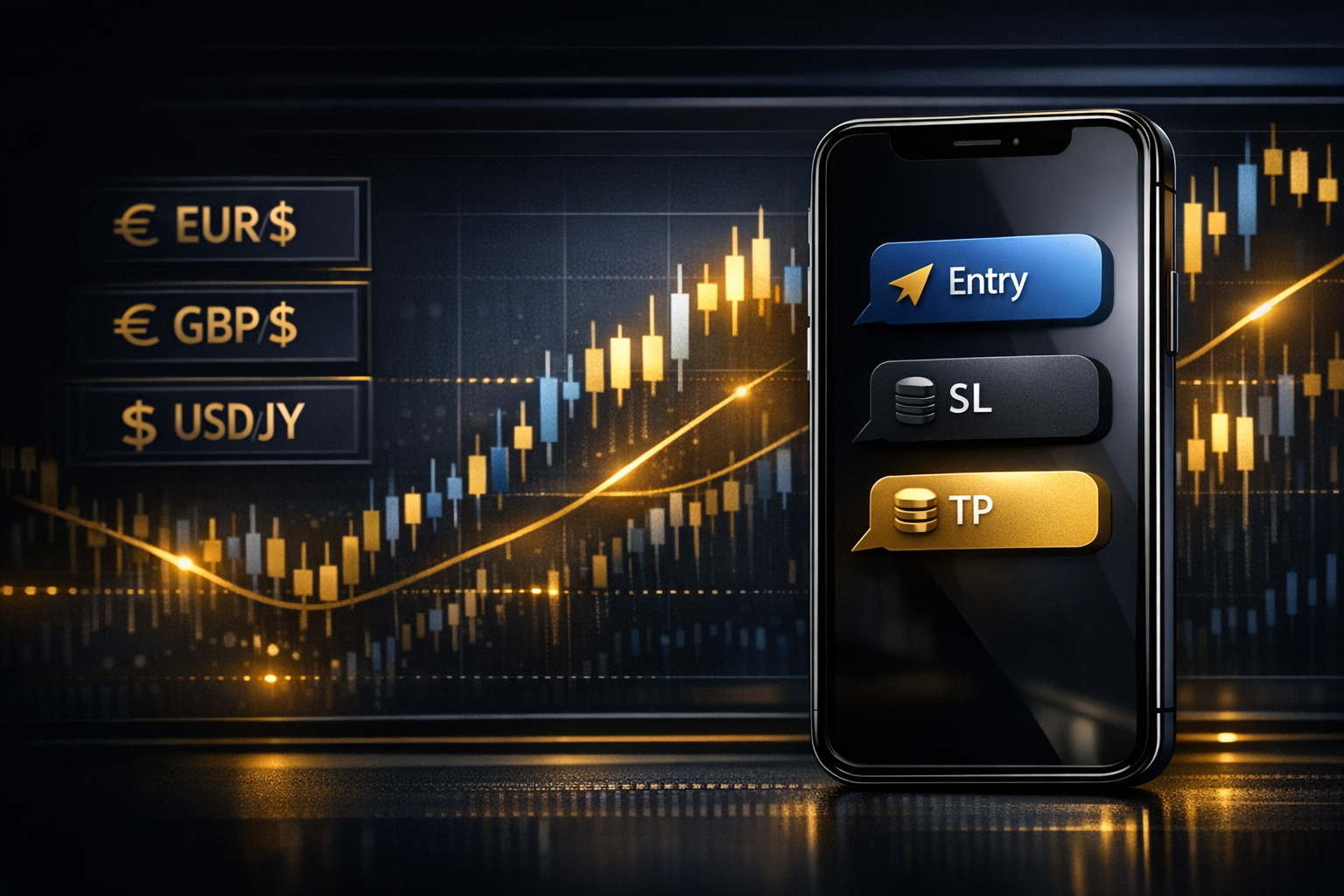
Ever opened Telegram, saw “BUY EURUSD 1.0520 | SL 1.0495 | TP 1.0570,” and thought: “Okay… but what do I actually do now?”
If you’re new, forex signals can feel like a cheat code and a trap at the same time.
This forex signals guide is built to remove the confusion.
We’ll break down what signals are, how to execute them properly, how to manage risk like a pro, and how to avoid the beginner mistakes that wipe accounts.
TL;DR: Forex Signals for Beginners (Quick Takeaways)
- A forex signal is a trade idea with entry, stop loss (SL), and take profit (TP)—you still control execution and risk.
- Your #1 job is risk management: risk 0.5%–1% per trade, aim for 1:2+ risk-reward, and avoid overtrading.
- Signals work best when you follow a process: verify price, set orders, calculate lot size, and log the trade.
- Choose providers with proof, structure, and support—not screenshots and hype.
- Start on demo, then go small live until you can follow rules under pressure.
- Consistency beats intensity: a calm, repeatable routine wins more than “all-in” days.
What Are Forex Signals (And What They Are NOT)

Forex signals are structured trade setups shared by a trader, analyst, or algorithm.
Most signals include an entry price, a stop loss, and one or more take-profit targets.
Some also include the setup logic, session timing (London/NY), and risk guidance.
What a good beginner-friendly signal looks like
- Pair: EUR/USD
- Direction: Buy or Sell
- Entry: 1.0520 (or a range like 1.0518–1.0523)
- Stop Loss: 1.0495 (25 pips risk)
- Take Profit: TP1 1.0570 (50 pips), TP2 1.0600 (80 pips)
- Context: “London session breakout / DXY softening”
In today’s market context, EUR/USD is around 1.0520, GBP/USD around 1.2680, USD/JPY around 149.50, and DXY around 106.80.
Gold (XAUUSD) is trading near $2650, up about +0.35% over the last 24 hours.
What forex signals are NOT
Signals are not a guarantee.
They are also not a replacement for discipline, execution, and risk control.
If you copy a signal but ignore the stop loss, you are no longer following the signal.
Why beginners love signals (and why beginners blow up with them)
Signals reduce decision fatigue.
You don’t have to stare at charts for six hours to find a setup.
But beginners often treat signals like lottery tickets.
They increase lot size after a win, revenge trade after a loss, and skip SL “just this once.”
That’s not a signals problem.
That’s a process problem.
If you want to see how a structured signals service is supposed to look, start by exploring our premium channels overview at United Kings Signals.
How Forex Signals Work in Real Life (From Telegram to Your Broker)
Let’s make it practical.
A signal only becomes a trade when you execute it in your broker platform.
That execution step is where most beginners lose money, even with good signals.
Signal delivery formats you’ll see
- Market execution: “Buy now at 1.0520”
- Limit order: “Buy limit 1.0505” (wait for a pullback)
- Stop order: “Buy stop 1.0550” (breakout confirmation)
- Update messages: “Move SL to breakeven” or “Partial close at TP1”
Beginner execution mistake #1: chasing price
Imagine a signal says: Buy GBP/USD 1.2680.
You see it late and price is already 1.2692.
If you buy anyway, your stop loss is effectively tighter and your risk-reward worsens.
That turns a high-quality setup into a low-quality entry.
Beginner execution mistake #2: setting the wrong order type
If a signal is a buy limit at 1.2665, it means the trader expects a pullback.
Placing a market buy at 1.2680 changes the entire trade idea.
Now you’re buying higher, and the stop might be too close for normal volatility.
Beginner execution mistake #3: ignoring spread and session volatility
During London and New York sessions, spreads are usually tighter and fills are cleaner.
During rollover or thin liquidity, spreads can widen and stop losses get tagged more easily.
This matters a lot on pairs like GBP/USD and on gold (XAUUSD) where $3–$6 spikes can happen quickly.
Step-by-step: how to execute a signal correctly
- Read the full signal (pair, direction, entry, SL, TP, and notes).
- Check current price vs entry. If it’s too far, skip or wait.
- Choose the correct order type (market, limit, stop).
- Set SL first (not “later”).
- Set TP levels or plan partial closes if provided.
- Calculate lot size based on your risk % (we’ll cover this next).
- Place the trade and screenshot/log it.
- Follow updates (breakeven moves, partial closes, exits).
If you want a Telegram-specific walkthrough, our beginner-friendly resource is here: Forex signals on Telegram for beginners.
Risk Management for Beginners: The Difference Between Surviving and Blowing Up
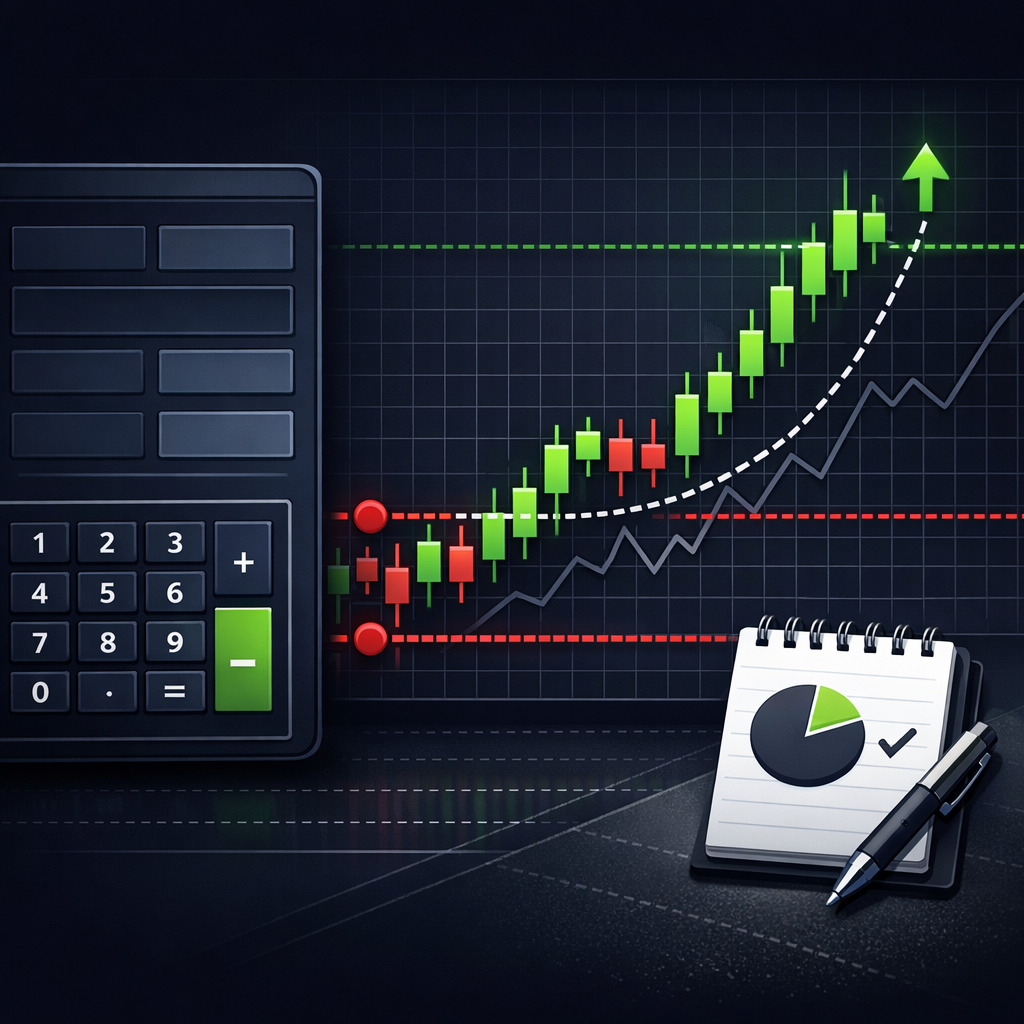
If you remember one thing from this guide, make it this.
Signals don’t make you profitable—risk management does.
A beginner can be wrong 45% of the time and still grow an account with proper risk-reward.
A beginner can be right 70% of the time and still blow up by oversizing and holding losers.
The beginner risk rule that actually works
Risk a small, fixed percentage per trade.
For most beginners, 0.5% to 1% per trade is the sweet spot.
- $500 account → 1% risk = $5 per trade
- $2,000 account → 1% risk = $20 per trade
- $10,000 account → 0.5% risk = $50 per trade
This keeps you emotionally stable.
It also keeps you in the game long enough to learn.
Risk-reward: why 1:2 is a beginner’s best friend
Let’s use EUR/USD at 1.0520.
Signal: Buy 1.0520, SL 1.0495 (25 pips).
A 1:2 target would be 50 pips → TP around 1.0570.
If you take trades like this consistently, you don’t need to win every time.
Gold example (XAUUSD) with realistic levels
Gold is near $2650 with active intraday swings.
Example signal: Buy XAUUSD at $2648, SL at $2633 (15 dollars risk).
1:2 TP would be +$30 → TP at $2678.
1:3 TP would be +$45 → TP at $2693 (slightly above our guideline range, so you might set TP2 at $2688–$2690 instead).
Position sizing (simple version)
Your lot size should be the output of a formula, not a feeling.
The simplest approach is using a position size calculator inside your broker or a trusted tool.
But you should understand the logic:
- Account risk ($) = Account balance × Risk %
- Trade risk ($) = SL distance (pips or $) × value per pip/point × lot size
- Choose lot size so trade risk equals your account risk
Why beginners should avoid “martingale” with signals
Martingale means doubling after losses.
It feels smart until the losing streak arrives.
Signals can have losing streaks even with strong analysis, especially around major news.
When you double size into a streak, you turn normal variance into account destruction.
For a deeper framework, keep this bookmarked: risk management strategies when using forex signals.
Choosing a Forex Signals Provider: A Beginner’s Checklist (No Hype)
The signals industry is crowded.
Some providers are excellent.
Many are marketing machines with no real edge.
As a beginner, you don’t need “the most complex strategy.”
You need clarity, consistency, and accountability.
What to look for (beginner-friendly standards)
- Clear formatting: entry, SL, TP, and whether it’s market/limit/stop.
- Session awareness: signals aligned with London and NY liquidity.
- Risk guidance: suggested risk and trade management rules.
- Updates: breakeven moves, partial closes, invalidation notes.
- Education: explanation of why trades are taken.
- Community: an active group where you can learn from repetition.
Red flags beginners should treat as deal-breakers
- Guaranteed profits or “100% win rate.”
- Only screenshots with no consistent structure.
- No stop loss or “mental SL.”
- Pressure tactics like “deposit now or miss the next 10x.”
- Overtrading: 20–50 signals per day with no quality control.
Comparison table: Free vs Paid vs Premium (what beginners really get)
| Feature | Free Signals (Typical) | Paid Signals (Average) | Premium Signals (United Kings Style) |
|---|---|---|---|
| Signal clarity (Entry/SL/TP) | Often missing details | Usually included | Always clear and structured |
| Trade management updates | Rare | Sometimes | Frequent updates (BE, partials) |
| Education & mentoring | Minimal | Basic | Education alongside signals |
| Transparency & consistency | Unstable | Varies | Process-driven, repeatable approach |
| Community support | Noisy, spammy | Mixed | 300K+ active traders community |
| Best for beginners? | Only for experimenting | Depends on provider | Yes, if you follow rules |
If you want a provider-selection checklist you can literally tick through, use this: forex signals provider checklist for beginners.
And if you want to compare providers in the current landscape, see: best forex signals (latest review).
How to Use Forex Signals Step-by-Step (Beginner Execution Blueprint)
This section is your “do this every time” blueprint.
If you follow it, you’ll instantly trade more professionally than most beginners.
If you skip it, you’ll keep blaming signals for execution mistakes.
Step 1: Confirm the market context (30 seconds)
Before you place any trade, ask: what’s the USD doing?
Right now, DXY is around 106.80.
If DXY is pushing higher strongly, USD pairs often trend in that direction.
That can pressure EUR/USD lower and lift USD/JPY higher, for example.
Step 2: Check the distance from entry
Set a simple rule.
For majors like EUR/USD and GBP/USD, if price is more than 5–10 pips away from entry, you wait.
For USD/JPY, maybe 8–15 pips depending on volatility.
For gold, if price is more than $2–$4 away from entry, you wait.
Step 3: Place SL and TP immediately
Beginners love to “enter now, SL later.”
That’s how small losses become large losses.
On gold near $2650, a $15 SL (like $2648 → $2633) is normal.
Skipping it because “it’ll come back” is how accounts disappear during a $25 spike.
Step 4: Calculate lot size using your fixed risk
Don’t change risk because you “feel confident.”
Confidence is not a metric.
Risk is a metric.
Use 0.5%–1% and keep it constant for at least 50 trades.
Step 5: Decide your management plan before entry
- Will you take partial profit at TP1?
- Will you move SL to breakeven after +1R?
- Will you leave it alone and let the plan play out?
Whatever you choose, choose it before the trade is live.
Step 6: Log the trade (yes, even if it’s a signal)
Logging is how you build consistency.
Write down:
- Signal ID or screenshot
- Entry, SL, TP
- Risk % and lot size
- Session (London/NY)
- Outcome and notes (did you follow rules?)
Step 7: Stop trading after your daily limit
Beginners think more trades = more money.
Professionals think more trades = more exposure to mistakes.
A clean rule is:
- Max 2–3 trades per day, or
- Stop after -2R (two full risk units lost)
If you also trade gold, you’ll find it helpful to follow a dedicated stream like our premium gold signals alongside your forex signals.
Understanding Signal Types: Scalps vs Intraday vs Swing (Beginner-Friendly)
Not all signals are meant to be held the same way.
A major beginner error is using the wrong expectations for the signal type.
If you treat a scalp like a swing, you’ll give back profits.
If you treat a swing like a scalp, you’ll exit too early.
Scalp signals (fast, session-dependent)
Scalps typically target smaller moves.
On EUR/USD, that might be 10–25 pips.
On gold near $2650, that might be $5–$12.
These trades work best during London and NY sessions when liquidity is strong.
They require attention because management decisions happen quickly.
Intraday signals (most beginner-friendly if structured)
Intraday trades usually aim for 30–80 pips on majors.
On gold, intraday targets might be $15–$35 depending on volatility.
This style fits people who can check charts a few times a day.
You’re not glued to the screen, but you’re not ignoring updates either.
Swing signals (slower, fewer trades, bigger patience)
Swing trades can last days.
They often have wider stop losses and are more sensitive to macro events.
For beginners, swings can be psychologically difficult.
You’ll see floating drawdown and feel tempted to close early.
How to match signal type to your personality
- If you hate waiting and overthink: avoid scalps at first.
- If you have a day job: intraday signals are usually ideal.
- If you’re patient and can handle swings: swing signals can be powerful.
A realistic example using today’s pairs
USD/JPY around 149.50 can move 30–70 pips quickly on US data.
A scalp might target 15–25 pips with a tight SL.
An intraday trade might target 50–90 pips with a more reasonable SL.
A swing might target 150–300 pips but needs room and time.
In our experience, beginners do best when they start with fewer, higher-quality trades.
That’s why structured London/NY session execution matters so much.
Reading a Signal Like a Pro: Entry Zones, SL Logic, and TP Targets
Most beginners read signals like a robot.
They see “BUY” and press buy.
But the profitable way is to understand what each number means.
Entry price vs entry zone
Markets move fast.
A single entry price is sometimes unrealistic, especially on gold.
That’s why professional signals often use a zone, like:
- Buy EUR/USD 1.0518–1.0523
- Sell XAUUSD 2662–2666
Zones help you avoid chasing and allow normal spread/volatility.
Stop loss logic: where is the trade idea “wrong”?
A good SL is not random.
It’s placed where the setup is invalidated.
For example:
- If EUR/USD is buying a support at 1.0520, the SL might go below the support structure at 1.0495.
- If gold is buying a pullback near $2648, the SL might go below the swing low at $2633.
As a beginner, your job is to respect that invalidation level.
Don’t widen it because you don’t want to be wrong.
Take profit logic: structure + risk-reward
TPs should make sense technically and mathematically.
Mathematically, 1:2 or 1:3 risk-reward gives you room to be wrong and still grow.
Technically, TP often aligns with:
- Prior highs/lows
- Supply/demand zones
- Round numbers (like gold $2660, $2675, $2685)
- Session highs/lows
Partial profits: a beginner-friendly compromise
Many beginners struggle to hold winners.
Partial profit can help.
Example on gold:
- Buy $2648, SL $2633 (risk $15)
- TP1 $2663 (+$15 = 1R) → close 50%
- Move SL to breakeven
- TP2 $2678 (+$30 = 2R) → close remainder
This approach reduces emotional pressure.
It also keeps you aligned with the signal’s intent.
When NOT to take a signal (filters beginners can apply)
- Price too far from entry (you’re late).
- Major news in minutes and the signal is not news-based.
- Spread is abnormally wide (rollover or illiquid time).
- You’ve hit daily loss limit (protect your mindset).
If you’re also learning how gold behaves during sudden headlines, this is a strong companion read: how gold signals react to unexpected news events.
Beginner Mistakes With Forex Signals (And How to Fix Them Fast)
You don’t need years of experience to avoid the common traps.
You need awareness and a few non-negotiable rules.
Below are the mistakes we see repeatedly in beginners using signals.
Mistake #1: Increasing lot size after a win
You win two trades.
You feel “in sync” with the market.
You double your lot size on the third trade.
That third trade loses, and you give back the entire day.
Fix: lock your risk % for the week (or 50 trades).
Mistake #2: Moving stop loss further away
This is the silent account killer.
On gold at $2650, a normal SL might be $15.
Beginners move it to $30 because “gold is volatile.”
Now your position size is wrong, your risk doubles, and one loss hurts too much.
Fix: never widen SL. If anything, reduce risk by using smaller size.
Mistake #3: Taking every signal
Even the best providers will share multiple setups.
You don’t need them all.
If you take 8 trades in a day, you’re not “active.”
You’re increasing exposure to mistakes, slippage, and emotional fatigue.
Fix: set a max trades/day rule and prioritize the cleanest setups.
Mistake #4: Confusing “win rate” with profitability
A 90% win rate with tiny wins and huge losses is a losing system.
A 55% win rate with 1:2 risk-reward can be very profitable.
Fix: track expectancy, not just wins.
Mistake #5: Trading during the wrong session
Many signal strategies are built around London and New York sessions.
If you trade them in thin liquidity, you may get worse fills and random spikes.
Fix: align your trading window with the provider’s style.
Mistake #6: Not understanding correlation risk
EUR/USD and GBP/USD often move similarly because both are USD-quoted majors.
If you buy both at the same time, you may be doubling your USD exposure.
Fix: treat correlated trades as one “theme.” Reduce risk or pick one.
If you want to go deeper into building a repeatable approach, explore more educational posts in our trading blog.
Building a Beginner Routine: Consistency Framework for Using Signals
Most beginners don’t fail because they lack information.
They fail because they lack a routine.
A routine turns signals into a structured practice instead of random gambling.
Your 15-minute pre-session routine (London or NY)
- Check key prices: EUR/USD ~1.0520, GBP/USD ~1.2680, USD/JPY ~149.50, DXY ~106.80, XAUUSD ~$2650.
- Note volatility: Is gold moving $10+ quickly? Are majors trending or ranging?
- Check the calendar: any major US or EU data soon?
- Set your rules: max trades, max risk, daily stop.
Your execution routine (the same every trade)
- Verify entry distance
- Place correct order type
- Set SL and TP
- Confirm lot size equals fixed risk
- Log the trade
Your post-session routine (10 minutes)
- Screenshot outcomes and note if you followed rules
- Record R-multiple (example: +2R, -1R)
- Write one improvement for tomorrow
Why “R-multiples” simplify everything for beginners
R is your risk unit.
If you risk $10, then:
- -1R = -$10
- +1R = +$10
- +2R = +$20
This keeps your focus on process, not money emotions.
It also allows you to compare trades across pairs like EUR/USD and gold without confusion.
Demo first, then small live (a realistic progression)
Beginners should use demo to learn execution speed and platform mechanics.
But don’t hide in demo forever.
When you can follow rules for 30–50 demo trades, go live with the smallest size possible.
The goal is to train your psychology with real money at low emotional cost.
Forex Signals + Fundamentals: News, Central Banks, and Why Timing Matters
Even if you’re “just following signals,” fundamentals still affect your results.
Forex is driven by interest rates, inflation expectations, and risk sentiment.
Gold adds another layer: real yields, USD strength, and geopolitical risk.
How DXY (USD strength) impacts beginner signal outcomes
With DXY around 106.80, USD is relatively strong.
That can create headwinds for EUR/USD and GBP/USD longs.
It can also support USD/JPY strength depending on yields and risk tone.
For beginners, the takeaway is simple.
When USD is trending, signals aligned with that trend often perform better.
Gold (XAUUSD) fundamentals beginners should respect
Gold near $2650 can move sharply around:
- US CPI and jobs data
- Fed speeches
- Risk-off headlines
- Bond yield spikes
A perfectly technical gold setup can fail if a surprise headline hits.
That’s not “bad signals.”
That’s the nature of gold volatility.
Beginner rule: avoid entering 2–5 minutes before major news
If you enter right before a high-impact release, you risk:
- Slippage (filled worse than your intended entry)
- Spread widening
- Stop loss getting hit even if the idea was correct
A smarter approach is waiting for the first spike to settle.
Then you execute the signal (or an updated one) with cleaner structure.
Signals that include “news caution” are beginner gold
One of the most underrated features of a premium provider is context.
When a provider says “wait for NY open” or “avoid until after CPI,” that saves beginners money.
It’s not exciting, but it’s professional.
If you’re interested in trading beyond forex and gold, we also cover other markets through crypto signals—but beginners should master one lane first.
What to Expect From a Premium Signals Service (United Kings Approach)
Let’s set realistic expectations.
A premium service should not promise you guaranteed profits.
It should give you a repeatable edge, clean execution details, and a support environment that improves your decision-making.
What “premium” should mean for beginners
- Clarity: every trade includes Entry, SL, TP.
- Consistency: signals are based on a defined method, not random calls.
- Timing: focus on high-liquidity windows (London and NY sessions).
- Communication: updates when conditions change.
- Education: you learn the “why,” not just the “what.”
How United Kings is built for beginners who want to grow
United Kings is a premium Telegram signals community with 300K+ active traders.
We share forex and gold setups with clear structure and trade management.
We aim for an 85%+ win rate as a performance target, but we never frame this as guaranteed results.
Past performance does not guarantee future results.
Where beginners usually feel the difference
Beginners don’t just need entries.
They need help with:
- Not chasing price
- Knowing when a setup is invalid
- Handling breakeven moves without panic
- Staying disciplined after a loss
This is where a structured premium channel and active community matter.
Getting started: the simplest path
Start by reviewing our service overview at UnitedKings.net.
Then explore our dedicated pages for forex signals and gold signals.
If you want to speak with our team, use contact United Kings or learn more about who we are at about United Kings.
Pricing, Plans, and How Beginners Should Choose (Without Overpaying)
Signals should be an investment in structure and learning.
But beginners should also avoid paying for features they won’t use yet.
Here’s how to think about plans like a professional.
United Kings plans (3 options)
- Starter (3 Months): $299 (about $100/month)
- Best Value (1 Year): $599 (about $50/month) with 50% savings + FREE ebook
- Unlimited (Lifetime): $999 (pay once, access forever)
You can review the latest offers and choose your plan on our pricing page.
How a beginner should decide
- If you’re brand new and want a structured trial period: 3 Months is a clean start.
- If you’re serious about building a routine and tracking 200+ trades: 1 Year is usually the smartest value.
- If you already know you’ll commit long-term and want simplicity: Lifetime removes monthly decisions.
What matters more than the plan
Your results will depend more on your execution rules than the subscription length.
If you risk 5% per trade, no plan can save you.
If you risk 1% per trade and follow entries properly, even a modest edge can compound over time.
48-hour money-back guarantee (risk-controlled onboarding)
Beginners often hesitate because they’ve been burned by low-quality groups.
That’s why United Kings offers a 48-hour money-back guarantee.
Use that window to evaluate structure, clarity, and whether the process fits your schedule.
FAQ: Forex Signals for Beginners
1) Are forex signals good for complete beginners?
Yes, if you treat them as structured trade ideas and follow strict risk rules.
Start on demo, then trade small live until you can execute without breaking rules.
2) How many signals should a beginner take per day?
Usually 1–3 high-quality setups is enough.
More trades often increases mistakes, especially when you’re learning execution.
3) What risk percentage should I use with forex signals?
Most beginners should risk 0.5%–1% per trade.
This keeps you stable during losing streaks and protects your psychology.
4) Can I use the same signal rules for gold (XAUUSD)?
The process is the same, but gold is more volatile.
Expect wider stops (often $10–$25) and faster moves, especially near major US news.
5) What’s the best way to verify a signals provider is legit?
Look for consistent formatting, clear SL/TP, trade management updates, education, and realistic claims.
Avoid providers promising guaranteed profits or hiding risk.
Risk Disclaimer (Read Before You Trade)
Trading forex and gold involves significant risk and may not be suitable for all investors. You can lose some or all of your capital.
Signals and educational content are provided for informational purposes only and do not constitute financial advice.
Past performance does not guarantee future results. Always use stop losses, practice on a demo account if you’re a beginner, and never risk money you cannot afford to lose.
Join United Kings: Premium Forex & Gold Signals (Telegram)
If you want a structured way to trade London and New York sessions with clear entries, stop losses, and take profits, we’re ready for you.
Explore our full offering at United Kings premium signals, including dedicated forex signals and gold (XAUUSD) signals.
Join our Telegram community here: United Kings official Telegram channel.
When you’re ready to upgrade, choose between Starter (3 Months $299), Best Value (1 Year $599), or Unlimited (Lifetime $999) on our pricing plans page.
Your next step: commit to the process for 30 days, track every trade, and let consistency do what luck never will.