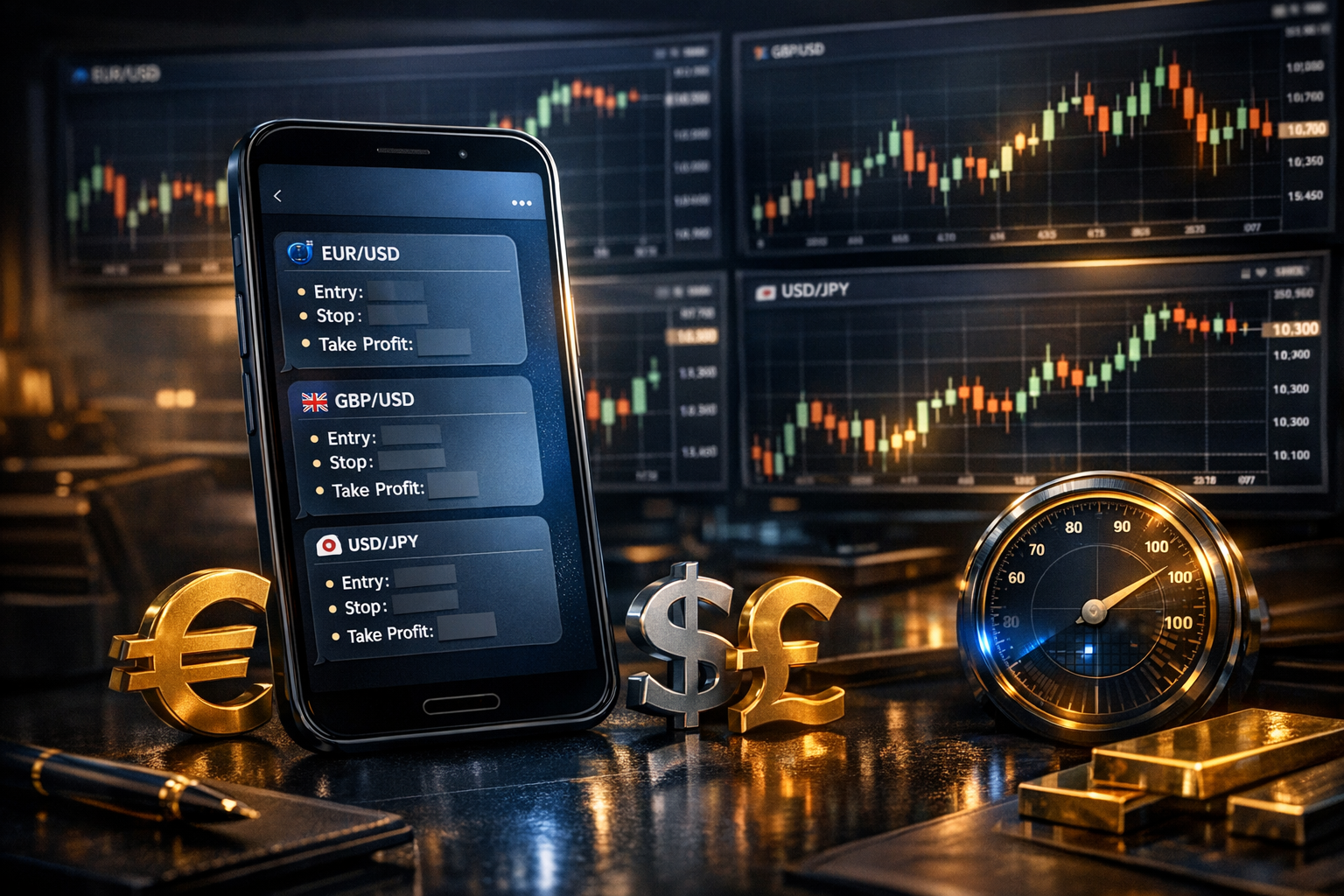
Forex signals for beginners can feel like a cheat code—until you take a trade, price spikes 25 pips against you, and you realize you don’t actually know what you’re following.
If you’ve ever stared at EUR/USD at 1.0520, GBP/USD at 1.2680, USD/JPY around 149.50, and wondered, “Where do I even start?”, this guide is for you.
We’re going to turn forex signals from “random alerts” into a structured, repeatable process you can execute with confidence.
TL;DR: How to use forex signals (beginner-safe)
- Signals are instructions (Entry, SL, TP)—your job is execution, risk control, and consistency.
- One good provider beats ten noisy groups; prioritize transparency, clear levels, and a realistic approach to drawdowns.
- Risk per trade is everything; most beginners should start at 0.5%–1% risk per trade, not 5%.
- Use a pre-trade checklist (spread, session, news, position size) before you press Buy/Sell.
- Journal every signal to find what works for you (pairs, sessions, setups, and your own mistakes).
- Demo first, then scale; treat the first 30–50 signals as training reps, not a money-making sprint.
What forex signals are (and what they are not)
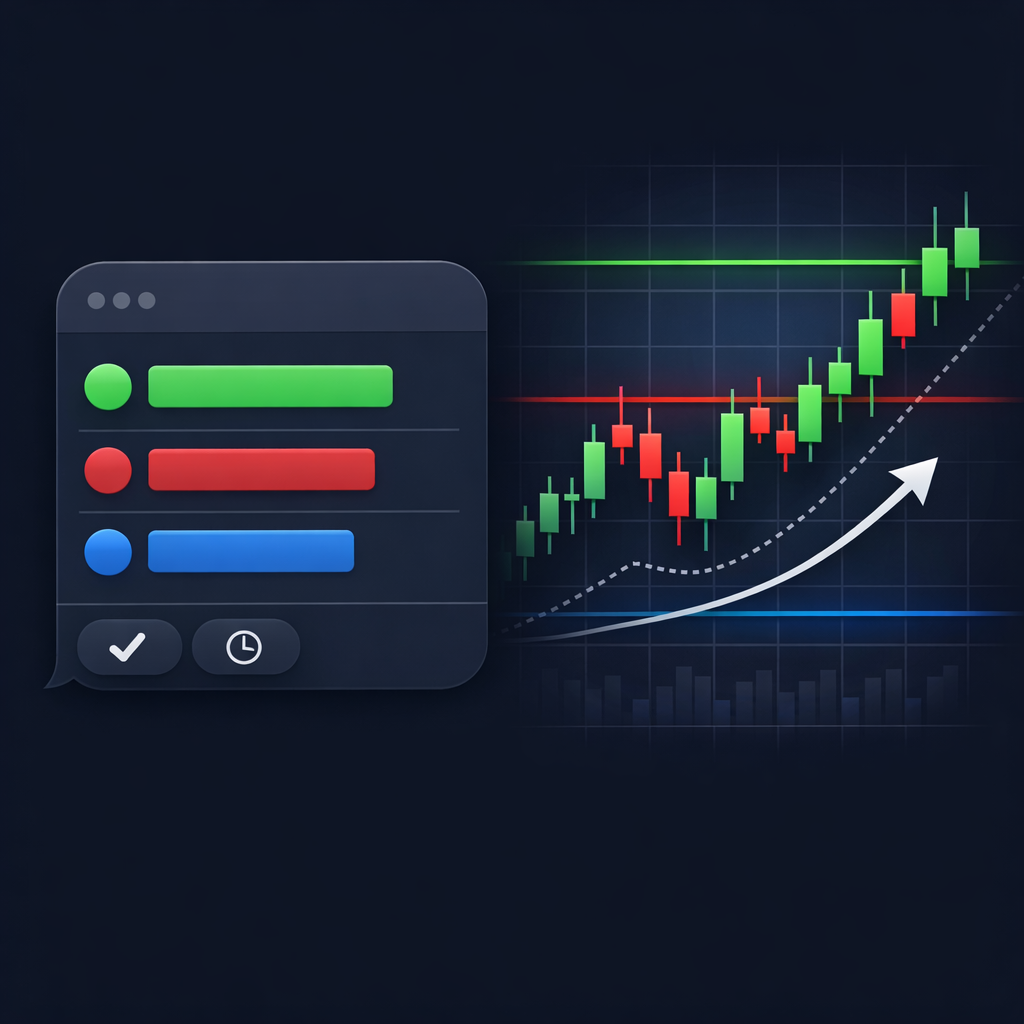
A forex signal is a trade idea delivered in a structured format. In its simplest form, it tells you what to trade, where to enter, where to exit if wrong (Stop Loss), and where to take profit (Take Profit levels).
Most high-quality signals also include context: the session (London/NY), the setup type (breakout, pullback, reversal), and sometimes risk guidance.
Here’s what signals are not: they are not guaranteed profits, they are not a replacement for risk management, and they are not “copy-paste money.”
Think of a signal like a GPS route. It can be accurate and still require you to drive safely. If you speed, ignore road conditions, or take every turn late, you’ll crash even with perfect directions.
Typical forex signal formats you’ll see
- Market execution: “Buy EUR/USD now @ 1.0520, SL 1.0495, TP 1.0570.”
- Pending orders: “Sell GBP/USD limit @ 1.2705, SL 1.2730, TP 1.2655.”
- Multi-TP scaling: “TP1, TP2, TP3” to take partial profits.
- Intraday scalp: smaller targets (10–30 pips) during London/NY volatility.
- Swing signal: wider SL, larger TP, held for days.
Signals vs analysis: why beginners love signals
Analysis is a skill. Signals are a service. Beginners often use signals to shortcut the time it takes to identify setups, while they build foundational knowledge in the background.
Done correctly, signals can accelerate learning because you see repeated patterns in real time: how EUR/USD reacts around a level, how USD/JPY moves with DXY at 106.80, and how volatility changes across sessions.
Done incorrectly, signals become gambling with extra steps.
Forex vs gold signals: what beginners should know (with real price context)
Many beginners start with forex pairs like EUR/USD and GBP/USD because pip values feel simpler. Others gravitate to gold (XAUUSD) because it “moves more,” especially when headlines hit.
Right now, gold is trading around $2650 (up roughly +0.35% over 24h). That’s a normal day in gold—enough movement to create opportunity, but also enough volatility to punish sloppy stops.
Forex majors are also active: EUR/USD near 1.0520, GBP/USD around 1.2680, USD/JPY near 149.50. The Dollar Index (DXY) at 106.80 suggests the USD is still relatively firm, which often creates pressure on EUR/USD and can influence gold’s pace depending on yields and risk sentiment.
Why gold can feel “easier” but is often harder
Gold moves in clean $5–$15 waves during London and New York sessions. But spreads can widen, news spikes can be sharp, and stops need to respect volatility.
A realistic gold example in today’s $2610–$2690 range might look like:
- Buy XAUUSD @ $2648
- SL @ $2635 (13 dollars risk)
- TP @ $2674 (26 dollars reward, ~1:2 RR)
That’s a disciplined structure. Beginners often do the opposite: tiny SL ($3–$5) in a market that breathes $8–$12 regularly, then they blame the signal.
Quick comparison table: forex signals vs gold signals
| Feature | Forex Majors (EUR/USD, GBP/USD) | Gold (XAUUSD) |
|---|---|---|
| Typical volatility (intraday) | 30–80 pips (varies by pair/session) | $10–$30 common; spikes bigger on news |
| Stop-loss sizing (beginner-friendly) | 15–40 pips often reasonable | $10–$25 typical in active sessions |
| News sensitivity | High (CPI, NFP, central banks) | Very high (rates, USD, geopolitics, risk-off) |
| Spread impact | Usually lower on majors | Can be higher; widens around news |
| Best sessions | London + NY overlap | London open and NY session |
If you want both, it’s fine. Just don’t treat them the same. A “tight” EUR/USD stop is not the same as a “tight” gold stop.
United Kings covers both through our forex signals and gold signals, with a heavy focus on London and New York session timing.
The 5 types of forex signals you’ll encounter (and which beginners should choose)
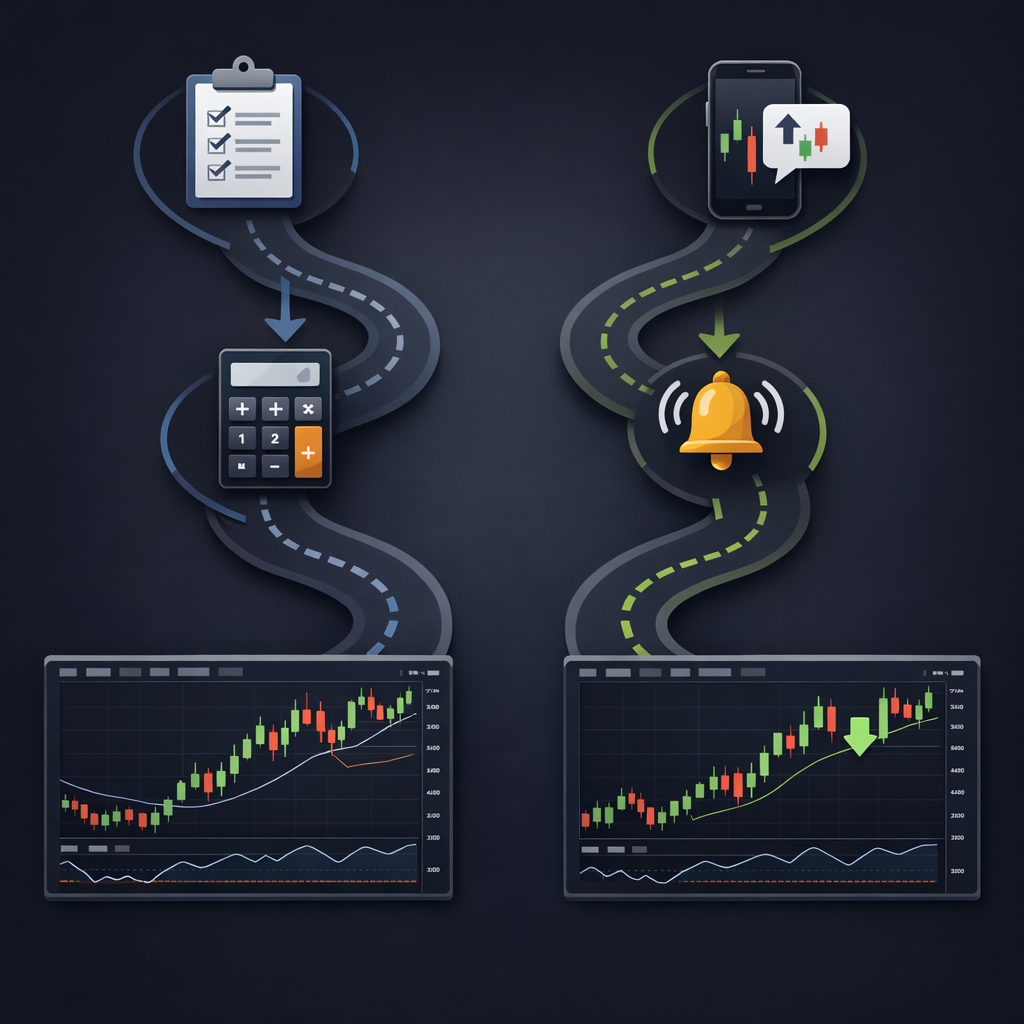
Not all signals are created equal. Some are built for speed (scalps), some for patience (swings), and some are basically noise dressed up as certainty.
As a beginner, your goal is to choose the signal style that matches your schedule, your psychology, and your broker conditions.
1) Scalping signals (fast, frequent, high execution quality required)
Scalps aim for smaller moves—often 10–25 pips—during high liquidity. They can work well in the London session and the NY session, but they punish slow execution and wide spreads.
If your broker has slippage or you’re trading from a phone with poor connection, scalps can turn into “almost wins.”
2) Intraday signals (best starting point for most beginners)
Intraday signals typically target 25–80 pips and use SLs that respect structure. This gives you breathing room and reduces the stress of micro-management.
For example, an intraday EUR/USD idea might be:
- Sell EUR/USD @ 1.0520
- SL @ 1.0550 (30 pips)
- TP @ 1.0460 (60 pips, ~1:2 RR)
This is the kind of structure that allows disciplined repetition.
3) Swing signals (slower, fewer trades, larger stops)
Swings might run for days. Stops are wider, and you must be comfortable holding through pullbacks and overnight swaps.
Beginners can use swings, but only if they truly understand position sizing. A 120-pip stop doesn’t mean “more risk” if your lot size is adjusted correctly.
4) News-based signals (high risk if you don’t understand volatility)
Trading CPI, NFP, or central bank decisions can be profitable, but it’s not beginner-friendly. Spreads widen, price gaps, and slippage can hit your stop worse than expected.
Many new traders lose money not because the direction was wrong, but because execution conditions were brutal.
5) Automated/copy-trading signals (convenient, but you must verify logic)
Automation can remove emotion. But it can also remove responsibility. If you don’t know what the strategy does during drawdowns, you’ll panic at the worst moment.
Beginner recommendation: start with intraday signals, learn execution, then experiment with scalps or swings once your process is stable.
How to choose a forex signals provider (beginner checklist)
This is where most beginners either set themselves up for steady progress—or for months of confusion.
A reliable provider isn’t the one that posts the most screenshots. It’s the one that provides repeatable structure, clear risk parameters, and realistic expectations.
What “good” looks like in a signal message
- Instrument: EUR/USD, GBP/USD, USD/JPY, XAUUSD.
- Direction: Buy or Sell.
- Entry: exact price or entry zone.
- Stop Loss: fixed level, not “mental stop.”
- Take Profit: at least one target; ideally multiple targets.
- Time context: “London session” or “NY open.”
- Management rule: e.g., “move SL to BE after +25 pips.”
Red flags beginners should avoid
- No stop loss. That’s not a signal; it’s a prayer.
- Constant averaging down without clear max risk.
- “Guaranteed” language or unrealistic win-rate claims with no context.
- Cherry-picked results without losses shown.
- Too many pairs at once with no session logic.
Beginner-friendly due diligence (step-by-step)
- Read 30 days of history in the group (wins and losses).
- Check clarity: Could you place the trade without asking questions?
- Check risk logic: Are SLs consistent with volatility? Are targets realistic?
- Check trade frequency: 1–5 quality trades/day beats 20 random alerts.
- Check education: Do they explain why a trade is taken?
If you want a printable checklist, pair this guide with our dedicated resource: forex trading signals provider checklist for beginners.
You can also explore our track-record-focused breakdown here: best forex signals (November 2025).
How to use forex signals step-by-step (execution workflow)
Most beginners don’t fail because the signal was bad. They fail because execution was inconsistent.
Execution means: placing the right order type, at the right price, with the right size, during the right conditions.
Step 1: Confirm the instrument and session
If a signal is designed for London volatility, taking it during the quiet Asian range can change everything. Spreads, liquidity, and follow-through are different.
United Kings focuses heavily on London and NY sessions because that’s where majors and gold typically offer the cleanest movement.
Step 2: Check spread and slippage risk
Before entering, look at the spread. On EUR/USD, a tight spread is common. On gold, spreads can widen quickly, especially around news.
If gold is at $2650 and spread is $0.30–$0.60, that’s normal. If it’s $1.50+ during a spike, your fill quality matters more than your analysis.
Step 3: Place the correct order type
- Market order: for “Buy now” signals when price is near the entry.
- Limit order: for pullback entries (better price, may not fill).
- Stop order: for breakouts (fills only if price confirms).
Beginner tip: if you don’t understand why a pending order is used, ask. It’s often the difference between buying a pullback and chasing a spike.
Step 4: Set SL and TP immediately (non-negotiable)
Place the stop loss and take profit at the same time you enter. This protects you from emotional decision-making when price moves fast.
Example on USD/JPY near 149.50:
- Buy USD/JPY @ 149.50
- SL @ 149.10 (40 pips)
- TP @ 150.30 (80 pips, ~1:2 RR)
Step 5: Manage the trade only with rules
Beginners love to “help” trades by moving stops randomly. That’s usually self-sabotage.
Use a simple rule set:
- Move SL to break-even only after price reaches a defined threshold (e.g., +25 pips).
- Take partial profits at TP1 if the plan includes it.
- Do not widen the stop loss.
Step 6: Log the trade (2 minutes that change everything)
Write down: pair, entry, SL, TP, session, result, and what you did well/poorly. After 30 trades, your journal becomes your personal edge.
If you want a Telegram-first workflow, our beginner-friendly breakdown here pairs well with this article: forex signals on Telegram for beginners.
Risk management for signal followers (the part that decides your future)
Signals don’t manage risk. You do.
Two traders can take the exact same 50 signals and end with completely different results because of position sizing, overtrading, and emotional interference.
The golden rule: risk a fixed percentage, not a fixed lot
Beginners often trade “0.10 lots” on everything. That’s a mistake because stop sizes vary.
Instead, decide: “I risk 1% per trade.” If your account is $1,000, that’s $10 risk. Then you size the position based on the stop distance.
Simple position sizing example (EUR/USD)
Account: $1,000. Risk: 1% ($10). Signal: Sell EUR/USD 1.0520, SL 1.0550 (30 pips).
You need a lot size where 30 pips ≈ $10. On many brokers, 0.03 lots is roughly $0.30/pip, so 30 pips ≈ $9. Adjust to your broker’s pip value.
The exact number varies by account currency and broker, but the principle is constant: risk stays fixed, size changes.
Gold risk example (XAUUSD) using current context
Account: $2,000. Risk: 0.5% ($10). Signal: Buy XAUUSD @ $2648, SL @ $2636 (12 dollars).
Your position size should be small enough that a $12 move against you equals ~$10 loss. Gold contract specifications differ by broker (some use 1 lot = 100 oz, some use micro lots), so always check your platform’s “tick value.”
Beginner risk framework (practical and realistic)
- Start at 0.5% risk per trade for the first 30–50 trades.
- Cap daily loss at 2% (e.g., stop after 2–4 losses depending on SL size).
- Never increase lot size to “make it back.”
- Respect correlation: EUR/USD and GBP/USD often move together due to USD strength.
For a deeper, structured approach, keep this guide bookmarked: risk management strategies when using forex signals.
Understanding win rate, risk-reward, and why beginners misread performance
Many beginners chase a high win rate. That’s normal. It’s also incomplete.
What matters is expectancy: the average amount you can expect to make per trade over a large sample size.
Why a 50% win rate can be profitable
If your average win is 2R and your average loss is 1R, then even winning half the time can grow an account.
Example:
- 10 trades
- 5 wins at +2R = +10R
- 5 losses at -1R = -5R
- Net: +5R
That’s why many professional systems don’t need 80–90% win rates.
Why high win-rate systems can still blow up
Some providers “win” often by using very tight targets and very wide stops, or by holding losers too long. That can create months of small wins and one massive loss.
Beginners get trapped because they’re emotionally conditioned by frequent wins. Then the big loss hits and wipes out weeks of progress.
How to evaluate a signal provider like a pro (without being one)
- Look for consistency in SL placement and trade logic.
- Ask about average R-multiple (are trades aiming for 1:2 or better?).
- Expect losing streaks; even strong systems can have 5–8 losses in a row.
- Check drawdown behavior: do they reduce risk or get aggressive?
At United Kings, we focus on clear Entry/SL/TP delivery and disciplined session-based execution. We also publish educational context so you learn the “why,” not just the “where.”
Market context matters: sessions, news, and volatility (beginner survival guide)
A signal is not taken in a vacuum. The same setup behaves differently depending on session liquidity, news risk, and overall USD strength.
Right now, with DXY around 106.80, USD flows matter. That can influence EUR/USD’s ability to rally above 1.0520, and it can keep USD/JPY supported near 149.50 depending on yields.
Gold at $2650 tells us risk appetite and rate expectations are in play. Gold can trend while forex chops, and vice versa.
London session vs New York session (practical differences)
- London open: strong directional moves, breakouts from Asian range.
- London/NY overlap: highest liquidity; many day’s biggest moves happen here.
- Late NY: can be choppy; follow-through may fade.
News events beginners must respect
Even if you don’t trade news, you must know when it happens. CPI, NFP, FOMC, ECB, BOE—these can cause 30–80 pip spikes on majors and $20+ bursts on gold.
Beginner rule: avoid opening new positions 10–15 minutes before high-impact news unless the provider explicitly trades the event with a defined plan.
Realistic example: gold volatility around a headline
Let’s say gold is at $2650 and a surprise headline hits. Price can jump to $2662, drop to $2641, then settle at $2656 within minutes.
If your SL is $5 away, you’re likely stopped even if the final direction was correct. That’s why gold stops in the $10–$25 range are common for intraday signals.
If you trade gold signals, it’s worth reading how signals behave during chaos: how gold signals react to unexpected news events.
The beginner’s signal-following routine (daily plan you can actually stick to)
Consistency doesn’t come from motivation. It comes from a routine that reduces decisions.
Here’s a realistic daily plan for beginners who work, study, or can’t stare at charts all day.
Step-by-step daily routine (30–60 minutes total)
- Pre-session (5 minutes): check the economic calendar and note any high-impact events.
- Set alerts (2 minutes): for key pairs you trade (EUR/USD, GBP/USD, USD/JPY, XAUUSD).
- Review the signal channel (10 minutes): read the plan, not just the entry.
- Execute only A-grade signals (10 minutes): those with clear Entry/SL/TP and reasonable spread.
- Walk away (0 minutes): seriously—avoid micromanaging.
- End-of-day journal (10–20 minutes): log trades, screenshots, and mistakes.
The “A-grade signal” filter for beginners
- Entry is not too far from current price (no chasing).
- Stop loss is logical (not tiny in a volatile market).
- Target offers at least 1:2 RR when possible.
- The trade fits the session and avoids obvious news landmines.
Common beginner schedule matches
- London-only trader: 1–2 hours in the morning, best for EU/UK residents.
- NY-only trader: 1–2 hours in the afternoon US time, good liquidity.
- Hybrid: take 1–2 trades from London and 1 from NY, cap daily risk.
This is also why a focused provider beats a “24/7 signals” group. Markets have rhythms. Your routine should match them.
Trading psychology for beginners using signals (how to stop self-sabotage)
Signals reduce analysis stress, but they don’t remove fear, greed, or impatience. In fact, signals can amplify emotions because the decision feels outsourced—so you take trades you wouldn’t take if you had to analyze them yourself.
Most beginner losses come from five behaviors, not from the provider.
Behavior #1: Overtrading after a win
You hit TP on GBP/USD and feel unstoppable. Then you take the next three signals without checking spread, news, or lot size.
Fix: cap your trades per day. Two high-quality trades beat six impulsive ones.
Behavior #2: Revenge trading after a loss
You get stopped out, then double the lot size on the next trade “to recover.” That’s how accounts die.
Fix: after any loss, take a 10-minute break. Then re-check your risk calculator before entering again.
Behavior #3: Moving stop loss wider
This is the silent killer. A planned -1R becomes -2R, then -4R, then margin pressure.
Fix: make a personal rule: SL can only be tightened, never widened.
Behavior #4: Closing winners early
Beginners often take +10 pips on a trade targeting +60 pips because they fear giving profit back. Then they wonder why the account doesn’t grow.
Fix: use partials. Take some at TP1, let the rest run to TP2.
Behavior #5: Signal-hopping
You join five groups. One loses today, so you abandon it. Another wins today, so you follow it tomorrow. You never build a sample size.
Fix: commit to one provider for 30 days on demo or micro risk, then evaluate with data.
If you want a structured approach to staying disciplined when markets spike, you’ll also like our psychology-focused resources on the United Kings blog.
Building consistency: demo-to-live transition and performance tracking
The smartest beginners don’t rush to live trading. They treat demo trading as a simulator where execution becomes automatic.
Your goal is not to “prove” you can win in demo. Your goal is to prove you can follow rules under pressure, without improvising.
Phase 1: Demo trading (30–50 signals)
- Trade exactly as you would live: same session, same pairs, same risk.
- Practice order types: market, limit, stop.
- Track slippage and spread at entry time.
- Build the habit of journaling every trade.
Phase 2: Micro live trading (0.25%–0.5% risk)
When you go live, emotions change. Even $5 risk can trigger fear and impatience if you’re new.
Start small and focus on process metrics:
- Did you place SL/TP correctly?
- Did you avoid trading into major news?
- Did you follow the provider’s management rules?
Phase 3: Scale cautiously (only after consistency)
After 8–12 weeks of stable execution, you can consider moving from 0.5% to 1% risk per trade. Scaling is earned, not hoped for.
What to track in your signal journal (beginner-friendly KPIs)
- R-multiple per trade (e.g., +2R, -1R).
- Session performance (London vs NY).
- Pair performance (EUR/USD vs GBP/USD vs USD/JPY).
- Mistake count (late entry, wrong lot size, moved SL, etc.).
Consistency is boring. That’s why it works.
Why United Kings signals are built for beginners (without dumbing it down)
If you’re new, you don’t need hype. You need clarity, structure, and a community that helps you stay consistent.
United Kings is built around that idea.
What you get with United Kings
- Premium Telegram signals for forex and gold with clear Entry, SL, and TP levels.
- A community of 300K+ active traders learning and executing together.
- A performance mindset targeting a high win-rate approach (85%+) with disciplined trade structure and management rules.
Note: win rate varies by market conditions and period; past performance is not a guarantee of future results. - London and New York session focus for liquidity and cleaner movement.
- Education alongside signals so you understand the “why,” not just the “what.”
- 48-hour money-back guarantee for new members (terms apply).
Where to start (navigation)
- Explore our full suite on the United Kings signals page.
- If you want currencies only, start with our forex signals.
- If you want XAUUSD setups, go to our gold signals.
- If you also trade digital assets, we have crypto signals as well.
Pricing plans (choose based on your time horizon)
We keep pricing simple with three plans on our pricing page:
- Starter (3 Months): $299 (~$100/month) for testing the workflow and building routine.
- Best Value (1 Year): $599 (~$50/month, 50% savings) + FREE ebook for structured learning.
- Unlimited (Lifetime): $999 pay once for permanent access if you’re committed long-term.
If you want to learn more about who we are and how we operate, visit About United Kings. If you have questions before joining, our team is reachable via Contact.
FAQ: Forex signals for beginners
1) Are forex signals good for beginners?
Yes—if you treat them as a structured learning and execution tool. Beginners do best with providers that deliver clear Entry/SL/TP, realistic risk guidance, and education. Signals are risky if you overtrade, oversize, or ignore news and spreads.
2) How many signals should I take per day as a beginner?
Usually 1–3 high-quality signals is enough. More trades doesn’t mean more profit. It often means more mistakes, more spread paid, and more emotional decisions.
3) What risk percentage should I use when following signals?
Most beginners should start at 0.5%–1% per trade. If you’re very new or emotionally reactive, start at 0.25% until you can follow rules consistently for 30–50 trades.
4) Can I follow signals on my phone only?
You can, but execution quality matters. Use a stable connection, set SL/TP immediately, and avoid scalping signals if your fills are slow. If possible, place trades from a desktop during active sessions.
5) Should I trade forex signals or gold signals first?
If you want smoother movement and typically tighter spreads, start with major forex pairs. If you prefer strong intraday momentum and can respect wider stops, gold can be great—especially around London and NY sessions. Many traders do both, but beginners should keep the number of instruments small at first.
Risk disclaimer (read before you trade)
Forex and gold trading involves significant risk and is not suitable for every investor. You can lose some or all of your capital. Signals and educational content are provided for informational purposes only and do not constitute financial advice. Past performance does not guarantee future results. Beginners should start on a demo account and use strict risk management before trading live.
Ready to follow signals the right way?
If you want a clean, beginner-friendly system for executing trades with discipline—Entry, Stop Loss, Take Profit, and session-based logic—join the United Kings community.
Start here: explore United Kings premium signals, pick your plan on our pricing page, and join our Telegram channel at United Kings on Telegram to get plugged into the daily workflow.
Build consistency first. Scale second. That’s how real trading progress happens.