
Ever watched gold (XAUUSD) jump $20 in 60 seconds during an FOMC rate decision… then reverse and stop you out, only to run in your original direction?
If you’ve traded gold during FOMC, you know the feeling. Spreads widen, slippage appears, and the first “breakout” is often the market’s way of clearing liquidity before the real move.
In today’s market, gold is trading around $2650 (+0.35% on the day). DXY is firm near 106.80, USD/JPY sits around 149.50, EUR/USD near 1.0520, and GBP/USD around 1.2680. That mix—strong dollar plus resilient gold—creates exactly the kind of two-sided volatility FOMC loves to amplify.
This guide gives you a 60-minute volatility playbook for how to trade gold during FOMC using two tools that work extremely well together: signals (for direction + levels) and ATR (for volatility-aware stops, targets, and sizing).
TL;DR: The 60-Minute XAUUSD FOMC Plan
- Don’t trade the calendar—trade volatility. Use ATR to adapt your SL/TP and position size to FOMC conditions.
- Split FOMC into 3 windows: pre-release (T-30 to T-5), first spike (0–5 min), post-statement (5–60 min).
- Filter signals aggressively when spreads widen: only take setups with room to run (1:2+ R:R) and clear structure.
- ATR rule of thumb: SL ≈ 0.8–1.2 × ATR(5) on M5 (or ATR(14) on M1/M5) during news.
- Use staged take-profits: TP1 at 1R, TP2 at 2R, TP3 at 3R (or trail with ATR) to survive whipsaws.
- Standing aside is a strategy. If spreads/slippage exceed your thresholds, skip the first 5 minutes and trade the “second move.”
Why FOMC Turns XAUUSD Into a Different Market

FOMC rate decisions are not “just another news event.” For gold, they can change the market’s assumptions about real yields, the USD path, and risk appetite within minutes.
Gold often reacts to the rate decision, then reacts again—sometimes more violently—to the statement, then a third time to the press conference. That’s why traders get chopped: they treat FOMC like a single candle event instead of a multi-stage liquidity process.
Here’s what typically changes during FOMC on XAUUSD:
- Spread expansion: even on good brokers, XAUUSD spreads can widen from, say, $0.20–$0.40 to $0.80–$2.00+ around release.
- Slippage risk: market orders fill worse; stop orders can trigger at poor prices.
- One-minute range explosion: a normal M1 candle might be $1.50–$3.00; FOMC can print $8–$20.
- False breakouts: price sweeps both sides of the pre-FOMC range to collect stops and trigger breakout traders.
Now connect that to today’s context: gold at $2650 while DXY is 106.80. That’s a tug-of-war. If the Fed sounds hawkish (rates higher for longer), DXY may spike and gold can flush from $2650 toward $2635 or $2620 quickly. If the Fed hints at easing or growth concerns, yields can drop and gold can rip from $2650 toward $2675 and $2690.
Your job is not to predict the Fed. Your job is to trade a structured volatility plan that survives the noise and captures the clean move when it shows itself.
That’s where ATR-based rules and high-quality levels from a professional signal service become a powerful combo. Signals give you where to trade; ATR tells you how wide your risk needs to be and how big your position should be.
The 60-Minute FOMC Timeline: What to Trade (and When)
Most traders lose money on FOMC because they treat the full hour like one continuous setup. We trade it as three distinct windows with different goals and different rules.
Window 1: Pre-Release (T-30 to T-5 minutes)
This is where you do your preparation, not your gambling. Liquidity is still decent, but positioning becomes cautious. Gold often compresses into a tight range, like $2646–$2656, with quick stop runs.
Goal: define the “battlefield” and the invalidation points. Mark the pre-FOMC high/low, key intraday levels (like $2640, $2650, $2660), and identify whether price is trending or ranging into the event.
In this window, we prefer either:
- No trade (best for most traders), or
- Small risk mean-reversion inside the range if spreads are normal and you can exit quickly.
Signals can still be useful here, but we apply stricter filters (we’ll define them later). If you’re following United Kings, you’ll often see us emphasize London/NY session structure and “wait for confirmation” language on major news.
Window 2: The First Spike (0–5 minutes after release)
This is the danger zone. The first move is frequently a liquidity sweep. Gold can jump from $2650 to $2666, then dump to $2640, all before you can blink.
Goal: preserve capital. If you trade this window, you must accept higher variance and use volatility-aware stops and smaller size.
We only trade the first spike if:
- Spreads are within our maximum threshold (you’ll set one in your checklist).
- We have a clean, pre-defined level (from structure or a signal) and a clear invalidation.
- ATR confirms that the stop can be placed outside noise without exceeding your risk.
Window 3: Post-Statement (5–60 minutes)
This is where the “real trade” often appears. After the initial sweep, price forms a new structure—break and retest, continuation, or reversal—with spreads normalizing.
Goal: capture the directional move with better fills and clearer structure. This is the best window for most signal-based traders because entries can be planned and executed with less chaos.
Think of it like this: the first 5 minutes is the market shouting. The next 55 minutes is the market explaining what it actually meant.
Signals vs Manual Trading During FOMC: What Changes (and What Doesn’t)
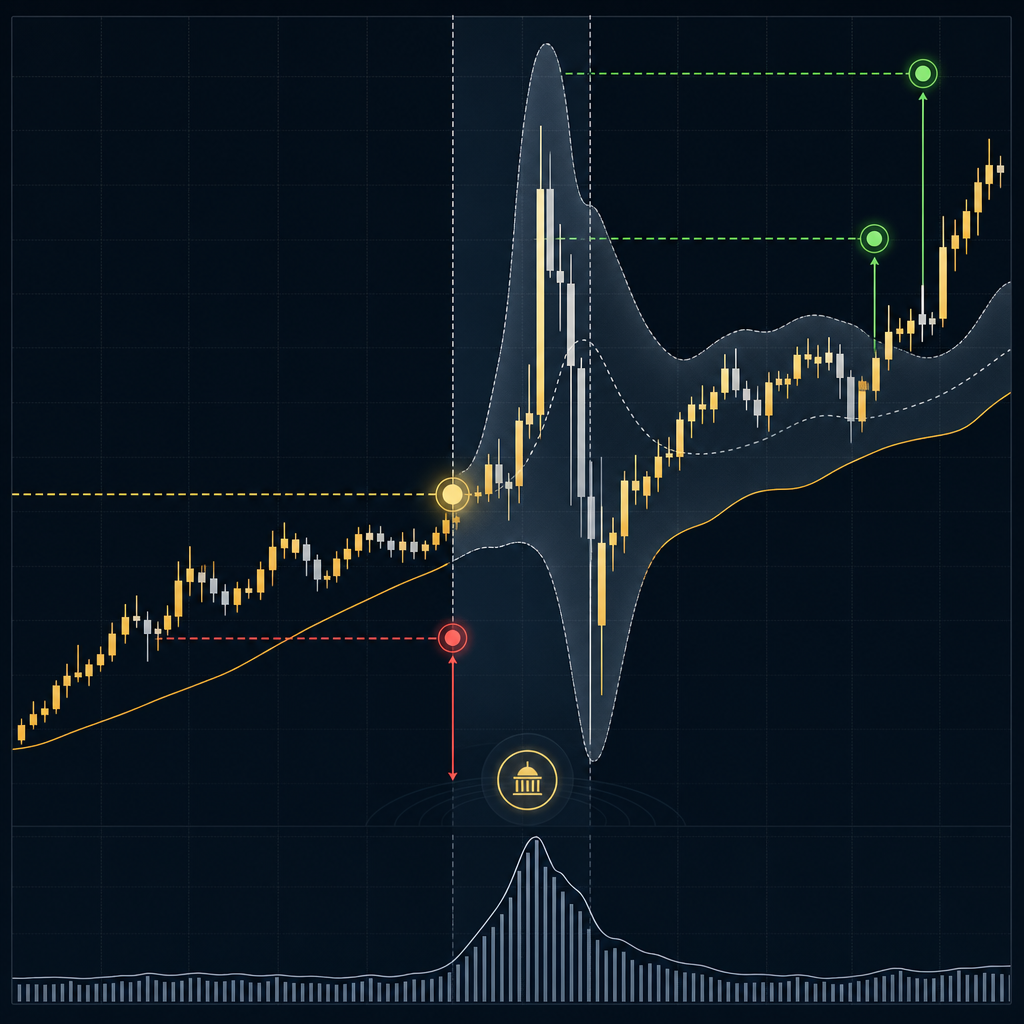
Signals don’t magically “solve” FOMC. But they do solve two big problems: decision fatigue and level quality. During a rate decision, your biggest enemy is not lack of information—it’s too much information at once.
A professional signal (with Entry, SL, TP) gives you a pre-built decision framework. But during FOMC, you must adapt execution rules, because the microstructure changes.
Here’s a practical comparison of approaches traders use during FOMC:
| Approach | Best For | Main Advantage | Main Risk During FOMC | Our Recommendation |
|---|---|---|---|---|
| Manual market orders | Very experienced news traders | Fast execution | Slippage + emotional clicks | Avoid for most traders |
| Pending orders (buy stop/sell stop) | Breakout traders | Pre-planned entries | False breakouts + spread triggers | Use only with strict filters |
| Signal-based trading (Entry/SL/TP) | Most retail traders | Structure + discipline | Taking every alert blindly | Best option with FOMC filters |
| Wait 5–15 minutes, then trade structure | Risk-controlled traders | Cleaner price action | Missing the first leg | Our default “safe” plan |
At United Kings, our edge isn’t just sending alerts. It’s the process: we focus on London and New York sessions, we publish clear levels, and we teach you how to execute like a pro around high-impact events.
If you’re new to signal-based trading, start with our broader framework in the United Kings signals hub, then specialize into gold via premium XAUUSD gold signals.
The key mindset shift for FOMC is this: signals are not commands. They’re high-probability ideas that still require execution rules—especially when spreads widen and ATR doubles.
ATR for FOMC Gold Trading: The Only Volatility Tool You Actually Need
ATR (Average True Range) tells you how much XAUUSD is moving per candle over a given period. During FOMC, that number changes fast—and if your stop doesn’t change with it, you’re basically donating to the market.
Let’s make ATR practical, not academic.
Which ATR settings work best for FOMC?
- M5 ATR(5): fast and responsive. Great for the 60-minute playbook.
- M5 ATR(14): smoother, less jumpy. Good for conservative execution.
- M1 ATR(14): useful for the first spike, but can be noisy.
If you want one setup: use ATR(5) on M5 for FOMC execution decisions.
How ATR changes your stop loss (SL)
On a normal day, you might use a $10 stop on gold. During FOMC, if M5 ATR jumps to $8–$12, a $10 stop is no longer “safe”—it’s inside noise.
We use this rule set:
- Conservative SL: SL distance = 1.2 × ATR(M5, 5)
- Balanced SL: SL distance = 1.0 × ATR(M5, 5)
- Aggressive SL: SL distance = 0.8 × ATR(M5, 5) (only with perfect structure)
Example: Gold is at $2650. M5 ATR(5) is $10.2 right after the release. A balanced SL would be about $10. Conservative would be around $12. That fits the guideline range ($10–$25), but now it’s justified by volatility, not guesswork.
How ATR shapes take profit (TP) logically
Once SL is volatility-based, TP becomes simple: use risk-reward ratios that match the environment.
- TP1: 1R (reduce risk quickly)
- TP2: 2R (core objective)
- TP3: 3R (only if trend persists)
Example: You buy XAUUSD at $2652 with a $12 SL (at $2640). Your TP2 at 2R is $2676. TP3 at 3R is $2688. Those targets sit perfectly inside today’s realistic range cap near $2690.
ATR-based trailing stop (optional but powerful)
When the post-statement trend is strong, trailing can outperform fixed targets.
- Trail SL at 1.0 × ATR(M5,5) behind the last swing low (for longs) or swing high (for shorts).
- Only trail after price has moved at least +1R in your favor.
This keeps you in the move when gold trends $25–$40 after FOMC, while still respecting volatility.
Pre-FOMC Checklist: The 12 Items That Prevent Dumb Losses
Most FOMC losses are avoidable. They happen because traders show up unprepared, oversize, and react to headlines. This checklist is designed to keep you professional even when the market is not.
Step-by-step pre-event checklist (T-60 to T-10)
- 1) Confirm the exact time of the decision and press conference in your platform timezone.
- 2) Mark key XAUUSD levels from the last 24 hours: prior high/low, Asia range, London high/low, NY open.
- 3) Note current price context: gold ~$2650; identify nearest liquidity pools like $2640 and $2665.
- 4) Check DXY (106.80) and USD/JPY (149.50): are they trending or ranging into the release?
- 5) Measure ATR(M5,5) 30 minutes before release. Write it down.
- 6) Define your max spread rule (example: do not enter if spread > $1.20).
- 7) Define your max slippage tolerance (example: if you get slipped > $1.50 on a test fill, you stand aside).
- 8) Decide your window: will you trade the first spike or only post-statement? Decide now, not later.
- 9) Reduce risk per trade (example: from 1% to 0.25%–0.5% for FOMC).
- 10) Check your broker execution mode and whether stops are guaranteed (most are not).
- 11) If using signals: decide your filter rules (next section) and commit to them.
- 12) Prepare mentally: you are allowed to miss the move. Your job is to protect capital.
If you want a broader due-diligence framework for choosing and using signal providers (especially if you’re newer), pair this with our signal provider checklist for beginners.
And one more practical note: if you’re trading from Telegram, ensure notifications are on and your charts are ready before the event. If you’re part of a large community (we’re 300K+ active traders), the value isn’t just the alert—it’s the shared context and the discipline that comes with a proven process.
How to Filter Gold Signals During FOMC (Spreads, Slippage, and “No-Trade” Rules)
During FOMC, the worst habit is taking every alert instantly. Even high-quality signals can suffer from bad fills when spreads widen.
So we filter. Hard.
The 5 signal filters we use during FOMC
- Filter #1: Spread threshold
If spread is above your limit (example: > $1.20), you don’t enter. Period. - Filter #2: ATR compatibility
If ATR(M5,5) implies you need a $18 SL but the signal SL is $10, you either adjust size and widen SL (if structure allows) or skip. - Filter #3: Structure alignment
Only take signals that align with a clear technical level: range high/low, prior day high/low, or a clean break-and-retest. - Filter #4: R:R minimum
If you can’t realistically reach 2R before major nearby liquidity, skip. FOMC demands payoff when you’re right. - Filter #5: Time window rule
If you’re not trading the first spike, you ignore any entry triggers in the first 5 minutes. You wait for the post-statement setup.
When to stand aside (the professional move)
Standing aside is not weakness. It’s risk management.
Skip trading XAUUSD during FOMC if any of these are true:
- Spread is erratic (jumping from $0.60 to $2.50 repeatedly).
- Your platform freezes or requotes.
- ATR is so high that your required SL would exceed your plan (example: > $25).
- You already took a loss and feel the urge to “make it back” during the same event.
This is also where education matters. If you want a deeper survival framework for sudden volatility and headline risk, read how gold signals react to unexpected news events.
Signals should reduce your stress, not increase it. During FOMC, your job is to execute only the cleanest opportunities and let the rest go.
The 60-Minute ATR Playbook: Exact Rules for Entry, SL, TP, and Sizing
Now let’s turn everything into a simple, repeatable system. This is the core XAUUSD FOMC strategy we use for a 60-minute window.
Step 1: Define the pre-FOMC range (T-30 to T-5)
Mark the high and low of the last 30 minutes before the release. Let’s say gold compresses between $2646 and $2656.
This range becomes your “liquidity box.” FOMC often sweeps one side, then reverses through the other.
Step 2: Measure ATR(M5,5) at release time
Assume ATR(M5,5) prints $10 after the first candle. That’s your volatility baseline for the next 15–30 minutes.
Step 3: Choose your entry model (we use two)
- Model A: Break-and-retest (preferred)
Wait for price to break the range, then retest the broken level with rejection. - Model B: Sweep-and-reclaim (advanced)
Price sweeps above $2656 to $2664, then closes back below $2656; you sell the reclaim with tight structure.
Step 4: Place SL using ATR (not emotions)
Use the balanced rule: SL = 1.0 × ATR(M5,5), but ensure it sits beyond structure.
Example long: Break-and-retest long at $2652 after reclaiming $2650. ATR is $10. SL = $10–$12 below entry. Place SL at $2640 (12 points), under the retest low.
Step 5: Set TP with staged exits
- TP1 (1R): $2664 (take 30–50% off, move SL to BE if spreads normalize)
- TP2 (2R): $2676 (core target)
- TP3 (3R): $2688 (runner into $2690 liquidity)
Step 6: Position sizing formula (simple and strict)
First decide your event risk. Many profitable traders cut risk on FOMC to 0.25%–0.5% per trade.
Then:
- Dollar risk = Account balance × Risk %
- Stop distance = SL in dollars (e.g., $12)
- Position size = Dollar risk ÷ (Stop distance × $ value per $1 move for your lot size)
Your broker’s gold contract specs vary. If you’re unsure, review pip/point value mechanics first (it matters a lot on XAUUSD). We cover the calculation logic in our ecosystem already; keep your sizing consistent and always test on demo if you’re not 100% sure.
Step 7: The “two strikes” rule for FOMC
FOMC is not the day to revenge trade. If you take two losses (or one full loss and one scratch), you stop trading the event.
Professionals survive by protecting capital. Amateurs blow accounts trying to win back a single candle.
Three Trade Setups That Work Best on XAUUSD During FOMC (With Realistic Examples)
Let’s get concrete. Below are three setups that repeatedly show up during rate decisions. We’ll use realistic prices around the current range ($2610–$2690) and the current spot context near $2650.
Setup 1: Post-release break-and-retest continuation
When it happens: The Fed outcome aligns with the pre-event drift and gold trends cleanly after the first 5 minutes.
Example: Gold spikes to $2668, pulls back, and retests $2656 (the pre-FOMC range high). It holds, prints higher lows, and spreads normalize.
- Entry: Buy $2658–$2660 on retest confirmation
- ATR(M5,5): $9.5
- SL: $2648 (≈ $10–$12 risk, below retest low)
- TP1: $2670 (1R)
- TP2: $2682 (2R)
- TP3: $2690 (3R / liquidity cap)
Why it works: You’re trading with confirmation after the market reveals direction. ATR keeps the stop outside the chop.
Setup 2: Sweep-and-reverse (false breakout trap)
When it happens: The first spike is a liquidity grab. Gold breaks the range, triggers breakout buys, then snaps back.
Example: Pre-FOMC range high is $2656. Price spikes to $2666, then closes back below $2656 on M1/M5.
- Entry: Sell $2652–$2654 after the reclaim + bearish confirmation
- ATR(M5,5): $11
- SL: $2665 (≈ $11–$13 risk, above sweep high zone)
- TP1: $2641
- TP2: $2630
- TP3: $2619 (only if momentum continues)
Why it works: FOMC loves to punish breakout traders. This setup trades the trap, not the headline.
Setup 3: Post-statement trend day with ATR trail
When it happens: After 15–20 minutes, gold forms a clean trend with shallow pullbacks. This is where trailing stops shine.
Example: Gold reclaims $2650, then grinds to $2675 with higher lows. ATR(M5,5) cools from $12 down to $7.
- Entry: Buy $2650–$2654 on pullback to support
- SL: 1.0 × ATR below last swing low (e.g., $2642)
- Management: Take partial at 1R, then trail using ATR as it declines
- Potential exit zone: $2685–$2690 if trend persists
Why it works: ATR trailing adapts as volatility compresses, keeping you in the trend without guessing the top.
Common FOMC Mistakes on XAUUSD (and How Our Traders Avoid Them)
If you want to trade gold during FOMC profitably over time, you don’t need to be right every month. You need to avoid the big, dumb losses that wipe out weeks of gains.
Mistake 1: Using normal-day stops in a news-day market
A $10 stop might be fine when M5 ATR is $4. But when ATR is $10–$12, that stop is basically inside the spread-and-whipsaw zone.
Fix: ATR-based SL and smaller size. Volatility goes up, size goes down.
Mistake 2: Taking entries during spread spikes
Many traders get “mysteriously” stopped out because the spread briefly widens and tags the stop.
Fix: Spread threshold rule. If spread > your max, you wait. No negotiation.
Mistake 3: Confusing the first move with the real move
The first spike is often a sweep. If you chase it, you become liquidity.
Fix: Default to trading the post-statement window (5–60 minutes). You can still catch a $20–$35 move without the chaos.
Mistake 4: Oversizing because “it’s FOMC”
Big event does not mean big size. It means big uncertainty.
Fix: Cut risk to 0.25%–0.5% per trade. If you insist on trading the first spike, go even smaller.
Mistake 5: Trading without a maximum daily loss
FOMC can tempt you into multiple entries, especially if you get chopped twice early.
Fix: Two strikes rule + daily max loss. If you hit it, you’re done.
If you want to build a complete framework around protecting your account when using signals, keep this open alongside our dedicated guide on risk management strategies for signal-based trading.
How FOMC Moves Gold Through DXY, Yields, and Risk Sentiment (Fast Fundamentals)
You don’t need a PhD in macro to trade FOMC, but you do need a simple cause-and-effect model. Gold reacts most directly to real yields and the US dollar, and indirectly to risk sentiment.
The simple model
- Hawkish Fed (higher-for-longer tone) → yields up → DXY up → pressure on gold
- Dovish Fed (cuts sooner / growth worries) → yields down → DXY down → support for gold
But the tricky part is that markets often “price in” the decision. So gold may move opposite the headline if positioning was crowded.
That’s why we prefer confirmation-based entries: let price show you whether the market interprets the Fed as hawkish or dovish.
Use today’s context as a lens
With DXY at 106.80 and USD/JPY at 149.50, USD strength is present. Yet gold holds near $2650. That suggests one of two things:
- There’s underlying demand for gold (hedging, geopolitical risk, or expectations of future easing).
- Or the market is simply waiting for the Fed to resolve uncertainty.
Either way, FOMC can act like a “release valve.” The move can be sharp and directional once the market commits.
Practical fundamental tells during the 60-minute window
- If DXY spikes and holds above the pre-release high while gold fails to reclaim $2650, shorts have tailwind.
- If DXY fades within 10–20 minutes and gold reclaims $2656/$2660, longs often have the cleaner path.
- If both DXY and gold rise together briefly, treat it as a volatility phase—wait for structure, not headlines.
Fundamentals give you context. ATR and structure give you execution. Signals give you levels and discipline.
Execution Details: Orders, Slippage Control, and Platform Settings
FOMC is where good analysis dies to bad execution. So let’s talk about the details traders ignore until it’s too late.
Market orders vs limit orders during FOMC
- Market orders: highest slippage risk. Use only if you accept unpredictable fills.
- Limit orders: better price control, but you might miss the trade if price doesn’t retest.
For the post-statement window, limit entries on retests are often superior. For the first spike, almost everything is messy—another reason we prefer waiting.
Stop placement: structure first, ATR second
ATR gives you distance. Structure gives you logic. Combine them:
- Place SL beyond the swing level that invalidates your idea.
- Ensure that distance is at least 0.8–1.2 × ATR(M5,5) depending on aggressiveness.
Partial profits and break-even rules
On FOMC, moving to break-even too early is a common mistake. Price often retests and shakes you out before trending.
We use:
- Take partial at +1R.
- Move SL to BE only if spreads normalize and structure supports it (higher low for longs, lower high for shorts).
Platform preparation (simple but critical)
- Set your chart to M1 and M5 with ATR visible.
- Pre-draw your key levels.
- Know your one-click trade size in advance.
- Disable distractions: you don’t need five indicators during FOMC.
If you’re building a complete signal execution workflow, our ecosystem pages can help you organize: the forex signals page is useful for multi-asset traders, and the signals overview explains how we structure entries, SL, and TP across sessions.
A Realistic 60-Min FOMC Walkthrough (Minute-by-Minute Example)
Let’s simulate a realistic FOMC sequence using today’s context and price levels. This will show you how the playbook feels in real time.
T-30 to T-5: Range mapping
Gold trades quietly around $2650. It makes a tight range: $2646 low and $2656 high. ATR(M5,5) is calm at $4.8.
You mark the box. You decide you will not trade the first 5 minutes. Your max spread rule is $1.20.
Minute 0–1: First spike chaos
At release, gold instantly spikes from $2650 to $2667. Spread jumps to $1.80. ATR(M5,5) starts expanding.
You do nothing. That’s not passivity—it’s discipline.
Minute 1–3: Reversal sweep
Gold dumps from $2667 to $2642 in under two minutes. Breakout buyers are trapped. Sellers chase late. Spread is still wide at $1.40.
You still do nothing. You’re waiting for spreads to normalize and structure to form.
Minute 5–12: Structure appears
Gold stabilizes and reclaims $2650. Spread drops back to $0.70–$0.90. ATR(M5,5) is now $10.0.
Price breaks above $2656 and pulls back to retest $2654–$2656. You see rejection wicks and higher lows on M1.
Minute 12–20: The entry
You enter long at $2656. Using 1.2×ATR for safety, you set SL at $2644 ($12 risk). That’s beyond the retest structure and consistent with volatility.
Your TP1 is $2668 (1R), TP2 is $2680 (2R), TP3 is $2692 (3R, but you’ll likely cap at $2690 liquidity).
Minute 20–35: Payoff phase
Gold pushes to $2668. You take partial at TP1 and reduce risk. You don’t rush to BE if structure is still forming, but you can tighten if a higher low is confirmed.
Gold continues to $2680. You take TP2. Now you trail the rest using 1×ATR behind swings.
Minute 35–60: Trend management
Gold tags $2688–$2690, stalls, and pulls back. Your ATR trail takes you out somewhere around $2682–$2685.
You didn’t catch the exact top. You captured the clean middle of the move with controlled risk. That’s professional trading.
How United Kings Traders Use This Playbook With Premium Telegram Signals
Let’s connect the strategy to a real workflow. A volatility playbook is only useful if you can execute it consistently.
United Kings is built for that: premium Telegram signals for forex and gold, with clear Entry, SL, and TP levels, plus education to help you execute. Our community has 300K+ active traders, and we focus heavily on London and New York session timing—which matters because FOMC volatility is overwhelmingly a New York session phenomenon.
How to combine signals + ATR during FOMC (simple workflow)
- 1) Use the signal for levels: Entry zone, invalidation (SL), and target zones.
- 2) Use ATR for adaptation: If volatility is higher than normal, widen SL to the nearest logical structure + ATR distance, then reduce lot size to keep risk constant.
- 3) Use the time window rules: If your plan is “post-statement only,” you wait 5–15 minutes even if the alert triggers earlier.
- 4) Use staged exits: Lock in at 1R, aim for 2R, trail the remainder if trend persists.
Why this improves consistency
- Signals reduce overthinking during fast markets.
- ATR prevents “too tight” stops and random sizing.
- Time windows prevent impulse entries during the most chaotic minutes.
If you want to see how our ecosystem is structured, start at the UnitedKings.net homepage and explore our gold signals service for XAUUSD-specific alerts. For broader multi-pair coverage, our forex signals are designed for the same session-based approach.
And if you want the fastest way to follow along live during FOMC, join our official Telegram channel: United Kings signals on Telegram.
FAQ: Trading XAUUSD During FOMC Rate Decisions
1) Is it better to trade gold during the FOMC decision or after?
For most traders, it’s better to trade after—specifically 5–60 minutes post-release. Spreads and slippage are usually worse in the first 1–5 minutes, and false breakouts are common.
2) What ATR should I use for an XAUUSD FOMC strategy?
A practical choice is ATR(5) on the M5 chart. It reacts quickly to the volatility shift and provides a realistic basis for SL/TP distances during the 60-minute window.
3) How wide should my stop loss be on gold during FOMC?
Use volatility-based logic. A common range is $10–$25 depending on ATR and structure. A solid rule is SL ≈ 1.0 × ATR(M5,5), placed beyond the swing that invalidates your trade idea.
4) Can I rely on gold signals during FOMC?
Yes, but you must filter them. During FOMC, only take signals that align with structure, offer 1:2+ R:R potential, and meet your spread/slippage rules. Signals help most when paired with an execution framework like this ATR playbook.
5) What’s the safest approach if I’m a beginner?
Trade on a demo account first, avoid the first 5–15 minutes, and focus on post-statement break-and-retest setups with small risk (0.25%–0.5%). The goal is process, not adrenaline.
Risk Disclaimer: Trading forex and gold (XAUUSD) involves significant risk and may not be suitable for all investors. Volatility around FOMC can cause widened spreads, slippage, and rapid losses. Past performance does not guarantee future results. No signal or strategy can guarantee profits. Always use proper risk management, consider practicing on a demo account first, and trade only capital you can afford to lose.
Join United Kings: Trade FOMC with Clear Levels, Better Discipline
If you want to trade FOMC like a professional, you need two things: high-quality levels and a repeatable volatility plan. You now have the plan.
When you’re ready to add premium execution support, join United Kings for 85%+ win-rate focused forex and gold signals with clear Entry, SL, and TP levels—delivered in Telegram with a community of 300K+ active traders.
- Starter (3 Months): $299 (~$100/mo)
- Best Value (1 Year): $599 ($50/mo) + FREE ebook (50% savings)
- Unlimited (Lifetime): $999 (pay once)
See all options on our pricing page with 3 plans, then join the live channel here: United Kings Telegram signals.
48-hour money-back guarantee included—so you can evaluate the service with confidence and focus on building consistent execution for the next FOMC.
Trade smart. Protect capital. Let volatility work for you—not against you.