
You’re watching gold at $2,650. The FOMC rate decision is minutes away. Your Telegram lights up with a signal. Spreads widen, candles jump $8 in seconds, and the first move instantly reverses.
If you’ve ever tried to trade XAUUSD during FOMC and felt like the market was designed to stop you out, you’re not alone. The problem usually isn’t the idea. It’s execution—timing, confirmation, and risk sizing inside a volatility storm.
This guide is a tactical, minute-by-minute playbook: 15 minutes before the Fed rate decision to 60 minutes after. We’ll show you how to execute gold signals without getting trapped by whipsaws, how to filter bad conditions (spread/ATR), and how to manage trades when the “news candle” is bigger than your normal stop.
TL;DR — The FOMC XAUUSD Execution Plan (Read This First)
- Don’t trade the first spike blindly. Your job is to survive the initial whipsaw and enter when the market shows direction.
- Use a volatility filter: if spreads widen above your threshold or 1-min ATR explodes, you wait—even if a signal arrives.
- Require confirmation: close beyond a level + retest, or a 2-candle rule on M1/M5 before executing.
- Adjust stops for news candles: on FOMC, $10–$25 stops are common, but placement must respect structure, not emotion.
- Manage in phases: first 5 minutes = protection, 5–20 minutes = confirmation entry, 20–60 minutes = trend/mean reversion play.
- Risk small and consistent: 0.25%–1% per idea is plenty; you can scale only after volatility normalizes.
Why Gold (XAUUSD) Goes Wild During Fed Rate Decisions
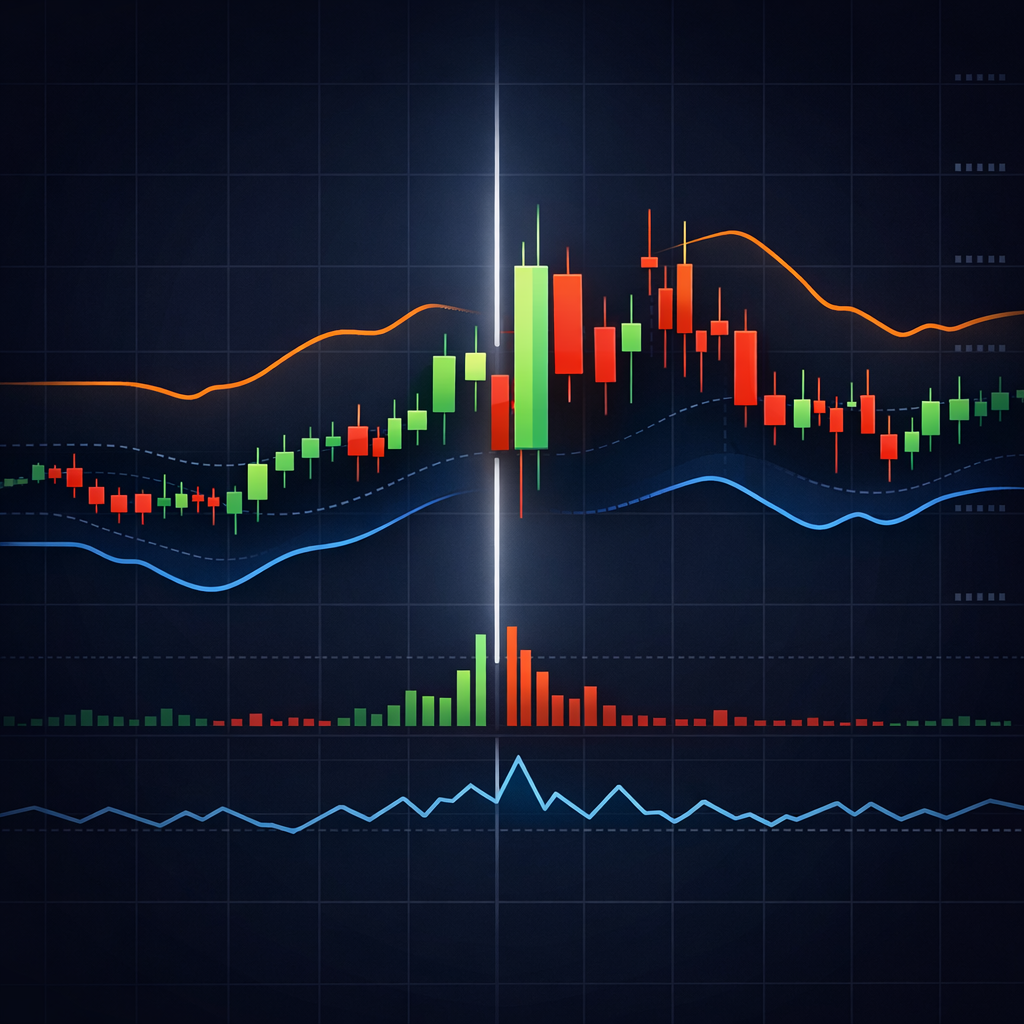
FOMC rate decisions create a perfect storm for gold: interest-rate expectations, USD repricing, and positioning all collide in a 30–90 minute window. Gold is priced in dollars, so when the USD moves aggressively, XAUUSD often reacts immediately.
Right now, the market context matters. Gold is trading around $2,650 (+0.35% on the day). The DXY is ~106.80, with USD/JPY near 149.50. That’s a “strong USD” backdrop, which can pressure gold—unless the Fed turns dovish or the statement triggers a risk-off bid.
The key is that FOMC is not just “rate up or down.” It’s also:
- Statement language (hawkish/dovish tweaks)
- Dot plot (future rate path expectations)
- Powell’s press conference (second wave volatility)
- Market positioning (crowded longs/shorts get squeezed)
That’s why you often see a 3-step sequence in XAUUSD:
- Step 1: First impulse move (often stops get cleared)
- Step 2: Snapback/whipsaw (liquidity hunt)
- Step 3: Real direction emerges (trend or range)
Most losses happen in Step 1 and Step 2. Most clean money is made in Step 3. Our goal is to build a plan that systematically avoids the early chaos while still capturing the best part of the move.
If you’re using a signal service, your biggest edge is speed plus clarity. But speed without rules is how traders get chopped. This is why United Kings focuses on clear Entry, SL, and TP levels and an execution framework around the London and New York sessions, where liquidity is deepest and technical levels are more respected.
What Changes on FOMC Day: Spreads, Slippage, and “Fake Breaks”
On normal days, you can trade gold with tight execution assumptions. On FOMC, those assumptions break. If you don’t adjust, you’ll blame the signal, the broker, or “manipulation,” when the real issue is that your trade model didn’t account for event microstructure.
Here’s what typically changes during the rate decision window:
- Spread expansion: A spread that’s normally $0.20–$0.40 can widen to $0.80–$2.00+ for seconds or minutes.
- Slippage: Your entry may fill worse than expected, especially with market orders or tight stop entries.
- Wick size increases: M1 candles can print $5–$15 wicks in both directions.
- Stop hunts intensify: Obvious highs/lows get swept before the real move.
- Correlation spikes: DXY and US yields can drag gold violently in seconds.
Let’s make this real. Suppose gold is at $2,650 pre-release. You place a buy with a $12 stop at $2,638 and a target at $2,674 (1:2 RR). The news hits, price spikes to $2,657, then wicks to $2,636, then rockets to $2,675.
You were “right,” but you still lost—because your stop sat exactly where the liquidity sweep happened. That’s not bad luck. That’s predictable FOMC behavior.
So the solution is not “bigger stops” alone. It’s smarter stop placement + confirmation timing + volatility filters. When you combine these, you trade the market you have, not the market you wish you had.
If you’re newer to signal execution, it’s worth reading our educational posts inside the United Kings blog and learning how professional services structure alerts, especially around high-impact news. The best traders aren’t always the fastest. They’re the most consistent under pressure.
Pre-FOMC Setup (T-15 to T-5): Build Your Map, Not Your Bias

The biggest execution mistake happens before the news: traders form a strong opinion and then force entries. Your job from 15 minutes before the decision is to create a “map” of levels and scenarios.
Start with a simple top-down structure:
Step 1: Mark the 3 key zones on M15/H1
- Immediate resistance: recent swing highs (example: $2,664–$2,668)
- Immediate support: recent swing lows (example: $2,636–$2,640)
- Midpoint/pivot: the magnet level price keeps returning to (example: $2,650)
These numbers are realistic around the current context ($2,610–$2,690). The exact levels will vary, but the concept doesn’t.
Step 2: Define your “no-trade zone”
On FOMC, there’s often a chop box where price whipsaws and fills both sides. A common approach is to define a $8–$15 buffer around the pivot and avoid trading inside it until direction is confirmed.
Example: if $2,650 is the pivot, your no-trade zone might be $2,643–$2,657. You can still trade, but only with confirmation rules (we’ll define those soon).
Step 3: Check your broker conditions
Before FOMC, open your platform and watch:
- Current spread on XAUUSD
- Execution mode (instant vs market)
- Stop level restrictions (minimum distance)
If your spread is already wide 10 minutes before the release, that’s a warning. If it’s stable, it doesn’t guarantee stability during the decision, but it’s a good sign.
Step 4: Decide your risk budget for the event
FOMC is not the time to “make back losses.” Set a maximum risk for the entire event window. A professional guideline:
- Conservative: 0.25%–0.5% total risk across all attempts
- Moderate: 0.75%–1% total risk
- Aggressive (not recommended for most): 1.5%+ total risk
Even great signal providers can’t control spreads and slippage. Risk budgeting is how you stay in the game long enough to benefit from high-quality setups across weeks and months.
Volatility Filters That Keep You Out of Bad FOMC Trades (Spread + ATR Rules)
This section is the difference between “I trade news” and “I survive news.” You need objective filters that tell you when not to execute a signal immediately.
We use two simple volatility filters: spread and ATR (Average True Range). You don’t need fancy tools—most platforms show spread, and ATR is built-in.
Filter #1: Spread threshold (your first gate)
Create a personal spread threshold based on your broker’s normal conditions. For many traders, a practical rule is:
- If spread is > 2x your normal spread, you wait.
Example: if your typical XAUUSD spread is $0.30, then a spread above $0.60 is a caution. Above $0.90–$1.20, you generally avoid market execution and require confirmation entries only.
Why? Because your stop is effectively smaller than you think. A $15 stop with a $1.20 spread and slippage can behave like a $12–$13 stop in real market impact.
Filter #2: ATR expansion (your second gate)
ATR tells you how “wide” candles have become. On FOMC, ATR often doubles or triples. The trick is not to fear volatility—it’s to match your stop and entry timing to it.
A practical method:
- Use M1 ATR(14) and M5 ATR(14).
- If M1 ATR is > $3.00 and rising fast, you avoid instant entries.
- If M5 ATR is > $8.00–$12.00, you trade only after a clear break-and-retest.
These thresholds are realistic in the $2,610–$2,690 gold environment. Some FOMC events push beyond that, especially if the statement surprises markets.
How the filters work together (simple decision tree)
- Spread normal + ATR moderate: you can execute a signal with standard confirmation.
- Spread wide + ATR high: you wait for a post-spike structure (retest, range break, or 2-candle close).
- Spread extreme: you skip the first 5–10 minutes entirely.
Skipping trades is a skill. It’s also one of the most profitable decisions you’ll make on FOMC days.
For a deeper approach to controlling risk while following alerts, keep our risk guide bookmarked: risk management strategies when using forex signals. The principles apply directly to gold, especially around news.
The United Kings Signal Execution Framework for FOMC (What You Follow vs What You Ignore)
Signals are only as good as the execution rules around them. During FOMC, we treat every alert as a trade idea that must pass your execution checklist. That’s how you avoid blindly buying the top of the spike or selling the bottom of the wick.
United Kings signals are designed with clear levels—Entry, SL, TP—delivered in premium Telegram. If you’re new to this approach, start here: United Kings gold signals and our broader signals page to understand how we structure alerts across sessions.
What you follow (non-negotiables)
- Entry price zone (not a single number obsession—use a small band)
- Stop-loss placement (structure-based, not “tight because I’m scared”)
- Take-profit logic (1:2 or 1:3 RR is typical; partials are allowed)
- Time validity (FOMC trades expire quickly if the market doesn’t move)
What you ignore (common trader traps)
- Your bias (“Rates are surely going to…”)
- The first 30-second candle (it’s often a liquidity sweep)
- Revenge entries after a stop-out
- Overleveraging to “make the event worth it”
FOMC-specific rule: One setup, two attempts max
Because whipsaws are common, we recommend a strict cap: maximum two attempts on the same directional idea during the FOMC window. If you get stopped twice, you step back and wait for the post-news trend to form.
This rule protects your psychology. It also protects your account from death-by-a-thousand-cuts when price is chopping around $2,650 and sweeping both sides.
Position sizing adjustment (simple and practical)
Instead of widening stops and keeping lot size the same (which increases risk), you do the opposite: if the stop must be wider, reduce lot size so your dollar risk stays constant.
Example:
- Normal day: $10 stop, risk $100
- FOMC day: $20 stop, risk still $100 → your lot size is cut roughly in half
This is how professionals trade news. Same risk, different volatility.
Minute-by-Minute Plan: 15 Minutes Before the Decision (T-15 to T-0)
This is your calm window. Your goal is to prepare, not predict. You want clean charts, marked levels, and a clear “if/then” plan.
T-15 to T-10: Build the level map and scenario tree
- Mark H1 support/resistance around current price ($2,650).
- Identify the most recent liquidity pools: equal highs, equal lows, prior day high/low.
- Write two scenarios: bullish break above resistance and bearish break below support.
Example map (illustrative):
- Resistance: $2,664–$2,668
- Pivot: $2,650
- Support: $2,636–$2,640
T-10 to T-5: Check volatility filters and open orders policy
- Record current spread (baseline).
- Check M1 and M5 ATR(14).
- Decide: market orders allowed or not?
If spreads are already unstable, you commit to confirmation entries only. This one decision can save you multiple stop-outs.
T-5 to T-0: Decide your “first trade timing rule”
We recommend one of these two execution policies:
- Policy A (safer): no new trades in the last 60 seconds before the release.
- Policy B (active): trade only if price is breaking a pre-marked level with a clean close (not just a wick).
Most traders should choose Policy A. The last minute is where spreads can jump and brokers can re-quote.
Also: if you’re following Telegram alerts, ensure notifications are on and your chart is ready. You can join the United Kings channel here: United Kings Telegram signals channel. Speed matters, but only after your rules are set.
Execution Plan: The First 0–5 Minutes After FOMC (Survive the Whipsaw)
The first five minutes are where accounts go to die. Your job is to protect capital and let the market reveal its hand.
Rule #1: No “instant revenge” entries
If your first attempt gets stopped, you pause. You do not immediately re-enter on emotion. You wait for structure: a close, a retest, or a clear range break.
Rule #2: Use confirmation triggers, not feelings
Here are three confirmation triggers that work well for XAUUSD news volatility signal execution:
- 2-candle close rule (M1): two consecutive closes above resistance for buys, or below support for sells.
- Break-and-retest (M1/M5): price breaks a level, then retests it and holds (wicks allowed, but closes matter).
- Range expansion + pullback: first impulse creates a range, then you trade the pullback to the range edge.
Example: gold spikes from $2,650 to $2,666, then snaps back to $2,656. If $2,656 holds as support and you get two M1 closes back above $2,660, that’s a higher-quality long than buying the first spike at $2,665.
Rule #3: Stop-loss sizing must match the news candle
During the first 5 minutes, the “news candle” can be massive. If you place a $10 stop inside a $15 candle range, you’re basically placing your stop where wicks live.
Practical SL guidelines:
- Use $15–$25 stops if structure demands it.
- Place SL beyond the liquidity sweep, not right at it.
- Reduce lot size to keep risk constant.
Example trade plan (illustrative long)
- Entry: $2,660 after confirmation
- SL: $2,645 (15 dollars)
- TP1: $2,690 (30 dollars, ~1:2 RR)
- TP2: trail if momentum remains strong
You’re not trying to catch the first tick. You’re trying to catch the cleanest part of the move with controlled risk.
Execution Plan: 5–20 Minutes After FOMC (Catch the Real Direction)
This is often the best window for traders who want volatility but not chaos. The initial stop hunt has usually happened, and the market begins to respect levels again—especially if the Fed outcome was clearly hawkish or dovish relative to expectations.
Step-by-step: The “confirmation entry” process
- Step 1: Identify the post-news high and low (the first 5-minute range).
- Step 2: Wait for a break of that range with a close on M1 or M5.
- Step 3: Enter on the retest of the broken boundary (or on a second close if retest is too fast).
- Step 4: Place SL beyond the opposite side of the range or beyond the retest swing.
- Step 5: Target 1:2 first, then reassess for 1:3 if momentum persists.
Example: Bearish break scenario
Assume gold prints a first 5-min range between $2,662 and $2,646. Price breaks below $2,646 and closes on M1 at $2,642. It retests $2,646, rejects, and prints a lower high at $2,645.
- Entry: $2,644–$2,645
- SL: $2,660 (15 dollars)
- TP: $2,614 (30 dollars, ~1:2 RR) or partial at $2,625
This fits the price-level guidelines ($2,610–$2,690) and uses a realistic stop for news volatility.
How to handle a signal that arrives “late”
Sometimes a Telegram signal comes after the first move. That doesn’t mean it’s useless. It means you must decide if the setup is still valid.
- If price is already 70% to TP, you usually skip.
- If price is near entry and structure still matches, you can execute with confirmation.
- If volatility filters show extreme spread/ATR, you wait even if the setup is good.
This is where experience matters. It’s also why United Kings pairs signals with education—so you know when to execute aggressively and when to stand down.
Execution Plan: 20–60 Minutes After FOMC (Manage, Trail, and Avoid Giving Back)
After 20 minutes, the market typically transitions into one of two modes: trend continuation or mean reversion. Your job is to identify which mode you’re in and manage accordingly.
Mode A: Trend continuation (the cleanest outcome)
Signs you’re in a continuation trend:
- Higher highs/higher lows (bull trend) or lower highs/lower lows (bear trend)
- Pullbacks are shallow (often $4–$8) and quickly bought/sold
- DXY and yields confirm the direction (not always, but often)
Management approach:
- Take partial profits at 1:2 RR.
- Move SL to breakeven only after structure confirms (not instantly).
- Trail behind M5 swing lows/highs or a short moving average if you use one.
Mode B: Mean reversion (the “fade the spike” outcome)
Signs you’re in mean reversion:
- Price fails to hold beyond a key level (false break)
- Long wicks on M5 showing rejection
- Price returns to the pre-news pivot (often $2,650 in our context)
Management approach:
- Reduce targets; don’t expect a huge trend.
- Be quicker to take profit at 1:1.5–1:2.
- Avoid adding positions unless volatility calms.
Example: Protecting profit in a bullish continuation
You’re long from $2,660 with SL at $2,645. Price hits $2,690 (TP1). You bank partials. Now you trail the remainder with SL under the latest M5 higher low, maybe around $2,674.
If price reverses sharply, you still walk away with a win. If it continues to $2,698 (outside our guideline range, but possible on extreme events), you participate without risking your original capital.
This is how professionals avoid the classic FOMC mistake: turning a winner into a loser because they refused to take partials.
Comparison Table: FOMC Execution Styles (Which One Fits You?)
Not every trader should trade FOMC the same way. Below is a practical comparison of common execution styles and who they’re for.
| Style | Entry Timing | Pros | Cons | Best For |
|---|---|---|---|---|
| Instant Spike Trading | 0–30 seconds after release | Can catch the full move early | Highest slippage, widest spreads, most whipsaws | Advanced traders with fast execution + strict risk caps |
| Confirmation Entry | 1–10 minutes after release | Lower whipsaw risk, clearer structure, better fills | May miss the first $5–$10 of the move | Most signal followers and disciplined intraday traders |
| Break-and-Retest | 5–20 minutes after release | Highest quality entries, logical SL placement | Sometimes no retest happens | Traders who prioritize consistency over excitement |
| Post-Event Trend Ride | 20–60 minutes after release | Calmer spreads, trend clarity, easier management | Smaller RR if the move already extended | Conservative traders and beginners using signals |
Do/Don’t Checklists for Trading XAUUSD During FOMC
When volatility hits, your brain wants shortcuts. Checklists prevent impulsive clicks. Use these as your “pre-trade” and “in-trade” guardrails.
DO: Pre-trade checklist (before you execute any signal)
- Do confirm the event time and whether Powell speaks afterward.
- Do mark the nearest H1 support/resistance and the pivot around $2,650.
- Do measure spread and compare it to your normal baseline.
- Do check M1/M5 ATR; if it’s exploding, require confirmation.
- Do set a maximum event risk (example: 0.5%–1%).
DON’T: Pre-trade mistakes that destroy accounts
- Don’t place oversized lots because “it’s FOMC.”
- Don’t trade inside the no-trade zone without confirmation.
- Don’t put SL exactly at the obvious swing high/low on the first spike.
- Don’t stack multiple correlated trades (gold + EURUSD + GBPUSD) unless you understand USD exposure.
DO: In-trade management checklist (after entry)
- Do take partials at 1:2 RR when volatility is high.
- Do trail behind structure (M5 swings), not random numbers.
- Do accept that breakeven stops can be hit often—use them strategically.
DON’T: In-trade emotional management errors
- Don’t widen SL mid-trade because you “feel” it will come back.
- Don’t remove TP because you got greedy after a fast $12 candle.
- Don’t re-enter immediately after a stop without a new setup.
If you want a broader framework for evaluating any provider and avoiding common traps, read: forex trading signals provider checklist. It’s especially relevant on news days when execution quality matters most.
Realistic FOMC Scenarios Using Current Market Levels (Gold, DXY, Majors)
Let’s connect the macro dots with realistic price behavior around current levels: gold $2,650, DXY 106.80, EUR/USD 1.0520, GBP/USD 1.2680, USD/JPY 149.50.
Scenario 1: Hawkish Fed surprise (USD up, gold down)
If the Fed signals “higher for longer,” DXY can spike. USD/JPY might push higher. Gold often sells off sharply.
- Gold breaks below $2,640 support.
- First move wicks to $2,636, bounces to $2,646, then continues lower.
- A clean sell entry often appears on the retest of $2,646.
Execution idea:
- Sell zone: $2,644–$2,646 after rejection
- SL: $2,660 (structure + $14–$16 risk)
- TP: $2,614–$2,616 (1:2 RR)
Scenario 2: Dovish tilt (USD down, gold up)
If the Fed hints at earlier cuts or sounds concerned about growth, the USD can drop. Gold often rallies aggressively.
- Gold breaks above $2,664–$2,668 resistance.
- First spike hits $2,676, wicks back to $2,666.
- The best entry is often the hold above $2,666 with two M1 closes.
Execution idea:
- Buy zone: $2,666–$2,668 after confirmation
- SL: $2,652 (about $14–$16)
- TP: $2,696 (1:2 RR; if you cap within $2,690, take partials into $2,688–$2,690)
Scenario 3: “As expected” decision (whipsaw then range)
If the decision matches expectations, gold may spike both ways and then return to the pivot around $2,650.
In this case:
- You reduce trade frequency.
- You prefer mean reversion setups back to the pivot.
- You take quicker profits and avoid big targets.
This scenario is where traders lose money by forcing trend trades that never materialize.
How United Kings Traders Execute FOMC Signals (Process, Not Hype)
Signal execution is a skill. At United Kings, we focus on building a repeatable process around high-impact events, not hype around “catching the spike.”
Here’s the process we recommend our community follow during FOMC:
1) Prepare your platform like a pro
- Use one clean XAUUSD chart (M1 + M5) and one higher timeframe (M15/H1).
- Mark levels and set alerts at $2,640 and $2,666 (example levels).
- Know your maximum risk before the first candle prints.
2) Treat signals as “conditional” during the first minutes
During 0–5 minutes, your execution is conditional on spreads and confirmation. This is not hesitation. This is professionalism.
3) Use the community to stay disciplined
One underrated edge is trading alongside a serious community. United Kings has a 300K+ active trader community. When you see others following the same rules—waiting for confirmation, respecting SL—you’re less likely to panic.
4) Combine signals + education
We publish educational content alongside alerts so you understand the “why,” not just the “what.” For news-specific survival tactics, this is a strong companion read: how gold signals react to unexpected news events.
5) Choose the plan that matches your trading frequency
If you trade major events and want consistent access, review our plans on the United Kings pricing page. We offer three options:
- Starter (3 Months): $299 (~$100/month)
- Best Value (1 Year): $599 (~$50/month) with 50% savings + FREE ebook
- Lifetime: $999 (pay once, unlimited access)
We also offer a 48-hour money-back guarantee, so you can evaluate the service responsibly.
Common FOMC Mistakes (And the Exact Fix for Each)
Most traders don’t fail because they lack information. They fail because they repeat the same execution errors under stress. Let’s make the mistakes explicit and give you a direct fix.
Mistake #1: Trading the first candle with a tight stop
What happens: you buy at $2,658, set SL at $2,648, and the wick hits $2,647 before running to $2,680.
Fix: wait for confirmation (2-candle close or retest), and place SL beyond the sweep. If the structure requires $18 risk instead of $10, reduce size.
Mistake #2: Ignoring spread expansion
What happens: your entry fills late, your SL triggers early, and you feel like the broker “hunted” you.
Fix: apply a spread threshold. If spread is >2x normal, you do not market execute. You either wait or use confirmation entries with wider structure-based stops.
Mistake #3: Overtrading the chop
What happens: you take 6 trades in 20 minutes, all small losses, and miss the clean move later.
Fix: cap attempts (two max per directional idea). Set a maximum event risk (for example, 1%).
Mistake #4: Moving SL further away mid-trade
What happens: a manageable loss becomes a large one because you refused to accept the trade was wrong.
Fix: SL is final. If you need a wider SL, you decide that before entry and size accordingly.
Mistake #5: Taking profit too early because volatility feels scary
What happens: you close at +$6, price goes +$30 without you.
Fix: use partials. Take some profit at 1:2 RR and let the rest run with a structure-based trail.
FAQ: Trading XAUUSD During FOMC Rate Decisions
1) Is it safe to trade gold during FOMC?
It can be traded, but it’s not “safe.” Volatility, spread expansion, and slippage are real. The safest approach is confirmation entries, smaller risk, and strict attempt limits.
2) What timeframe is best for FOMC gold trading?
Use H1/M15 to map levels, then M5/M1 for execution. Most traders get trapped when they only watch M1 without understanding higher-timeframe structure.
3) Should I hold gold trades through the Powell press conference?
Only if your trade is already protected (partials taken, SL improved) and the structure supports continuation. The press conference can create a second wave of whipsaws.
4) What stop loss is typical for XAUUSD during FOMC?
It depends on structure and volatility, but during FOMC it’s common to see $10–$25 stops. The key is to reduce lot size so your account risk stays consistent.
5) Can beginners follow FOMC signals?
Yes, but beginners should consider demo trading first and using a conservative plan (post-event trend ride, 20–60 minutes after). If you’re new, study signal execution and risk rules before going live.
Risk Disclaimer (Read Before You Trade FOMC)
Forex and gold trading involves significant risk and may not be suitable for all investors. Trading around FOMC can include extreme volatility, spread widening, and slippage. Always use a stop loss, risk only what you can afford to lose, and consider practicing on a demo account first. Past performance does not guarantee future results, and no signal provider can guarantee profits.
Final CTA: Get FOMC-Ready XAUUSD Alerts with United Kings
If you want a professional way to trade gold around major events without guessing, follow a structured plan and use clear alerts. United Kings delivers premium Telegram signals for forex and gold with precise Entry, SL, and TP levels, built for London and New York sessions.
Join the community of 300K+ active traders and get the execution discipline you need for FOMC weeks. Start here:
- Join United Kings Telegram for live gold & forex signals
- Explore our full signals service and dedicated XAUUSD gold signals
- Pick the right plan on our pricing page (3 Months $299, 1 Year $599 best value, Lifetime $999)
If you have questions before joining, visit about United Kings or reach our team via contact. Trade smart, protect your downside, and let the market confirm the move.