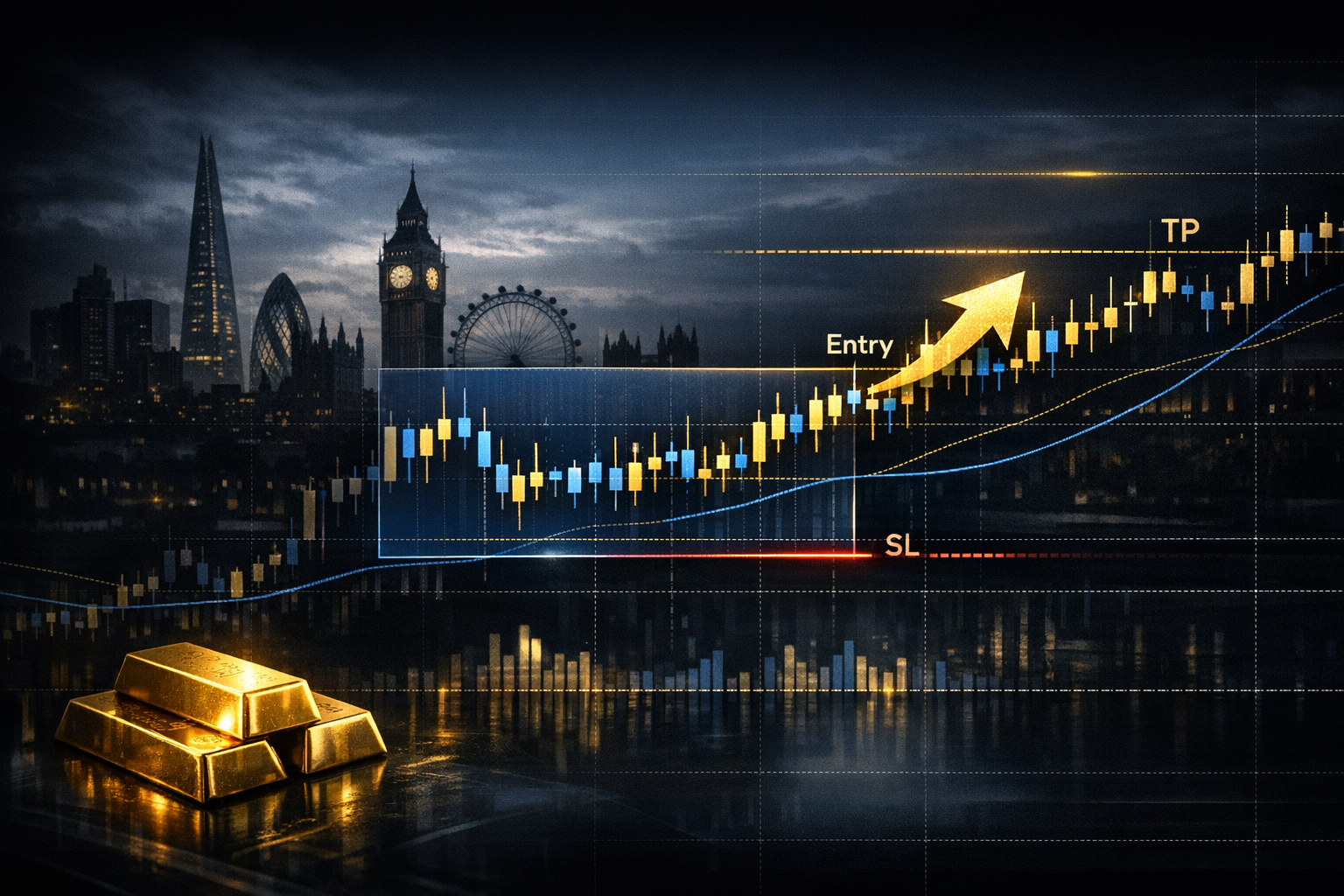
FOMC day can make gold (XAUUSD) look “easy” for 30 seconds—and then punish you for the next 30 minutes.
If you’ve ever tried to trade XAUUSD during FOMC, you know the feeling: spreads widen, price spikes $15–$30 in a blink, and your “perfect” entry turns into a whipsaw.
This guide gives you a practical, repeatable 3-phase signal plan for trading gold around Fed rate decisions: what to prepare before the event, how to survive the spike, and how to trade the follow-through with defined risk.
TL;DR: The 3-Phase FOMC Gold Strategy
- Phase 1 (Pre-Event): Build a “level map” (day high/low, Asia range, key H1/H4 zones) and decide what you will not trade.
- Phase 2 (Spike): Treat the first move as information, not an entry—protect yourself from spread expansion and wick sweeps.
- Phase 3 (Follow-Through): Your highest-probability entry often comes after the first 5–30 minutes when structure returns (break + retest or pullback to VWAP/EMA zone).
- Risk rules win FOMC: Fixed $ risk, smaller size, wider SL (often $10–$25), and realistic TPs (1:2 to 1:3 R:R).
- Signals work best with a framework: You want clear Entry/SL/TP plus context (levels, timing, and what invalidates the idea).
- Watch DXY + USD/JPY: With DXY near 106.80 and USD/JPY around 149.50, USD momentum can amplify gold’s reaction.
Current Market Context: Why This FOMC Setup Matters for XAUUSD
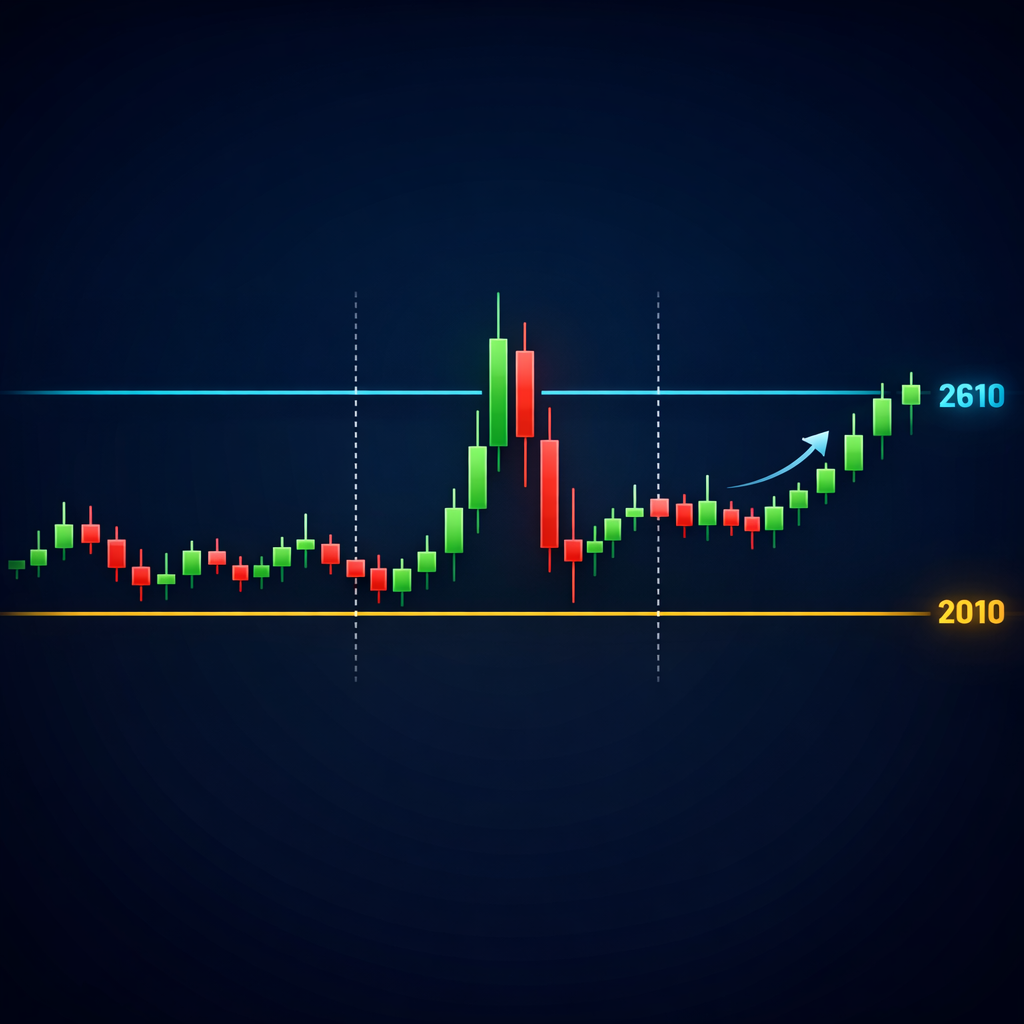
Right now, gold is trading around $2650.00 with a modest +0.35% 24-hour change.
That’s important because FOMC volatility doesn’t arrive in a vacuum.
It lands on top of existing positioning, liquidity conditions, and the market’s expectations about the Fed’s next move.
Where the majors sit (and why you should care)
EUR/USD is around 1.0520, GBP/USD near 1.2680, and USD/JPY around 149.50.
The Dollar Index (DXY) is near 106.80, which is a “firm USD” environment.
In simple terms: if the Fed surprises hawkish, the USD can surge and gold can dump fast.
But here’s the twist: gold is not just “anti-dollar.”
Gold also trades as a real-yield proxy, a risk hedge, and a positioning instrument.
That’s why you often see a two-step FOMC reaction: first a headline spike, then a reversal, then a trend once the press conference clarifies the message.
Realistic FOMC volatility expectations for gold
On normal days, XAUUSD might move $10–$18 in a session.
On FOMC days, a $25–$50 range is common, with the first 1–5 minutes printing violent wicks.
That’s why a plan that works on a calm Tuesday can fail on a Wednesday FOMC.
Why “signals only” is not enough on FOMC
Even the best signal can get wrecked if you execute it in the wrong phase of the event.
FOMC demands a timing filter and a liquidity filter.
That’s the core of this article: we’re not changing your strategy every month.
We’re giving you a stable framework you can apply to any FOMC while using professional entries, stops, and targets from a signal provider.
If you want to see how we structure our trade ideas with clear Entry/SL/TP, start with our main United Kings premium signals hub.
How FOMC Moves Gold: The Mechanics Behind the Whipsaw
To trade XAUUSD during FOMC, you need to understand what you’re actually trading.
You’re not trading “a candle.”
You’re trading a fast repricing of expectations—plus a liquidity game where stops become fuel.
Three drivers that hit gold during FOMC
- Rate decision (headline): The initial spike often reacts to the statement and the decision itself.
- Dot plot / projections: This is where the market recalibrates the path of rates, not just today’s decision.
- Press conference tone: The second wave often begins here—trend confirmation or full reversal.
Gold responds most cleanly when the message is consistent across these three.
When the message is mixed, you get the classic FOMC chop: up $18, down $22, then sideways for 40 minutes.
Why spreads widen (and why it matters more than you think)
During the first seconds after the release, liquidity providers protect themselves.
That means spreads can expand sharply, and your stop can be hit even if the chart “never touched it” in a perfect world.
It also means market orders can slip—turning a $12 stop into a $18 realized loss.
Stop runs and wick sweeps: the FOMC signature
On FOMC, price often hunts both sides of a range.
It’s not “manipulation” in a conspiracy sense.
It’s simply where the liquidity is: above obvious highs and below obvious lows.
Example: if gold is boxed between $2638 and $2662 pre-event, the spike may run to $2676, then dump to $2628, then only after that choose direction.
If you buy the first breakout with a tight $8 stop, you often become the liquidity.
The key principle: treat the first move as a “probe”
Our framework assumes the first move is frequently a probe.
We let the market show its hand, then we trade the part that is tradable: the structured follow-through.
For more on how signals behave in chaotic headlines, you’ll like our breakdown: how gold signals react to unexpected news events.
The 3-Phase Plan Overview (Pre-Event, Spike, Follow-Through)
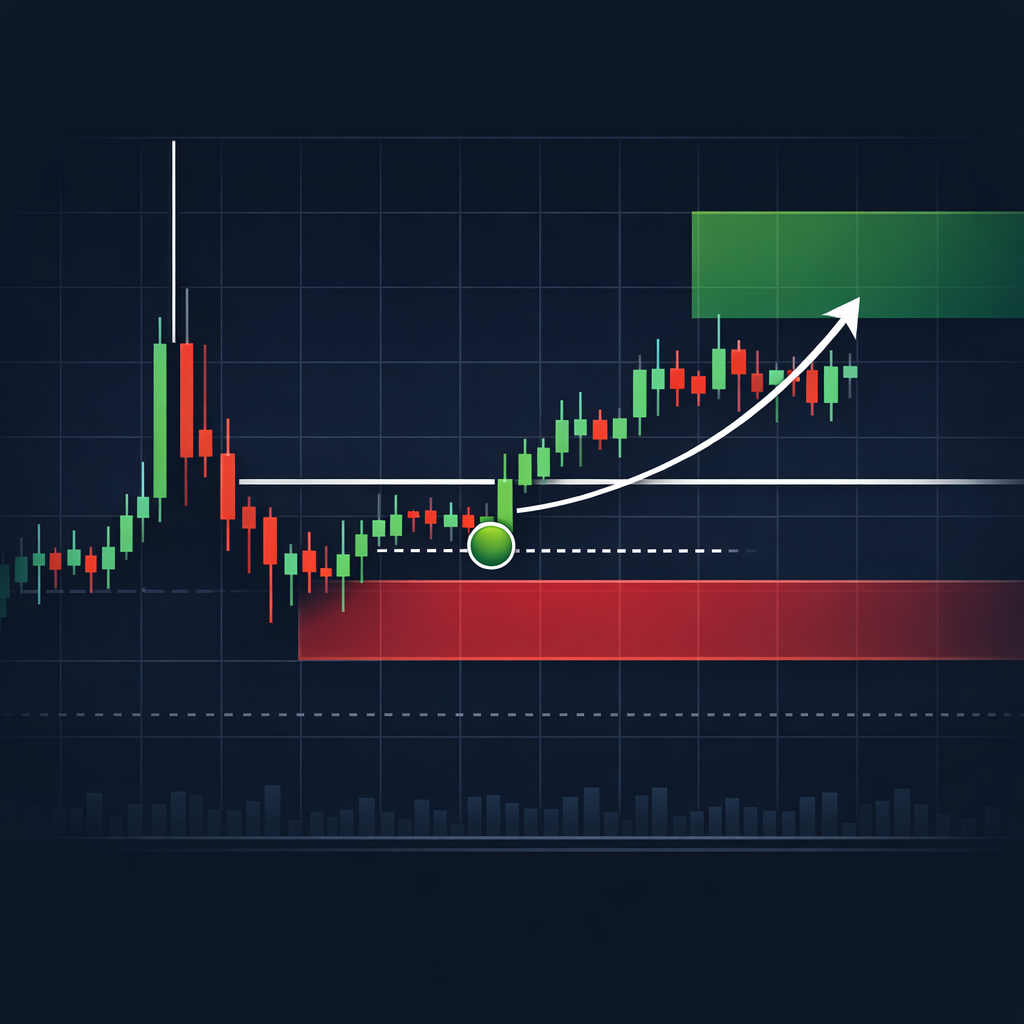
Most traders lose on FOMC for one reason: they try to trade one “moment” with one “trick.”
Professionals treat FOMC as a sequence.
We break it into three phases, each with a different job.
Phase 1: Pre-Event (build the map)
Your job is to define levels, scenarios, and risk limits.
You’re not predicting; you’re preparing.
Phase 2: Spike (avoid the trap)
Your job is to protect capital.
You either stand aside or use a very specific rule-based approach designed for widened spreads and wick risk.
Phase 3: Follow-Through (trade structure)
Your job is to trade the “second-order” move.
This is where signals shine: clear Entry/SL/TP, executed when the market returns to tradable structure.
What this framework is (and isn’t)
- It is: repeatable, risk-first, and compatible with premium signal execution.
- It isn’t: a guaranteed profit method or a promise that every FOMC will trend.
If you’re newer to signal execution, pair this article with our practical guide on execution discipline: forex signals on Telegram for beginners.
Comparison: 3 ways traders approach FOMC (and what we recommend)
| Approach | What you do | Pros | Cons | Best for |
|---|---|---|---|---|
| Gamble the headline | Market buy/sell at release | Can catch huge move fast | Slippage, spread blowout, stop hunts | Rarely recommended |
| Straddle stops | Buy stop above / sell stop below range | Automates direction choice | Often triggers both sides in whipsaw | Advanced only |
| 3-phase follow-through | Map levels, survive spike, trade retest | Higher-quality entries, clearer invalidation | Requires patience and rules | Most traders using signals |
Phase 1 (Pre-Event): Build Your XAUUSD Level Map and Volatility Plan
Phase 1 is where you earn the right to trade Phase 3.
If you skip prep, you’ll interpret every wick emotionally.
On FOMC, emotions are expensive.
Step-by-step: the 15-minute pre-FOMC checklist
- Mark the day’s high and low on M15/H1.
- Mark the Asia range (roughly the first 6–8 hours) and London’s extension.
- Identify 2–3 H1/H4 zones where price previously reacted sharply.
- Mark the “magnet” level (often round numbers like 2650, 2660, 2675).
- Write two scenarios: bullish follow-through vs bearish follow-through, with invalidation.
- Set your max loss for the event (example: 1R total for the day).
With gold around $2650, a realistic map might include:
- Resistance zone: $2668–$2678 (prior swing supply)
- Pivot: $2650 (round number + session magnet)
- Support zone: $2632–$2622 (prior reaction + liquidity pocket)
Volatility planning: choose your “FOMC mode”
You need to decide before the release whether you’re trading the event or waiting.
Here are three modes that work well with signals.
- Conservative: no trades until 5–15 minutes after the release.
- Balanced: one attempt during spike only if the setup is perfect, then focus on follow-through.
- Aggressive: trade both spike and follow-through with reduced size and strict rules.
Most traders should use Conservative or Balanced.
It’s not about bravery.
It’s about surviving long enough to compound.
What to expect from spreads and execution
Assume spreads widen and slippage increases.
So your position size should drop.
If your normal gold stop is $10, on FOMC you may need $15–$25 to avoid noise.
How we use signals pre-event at United Kings
Pre-event, we focus on context and zones.
During London and New York sessions, we highlight levels where the market is likely to react.
If you want dedicated XAUUSD ideas, our gold signals page explains how we structure entries and risk.
Phase 2 (Spike): How to Handle the First Move Without Getting Wrecked
The spike phase is where most accounts get damaged.
Not because the trader is “bad.”
Because the environment is temporarily hostile to tight execution.
The Spike Rule #1: Don’t click in the first 30–60 seconds
This one rule saves more money than any indicator.
In the first minute, spreads and slippage are at their worst.
Even if you guess right, your fill can be so poor that the trade’s math collapses.
The Spike Rule #2: Treat wicks as “liquidity tests”
If gold rips from $2650 to $2672 and instantly wicks back to $2654, that wick is information.
It’s telling you where stops were and where liquidity got filled.
It is not telling you “buy now.”
A safe spike play (advanced): fade the extreme only after confirmation
If you insist on trading the spike, do it with a confirmation filter.
Example scenario (illustrative):
- Pre-event resistance marked at $2675.
- Spike runs to $2682 and closes back below $2675 on M1/M5.
- You wait for a retest of $2672–$2675 and rejection.
- Entry: Sell $2672
- SL: $2687 (15 points)
- TP1: $2642 (30 points, ~1:2)
- TP2: $2627 (45 points, ~1:3)
Notice the logic: you’re not fading randomly.
You’re fading a liquidity sweep of a pre-marked level, after price re-accepts below it.
What not to do during the spike
- Don’t widen your stop mid-trade because “it will come back.”
- Don’t average down into a news move.
- Don’t chase a candle that already moved $12–$20.
- Don’t over-leverage because you want to “make the event worth it.”
Signals + spike phase: how to use them correctly
On FOMC, the best signal providers adapt.
They either pause during the spike or send “conditional” guidance (wait for close above/below, wait for retest, etc.).
Inside United Kings, our approach is built around clear levels and disciplined execution windows.
For broader execution best practices (entries, partials, and stop handling), see: risk management strategies when using forex signals.
Phase 3 (Follow-Through): The Highest-Probability FOMC Gold Entries
Phase 3 is where the market becomes tradable again.
Spreads normalize, the narrative becomes clearer, and price starts respecting levels.
This is where a structured FOMC gold strategy pays.
What “follow-through” looks like on XAUUSD
Follow-through is not a single candle.
It’s when price breaks a key level and then holds it, or breaks and retests it cleanly.
On gold, the best follow-through setups often appear 10–45 minutes after the release.
Two follow-through patterns you can trade repeatedly
1) Break-and-retest continuation
- Gold breaks above a pre-marked resistance (example: $2668).
- Price pulls back to $2668–$2664, holds, then prints higher highs.
- This gives you a defined invalidation point below the retest low.
2) Reversal after a double sweep (stop hunt both sides)
- Spike takes out the high (example: $2680) and then dumps through support (example: $2632).
- Price reclaims $2632 and holds it.
- This often signals the “real move” is up, after liquidity is collected.
Example follow-through trade plan (bullish)
Assume gold spikes down, then finds support and reclaims the pivot.
- Context: XAUUSD around $2650; pre-event support $2632–$2622.
- Event reaction: dump to $2624, then reclaim $2632.
- Entry trigger: M5 close above $2640 + retest holds.
- Entry: Buy $2642
- SL: $2627 (15 points)
- TP1: $2672 (30 points, 1:2)
- TP2: $2687 (45 points, 1:3)
This is the type of structure we prefer because it reduces randomness.
You’re trading acceptance back above a key zone, not guessing the headline.
Confirmation tools that work (without overcomplicating)
- Market structure: higher high + higher low (bull) or lower low + lower high (bear) on M5/M15.
- Key level acceptance: price holds above/below the pre-marked zone for 2–3 candles.
- Volume / volatility normalization: candle bodies become more consistent; wicks reduce.
If you want more XAUUSD-specific trade ideas beyond FOMC, our blog regularly covers gold setups, sessions, and signal execution frameworks.
Signal Execution on FOMC: Entries, SL/TP, and Timing Rules
Trading signals during news is not about having more signals.
It’s about executing fewer signals with better timing and cleaner invalidation.
FOMC rewards traders who can say “not now.”
Timing rules that protect you from the worst fills
- No market orders in the first 60 seconds after the release.
- Prefer limit entries on retests (Phase 3), not breakouts during the spike.
- Wait for a candle close on M1/M5 beyond the level before you treat it as “broken.”
- Trade during the liquid window: London/NY overlap and NY session continuation.
Stop loss placement for gold around FOMC
Gold needs breathing room on FOMC.
In the $2610–$2690 zone, a common tactical SL is $10–$25 from entry.
But it must be placed where your idea is invalidated, not where it “feels safe.”
Practical examples:
- If you buy a retest at $2642, an SL at $2639 is usually too tight.
- An SL under the reclaimed support (example: $2627) makes more sense.
- If you sell a retest at $2672, an SL above the sweep high (example: $2687) is logical.
Take profit logic: 1:2 to 1:3 with partials
FOMC can trend, but it can also snap back.
That’s why partial profit-taking is useful.
- TP1 at 1:1 or 1:1.5 to reduce pressure (optional).
- TP2 at 1:2 as the core target.
- TP3 at 1:3 if the trend is clean and DXY confirms.
How to handle “late signals” on FOMC
Sometimes you’ll get a signal after the move started.
On FOMC, you must be strict:
- If price is already halfway to TP, skip.
- If you missed the entry, wait for the retest and ask: does the setup still exist?
- Never widen SL to “make it fit.”
Our community focuses on clarity: entry, stop, target, and what cancels the setup.
Learn how we deliver that across markets on our forex signals page (and yes, the same execution rules apply).
Cross-Market Confirmation: Using DXY, EUR/USD, and USD/JPY to Filter Gold Trades
Gold doesn’t trade alone on FOMC.
If you want to trade XAUUSD during FOMC with higher confidence, you should watch the USD complex.
Think of it as a “second opinion.”
DXY at 106.80: why it’s a big deal
With DXY around 106.80, the market is already leaning toward a stronger USD regime.
That doesn’t guarantee gold will fall.
But it means a hawkish surprise can accelerate downside quickly.
EUR/USD and GBP/USD: risk sentiment and USD direction
EUR/USD around 1.0520 and GBP/USD around 1.2680 provide clean USD read-through.
If both pairs dump hard on the statement and keep dumping through the press conference, USD strength is likely real.
That’s a tailwind for bearish gold follow-through setups.
USD/JPY at 149.50: the “rate differential” tell
USD/JPY near 149.50 is a sensitive gauge of US yields and rate expectations.
If USD/JPY breaks higher and holds after FOMC, it often aligns with higher yields.
Higher yields can pressure gold, especially if real yields rise.
Simple confirmation rules you can apply in real time
- Bearish gold bias: DXY up + EUR/USD down + USD/JPY up, all holding their post-news direction.
- Bullish gold bias: DXY fades the spike + EUR/USD recovers + USD/JPY fails to hold highs.
- No-trade zone: mixed signals across USD pairs (classic chop conditions).
Example: gold reclaims $2640 and looks bullish, but DXY is breaking above its post-news high and holding.
That’s a warning: your gold long may be fighting the macro tape.
This is exactly why a signals framework matters.
We’re not just taking trades—we’re filtering them using context so you’re not buying into a USD surge.
Risk Management for FOMC Gold Trades: Position Sizing, Limits, and Damage Control
On FOMC, risk management is not a “chapter.”
It’s the strategy.
If you size too big, even a correct read can lose due to slippage and noise.
Rule 1: Reduce size automatically on news
If your normal risk is 1% per trade, consider 0.25%–0.5% on FOMC.
This is not fear.
It’s math: variance increases, so you reduce exposure.
Rule 2: Set a daily loss limit (and respect it)
FOMC can tempt you into revenge trading.
Set a hard limit: for example, max -1R or max -2R for the day.
If you hit it, you’re done, even if the “perfect setup” appears later.
Rule 3: Don’t stack correlated bets
If you’re short gold and also long DXY proxies (short EUR/USD, short GBP/USD), you’ve stacked USD exposure.
That can be fine—if you planned it.
But most traders do it accidentally and then wonder why the drawdown is huge.
Rule 4: Use “structure-based” stops, not emotional stops
On gold, a $10 stop can be normal on calm days.
On FOMC, $10 can be noise.
So you either widen the stop to $15–$25 and reduce size, or you don’t trade.
Damage control: what to do when a trade goes wrong fast
- Don’t move SL farther. If the level failed, the idea failed.
- Don’t “double down.” FOMC is not the time to average.
- Review execution. Was it the right phase? Did you enter during the spike?
- Take a break. Five minutes off-screen can prevent a second mistake.
If you want a practical framework for managing risk while following signals, keep this bookmarked: risk management strategies when using forex signals.
Step-by-Step: A Repeatable FOMC Trading Routine for XAUUSD (Using Signals)
Let’s turn the 3-phase plan into a routine you can run every FOMC.
This is the part you print, save, and follow.
60–90 minutes before FOMC: preparation block
- Open XAUUSD M15 and H1.
- Mark day high/low and the Asia range.
- Mark two key zones above and two below current price (around $2650).
- Check DXY (106.80), EUR/USD (1.0520), USD/JPY (149.50) for pre-event positioning.
- Decide your mode: Conservative/Balanced/Aggressive.
15 minutes before FOMC: execution block
- Cancel any random pending orders you forgot about.
- Confirm your max loss limit for the day.
- Make sure you know your broker’s typical spread behavior on news.
- If you’re using signals, be ready to act on Phase 3 retests, not the first candle.
Release moment (Phase 2): spike protocol
- Hands off for 30–60 seconds.
- Observe: where did price sweep? Which level got violated and then reclaimed?
- Note the “event high” and “event low.” These become new reference points.
5–30 minutes after: follow-through hunting (Phase 3)
- Look for break-and-retest setups around your pre-marked zones.
- Only take trades with clear invalidation (structure-based SL).
- Use partials and aim for 1:2 to 1:3 R:R.
Example routine in action (realistic price path)
Gold is at $2650 pre-event.
FOMC hits: spike up to $2681, then dump to $2630.
After 10 minutes, price reclaims $2640 and retests it.
You take the buy at $2642 with SL $2627 and TP $2672/$2687.
This is not “guessing.”
This is letting the event show the extremes, then trading the structure that follows.
Want to combine this routine with premium trade ideas and education?
Start with our dedicated XAUUSD gold signals and expand into multi-asset coverage via all United Kings signals.
Common FOMC Mistakes (and the Fixes That Actually Work)
Most FOMC losses are not “bad analysis.”
They’re predictable behavioral mistakes.
Fix the behaviors and your results stabilize.
Mistake 1: Trading because you feel you “must” trade FOMC
FOMC is optional.
Your career is not built on one Wednesday.
Fix: pre-commit to Conservative mode if you’ve had recent drawdown.
Mistake 2: Using normal-day stops on a news-day chart
A $7 stop might work on a quiet session.
On FOMC, it’s often a donation.
Fix: widen to $15–$25 and reduce size so $ risk stays constant.
Mistake 3: Chasing a candle because it “looks strong”
Gold can move $18 in a minute and then reverse $25.
Strength on FOMC is often a trap until it’s confirmed.
Fix: only enter on retests or confirmed acceptance.
Mistake 4: Overtrading the chop after the first move
After the spike, many traders take 5–10 trades trying to “catch it.”
But chop is designed to drain patience and capital.
Fix: limit yourself to 1–2 high-quality attempts.
Mistake 5: Confusing “signal received” with “signal executable”
Even a great signal can be untradeable if the spread is blown out or price already ran.
Fix: create an execution filter: if spread is abnormal or entry is missed, you wait for Phase 3.
If you want a broader checklist for choosing and using a provider, read: forex trading signals provider checklist.
How United Kings Trades FOMC: What to Expect From Premium Gold Signals
Let’s be direct: FOMC is not the time for vague calls like “gold buy now” with no invalidation.
You need precision, patience, and a plan that respects liquidity.
That’s the philosophy behind United Kings.
What we prioritize on FOMC weeks
- Clear levels and scenarios before the event.
- London and New York session focus, where liquidity is highest.
- Defined Entry, SL, TP so you can execute without improvising.
- Education alongside signals so you understand the “why,” not just the “what.”
Community and transparency
We’re built for active traders who want structure.
United Kings has a community of 300K+ active traders who share execution, psychology, and risk discipline.
We aim for an 85%+ win rate on our tracked approach, while being clear that past performance doesn’t guarantee future results.
Where to follow and how to join
If you want to see the flow of our updates and community, join our Telegram channel here: United Kings Telegram trading community.
If you’re comparing options, you can also explore our broader coverage including crypto signals—but for FOMC specifically, gold and USD pairs are the main stage.
Pricing plans (3 options) + 48-hour guarantee
We keep it simple with three plans:
- Starter (3 Months): $299 (~$100/month)
- Best Value (1 Year): $599 (~$50/month) with 50% savings + FREE ebook
- Unlimited (Lifetime): $999 pay once, access forever
See the plan details on our United Kings pricing page.
We also offer a 48-hour money-back guarantee so you can evaluate fit without pressure.
FAQ: Trading XAUUSD Around FOMC With Signals
1) Is it safe to trade gold during FOMC?
It can be, but only with reduced size, wider structure-based stops, and strict timing rules.
For many traders, the safest choice is waiting for Phase 3 follow-through rather than trading the initial spike.
2) What timeframe is best for FOMC gold trading?
Use H1/H4 to mark zones and M5/M15 for execution.
M1 can help you observe the spike, but it often triggers impulsive entries and overtrading.
3) How wide should my stop loss be on XAUUSD during FOMC?
It depends on structure, but a common range is $10–$25 from entry during FOMC volatility.
Widening the stop should be paired with smaller position size so the $ risk stays constant.
4) Should I use pending orders (buy stop/sell stop) to catch the breakout?
Straddles can work, but they’re advanced and often get triggered on both sides during whipsaws.
For most traders using signals, a break-and-retest entry in Phase 3 is more consistent.
5) What’s the best way to avoid whipsaws on FOMC?
Don’t trade the first 30–60 seconds, define pre-event levels, and only trade when price shows acceptance (close + hold) beyond a key zone.
Also confirm with USD proxies like DXY, EUR/USD, and USD/JPY when possible.
Risk Disclaimer (Read This Before You Trade)
Trading forex and gold involves significant risk and may not be suitable for all investors.
FOMC events can cause extreme volatility, widened spreads, slippage, and rapid losses.
Past performance does not guarantee future results, and no signal provider can guarantee profits.
If you’re a beginner, consider practicing this 3-phase plan on a demo account before risking real capital.
Join United Kings: Trade FOMC With a Plan, Not Panic
If you’ve been trying to trade XAUUSD during FOMC by reacting to the first candle, it’s time to upgrade your process.
Use the 3-phase plan: map levels, survive the spike, and trade the follow-through with clear invalidation.
When you’re ready to pair that framework with premium trade ideas, join United Kings.
- Premium Telegram signals for forex and gold
- Clear Entry, SL, TP levels designed for real execution
- London + New York session focus
- Education + community support (300K+ traders)
- Three plans: 3 Months $299, 1 Year $599 (Best Value), Lifetime $999
Explore membership options on our pricing page and join the community on United Kings Telegram.
Trade the event like a pro: structured, patient, and risk-first.