
Ever watched gold (XAUUSD) jump $15–$30 in seconds during an FOMC rate decision—only to see your spread widen, your entry slip, and your “perfect” setup turn into instant drawdown?
If you’ve tried to trade XAUUSD during FOMC, you already know the first 30 minutes can be the most profitable and the most punishing window of the month.
In this guide, we’ll build a signal-based, step-by-step XAUUSD news trading plan designed specifically for the first 5–30 minutes after the Fed decision, with realistic rules for volatility spikes, spread widening, and slippage.
TL;DR: The FOMC 30-Min XAUUSD Signal Playbook
- Don’t trade the first spike blindly. Let the first 1–3 minutes print the “headline candle,” then trade the confirmation.
- Use a two-mode plan: Mode A (break-and-hold) and Mode B (spike-and-fade). Pick one based on structure, not emotion.
- Spread and slippage are part of the strategy. If spread widens beyond your limit (example: $0.50–$1.50+ on some brokers), you skip.
- Stops must be volatility-aware: typical FOMC gold SL is $10–$25 from entry, sized small enough to survive noise.
- Take partials early. Bank 30–70% at 1R, then trail or target 2R–3R when conditions stabilize.
- Best edge comes from discipline: many of the best “trades” are the ones you don’t take.
Why FOMC Moves Gold So Violently (And Why Your Usual Strategy Breaks)
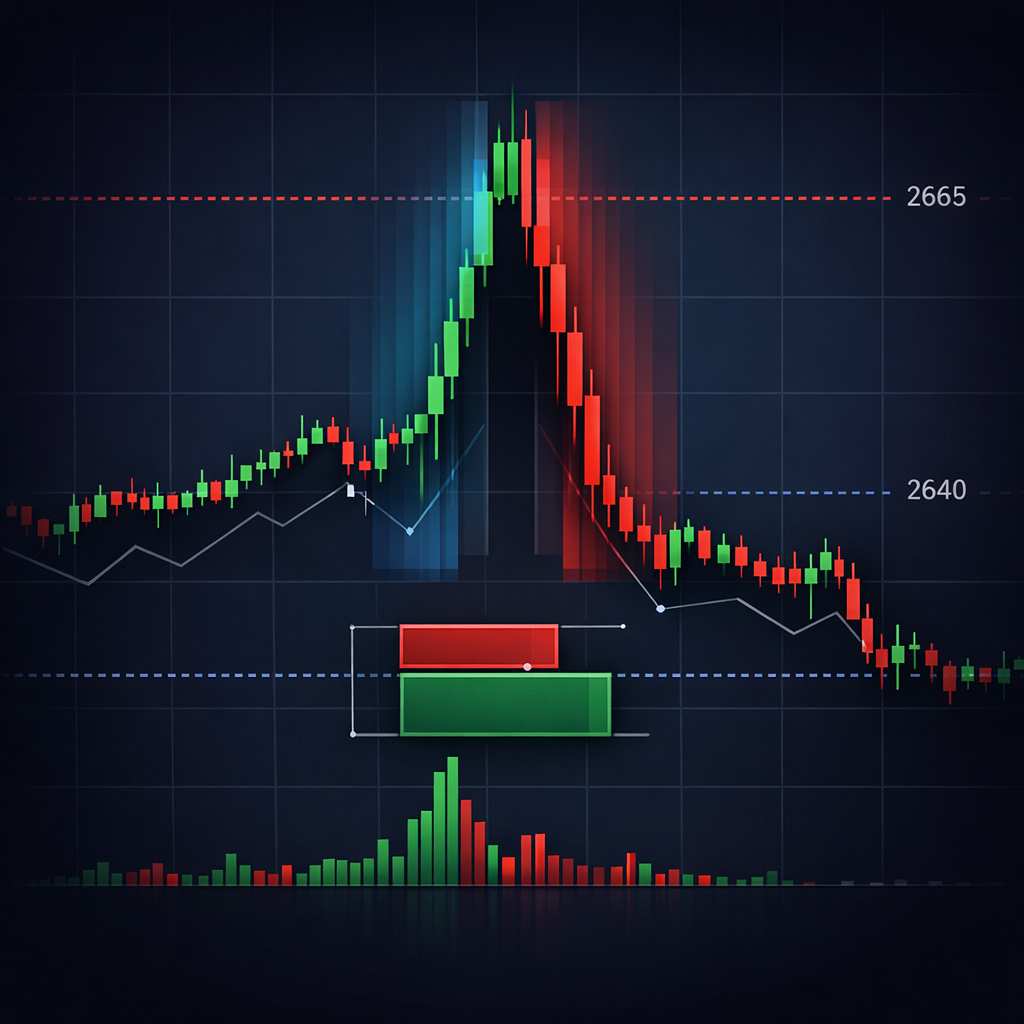
Gold doesn’t move on “rates” alone.
Gold moves on the market’s changing expectations about real yields, the US Dollar, and risk appetite.
During FOMC, those expectations can reprice in seconds.
The three engines behind the FOMC gold spike
1) The rate decision (headline): If the Fed surprises (hike/cut vs hold), gold can gap quickly.
2) The statement and dots (interpretation): Even if rates are unchanged, the language around inflation and growth can shift expectations.
3) Powell’s press conference (confirmation/whipsaw): The first move can reverse when the Q&A reframes the message.
Right now, we’re working with a realistic context: XAUUSD around $2650 (+0.35% on the day), DXY near 106.80, and major FX pairs like EUR/USD 1.0520, GBP/USD 1.2680, and USD/JPY 149.50.
That mix matters because gold’s first reaction often mirrors the dollar’s first reaction.
Why “normal” technicals fail in the first minutes
In calm markets, a 1-minute break of a level can be meaningful.
In FOMC minutes, that same break can be nothing more than a liquidity sweep.
Spreads widen, limit orders get skipped, and market orders fill worse than expected.
So the goal isn’t to predict.
The goal is to execute a plan that assumes chaos and still controls risk.
If you’re using signals, your edge becomes even more specific: you’re not trying to “trade everything.”
You’re trying to trade one or two high-quality signal confirmations with rules that protect you from the worst fills.
FOMC Reality Check: Spreads, Slippage, and Broker Behavior
Let’s say gold is trading at $2650.00 right before the release.
On a normal day, you might see a tight spread and clean fills.
During FOMC, your platform can show a completely different market than what you “thought” you were trading.
Spread widening: the hidden tax
Gold spreads can widen dramatically around the release.
Even a “small” widening can ruin your R:R if you don’t plan for it.
Example: you want to buy at $2652.00 with a $12 stop at $2640.00 and a 2R target at $2676.00.
If the spread widens and you get filled at $2653.20, you’ve already lost $1.20 of edge.
Slippage: why your stop gets hit “too fast”
Slippage is not always your broker “hunting” you.
Often, there simply isn’t liquidity at your stop price when price teleports through it.
That’s why the first 30 minutes needs a plan that limits exposure and avoids low-quality entries.
Execution types: market vs limit vs stop orders
During FOMC, each order type has a tradeoff:
- Market orders: highest fill probability, worst slippage risk.
- Limit orders: best price control, but you may miss the move entirely.
- Stop orders: great for breakouts, but can trigger on spikes and fill poorly.
Most traders lose here because they treat order types like preferences.
In FOMC, order types are risk controls.
Comparison table: FOMC order choice for XAUUSD (first 30 minutes)
| Order Type | Best Use Case | Main Risk in FOMC | Our Rule of Thumb |
|---|---|---|---|
| Market | After confirmation candle closes and spread normalizes | Slippage and poor average entry | Use only if spread is within your cap and structure is clear |
| Limit | Retests of a broken level (break-and-retest) | Missed fills in fast continuation | Great for Mode A retests; avoid placing too early |
| Stop | Breakout continuation when market is orderly | Triggered by wick sweeps; bad fills | Use only after the headline candle; never pre-place blindly |
One more reality: your broker’s gold contract specs matter.
If you don’t know your tick value, minimum lot size, and typical spread behavior during news, you’re trading blind.
Pre-FOMC Preparation (60 Minutes Before): Build Your “No-Panic” Setup

The first 30 minutes after FOMC are decided by what you do before FOMC.
Preparation removes improvisation, and improvisation is where most losses come from.
Step-by-step pre-news checklist (practical, not theoretical)
- Mark the nearest 2–3 key levels on M15/H1. Around $2650, that could be zones like $2638–$2642 support and $2668–$2672 resistance (use your chart, not guesses).
- Check today’s range and volatility. If gold has already moved $25–$35 pre-news, expect thinner follow-through and more whipsaw.
- Define your max spread rule. Example: “I only execute if spread is below $0.60.” Your number depends on broker and account size.
- Decide your risk per attempt. For FOMC, many disciplined traders cut risk to 0.25%–0.50% per trade instead of 1%.
- Plan two scenarios: bullish USD (often bearish gold) and bearish USD (often bullish gold). You’re not predicting—just preparing.
- Open your signal channel and confirm timing. If you follow United Kings, keep Telegram ready and avoid distractions.
If you’re new to signal execution, it helps to standardize how you follow alerts.
Our broader approach to signal selection and verification is covered in our guides and resources on the United Kings blog.
Build a “trade/no-trade” box before the release
Here’s a simple rule that saves accounts: if price is sitting in the middle of a messy range 2 minutes before the release, you don’t force it.
You wait for price to show its hand.
Example: Gold is at $2650 with a visible range between $2643 and $2662.
FOMC hits, price spikes to $2668, then snaps back to $2648.
If you pre-committed to “only trade after a close outside the range,” you avoid the trap.
Signal alignment: what you want to see before trusting an FOMC alert
- Clear levels already mapped (not drawn after the fact).
- Room to target at least 2R before the next major level.
- Position size reduced to account for unpredictable fills.
- Broker conditions acceptable (spread cap not violated).
If you want a consistent stream of structured entries with clear SL/TP, explore our premium gold signals built around London and New York session behavior.
The First 0–5 Minutes: Survive the Headline Candle (Don’t Try to Be a Hero)
The first 0–5 minutes are where accounts go to die.
Not because traders are “bad,” but because they treat FOMC like a normal breakout.
It isn’t.
What typically happens right at the release
Gold prints a violent 1-minute candle that can be $8–$20 tall.
Often, it has a huge wick on one side, showing a liquidity sweep.
Then the next candle reverses part or all of it.
Rule #1: Do not execute on the first candle unless your strategy is built for it
Most signal-based traders should avoid instant execution.
Your job is to wait for the market to reveal whether the first move is real.
Two acceptable approaches in minutes 0–5
Approach A: Wait for a 1-minute close + retest.
Example: price spikes from $2650 to $2665 and closes above $2660.
You wait for a retest of $2660–$2662 and only buy if it holds.
Approach B: Wait for a 3-minute “micro range” break.
Let 3 candles print, mark the high/low, then trade the break with confirmation.
This reduces the chance you’re trading the wick instead of the move.
Spread filter (non-negotiable)
In the first 60–120 seconds, spreads can be the widest.
If your spread cap is violated, you do nothing.
This is not “missing profit.” This is avoiding negative expectancy.
How to interpret your signal in the first 5 minutes
Signals are only as good as execution conditions.
If a signal says “BUY XAUUSD 2652, SL 2640, TP 2676,” but price is jumping $3 per tick, you need confirmation rules.
That’s why our community emphasizes structured execution alongside the alert itself.
If you’re still building consistency with signal execution, our guide on choosing and validating providers can help: forex signals provider checklist for beginners.
The 5–15 Minute Window: Your Highest-Probability Signal Confirmations
Minutes 5–15 are often the sweet spot.
The market has printed the initial reaction, spreads often start to normalize, and you can finally see structure.
This is where a gold signals FOMC strategy can be executed with rules instead of luck.
Mode A: Break-and-hold (continuation)
Use Mode A when price breaks a key level and holds above/below it with clean closes.
Think: “the market repriced and is now accepting the new range.”
Example (bullish gold continuation):
- Pre-FOMC resistance: $2668–$2672
- Headline spike breaks to $2678, then pulls back
- In minutes 7–10, price retests $2670 and prints higher lows
- Entry: Buy $2672
- Stop: $2658 (14 dollars risk)
- TP1 (1R): $2686
- TP2 (2R): $2700 (if within your broker’s liquidity and the day’s range allows; otherwise target $2696–$2698)
Notice the stop is not “tight.”
FOMC noise demands breathing room, so we reduce position size instead of forcing a $6 stop.
Mode B: Spike-and-fade (reversal)
Use Mode B when the first move is clearly rejected and price re-enters the pre-news range.
This is common when the headline is less important than the statement or when positioning was crowded.
Example (bearish gold fade after failed breakout):
- Gold spikes to $2684 but closes back below $2672
- Minutes 8–12: lower highs form under $2670
- Entry: Sell $2666
- Stop: $2682 (16 dollars risk)
- TP1 (1R): $2650
- TP2 (2R): $2634
Confirmation rules that keep you out of chop
- Two closes rule: require two 1-minute closes beyond a level before committing full risk.
- Wick filter: if both candles have huge opposing wicks, skip (market is still sweeping liquidity).
- Momentum check: if price can’t move $3–$5 in your direction after entry, it’s often a warning sign.
Our members often trade these windows using structured alerts in our United Kings signals room, where entries, SL, and TPs are posted clearly for fast-moving conditions.
The 15–30 Minute Window: Managing the Trade Like a Pro (Partials, BE, Trails)
The first entry is only half the game.
In FOMC conditions, trade management is where you protect your month.
Minutes 15–30 are when the move either trends cleanly or turns into a violent mean reversion.
Why partial profits matter more on FOMC than normal days
On a quiet session, you can hold for 2R–3R without much stress.
On FOMC, the market can give you 1R quickly and then snap back $12 in one candle.
Partials turn a stressful trade into a managed campaign.
A simple partial plan you can apply to most signals
- At +1R: take 30%–70% off (choose one rule and stick to it).
- After TP1: move stop to break-even only if price structure supports it (higher lows for buys, lower highs for sells).
- Runner target: aim for 2R–3R if spreads normalize and candles are directional.
Example management (buy scenario):
You buy $2654 with SL $2642 (12 risk).
TP1 at $2666 hits in minute 18.
You take 50% off and move SL to $2652 (not exactly BE, but under a micro swing).
You then target $2678 (2R) while trailing under 1-minute higher lows.
When to trail vs when to take the full target
Trail when the move is smooth and pullbacks are shallow.
Take the full target when price is hitting pre-marked H1 levels and printing long wicks.
How to handle the Powell whipsaw risk
Sometimes the first 15 minutes trend, then Powell reverses it.
If you’re still in a full-size position at minute 25 with no partials taken, you’re exposed.
That’s why our plan emphasizes banking something early and letting the rest run only when conditions support it.
If you want more structured guidance on how we think about protective rules, read: risk management strategies when using forex signals.
Stops and Position Sizing for FOMC Gold: The Math That Saves You
Most FOMC blowups aren’t caused by a “bad entry.”
They’re caused by a normal-sized position with an FOMC-sized stopout.
Volatility-aware stop placement (practical ranges)
In this market context (gold near $2650), a typical FOMC stop might be $10–$25 from entry.
That’s not a recommendation to use wide stops blindly.
It’s an acknowledgment that a $6 stop often becomes a donation when 1-minute candles are $8 tall.
Two stop models you can use with signals
Model 1: Structure stop.
Place SL beyond the level that invalidates the setup (previous swing high/low, or the broken level).
Model 2: Volatility stop.
If the market is printing $10 1-minute candles, your stop must account for that or you must reduce size and wait.
Position sizing example (simple and realistic)
Assume a $10,000 account.
You decide FOMC risk per attempt is 0.5% ($50).
Your signal entry is $2652 with SL $2637 (15 dollars risk).
Your lot size should be calculated so that a $15 move equals $50 loss.
The exact lot depends on your broker’s contract specification for XAUUSD.
So your rule is: calculate lot size from $ risk ÷ stop distance, not from “what you usually trade.”
Why you should reduce risk during FOMC
- Slippage risk can turn a planned $50 loss into $70–$120.
- Spread spikes can trigger stops early.
- Emotional decisions are more likely when candles are huge.
Professional traders don’t avoid risk.
They price it in.
If you want a broader roadmap on signal execution and position control, pair this article with: forex signals Telegram for beginners guide.
When to Skip the Trade (The Most Profitable Decision You’ll Make)
Skipping is a skill.
And during FOMC, it’s often the difference between a green month and a revenge-trading spiral.
Skip rule #1: Spread is beyond your cap
If your spread cap is $0.60 and you see $1.20, you don’t “hope it improves.”
You wait.
If it never improves, you skip the entire event.
Skip rule #2: The signal conflicts with obvious higher-timeframe levels
Example: a buy signal triggers at $2682 directly into a major H1 resistance zone at $2685–$2690.
Even if price can pop $3–$5, your 2R target may be blocked.
That’s a low-quality trade.
Skip rule #3: You missed the entry and price ran too far
Chasing is expensive in FOMC.
If the signal was buy $2654 and price is now $2666, your stop distance and R:R change.
Either you recalculate a new plan or you skip.
Skip rule #4: The chart is printing “equal pain” (whipsaw symmetry)
If price is ripping up $12 and down $12 repeatedly inside a tight band, that’s a liquidity machine.
Your job is not to feed it.
Skip rule #5: You’re not mentally ready
If you’re coming into FOMC after a loss, tired, or distracted, you are more likely to break rules.
Skipping protects your capital and your psychology.
We also cover how signals behave during surprises and chaotic headlines here: how gold signals react to unexpected news events.
Putting It Together: A Step-by-Step XAUUSD News Trading Plan (First 30 Minutes)
This is the full playbook you can follow like a checklist.
It’s designed for traders using signals, but it works even if you trade discretionary.
Step 1 (T-60 to T-15): Map levels and set risk
- Mark H1/M15 zones around current price ($2650): nearest support and resistance.
- Decide risk per attempt (commonly 0.25%–0.50% for FOMC).
- Set a max spread cap and commit to it.
Step 2 (T-15 to T-1): Prepare execution tools
- Open XAUUSD M1 and M5 charts.
- Ensure one-click trading is configured (only if you are experienced).
- Have your signal source ready (Telegram, platform alerts).
Step 3 (Minute 0–3): Observe the headline candle
- No impulsive entries.
- Watch spread and price speed.
- Mark the high and low of the first 1–3 minutes.
Step 4 (Minute 3–10): Choose Mode A or Mode B
- Mode A: break-and-hold above resistance or below support with clean closes.
- Mode B: spike rejection and re-entry into the pre-news range.
Step 5 (Minute 5–15): Execute only with confirmation
- Two closes beyond a level (or close + retest hold).
- Spread within cap.
- SL placed beyond invalidation, typically $10–$25 depending on structure.
- TP set for 2R minimum when conditions allow.
Step 6 (Minute 15–30): Manage aggressively, not emotionally
- Take partials at 1R.
- Move SL only when structure supports it.
- Trail a runner if the move is clean; otherwise take profit into major levels.
Step 7 (After 30 minutes): Stop trading if you hit limits
Set a hard rule: max 1–2 attempts in the first 30 minutes.
If you lose once, don’t instantly “win it back.”
Wait for the market to stabilize or come back next session.
If you want this kind of structured execution paired with real-time alerts, our XAUUSD gold signals are built specifically for fast decision-making with clear entries, SL, and TP.
Realistic FOMC Trade Examples (Using Today’s Price Context)
Let’s ground this in realistic numbers around current levels.
Gold is around $2650, DXY is 106.80, and USD/JPY is 149.50.
That’s a backdrop where gold can react sharply to any perceived shift in Fed tone.
Example 1: Mode A continuation buy (clean break)
Setup: Pre-news resistance at $2662 and $2672.
Event: Gold spikes to $2676, pulls back, then holds above $2662 with two 1-minute closes.
- Entry: Buy $2664
- Stop: $2649 (15 risk)
- TP1 (1R): $2679 (take 50%)
- TP2 (2R): $2694 (take remaining or trail)
Why it works: You’re not buying the spike.
You’re buying acceptance above a level with room to the next zone.
Example 2: Mode B reversal sell (failed breakout)
Setup: Pre-news range high at $2668–$2672.
Event: Gold wicks to $2688 but closes back under $2672 and then prints a lower high.
- Entry: Sell $2668
- Stop: $2686 (18 risk)
- TP1 (1R): $2650
- TP2 (2R): $2632
Why it works: You’re trading the reclaim of the range, not guessing the top.
Example 3: A “skip” that saves money (spread + chaos)
Event: In minute 1, spread jumps and price prints $20 candles.
A signal triggers, but your platform shows inconsistent quotes and your spread cap is violated.
Decision: You skip.
Outcome: Price whipsaws $30 up and down, taking both sides.
This is a win even though you didn’t trade.
Signals are a tool, not a command.
Execution conditions decide whether the tool is usable.
How United Kings Traders Use Signals During FOMC (Without Overtrading)
Signals can be powerful in FOMC, but only if they’re paired with rules.
At United Kings, the goal is not to spam trades.
The goal is to give you clear Entry, SL, and TP levels and help you execute with discipline.
Our community framework (what “signal-based” really means)
- Clarity: entries and risk levels are explicit.
- Session focus: we emphasize London and New York behavior because liquidity matters.
- Education alongside alerts: you learn why a setup is valid, not just what to click.
- Community scale: 300K+ active traders sharing context and execution notes.
We also aim for a high-quality approach that our members recognize for consistency, with a stated 85%+ win rate track record in our community communications.
Remember: past performance doesn’t guarantee future results, and outcomes depend on execution, broker conditions, and risk control.
Where signals fit in your FOMC plan
Signals are best used as:
- A structured bias (buy vs sell) after the initial reaction.
- A precise entry framework when the market confirms Mode A or Mode B.
- A management guide for partials and targets when volatility is high.
Where signals should NOT be used
- As a reason to trade when spreads are out of control.
- As permission to revenge trade after a loss.
- As “guaranteed” outcomes (no legitimate provider can promise that).
If you trade more than gold, you can also explore our broader coverage on forex signals and even diversification options like crypto signals—but for FOMC, we recommend keeping your focus tight.
To follow the live community and alerts, you can join our Telegram here: United Kings Telegram channel for real-time signals.
FAQ: Trading XAUUSD During FOMC (First 30 Minutes)
1) Is it better to trade immediately at the FOMC release or wait?
For most traders, waiting is better.
The first 1–3 minutes often contain liquidity sweeps and extreme spreads.
A confirmation-based entry in minutes 5–15 is usually more controllable.
2) What stop loss size is “normal” for gold during FOMC?
Many setups require $10–$25 depending on volatility and structure.
The key is not the stop size alone, but matching it with smaller position sizing so your account risk stays fixed.
3) How many trades should I take in the first 30 minutes?
Typically 0–2 attempts.
Overtrading is the fastest way to give back gains during FOMC whipsaws.
4) What if I get slippage and my entry is worse than planned?
Recalculate the trade.
If the new entry ruins your risk-to-reward or pushes your stop too far, skip.
5) Can beginners trade FOMC gold safely with signals?
Beginners should start with demo trading and smaller risk.
Signals help with structure, but they don’t remove the need for execution discipline and risk control.
Risk Disclaimer (Read Before You Trade)
Forex and gold trading involves significant risk and can result in substantial losses.
FOMC events are highly volatile, and spreads, slippage, and rapid price moves can exceed your planned risk.
Nothing in this article is financial advice, and no profits are guaranteed.
Past performance does not guarantee future results. If you’re new, practice on a demo account and use proper position sizing.
Join United Kings: Trade FOMC With Structure, Not Stress
If you want a clear, signal-based framework for trading XAUUSD during major events, we built United Kings for exactly that.
You’ll get premium Telegram signals for forex and gold with clear Entry, SL, and TP levels, plus educational context to help you execute under pressure.
Choose your plan (3 options)
- Starter: 3 Months for $299 (~$100/mo)
- Best Value: 1 Year for $599 (~$50/mo) with 50% savings + FREE ebook
- Unlimited: Lifetime for $999 (pay once, access forever)
See all options on our pricing page with the 3 plans.
We also offer a 48-hour money-back guarantee for added confidence.
Next step: Join the community and get real-time alerts here: United Kings Telegram for gold & forex signals.
Or explore our full signal coverage on UnitedKings.net signals and our dedicated gold signals page.