
Ever watched gold (XAUUSD) spike $12 in 30 seconds during FOMC Minutes… only to reverse, stop you out, and then run another $25 in the original direction?
If you’ve traded news even once, you know the feeling. Your analysis wasn’t “wrong”—the market structure was right, the level was clean, and the bias made sense.
What failed was the execution environment: spreads widen, liquidity thins, algorithms hunt stops, and your broker fills you at the worst possible price. That’s why learning how to trade XAUUSD during FOMC minutes is less about predicting and more about following a strict, signal-based playbook.
TL;DR — The Signal-Based FOMC Minutes Playbook
- Don’t “pre-guess” direction. Use a two-phase plan: (1) survive the spike, (2) trade the 30–90 minute continuation.
- Spread filter is non-negotiable. If XAUUSD spread is above your threshold (example: > $0.60–$1.20 depending on broker), you skip market entries and switch to confirmation-only.
- Expect fakeouts. First move is often a liquidity sweep. Wait for a reclaim/close and a retest before trusting the breakout.
- Volatility-adjust SL/TP. Use a news SL range of roughly $10–$25 and aim for 1:2 to 1:3 R:R (example: risk $12 to target $24–$36).
- Use time-based stops. If price doesn’t follow through within 10–20 minutes after entry, reduce risk or exit—FOMC minutes moves can die fast.
- Signals work best with rules. A premium signal (Entry/SL/TP) is powerful, but only if you apply spread, slippage, and invalidation filters consistently.
Why FOMC Minutes Move Gold So Aggressively (And Why It’s Different)
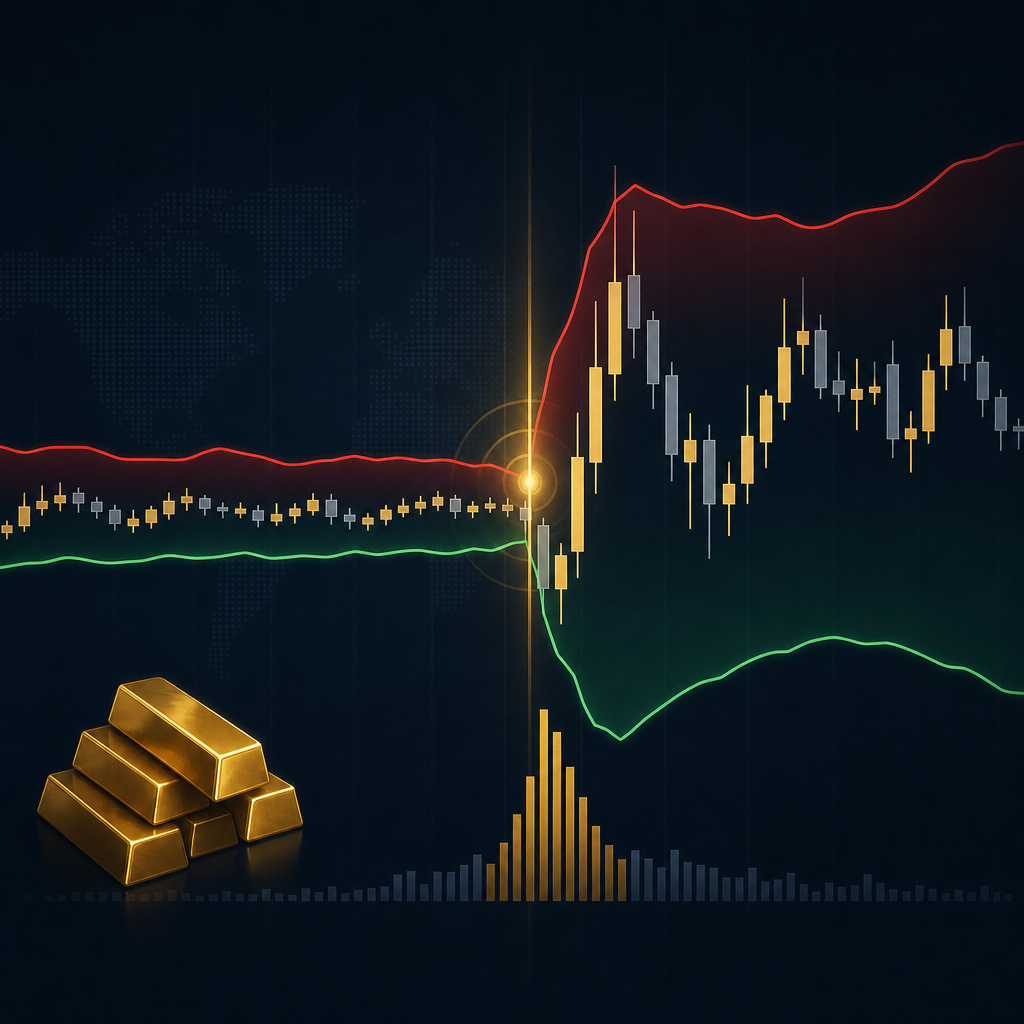
FOMC Minutes are not a rate decision. They’re the story behind the decision, and that story changes expectations fast.
Gold is priced in dollars and heavily influenced by real yields. So when the Minutes hint at “higher for longer” or reveal disagreement inside the Fed, markets reprice the path of rates.
That repricing hits three instruments instantly: US yields, DXY, and XAUUSD. Right now, with DXY around 106.80 and gold near $2650 (+0.35% on the day), even small wording changes can cause sharp bursts of volatility.
There’s another layer: FOMC Minutes often drop into a market that already has positioning. If traders are heavily long gold into the release, a mildly hawkish tone can trigger a fast liquidation.
Then, once stops are cleared, the “real” move starts. That’s why your first job is to identify whether the initial spike is price discovery or liquidity hunting.
Typical XAUUSD behavior during FOMC Minutes
- 1–3 minutes: spread expansion + whipsaw; both sides get tagged.
- 3–15 minutes: a directional attempt forms; fake breakouts are common.
- 15–45 minutes: continuation or full reversal; this is where structured entries shine.
- 45–90 minutes: trend extension, mean reversion, or range; best time for signal-based scaling and trailing.
Think of FOMC Minutes as a “two-act play.” Act 1 is chaos. Act 2 is tradable.
Pre-News Checklist: Build the Map Before the Market Goes Loud
Most traders lose on FOMC Minutes before the Minutes even drop. They enter with no map, no thresholds, and no plan for spreads.
We want the opposite. Your goal is to arrive at the release with three things: (1) key levels, (2) volatility expectations, (3) execution rules.
Use the current context as your anchor. Gold is around $2650. Your key working range for examples is $2610–$2690.
Step-by-step: the 20-minute pre-news routine
- Step 1 — Mark the session structure. Identify London/NY highs and lows. FOMC Minutes often sweep one of them first.
- Step 2 — Mark 3–5 “decision levels.” Use round numbers and recent swing points (example: $2635, $2650, $2666, $2682).
- Step 3 — Measure 60-minute ATR. If your 60-min ATR is $8 normally and it’s printing $12 into the event, expect wider swings and reduce size.
- Step 4 — Define your spread threshold. Decide in advance what spread makes you “hands off.”
- Step 5 — Choose your trade type. Spike trade (high risk) or continuation trade (higher probability).
This is also where signals become valuable. If you’re using premium alerts from a provider, you want to know which signals are valid in news conditions and which are “normal market only.”
At United Kings, our Telegram-style format is clear: Entry, SL, TP targets. But the pro edge is applying a consistent execution filter around news.
If you’re new to signal execution, pair this guide with our resources inside United Kings trading signals and the risk rules in risk management strategies when using forex signals.
The Spread & Slippage Problem: Your Real Enemy During FOMC Minutes

Most “news trading strategies” ignore the most important variable: execution quality.
On FOMC Minutes, XAUUSD spreads can widen sharply. What looks like a clean breakout at $2652 might fill you at $2653.20, instantly putting you in drawdown.
That changes everything: your stop is effectively tighter, your R:R shrinks, and your psychology deteriorates.
Define your spread filter (practical numbers)
Your broker and account type matter, but here’s a realistic decision framework:
- Normal conditions: $0.20–$0.45 spread (varies).
- Caution zone: $0.60–$1.20 spread (you need confirmation-only entries).
- Skip zone: above $1.20–$2.00 (avoid market orders; consider standing aside).
We’re not saying “never trade.” We’re saying trade differently.
Comparison: Entry methods during FOMC Minutes
| Method | Best Use | Main Risk | When We Prefer It |
|---|---|---|---|
| Market order on release | Capturing the first spike | Slippage + spread blowout + whipsaw | Only with strict spread cap + small size |
| Stop order (breakout) | Momentum continuation | Triggered by fakeout, filled at worst price | Rarely; only after structure forms |
| Limit order at retest | Post-spike continuation | Missed trade if no retest | Most common for 30–90 min plan |
| Wait for candle close + enter | Filtering fakeouts | Late entry, smaller R:R | Best for beginners and consistency |
Slippage reality check (and how to plan for it)
Assume you may experience $0.50–$2.00 slippage in peak seconds. That’s why your stop needs breathing room.
If your stop is only $6 away in a news release, you’re not trading a strategy—you’re donating to volatility.
Instead, set your plan like this: “If spread exceeds $1.20, I wait for a 5-minute close + retest.” That rule alone saves accounts.
Phase 1 — The Initial Spike: When to Trade It (and When to Let It Go)
The initial spike is seductive because it’s fast money. It’s also where most traders get chopped.
We treat spike trading as an advanced add-on, not the core plan. If you’re building consistency, your bread and butter should be the continuation phase.
The only two spike setups we consider “valid”
- Setup A: Level-to-level impulse with spread under control. Price breaks a major level (example $2650) and immediately accelerates to the next level (example $2666) with minimal wick-back.
- Setup B: Liquidity sweep + instant reclaim. Price spikes below a known low (example $2638), then closes back above it and holds for 1–3 minutes.
Anything else is usually noise. If it’s messy, it’s a pass.
Example: Spike trade with volatility-adjusted risk
Let’s say gold is at $2650 pre-release. Minutes hit, price spikes to $2662, pulls back, then prints a 1-minute close above $2658.
- Entry: Buy $2659.0 (only if spread is acceptable)
- Stop: $2647.0 (risk $12)
- TP1: $2683.0 (reward $24, 1:2)
- TP2: $2695.0 (reward $36, 1:3) — only if volatility remains elevated
Notice the stop. It’s not “tight.” It’s realistic for news.
Also notice the logic: we’re not buying the first candle. We’re buying acceptance above a level.
Trade invalidation criteria (spike phase)
- Spread jumps above your cap after entry and price stalls.
- Price re-enters the pre-news range and holds there for 3–5 minutes.
- A 5-minute candle closes back below the breakout level (for longs) or above it (for shorts).
Spike trading is about quick decisions. If you hesitate, you’re late.
Phase 2 — The 30–90 Minute Continuation: The Highest-Probability Window
If you only trade one part of FOMC Minutes, trade this.
By 30 minutes after release, spreads often normalize, the market chooses a narrative, and structure becomes visible. That’s where signals shine because entries can be planned and stops can be placed logically.
What continuation looks like on XAUUSD
Continuation is usually one of these:
- Break → retest → go. Price breaks $2650, retests it as support, then runs to $2666/$2682.
- Fakeout → reversal → trend. Price breaks up first, fails, then sells off through $2650 and trends down.
- Range → expansion. Price ranges for 20–40 minutes, then expands when liquidity returns.
Step-by-step: the continuation entry model (signal-friendly)
- Step 1 — Identify the “post-news range.” Mark the high/low of the first 15 minutes.
- Step 2 — Wait for a 5-minute close outside the range. This is your confirmation filter.
- Step 3 — Wait for the retest. Price revisits the broken boundary or key level.
- Step 4 — Enter with a defined invalidation. Stop goes beyond the retest swing (usually $10–$25).
- Step 5 — Target the next liquidity pocket. Previous highs/lows, round numbers, or measured moves.
This approach reduces the chance you buy the top of the spike or sell the bottom of the flush.
Example: 30–90 minute continuation long
Assume the first 15 minutes after release create a range: $2642 low to $2660 high. Then a 5-minute candle closes above $2660 at $2663.
- Entry: Buy the retest at $2660.5
- Stop: $2648.5 (risk $12)
- TP1: $2684.5 (reward $24)
- TP2: $2696.5 (reward $36) if momentum persists
This is clean, repeatable, and compatible with signal alerts because your execution is based on confirmation, not prediction.
Fakeouts & Liquidity Sweeps: How to Stop Being the Exit Liquidity
FOMC Minutes fakeouts aren’t random. They’re a function of liquidity.
When spreads widen and order books thin, it takes less volume to push price into obvious stops. Algorithms know where retail stops cluster: just beyond recent highs/lows and round numbers.
If you trade gold around $2650, understand that $2650 itself is a magnet. So are $2660, $2670, and $2680.
Three fakeout patterns that show up repeatedly
- Wick-through level + close back inside. Price trades $2666 briefly but closes the 1-min/5-min candle back below $2666.
- Double break. Break up, fail, then break down. This is the “both sides get paid” move.
- Range expansion trap. Price breaks the first 15-min range, runs $6–$10, then snaps back through the range to the other side.
Confirmation tools that actually help (without overcomplicating)
You don’t need 12 indicators. You need a simple confirmation stack:
- Candle close rule: Require a 5-minute close beyond the level, not just a wick.
- Retest rule: Enter on retest, not on initial break.
- Momentum check: After the break, does price make higher highs (for longs) without immediate deep pullbacks?
If you want one indicator, use VWAP or a fast EMA as a “mean” reference. But remember: during news, price can ignore means for longer than you expect.
Story: the most common FOMC minutes trap
Gold trades $2650 pre-release. Minutes hit, it spikes to $2668. Retail buys the breakout.
Then it dumps to $2644, stops everyone, and only then trends up to $2685 over the next hour. Same direction. Wrong timing.
The fix is simple: wait for the reclaim and retest. Let the trap happen without you.
Signal-Based Execution: How to Use Entries/SL/TP Around FOMC Minutes
Signals are not magic. They’re a framework: a proposed entry, a defined stop, and a set of targets.
During FOMC Minutes, the question is not “Is the signal good?” It’s “Is the execution environment suitable for this signal type?”
That’s why we use a signal-based playbook with two modes: Normal Mode and News Mode.
Normal Mode vs News Mode (what changes)
- Entry: In News Mode, you prefer confirmation entries (close + retest) over instant entries.
- Stop loss: In News Mode, stops are volatility-adjusted ($10–$25 typical) and placed beyond structure, not tight behind it.
- Targets: In News Mode, TP1 is often closer (1:2) to bank something, while TP2 aims for 1:3 if the trend persists.
- Position size: In News Mode, you reduce size to keep the same $ risk.
Step-by-step: converting a signal into a “news-proof” plan
- Step 1 — Check the clock. If you’re within 10 minutes of Minutes release, assume spreads can widen.
- Step 2 — Check spread threshold. If spread is above your cap, do not market-enter.
- Step 3 — Add confirmation. Require a 1-min or 5-min close in the signal direction.
- Step 4 — Use the retest entry. Enter near the level after confirmation, not at the spike extreme.
- Step 5 — Keep the original invalidation idea. Don’t “widen” stops randomly; widen them only to match structure and volatility.
Where United Kings signals fit
Our community focuses heavily on London and New York sessions, where gold liquidity is best. That matters because FOMC Minutes usually hit during US hours, when XAUUSD can move fast but also offers the best follow-through.
If you want to see how professional signal formatting should look (Entry/SL/TP clarity), start with United Kings gold signals and our broader forex signals coverage for correlated moves (EUR/USD at 1.0520, GBP/USD at 1.2680, USD/JPY at 149.50 can all hint at USD strength/weakness).
And if you’re still learning how to execute alerts like a pro, browse more guides in our trading blog.
Volatility-Adjusted SL/TP, Time-Based Stops, and Invalidation Rules
News trading without strict risk rules is not trading. It’s gambling with a chart.
FOMC Minutes can produce a $20 move that reverses in 2 minutes. Your stop and trade management must reflect that reality.
Volatility-adjusted stops (practical framework)
Use one of these stop models:
- Structure stop: Place SL beyond the retest swing (often $10–$18 in active conditions).
- ATR stop: SL = 1.0–1.5x 15-min ATR during news (often lands in the $12–$25 range).
If you’re risking $12 on gold, you’re risking roughly 120 “points” (depending on broker quoting). Make sure your position size reflects that.
Targets that match news behavior
- TP1 (bank): 1:2 is your “professional” target (risk $12 → take $24).
- TP2 (runner): 1:3 is your “trend extension” target (risk $12 → take $36).
During FOMC Minutes, taking partials is not weakness. It’s survival.
Time-based stops: the underrated weapon
A time-based stop means: if the trade doesn’t move as expected within a defined window, you cut it.
- Spike trades: if not in profit within 3–7 minutes, exit or reduce.
- Continuation trades: if no follow-through within 10–20 minutes, consider closing or moving to break-even after structure forms.
This prevents “dead trades” that later get reversed by a second wave of volatility.
Clear invalidation criteria (copy/paste rules)
- Level failure: 5-min close back inside the broken range.
- Momentum failure: two consecutive lower highs after a bullish break (or higher lows after bearish break).
- Correlation warning: DXY flips hard against your position (example: DXY rips above 106.80 while you’re long gold).
Invalidation rules keep you objective when the tape gets emotional.
Correlation Playbook: Use DXY and USD Pairs as a Real-Time Filter
Gold doesn’t trade in a vacuum. During FOMC Minutes, the cleanest filter is the US dollar.
Right now, we’re watching DXY around 106.80. If DXY surges, gold often drops. If DXY dumps, gold often rallies.
It’s not perfect, but it’s useful in the exact moments when XAUUSD is chaotic.
How to use DXY as confirmation (simple rules)
- Gold long bias: prefer when DXY is making lower highs and breaking down intraday.
- Gold short bias: prefer when DXY is making higher highs and holding above key levels.
Think of it as “wind at your back.” You can still trade against it, but you need stronger confirmation.
FX pairs as supporting evidence
Use major pairs as a quick USD sentiment dashboard:
- EUR/USD at 1.0520: if it breaks up strongly, USD weakness can support gold longs.
- GBP/USD at 1.2680: same logic—strong GBPUSD often aligns with softer USD.
- USD/JPY at 149.50: if USDJPY spikes higher, it can reflect USD strength or yield strength (often bearish gold).
This is not about over-analysis. It’s about preventing the classic mistake: buying gold while USD strength is accelerating.
Example: correlation saves you from a bad long
You see gold break above $2660 and consider a long. But at the same time, DXY breaks above 106.80 and USD/JPY pushes through 149.50 with momentum.
That’s a yellow flag. You either wait for stronger gold confirmation (close + retest) or you skip. Many “mystery reversals” are just correlation doing its job.
Two Complete Trade Scenarios (With Numbers): Fakeout Reversal and Continuation Trend
Let’s turn the playbook into two realistic scenarios using the current price zone ($2610–$2690) and typical news volatility.
Scenario 1: The classic fakeout reversal (break up, then dump)
Context: Gold sits near $2650 pre-release. Minutes are interpreted hawkish. First move is up (trap), then the real move is down.
- Pre-news levels: resistance $2666, support $2640
- Initial spike: price wicks to $2668, then closes 5-min back below $2666
- Trigger: break below $2650 with a 5-min close at $2647
Trade plan (continuation short):
- Entry: Sell retest at $2650.0
- Stop: $2663.0 (risk $13)
- TP1: $2624.0 (reward $26, 1:2)
- TP2: $2611.0 (reward $39, 1:3) if momentum persists
Time stop: If price can’t trade below $2640 within 15 minutes after entry, reduce risk or exit.
This scenario is where beginners often get hurt because they buy the first break above $2666. The pro waits for the failure and sells the retest.
Scenario 2: Post-news continuation trend (break, retest, run)
Context: Minutes lean dovish or show concern about growth. USD softens. Gold trends higher after the initial noise.
- First 15-min range: $2646 to $2662
- Confirmation: 5-min close above $2662 at $2665
- Retest: price pulls back to $2662–$2663 and holds
Trade plan (continuation long):
- Entry: Buy $2663.0
- Stop: $2651.0 (risk $12)
- TP1: $2687.0 (reward $24)
- TP2: $2699.0 (reward $36) if volatility remains elevated
Management: At TP1, consider taking 50–70% and moving SL to break-even or under the last 5-min swing low.
This is the “boring” trade that makes money. It’s also the one most traders miss because they’re emotionally exhausted from the first 5 minutes.
Position Sizing for FOMC Minutes: Keep the Same Risk, Trade Smaller
FOMC Minutes doesn’t require bravery. It requires math.
If your normal gold stop is $7 and news requires $14, your size should be roughly half to keep risk constant.
That’s how professionals survive high-volatility events and still show up tomorrow.
Simple sizing logic (no complicated formulas)
- Decide your account risk: many disciplined traders use 0.5%–1.0% per idea.
- Set your stop distance: during FOMC Minutes, often $10–$25.
- Reduce size accordingly: bigger stop = smaller size.
If you want a deeper sizing walkthrough, pair this with a calculator-based approach from our broader education and risk framework content. The goal is simple: your $ risk stays stable even when volatility doubles.
Common sizing mistakes during news
- Mistake 1: keeping normal lot size with a wider stop (risk explodes).
- Mistake 2: keeping normal stop with normal lot size (you get stopped by noise).
- Mistake 3: revenge sizing after a whipsaw loss (you compound the problem).
FOMC Minutes rewards calm execution. If you feel your heart rate spike, your size is too big.
Operational Rules: The Exact “Do / Don’t” List for FOMC Minutes
Let’s make this painfully practical. When the release hits, you don’t want to think. You want to follow rules.
Do this
- Do pre-mark levels ($2635/$2650/$2666/$2682 are common style anchors in this zone).
- Do use a spread cap and switch to confirmation-only when spreads widen.
- Do wait for 5-min closes to confirm a break.
- Do trade the retest (best blend of price and confirmation).
- Do use time stops (3–7 minutes for spike, 10–20 for continuation).
- Do take partial profits at 1:2 and let a runner aim for 1:3.
Don’t do this
- Don’t place tight stops ($4–$6) in peak news volatility.
- Don’t chase the first candle unless you are an experienced spike trader with strict rules.
- Don’t stack multiple positions in the first 2 minutes because “it has to go.”
- Don’t ignore DXY when it’s moving aggressively against your gold bias.
How United Kings traders implement this in real time
In our community, the best performers treat FOMC Minutes as a structured session. They show up with levels, a spread filter, and a plan to trade the continuation.
Signals help because they remove guesswork. But discipline is what turns a signal into a result.
If you want premium Telegram alerts with clear Entry/SL/TP and educational guidance, explore United Kings signals and our dedicated gold signals page. You can also join the live community feed on United Kings Telegram channel.
FAQ: Trading XAUUSD During FOMC Minutes
1) Is it better to trade the spike or the continuation after FOMC Minutes?
For most traders, the 30–90 minute continuation offers better probability and cleaner spreads. The spike is faster but more prone to slippage and fakeouts.
2) What spread is “too high” to trade gold during FOMC Minutes?
It depends on your broker, but many traders avoid market entries when spread is above roughly $1.20. Above that, confirmation-only entries (close + retest) are usually safer.
3) What stop loss size is realistic for XAUUSD during FOMC Minutes?
A common workable range is $10–$25 depending on volatility and structure. Tight stops often get tagged by news wicks.
4) How do I avoid false breakouts on FOMC Minutes?
Use a 5-minute close confirmation and enter on the retest of the level. Avoid trading wick-only breaks.
5) Can I use gold signals during FOMC Minutes?
Yes, but you should apply a news execution filter: spread cap, confirmation requirement, volatility-adjust sizing, and clear invalidation criteria. Demo testing first is recommended if you’re new.
Risk Disclaimer (Read Before You Trade)
Trading forex and gold (XAUUSD) involves significant risk and is not suitable for every investor. News events like FOMC Minutes can cause extreme volatility, widened spreads, and slippage that may increase losses. Past performance does not guarantee future results. No signal provider can guarantee profits. If you are a beginner, practice on a demo account first and use strict risk management on every trade.
Join United Kings: Premium XAUUSD Signals Built for Real Market Conditions
If you want a structured way to trade gold around high-impact events, you don’t need more indicators. You need clear levels, clear risk, and consistent execution.
United Kings delivers premium Telegram signals for forex and gold with clear Entry, SL, and TP levels, backed by an experienced team and a community of 300K+ active traders. We focus heavily on London and NY session opportunities and provide educational context alongside alerts.
Choose a plan that fits your goals on our United Kings pricing page: Starter (3 Months $299), Best Value (1 Year $599 with 50% savings + FREE ebook), or Unlimited (Lifetime $999). Every plan includes a 48-hour money-back guarantee.
Ready to trade XAUUSD with a professional, rule-based edge? Start with United Kings Gold Signals and join the live feed on our official Telegram.


