Ever watched gold (XAUUSD) jump $20–$40 in seconds during an FOMC rate decision… and felt like the market moved perfectly without you?
You’re not alone.
Trading XAUUSD during Fed rate decisions can feel like trying to catch a falling knife—except the knife can teleport.
In this guide, we’ll build a time-boxed, step-by-step signal execution plan for FOMC days: what to do 60–15 minutes before, how to survive the initial spike, and how to take safer continuation or reversal entries after the dust settles.
We’ll use realistic market context: XAUUSD ~$2650 (+0.35% 24h), DXY 106.80, EUR/USD 1.0520, GBP/USD 1.2680, USD/JPY 149.50.
TL;DR: Trade XAUUSD During FOMC (Quick Playbook)
- Don’t “guess” the Fed. Build a plan that reacts to price, not your opinion, and use predefined entry/SL/TP levels from a trusted signal source.
- 60–15 minutes pre-news: Mark key liquidity levels (range high/low, Asia high/low, London swing), reduce risk, and decide whether you’ll trade the spike or only the post-spike setup.
- During the spike: Expect spread widening and slippage. Prefer confirmation entries over market orders, and avoid chasing the first candle.
- Post-news (5–30 minutes): The highest-quality trades often come from a retest (break-and-retest) or a failed breakout reversal with clear invalidation.
- Risk framework: On FOMC, cut position size to 25–50% of normal and use structured stops (typically $10–$25 on gold depending on volatility).
- Signals execution: A good signal includes Entry, SL, TP1/TP2 and a plan for partials. United Kings focuses on London/NY timing and clean levels.
Why FOMC Rate Decisions Move XAUUSD So Violently
If you want to trade XAUUSD during FOMC consistently, you need to understand why the move happens.
Gold is not just “a commodity.” It’s a global macro instrument priced in USD, sensitive to real yields, the Dollar Index (DXY), and risk sentiment.
On FOMC days, markets reprice the future path of interest rates in minutes.
That repricing hits gold through three main channels.
1) Real yields and opportunity cost
Gold doesn’t pay interest.
When the Fed is perceived as more hawkish (higher-for-longer), real yields can rise, increasing the opportunity cost of holding gold.
That often pressures XAUUSD lower, especially if the move is “clean” and not risk-off driven.
2) USD strength (DXY) and funding flows
Gold is priced in dollars.
When DXY strengthens (today around 106.80), it can mechanically weigh on XAUUSD.
But on FOMC, the USD can whipsaw: an initial spike up, then a reversal as traders digest the statement and press conference tone.
3) Risk sentiment and safe-haven demand
Sometimes gold rallies even if the Fed is hawkish.
Why?
Because markets might interpret the decision as increasing recession risk, credit stress, or equity volatility.
That’s when gold trades like a hedge and can rip higher.
The practical takeaway for signal traders
FOMC is not one event; it’s a sequence.
The rate decision hits, then the statement, then the press conference Q&A.
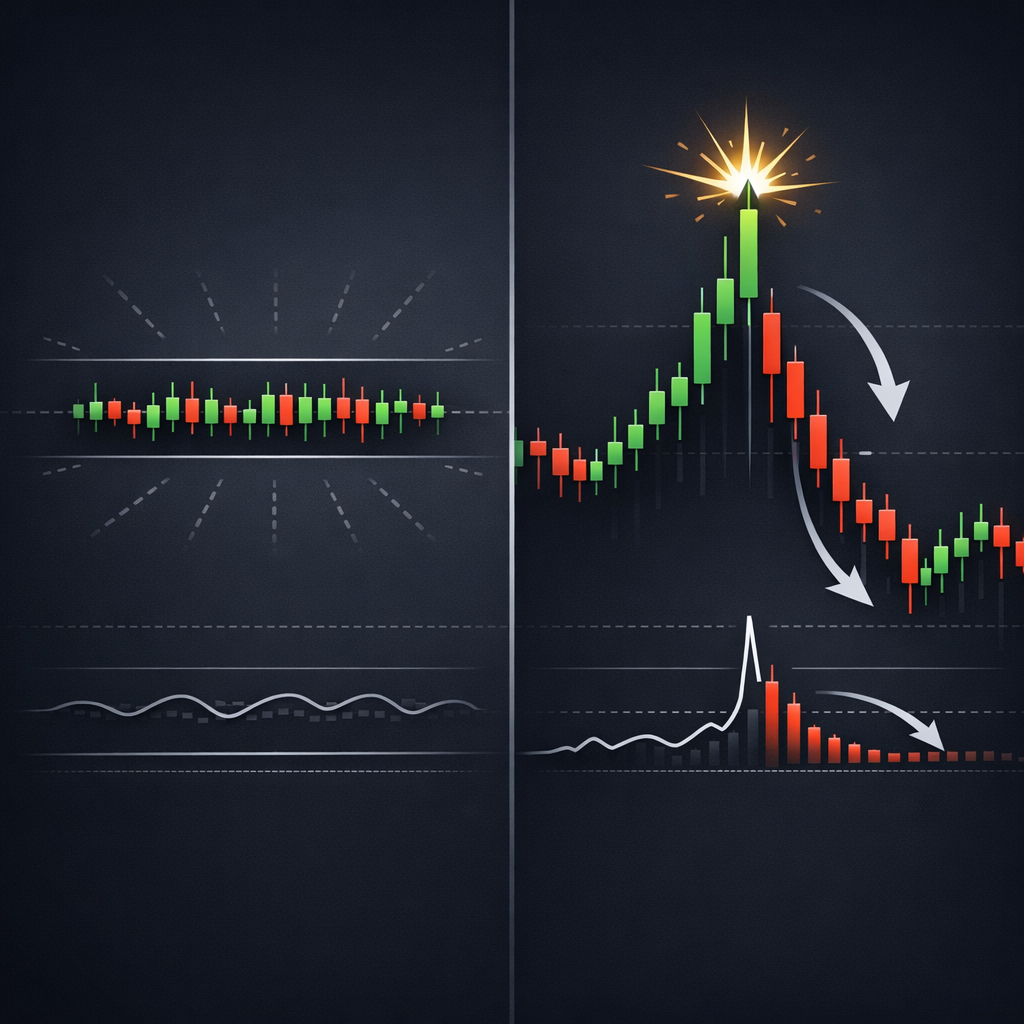
That’s why you often see a spike → reversal → continuation structure around XAUUSD.
Your edge comes from having a time-boxed execution plan and respecting the unique microstructure: spreads widen, liquidity thins, and “obvious” breakouts fail.
Know Your Battlefield: Today’s Price Context and Key Levels (XAUUSD ~$2650)
Before you place any trade on FOMC day, you must define the map.
When gold is trading around $2650, even a “normal” intraday swing can be $15–$25.
During an FOMC release, that can double.
So our first job is to identify where liquidity is likely sitting.
Step 1: Mark the obvious liquidity pools
Liquidity pools are the levels where stop orders cluster.
On XAUUSD, these are often:
- Round numbers: $2650, $2660, $2675, $2690
- Session highs/lows: Asia high/low, London high/low
- Previous day high/low
- 4H/1H swing points and consolidation boundaries
Example mapping (realistic range):
- Resistance zone: $2668–$2675 (prior swing + round number magnet)
- Support zone: $2632–$2640 (previous breakdown area)
- Extreme levels: $2610–$2620 and $2685–$2690 (where spikes can tag and reverse)
Step 2: Align with the USD complex (DXY + majors)
Gold’s reaction often makes more sense when you watch DXY and USD/JPY.
With DXY at 106.80 and USD/JPY near 149.50, a hawkish surprise can drive a USD pop.
That can slam gold quickly—often before retail traders can react.
On the other hand, if DXY spikes and then fades, gold can reverse violently upward.
Step 3: Decide the “trade mode” you’ll use
On FOMC, you’re either:
- Spike trader: you accept chaos, wider stops, smaller size, and strict rules.
- Post-spike trader: you let the first move happen, then trade the retest or reversal with better structure.
Most traders do better as post-spike traders.
It’s not less profitable—it’s often more consistent.
Comparison Table: Three Ways to Trade XAUUSD on FOMC Day
Not every approach fits every trader.
Here’s a practical comparison so you can pick a lane and execute it cleanly—especially if you’re following United Kings gold signals during high-impact news.
| Approach | When You Enter | Pros | Cons | Best For |
|---|---|---|---|---|
| Pre-news range trade | 60–15 min before release inside a tight range | Clear structure, tight invalidation, calmer execution | Can get blown out by spike; must be flat or protected before release | Disciplined traders who can exit on time |
| Spike breakout trade | 0–2 min after release on momentum break | Big R-multiples possible fast; catches the headline move | Worst slippage/spread; false breakouts common; emotional execution | Experienced news traders with strict rules |
| Post-spike retest/reversal | 5–30 min after release on retest or failed breakout | Cleaner entries, better fills, more reliable invalidation | May miss the first $10–$20 of the move | Most signal followers aiming for consistency |
The 60–15 Minute Pre-News Checklist (Signal Execution Prep)
This is where most traders either earn their money—or donate it.
The goal in the last hour before FOMC is not to predict direction.
The goal is to remove avoidable mistakes so you can execute your XAUUSD news trading strategy cleanly.
Step-by-step pre-news routine (60–15 minutes)
- Check the exact release time and your broker’s server time. Don’t rely on memory.
- Read the market expectations: is a hold expected? Is a cut/hike priced? This frames the “surprise” risk.
- Mark the pre-news range on 5M/15M: identify the high and low of the last 60–90 minutes.
- Identify the “trap zones”: thin liquidity areas where price can wick $8–$15 and snap back.
- Decide your execution mode: spike trader or post-spike trader.
- Adjust risk: reduce size to 25–50% of normal and widen stops only if your plan requires it.
- Plan your exits: where will you take partials, and when will you move to breakeven?
How we prepare levels using realistic prices
Let’s say gold is hovering at $2650 and compressing.
The last hour range is $2644 to $2658.
We mark:
- Range high: $2658 (breakout trigger zone)
- Range low: $2644 (breakdown trigger zone)
- Midpoint: $2651 (often a magnet)
We also mark higher liquidity above: $2668–$2675.
And lower liquidity below: $2632–$2640.
Signal followers: what to clarify before the news
If you’re using a signal, your “pre-news job” is to remove ambiguity.
Before FOMC, you should know:
- Is the signal a limit order (retest entry) or a stop order (breakout entry)?
- Is the stop loss fixed (e.g., $15) or structure-based (beyond a swing)?
- Where are TP1/TP2, and what’s the partial plan?
At United Kings, we focus on clarity: Entry, SL, TP levels and an execution note—especially during London and NY sessions when liquidity is best.
If you want the broader framework of choosing a provider, keep this signal provider checklist bookmarked.
The “No-Trade Window”: When Standing Aside Is the Best Trade
One of the most profitable habits on FOMC days is knowing when not to trade.
That might sound boring.
But boredom is often a sign you’re doing it right.
Why spreads and fills become your hidden enemy
During the release minute, brokers and liquidity providers protect themselves.
That means:
- Spreads widen (gold can jump from a tight spread to something that feels “untradable”).
- Slippage increases: your fill can be $2–$8 worse than expected in fast markets.
- Stop orders can trigger early due to wicks.
Even if your analysis is correct, execution can destroy your edge.
A realistic “no-trade” rule set
Consider standing aside if any of these are true:
- You’re new and haven’t practiced FOMC execution on a demo.
- Gold is already in a stretched move (e.g., up $35 before the release), making mean reversion likely.
- Your broker’s spread behavior is unpredictable during news.
- You can’t watch the chart live for the 10–20 minutes around the event.
There’s nothing wrong with trading the post-news setup only.
In fact, many professional signal followers do exactly that.
A simple time-boxed approach
- T-15 to T+2 minutes: no new trades (unless you are a dedicated spike trader with rules).
- T+5 to T+30 minutes: hunt for retests, failed breakouts, and continuation patterns.
This single rule prevents most “revenge entries” that come from watching the first candle run.
Trading the Initial Spike (0–2 Minutes): Rules to Avoid Slippage Traps
If you choose to trade the spike, you must accept one truth.
You are not trading a chart pattern—you’re trading market microstructure.
The first move is often a liquidity sweep, not “real direction.”
So your rules must protect you from the most common FOMC trap: chasing a breakout that immediately reverses.
Spike rule #1: Don’t trade the first 5–15 seconds
The first candle can be pure chaos.
Let the initial burst print.
Then assess whether the move is holding above/below the pre-news range.
Spike rule #2: Use a confirmation trigger, not a feeling
Here’s a practical trigger set for XAUUSD:
- Price breaks above the pre-news range high (e.g., $2658).
- It then holds above it for 1–2 closes on the 15-second/1-minute view (depending on your platform).
- DXY confirms (either spikes in the opposite direction for gold, or fades if gold is rallying).
This reduces the “one wick and done” problem.
Spike rule #3: Stop loss must be volatility-aware
On normal days, you might use a $8–$12 stop on gold.
On FOMC, that’s often too tight.
A realistic spike stop might be $15–$25, but only if your position size is reduced.
Example:
- Buy stop trigger: $2660 (after holding above $2658)
- SL: $2644 (risk $16)
- TP1: $2692 (reward $32, ~1:2)
- TP2: $2708 (reward $48, ~1:3) (only if volatility supports it)
Notice how TP aligns with likely liquidity zones near $2690.
Spike rule #4: If you don’t get filled cleanly, you don’t “fix it”
A common mistake is getting slipped, then widening the stop to “make it work.”
That’s not a strategy—it’s panic.
If your fill is materially worse (e.g., you expected $2660 but got $2666), your risk changes.
In that case, the professional move is to either:
- reduce size immediately, or
- exit and wait for the retest setup
Post-News Continuation (5–30 Minutes): The Highest-Probability Retest Entry
If there’s one setup that consistently works for signal followers on FOMC days, it’s the break-and-retest continuation.
You let the market show its hand.
Then you enter where risk is defined and fills are cleaner.
What “continuation” looks like on XAUUSD after FOMC
Gold often breaks a pre-news range, runs $10–$25, then pulls back.
That pullback is where you want to execute—if structure remains intact.
Key idea: the broken level should flip.
Old resistance becomes new support (or vice versa).
Step-by-step continuation plan (signal-friendly)
- Step 1: Identify the breakout level (e.g., range high at $2658).
- Step 2: Wait for price to move away (e.g., spike to $2672).
- Step 3: Wait for a pullback into the level (e.g., back to $2660–$2658).
- Step 4: Confirm with a reaction (bullish rejection wick, strong close back above, or a micro higher-low).
- Step 5: Enter with a stop below the level or the pullback low.
Concrete example with SL/TP (within today’s range)
Scenario: FOMC triggers bullish gold continuation.
- Entry: Buy $2661 on retest
- SL: $2648 (risk $13)
- TP1: $2687 (reward $26, 1:2)
- TP2: $2700 (reward $39, 1:3) (only if momentum continues)
Execution note: if price taps $2687 quickly, taking partial profit is rational.
FOMC candles can reverse without warning.
Filters that improve continuation quality
- Time filter: wait at least 5 minutes after the release.
- Structure filter: the retest should hold; no deep close back inside the old range.
- USD filter: DXY should not aggressively reverse against your trade.
- Volatility filter: if spreads are still wild, wait longer.
This is where premium signals shine: you’re not improvising under pressure.
You’re executing a pre-defined plan from United Kings signals with clear levels.
Post-News Reversal (5–60 Minutes): How to Trade the “False Breakout” Safely
The other classic FOMC structure is the fake breakout reversal.
Gold spikes above resistance, triggers breakout buyers, then collapses.
Or it dumps below support, triggers shorts, then rips higher.
This is where many traders lose twice—first chasing, then revenge trading.
But with rules, reversals can be clean, high R:R setups.
What a high-quality reversal looks like
We want evidence that the breakout failed.
On XAUUSD, that evidence often includes:
- A spike into a liquidity zone (e.g., $2685–$2690)
- A sharp rejection (long wick) and then a close back below the breakout level
- A lower high / lower low sequence on 1M–5M
We do not want to short just because “it went up a lot.”
We short because the market proved the breakout failed.
Step-by-step reversal plan
- Step 1: Identify the swept level (e.g., $2688 tags liquidity).
- Step 2: Wait for a close back below the key level (e.g., below $2675).
- Step 3: Enter on a pullback to the broken level (e.g., retest $2672–$2675).
- Step 4: SL above the swing high (structure-based).
- Step 5: Target the opposite side of the pre-news range or the midpoint magnet.
Concrete reversal example with realistic numbers
Scenario: Gold spikes to $2688, then fails.
- Entry: Sell $2673 on retest
- SL: $2689 (risk $16)
- TP1: $2641 (reward $32, 1:2)
- TP2: $2625 (reward $48, 1:3)
This targets the lower liquidity zone around $2632–$2640 and potentially the deeper flush into $2620s.
The “press conference” factor
Many reversals happen not on the decision, but during the press conference.
That’s why you must keep your plan flexible for a second wave of volatility.
If you’re trading reversals, avoid moving your stop to breakeven too early.
Give the trade room to breathe—while respecting your predefined invalidation.
Stop Loss, Take Profit, and Partial Strategy for FOMC Gold Trades
On FOMC, your strategy can be correct and still lose if your trade management is sloppy.
Gold can move $10 in a blink.
So we need a framework that’s simple enough to execute under stress.
SL frameworks that actually work on XAUUSD news
There are two practical stop approaches during FOMC.
1) Structure-based stop (preferred)
Your stop goes beyond the swing that invalidates the idea.
Example: if you buy a retest at $2661, and the pullback low is $2650, an SL at $2648 makes sense.
It’s not random—it’s where your thesis breaks.
2) Volatility-based stop (when structure is messy)
If candles are chaotic, structure is hard to define.
In that case, you can use a fixed volatility stop like $18–$22—but only with smaller size.
This is common for spike traders.
TP frameworks: why 1:2 is your friend on FOMC
Many traders aim for huge targets because the day feels “special.”
But FOMC moves are often two-sided.
A practical approach:
- TP1 at 1:1 or 1:1.5 to reduce pressure
- TP2 at 1:2 as the core target
- TP3 at 1:3 only if structure and momentum support it
Example with $15 risk:
- Risk: $15
- TP2 (1:2): $30 move
- TP3 (1:3): $45 move
Partial profit and breakeven rules (simple and executable)
- Take 30–50% off at TP1 if price reaches it quickly.
- Move SL to breakeven only after the market confirms (e.g., a higher-low for buys).
- If spread is still wide, don’t micro-manage—let structure guide you.
If you want a deeper risk framework for signal-based trading, keep our risk management guide open on FOMC days.
Position Sizing on FOMC: How to Reduce Risk Without Killing Your Upside
Most traders think the secret to FOMC is “being brave.”
In reality, the secret is right-sizing.
You want exposure, but you don’t want one candle to wreck your week.
The core principle: volatility up → size down
If your normal gold stop is $10 and you trade 1 lot, then an FOMC stop might be $20.
To keep risk equal, you cut size roughly in half.
This is non-negotiable.
A practical sizing example (numbers you can copy)
Let’s say your account is $5,000.
You normally risk 1% per trade ($50).
On a calm day you might use a $10 stop.
On FOMC, you decide to use a $20 stop.
To keep risk at $50, your position size must be reduced by 50% versus your normal sizing.
Many experienced traders reduce even more—down to 0.25–0.50R risk on the first post-news trade.
Two-tier risk plan for FOMC day
- Trade #1 (first setup after news): 0.5R risk (example: $25 if your normal is $50)
- Trade #2 (if Trade #1 wins and structure is clear): up to 1R risk
This prevents “double loss days” where you lose on a spike and then lose again on a revenge entry.
Margin and leverage: the silent killer
On FOMC, leverage can turn small mistakes into forced liquidation.
Keep margin usage conservative.
If you’re unsure, trade smaller and focus on execution quality.
Professional trading is not about maximum exposure—it’s about repeatability.
Common FOMC Traps (Slippage, False Breakouts, and Signal Misuse)
Let’s talk about the mistakes that keep repeating every single Fed decision.
Most of them are not “analysis” mistakes.
They’re execution mistakes.
Trap #1: Chasing the first candle
Gold spikes from $2650 to $2666 in seconds.
You buy at $2666 because you’re afraid of missing out.
It wicks to $2672, then dumps to $2648 and stops you.
Then it rallies again without you.
The fix: trade the retest, not the emotion.
Trap #2: Placing stops where everyone places stops
On XAUUSD, obvious stops sit just below the breakout level.
Market makers and large players know this.
So price often dips $3–$6 below the level, triggers stops, then reverses.
The fix: use structure-based stops beyond the true invalidation, and reduce size.
Trap #3: Treating a signal like a “guarantee”
No signal is magic.
Even with an 85%+ historical win rate, losses happen—especially during news.
The fix: execute the plan exactly, accept the SL if it hits, and avoid re-entering without a new setup.
Trap #4: Ignoring the second wave (statement + press conference)
Many traders relax after the first spike.
Then the press conference triggers the real move and catches them overexposed.
The fix: keep risk controlled for the entire FOMC window.
Trap #5: Using the wrong order type
Market orders during the spike can be brutal.
Limit orders can also be missed if price doesn’t retest.
The fix: match the order type to the setup:
- Continuation retest: limit/confirmation entry
- Breakout momentum: stop order with confirmation rules
For more on handling surprise volatility, see how gold signals react to unexpected news events.
A Complete Time-Boxed Signal Execution Plan (Copy/Paste Checklist)
This is the practical playbook you can use every FOMC.
It’s designed for traders who follow signals and want consistent execution under pressure.
T-60 to T-30 minutes: Build the map
- Mark previous day high/low and current session high/low.
- Draw the last 60–90 minute range (high/low + midpoint).
- Identify liquidity magnets: $2650, $2660, $2675, $2690, $2635, $2620.
- Check DXY (106.80) and USD/JPY (149.50) for directional pressure.
T-30 to T-15 minutes: Choose your mode + reduce risk
- Decide: spike trade or post-spike only.
- Reduce size to 25–50% of normal.
- Cancel non-essential pending orders.
- Confirm your broker’s spread behavior (watch it live).
T-15 to T+2 minutes: Protect your account
- Ideally, no new trades unless you’re a dedicated spike trader.
- If you trade the spike, wait for confirmation and accept potential slippage.
- Do not widen stops impulsively.
T+5 to T+30 minutes: Trade the A+ setups
- Continuation: break-and-retest of $2658/$2644 range boundaries.
- Reversal: failed breakout at $2685–$2690 or flush to $2620–$2630 with reclaim.
- Use 1:2 as the core target; take partials if momentum is fast.
T+30 to T+90 minutes: Manage the second wave
- Watch for press conference reversals.
- Trail behind structure, not behind every candle.
- If you’re up on the day, consider stopping after one clean win.
If you want a live community executing these steps together, United Kings runs premium Telegram guidance alongside entries—especially around London and NY liquidity windows.
How United Kings Gold Signals Fit This FOMC Playbook (Practical Workflow)
Signals are only as good as the way you execute them.
On FOMC days, execution matters even more than analysis.
Here’s how we recommend integrating a premium signal workflow into the playbook above.
What a “FOMC-ready” gold signal should include
- Clear entry price (not vague “buy now” messaging)
- Stop loss that respects news volatility (often $10–$25 depending on setup)
- Multiple take profits (TP1/TP2) aligned with liquidity levels
- Execution note: “wait for retest,” “post-news only,” or “no trade if spread is above X”
How to execute a United Kings-style signal on FOMC day
- Before the release, open the signal and pre-enter the levels in your platform (without placing the order if you’re post-spike only).
- At T+5 minutes, check if the setup is still valid (structure + spreads).
- Place the trade with reduced size, then manage partials as instructed.
Where to follow and what to explore next
- Explore our full signal ecosystem at United Kings signals (forex, gold, and more).
- If XAUUSD is your main market, start with premium gold signals built for volatility.
- If you also trade majors around Fed events, see forex signals for pairs like EUR/USD and GBP/USD.
- For beginners who want a Telegram-first workflow, read our Forex signals Telegram guide.
- Join the live community on Telegram: United Kings official Telegram channel.
United Kings is built for traders who want both execution and education.
That’s why we pair signals with context and trading guidance, and why our community has grown to 300K+ active traders.
Pricing, Plans, and How to Choose the Right Subscription for FOMC Traders
If you trade FOMC regularly, you need consistency.
Consistency comes from having a repeatable process and reliable trade levels.
That’s exactly what a premium signal subscription is meant to provide—without turning you into an overtrader.
United Kings plans (3 options)
- Starter (3 Months): $299 (~$100/month)
- Best Value (1 Year): $599 (~$50/month) with 50% savings + FREE ebook
- Unlimited (Lifetime): $999 (pay once, access forever)
You can review all options on our pricing page.
Which plan fits which trader?
- 3 Months: best if you want to test-drive execution through 1–2 major Fed cycles and build the habit.
- 1 Year: best if you want the full macro calendar (multiple FOMCs, CPI cycles, seasonal gold flows) and the lowest monthly cost.
- Lifetime: best if you’re committed long-term and want “set and forget” access.
48-hour money-back guarantee (process matters)
We offer a 48-hour money-back guarantee because we want serious traders to feel comfortable evaluating the service.
The goal is not hype.
The goal is clean execution: entry, SL, TP, and the discipline to follow them.
FAQ: Trading XAUUSD During Fed Rate Decisions
1) Is it safe to trade gold during FOMC?
It can be, but only with reduced position sizing, wider volatility-aware stops, and a strict plan.
For many traders, the safest approach is trading post-news retests instead of the initial spike.
2) What’s the best XAUUSD news trading strategy for beginners?
A post-spike continuation or reversal with confirmation.
Wait 5–15 minutes after the release, then trade a retest or failed breakout with a clear invalidation level.
Beginners should also practice on demo first.
3) How much stop loss should I use on gold during FOMC?
There’s no single number, but many FOMC setups require $10–$25 depending on volatility and structure.
The key is to size your position so the dollar risk remains controlled.
4) Why does gold sometimes move opposite of what I expect after a hawkish decision?
Because the market trades expectations and forward guidance, not just the headline.
Also, gold can rally on risk-off flows even when rates are hawkish.
5) Are gold signals reliable during Fed rate decisions?
Signals can be effective if they’re built around structure and include clear Entry/SL/TP.
But execution risk (spread, slippage) is real, so you must follow the plan and manage risk properly.
Risk Disclaimer (Read Before You Trade)
Trading forex and gold (XAUUSD) involves significant risk and may not be suitable for all investors. High-impact news events like FOMC rate decisions can cause extreme volatility, spread widening, and slippage. You can lose more than you expect if risk is not controlled. Past performance is not indicative of future results. No signal or strategy can guarantee profits. If you are a beginner, consider practicing on a demo account first and use strict position sizing and stop losses.
Final Call: Trade FOMC Gold Like a Pro (With a Plan and a Team)
FOMC days don’t reward the bravest trader.
They reward the trader with the clearest plan.
If you want a structured, signal-driven approach to trading gold around Fed decisions—entries, stops, targets, and execution guidance—join the United Kings community.
Get premium Telegram signals with clear Entry, SL, and TP levels, built for London and NY session liquidity, and backed by a 300K+ trader community.
Start here: United Kings Gold Signals or explore all markets at United Kings Signals.
When you’re ready, choose your plan on United Kings pricing (Starter 3 Months $299, Best Value 1 Year $599, or Lifetime $999).
And to trade alongside the community in real time, join our Telegram: https://t.me/unitedkings1.