
FOMC day can make gold (XAUUSD) look “easy” for 30 seconds… and then punish you for the next 3 hours.
If you’ve ever followed a buy signal at $2652, watched price jump to $2660, and then got stopped at $2640 on a 20-second wick, you already know the problem: FOMC volatility is not normal volatility.
In this guide, we’ll show you exactly how to trade XAUUSD during FOMC using a signal-following approach that respects spreads, timing, and confirmation rules—so you can participate in the move without donating to whipsaws.
TL;DR: The FOMC XAUUSD Signal-Following Playbook
- Don’t treat FOMC like a normal session. Expect spread widening and wick spikes that can hit stops even if your direction is correct.
- Use “safe windows” for entries: typically 60–15 minutes before the decision (only if structure is clean) and 10–45 minutes after for confirmation trades.
- Split your plan into two trades: a small “event probe” (optional) and a larger “post-news confirmation” position.
- Widen SL intelligently, not emotionally. On gold around $2650, common FOMC SL ranges are $12–$25, but only if your position size is reduced accordingly.
- Confirmation beats prediction. Wait for a 5–15 minute candle close beyond a key level + retest behavior before scaling in.
- Signals work best when you execute professionally. Use limit rules, max spread rules, and a “no-trade if” checklist.
Why FOMC Days Are Different for XAUUSD (And Why Gold Reacts So Violently)
Gold doesn’t move on “rate decisions” alone.
Gold moves on the gap between expectations and reality, and on the market’s instant re-pricing of real yields, the US dollar, and risk sentiment.
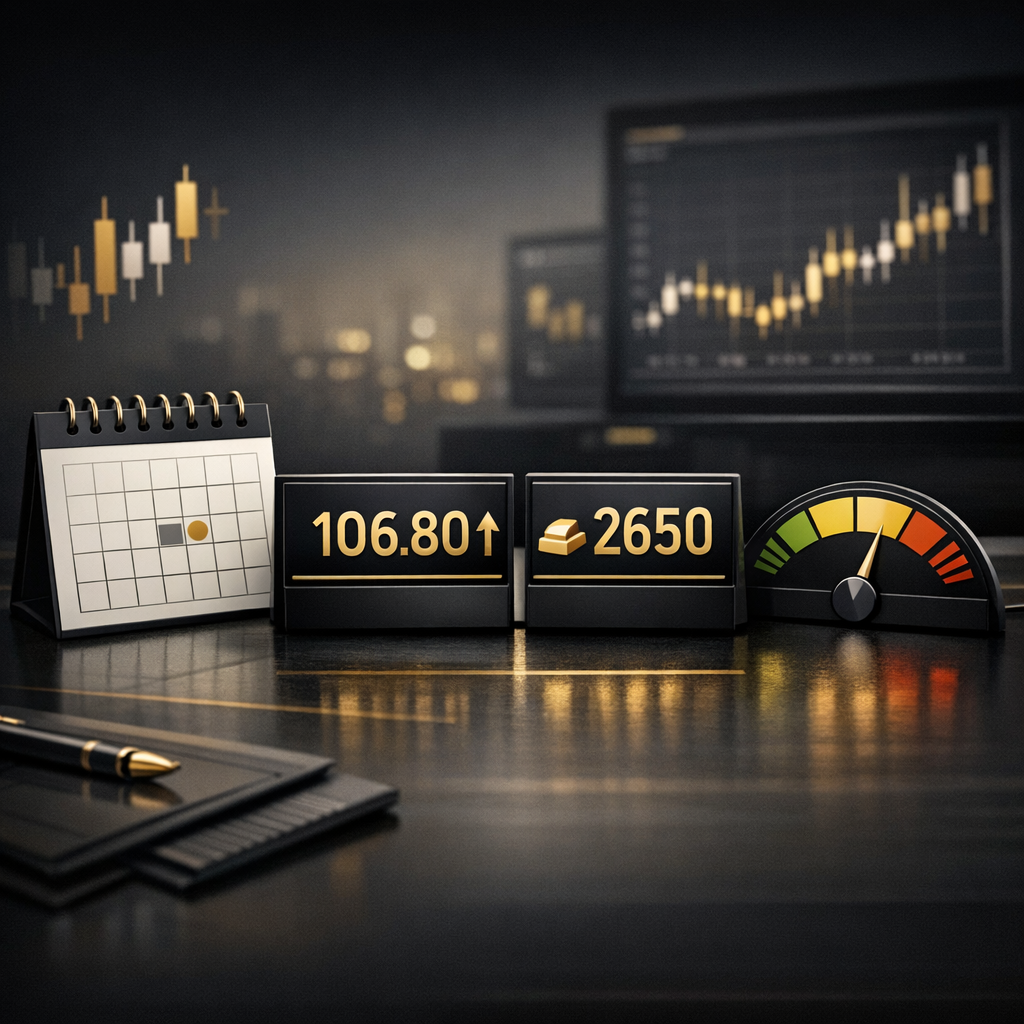
Right now, our context is realistic and tight: XAUUSD ~$2650 (+0.35% on the day), DXY ~106.80, EUR/USD ~1.0520, GBP/USD ~1.2680, and USD/JPY ~149.50.
On an FOMC day, those numbers can change fast—sometimes in a way that looks contradictory at first (gold up while DXY also up), because flows are not always linear in the first minutes.
The three drivers that matter most on FOMC for gold
- Rates path (dot plot + guidance): Not just the hike/hold, but what the Fed signals about the next 2–3 meetings.
- Real yields: Gold tends to like falling real yields. If the market interprets the Fed as less hawkish than expected, yields can drop and gold can rip.
- USD and risk sentiment: DXY spikes can pressure gold, but “risk-off” can also bid gold as a safety trade—creating quick two-way moves.
Why spreads widen and whipsaws happen (even with the right signal)
FOMC candles are often liquidity hunts disguised as “volatility.”
Liquidity providers protect themselves by widening spreads, and many brokers increase margin requirements or execution delays.
That means your stop can get tagged by a wick that never existed on your friend’s broker, or your entry can slip by $2–$8 on gold (20–80 pips in XAUUSD terms depending on your platform’s pip definition).
The signal-follower’s edge: structure + timing
Signals can absolutely work on FOMC days—if you treat them like a professional execution problem.
Your job is not to “predict Powell.”
Your job is to enter when spreads are tradable, volatility is readable, and the chart confirms the direction.
FOMC Day Timeline: The Only 4 Windows That Matter for Entry Timing
If you only remember one thing from this article, make it this: FOMC day is a schedule.
Most losses happen because traders treat the whole day like one continuous opportunity.
In reality, there are four distinct windows, and each one has different rules for signal execution.
Window 1: The “London-to-NY overlap” pre-positioning (3–6 hours before)
This is where the market often builds the day’s key levels.
Gold might grind between $2638 and $2658, printing fake breaks that are actually liquidity building.
If you’re using premium signals, this window is often about mapping rather than firing: identify the levels where a post-news move will likely accelerate.
Window 2: The “danger zone” (15 minutes before to 5 minutes after)
This is where spreads can widen sharply.
Even if a signal is correct directionally, execution can be poor. Slippage can turn a planned $15 stop into a $25–$35 realized loss.
For most signal followers, this window is best treated as no-trade unless you’re using a specific event strategy with reduced size.
Window 3: The “first reaction” (5–10 minutes after)
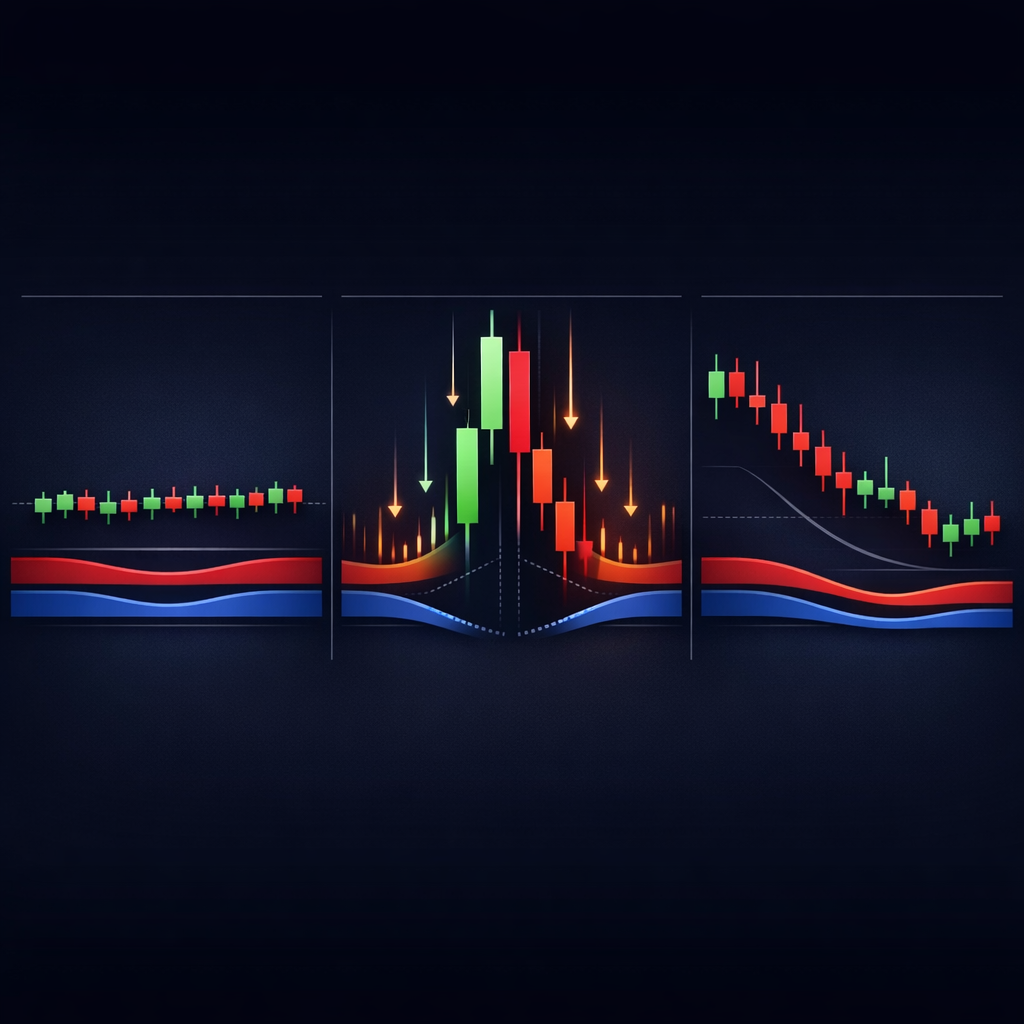
Gold often makes a violent first move, then immediately retraces 50–100% of that candle.
Many traders buy the first green candle and get trapped on the pullback. Or they sell the first red candle and get trapped on the snap-back.
Signal followers should usually wait for a candle close on the 5-minute or 15-minute chart before committing full risk.
Window 4: The “confirmation trend” (10–45 minutes after)
This is the sweet spot.
Spreads normalize, structure becomes readable again, and the market reveals whether the move is real or a fakeout.
Most of our highest-quality FOMC day gold trades come from this window—especially during the New York session, where United Kings focuses execution.
Quick comparison: entry timing styles on FOMC days
| Approach | Entry Timing | Pros | Cons | Best For |
|---|---|---|---|---|
| Pre-news position | 60–15 min before | Best price, smallest spread | Can be reversed instantly | Experienced traders with strict risk caps |
| Instant breakout | 0–5 min after | Catches the first impulse | Worst spreads, worst whipsaws | Not recommended for most signal followers |
| Post-news confirmation | 10–45 min after | Cleaner structure, better fills | Entry is not the “best” price | Signal followers (recommended) |
| Late continuation | 60–180 min after | Trend is obvious | RR can shrink, late entries get chopped | Conservative traders who accept smaller RR |
Pre-FOMC Checklist for XAUUSD Signals (So You Don’t Get Caught by Spreads)
When traders lose on FOMC days, it’s rarely because they “didn’t know the news.”
It’s because they didn’t control the parts they actually can control: spread, execution, and risk.
Step-by-step: your 30-minute pre-FOMC checklist
- Check your broker’s typical XAUUSD spread today. If gold is at $2650, you want to know whether your normal spread is $0.20, $0.40, or $1.20 before the event.
- Set a “max spread rule.” Example: “I will not enter if spread is above $0.80.” This single rule prevents most FOMC impulse mistakes.
- Mark the day’s key levels. Use Asia high/low, London high/low, and the nearest clean H1 swing points. Example levels: $2632 support, $2658 resistance, $2675 extension.
- Know the consensus expectation. You’re not predicting; you’re measuring surprise. If the market expects a hold but hints hawkish, gold can dump $20–$40 quickly.
- Decide your plan type: “No trade until confirmation” vs “small probe + confirmation.” Write it down.
- Reduce risk by default. If your normal risk is 1.0% per trade, consider 0.25%–0.50% on FOMC entries unless you’re trading only the post-news confirmation window.
- Confirm your platform settings. One-click trading, lot size presets, and whether your SL/TP are in dollars or points. Mistakes here are expensive on event candles.
What to do with your signals before the event
If you follow United Kings signals, your advantage is clarity: Entry, Stop Loss, Take Profit—no guessing.
But on FOMC, you still need execution rules.
- If a signal arrives 60–20 minutes before the decision, treat it as a setup and confirm structure.
- If a signal arrives 20 minutes before to 5 minutes after, consider waiting unless it is explicitly labeled as an event trade and you are using reduced size.
- If a signal arrives 10–45 minutes after, that’s typically the best time to execute with normal rules—because spreads and price action are readable again.
One simple filter that saves accounts: “SL must survive a normal wick”
On FOMC days, gold can print $8–$15 wicks on a 1-minute candle.
So if your stop is only $7 away, it’s not a stop—it’s a target for volatility.
Instead, if you’re buying at $2650, consider whether your stop at $2638 (a $12 SL) sits beyond a real level, not just beyond your comfort zone.
Spreads on FOMC: How to Avoid the “Perfect Signal, Bad Fill” Trap
Spreads are the silent killer of FOMC gold trades.
You can be correct on direction and still lose because your entry was inflated and your stop was effectively closer than planned.
What “widening spread” really does to your trade
Let’s say gold is trading around $2650.00.
Your signal says: Buy 2651.50, SL 2639.50 (12.0), TP 2675.50 (24.0).
On normal conditions, you might get filled near 2651.50 with a $0.30–$0.60 spread.
On FOMC, your spread can widen to $1.50+ for a few seconds. That can mean:
- You get filled at 2652.60 instead of 2651.50 (slippage + spread).
- Your effective risk becomes $13.10 instead of $12.00.
- Your reward shrinks if TP stays fixed.
Step-by-step: a spread-safe execution rule for signal followers
- Define a max spread (example: $0.80) for market entries.
- Use limit entries when possible for post-news retests (more on this in the confirmation section).
- Don’t chase a candle. If price runs $10 without you, let it go. FOMC offers multiple swings.
- Use “one attempt only.” If you miss the planned entry by more than $2–$3, wait for the next setup.
Broker reality check: why two traders see different charts
On news, different liquidity pools produce different wicks.
This is why you should avoid placing stops exactly at obvious round numbers like $2650 or $2640 if the level is widely watched.
Instead, place SL beyond structure: below a swing low, below a demand zone, or below the post-news retest low.
When spreads normalize (and when they don’t)
Typically, spreads calm down 5–15 minutes after the decision.
But if the Fed surprises the market, spreads can remain elevated for 30–60 minutes.
Your rule should be simple: if spreads don’t normalize, you don’t trade.
There will always be another setup tomorrow in London or New York—especially if you’re following a consistent feed like our premium gold signals.
Volatility Mapping: Building Your XAUUSD Levels Before Powell Speaks
Signal following isn’t blind copying.
It’s executing a high-quality idea inside a map of levels—so you know whether price is breaking out, retesting, or just wicking.
The minimum levels to mark on an FOMC gold chart
- Asia range high/low (often the first liquidity pool).
- London session high/low (often the “true” pre-news range).
- NY pre-news swing (where the market is positioned right before the event).
- Round numbers near current price (e.g., $2650, $2660, $2670).
- Nearest H1/H4 swing points (the levels institutions actually react to).
Example map using today’s context (XAUUSD around $2650)
Here’s a realistic level framework you might see:
- Support zone: $2632–$2638 (prior H1 swing + London low)
- Mid pivot: $2650–$2652 (round number + intraday pivot)
- Resistance zone: $2662–$2666 (prior rejection area)
- Extension targets: $2675 and $2688–$2690 (liquidity + measured move)
Notice what we’re doing: we’re not predicting direction.
We’re creating decision points where signals can be executed with rules.
How DXY and USD/JPY help you read gold’s “truth” on FOMC
During FOMC, gold often reacts with the dollar—but not always instantly.
Watch these two as confirmation tools:
- DXY (106.80): If DXY breaks higher and holds, gold rallies are more likely to fail or become choppy.
- USD/JPY (149.50): Sharp USD/JPY spikes can signal yield strength. If USD/JPY is ripping and gold is trying to rally, be cautious until gold proves itself with closes above resistance.
A story you’ll recognize: the “double fake”
We’ve seen this pattern dozens of times: gold spikes up $18 in 60 seconds, then dumps $28 in the next 3 minutes, then trends up for the next 2 hours.
The traders who lose are the ones who treat the first spike as the trade.
The traders who win are the ones who treat the first spike as information—then trade the confirmation.
Entry Timing Rules for XAUUSD Signals on FOMC (The “Don’t Get Wicked Out” Framework)
Let’s get practical.
You want a set of rules you can apply the same way every FOMC—whether gold is at $2650 or $2350.
Rule #1: Don’t enter in the 15-minute pre-news “compression” unless you have a specific plan
The last 15 minutes before the decision often creates a tight range.
That range is designed to trap both sides.
If you enter here, you’re betting that your broker fill + spread + wick behavior won’t ruin the trade.
Rule #2: Use the “close + hold” requirement after the news
For a long:
- Wait for a 5-minute close above a marked resistance (example: close above $2662).
- Then require price to hold above that level for at least 1–2 candles or show a clean retest.
For a short:
- Wait for a 5-minute close below support (example: close below $2638).
- Then require a hold below or a retest failure back into the zone.
Rule #3: The retest entry beats the breakout entry for signal followers
Breakouts on FOMC are expensive because spreads are wide and candles are large.
Retests are cheaper because the market comes back to you.
That’s why our best signal execution on FOMC days often looks like:
- Impulse move breaks level.
- Price pulls back 30–60%.
- Signal entry triggers on the retest with a defined SL under/over structure.
Rule #4: One trade, one idea (no revenge stacking)
FOMC can make you feel like you “have to get it back” because the move is big.
That’s how accounts get wrecked.
Use a hard rule: maximum 1–2 attempts on gold during the event window, then stop.
Example: a confirmation long plan around $2650
Scenario: price spikes up, closes above $2662, then retests $2660–$2662.
- Entry: Buy $2662.00
- Stop Loss: $2648.00 (risk $14)
- Take Profit 1: $2690.00 (reward $28, 1:2)
- Take Profit 2 (optional runner): $2704.00 if trend is strong (manage actively)
Notice the logic: SL is beyond the retest structure, not just “$10 because it feels right.”
Stop Loss & Take Profit on FOMC: Adjusting SL/TP Without Destroying RR
On normal days, you might run a tight $8–$12 stop on gold.
On FOMC, that can be a donation—unless your entry is post-news and structure is extremely clean.
The correct way to widen stops: reduce size, not discipline
Many traders widen SL but keep the same lot size.
That’s not “giving the trade room.” That’s increasing risk.
If your normal risk is $100 per trade and you usually use a $10 SL, widening to a $20 SL means your lot size should be cut in half.
FOMC-friendly SL ranges for gold near $2650
As a guideline (not a rule):
- $10–$14 SL: Only for post-news confirmation entries with tight structure.
- $15–$20 SL: Common for retest entries where wicks are still present.
- $21–$25 SL: Only if the structure demands it and your size is reduced.
TP logic: keep 1:2 or 1:3 even on news
FOMC moves can be large, so traders get greedy and remove take profit.
Then the reversal hits and they give it all back.
A better method is structured scaling:
- TP1 at 1:2 (bank partial profits).
- Move SL to breakeven only after structure confirms (not instantly after +$3).
- Leave a runner toward the next liquidity zone (like $2688–$2690).
Example: short setup with disciplined exits
Scenario: price dumps below $2638, retests $2638–$2640, fails, and rolls over.
- Entry: Sell $2637.50
- Stop Loss: $2652.50 (risk $15)
- TP1: $2607.50 (reward $30, 1:2)
- TP2: $2592.50 (reward $45, 1:3) if momentum persists
This uses the user guideline range ($2610–$2690) for examples, while showing how a 1:2 and 1:3 framework stays intact even in event volatility.
Breakeven rules that don’t get you chopped
On FOMC, moving to breakeven too early is a common mistake.
Use a simple rule: only move SL to BE after either:
- Price hits TP1, or
- Price closes beyond the next intraday level (example: long closes above $2670 after entry at $2662).
Post-News Confirmation Rules: Filtering False Breakouts Like a Pro
If you want consistency on FOMC days, you need a confirmation model.
This is the difference between gambling on the first candle and trading the actual trend.
The “3C” confirmation model for FOMC gold trades
- Close: Wait for a 5m or 15m candle close beyond the key level.
- Consolidate: Price should pause or base, not instantly reverse.
- Continue: The next push should break the impulse high/low with less wickiness.
What a false breakout looks like on gold
Example: gold spikes above $2666, prints $2672, then closes back under $2660 on the 5-minute candle.
That’s often a stop-run, not a true break.
A signal follower who buys the spike gets trapped. A signal follower who waits for the close avoids the trap.
Retest behavior: your “green light” for entries
After the close beyond a level, watch the retest:
- Healthy bullish retest: price dips into $2662, wicks slightly below, then closes back above and forms higher lows.
- Unhealthy retest: price re-enters the old range and closes below $2660 repeatedly.
Healthy retests are where limit orders shine.
Unhealthy retests are where patience saves you.
Timeframe rule for signal followers (keep it simple)
On FOMC days, the 1-minute chart can hypnotize you.
Use it for precision only after the 5-minute chart gives permission.
A clean workflow is:
- H1: identify the major levels and bias zones.
- M15/M5: confirm the break and retest.
- M1: fine-tune entry only if spreads are normal and the retest is clean.
How this fits with premium signals
United Kings signals are designed to be followed with discipline.
On event days, we recommend you combine our levels with these confirmation rules so you avoid the classic FOMC whip.
If you want the daily framework plus education, explore our full signals service and the dedicated XAUUSD gold signals feed.
Step-by-Step: Two Proven FOMC Trade Plans Using XAUUSD Signals
Let’s turn everything into two repeatable playbooks.
These are designed for signal followers who want structure, not adrenaline.
Plan A: “No-Trade Until Confirmation” (recommended for most traders)
- Before FOMC: mark support/resistance zones (example: $2638 and $2662).
- During the decision: do nothing. Observe spread behavior and the first impulse.
- After 5–10 minutes: wait for a 5-minute close beyond a key level.
- Enter on retest: use a limit entry near the broken level.
- SL placement: beyond the retest low/high (typically $12–$20 away).
- TP: TP1 at 1:2, leave a runner toward the next liquidity zone.
This plan sacrifices the “first candle bragging rights” for consistent execution.
Plan B: “Small Probe + Confirmation Add” (for experienced, disciplined traders)
This plan acknowledges that sometimes the post-news move doesn’t retest deeply.
So you take a small position early, then add after confirmation.
- Probe entry (small size): 0.25R risk max, placed 20–60 minutes pre-news only if structure is clean.
- Hard rule: no adding during the spike. You either survive the event or you’re out.
- Confirmation add: once the 5m close + retest rules trigger, add the main position.
- Manage as one idea: combined risk must not exceed your daily cap (example: 1% total).
Concrete example: Plan A long trade (numbers you can copy into a journal)
Assume XAUUSD is around $2650 pre-news.
Post-news, price closes above $2662 on M5 and retests the zone.
- Entry: Buy $2661.80
- SL: $2646.80 (risk $15)
- TP1: $2691.80 (reward $30, 1:2)
- Management: take 50–70% at TP1, trail the rest under M15 higher lows
Concrete example: Plan A short trade
Post-news, price closes below $2638 on M5 and retests from below.
- Entry: Sell $2637.20
- SL: $2657.20 (risk $20)
- TP1: $2597.20 (reward $40, 1:2)
- Management: if price reclaims $2638 and holds, exit early—don’t “hope”
If you want to build your execution discipline around signals (entries, SL, TP), also read our risk-focused guide: risk management strategies when using forex signals.
Signal Execution on FOMC: Order Types, Slippage, and “Do Not Chase” Rules
FOMC isn’t just a strategy day—it’s an execution day.
Two traders can follow the same signal and get different outcomes because one used better order logic.
Market order vs limit order on FOMC
Market orders give you certainty of entry but not certainty of price.
Limit orders give you certainty of price but not certainty of entry.
On FOMC, signal followers usually do best with:
- Market orders only in the confirmation window when spreads normalize.
- Limit orders on retests to avoid buying the top of a news candle.
Slippage reality: plan for it, don’t complain about it
On gold, a $2–$6 slippage event can happen around the decision.
If your plan can’t survive that, your plan is not FOMC-ready.
That’s why your max spread rule and your confirmation timing matter more than “being fast.”
The “do not chase” rule (with a hard number)
Set a personal rule like:
- If price is more than $3 away from the signal entry, I do not enter.
This prevents emotional entries after a $12 candle.
It also forces you to wait for the retest, which is where risk is definable.
Session focus: why London and New York matter most
FOMC is a US event, so the most reliable follow-through tends to happen in New York.
London often sets the levels; New York often breaks them.
This aligns with United Kings’ focus on London and NY session trading, where liquidity is deepest and signals are easiest to execute cleanly.
Where to get your signals (and why Telegram speed matters)
On event days, you want fast, clear delivery.
That’s why our premium community runs through Telegram, with clean formatting and trade management updates.
You can join our public channel path via United Kings Telegram and explore how we structure entries and updates.
If you’re still evaluating providers, use our beginner-friendly checklist: forex signals provider checklist.
Common FOMC Mistakes Gold Traders Make (Even When Following Signals)
Signals don’t fail traders as often as traders fail signals.
FOMC days amplify every bad habit: over-leverage, impatience, revenge trading, and poor stop placement.
Mistake #1: Taking every alert as an “urgent entry”
On FOMC, timing is everything.
A great setup can be a terrible trade if you enter during the spread blowout window.
Your job is to apply the timing rules we covered, not to treat every ping like a fire alarm.
Mistake #2: Putting SL at obvious numbers
Stops at $2650, $2640, or exactly under the last 1-minute wick are easy targets.
Place stops beyond structure, and accept that the correct stop may be $15–$22 away on event days.
Mistake #3: Moving SL to breakeven too early
Gold can swing $10 against you and still be in a valid trend.
If you move to BE after +$4, you’ll get tapped out and watch it run to TP without you.
Mistake #4: Overtrading the chop after the first move
After the first impulse, gold often ranges violently.
That range is where accounts bleed.
Set a daily limit: if you take two losses, you stop trading that day.
Mistake #5: Ignoring correlated markets
If DXY is breaking out above 106.80 and holding, gold longs need extra confirmation.
If USD/JPY is spiking through 149.50, yields may be driving flows—again, gold needs confirmation.
Mistake #6: Using normal leverage on abnormal volatility
FOMC is when you earn the right to trade smaller.
If you want a deeper guide on leverage discipline, pair this article with our risk and sizing resources inside the United Kings education stream on our blog.
How United Kings Trades FOMC Days: Community Workflow, Win-Rate Mindset, and What to Expect
Let’s set expectations the right way.
United Kings is a premium forex and gold signals provider with a large, active community and a structured approach to execution.
But no one can guarantee profits on FOMC—what we can do is help you trade with a plan.
What “85%+ win rate” means in practice
When we talk about an 85%+ win rate, we’re describing historical performance of our signal methodology in typical conditions and across many trades.
It does not mean every FOMC trade wins, and it does not mean you should increase risk.
FOMC is a day where the goal is often capital preservation + selective participation.
Our FOMC day workflow (what you’ll experience)
- Clear levels and plans: We focus on high-probability zones and avoid random mid-range entries.
- Session awareness: Most actionable trades are aligned with London/NY liquidity.
- Education alongside signals: We explain why a level matters and how to manage the trade.
- Community feedback loop: With 300K+ active traders, you see execution questions answered fast.
Where to start inside the United Kings ecosystem
If your main focus is gold, start with United Kings Gold Signals.
If you want a combined feed (gold + majors like EUR/USD and GBP/USD), explore United Kings Forex Signals and the unified signals hub.
Pricing plans (3 options) and who each is for
We keep pricing simple with three plans:
- Starter (3 Months): $299 (~$100/mo) for traders who want to test execution and build consistency.
- Best Value (1 Year): $599 (~$50/mo) with 50% savings + FREE ebook for serious traders.
- Unlimited (Lifetime): $999 pay once for permanent access.
You can review all options on our pricing page.
48-hour money-back guarantee (how to use it responsibly)
We offer a 48-hour money-back guarantee so you can evaluate quality and fit.
Use that time to judge clarity of entries/SL/TP, communication, and whether our FOMC-day discipline matches your trading style.
FOMC Day FAQ (XAUUSD Signals, Spreads, and Risk)
1) Is it safe to trade gold (XAUUSD) during FOMC?
It can be, but it’s not “safe” in the normal sense.
FOMC increases volatility, spreads, and slippage risk. The safest approach is post-news confirmation entries with reduced risk and strict spread rules.
2) What is the best time window to trade XAUUSD on FOMC days?
For most signal followers, the best window is 10–45 minutes after the decision, once spreads normalize and the chart confirms direction.
The worst window is typically 15 minutes before to 5 minutes after the announcement.
3) How wide should my stop loss be on FOMC for gold?
It depends on structure and your broker, but near $2650 many traders use $12–$25 stops on FOMC trades.
The key is to reduce position size so your account risk stays constant.
4) Should I use market orders or limit orders when following XAUUSD signals on FOMC?
Use market orders only when spreads are acceptable and you’re in the confirmation window.
For retests, limit orders can improve price and reduce chasing—but you must accept you may miss the trade.
5) How do I avoid false breakouts after the news?
Use a close + hold + retest rule: wait for a 5-minute close beyond the level, then look for a retest that holds.
This filters many “wick-only” breaks that reverse quickly.
Risk Disclaimer (Read Before You Trade FOMC)
Trading forex and gold (XAUUSD) involves significant risk and is not suitable for all investors. FOMC days can produce extreme volatility, widened spreads, slippage, and rapid losses. Signals and analysis are educational and informational and do not constitute financial advice. Past performance does not guarantee future results. Never risk money you cannot afford to lose, and consider practicing on a demo account before trading live—especially around major news events.
Final CTA: Trade FOMC Days with a Plan, Not Hope
FOMC days don’t reward the fastest clicker.
They reward the trader who follows a repeatable process: spread rules, confirmation timing, and disciplined SL/TP management.
If you want premium Telegram forex and gold signals with clear Entry, SL, and TP levels—plus education and a massive community—join United Kings.
- Explore our full service: United Kings Signals
- Focus on gold setups: XAUUSD Gold Signals
- Or diversify with majors: Forex Signals
- See all 3 plans (Starter, Best Value, Lifetime): United Kings pricing
- Join Telegram now: United Kings on Telegram
Next FOMC, don’t just “trade the news.” Trade a structure-backed confirmation move with professional execution—and let the market prove the direction before you commit size.