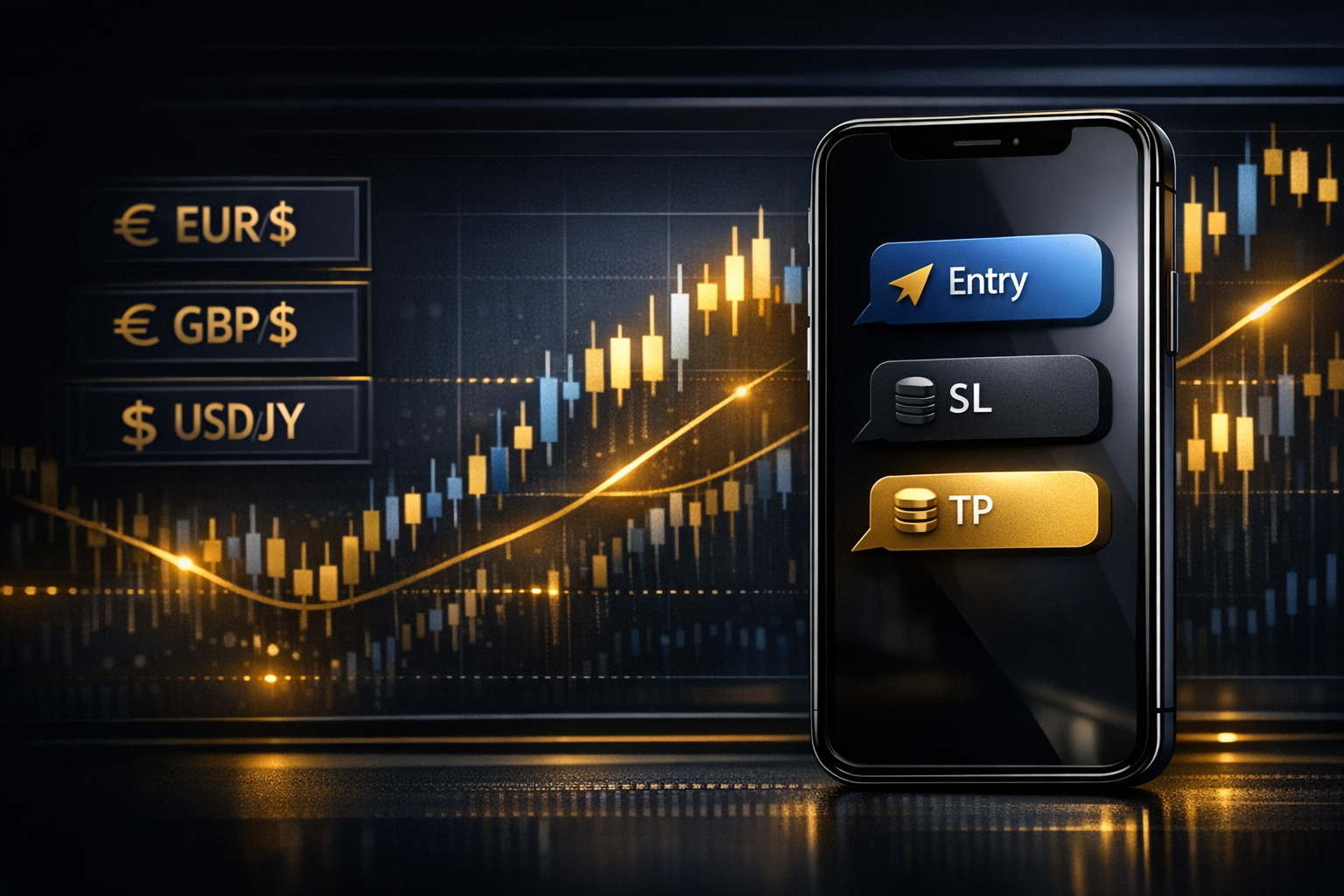
Ever opened a Telegram channel, saw “EUR/USD BUY 1.0520, SL 1.0490, TP 1.0580,” and wondered: “What do I do now… and how do I not blow my account?”
If you’re new, forex signals can feel like a shortcut and a trap at the same time.
This forex signals guide is built for beginners who want structure, not hype.
We’ll cover what signals are, how to execute them correctly, how to choose a provider, and how to manage risk using realistic market examples around today’s levels (EUR/USD 1.0520, GBP/USD 1.2680, USD/JPY 149.50, DXY 106.80, and Gold XAUUSD near $2650).
TL;DR: The Beginner’s Blueprint for Using Forex Signals
- Signals are trade ideas, not guarantees. Your job is execution, risk control, and consistency.
- Start with 0.5%–1% risk per trade and aim for 1:2 or better reward-to-risk where possible.
- Only follow signals you can execute (session timing, spread, broker conditions, and your schedule matter).
- Judge providers by process: transparency, clear Entry/SL/TP, track record, and risk guidance—not screenshots.
- Build a routine: pre-trade checklist → place order → manage trade → journal results weekly.
- Demo first if you’re new, then go small. Survival is the real “edge” in your first 90 days.
1) What Forex Signals Are (And What They Are Not)
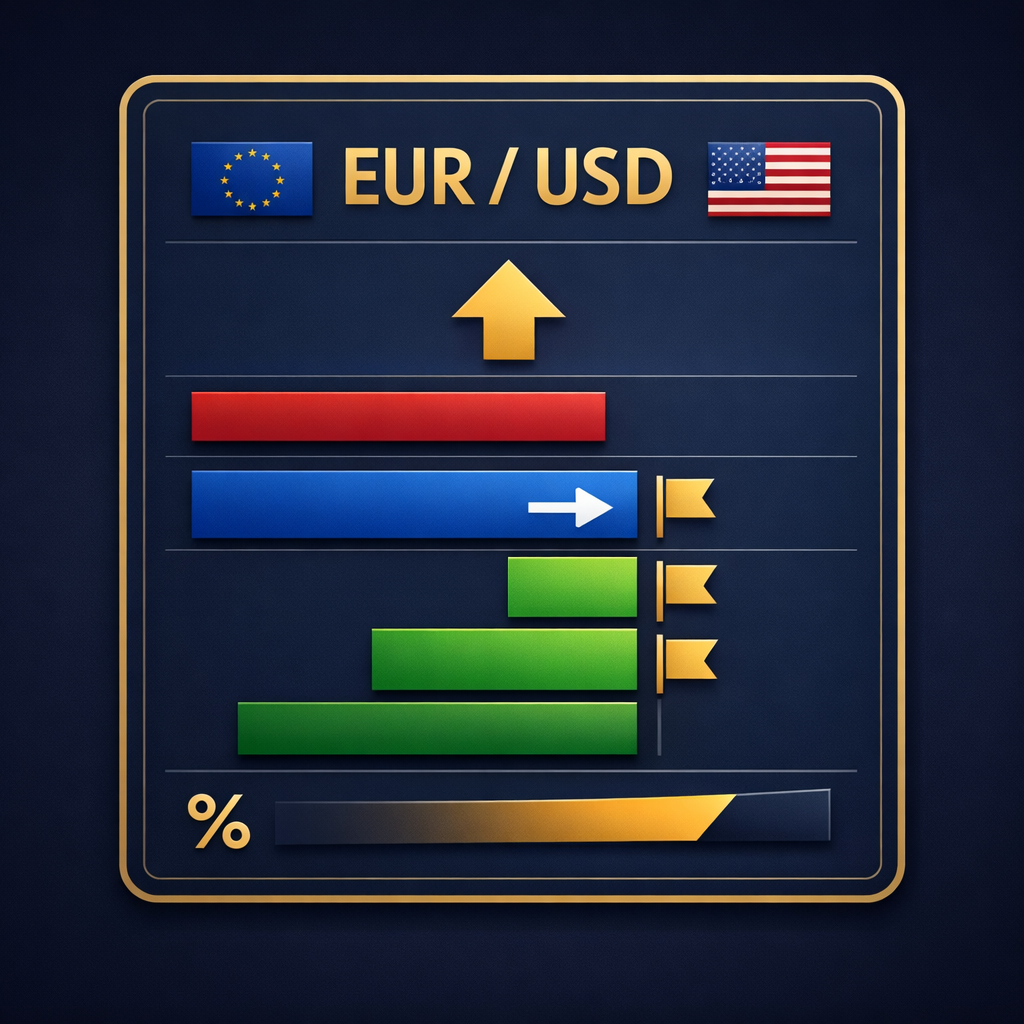
Forex signals are structured trade ideas that tell you what to trade, where to enter, where to exit if wrong (stop loss), and where to take profit.
A good signal removes guesswork and gives you a plan.
A bad signal removes your money and gives you excuses.
What a proper signal looks like
At minimum, a beginner-friendly signal should include:
- Pair (example: EUR/USD)
- Direction (BUY or SELL)
- Entry (market price or limit zone)
- Stop Loss (SL) (in pips, or price)
- Take Profit (TP) (one or multiple targets)
- Optional context: session, setup type, and risk guidance
Example (realistic around current levels):
- EUR/USD BUY 1.0520
- SL 1.0490 (30 pips risk)
- TP 1.0580 (60 pips reward = 1:2 R:R)
What signals are NOT
Signals are not a “money printer.”
They don’t remove risk, and they don’t replace learning.
Even the best providers will have losing streaks, because forex is probability-based.
Why beginners love signals (and why many misuse them)
Signals feel like training wheels.
You can participate in the market without staring at charts for 6 hours.
The problem is beginners often treat signals like a “copy and forget” system.
They oversize positions, ignore stop losses, and jump between providers after two losses.
This guide fixes that by giving you a simple operating system you can follow.
2) The Forex Signals Ecosystem: Telegram, Apps, Copy Trading, and Analysts
Not all signals arrive the same way, and the delivery method changes your results.
Execution speed, clarity, and your ability to manage trades depend on the platform.
Common signal delivery formats
- Telegram channels/groups: fast, simple, community-driven, but quality varies wildly.
- Mobile apps: clean UI and notifications, but some are marketing-heavy and vague.
- Copy trading: auto-copies trades, but you lose control over entry quality and risk.
- Email/Discord: slower, often used for swing signals.
Beginner reality check: speed matters more than you think
In active sessions (London and New York), EUR/USD can move 10–25 pips quickly.
USD/JPY near 149.50 can jump on data and headlines, especially with DXY around 106.80.
If a signal is sent at 1.0520 but you enter at 1.0532 due to delay, your stop and target math changes.
That’s not a small detail—it’s the difference between a 1:2 trade and a 1:1 trade.
Comparison table: which signal format is best for beginners?
| Format | Best For | Pros | Cons | Beginner Rating |
|---|---|---|---|---|
| Telegram Signals | Fast execution + community | Instant updates, easy to follow, quick edits | Many fake providers, noisy channels | High (if provider is premium) |
| Signals App | Structured UI | Clear formatting, push notifications | Often generic signals, limited context | Medium |
| Copy Trading | Hands-off approach | Automation, less manual work | Slippage, risk mismatch, no learning | Medium-Low |
| Email/Discord | Swing trading | Less urgent, more explanation | Slower updates, missed entries | Medium |
If you’re specifically learning how to use forex signals, Telegram is usually the most practical starting point.
If you want a deeper Telegram-specific breakdown, see our beginner resource on how to use forex signals on Telegram step-by-step.
3) How to Read a Forex Signal Like a Trader (Not a Gambler)

Beginners often read a signal as a prediction.
Professionals read a signal as a risk-defined scenario.
Same message, totally different mindset.
The four numbers that matter most
When you receive a signal, focus on:
- Entry: where the trade becomes valid
- Stop Loss: where your idea is proven wrong
- Take Profit: where the idea is proven right
- Risk size: how much you’ll lose if wrong
Pips, points, and why beginners get confused
EUR/USD moves in pips (0.0001).
USD/JPY moves in pips (0.01).
Gold (XAUUSD) moves in dollars, and many brokers quote it with decimals.
That’s why a “small” gold stop like $15 can be normal, while a 150-pip stop on EUR/USD is usually huge for a day trade.
Example: turning a signal into a plan
Let’s say you receive:
- GBP/USD SELL 1.2680
- SL 1.2720 (40 pips)
- TP 1.2600 (80 pips)
Before placing it, you ask:
- Is this during London/NY when liquidity is high?
- Is spread reasonable (not 3–5 pips during news)?
- Do I have a rule for risk (0.5%–1%)?
- Is the reward worth it (80 pips for 40 pips risk = 1:2)?
Market context matters (even if you don’t analyze charts yet)
With DXY around 106.80, USD strength can influence EUR/USD and GBP/USD behavior.
USD/JPY near 149.50 can be sensitive to yields and risk sentiment.
Gold near $2650 (+0.35% in 24h) can be volatile around data, and it often reacts sharply to sudden risk-off headlines.
You don’t need to predict the macro picture as a beginner.
You do need to respect that volatility can expand, and your execution must be clean.
4) Step-by-Step: How to Execute Forex Signals Correctly (Beginner Workflow)
This is the part most signal sellers skip.
Execution is where beginners lose money even with good analysis.
Use this workflow every time until it becomes automatic.
Step 1: Confirm the signal type (market vs limit)
- Market entry: you enter immediately at current price.
- Limit entry: you place a pending order at a better price.
If the signal says “BUY 1.0520–1.0510 zone,” that’s a limit-style plan.
If you chase it at 1.0530, you change the trade.
Step 2: Check spread and session
London and New York sessions are typically best for majors due to liquidity.
During illiquid hours, spreads widen and stop hunts become more common.
A 2-pip spread on EUR/USD is annoying but manageable.
A 6-pip spread can destroy a tight stop strategy.
Step 3: Place SL and TP at the same time
This is non-negotiable for beginners.
If you place a trade without a stop loss, you’re not trading—you’re hoping.
Set SL and TP as part of the order ticket.
Step 4: Use position sizing (not “lot guessing”)
Signals tell you where to enter and exit.
You decide how much to risk.
As a beginner, start with a fixed risk model:
- Conservative: 0.5% per trade
- Standard beginner: 1% per trade
- Aggressive (not recommended early): 2%+ per trade
Example: $500 account, 1% risk = $5 maximum loss.
If your stop is 40 pips, you size the lot so 40 pips = $5.
Step 5: Decide your management rule before entry
Will you move stop to breakeven at +1R?
Will you partial close at TP1 and hold for TP2?
Or will you set-and-forget?
Pick one approach and stick to it for 30 trades.
Consistency beats creativity when you’re learning.
Step 6: Journal the trade (2 minutes)
Write:
- Signal source
- Pair, entry, SL, TP
- Risk % used
- Result in R (e.g., +2R, -1R)
- Did you follow rules? Yes/No
After 30 trades, you’ll know whether the issue is the provider or your execution.
5) Risk Management for Beginners Using Signals (The Rules That Keep You Alive)
If you only take one lesson from this article, make it this:
Signals don’t control your risk. You do.
Most beginners don’t fail because signals are “bad.”
They fail because they risk too much, too often, with no plan for drawdowns.
The 1% rule (and why it works)
Risking 1% per trade means you can survive a losing streak.
Even a strong provider can hit 5–8 losses in a rough period.
If you risk 10% per trade, 5 losses can cut you in half.
If you risk 1% per trade, 5 losses is a manageable -5% drawdown.
Risk-to-reward: the beginner advantage
When you aim for 1:2 R:R, you can be wrong more often and still grow.
Example:
- 10 trades
- 4 wins at +2R = +8R
- 6 losses at -1R = -6R
- Net: +2R even with a 40% win rate
This is why professional signal structures matter.
Clear SL/TP and realistic targets keep your math in your favor.
Gold (XAUUSD) risk example using current context
Gold is around $2650.
A realistic beginner-friendly setup might look like:
- XAUUSD BUY 2642
- SL 2627 (risk $15)
- TP 2672 (reward $30 = 1:2)
- TP2 2687 (reward $45 = 1:3)
If your account is $1,000 and you risk 1% ($10), you size the position so a $15 move against you equals $10.
This is the difference between “following signals” and trading professionally.
Daily loss limits (your emergency brake)
Signals can cluster.
You might get 3–6 trades in a day during active sessions.
Set a daily max loss, such as:
- -2R per day (example: two full stop-outs)
- Or -2% if you risk 1% per trade
When you hit it, stop trading.
Protecting your psychology is part of protecting your capital.
For a deeper framework, read our detailed guide on risk management strategies when using forex signals.
6) How to Choose a Forex Signals Provider (Beginner Checklist + Red Flags)
Choosing a provider is like choosing a coach.
A good coach improves your process even when you lose.
A bad coach sells confidence and disappears during drawdowns.
The beginner checklist (what to look for)
- Clear entries and exits: Entry, SL, TP must be explicit.
- Risk guidance: recommended risk per trade and trade frequency.
- Consistency: same style, same session focus, repeatable logic.
- Transparency: track record, losses included, not just wins.
- Education: explanations, charts, and post-trade breakdowns.
- Support: someone answers questions (especially for beginners).
Red flags that should make you walk away
- “Guaranteed profits” or “100% win rate.” No serious trader says that.
- No stop loss or “mental SL only.” Beginners need hard SL.
- Martingale/grid doubling marketed as “recovery.” This can blow accounts fast.
- Only screenshots and no verifiable history.
- Pressure tactics: “Join now or miss the next 500 pips.”
Why beginners should prefer session-focused providers
Providers who focus on London and New York sessions tend to trade when spreads are tighter and moves are cleaner.
That matters for execution and for stop placement.
It also helps you build a routine: you know when to be available and when to ignore noise.
Use a formal provider checklist
If you want a printable checklist, use our dedicated resource: forex trading signals provider checklist for beginners.
It’s designed to help you compare providers objectively, not emotionally.
7) How to Avoid Common Beginner Mistakes When Following Signals
Most signal failures are not “bad signals.”
They’re beginner behaviors that sabotage good trades.
Fix these, and your results can change dramatically without switching providers.
Mistake #1: Entering late and blaming the signal
If a EUR/USD signal triggers at 1.0520 and you enter at 1.0531, you added 11 pips of hidden risk.
Your stop is now effectively tighter, and your target is effectively farther.
Solution: use pending orders when the signal is zone-based, and trade during sessions when you can execute quickly.
Mistake #2: Moving stop loss “just a little”
That “little” becomes a habit.
One moved stop turns a planned -1R loss into a -3R disaster.
Solution: hard rule—never widen SL. If you must adjust, only tighten.
Mistake #3: Overtrading because signals feel like permission
Some days the market is choppy.
Even with DXY stable around 106.80, intraday swings can be messy and stop-heavy.
Solution: cap your trades per day (example: 3 trades max) and follow a daily loss limit.
Mistake #4: Mixing providers and strategies
One provider might scalp EUR/USD with 15–25 pip stops.
Another might swing GBP/USD with 80–150 pip stops.
If you mix them, your risk becomes random.
Solution: commit to one style for 30 trades, then evaluate.
Mistake #5: Ignoring the broker reality
Your broker’s spread, slippage, and execution quality matter.
On USD/JPY near 149.50, fast spikes can cause slippage around news.
Solution: avoid trading major news unless your provider specifically trades it with a plan.
8) Building Consistency: A 30-Day Plan for Beginners Using Forex Signals
Beginners often ask, “How many signals should I take per day?”
The better question is: “How do I build a repeatable process?”
Here’s a simple 30-day plan designed to build consistency without overwhelm.
Week 1: Demo execution only (no money pressure)
- Trade on demo with the exact same platform you’ll use live.
- Practice placing market and limit orders.
- Practice setting SL/TP immediately.
- Goal: 0 execution mistakes, not profits.
Many beginners skip this and pay “tuition” in a live account.
Demo is free tuition.
Week 2: Micro risk live (0.25%–0.5%)
- Go live with tiny risk.
- Take only the cleanest signals (ideally 1–2 per day max).
- Journal every trade in R.
Your job is to prove you can follow rules under emotion.
Profit is secondary.
Week 3: Standardize management (one rule set)
Pick one trade management method:
- Set-and-forget: SL/TP fixed, no interference.
- Breakeven at 1R: move SL to entry when price reaches +1R.
- Partial close: close 50% at TP1, let the rest run.
Don’t switch mid-week.
Switching rules is how beginners create inconsistent results and blame signals.
Week 4: Review and refine
At the end of 30 days, calculate:
- Total trades taken
- Win rate
- Average R per trade
- Biggest mistake category (late entry, no SL, moved SL, overtrading)
Then make one improvement only.
Not five.
One.
A simple weekly review question
“Did I lose money because the setup failed, or because I broke my rules?”
That question alone can save you months.
9) Forex vs Gold Signals for Beginners: What Should You Start With?
Many beginners join a signals service for forex, then get tempted by gold because it “moves more.”
Gold (XAUUSD) near $2650 can indeed move $10–$25 quickly.
That can be opportunity—or danger—depending on your risk control.
Forex majors (EUR/USD, GBP/USD, USD/JPY): beginner-friendly traits
- Typically tighter spreads during London/NY sessions.
- More stable behavior compared to some commodities.
- Cleaner technical levels for many strategies.
Example: EUR/USD at 1.0520 might have a 25–40 pip intraday stop for a structured day trade.
That’s easier to position size and emotionally tolerate for many beginners.
Gold (XAUUSD): why it’s popular and why it punishes mistakes
Gold is liquid and highly tradable.
But it can spike on headlines, yields, and risk sentiment.
With gold around $2650 and up +0.35% in 24h, you can see fast intraday expansions.
A $15 stop is common, but if you enter late by $5, you just increased your risk by 33%.
A practical beginner approach
- Start with one major pair (EUR/USD or GBP/USD).
- Add gold signals only after you can execute consistently for 30 trades.
- If you trade gold, reduce risk to 0.5% until you’re comfortable.
If you want to follow both markets with one provider, United Kings offers combined access via our premium channels on United Kings trading signals, including dedicated streams for forex signals and gold signals.
10) What “Good” Forex Signals Look Like in Real Market Conditions (Examples)
Beginners need realism.
So let’s map signal structure to current market context without pretending we know the next candle.
These examples show what a well-defined signal should communicate.
Example A: EUR/USD continuation idea (around 1.0520)
Market context: DXY at 106.80 suggests USD strength is still relevant.
A quality signal might avoid guessing tops and instead trade structured breaks or pullbacks.
- EUR/USD SELL 1.0515
- SL 1.0550 (35 pips)
- TP 1.0445 (70 pips = 1:2)
Notice what’s good here: defined risk, defined reward, and a realistic target.
Example B: GBP/USD mean reversion idea (around 1.2680)
GBP/USD can be more volatile than EUR/USD.
A signal might use a slightly wider stop to avoid noise.
- GBP/USD BUY 1.2685
- SL 1.2645 (40 pips)
- TP 1.2765 (80 pips = 1:2)
Beginner note: if you can’t tolerate a 40-pip stop emotionally, you’re oversized.
Example C: USD/JPY volatility-aware setup (around 149.50)
USD/JPY can spike around yields and news.
Signals should account for that with either clear invalidation or reduced size.
- USD/JPY SELL 149.60
- SL 150.10 (50 pips)
- TP 148.60 (100 pips = 1:2)
Execution note: avoid entering during major data releases unless the provider explicitly trades news.
Example D: Gold (XAUUSD) intraday swing (around $2650)
Gold is currently around $2650, within a realistic $2610–$2690 working range.
- XAUUSD SELL 2660
- SL 2678 (risk $18)
- TP 2624 (reward $36 = 1:2)
Beginner note: gold can move $10 fast.
If you’re emotional, reduce size—not discipline.
Where beginners go wrong with “perfect-looking” signals
They see the numbers and forget the process.
They enter late, skip SL, or take profits early out of fear.
Good signals create advantage only when you execute them as designed.
11) Why United Kings Signals Work for Beginners (Process, Clarity, Community)
As a beginner, you don’t just need trade entries.
You need a system you can follow when you’re excited, confused, or coming off a loss.
That’s where a premium provider should feel different.
What we focus on (and why it matters)
- Premium Telegram signals for forex and gold with clear Entry, SL, and TP levels.
- London and New York session trading, where liquidity is typically strongest.
- Educational content alongside signals so you learn the “why,” not just the “what.”
- Community scale: 300K+ active traders sharing execution feedback and results.
Win rate vs. beginner outcomes (important distinction)
You’ll often see win-rate claims in the industry.
At United Kings, our edge comes from structured trade ideas, risk-defined execution, and disciplined management.
We target a high-quality approach (often referenced as 85%+ win rate by our community), but your individual results will still depend on your broker, spreads, execution speed, and risk control.
Past performance does not guarantee future results.
Where to start inside United Kings
- Explore our main hub: UnitedKings.net
- See all packages and offerings: United Kings signals
- Forex-only stream: premium forex signals
- Gold-focused stream: XAUUSD gold signals
Pricing plans (choose based on your learning horizon)
We keep it simple with three plans on our pricing page:
- Starter (3 Months): $299 (~$100/month)
- Best Value (1 Year): $599 (~$50/month, 50% savings) + FREE ebook
- Unlimited (Lifetime): $999 (pay once, access forever)
And yes, we include a 48-hour money-back guarantee so you can evaluate the service responsibly.
Want to compare providers first?
Use our monthly benchmark article: best forex signals (updated list and criteria).
12) FAQ: Forex Signals for Beginners
1) Are forex signals good for beginners?
They can be, if the provider is transparent and the signals include clear Entry, SL, and TP.
Signals help beginners learn structure, but you still need risk management and discipline.
2) How many forex signals should a beginner take per day?
Start with 1–3 trades max per day.
More trades doesn’t mean more profit.
It often means more mistakes and more emotional decisions.
3) Should I use a stop loss when following signals?
Yes.
Beginners should always use a hard stop loss placed at entry.
No SL is the fastest path to account damage.
4) Can I follow forex signals with a small account?
Yes, but you must size positions correctly.
Use 0.5%–1% risk per trade, avoid overtrading, and focus on consistency over speed.
5) Is Telegram a safe place to get forex signals?
Telegram is just a platform.
Quality depends on the provider.
Stick with premium services that show process, risk rules, and consistent communication.
Risk Disclaimer (Read Before You Trade)
Forex and gold trading involves significant risk and may not be suitable for all investors. You can lose some or all of your capital.
Signals are educational trade ideas and do not guarantee profits.
Past performance does not guarantee future results.
If you’re a beginner, consider practicing on a demo account first, and use strict risk management (such as 0.5%–1% per trade).
Join United Kings: Get Premium Forex & Gold Signals With Clear Risk Levels
If you want a structured way to learn how to use forex signals without guessing entries, stop losses, and targets, United Kings is built for you.
We deliver premium Telegram signals focused on the London and New York sessions, with clear Entry, SL, and TP levels—and educational guidance so you improve with every trade.
- Start here: United Kings premium signals
- Prefer forex only? Explore our forex signals
- Trading XAUUSD? See our gold signals
- Join the community channel on Telegram: United Kings official Telegram
- Pick your plan (Starter, Best Value, or Lifetime): view pricing and get started
Your next step is simple: choose one plan, start on demo if you’re new, and follow the beginner workflow in this guide for 30 trades.
That’s how traders stop chasing and start building consistency.