
You followed a forex signal, did everything “right,” and still lost.
Now you’re wondering if forex signals are a scam, if your broker cheated you, or if you’re simply not cut out for trading.
Here’s the truth: forex signals can be extremely useful for beginners, but only when you understand what a signal really is, how to execute it correctly, and how to manage risk like a professional.
This is your complete forex signals guide built for absolute beginners, using realistic market prices right now: EUR/USD around 1.0520, GBP/USD near 1.2680, USD/JPY around 149.50, DXY near 106.80, and Gold (XAUUSD) trading around $2650.
TL;DR: Forex Signals for Beginners (Key Takeaways)
- A forex signal is a trade idea with a plan: entry, stop loss (SL), and take profit (TP). Your job is execution and risk control.
- Most beginner losses come from bad execution: wrong lot size, late entries, ignoring SL, trading during news spikes, or using the wrong account type.
- Choose signal providers based on clarity and process, not screenshots: look for consistent risk rules, session focus, and transparent trade management.
- Risk 0.5%–1% per trade until you prove consistency over 30–50 trades. Signals don’t remove risk.
- Match signals to your lifestyle: London/NY session signals work best when you can monitor volatility and spreads.
- Track every signal you take in a simple journal. Your consistency comes from feedback loops, not “more signals.”
What Are Forex Signals (And What They Are Not)?
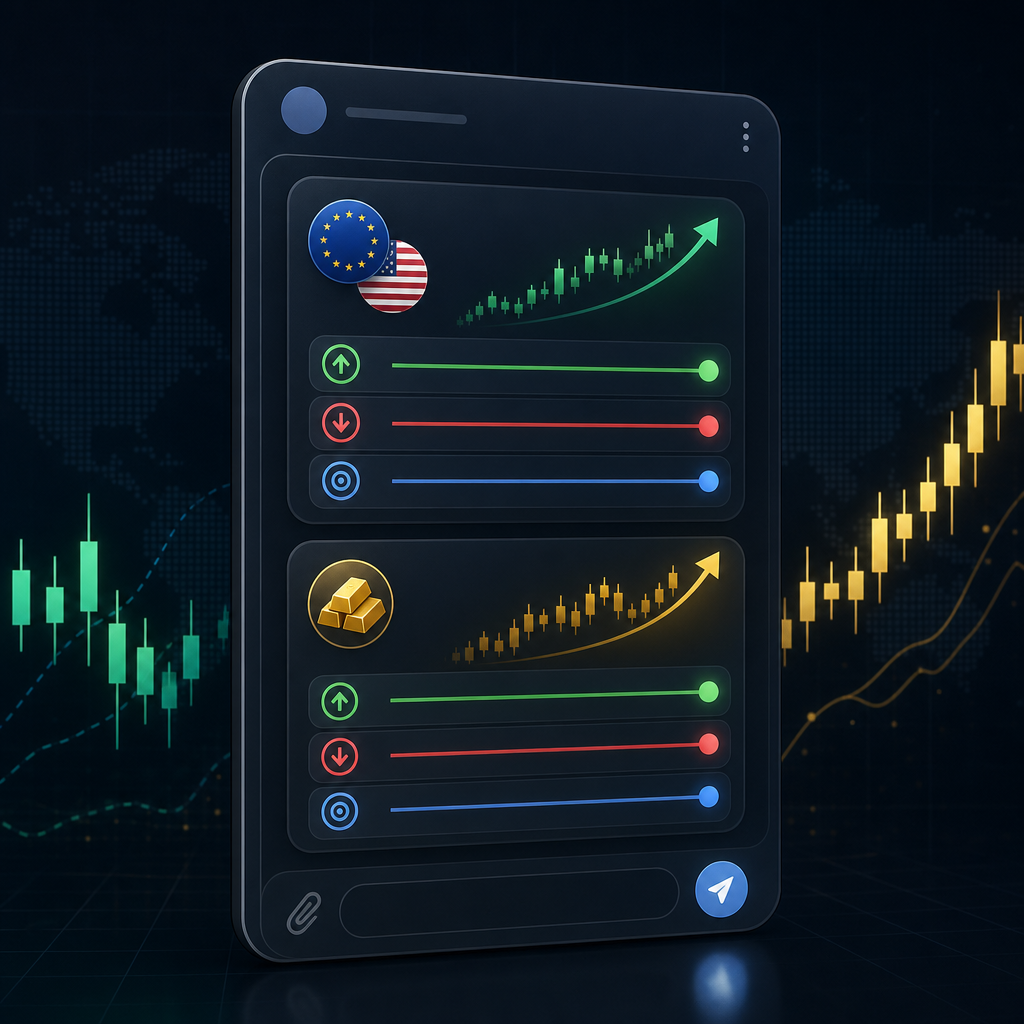
Forex signals are trade recommendations designed to help you enter the market with a structured plan.
A complete signal usually includes direction (buy/sell), entry, stop loss, and one or more take profit targets.
For beginners, the biggest benefit is simple: signals remove the need to “guess” entries from scratch.
Instead of staring at EUR/USD at 1.0520 and asking “up or down?”, you’re given a plan like:
- Buy EUR/USD @ 1.0515
- SL 1.0485 (30 pips)
- TP1 1.0575 (60 pips)
- TP2 1.0605 (90 pips)
That’s a defined risk-reward framework.
What signals are not: they are not guaranteed profits, they are not a replacement for discipline, and they are not a license to over-leverage.
Even a high-quality provider will have losing trades.
In real markets—especially when the Dollar Index is firm around 106.80 and USD/JPY is elevated near 149.50—moves can be sharp, liquidity can shift, and stops can get hit quickly.
Signals give you an edge, not certainty.
Why beginners love signals (and where they get trapped)
Signals feel like a shortcut because they reduce decision fatigue.
The trap is that beginners often treat signals like lottery tickets.
They increase lot size after a win, revenge trade after a loss, or hold past TP because they “feel it will go more.”
If you want signals to work, you must treat them like a process, not a prediction.
How Forex Signals Work in Real Life (From Telegram to Your Trade)
Most modern signal services deliver trades via Telegram, apps, or private dashboards.
The delivery method matters less than the structure and the speed of execution.
In fast markets, being late by even 5–15 minutes can change the trade completely.
For example, imagine a GBP/USD sell signal triggers near 1.2680 during the London session.
If price drops to 1.2655 quickly and you enter late, you might be selling into support.
That’s how beginners turn good signals into bad trades.
Signal formats you’ll see (and how to read them)
- Market execution signals: “Buy now @ 1.0520, SL 1.0490, TP 1.0580.”
- Limit order signals: “Sell limit 1.2700, SL 1.2725, TP 1.2640.”
- Zone entries: “Buy 1.0510–1.0520, SL 1.0485, TP 1.0570.”
- Multi-TP scaling: TP1/TP2/TP3 to lock profits gradually.
As a beginner, prefer providers that send clear numbers and explain trade management.
Ambiguous calls like “Gold bullish, buy dips” are not beginner-friendly.
Why execution matters more than the signal itself
Two traders can take the same signal and get different results.
The difference is usually:
- Spread and broker execution quality
- Entering late
- Using the wrong lot size
- Moving the stop loss
- Closing early out of fear
If you’re using Telegram signals, you need a routine.
If you want a structured Telegram approach, also read our beginner-focused guide on Telegram workflows: forex signals Telegram for beginners guide.
Types of Forex Signals: Manual vs Automated, Scalping vs Swing

Not all forex signals are built for the same trader.
If you choose the wrong type, you’ll feel like signals “don’t work,” when the real issue is mismatch.
Let’s break down the main categories in a beginner-friendly way.
Manual signals vs automated signals
Manual signals are created by human analysts using price action, indicators, fundamentals, and experience.
Automated signals are generated by algorithms that follow coded rules.
Beginners often assume automation is better because it sounds “objective.”
But manual signals can adapt to context—like a sudden DXY spike to 106.80 or a risk-off move that pushes gold from $2635 to $2650 quickly.
Scalping signals vs intraday signals vs swing signals
Scalping signals target small moves (5–20 pips) and require fast execution.
They’re tough for beginners because spreads and slippage become a big percentage of the move.
Intraday signals target 20–80 pips and often play London/NY session momentum.
Swing signals target 100–300+ pips and may take days.
Beginners usually do best with intraday signals because:
- You’re not glued to the screen like scalping.
- You don’t need to hold through multiple nights like swing trading.
- Risk and reward are easier to structure.
Forex vs Gold signals (why beginners mix them incorrectly)
Gold (XAUUSD) behaves differently from EUR/USD.
At $2650, gold can move $10–$25 in minutes during high volatility.
That’s 100–250 “points” on many platforms.
Forex majors often move slower, but can spike around data releases.
If you trade both, you need different stop sizes and position sizing rules.
If your main interest is gold, explore our dedicated page: premium gold signals.
Comparison Table: Free vs Paid Signals (What Beginners Should Expect)
Most beginners start with free signals.
That’s understandable.
But free signals often come with hidden costs: inconsistent quality, no risk framework, and no accountability.
Here’s a practical comparison you can use before subscribing anywhere.
| Feature | Free Signals (Typical) | Premium Signals (Typical) | What Beginners Should Choose |
|---|---|---|---|
| Entry/SL/TP clarity | Often vague or missing | Clear levels with structure | Clear levels only |
| Risk management guidance | Rare | Position sizing & rules included | Must-have |
| Consistency | Unpredictable | Process-driven approach | Process & routine |
| Support & education | None | Community + learning resources | Education matters |
| Best for | Testing, learning basics | Execution + scaling with discipline | Start learning, then upgrade |
If you want a deeper breakdown of what to look for, our beginner checklist is a strong companion to this guide: signals provider checklist for beginners.
How to Choose a Forex Signal Provider (Beginner Checklist That Actually Works)
Choosing a provider is where most beginners get manipulated.
Scammers sell “wins,” professionals sell process.
If you remember one thing: you’re not buying signals, you’re buying a decision framework.
What to check before you pay (step-by-step)
- Step 1: Look for complete trade plans. Every signal should include Entry, SL, TP, and ideally guidance like “move SL to breakeven at TP1.”
- Step 2: Ask how they handle losses. Real providers talk about drawdowns, not just wins.
- Step 3: Check session alignment. If signals are focused on London/NY, can you actually trade those hours?
- Step 4: Verify risk rules. If the provider encourages high leverage or “recover losses,” walk away.
- Step 5: Inspect communication quality. Are updates clear? Do they post trade management and closures?
- Step 6: Confirm realistic expectations. No provider can guarantee profit. If they do, it’s a red flag.
Beginner red flags (these cost people accounts)
- “Guaranteed” daily profits
- No stop losses
- Martingale or “double lot after loss” as the main strategy
- Signals that arrive after the move already happened
- Overtrading: 20–40 signals per day without context
What we do differently at United Kings (and why it matters)
United Kings is built around clarity and execution.
We deliver premium Telegram signals for forex and gold with a documented, disciplined approach.
Our community includes 300K+ active traders, and our signals focus heavily on London and New York sessions, where liquidity is strongest.
We also publish educational content alongside signals so you don’t stay dependent forever.
You can explore our signal hub here: United Kings signals, or go directly to forex signals.
How to Use Forex Signals Correctly (Execution Workflow for Beginners)
This is the part most guides skip.
Signals don’t fail beginners—workflows fail beginners.
Here’s a practical execution routine you can follow every time a signal arrives.
Step-by-step: from signal message to live trade
- Step 1: Check the pair and context. If USD/JPY is at 149.50 and DXY is strong, USD strength might affect EUR/USD and GBP/USD sentiment.
- Step 2: Confirm your spread. If EUR/USD spread is 0.8 pips it’s fine. If it’s 2.5 pips, your entry quality changes.
- Step 3: Set the order properly. Market order for “buy now,” pending order for “buy limit/sell limit.”
- Step 4: Place SL and TP immediately. Beginners blow accounts by “adding SL later.” Don’t.
- Step 5: Calculate lot size from risk. Risk a fixed % (0.5%–1%) based on SL distance.
- Step 6: Follow the management rule. If the plan says “partial at TP1” or “move SL to breakeven,” do exactly that.
- Step 7: Log the trade. Screenshot entry, note time, spread, and emotions.
A real example using current prices (EUR/USD)
Assume EUR/USD is 1.0520 and you receive:
- Buy 1.0518
- SL 1.0493 (25 pips)
- TP 1.0568 (50 pips)
This is a clean 1:2 risk-reward setup.
If you risk $10 on the trade, you aim to make about $20 at TP.
If you risk $100, you aim to make about $200.
Notice what matters: your risk is defined before you enter.
A real example using current prices (Gold / XAUUSD)
Gold is around $2650.00 and you receive:
- Sell 2652
- SL 2667 (15 dollars)
- TP 2622 (30 dollars)
That’s again roughly 1:2.
Gold can move $10 fast, so execution and spread matter even more than majors.
Risk Management for Beginners Using Forex Signals (The Rules That Keep You Alive)
If you ignore risk management, signals will feel random.
If you apply risk management, signals become a long-term probability game.
That’s the difference between hobby trading and professional behavior.
The beginner risk model (simple and effective)
- Risk per trade: 0.5%–1% of account balance.
- Max daily loss: 2% (stop trading after that).
- Max open trades: 1–3 until you gain experience.
- No moving SL wider. You can tighten SL; you don’t widen it.
With a 1:2 risk-reward, you can be wrong more than right and still grow.
Example: win rate 45% with 1:2 RR can still be profitable.
Why beginners blow accounts even with “good” signals
The most common reason is over-leverage.
A 30-pip SL on EUR/USD is normal.
If your lot size is too big, that 30 pips becomes a 10% account hit.
Then one loss turns into panic, and panic turns into revenge trading.
Position sizing made practical (a quick method)
Do this every trade:
- Decide risk dollars: e.g., $20 risk
- Measure SL distance: e.g., 25 pips
- Choose lot size so 25 pips = $20 loss if SL hits
If you want a full framework, read our dedicated guide: risk management strategies when using forex signals.
Gold-specific note (XAUUSD)
Gold stops are often $10–$25 away from entry for intraday trades.
If you trade gold like EUR/USD, you’ll oversize.
At $2650, a $15 stop is common, but your lot must match that volatility.
Understanding Market Context: Sessions, Volatility, and News (Beginner Edition)
Signals don’t exist in a vacuum.
Market context is why the same setup works on Tuesday and fails on Friday.
As a beginner, you don’t need to predict macroeconomics.
You do need to understand when volatility is likely to expand.
London and New York sessions (why most signals focus here)
London is where liquidity wakes up for EUR and GBP pairs.
New York adds USD volume and often creates the day’s biggest moves.
That’s why professional signal providers often focus on these windows.
When GBP/USD is around 1.2680, a London breakout can run 40–80 pips quickly.
When USD/JPY is around 149.50, a NY bond-yield shift can push it 50–120 pips.
DXY and “USD mood” (a simple beginner filter)
You don’t need to trade DXY, but you should watch it.
With DXY around 106.80, the market is leaning toward USD strength.
That can pressure EUR/USD (1.0520) and influence GBP/USD (1.2680).
It can also interact with gold (XAUUSD), which often moves inversely to USD—though not always.
News events: what beginners should do when signals arrive near data
Major releases can cause spread widening and slippage.
If you’re unsure, the safest beginner rule is:
- Avoid entering new trades 5–10 minutes before high-impact news.
- Reduce risk if you must trade.
- Never remove SL to “survive the spike.”
If you trade gold, unexpected headlines can move XAUUSD from $2650 to $2665 in minutes.
That’s not “manipulation.” That’s liquidity repricing.
Building Consistency With Signals: Journaling, Metrics, and Feedback Loops
Beginners think consistency comes from finding the “best” signal provider.
In reality, consistency comes from your execution quality over a meaningful sample size.
You can’t improve what you don’t measure.
The beginner signal journal (what to track)
- Date and time (session: London/NY)
- Pair (EUR/USD, GBP/USD, USD/JPY, XAUUSD)
- Signal details (Entry, SL, TP)
- Your actual entry price (were you late?)
- Spread at entry
- Risk % used
- Result in R (e.g., +2R, -1R)
- Notes: emotions, mistakes, distractions
Tracking in “R” is powerful.
It normalizes results regardless of lot size.
Example: if you risked 1% and hit TP at 2R, that’s +2%.
What to analyze every 20–30 trades
- Late entries: how many trades did you enter outside the recommended zone?
- SL discipline: did you ever widen stops?
- Early exits: did fear reduce your average win?
- Overtrading: did you take low-quality signals out of boredom?
Most beginners discover they’re not losing because signals are bad.
They’re losing because they break the same 1–2 rules repeatedly.
A simple consistency plan (30-day routine)
- Week 1: Demo trade signals only, focus on flawless execution.
- Week 2: Live micro lot or smallest size, risk 0.5%.
- Week 3: Continue 0.5%–1% risk, journal every trade.
- Week 4: Review stats, remove your biggest mistake, repeat.
Consistency isn’t exciting.
But it’s what creates the results you’re looking for.
Common Beginner Mistakes When Following Forex Signals (And How to Fix Them)
If you’re new, you will make mistakes.
The goal isn’t perfection.
The goal is to avoid the mistakes that destroy accounts.
Mistake #1: Entering late and blaming the provider
If the signal says sell GBP/USD at 1.2680 and you enter at 1.2662, you changed the trade.
Your SL might now be too tight, or your TP too close.
Fix: use pending orders when possible, or only take signals when you can execute immediately.
Mistake #2: Changing SL/TP because of emotions
Beginners often move TP closer to “secure profit,” then watch price hit the original TP.
Or they widen SL to avoid being stopped out, then take a bigger loss.
Fix: pre-commit to the plan. If you want to adjust, do it systematically (e.g., partial close at TP1).
Mistake #3: Using one lot size for every pair
EUR/USD 25-pip SL and XAUUSD $15 SL are not the same risk.
Fix: size positions based on risk and SL distance, not habit.
Mistake #4: Trading every signal
More trades don’t mean more profit.
They often mean more mistakes.
Fix: start with 1–3 high-quality trades per day or even per week.
Mistake #5: Ignoring broker conditions
High spreads, slow execution, and slippage can turn a 1:2 setup into 1:1.
Fix: test your broker on demo during London/NY volatility, especially around major market opens.
What “Good” Forex Signals Look Like (Examples Using Today’s Market Levels)
As a beginner, you need a reference for what professional-grade signals look like.
Not just “buy/sell,” but a complete trade thesis with risk control.
Below are examples using today’s realistic levels.
Example 1: EUR/USD intraday continuation (around 1.0520)
- Pair: EUR/USD
- Bias: intraday buy after pullback
- Entry: 1.0515
- SL: 1.0485 (30 pips)
- TP: 1.0575 (60 pips)
- RR: ~1:2
Why it’s “good”: clear numbers, realistic target, and a stop that respects normal volatility.
Example 2: GBP/USD reversal scalp (around 1.2680)
- Pair: GBP/USD
- Entry: sell 1.2685
- SL: 1.2710 (25 pips)
- TP: 1.2635 (50 pips)
- RR: ~1:2
Beginner note: if spreads widen at NY open, your entry quality matters.
Example 3: USD/JPY momentum (around 149.50)
- Pair: USD/JPY
- Entry: buy 149.40
- SL: 149.00 (40 pips)
- TP: 150.20 (80 pips)
- RR: ~1:2
USD/JPY can move quickly when yields shift.
Don’t use oversized lots on JPY pairs if you’re not used to the pace.
Example 4: Gold (XAUUSD) structured intraday trade (around $2650)
- Instrument: XAUUSD
- Entry: buy 2642
- SL: 2627 (15 dollars)
- TP: 2672 (30 dollars)
- RR: ~1:2
Gold can spike and retrace fast.
If you’re trading gold signals, you’ll want a gold-specific feed: United Kings gold signals.
Getting Started With United Kings Signals (Beginner Roadmap)
If you want to follow signals seriously, you need a simple onboarding plan.
Not “join and trade everything,” but a controlled ramp-up.
Step-by-step beginner roadmap
- Step 1: Start with education first. Read a few foundational posts from our blog so the terminology is familiar.
- Step 2: Join the Telegram channel. This is where execution speed matters most: United Kings Telegram signals channel.
- Step 3: Demo trade for 1–2 weeks. Focus on execution, not profit.
- Step 4: Go live with small risk. 0.5% per trade until you build a 30-trade track record.
- Step 5: Scale only after consistency. Increase size slowly, not emotionally.
What you should expect from a premium provider (and what you should not)
You should expect:
- Clear Entry, SL, TP levels
- Trade updates and closures
- Session-focused opportunities (London/NY)
- Education to improve your independence
You should not expect:
- Guaranteed profits
- Zero losing trades
- “Always win” marketing
United Kings value props (in plain language)
- Premium Telegram signals for forex and gold
- 85%+ win rate target with clear Entry/SL/TP (note: win rate varies with market conditions and execution)
- 300K+ active traders in the community
- Educational content alongside signals
- 48-hour money-back guarantee for added confidence
Plans and pricing (choose based on your commitment)
We offer three plans on our pricing section: United Kings pricing plans.
- Starter: 3 Months for $299 (about $100/month)
- Best Value: 1 Year for $599 (about $50/month) with 50% savings + FREE ebook
- Unlimited: Lifetime for $999 (pay once, access forever)
If you’re still evaluating providers, you can also review our broader breakdown here: best forex signals (our latest analysis).
FAQ: Forex Signals for Beginners
1) Are forex signals good for beginners?
Yes, if the signals include clear Entry/SL/TP and you follow strict risk management.
They help you avoid random entries, but they don’t remove risk.
2) How many signals should a beginner take per day?
Start small: 1–3 trades maximum, or even fewer if you’re learning.
Your goal is consistent execution, not constant action.
3) What risk percentage should I use when following signals?
Most beginners should risk 0.5%–1% per trade.
If you’re in a drawdown or learning, lean toward 0.25%–0.5%.
4) Can I use the same strategy for forex and gold signals?
You can use the same process (Entry/SL/TP and risk rules), but not the same stop sizes or lot sizing.
Gold at $2650 can move $10–$25 fast, so your sizing must be adjusted.
5) What’s the fastest way to improve results with signals?
Journal your trades and fix one execution error at a time.
Most improvements come from better entries, consistent risk, and not breaking rules under pressure.
Risk Disclaimer (Read This Before You Trade)
Forex and gold trading involves significant risk and may not be suitable for all investors.
You can lose some or all of your capital.
Signals and analysis are for educational and informational purposes and do not constitute financial advice.
Past performance is not indicative of future results. Always use stop losses, manage leverage carefully, and consider practicing on a demo account if you’re a beginner.
Final CTA: Start Following Signals the Smart Way (Not the Emotional Way)
If you want to stop guessing and start trading with structure, we’re ready for you.
Join the United Kings community and get premium forex and gold signals with clear Entry, SL, and TP levels, plus education to build your independence.
Explore our full signals offering: United Kings signals.
Prefer forex only? Start here: premium forex signals.
Want faster access via Telegram? Join now: United Kings Telegram channel.
When you’re ready, choose the plan that matches your commitment on our pricing page (Starter 3 Months $299, Best Value 1 Year $599, Unlimited Lifetime $999).
Your next step is simple: follow signals with discipline, risk small, track results, and let consistency do the heavy lifting.