
Prop firm trading looks simple on paper: hit a profit target, respect drawdown rules, get funded.
In reality, most traders fail for one reason: they trade like it’s their personal account, not a rule-based evaluation.
If you’re using forex signals (or gold signals) to pass, you’re not “cheating” the challenge.
You’re doing what prop firms reward: disciplined execution, controlled risk, and repeatable decision-making.
TL;DR: Using Forex Signals to Pass a Prop Firm Challenge
- Signals can work extremely well for prop firm challenges if you adapt them to daily loss, max drawdown, and consistency rules.
- Your biggest edge is risk control: cap risk per trade (often 0.25%–0.75%) and avoid stacking correlated positions.
- Choose the right challenge type: longer time windows and realistic profit targets suit signal trading better than aggressive “sprint” models.
- Trade the best sessions: London and New York provide cleaner liquidity for executing entries/SL/TP with less slippage.
- Use a prop-firm execution checklist: lot sizing, news filter, spread check, and partial management rules before placing any trade.
- Track performance like a funded trader: expect variance, avoid revenge trades, and aim for steady equity curves—not hero days.
Why Prop Firm Traders Use Signals (and Why Many Still Fail)
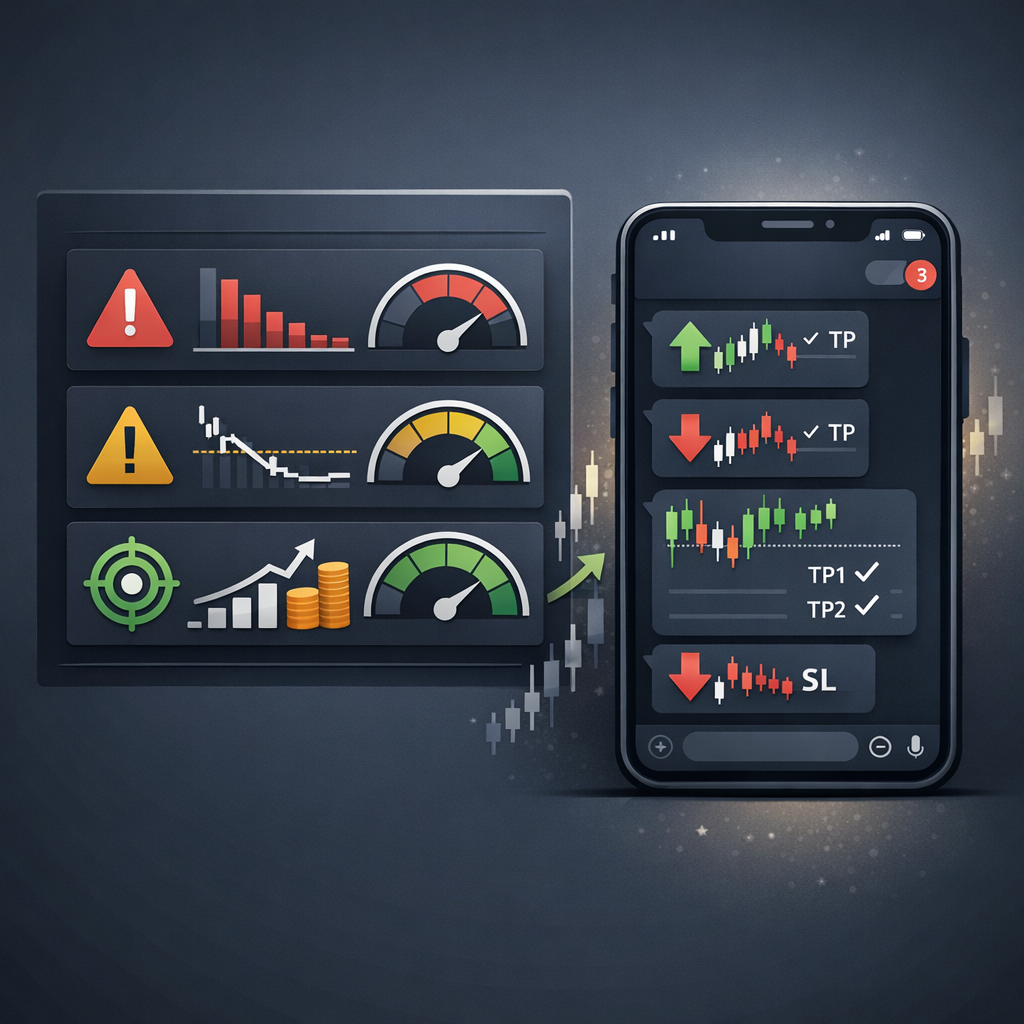
Signals are attractive during a challenge because they reduce decision fatigue.
You get a clear entry, stop loss, and take profit, then your job becomes execution.
That’s exactly why many funded traders rely on structured systems and external analysis.
But signals don’t automatically solve the problem prop firms are testing: risk behavior under pressure.
Here’s the trap.
A trader receives a strong buy on XAUUSD around $2650 (current market context), sees gold moving fast, and increases lot size “just this once.”
Gold spikes down $12, tags the stop, and the trader just burned a large portion of daily loss.
The second trap is overtrading.
Signals come in across pairs: EUR/USD at 1.0520, GBP/USD at 1.2680, USD/JPY at 149.50, and gold at $2650.
Without correlation control, that can become one big USD bet, especially with DXY around 106.80.
The third trap is misunderstanding “win rate.”
Even premium providers can have losing streaks.
Prop firm rules punish traders who size too aggressively or chase losses.
So the right question isn’t “Do signals work?”
It’s: Can you execute signals within prop firm constraints, without emotional overrides?
At United Kings, our approach is built around that reality.
We publish premium Telegram signals with clear Entry/SL/TP and a documented track record (often cited by members as 85%+ win rate), but we also emphasize the part that gets you funded: risk frameworks and execution discipline.
If you’re new to signal trading mechanics, start with our broader resources on the United Kings blog and then align your plan with the prop firm rulebook.
Which Prop Firm Challenges Suit Signal Trading Best?
Not all challenges are created equal.
Some are designed like endurance tests, others like sprints.
Signals can pass both, but the “fit” changes based on time limits, profit targets, and drawdown math.
Signal-friendly challenge traits
A signal-based approach thrives when you have time to be selective.
You want the freedom to wait for A+ setups and skip messy conditions.
- Longer evaluation window: more days to let probability play out.
- Reasonable profit target: targets that don’t force you into oversized risk.
- Static drawdown rules: clearer risk planning than trailing equity models.
- News flexibility: ability to avoid high-impact releases if your strategy requires it.
Challenges that can be risky for signal traders
Some models push you into high frequency or high risk.
That can clash with disciplined signal execution.
- Very short time limits that force daily trading.
- High profit targets relative to max drawdown.
- Strict consistency rules that penalize one strong day.
- Trailing drawdown that tightens as you profit, punishing normal pullbacks.
Think of it like this.
Signals are a probability engine.
Prop firm rules are a risk container.
Your job is to match the engine to a container that won’t crack under normal variance.
That’s why many funded traders prefer trading fewer, higher-quality signals during London and New York sessions.
Liquidity is deeper, spreads are tighter, and entries are more reliable.
If you want a steady flow of high-quality setups across forex and gold, explore our premium feeds at United Kings Signals, with dedicated streams for Forex Signals and Gold Signals.
Prop Firm Rules Explained: Profit Target, Daily Loss, Max Drawdown
To pass consistently, you must translate every signal into the language prop firms care about.
That language is: daily loss, max drawdown, and profit target.
Everything else is noise.
Profit target: the temptation to rush
A profit target is not a command to trade more.
It’s a finish line you reach by respecting risk until probability does its job.
The fastest way to fail is to treat the target like a deadline.
Example mindset shift.
If your target is 8% and you risk 1% per trade, you might need 8–12 solid trades depending on R:R and win rate.
If you risk 2% per trade, you might need fewer trades, but one losing streak can end your challenge.
Daily loss: the silent killer
Daily loss limits are designed to stop tilt.
They also punish “signal stacking” when multiple alerts appear close together.
Two losses in a row on gold (easy during volatile sessions) can put you near the daily cap if you’re oversized.
Gold at $2650 is currently in a moderately volatile regime (24h change +0.35%).
That’s enough movement to tempt overconfidence, but also enough to hit stops quickly if you ignore structure.
Max drawdown: the long-term gatekeeper
Max drawdown is where challenges are truly won.
Daily loss might stop you today, but max drawdown stops you forever.
Your signal strategy must be built to survive a normal losing streak without breaking the account.
Here’s a practical rule we like for challenges.
Assume you can take 6 consecutive losses at some point.
If that scenario breaks max drawdown, your sizing is too big.
Signals don’t remove drawdown.
They help you avoid random trades, but you still need a plan for variance.
That’s why you should anchor your challenge approach to a robust risk framework like the one in our guide on risk management strategies when using forex signals.
Signal Types vs Challenge Styles (Comparison Table)
Not every signal style fits every evaluation model.
Some challenges reward low variance and steady daily gains.
Others reward fewer trades with higher R multiples.
Use this table to map your signal approach to the challenge environment.
| Signal Style | Typical Hold Time | Best Market Conditions | Prop Challenge Fit | Main Risk | How to Adapt |
|---|---|---|---|---|---|
| Scalp signals (5–20 min) | Minutes | High liquidity (London/NY overlap) | Good for consistency-focused models | Overtrading, spread/slippage | Limit to 1–3 trades/day, strict daily stop |
| Intraday signals (1–6 hours) | Hours | Trend days, clean sessions | Excellent for most evaluations | Holding through news spikes | News filter + partial profits at 1R |
| Swing signals (1–5 days) | Days | Macro-driven trends | Great if time limits are flexible | Overnight swaps, gaps | Use smaller risk, avoid weekend holds |
| Gold-only signals (XAUUSD) | Minutes to days | Volatility + clear structure | High potential, but needs discipline | Fast drawdown from volatility | Use $10–$25 SL, reduce lot size |
| Multi-pair FX basket signals | Hours | USD trend regimes (DXY-driven) | Good if correlation is managed | Hidden concentration risk | Cap exposure: max 1–2 USD trades at once |
Notice what’s missing: “take every signal.”
Prop firm passing is not about activity.
It’s about selective execution with controlled exposure.
Step-by-Step: How to Adapt Forex Signals to Prop Firm Rules
This is the core process we recommend for funded trader candidates using signals.
It’s simple, but it’s not easy.
Your edge comes from repeating it without shortcuts.
Step 1: Translate the signal into % risk (not lots)
Signals often come with entry, SL, TP.
Prop firms evaluate your equity behavior, so convert every trade into percentage risk.
Most challenge traders do well at 0.25%–0.75% risk per trade.
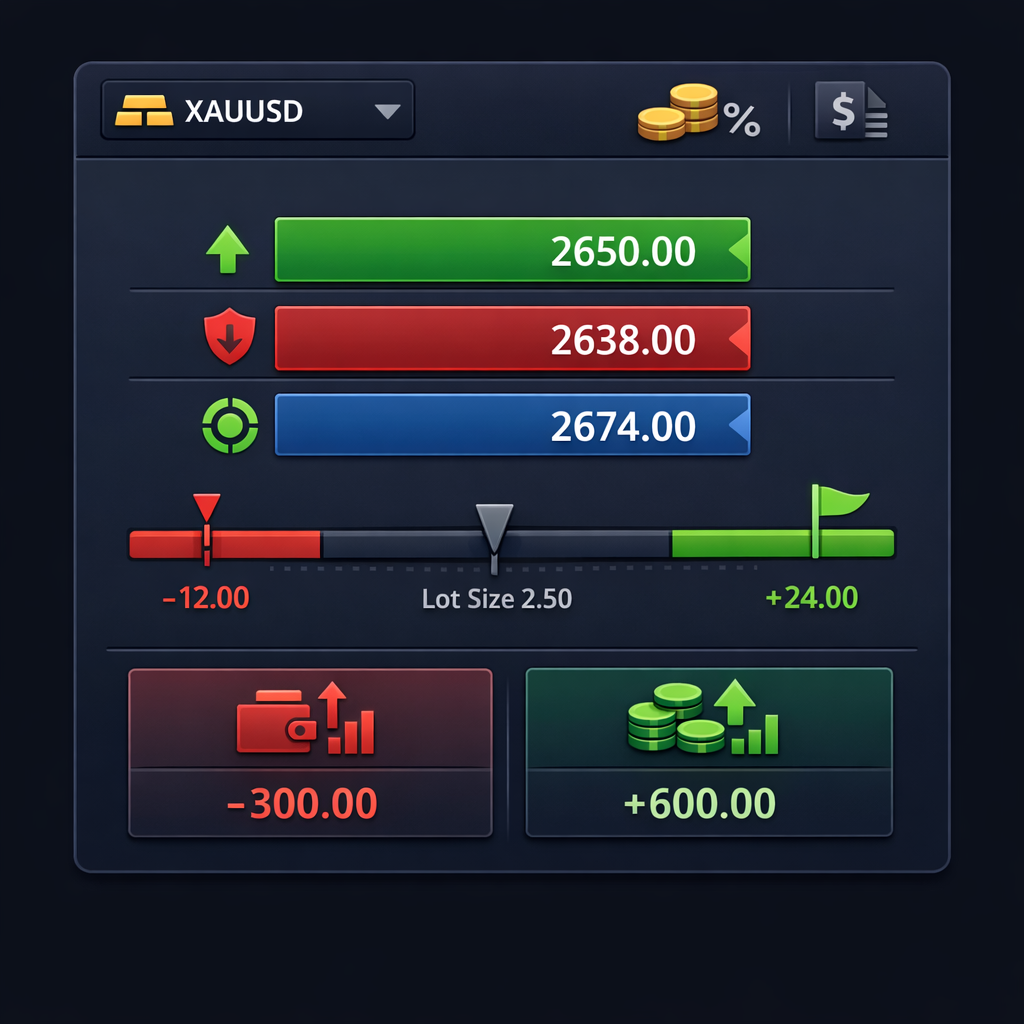
Example (Gold):
- Buy XAUUSD: $2650
- Stop loss: $2638 (12 dollars risk)
- Take profit: $2674 (24 dollars reward, ~1:2)
If your risk cap is 0.5%, you size the position so that a $12 move equals 0.5% of account.
You do not “round up” because you feel confident.
Step 2: Check correlation and exposure
At current context, DXY is around 106.80.
That means USD strength/weakness can drive multiple pairs simultaneously.
If you take EUR/USD long at 1.0520 and GBP/USD long at 1.2680, you’re effectively short USD twice.
Prop-friendly rule:
- Max 1–2 positions tied to the same driver (USD, risk-on, yields) at the same time.
- Reduce risk if you do take two correlated trades (e.g., 0.25% each instead of 0.5%).
Step 3: Apply a news filter (even if the signal is good)
Prop firms don’t care if you were “right” on direction.
They care if you violated risk behavior by trading into chaos.
High-impact news can spike gold $15–$25 in minutes, especially around US data.
Practical rule:
- Avoid new entries 10–15 minutes before major releases.
- Consider reducing size or taking partial profit if already in.
If you want to understand how this impacts gold specifically, read how gold signals react to unexpected news events.
Step 4: Match management style to challenge rules
Some prop firms penalize “one big day.”
So instead of always holding for TP2/TP3, you may take partials at 1R and trail.
This keeps your equity curve smoother and reduces the chance of giving back gains.
Step 5: Stop trading after your daily limit (win or lose)
This sounds boring, and that’s the point.
Set a daily stop: for example, stop after -1% or after +1.5%–2%.
Challenges are passed by traders who protect good days from turning into average days.
Risk Management for Funded Trader Evaluations (Numbers That Work)
Most evaluation failures are not “bad signals.”
They’re bad risk math.
So let’s talk numbers that are realistic for a funded trader path.
A practical risk model for challenges
We’ve seen the best results when traders treat the challenge like a marathon.
Here’s a prop-friendly baseline model you can adapt:
- Risk per trade: 0.25%–0.75%
- Max trades per day: 1–3
- Daily stop loss: -1% to -2% (before the firm’s limit)
- Weekly stop loss: -3% to -5%
- Target per day: +0.5% to +1.5% (not mandatory)
This model has one purpose: keep you alive through variance.
Once you’re funded, you can scale carefully.
Gold (XAUUSD) sizing: respect volatility
Gold at $2650 can move $8–$15 quickly even on normal days.
That means your SL distance and lot size must be aligned.
Example A (conservative):
- Sell XAUUSD: $2662
- SL: $2677 (15 dollars)
- TP: $2632 (30 dollars, 1:2)
If you risk 0.5%, that $15 SL must equal 0.5% loss.
If you risk 1.5% “because gold is easy,” a single spike can ruin your day.
FX pairs: avoid the “pip blindness” problem
EUR/USD at 1.0520 and GBP/USD at 1.2680 can feel slow compared to gold.
That tempts traders to increase size to “make it worth it.”
Then a 25–40 pip stop becomes a big percentage hit.
Instead, standardize risk.
Let the stop distance change, but keep % risk constant.
USD/JPY: special caution near psychological levels
USD/JPY around 149.50 often reacts sharply to yield moves and policy headlines.
It can also gap on unexpected comments.
Prop firms don’t forgive gaps.
Rule of thumb:
- Use smaller risk on USD/JPY than on EUR/USD if volatility is elevated.
- Avoid holding through major central bank events unless your plan explicitly allows it.
For a deeper framework built specifically for signal users, review our resource on risk management strategies when using forex signals.
Execution Like a Pro: Entries, Slippage, and Session Timing
Prop firm challenges are won in the details.
Not in the idea of a trade, but in how you enter it.
Signals give you structure, but execution decides whether your R:R is real.
Why London and New York sessions matter for signal traders
United Kings focuses heavily on London and NY sessions for a reason.
Liquidity is strongest, spreads are generally tighter, and moves are cleaner.
That reduces slippage and improves fill quality, which matters when drawdown is capped.
Use limit orders when the signal allows
Market orders during spikes can destroy your plan.
If the signal provides a zone, consider a limit entry near the intended level.
This can improve entry by a few pips on FX or $1–$3 on gold, which is meaningful in a challenge.
Spread and volatility checks (quick but essential)
Before you execute, check:
- Spread: if it’s unusually wide, skip or reduce size.
- Recent candle size: if gold just printed a $10 candle, wait for stabilization.
- Distance to SL: avoid entering after price already moved 70% toward TP.
Example: executing a gold signal responsibly
Let’s say you receive:
- Buy XAUUSD: $2648–$2651
- SL: $2636
- TP1: $2668
- TP2: $2676
If price is already at $2662 when you see it, you’re late.
A disciplined prop trader either waits for a pullback or skips.
Late entries create “fake” R:R and increase stop-out probability.
Consistency rules and partial profits
Some evaluations penalize large single-day profits.
Partial profits help smooth the curve.
A simple method is: close 30%–50% at 1R, move stop to breakeven, then let the rest run.
This is not about maximizing profit on one trade.
It’s about maximizing the probability of passing.
Building a Prop-Firm Signal Trading Plan (Weekly Structure)
If you want to pass like a professional, treat your challenge like a business week.
Signals become your “trade ideas,” but your plan decides which ideas become positions.
Monday: map the macro drivers
Start the week with context.
DXY at 106.80 suggests USD strength is a major narrative driver.
That impacts EUR/USD (1.0520), GBP/USD (1.2680), and gold ($2650) through yields and risk sentiment.
Write down:
- Key news events (CPI, NFP, central bank speakers).
- Which pairs you will prioritize (2–4 instruments max).
- Your weekly loss limit and daily stop.
Tuesday–Thursday: execute selectively
This is where most opportunities happen.
Liquidity is stable, and trends often develop.
Use signals, but apply filters: session timing, structure, correlation, and news proximity.
Friday: protect the week
Friday is where many challenge accounts die.
Traders try to “finish the target” before the weekend.
Instead, reduce risk and trade only A+ setups.
Daily routine (15 minutes that changes everything)
- Check your current drawdown vs limits.
- Check upcoming high-impact news.
- Decide your max trades for the day.
- Only then open Telegram and evaluate signals.
That order matters.
If you open signals first, you’ll be tempted to trade first and plan later.
If you’re still building your signal workflow, our beginner-friendly guide on Forex signals Telegram for beginners can help you set up a clean process without noise.
Realistic Examples: Adapting Signals for FTMO-Style Rules
Many traders search for FTMO signals because they want a plug-and-play solution.
The truth is you don’t need “special signals.”
You need a special execution layer that respects evaluation rules.
Example 1: EUR/USD signal with conservative risk
Market context: EUR/USD around 1.0520.
Signal idea:
- Sell EUR/USD: 1.0520
- SL: 1.0550 (30 pips)
- TP: 1.0460 (60 pips, 1:2)
Prop adaptation:
- Risk 0.5% maximum.
- If you already have a USD-heavy position (like USD/JPY long), reduce to 0.25% or skip.
- If a major US event is within 30 minutes, delay entry.
Example 2: Gold signal with a “challenge-safe” SL
Market context: XAUUSD around $2650, moderate volatility.
Signal idea:
- Buy XAUUSD: $2653
- SL: $2641 (12 dollars)
- TP: $2677 (24 dollars, 1:2)
Prop adaptation:
- Do not widen SL to “avoid stop.” That breaks your R:R and risk cap.
- Consider partial at $2665–$2667 if your challenge has consistency rules.
- Stop trading for the day if you hit -1% total, even if the firm allows -2% or more.
Example 3: GBP/USD signal and the temptation to double up
Market context: GBP/USD around 1.2680.
Signal idea:
- Buy GBP/USD: 1.2680
- SL: 1.2645 (35 pips)
- TP: 1.2750 (70 pips, 1:2)
If EUR/USD also signals buy, many traders take both at full size.
That’s a correlation mistake.
Choose the cleaner setup, or split risk across both.
Example 4: USD/JPY near 149.50
Market context: USD/JPY around 149.50.
Signal idea:
- Sell USD/JPY: 149.50
- SL: 150.10 (60 pips)
- TP: 148.30 (120 pips, 1:2)
Prop adaptation:
- Reduce risk if volatility is high or if yields are moving fast.
- Consider a break-even move after 1R to protect drawdown.
These examples aren’t about predicting the market.
They’re about controlling your behavior under evaluation pressure.
Mistakes That Blow Challenges (Even With Great Signals)
We’ve watched traders with excellent signal feeds fail challenges repeatedly.
Not because the analysis was wrong, but because their process was unstable.
Here are the most common failure patterns, and how to eliminate them.
1) Increasing lot size after a win
This is the “I’m in the zone” mistake.
One win becomes two, then you size up, then you give it all back on a normal loss.
Prop firms are designed to catch this behavior.
Fix:
- Use fixed fractional risk (0.25%–0.75%) until you pass.
- No scaling up during evaluation, only scaling down during volatility.
2) Revenge trading after a stop-out
A stop-out on gold can feel personal because it happens fast.
At $2650, a $12 SL can be hit in minutes if a spike prints.
Traders then jump into the next signal without filtering.
Fix:
- Mandatory cooldown: 10–20 minutes after any loss.
- Stop after 2 consecutive losses in a day.
3) Taking every alert
Signal feeds are not a command.
They are opportunities.
Your job is to pick the ones that fit your account state and rules.
Fix:
- Predefine max trades per day.
- Only trade signals that align with your session and volatility filter.
4) Ignoring spreads and execution
Slippage turns a 1:2 setup into a 1:1.6 setup.
Over a challenge, that difference is massive.
Fix:
- Trade during liquid hours.
- Avoid entering during fast candles.
- Use limits when possible.
5) Violating the “consistency” spirit
Even if a firm doesn’t have a strict consistency rule, they still evaluate behavior.
One oversized day followed by drawdown is a red flag pattern.
Fix:
- Cap daily profit and stop trading once hit.
- Use partials and protect equity.
If you want a structured way to evaluate any provider before you rely on them in a challenge, use our checklist: Forex trading signals provider checklist for beginners.
How United Kings Signals Fit Prop Firm Trading (Process + Support)
To pass a challenge, you need more than entries.
You need clarity, repeatability, and a community that reinforces discipline.
That’s where United Kings is designed to help.
Clear trade structure built for execution
Our premium Telegram signals focus on clean formatting.
You get Entry, SL, and TP levels so you can size correctly and execute without confusion.
This reduces the #1 prop firm killer: impulsive decision-making.
Forex + gold coverage (without forcing you to trade everything)
Many funded traders specialize.
Some prefer EUR/USD and GBP/USD for steadier movement.
Others prefer gold for faster R multiples.
We support both paths with dedicated streams:
- Forex signals for major pairs like EUR/USD, GBP/USD, and USD/JPY.
- Gold signals (XAUUSD) for traders who thrive in volatility.
London and New York session focus
Execution quality matters in evaluations.
We emphasize the sessions where spreads and liquidity are typically most favorable.
This is especially important for gold around key levels like $2650 where fast spikes can occur.
Education alongside signals
Signals alone can’t fix psychology.
That’s why we share educational guidance and market context so you understand the “why.”
When you understand the setup, you’re less likely to panic-manage it.
Community scale and feedback loop
With 300K+ active traders, you’re not trading in isolation.
That matters during a challenge because isolation increases emotional decisions.
If you want to see how our signal service is positioned, you can also review our curated page: best forex signals (latest guide).
Prop Firm Challenge Checklist (Print This Before You Trade)
Most traders don’t fail because they didn’t know what to do.
They fail because they didn’t do it consistently.
This checklist makes “good behavior” automatic.
Pre-trade checklist (60 seconds)
- Account state: Are you within daily loss and max drawdown limits?
- Today’s plan: Max trades and max risk set?
- News: Any red-folder events in the next 15–30 minutes?
- Spread: Normal for this instrument right now?
- Correlation: Are you already exposed to the same USD driver?
- Entry quality: Are you late? Did price already move too far?
Order checklist (before you click “Place”)
- Lot size matches your % risk, not your emotion.
- SL is placed immediately (no mental stops).
- TP is placed or management plan is written.
- No widening SL after entry.
Post-trade checklist (2 minutes)
- Screenshot the trade and note why you took it.
- Record R multiple (+2R, -1R, etc.).
- Stop trading if you hit your daily stop or daily goal.
This is how you become a funded trader: not by being right, but by being consistent.
FAQ: Using Forex Signals for Prop Firm Challenges
Can I really pass a prop firm challenge using forex signals?
Yes, many traders do, but only if you adapt signals to the firm’s risk rules.
Your sizing, correlation control, and daily stop rules matter as much as the entries.
Are “FTMO signals” different from normal forex signals?
Usually, no.
What makes them “FTMO-friendly” is the execution layer: lower risk per trade, fewer trades, and strict drawdown protection.
What risk per trade is best for a funded trader evaluation?
For most traders, 0.25%–0.75% per trade is a strong range during evaluation.
It keeps you alive through losing streaks and prevents daily loss breaches.
Is gold (XAUUSD) good for prop firm challenges?
Gold can be excellent because it can reach 1:2 or 1:3 quickly.
But it’s also volatile, so you must reduce lot size and respect $10–$25 SL ranges around levels like $2650.
Should beginners use signals for prop firm trading?
Beginners can use signals, but they should start on a demo first.
Learn execution, sizing, and discipline before risking a challenge fee.
Risk Disclaimer (Read This Before You Trade)
Forex and gold trading involves significant risk and may not be suitable for all investors.
You can lose more than your initial deposit in some leveraged products, and prop firm evaluations have strict drawdown rules that can cause rapid disqualification.
Past performance does not guarantee future results. Signals and analysis are for educational purposes and do not constitute financial advice.
If you are new, practice on a demo account first and use conservative risk.
Join United Kings: Trade Prop Challenges with Structure, Not Stress
If you’re serious about becoming a funded trader, you need a system you can execute repeatedly.
That means clear signals, session-focused opportunities, and risk-first discipline.
United Kings delivers premium Telegram forex and gold signals with clear Entry/SL/TP, an education-first approach, and a community of 300K+ active traders.
We also offer a 48-hour money-back guarantee so you can test the fit with confidence.
Start here based on what you trade:
- Explore all United Kings signals
- Get premium forex signals for majors
- Get premium XAUUSD gold signals
Choose a plan that matches your challenge timeline at United Kings pricing:
- Starter: 3 Months ($299 ~ $100/mo)
- Best Value: 1 Year ($599 ~ $50/mo, 50% savings + FREE ebook)
- Unlimited: Lifetime ($999 pay once)
Join the community and get signals directly on Telegram: United Kings official Telegram channel.
Your challenge doesn’t need more trades. It needs better execution, better risk, and a plan you’ll follow on your worst day.