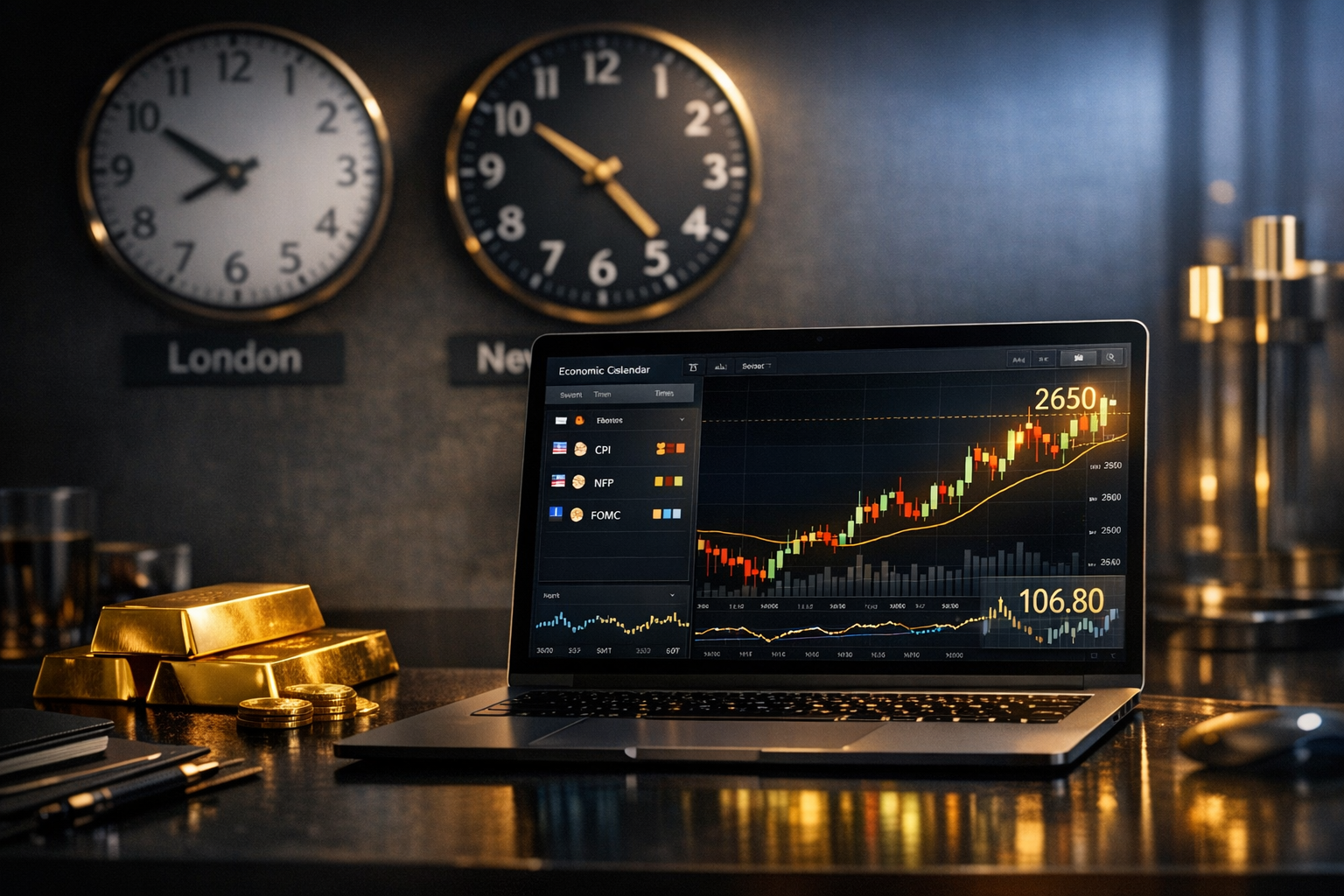
You take a clean gold signal at $2650.00. The setup looks perfect: trend aligned, structure break, tidy stop. Then, 6 minutes later, US CPI prints hotter than expected and XAUUSD whipsaws $18 up, $22 down, and stops you out before running to your original target.
If that scenario feels familiar, you don’t need “more indicators.” You need a better filter. Specifically, you need to use the XAUUSD economic calendar as a decision framework to protect your entries when CPI, NFP, and Powell speeches turn the market into a volatility machine.
This guide gives you a practical, step-by-step method to combine an economic calendar with gold trading signals so you can avoid low-quality entries around high-impact news, reduce drawdowns, and keep your best trades.
TL;DR: The calendar-based filter that saves gold traders
- CPI, NFP, and Powell/FOMC communication are the three most common catalysts for violent XAUUSD spikes and stop-hunts.
- Use a pre-news no-trade window: typically 60 minutes before CPI/NFP and 30–45 minutes before Powell speeches (adjust for current volatility).
- After the release, wait for a post-news “structure confirmation” (new high/low + retest, or a 5–15 min close beyond key levels) before taking signals.
- When you must trade, reduce risk (e.g., from 1.0% to 0.25–0.5%) or use wider stops only if your plan supports it.
- Use DXY (now ~106.80) and USD/JPY (~149.50) as “risk temperature gauges” for gold volatility around US news.
- Combine calendar + signal quality: if the signal is good but news is near, you don’t “skip trading.” You delay, downsize, or wait for confirmation.
Why the XAUUSD economic calendar matters more than any indicator
Gold is not just a commodity. In FX terms, XAUUSD is a macro instrument priced against the US dollar, reacting to inflation expectations, real yields, and risk sentiment.
That’s why the economic calendar is not optional for gold traders. It’s the map of when the market is most likely to reprice aggressively.
Right now, with XAUUSD around $2650.00 (+0.35% on the day) and DXY near 106.80, even “normal” US data can trigger outsized moves. When the dollar is bid and yields are sensitive, gold can swing $15–$30 in minutes.
Here’s the core problem: most signal entries are designed for technical conditions—clean liquidity, predictable spreads, and stable order flow. High-impact news breaks those assumptions.
During CPI or NFP, you can see:
- Spread expansion (your entry is worse than expected).
- Slippage (your stop loss fills beyond your level).
- Liquidity gaps (price jumps through support/resistance without trading).
- False breaks (classic “up first, then down” whip moves).
So the goal of using an XAUUSD economic calendar is not to predict the number. It’s to decide when your signal is tradable and when it’s statistically lower quality.
At United Kings, our traders focus heavily on London and New York sessions because that’s where liquidity and follow-through are strongest. But those sessions are also where CPI, NFP, and Powell events land—meaning your calendar filter becomes even more important.
The 3 news categories that move XAUUSD most (and why)
Not all “red folder” events hit gold the same way. If you treat every high-impact release equally, you’ll either over-filter (miss great trades) or under-filter (get chopped).
Use these three categories as your hierarchy.
1) Inflation shocks: US CPI (and PCE as the close second)
CPI is the headline event because it directly shifts expectations for Fed policy and real yields. A hotter CPI typically strengthens the USD and can pressure gold, but the real driver is how the number changes the path of rates.
In practice, CPI days often produce a two-phase move:
- Phase 1 (0–5 minutes): algorithmic spike, wide spreads, stop runs.
- Phase 2 (15–90 minutes): direction emerges after bonds and DXY stabilize.
Example around current levels: if XAUUSD is hovering at $2650 pre-CPI in a tight range, a surprise can push it to $2668 then slam to $2642—all before your chart pattern “confirms.”
2) Labor market shocks: NFP and unemployment rate
NFP is the volatility king because it hits growth expectations, inflation expectations, and risk sentiment at once. Even when the headline payrolls are close, the unemployment rate and wage growth can flip the reaction.
Gold often reacts as a “risk barometer” here. Strong jobs can boost USD and yields (bearish gold), but if it triggers risk-off positioning or a sudden repricing of Fed expectations, gold can rip higher anyway.
That’s why for gold signals CPI NFP days, the best filter is not “bullish vs bearish.” It’s “tradable vs not tradable until structure returns.”
3) Fed communication: Powell speeches, FOMC statement, press conference, minutes
Powell is unique because he can change the market with one sentence. Unlike CPI/NFP (single data print), speeches create headline risk for 30–90 minutes.
Gold can move on tone shifts like:
- “We are not confident inflation is defeated” (hawkish)
- “Policy is sufficiently restrictive” (dovish)
- “We are data dependent” (often whipsaw)
When Powell speaks during New York hours, you can see XAUUSD swing $10–$20 without any technical level “holding” the way it normally would.
Comparison table: How CPI vs NFP vs Powell typically impacts gold signals
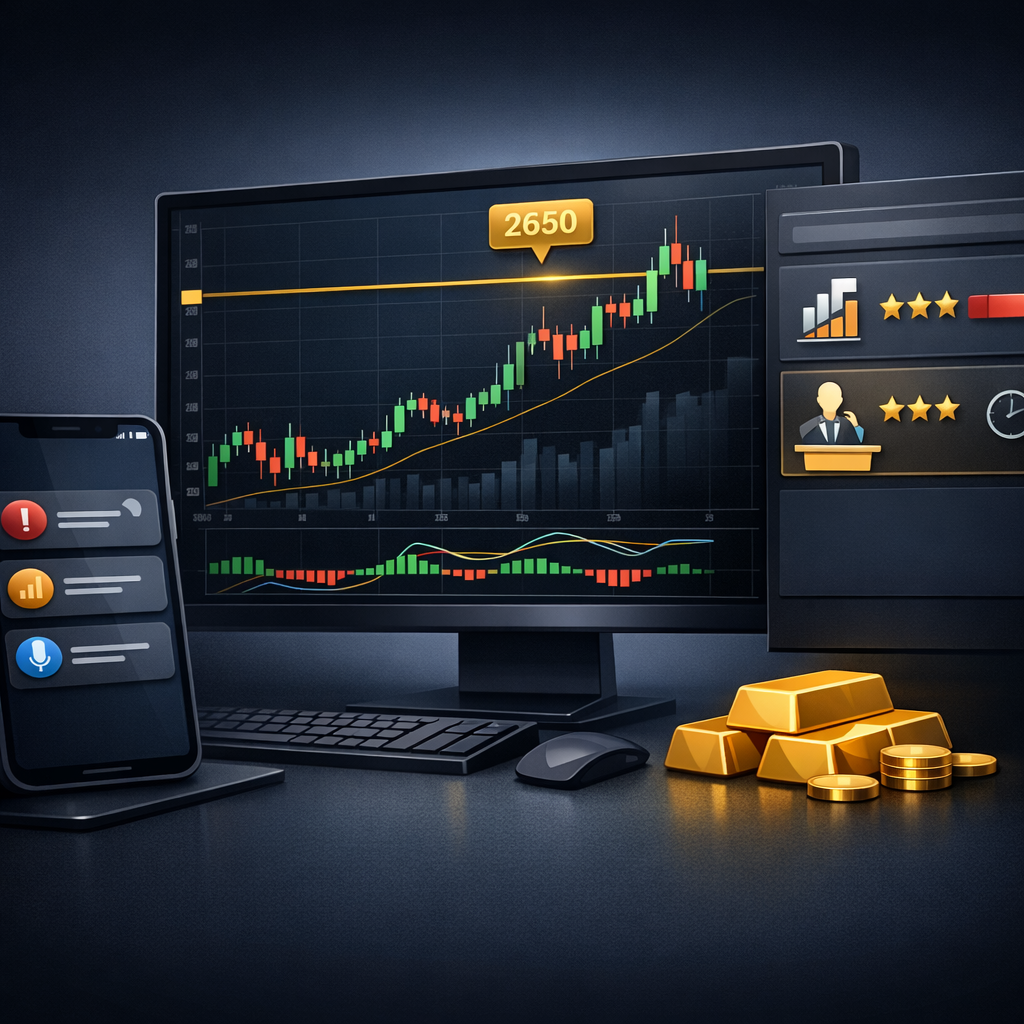
Use this table to decide how strict your filter should be on each event. It’s not about fear—it’s about matching your trade execution to the environment.
| Event | Typical XAUUSD volatility (first 30 min) | Most common trap | Best no-trade window | Best post-news entry style |
|---|---|---|---|---|
| US CPI | $12–$28 spikes are common | Instant breakout that reverses within 3–10 min | 60 min before + wait 15–30 min after | 15m structure break + retest; or 5m close beyond key level |
| NFP | $15–$35 swings possible | Two-way whipsaw (up then down) that hits both sides | 60–90 min before + wait 20–45 min after | Range expansion then pullback entry; avoid first impulse |
| Powell speech | $8–$20, often choppy | Headline-driven spikes that ignore levels | 30–45 min before + wait until speech tone is “priced” | Trade only after a clear direction forms; smaller size |
Step-by-step framework: Use the XAUUSD economic calendar to filter signals
This is the exact framework we recommend if you want to trade gold around news without turning every week into a coin flip.
Think of it as a three-layer filter: time filter, volatility filter, and structure filter.
Step 1: Mark the “red zones” on your trading day
At the start of London or before New York opens, open your economic calendar and mark:
- US CPI / Core CPI
- NFP / unemployment rate / average hourly earnings
- Powell speeches / FOMC statement & press conference / minutes
- Optional: US Retail Sales, ISM, GDP (secondary but can still move)
Then convert the release time to your broker/server time. This sounds basic, but it prevents the #1 calendar mistake: thinking you have 45 minutes left when you actually have 5.
Step 2: Apply a pre-news no-trade window (hard rule)
Use a default rule set, then adjust for volatility. With gold at $2650 and recent intraday swings, these are realistic:
- CPI/NFP: no new trades 60 minutes before
- Powell/FOMC headlines: no new trades 30–45 minutes before
If spreads are already expanding or price is coiling tightly (compression), widen your no-trade window by 15–30 minutes. Compression before CPI is where stop-hunts are born.
Step 3: Decide what to do with an open signal before news
If you’re already in a trade and news is approaching, you have three professional choices:
- Take partial profit and move stop to reduce exposure.
- Close the trade if it hasn’t moved and the event is top-tier (CPI/NFP).
- Hold only if your stop is protected and the trade is deep in profit.
Example: you buy XAUUSD at $2648, SL $2636 (12 risk), TP $2672 (24 reward, 1:2). If CPI is in 40 minutes and price is only at $2651, you’re basically gambling. A professional move is to close or reduce.
Step 4: Wait for post-news structure (soft rule, but powerful)
After the release, don’t rush. Your edge is not being first—it’s being right.
Use one of these confirmations:
- 5-minute rule: wait for 2–3 five-minute candles to close and show direction.
- 15-minute structure: wait for a break of the pre-news range, then a retest that holds.
- Key level reclaim: price spikes below support then reclaims it and closes above.
This is how you turn “news chaos” into a tradable trend day.
Building your “no-trade windows” for CPI, NFP, and Powell (practical rules)
Most traders lose money around news because they don’t have a written policy. They improvise in real time, and the market punishes hesitation.
Here’s a simple policy you can copy into your notes.
CPI no-trade window (the cleanest rule set)
Default: stop taking new XAUUSD signals 60 minutes before CPI. Resume only after 15–30 minutes post-release, once price forms a clear high/low and spreads normalize.
When to extend it:
- Gold is stuck in a $6–$10 box (tight range) right before CPI.
- DXY is trending hard into the release (e.g., pushing above 106.80).
- USD/JPY is accelerating (e.g., 149.50 → 150.00), signaling USD momentum.
Why it works: CPI often produces a first move that is “wrong” and a second move that is “real.” Your window keeps you out of the first move.
NFP no-trade window (wider, because the whipsaw is real)
Default: no new trades 60–90 minutes before NFP. Resume after 20–45 minutes post-release.
Extra caution: NFP Fridays often include position squaring, options flows, and thin liquidity pockets. That’s why even great technical signals can fail for execution reasons.
Practical tip: if you trade the New York session, plan your day around NFP. Either you trade the post-news structure, or you treat it as a “review and education” day.
Powell speech window (smaller time block, but more headline risk)
Default: no new trades 30–45 minutes before. Resume when the speech is clearly being priced (often 10–20 minutes after the key remarks begin).
Why Powell is tricky: the market can reverse multiple times as headlines hit. Your chart can look like a “perfect breakout” and then instantly fail on the next quote.
Professional adaptation: if you absolutely must trade during Powell, reduce risk. For many traders, 0.25–0.5% risk is reasonable when normal conditions would allow 1%.
How to read the post-news reaction: the 3 patterns that decide your next trade
Once news hits, your job is to identify which of these three environments you’re in. Each environment has a different “signal acceptance” rule.
Pattern A: Spike-and-reverse (stop-hunt day)
This is common on CPI and NFP. Price blasts through a level, triggers breakout traders, then reverses hard.
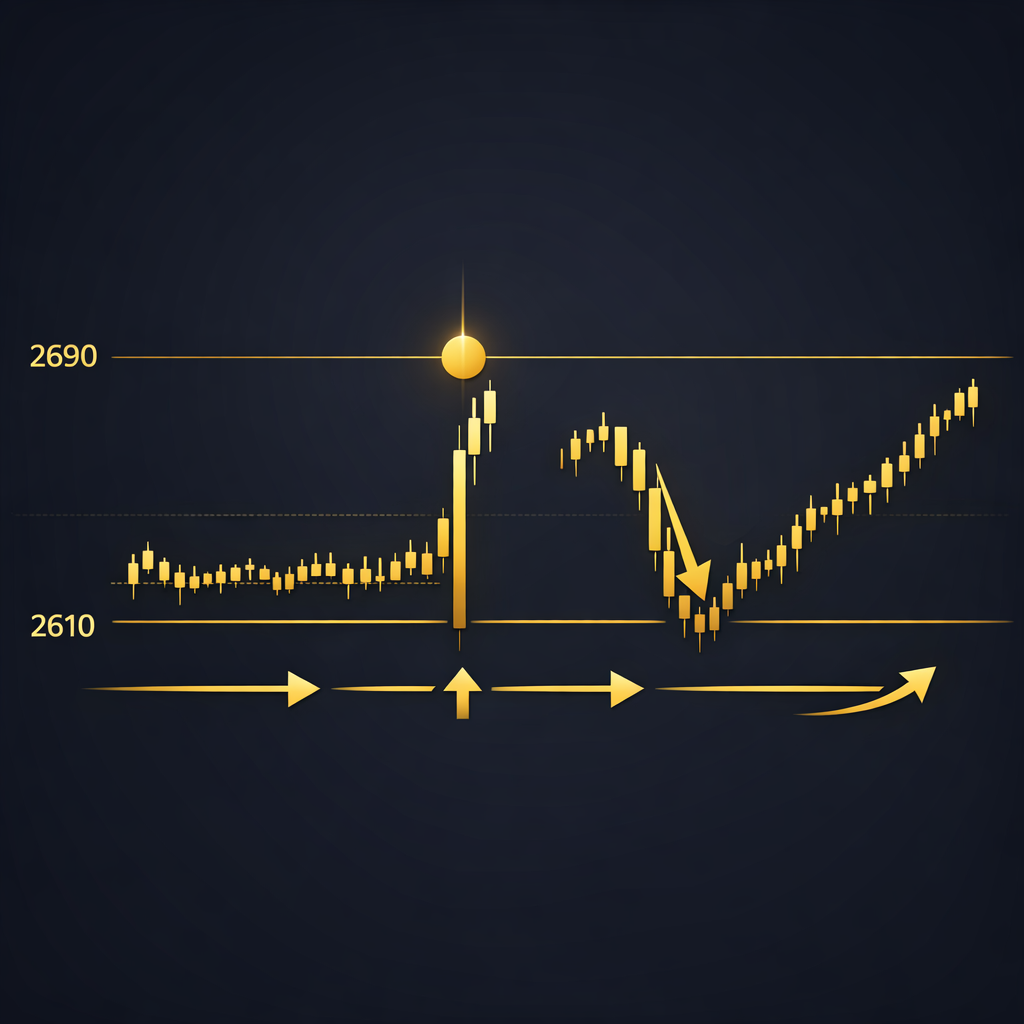
What it looks like: XAUUSD spikes from $2650 to $2666, then dumps to $2644 within 10–15 minutes.
What to do:
- Ignore the first breakout signal.
- Wait for a reclaim of the original range and a retest.
- Only then consider following your signal provider’s direction.
Signal filter rule: accept signals only after a 15-minute close confirms direction.
Pattern B: Range expansion then trend (best day to trade)
This is when news creates a new directional day. The first move holds, and pullbacks become buy/sell opportunities.
Example: after CPI, gold breaks above $2660, retests $2656, then trends to $2684.
What to do:
- Wait for the retest after the initial push.
- Enter on confirmation with a measured stop.
- Target logical liquidity zones (prior highs/lows).
Signal filter rule: accept signals that align with the post-news trend and occur on pullbacks, not on the impulse candle.
Pattern C: Choppy mean reversion (avoid or downsize)
This is common during Powell speeches. Price swings both ways, but doesn’t go anywhere.
Example: gold oscillates between $2646 and $2662 for an hour, taking out both sides.
What to do:
- Either stand down or trade smaller with tight rules.
- Focus on extremes of the range only, if you’re experienced.
- Don’t chase mid-range signals.
Signal filter rule: if the market is choppy, only take A+ setups or skip entirely.
How to combine United Kings gold signals with calendar filtering (real examples)
Signals are powerful when they’re executed in the right conditions. The economic calendar helps you decide whether a signal is an “A trade” or a “wait trade.”
Inside our United Kings Gold Signals, we provide clear Entry, SL, and TP levels and focus heavily on London and NY session opportunities. Your job is to execute those levels with a professional filter.
Example 1: CPI day — the correct way to “delay” a buy signal
Market context: XAUUSD is around $2650. CPI is scheduled in 50 minutes.
A buy signal arrives: Buy 2651, SL 2639 (12), TP1 2675 (24), TP2 2687 (36).
Calendar filter decision: you are inside the CPI no-trade window. You do not enter, even if the setup looks perfect.
What you do instead:
- Mark the signal levels on your chart.
- Wait for CPI to print and for spreads to normalize.
- If price breaks above 2651 after CPI and retests it as support, you can take a delayed entry (often with better confirmation).
This is how you avoid the classic CPI stop-out while still participating if the market confirms.
Example 2: NFP day — converting a risky sell into a safer post-news trade
Pre-NFP, gold is drifting at $2658 and looks heavy. A sell signal arrives: Sell 2656, SL 2672 (16), TP 2624 (32) for 1:2.
Calendar filter decision: if NFP is within 90 minutes, you do not open fresh exposure. The risk of getting wicked out is too high.
Post-news approach: if NFP causes a spike to 2670 and then a sharp reversal below 2656 with a 15-minute close, the original sell thesis is now confirmed by structure. That’s when the trade becomes higher quality.
Example 3: Powell speech — same signal, smaller risk
Powell is speaking in 35 minutes. You receive a technical long idea: Buy 2644, SL 2632 (12), TP 2668 (24).
Calendar filter decision: you’re inside the Powell window. Either skip or reduce risk.
Professional compromise: if you choose to trade, you might risk 0.25% instead of 1%. Your stop remains the same, but your position size is smaller, protecting your account from slippage.
If you’re new to using signals, pair this guide with our beginner-friendly breakdown: how Telegram forex signals work and how to follow them safely. The execution principles apply to gold too.
Checklist: Trade, wait, or reduce risk (simple decision tree)
When a signal hits your phone, you need a fast, repeatable decision. Use this checklist like a pilot’s pre-flight routine.
The 60-second calendar checklist
- 1) What event is next? CPI, NFP, Powell, or “medium impact”?
- 2) How close are we? Under 60 minutes (CPI/NFP) or under 45 minutes (Powell) = default no-trade.
- 3) What session is it? London/NY overlap increases volatility and follow-through.
- 4) What is DXY doing? With DXY near 106.80, strong USD momentum can amplify gold moves.
- 5) Is price compressing? Tight ranges before news often explode both ways.
- 6) Is the signal on impulse? If the candle is already stretched $8–$12, you’re late.
Decision rules (print these)
- TRADE if: no high-impact news within the window + spreads normal + signal aligns with structure.
- WAIT if: CPI/NFP/Powell is inside the window OR price is compressing into the release.
- REDUCE RISK if: you must trade near headline risk (rare) and the setup is A+ with clear invalidation.
For an even broader evaluation framework (especially if you’re comparing providers), use our internal guide: forex signals provider checklist for beginners.
Risk management around news: position sizing, stops, and execution
News doesn’t just change direction—it changes execution quality. If you keep the same risk and the same stop logic you use on calm days, you’ll get punished by slippage and wicks.
Here’s how to adapt without turning your plan into chaos.
1) Reduce risk, not discipline
The cleanest adjustment is to reduce % risk per trade near news.
- Normal day: 0.5%–1% per trade (depending on your plan)
- Powell day: 0.25%–0.5%
- CPI/NFP: ideally 0% inside the window, then normal risk after structure returns
This single change prevents a “bad fill” from becoming a bad week.
2) Keep stops logical (don’t widen blindly)
Gold stops are typically $10–$25 from entry for many intraday strategies. That range makes sense in current conditions (XAUUSD $2610–$2690 band).
But widening a stop just to survive news is usually a mistake. Why?
- You increase $ risk unless you reduce position size.
- You often place the stop in “no man’s land,” where it still gets hit.
- You normalize bad trades by giving them more room.
Better approach: avoid the window or wait for post-news structure where stops can sit behind real levels.
3) Use partials and breakeven intelligently
On trend days after CPI/NFP, gold can run. But it can also snap back $8–$12 quickly.
A practical management plan:
- At +1R (e.g., +12 if your stop is 12), take partial profit.
- Move stop to breakeven only after structure supports it (not instantly).
- Let TP2/TP3 run toward liquidity (previous highs/lows).
If you want a deeper playbook, we’ve laid out robust techniques in risk management strategies when using forex signals (the principles apply directly to XAUUSD).
4) Accept that some days are for protection, not profit
Professional trading is not “always in the market.” It’s selecting moments when your edge is strongest. CPI and NFP are often edge destroyers for the first 15 minutes.
Skipping those minutes is not missing out. It’s avoiding the part of the game designed to trap impatience.
Using DXY, USD/JPY, and EUR/USD as confirmation around US news
Gold is priced in USD, so the dollar’s behavior matters. But you don’t need a complicated intermarket model. You need a few simple tells.
Current context: DXY ~106.80, USD/JPY ~149.50, EUR/USD ~1.0520, GBP/USD ~1.2680.
DXY as the “directional pressure” indicator
When DXY is trending strongly into a CPI/NFP release, gold reactions can be exaggerated.
- DXY up hard: gold rallies are more likely to be sold (unless risk-off dominates).
- DXY down hard: gold dips are more likely to be bought.
In real terms: if CPI hits and DXY spikes above 106.80 while gold pops to $2665, be cautious buying the pop. That’s a common fade setup.
USD/JPY as a proxy for yields and risk appetite
USD/JPY often moves with US yields. Around news, a fast USD/JPY move (e.g., 149.50 → 150.10) can signal that rates are repricing, which can pressure gold.
It’s not perfect. But it’s a useful “temperature check” for whether the market is in USD-momentum mode.
EUR/USD and GBP/USD as USD breadth confirmation
EUR/USD at 1.0520 and GBP/USD at 1.2680 help you see whether USD strength is broad-based.
If CPI triggers a USD rally and both EUR/USD and GBP/USD dump simultaneously, that’s broad USD strength. Gold may struggle to sustain rallies unless risk-off flows overwhelm the USD move.
If USD is mixed (EUR/USD stable, GBP/USD stable), gold’s move may be more about risk sentiment than pure dollar strength.
If you want more market-wide context beyond gold, our signals hub and forex signals page show how we approach multi-asset opportunities across sessions.
A realistic weekly routine: calendar prep for London & NY gold traders
The easiest way to use the calendar is not to stare at it all day. It’s to build a routine that takes 10–15 minutes and prevents the biggest mistakes.
Sunday or Monday: map the week’s “landmines”
Before the week starts, identify:
- CPI/PPI/PCE dates
- NFP week (including ADP and jobless claims as pre-events)
- FOMC statement, press conference, minutes
- Scheduled Powell appearances
Then decide your intention for those days: “trade post-news only” or “reduced size.”
Daily pre-London (or pre-NY): 5-minute scan
- Check today’s high-impact releases.
- Mark times on your chart.
- Note current gold state: trending or ranging around $2650.
- Check DXY (106.80), USD/JPY (149.50) for momentum.
30 minutes before news: switch to defense mode
This is where discipline pays.
- No new trades.
- Manage open positions: partials, tighten exposure, or close.
- Prepare levels: pre-news high/low, key supports like $2640/$2630, resistances like $2665/$2680.
After news: hunt the best trade of the day
News days often produce one high-quality move after the dust settles. Your job is to catch that move, not the first spike.
Wait for structure, then execute with calm. This is where premium signals shine—because you’re combining a clear plan (entry/SL/TP) with a professional timing filter.
For more on handling surprise headlines and volatility spikes, pair this with: how gold signals react to unexpected news events.
Common mistakes when trading gold around news (and how to fix them)
Most losses around CPI/NFP/Powell come from a few repeatable behaviors. Fixing them is often the fastest way to improve your P&L without changing strategy.
Mistake 1: Treating the first candle as “confirmation”
The first candle after CPI is often an algorithmic liquidity grab. It can look like a breakout, but it’s frequently a trap.
Fix: require a second confirmation (5m closes or 15m structure). If you miss the first $6, that’s fine. You’re buying safety.
Mistake 2: Moving stops during volatility
Traders widen stops mid-spike to “avoid getting stopped,” then take a bigger loss when the move continues.
Fix: decide stop placement before entry. If the stop is too tight for the environment, the trade is wrong for that moment.
Mistake 3: Revenge trading after slippage
News slippage feels unfair. The emotional response is to “win it back” immediately, usually by over-sizing.
Fix: if you experience abnormal execution, pause. Wait for spreads to normalize and return to your checklist.
Mistake 4: Ignoring the calendar because “the signal is strong”
Even the best setup can fail if execution conditions are broken. A+ technicals don’t override CPI.
Fix: make the calendar a hard gate. If it’s inside the window, you wait. No debate.
Mistake 5: Trading every event like it’s CPI
Over-filtering can be just as damaging. If you avoid every medium-impact release, you’ll miss great London/NY moves.
Fix: reserve strict windows for CPI, NFP, and Powell/FOMC. Use lighter caution for secondary events.
FAQ: XAUUSD economic calendar and trading gold around news
1) What is the best XAUUSD economic calendar to use?
Any reputable calendar that clearly labels impact level and provides accurate release times works. What matters most is consistency and converting the time correctly to your broker/server time.
2) How long should I wait after CPI or NFP before trading gold?
A practical baseline is 15–30 minutes after CPI and 20–45 minutes after NFP. If spreads are still wide or price is whipsawing, wait longer until structure forms.
3) Can I trade Powell speeches if I reduce position size?
You can, but it’s still higher risk because headlines can reverse price quickly. If you trade it, consider reducing risk (e.g., 0.25–0.5%) and only take A+ setups with clear invalidation.
4) Do gold signals work during news releases?
Signals can still be correct directionally, but execution risk (slippage, spread expansion, wicks) often makes them lower quality during the release window. Filtering improves consistency.
5) What if a signal triggers right before CPI/NFP?
By rule, you should usually skip the entry and wait. If the post-news move confirms the same direction and retests the level, you can take a delayed entry with better confirmation.
Risk disclaimer (read before you trade)
Forex and gold (XAUUSD) trading involves significant risk and may not be suitable for all investors. Trading around high-impact news like CPI, NFP, and Powell speeches can increase volatility, spreads, and slippage. Past performance does not guarantee future results. No signal provider can guarantee profits. If you are a beginner, consider starting on a demo account and only risk capital you can afford to lose.
Join United Kings: trade gold with signals + the right filters
If you want a cleaner way to trade XAUUSD without guessing through CPI and NFP chaos, we built United Kings for exactly that.
Inside our community of 300K+ active traders, you get premium Telegram signals with clear Entry, SL, and TP levels, plus education to help you execute with discipline. Our approach is built around London and New York session opportunities and a professional process—not hype.
- Explore all markets we cover on our United Kings Signals page.
- Start specifically with premium XAUUSD gold signals if gold is your main focus.
- Pair gold with majors using our forex signals for broader USD context.
- See our 3 plans on the United Kings pricing page: Starter (3 Months $299), Best Value (1 Year $599 with 50% savings + FREE ebook), and Unlimited (Lifetime $499).
- Join the Telegram channel now: United Kings official Telegram.
Bonus: We offer a 48-hour money-back guarantee so you can test the experience with confidence.
Your next step: open your economic calendar, mark CPI/NFP/Powell for the week, and commit to the no-trade windows. Then let our signals handle the “what,” while your calendar filter controls the “when.”