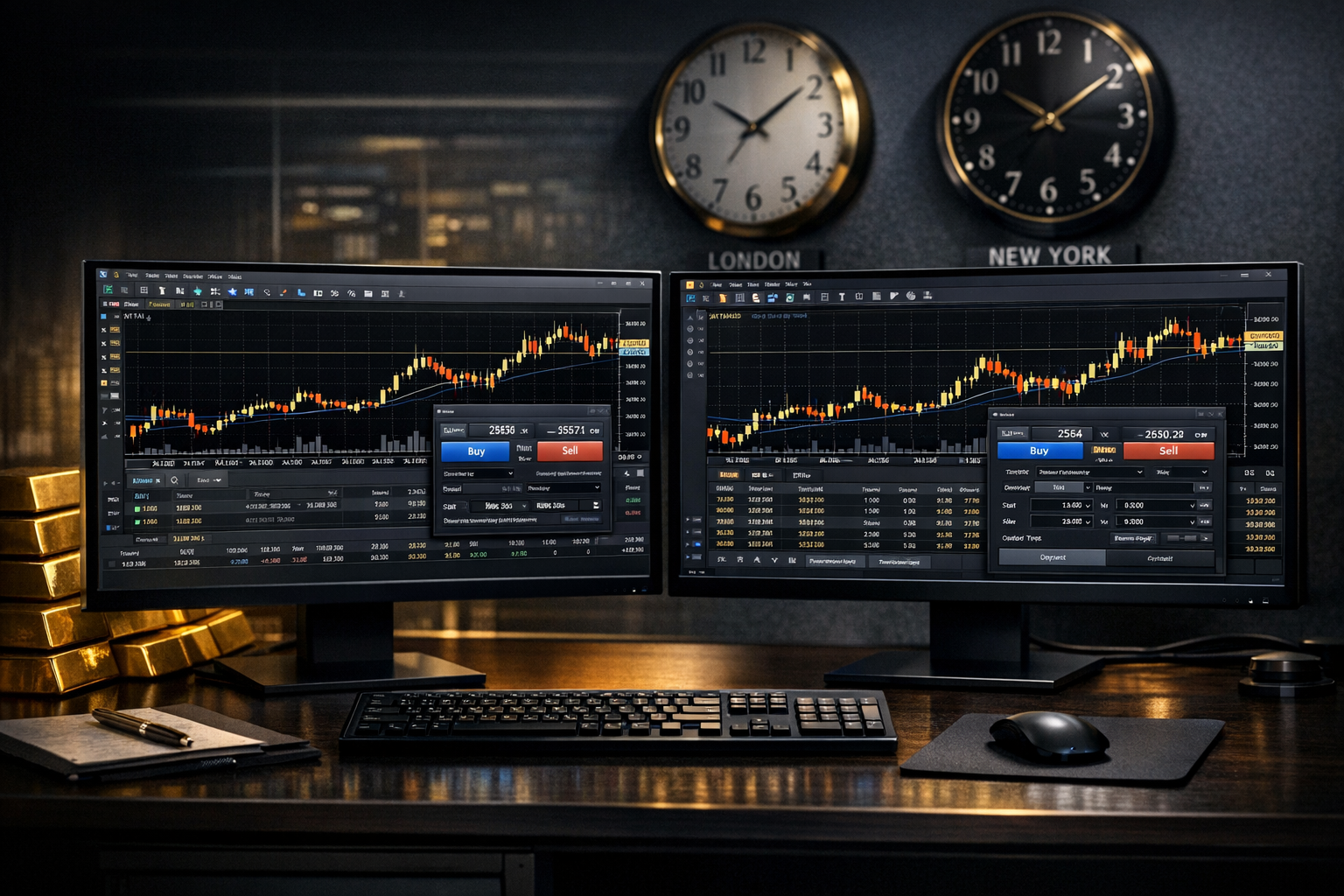
Ever watched XAUUSD spike $18 in one minute after an FOMC decision… and still felt like you had no “clean” trade?
That’s the paradox of trading gold during Fed rate decisions.
Volatility is huge, opportunity is real, but spreads widen, slippage appears, and the first move often lies.
In this guide, we’ll build a practical XAUUSD FOMC strategy you can execute in a single hour: the 30 minutes before and the 30 minutes after the announcement.
We’ll use realistic current levels: XAUUSD ~$2650, DXY ~106.80, EUR/USD 1.0520, GBP/USD 1.2680, and USD/JPY 149.50.
You’ll get entry triggers (break-and-retest, liquidity sweeps), spread rules, stop-loss adjustments, and signal filters to avoid the classic FOMC whipsaw.
TL;DR: The 60-minute XAUUSD FOMC game plan
- Trade the second move, not the first. The initial spike is often a liquidity grab; wait for structure.
- Use a spread filter. If your XAUUSD spread blows out beyond your rule (e.g., 60–100 points / $0.60–$1.00), you don’t trade.
- Two A+ triggers only: (1) break-and-retest of a key level, (2) liquidity sweep + reclaim with confirmation.
- Adjust stops for news volatility. Typical $10–$25 SL becomes $18–$28 around FOMC, but only if your position size is reduced.
- Time windows matter. Best execution is often +3 to +12 minutes after the release, not at 0 seconds.
- Signal filtering beats signal volume. If your setup doesn’t align with DXY/yields reaction and clean candle closes, skip it.
Why XAUUSD reacts violently to Fed rate decisions (and why the first move lies)

Gold is priced globally in USD, so Fed decisions hit XAUUSD through two main channels: real yields and the dollar.
When the Fed is perceived as more hawkish than expected, yields tend to rise, the dollar tends to strengthen, and gold often drops fast.
When the Fed is perceived as more dovish, yields can fall, the dollar can weaken, and gold often rallies.
But FOMC day is not “normal macro.”
It’s a microstructure event where liquidity thins, market makers widen spreads, and large players intentionally push price into obvious stops.
That’s why the first 30–90 seconds can be a trap.
Here’s what typically happens to XAUUSD around the release when gold is trading near $2650:
- Price rips to $2662 in seconds, then snaps back to $2646.
- Stops above the pre-news high get cleared, then stops below the pre-news low get cleared.
- Only after both sides are “washed” does the real directional move start.
This is why our approach is built around confirmation triggers and spread/volatility rules, not prediction.
We’re not trying to guess the Fed.
We’re trying to react professionally to how price behaves when the largest liquidity event of the week hits.
Also remember: FOMC isn’t just the rate decision.
It’s the full package: statement language, dot plot (when applicable), and the press conference.
Gold can reverse hard during Q&A even if the initial decision move looked “clear.”
That’s why a 60-minute plan is the sweet spot.
You’re trading a defined window with rules, not improvising through chaos.
The 60-minute timeline: what to do at -30, -15, 0, +5, +15, +30
Let’s map the hour like a pilot’s checklist.
You’ll know exactly what to do at each timestamp.
-30 minutes: build the battlefield (levels, bias, and no-trade zones)
At -30, you’re not trading.
You’re marking levels and defining where you will not take a trade.
If XAUUSD is around $2650, you mark:
- Pre-news swing high (example): $2661.80
- Pre-news swing low (example): $2639.60
- Key intraday pivot (example): $2650.00
- Nearest liquidity pools (round numbers): $2660, $2670, $2640, $2630
You also check the “macro dashboard”:
- DXY ~106.80: is it trending or range-bound?
- USD/JPY 149.50: risk sentiment proxy during USD moves.
- EUR/USD 1.0520 and GBP/USD 1.2680: do they confirm USD strength/weakness?
We’re not trading these pairs here, but they help validate whether gold’s move is “USD-driven” or just gold-specific noise.
-15 minutes: execution prep (spreads, platform, and position sizing)
At -15, you prepare for the reality of news trading: spreads and slippage.
Write down your spread cut-off for XAUUSD.
For many brokers, normal spread might be $0.20–$0.35 (20–35 points).
During FOMC, it can jump to $0.80–$2.50.
A professional rule is: if spread > $1.00, no market orders.
And if spread > $1.50, no trade at all, because your stop and entry quality get destroyed.
Now position size.
If your normal gold stop is $12, and you plan to use $24 during FOMC, you must reduce size by ~50% to keep risk constant.
This is non-negotiable risk math.
0 minutes: do nothing for 30–90 seconds (yes, really)
At the release, your edge is patience.
We want the market to show its hand.
That means we do not chase the first candle.
We let the first push hit liquidity, then we look for one of our two triggers.
+5 minutes: hunt the A+ trigger (structure over speed)
Between +3 and +12 minutes is often where spreads normalize enough and structure forms.
This is where break-and-retest and liquidity sweep setups become tradable.
+15 minutes: manage, scale, or exit before the next volatility wave
At +15, you manage the trade like it’s a live grenade.
Move stops only when structure confirms.
Take partials at 1R if conditions are messy.
+30 minutes: reassess (press conference risk and second wave)
At +30, you decide if the move is trend continuation or if the press conference can reverse it.
If you’re up 2R–3R, protect it.
FOMC reversals are famous for turning a perfect win into a scratch if you get greedy.
Spreads, slippage, and order types: the execution rules that keep you alive
Most traders lose money on FOMC not because their direction was wrong, but because their execution was poor.
Gold is particularly sensitive because it moves fast and many brokers widen spreads aggressively.
So we need rules that are simple enough to follow under stress.
Rule 1: define a “maximum acceptable spread” before the event
Pick a number and commit.
Example spread rules for XAUUSD:
- 0.20–0.50: normal conditions, standard execution.
- 0.50–1.00: acceptable only for limit orders or confirmed retests.
- > 1.00: no market orders; wait or skip.
- > 1.50: stand down entirely.
Why? Because a $1.20 spread effectively widens your stop and reduces reward-to-risk instantly.
If you aim for a $36 take profit (1:3 on a $12 stop), but you pay $1.20 spread and 0.80 slippage, you just donated $2.00 before the trade even breathes.
Rule 2: prefer limit orders on retests, not market orders on spikes
During FOMC, market orders are the most expensive form of entry.
If you get slipped $3–$6 on XAUUSD, your stop placement becomes meaningless.
Instead, we trade setups that naturally allow limit entries:
- Break-and-retest of a clean level.
- Liquidity sweep + reclaim + retest.
These are slower than “click and pray,” and that’s the point.
Rule 3: widen stops only if you reduce size
A common mistake is widening stops and keeping the same lot size.
That doubles or triples your risk without you noticing.
Example:
- Normal day: Buy XAUUSD 2650, SL 2638 (risk $12).
- FOMC day: Buy XAUUSD 2650, SL 2626 (risk $24).
If you keep the same lot size, you just doubled your $ risk.
Instead, halve the size so your account risk stays constant.
Rule 4: accept that some FOMC days are “no-trade days”
Professional trading is not constant activity.
It’s selective execution.
If spreads stay wide, candles are erratic, and price is ping-ponging between $2645 and $2660, you skip.
Capital preservation is a position.
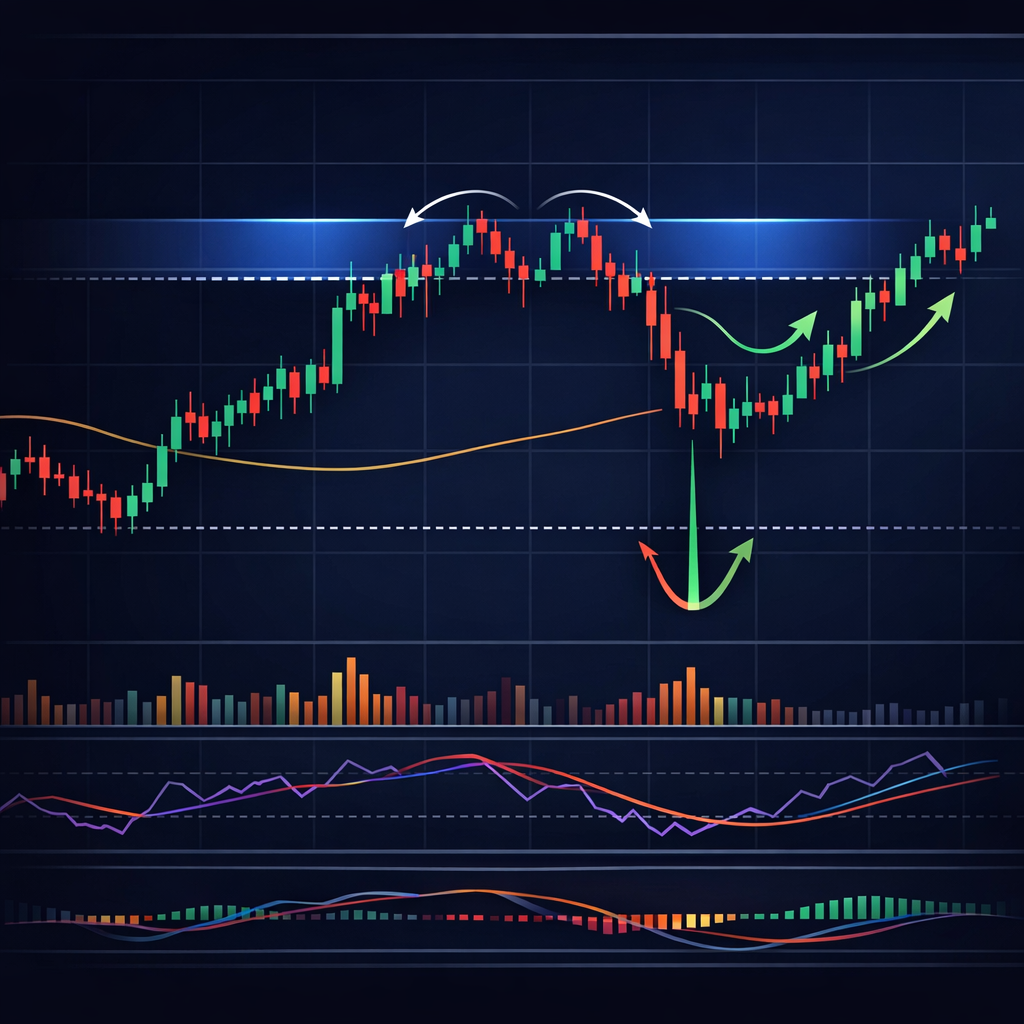
The two entry triggers we trust: break-and-retest and liquidity sweep + reclaim
If you try to trade every pattern during FOMC, you’ll get chopped.
We keep it to two triggers because they’re robust in volatile conditions and easy to validate.
Trigger A: Break-and-retest (the “adult” way to trade the breakout)
This trigger is perfect when gold breaks a pre-marked high/low and then comes back to retest it.
Example scenario with gold near $2650:
- Pre-news high: $2661.80
- FOMC spike breaks to $2668.50
- Price pulls back and retests $2662.00–$2661.50
- You buy the retest only if a lower timeframe candle closes back above 2662 with rejection wicks.
Sample trade plan:
- Entry: Buy 2662.20 (limit on retest)
- SL: 2642.20 (risk $20)
- TP1: 2702.20 (1:2)
- TP2: 2722.20 (1:3) if volatility stays directional
Notice how we’re not buying the spike at 2668.
We’re buying the “proof” that 2662 flipped from resistance to support.
Trigger B: Liquidity sweep + reclaim (the whipsaw filter in disguise)
This is the most valuable FOMC pattern because the market loves to run stops.
We use that behavior instead of fighting it.
Example:
- Pre-news low: $2639.60
- Release drives gold down to $2632.80 (sweeps stops)
- Within minutes, price reclaims $2640 and closes above it
- Then it retests $2640 from above and holds
Sample trade plan:
- Entry: Buy 2641.00
- SL: 2623.00 (risk $18)
- TP: 2677.00 (1:2) or 2695.00 (near range cap, if structure supports)
What you’re really doing here is letting the market “show” that the downside move was a stop run, not true bearish acceptance.
Minimum confirmation checklist for both triggers
- A candle close beyond the level on M1/M5 (not just a wick).
- Retest that respects the level (wicks reject, bodies hold).
- Spread is within your rule at the moment of entry.
- No immediate major opposing level within $6–$8 (avoid buying into a wall).
Signal filters to avoid whipsaws: DXY, yields behavior, and candle “quality”
FOMC whipsaws happen because traders act on incomplete information.
The market often needs several minutes to “price” the decision, the statement, and the positioning unwind.
Our filters are designed to keep you out of the worst trades: the ones that look obvious and then reverse violently.
Filter 1: the “two-candle rule” after the spike
After the initial impulse, wait for two candle closes on your execution timeframe (M1 or M5) that support the direction.
This reduces the chance you’re trading the first fakeout.
If the first candle is a monster and the second candle fully retraces it, that’s a warning.
Stand down until structure returns.
Filter 2: DXY confirmation (don’t ignore the dollar)
With DXY around 106.80, watch how it reacts post-release.
You don’t need a complex correlation model.
You need a simple alignment check:
- If DXY breaks higher and holds, gold longs are lower probability.
- If DXY drops and stays weak, gold longs have better follow-through odds.
When gold moves up while DXY also moves up, that can happen, but it’s often less stable and more headline-driven.
Filter 3: “acceptance” vs “rejection” candles at key levels
During FOMC, wicks are common.
So we focus on whether price accepts a level (closes beyond it and holds) or rejects it (wicks through and closes back).
Example around $2650:
- Gold wicks to 2658 but closes back under 2650 repeatedly: that’s rejection.
- Gold closes above 2650, retests 2650, and prints higher lows: that’s acceptance.
Trade acceptance, avoid rejection.
Filter 4: avoid the “middle of the range” entries
If your pre-news range is 2639.60 to 2661.80, the middle is around 2650.
FOMC often turns the middle into a blender.
We prefer entries near the edges after a sweep or after a confirmed retest.
That’s where risk is definable and reward is real.
A practical 60-minute step-by-step playbook (exact actions and example trades)
Now we combine everything into a single routine you can repeat every FOMC.
Keep this as your checklist.
Step 1: 30 minutes before — mark levels and choose your “decision levels”
On M15 or H1, mark:
- Today’s high/low so far.
- Yesterday’s high/low.
- Round numbers near price (2640, 2650, 2660, 2670).
With XAUUSD at 2650, you might decide:
- Bull trigger zone: acceptance above 2662
- Bear trigger zone: acceptance below 2639
Step 2: 15 minutes before — decide your maximum spread and your “risk per idea”
Pick one risk number for the event.
Example: risk 0.5% of account on one FOMC trade idea.
If you normally risk 1%, cut it.
News trading is not where you “make the month.”
It’s where you avoid giving the month back.
Step 3: At release — let the spike happen, then wait for your trigger
Do not enter within the first 30–90 seconds unless you are a specialist scalper with institutional-style execution.
Most retail traders are not, and that’s okay.
We’re building a repeatable plan for real-world conditions.
Step 4: Execute only A+ setups (two examples)
Example A: Break-and-retest long
- Spike breaks above 2661.80 to 2668.50.
- Price pulls back to 2662.20 and holds.
- Entry: Buy 2662.20
- SL: 2642.20 ($20)
- TP: 2702.20 ($40, 1:2)
Management: take partial at +$20 (1R), move SL to reduce risk only after a higher low forms above 2662.
Example B: Liquidity sweep + reclaim long
- Price sweeps below 2639.60 to 2632.80.
- Reclaims 2640 with a strong close.
- Retests 2640 and prints rejection wicks.
- Entry: Buy 2641.00
- SL: 2623.00 ($18)
- TP: 2677.00 ($36, 1:2)
Management: if spread widens again during the press conference, consider taking profit earlier.
Step 5: Post-entry — manage like a pro (partials, time stops, and invalidation)
FOMC trades need time-based rules.
If you enter and price doesn’t move in your favor within 10–15 minutes, that’s information.
It often means the market is rotating and your edge is gone.
Consider reducing exposure or scratching at a small loss if structure breaks.
Comparison table: FOMC trading styles (scalp, confirm, or stand aside)
Not every trader should trade FOMC the same way.
Here’s a clear comparison so you can choose the approach that matches your execution and psychology.
| Approach | Entry Timing | Typical Spread Tolerance | Stop Size (Gold) | Pros | Cons |
|---|---|---|---|---|---|
| Spike Scalping | 0–60 seconds | High (often > $1.00) | $8–$15 | Big moves fast; high adrenaline | Slippage heavy; whipsaws; hardest to execute |
| Confirmation Trading (Our Plan) | +3 to +12 minutes | Moderate (ideally < $1.00) | $18–$28 | Structure-based; fewer traps; repeatable | May miss the first leg; requires patience |
| Stand Aside / Post-News Trend | +30 minutes to +2 hours | Normalizing | $12–$22 | Cleaner charts; less chaos | Smaller immediate opportunity; trend may be partly priced |
Stops, targets, and position sizing for FOMC volatility (with real numbers)
If you get this section right, you can survive a bad FOMC read.
If you get it wrong, one event can erase weeks of progress.
Stop placement: why “tight stops” fail on FOMC
In normal conditions, a $10–$15 stop can be fine.
During FOMC, a $10 stop is often just “noise distance.”
Gold can wick $12 and continue in your direction without you.
So we typically plan:
- Conservative: $18 stop
- Standard FOMC: $20–$25 stop
- High chaos: $28+ (rare, only with reduced size and A+ structure)
Stops should sit beyond the level that invalidates your setup, not at a random dollar amount.
Targets: keep it simple with 1:2 and 1:3
During news, you want targets that are far enough to matter but not so far they require a miracle.
That’s why 1:2 is the baseline.
Example with entry 2662 and SL 2642 ($20 risk):
- TP at 2702 = $40 reward (1:2)
- TP at 2722 = $60 reward (1:3)
But be realistic about the day’s range.
If gold is already stretched to $2688 and your 1:3 target is $2722, you need to ask whether there’s enough fuel left.
Position sizing: the simplest method that works under pressure
Use a fixed account risk per trade idea (example: 0.5%–1%).
Then size your lot based on your stop distance.
Don’t “feel” your lot size on FOMC.
Calculate it.
If you don’t have a calculator ready, you’re not ready to trade the event.
And if you’re using signals, ensure the signal includes Entry, SL, and TP so you can size correctly.
This is one reason traders join United Kings gold signals: you get structured levels designed for execution, not vague commentary.
Common FOMC traps (and how to avoid them with simple rules)
Let’s talk about the mistakes that repeat every single rate decision.
They’re predictable, which means they’re avoidable.
Trap 1: entering at the midpoint because “it looks cheap/expensive”
If gold is whipping between 2640 and 2662 and you buy at 2650, you’re buying the worst location.
You’re paying maximum spread and giving the market room to stop you out on both sides.
Rule: only trade at levels, not in the middle.
Trap 2: revenge trading after the first stop-out
FOMC can stop you out even with a good plan.
The worst thing you can do is immediately re-enter without a fresh trigger.
Rule: after a loss, require a new structure (new break-and-retest or new sweep + reclaim).
Trap 3: ignoring the press conference
Gold can trend for 10 minutes after the decision and then reverse when Powell speaks.
Rule: if you’re in profit before the press conference, reduce risk.
Take partials, tighten invalidation, or exit if price action turns unstable.
Trap 4: treating every signal as tradable during news
Even good signal providers will tell you: not every setup is a trade during FOMC.
You need filters.
At United Kings, we emphasize quality over quantity, especially around high-impact events.
If you’re building your own filter framework, pair this article with our guide on risk management strategies when using forex signals.
How to filter gold signals around news (so you don’t copy-trade a whipsaw)
Signals can be powerful during FOMC, but only if you treat them like a plan, not a lottery ticket.
The goal is to execute the best signals and ignore the ones that are structurally vulnerable to spreads and fakeouts.
Filter 1: demand complete trade parameters (Entry, SL, TP)
If a “signal” doesn’t include a clear stop loss and take profit, it’s not a signal.
It’s a suggestion.
During FOMC, vague calls are dangerous because volatility punishes hesitation.
United Kings signals are built with clear levels and logic across our signals dashboard and specialized streams like gold trading signals.
Filter 2: validate the setup against your spread rule
A signal can be technically perfect and still be untradable if your broker’s spread is insane.
Before you enter, check the live spread.
If it violates your threshold, you skip or you wait for a retest when spreads normalize.
Filter 3: only take signals that match one of the two triggers
Ask: is this effectively a break-and-retest or a liquidity sweep + reclaim?
If yes, it’s compatible with the 60-minute plan.
If not, you’re mixing systems under stress.
Filter 4: session awareness (London/NY liquidity)
FOMC is a New York event.
That matters because liquidity and follow-through are different in NY than in late Asia.
United Kings focuses heavily on London and NY session trading because that’s where gold and majors like EUR/USD and GBP/USD offer the cleanest execution windows.
If you want the broader framework for signal execution and community support, our forex signals and gold streams are designed for these sessions.
Filter 5: use a “one-trade maximum” rule for beginners
If you’re newer to news trading, limit yourself to one high-quality attempt.
One clean trade with controlled risk beats three emotional trades with widening spreads.
If you’re still building confidence, consider practicing on demo first and reading more market-survival tactics in our post on how gold signals react to unexpected news events.
Realistic FOMC scenarios at $2650: bullish, bearish, and “fake both ways”
Let’s make this tangible with three scenarios you’ll actually see.
These are not fantasies.
This is what gold does when the Fed hits the tape.
Scenario 1: Bullish continuation after dovish surprise
Gold is at 2650 pre-news.
Decision hits, DXY drops from 106.80 toward 106.40.
Gold spikes to 2668, pulls back, retests 2662, then grinds higher.
This is a break-and-retest long.
Your job is to avoid buying the top and instead buy the retest with a defined stop.
Scenario 2: Bearish continuation after hawkish hold
Gold is at 2650 pre-news.
DXY pops higher, USD/JPY jumps above 150.00.
Gold dumps through 2639 to 2628, retests 2639 from below, and fails.
This is the bearish mirror of the break-and-retest.
Sample trade idea:
- Entry: Sell 2638.50 on retest failure
- SL: 2658.50 ($20)
- TP: 2598.50 ($40, 1:2) (Note: this is outside today’s example range, so you would likely take profits earlier near 2610–2615 if that’s the nearest support in your plan.)
In the $2610–$2690 guideline range, a more realistic TP might be 2612–2615 if structure supports it.
Scenario 3: Fake both ways (the classic FOMC stop-hunt)
Gold spikes up to 2669, then collapses to 2633, then returns to 2655.
Both breakout buyers and breakdown sellers get punished.
In this scenario, the only tradable edge is the liquidity sweep + reclaim pattern.
You wait for a sweep of one side, then a reclaim, then a retest.
If you can’t get that structure, you skip the session.
Building your personal FOMC checklist (printable rules you can follow)
When volatility hits, you don’t rise to the occasion.
You fall to the level of your systems.
So here’s a tight checklist you can copy into your notes.
Pre-news checklist (-30 to -15)
- Mark today’s high/low and pre-news high/low.
- Mark round numbers near price (2640/2650/2660/2670).
- Set maximum spread rule (example: no trades if > $1.50).
- Decide risk per idea (example: 0.5% account).
- Decide which trigger you will trade (break-retest or sweep-reclaim).
At release checklist (0 to +5)
- No entry in first 30–90 seconds.
- Watch for sweep of pre-news high/low.
- Check DXY reaction for alignment.
- Wait for candle closes (acceptance vs rejection).
Execution checklist (+5 to +15)
- Enter only on retest or reclaim confirmation.
- Stop beyond invalidation (typically $18–$28).
- Target 1:2 minimum; take partials if volatility is messy.
- If spread widens mid-trade, manage more conservatively.
Post-trade checklist (+15 to +30)
- Log screenshots and notes (what trigger, what filter, what spread).
- Do not re-enter without a new trigger.
- Be aware of press conference reversal risk.
FAQ: Trading XAUUSD during Fed rate decisions
1) Is it better to trade gold before or after the FOMC announcement?
For most traders, after is better.
The 0–60 second window has the worst spreads and slippage.
Our plan focuses on +3 to +12 minutes when structure starts to form.
2) What timeframe is best for an XAUUSD FOMC strategy?
Use H1/M15 to mark key levels.
Execute on M5 or M1 for confirmation candles and retests.
Don’t rely on one timeframe only; levels come from higher timeframes, entries from lower.
3) How wide should my stop loss be on gold during FOMC?
Many traders need $18–$28 during FOMC depending on volatility.
The key is to reduce position size so your account risk stays constant.
4) Why does gold often reverse during the press conference?
The decision is one piece of information.
Forward guidance, tone, and Q&A can shift rate expectations quickly.
That changes yields and the dollar, which can flip gold’s direction.
5) Can I use Telegram gold signals during FOMC safely?
Yes, if the signals provide clear Entry/SL/TP and you apply spread and confirmation filters.
If you want a structured feed built for London/NY execution, you can follow United Kings on Telegram at United Kings Telegram channel.
Risk Disclaimer: Forex and gold trading involves significant risk and may not be suitable for all investors. Spreads can widen and slippage can occur during high-impact news like FOMC rate decisions. Past performance does not guarantee future results. Nothing in this article is financial advice. Consider practicing on a demo account if you’re a beginner, and never risk money you cannot afford to lose.
Join United Kings: trade FOMC with clearer levels, better discipline, and a real community
If you’re serious about trading gold during Fed decisions, you need two things: a plan and execution support.
United Kings delivers premium Telegram signals for forex and gold with clear Entry, SL, and TP levels, built for the London and New York sessions.
We’re backed by a community of 300K+ active traders and a track record-focused process (no hype, no “guaranteed profits”).
Start with the signal stream that matches your focus:
Choose a plan that fits your commitment level on our pricing page:
- Starter: 3 Months — $299 (~$100/mo)
- Best Value: 1 Year — $599 ($50/mo) + FREE ebook (50% savings)
- Unlimited: Lifetime — $999 (pay once, access forever)
You’re also covered by a 48-hour money-back guarantee so you can test the experience with confidence.
Ready to trade FOMC with structure instead of stress? Join the team at UnitedKings.net and follow the live updates on United Kings Telegram.