
You wake up, open XAUUSD, and gold is hovering near $2650. London is about to open, spreads tighten, volume wakes up, and then—within minutes—price spikes $12, tags a “perfect” breakout level, and instantly snaps back.
If you’ve ever been stopped out right before the move, you’ve likely been on the wrong side of a liquidity sweep—a stop-hunt designed to grab resting orders above equal highs or below equal lows.
This guide breaks down a repeatable XAUUSD liquidity sweep strategy specifically for London open gold trading. We’ll use clear rules: identify liquidity pools, mark the sweep candle, wait for confirmation (market structure shift + retest), and then execute with a clean entry/SL/TP framework.
TL;DR (London Open Liquidity Sweep Strategy)
- Liquidity sweeps on XAUUSD often occur around London open when price targets equal highs/lows from the Asian range.
- Don’t trade the wick. Wait for confirmation: a sweep + market structure shift (MSS) + retest.
- Use realistic gold risk: $10–$25 stops, and aim for 1:2 to 1:3 RR (e.g., risk $12 to target $24–$36).
- Filter bad days: low liquidity, major news (CPI/NFP), and choppy DXY regimes can create false sweeps.
- Best execution windows: London open (first 60–90 minutes) and London–NY overlap for continuation.
- If you want these setups delivered with Entry/SL/TP, follow our premium gold signals and live community on United Kings Telegram.
What a Liquidity Sweep Really Means on XAUUSD (and Why London Loves It)
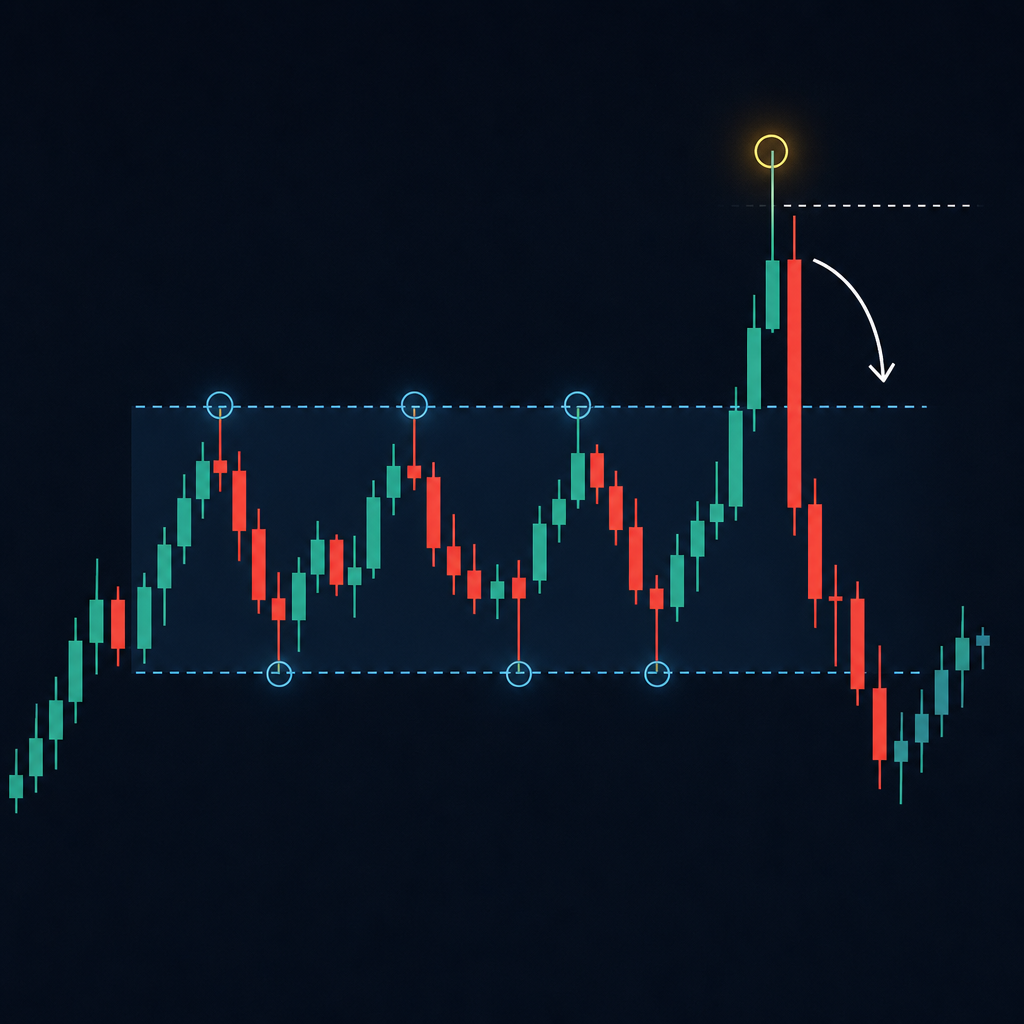
In gold, “liquidity” is where orders are clustered. Retail traders cluster stops at obvious places: above equal highs, below equal lows, above the Asian range high, or below the previous day low.
A liquidity sweep (often called a stop-hunt) is when price pushes into one of these obvious areas, triggers stop orders (and breakout orders), then reverses. That reversal is not magic—it’s order flow.
Here’s the key: stops are market orders when triggered. If a lot of stops sit above $2662 (equal highs), pushing price to $2664–$2668 can trigger a wave of buy stops. That buy flow provides liquidity for larger players to sell into (or to fill hedges) before price turns.
Why does London open matter? Because liquidity transitions. Asia often ranges. London injects volume. That combination creates a perfect environment for “range runs” and sweeps.
Current market context (why it matters today)
Let’s anchor this in the current tape. Gold is around $2650.00 (+0.35% in 24h). DXY is firm near 106.80. USD/JPY is elevated near 149.50. EUR/USD is soft around 1.0520, while GBP/USD is near 1.2680.
In this environment, gold can still rally, but it tends to do it in two-way volatility: sharp spikes, fast mean reversion, then continuation. That’s exactly the behavior liquidity sweeps exploit.
Liquidity sweep vs. breakout: the practical distinction
A breakout is acceptance above a level: price breaks, holds, and builds. A sweep is rejection: price breaks, grabs stops, and returns.
If you only remember one sentence from this article, make it this: We don’t trade the break—we trade the rejection after the break, confirmed by structure.
Where the “obvious” liquidity sits on gold
- Equal highs/lows on M5–M15 (the classic stop cluster).
- Asian range high/low (00:00–06:00 London time, depending on your broker).
- Previous day high/low and weekly levels.
- Round numbers (e.g., $2650, $2660, $2675).
- Session opens (London open, NY open) where liquidity surges.
If you want a deeper primer on how liquidity impacts signal quality, pair this with our broader education inside United Kings Signals, where we publish the “why” behind setups, not just the levels.
Why the London Open Creates Gold Stop-Hunts (Session Mechanics You Can Trade)
London open is not a single candle. It’s a transition from thin-to-thick liquidity, and that transition is where traps form.
During Asia, gold often prints a contained range—say $2638 to $2652. Many traders mark that range and plan a breakout trade. London knows that. The first push frequently runs one side of that range to trigger orders.
The three London-open behaviors we see most on XAUUSD
1) Asian range run → reversal. Price sweeps above the Asian high (or below the Asian low) by $3–$10, then snaps back. This is the classic liquidity grab.
2) Range run → consolidation → continuation. Price sweeps, returns into range, then later breaks the other side for the real move. This is common when DXY is trending and gold is “reactive.”
3) Clean trend day. No meaningful sweep; price respects structure and trends. These days are rarer than people think, and they usually align with strong fundamentals or heavy positioning.
How to time it (without obsessing over exact minutes)
Most stop-hunts happen in the first 60–90 minutes of London. If you’re trying to trade them at random times, your win rate will suffer.
We focus on a repeatable window: the pre-London build-up (to map liquidity) and the London impulse (to confirm the sweep).
Realistic example using today’s price zone
Suppose XAUUSD is ranging pre-London between $2642 and $2654. You notice two equal highs around $2654 on M5.
At London open, price spikes to $2663 (a $9 run through the highs), prints a large upper wick, then closes back below $2654. That’s the sweep candle.
Is it a short immediately? Not yet. We still need confirmation—because sometimes the spike is the start of a trend day.
Why confirmation matters more on gold than many FX pairs
Gold’s intraday volatility is naturally higher. A $6 wick is not “proof” of reversal. Without structure shift, you’ll short into a continuation and watch gold run $20 against you.
That’s why our strategy is built around sequence: liquidity sweep → market structure shift → retest → execute.
Inside our Gold Signals, we publish London and NY session setups with the same logic, including exact Entry, SL, and TP levels—so you’re not guessing in real time.
The XAUUSD Liquidity Sweep Strategy (Rules You Can Repeat Daily)
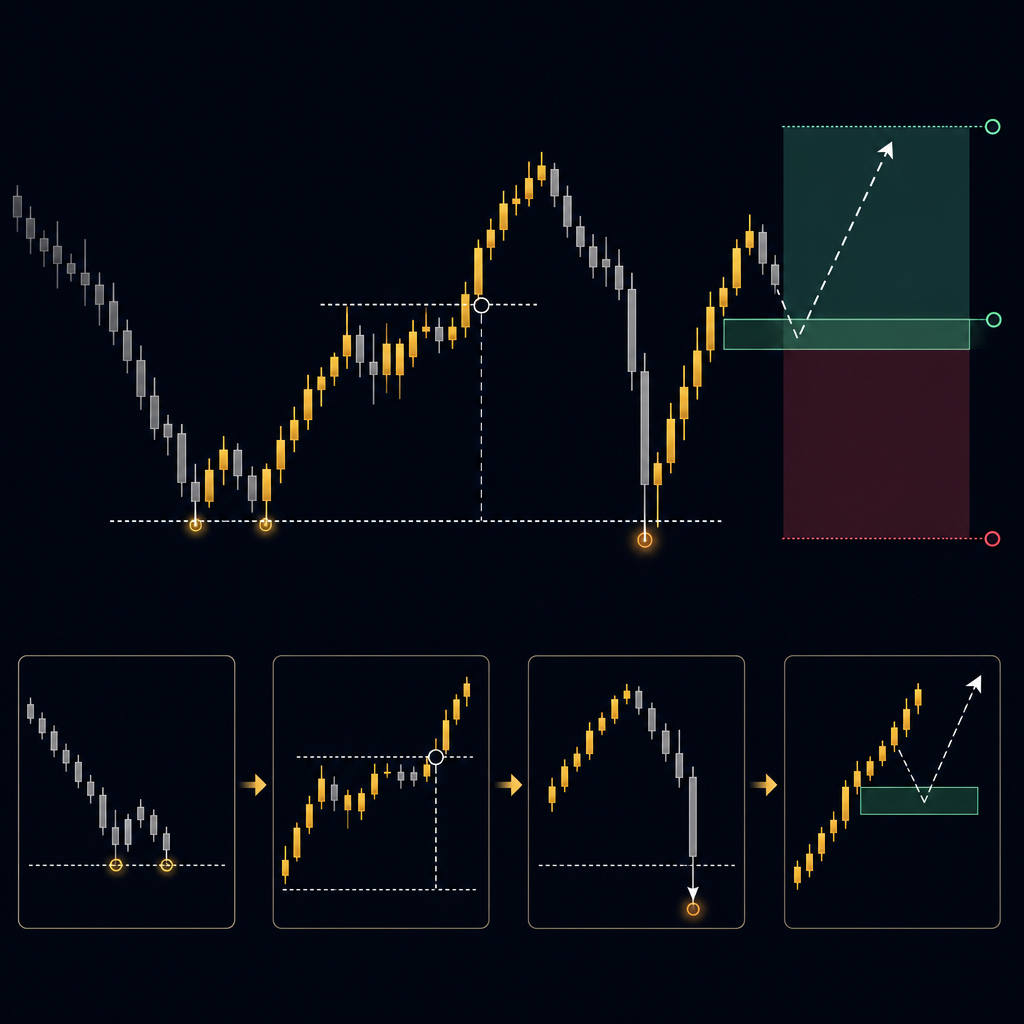
Let’s formalize the strategy. This is a rules-based approach designed for London open gold trading, not a “feel-based” scalp.
We’ll use M5–M15 for execution and H1 for context. You can trade it on M1 too, but false signals increase.
Definitions (keep these consistent)
- Liquidity pool: equal highs/lows, Asian high/low, previous day high/low.
- Sweep candle: candle that trades beyond the liquidity pool and closes back inside (or shows strong rejection).
- MSS (Market Structure Shift): after the sweep, price breaks the most recent swing in the opposite direction.
- Retest: price returns to the broken structure level (or a supply/demand zone formed by the shift) and rejects.
Core rules (the checklist)
Rule 1: Mark liquidity before London. Identify equal highs/lows on M15 and the Asian range high/low.
Rule 2: Wait for a sweep. Price must take the level (by at least ~$1–$3 on gold) and show rejection.
Rule 3: Confirm with MSS. After the sweep, price must break an internal swing in the opposite direction. No MSS, no trade.
Rule 4: Enter on retest. Use limit/market on the retest rejection, not in the middle of volatility.
Rule 5: SL beyond the extreme. Stop goes beyond the sweep high/low with a buffer (often $2–$6 extra).
Rule 6: TP at logical liquidity. Target the opposite side liquidity (Asian low/high) and/or next HTF level, maintaining 1:2–1:3 RR.
Why we don’t “fade every spike”
Because some spikes are real. Gold can trend hard when yields move, when DXY breaks, or when risk-off headlines hit.
The MSS requirement prevents you from shorting a genuine breakout. It forces the market to prove reversal.
A clean short example (numbers you can visualize)
- Pre-London equal highs: $2656 (three touches on M5).
- Sweep: wick to $2666, close back below $2656.
- MSS: break below the last higher low at $2650.
- Retest entry: sell $2653–$2655 on pullback.
- Stop loss: above sweep high, e.g., $2671 (risk ~$16–$18 depending on fill).
- Take profit 1 (1:2): $2621–$2623 (reward ~$32).
- Take profit 2 (1:3): $2605–$2607 (reward ~$48) if the day expands.
Notice the SL is not “tight for the sake of it.” On gold, a too-tight stop is a donation. The buffer is part of the strategy.
If you prefer to receive these as ready-to-execute alerts, our Forex Signals and Gold Signals are built for London/NY session execution with clear Entry, SL, and TP levels.
Step-by-Step: How to Mark Equal Highs/Lows and the Asian Range (Pre-London Routine)
Your results will largely come from what you do before London open. The best traders aren’t faster—they’re prepared.
Here’s a simple routine you can repeat daily in 10–15 minutes.
Step 1: Set your session map
Choose a consistent definition of the Asian range. Many traders use roughly 00:00–06:00 London time. Your broker server time may differ, so anchor to the actual session behavior, not the clock label.
Draw a box around the Asian high and low on M15. Keep it visible.
Step 2: Identify “real” equal highs/lows (not random noise)
Equal highs/lows are not required to be identical to the cent. On XAUUSD, treat levels within $0.50–$1.50 as “equal” depending on volatility.
- High-quality equal highs: 2–3 touches, clear rejection, formed over 30–120 minutes.
- Low-quality equal highs: formed in 5 minutes, messy, wide wicks everywhere.
Step 3: Mark the nearest external liquidity
External liquidity is higher timeframe: previous day high/low, weekly open, and obvious H1 swing points.
In the $2610–$2690 zone, you might see yesterday’s high near $2668 and yesterday’s low near $2622. Those become magnets for London.
Step 4: Decide your “A-side” and “B-side” scenarios
Write two scenarios before the move happens:
- A-side: sweep above equal highs/Asian high → MSS down → short to Asian low.
- B-side: sweep below equal lows/Asian low → MSS up → long to Asian high.
Step 5: Add one simple context filter (trend bias)
Use H1 structure: is gold making higher highs and higher lows into London? Or is it distributing under resistance?
In today’s context near $2650 with DXY at 106.80, be open to both directions. But if H1 is clearly bearish and London sweeps highs, that short has extra edge.
Step 6: Pre-plan your risk
Decide your maximum risk per trade (e.g., 0.5%–1%). Then translate that into dollars per $1 move on gold using your lot size.
If your SL is $16 and your max loss is $100, you need position sizing that makes $16 = $100 risk. That’s the difference between “I hope” and professional execution.
For a full risk framework, keep our guide bookmarked: risk management strategies when using forex signals. The principles apply directly to gold.
Confirmation Signals That Make Sweeps Tradable: MSS + Retest (No Guessing)
The market can sweep liquidity and still continue in the same direction. That’s why confirmation is the heart of this strategy.
We use two confirmations: Market Structure Shift and a retest. Together, they turn a “maybe” into a trade plan.
1) Market Structure Shift (MSS): what it looks like on M5
After a sweep above highs, you want to see price break below the most recent higher low. That break is the first sign that the buyers who chased the breakout are trapped.
Example: price sweeps to $2664, then drops and breaks below $2652 (the last higher low). That is your MSS.
2) Retest: where professionals enter
After the MSS, price commonly retests the broken level. This is where you enter with defined risk.
On a short, the retest might be $2652–$2655. On a long, it might be $2640–$2643.
Confirmation candle cues (simple and effective)
- Strong close: MSS candle closes decisively beyond the swing (not a tiny body).
- Displacement: a fast move away from the sweep zone (gold often moves $6–$12 quickly).
- Retest rejection: small wicks into the level, then continuation candle in your direction.
What to avoid (common trap)
A frequent mistake is entering immediately after the sweep candle, before MSS. That’s emotional trading disguised as “aggressive entry.”
Another mistake is labeling any small break as MSS. If price breaks by $0.50 and returns, it’s noise. On gold, you want a clean break and follow-through.
Optional confirmation: divergence and volume (use lightly)
You can add RSI divergence or volume spikes as secondary confirmation. But don’t let indicators override structure.
Our best results come from price action first. Indicators are supporting actors, not the main character.
How United Kings packages confirmation in signals
In our Telegram, we often annotate whether a trade is a “sweep + MSS + retest” setup or a continuation setup. That clarity helps traders avoid forcing entries.
If you’re new to Telegram execution, read: forex signals Telegram for beginners. The same execution discipline applies to gold stop-hunt signals.
Entry, Stop Loss, and Take Profit Frameworks (With Real XAUUSD Numbers)
You can spot sweeps perfectly and still lose money if your execution is sloppy. Gold punishes vague entries and random stops.
Below are three practical entry models you can choose from. Pick one, master it, and keep it consistent for at least 30 trades.
Model A: Conservative retest entry (highest win rate)
This is the default for most traders. You wait for the retest and a rejection candle.
- Short example: sweep to $2667, MSS breaks $2654, retest to $2656.
- Entry: sell $2655–$2657 after rejection.
- SL: above sweep high + buffer, e.g., $2673 (risk ~$16–$18).
- TP1 (1:2): $2621–$2625 (reward ~$32–$36).
- TP2 (1:3): $2607–$2611 (reward ~$48–$54) if momentum continues.
Model B: Aggressive MSS break entry (better RR, lower win rate)
You enter on the break of structure, not the retest. This can improve RR, but you’ll face more whipsaws.
- Entry: sell the break below $2654 right after MSS.
- SL: above the retest zone or above sweep high (choose one and be consistent).
- TP: same as Model A, but you may scale out sooner due to volatility.
Model C: Limit entry at premium/discount (advanced)
This model uses the idea of entering at a “better price” inside the pullback. It requires experience with gold’s pullback depth.
Example: after MSS, you place a sell limit at $2658–$2660 anticipating a deeper retest. SL stays above $2672. TP targets $2625 and $2610.
Stop placement: the two rules that protect you
- Rule 1: SL goes beyond the sweep extreme, not inside it. Otherwise you’re sitting where stops are hunted again.
- Rule 2: Add a buffer. For gold, a $2–$6 buffer is often reasonable depending on volatility.
Take profit logic: target liquidity, not feelings
Where does price want to go after a sweep? Often to the opposite liquidity.
If London sweeps above highs, the next magnet is commonly the Asian low or previous day low. That’s where trapped traders exit and where the next liquidity pool sits.
Trade management (simple, not over-optimized)
- At 1R, consider moving SL to breakeven only if structure supports it. Don’t do it mechanically.
- At TP1 (1:2), take partials (e.g., 50%) and let the rest run to TP2 if momentum remains.
- If price reclaims the MSS level and holds, exit. That’s the market telling you the reversal failed.
Want a done-for-you version of this framework? Our United Kings gold signals deliver Entry, SL, and multiple TP levels with a consistent approach, focused on London and NY sessions.
Comparison Table: Sweep Trading vs Breakout Trading at London Open
Many traders lose money at London open because they apply breakout logic in a sweep environment. Here’s a clear comparison so you can decide what you’re actually trading.
| Feature | Liquidity Sweep Strategy | London Open Breakout Strategy |
|---|---|---|
| Primary idea | Trade the rejection after stops are taken | Trade the acceptance above/below range |
| Key setup | Equal highs/lows → sweep wick → MSS → retest | Asian range break → hold → continuation |
| Best market condition | Ranging Asia, two-way volatility, clear liquidity pools | Strong trend day, macro catalyst, high momentum |
| Common mistake | Shorting/longing without MSS confirmation | Buying the first spike that is actually a stop-hunt |
| Stop placement | Beyond sweep extreme + buffer ($10–$25 typical) | Often tighter, but can get wicked out in gold |
| Targeting | Opposite liquidity (Asian low/high, PDH/PDL) | Measured move / trend continuation levels |
Neither approach is “better” in all conditions. The edge comes from matching the method to the day type—and being honest about what the market is offering.
Filters to Avoid False Sweeps (Low-Liquidity Days, News, and DXY Traps)
False sweeps are the tax you pay for trading London open. The goal isn’t to eliminate them—it’s to filter the worst ones.
Here are the filters we use to avoid the most common failure modes.
Filter 1: Avoid “dead” pre-London price action
If Asia ranges in a $4 band and London opens with tiny candles, the first sweep can be random noise. You want a range that’s tradable—often $8–$18 on gold depending on the week.
As a practical guideline: if the Asian range is under ~$6, reduce size or wait for clearer confirmation.
Filter 2: Check the economic calendar (especially CPI, NFP, Powell)
High-impact USD events can invalidate technicals. A perfect sweep setup can fail instantly if a surprise number hits.
If you trade on news days, either wait until after the release or reduce exposure. For a deeper playbook, read: how gold signals react to unexpected news events.
Filter 3: Watch DXY and USD/JPY for regime clues
With DXY near 106.80 and USD/JPY around 149.50, USD strength can pressure gold. That doesn’t mean “gold must fall,” but it changes the character of rallies.
When DXY is trending strongly, gold often produces sharper pullbacks and more aggressive stop-hunts before continuing.
Filter 4: Require displacement after the sweep
A good sweep reversal usually shows displacement: a fast move away from the sweep zone. If price barely moves and just chops, skip it.
Filter 5: One sweep is normal; two sweeps is a warning
Sometimes gold will sweep highs, reverse a bit, then sweep again and trend. Two sweeps in the same area often signals indecision or a larger accumulation/distribution process.
If you see multiple raids, reduce size and require cleaner MSS on a higher timeframe (M15/H1).
Filter 6: Spread and execution quality
London open can widen spreads briefly. If your broker’s spread spikes, your tight SL becomes vulnerable. Build this into your buffer.
If you want a curated approach where we filter days and only send the cleanest London/NY setups, explore United Kings Signals. The goal is fewer, higher-quality trades—especially on volatile gold weeks.
Two Full Trade Scenarios: London Open Sweep Short and Sweep Long
Let’s walk through two complete scenarios using realistic prices in the $2610–$2690 zone. Read these like a script you can replay on your chart.
Scenario 1: London open sweep short (run the highs, then dump)
Context: Gold is near $2650. Asia ranges between $2641 and $2656. DXY is steady around 106.80.
Liquidity map: Equal highs at $2656 (three touches). Asian high = $2656. Previous day high = $2668.
London event: Price spikes from $2652 to $2666 in minutes. It tags above the equal highs and approaches PDH liquidity.
Sweep candle: M5 prints a long upper wick, closes back below $2656.
Confirmation (MSS): Price breaks below the last higher low at $2649 with a strong close.
Retest: Price pulls back to $2653–$2655 and stalls.
- Entry: Sell $2654
- SL: $2672 (18 points risk)
- TP1 (1:2): $2618 (36 points reward)
- TP2 (1:3): $2600 (54 points reward) if the day expands
Management: If price reaches $2636 quickly, you can reduce risk by trailing behind new lower highs on M5. If price reclaims $2656 and holds, exit—your MSS failed.
Scenario 2: London open sweep long (run the lows, then rip higher)
Context: Gold is bid overall on H1, but Asia sells off into support. Range is $2648 to $2632.
Liquidity map: Equal lows at $2632. Asian low = $2632. Previous day low = $2622.
London event: Price flushes to $2624 (an $8 sweep through equal lows), printing a long lower wick.
MSS: Price breaks above the last lower high at $2638 with displacement.
Retest: Price comes back to $2637–$2639, holds, and prints a bullish continuation candle.
- Entry: Buy $2638
- SL: $2620 (18 points risk)
- TP1 (1:2): $2674 (36 points reward)
- TP2 (1:3): $2692 (54 points reward) if momentum continues
Management: If price struggles to reclaim the Asian midline and keeps wicking, take partials earlier. If price breaks back below $2632 after entry, accept the loss—don’t average down into a potential trend day lower.
These scenarios are exactly how we structure “gold stop hunt signals”: clear liquidity, clear confirmation, defined risk, and targets at logical magnets.
Risk Management for London Open Gold Trading (Position Sizing, Daily Limits, Psychology)
London open can make your week—or wreck it—because volatility compresses many emotions into 30 minutes.
If you want consistency, you need a risk framework that survives streaks, slippage, and the occasional “perfect setup” that fails.
1) Position sizing: translate SL dollars into account risk
Gold stops in this strategy are often $10–$25. That’s normal. Your lot size must adapt to the stop, not the other way around.
Example: you risk 1% on a $5,000 account = $50. If your SL is $16, size so that a $16 move equals $50 loss. If you can’t size that small due to broker constraints, reduce frequency or use a different instrument.
2) Daily loss limit (the rule that saves accounts)
Set a hard daily limit: 2R is a common professional rule. If you lose 2 trades at 1R each, you stop. London open will be there tomorrow.
3) Don’t revenge trade the second sweep
Gold loves to fake you twice. You get stopped, then immediately see the move you wanted.
If you re-enter without a new sweep + MSS sequence, you’re not trading a strategy—you’re trading frustration.
4) Use a “one setup per session” constraint
For most traders, one high-quality London open setup beats three mediocre ones. Your job is to catch the clean sweep, not every candle.
5) Record screenshots and stats
Track:
- Was there a clear equal high/low?
- Did the sweep close back inside?
- Was MSS clean (displacement)?
- Did you enter on retest or chase?
- What was the day type (trend vs range)?
Over 30–50 trades, you’ll see which filter improves your win rate most. That’s how you turn a concept into an edge.
If you want a structured approach to managing risk while following signals, read: risk management strategies when using forex signals. We built it for real traders, not theory.
How to Use United Kings Confirmation Signals (and What to Expect in Telegram)
Even with a solid strategy, execution in real time is hard. London open moves fast. Your chart is moving. Your emotions are louder than your rules.
This is where high-quality signals can help—not as a crutch, but as a framework you can mirror and learn from.
What our premium signals include
United Kings focuses on London and NY session opportunities, especially on gold. Our signals are delivered with:
- Clear Entry (often a zone, not a single price)
- Stop Loss (placed beyond structure, not random)
- Take Profit levels (commonly TP1/TP2 for scaling)
- Context notes (sweep setup, continuation, or news caution)
How to align signals with this sweep strategy
When you receive a London open gold idea, ask:
- What liquidity was taken (equal highs/lows, Asian range, PDH/PDL)?
- Did we get MSS confirmation?
- Is entry on retest (safer) or on break (aggressive)?
- Are targets aligned with opposite liquidity?
Community edge: you’re not trading alone
There’s a difference between a random chat group and a serious trading community. United Kings has a large, active community (300K+ traders) where traders share chart markup and execution notes.
That environment helps you stay disciplined on days where gold is choppy near $2650 and the market is hunting stops on both sides.
Where to start
- Explore our signal hub: United Kings Signals
- For gold-specific execution: premium gold signals
- Join the live channel: United Kings Telegram
If you’re comparing providers, also check: forex trading signals provider checklist. The standards apply to gold signal quality too.
Common Mistakes Trading Gold Stop-Hunts (and the Fix for Each)
Most traders don’t fail because they can’t spot a sweep. They fail because they turn a good concept into a messy execution.
Here are the most common mistakes we see with London open gold stop-hunt signals, and the fix you can apply immediately.
Mistake 1: Treating every wick as a sweep
Gold wicks. That’s normal. A sweep is meaningful only when it takes a clear liquidity pool and rejects.
Fix: Require equal highs/lows or Asian high/low to be clearly defined on M15. If you can’t explain where stops were, skip.
Mistake 2: Entering before MSS (the “I don’t want to miss it” entry)
This is the fastest way to get chopped. The market often sweeps, pauses, then sweeps again.
Fix: No MSS, no trade. Put it on a sticky note.
Mistake 3: Stops that are too tight for gold
A $6 stop on a London open sweep trade is often inside the noise. You’ll be right on direction and still lose.
Fix: Use $10–$25 stops depending on structure, and size down accordingly.
Mistake 4: Taking profit too early (and then chasing)
Gold can move $25–$50 on expansion days. If you take $6 and then chase, your expectancy collapses.
Fix: Use partials at 1:2, then let a runner target 1:3 when conditions support it.
Mistake 5: Ignoring the day’s volatility regime
Some days are clean. Some days are “wick city.” If you trade them the same way, you’ll feel like the market is personal.
Fix: Use filters: Asian range size, displacement requirement, and news awareness. Adapt, don’t force.
If you want daily execution examples, you can browse more education on our blog and combine it with our live gold signals for practical repetition.
FAQ: XAUUSD Liquidity Sweep Strategy for London Open
1) What timeframe is best for the XAUUSD liquidity sweep strategy?
Use H1 for context, M15 to mark liquidity, and M5 for MSS + retest execution. M1 can work, but false sweeps increase.
2) How far should the sweep go beyond equal highs/lows on gold?
There’s no fixed number, but as a guideline, a sweep that runs $1–$3 beyond a clear level can be enough if rejection is strong. On higher volatility days, sweeps of $6–$12 are common.
3) What stop loss size is realistic for London open gold trades?
Typically $10–$25 depending on structure and volatility. Many traders lose because they use $5–$8 stops and get wicked out.
4) Can this strategy work on NY open too?
Yes. NY open and the London–NY overlap can produce similar liquidity behavior, especially when USD data or yields drive flows. London open tends to be more consistent for Asian range runs.
5) Do I need a signal provider to trade this strategy?
No. But a good provider can speed up your learning and reduce decision fatigue by delivering structured Entry/SL/TP and session-based filters. If you’re exploring that route, start with our signals and gold-focused channel at United Kings Telegram.
Risk Disclaimer (Read Before You Trade)
Forex and gold trading involves significant risk and may not be suitable for all investors. You can lose more than your initial deposit if trading on leverage. Past performance, win rates, or historical results do not guarantee future outcomes.
All examples in this article are for educational purposes and use realistic market levels (e.g., XAUUSD around $2650) but are not investment advice. If you’re a beginner, we strongly recommend practicing on a demo account first and using strict risk management.
Join United Kings: Get London Open Gold Setups with Clear Entry/SL/TP
If you’re serious about trading London open stop-hunts, the fastest path is repetition with structure. That’s what United Kings is built for.
We provide premium Telegram signals for forex and gold with clear Entry, SL, and TP levels, focused on London and NY sessions, alongside educational notes so you understand the setup—not just copy it.
- Explore all plans on our pricing page: Starter (3 Months) $299, Best Value (1 Year) $599 with 50% savings + FREE ebook, and Unlimited (Lifetime) $999.
- Start with our dedicated gold signals if XAUUSD is your main market.
- Join the live community now: United Kings Telegram channel.
And yes—your experience matters. That’s why we offer a 48-hour money-back guarantee so you can evaluate the service with confidence.