
Can you prove a signal provider has an edge—before you risk real money?
If you’ve ever copied a trade, watched XAUUSD spike $18 in a minute, and then wondered whether the signal “was bad” or your execution was, you’re not alone.
In today’s market context—Gold (XAUUSD) hovering near $2650 (+0.35% on the day), EUR/USD around 1.0520, GBP/USD near 1.2680, USD/JPY around 149.50, and DXY elevated near 106.80—volatility and spreads can make good signals look average, and average signals look disastrous.
This guide is built to help you backtest forex signals and backtest gold signals XAUUSD using TradingView Bar Replay backtesting, then translate results into realistic TP/SL rules you can actually execute.
TL;DR (Read This If You’re Busy)
- Backtesting signals is not about “finding a perfect win rate.” It’s about measuring expectancy, drawdown, and whether the edge survives costs (spread + slippage).
- Use TradingView Bar Replay to simulate “as-if-live” entries and exits, then journal every trade with the same rules (entry trigger, SL, TP, time stop).
- Always include costs: for XAUUSD assume realistic spread + slippage (often $0.20–$0.80 combined depending on broker/session/news), and for majors assume 0.2–1.2 pips plus slippage.
- Set TP/SL rules based on volatility: in gold, a typical SL might be $10–$25 from entry; aim for 1:2 or 1:3 R:R unless your data proves otherwise.
- Track the right metrics: win rate, average R, expectancy, max drawdown in R, and “worst streak.” These determine position sizing more than any single trade.
- Test variations systematically: fixed TP/SL vs partials vs trailing stop, and choose the set that matches your account size and psychology.
Why Backtesting Signals Matters (And What Most Traders Get Wrong)
Most traders judge a signal provider by screenshots, a few winning days, or a Telegram feed that looks active.
That’s understandable, but it’s not a process. It’s hope wearing a suit.
Backtesting is how you turn “I feel like this works” into “I can quantify how this works.” And when you’re trading instruments like XAUUSD around $2650, where a single candle can travel $6–$12 in minutes during London or New York, you need numbers.
The biggest mistake is backtesting the wrong thing. Traders often backtest “the provider’s results,” not the provider’s rules. If you can’t define entry, SL logic, TP logic, and management rules in a repeatable way, you can’t test it.
Another common error is ignoring costs. A strategy that shows +0.25R per trade before costs can become negative after spread and slippage—especially on gold during news or at session transitions.
Finally, traders confuse win rate with edge. A 40% win rate system can be excellent with 1:3 R:R. A 75% win rate system can be terrible if losers are 3x bigger than winners.
What we want is a backtest that answers four practical questions:
- Does the signal logic have positive expectancy?
- How deep is the drawdown and how long does it last?
- How sensitive is it to TP/SL settings?
- Can you execute it in real sessions (London/NY) with real spreads?
When you do this properly, you stop chasing “perfect entries” and start building a risk plan that survives reality.
If you’re evaluating providers, pair this article with our forex signals provider checklist. It helps you verify transparency, execution guidance, and risk controls.
TradingView Bar Replay Backtesting: What It Can and Can’t Prove
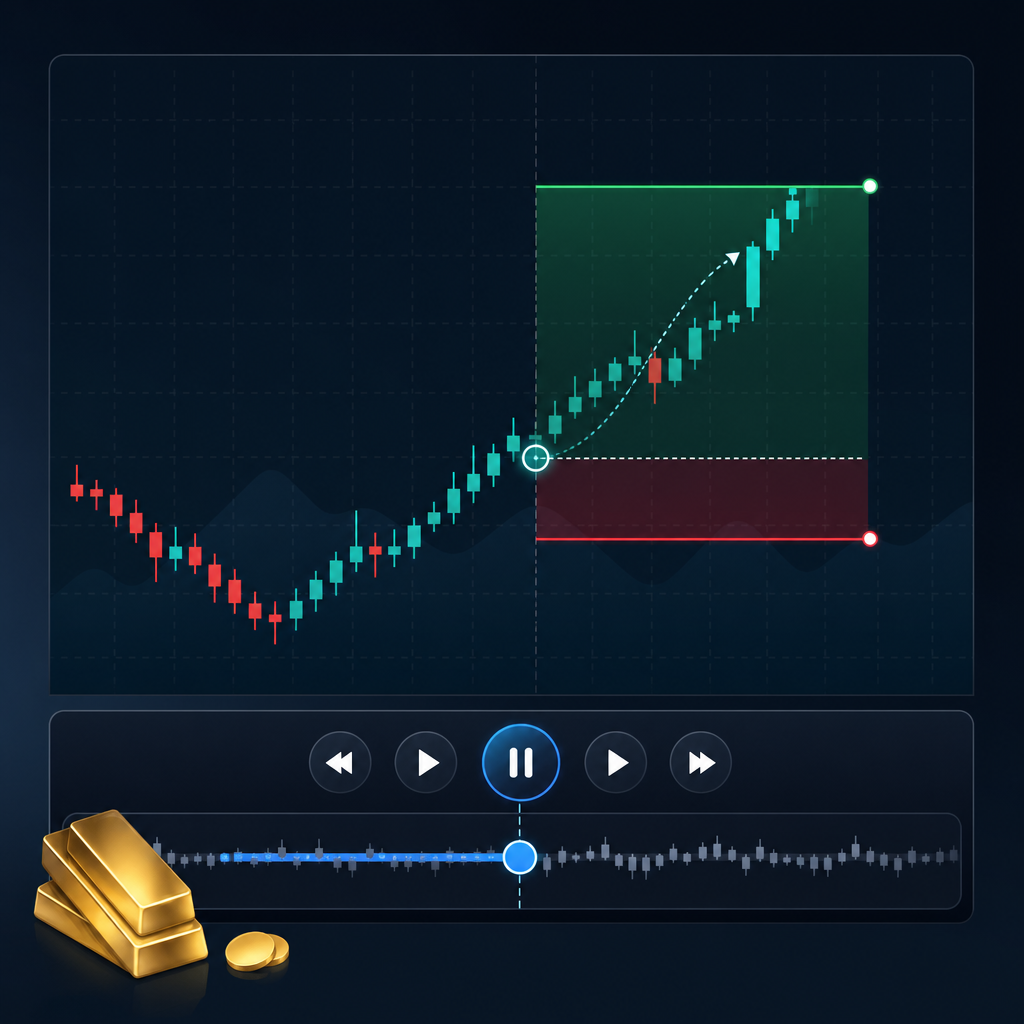
TradingView’s Bar Replay is one of the fastest ways to simulate a signal workflow without coding.
You can scroll back, hide the future, and “play” candles forward as if you were trading live. That’s exactly what you need to test whether a signal’s entry and management rules are executable.
But Bar Replay also has limits. It won’t automatically model your broker’s exact spread, commission, swaps, or slippage. That’s on you. It also can’t recreate the emotional pressure of real money, which is why your backtest must include conservative assumptions and a later demo phase.
What Bar Replay is great for
- Discretionary rule testing (price action, structure breaks, retests, session levels).
- Signal execution practice (placing orders, setting SL/TP, managing partials).
- Consistency checks (do you follow the same rules every time?).
What Bar Replay is weak for
- Precise fill modeling in fast markets (gold spikes, JPY volatility).
- News-driven spread blowouts (CPI/NFP/FOMC minutes).
- Multi-timeframe “peeking” if you’re not disciplined (it’s easy to cheat).
The solution is to use Bar Replay for structure and decision-making, then apply a simple “cost model” in your journal: add spread and slippage to every trade and see if expectancy survives.
For traders following premium Telegram calls, Bar Replay is perfect for answering: “If I had received this signal at the time, could I have executed it with my broker and my schedule?”
If you want a live benchmark to compare against after your backtest, explore our United Kings signals hub where we publish clear Entry, SL, and TP levels across markets.
Comparison Table: Three Practical Ways to Backtest Signals
There’s more than one way to backtest. The “best” method depends on your skill level and what you’re trying to validate.
| Method | Best For | Pros | Cons | Recommended If You… |
|---|---|---|---|---|
| TradingView Bar Replay + Journal | Manual execution signals (FX + XAUUSD) | Fast, visual, teaches execution, no coding | Costs modeled manually; easy to “cheat” if undisciplined | Want a repeatable process in 1–2 hours/day |
| Spreadsheet Backtest (rule-based) | Fixed TP/SL systems, simple triggers | Clear stats, easy scenario testing (TP/SL variations) | Harder to capture discretionary entries | Trade a consistent setup and want robust metrics |
| Platform Strategy Tester (MT4/MT5) | Algorithmic rules and EAs | Large sample size, automated metrics | Requires coding; still not perfect on slippage/news | Want high-volume validation and can code or hire |
This article focuses on the first method because it’s the most realistic for signal users: you’re not trying to build an EA. You’re trying to validate a provider’s edge and build TP/SL rules you can stick to.
Step-by-Step: Set Up TradingView for Signal Backtesting (The Right Way)
Your backtest is only as clean as your environment.
If your chart is cluttered, your timeframe is inconsistent, or you keep switching rules mid-test, your results will be noise.
Step 1: Pick the market and timeframe you actually trade
Start with one instrument. If you trade gold, start with XAUUSD near current levels around $2650. If you trade majors, choose one like EUR/USD (1.0520) or GBP/USD (1.2680).
Pick the timeframe your signals are designed for. Common combos:
- XAUUSD: M15–H1 for intraday, H4 for swing.
- EUR/USD & GBP/USD: M15–H1 for intraday, H4–D1 for swing.
- USD/JPY: M15–H1 often works well, but watch volatility around 149.50 with DXY at 106.80.
Step 2: Normalize your chart settings
- Use the same session timezone every time (e.g., New York time).
- Turn on “Session Breaks” if it helps you focus on London/NY.
- Decide which indicators are allowed. If signals are pure price action, keep it clean.
Step 3: Add only the tools you’ll use in real trading
Examples that are reasonable for signal execution:
- Key levels (previous day high/low, weekly open).
- Simple moving averages (e.g., 50/200) if your rules use them.
- ATR (Average True Range) for volatility-based SL sizing.
Don’t add 12 indicators “just for confirmation.” If it’s not in your live plan, it’s not in your test.
Step 4: Launch Bar Replay and remove the future
In TradingView, click Bar Replay, then choose a date in the past. Start far enough back to avoid “recent memory bias.”
For a meaningful sample, aim for:
- Gold intraday: 100–200 trades (because volatility varies a lot).
- FX majors intraday: 80–150 trades.
- Swing signals: 40–80 trades minimum, but expect longer testing time.
Step 5: Define your “signal receipt time”
If you follow Telegram signals, you rarely enter at the candle open. You enter when the message arrives and you see price.
So in your backtest, simulate that: when your rules trigger, assume you enter at the next realistic price, then apply costs.
For traders who rely on Telegram delivery, you can also join our community channel at United Kings Telegram to see how professional signal formatting reduces confusion: entry zone, SL, multiple TPs, and management notes.
Define Signal Rules Like a Scientist (Entry, SL, TP, and Invalidations)
If your rules can’t be written in 6–10 lines, you don’t have rules—you have vibes.
Backtesting requires you to define what counts as a trade, what invalidates it, and how you manage it. This is where most traders accidentally sabotage themselves.
A clean “signal rule card” template
- Market: XAUUSD / EURUSD / GBPUSD / USDJPY
- Timeframe: M15 / H1 / H4
- Session filter: London (07:00–10:00 London) and NY (08:00–11:00 NY) only
- Directional bias: trend (MA/structure) or range (support/resistance)
- Entry trigger: e.g., break-and-retest, rejection candle, BOS + pullback
- Stop loss: fixed ($15) or structure-based (below swing low) or ATR-based
- Take profit: fixed R multiple (2R/3R) or next liquidity/level
- Trade management: partial at 1R, move SL to BE, trail under swings
- Time stop: exit after X candles if no progress
- Invalidation: opposite structure break, close beyond key level, etc.
Now let’s make this practical with current pricing.
Example rule set (XAUUSD around $2650)
Assume gold is trading at $2650 during New York, and you’re using M15.
- Bias: bullish above $2638 (intraday support)
- Entry: buy on retest/rejection of $2646–$2648 after a break above $2652
- SL: $2633 (about $15 risk from $2648 entry)
- TP1: $2678 (2R ≈ $30)
- TP2: $2693 (3R ≈ $45)
- Management: at +1R ($2663), move SL to entry (or reduce risk by 50%)
This is testable. You can replay candles and see if the setup appears, if SL is hit, and whether 2R/3R is realistic under current volatility.
Example rule set (EUR/USD around 1.0520)
- Bias: bearish below 1.0540 with DXY at 106.80
- Entry: sell rejection from 1.0535–1.0540 on M15
- SL: 1.0552 (12–17 pips depending on entry)
- TP: 1.0500 (2R) and 1.0485 (3R) if momentum supports
The goal isn’t to “predict.” It’s to test whether your provider’s style produces a repeatable distribution of wins/losses with manageable drawdowns.
Step-by-Step: Run a Clean Bar Replay Backtest Without Cheating
This section is your repeatable workflow. Save it, because it’s what turns backtesting from a one-time experiment into a habit.
Step 1: Choose a test window and commit to it
Pick a date range that includes different conditions: trending days, range days, and at least a few high-volatility sessions.
For gold, include some days where price swings $30–$50 intraday between roughly $2610 and $2690. That’s realistic around major macro themes.
Step 2: Write your rules before you press play
Literally write them in a note. If you change rules mid-test, start a new test batch.
This prevents “curve-fitting,” where you subconsciously optimize for the last 20 trades.
Step 3: Use a two-timeframe view (but lock it)
A practical setup:
- Main execution: M15
- Context: H1
Do not scroll the H1 into the future. Keep both synced to the replay point.
Step 4: Mark entries and exits the same way every time
Use TradingView’s long/short position tool to plot entry, SL, and TP. This forces you to see R:R visually.
When the entry triggers, “place” it. If price barely touches your entry and runs, count it as missed if your rule requires a close or a retest.
That’s painful, but it’s honest.
Step 5: Add a time-stop to avoid fantasy holds
Many signal users hold losers too long and cut winners too early. A time-stop can reduce that bias.
Example:
- XAUUSD M15: if after 12 candles (3 hours) price hasn’t reached +0.5R, exit at market.
- EUR/USD M15: if after 16 candles (4 hours) it’s stagnant, exit.
Step 6: Record the trade immediately
Don’t “reconstruct” later. The whole point is to capture what you would do in the moment.
Record:
- Screenshot link (optional)
- Entry, SL, TP
- Outcome in R (e.g., +2.0R, -1.0R, +0.5R)
- Notes: session, news risk, execution quality
Step 7: Batch your results (20 trades per batch)
After every 20 trades, calculate interim metrics. This helps you spot if performance changes in different volatility regimes.
For example, gold near $2650 might behave differently when DXY is pushing 107 versus when it’s falling. Your backtest should reveal that.
If you want to compare your results to a professional-style signal format, browse our gold signals and forex signals pages to see how we structure entries, SL, and multiple take-profits.
How to Journal Backtest Trades (Simple Template + Metrics That Matter)
If Bar Replay is the simulator, your journal is the laboratory notebook.
You don’t need a fancy app. A spreadsheet is enough, as long as you track the right fields consistently.
The minimum journal columns (copy this)
- Date
- Instrument (XAUUSD, EURUSD, GBPUSD, USDJPY)
- Timeframe
- Session (London/NY/Asia)
- Direction (Buy/Sell)
- Entry
- SL
- TP plan (2R/3R, partials, trail)
- Exit price
- Result (R)
- Costs (spread + slippage in $ or pips)
- Net result (R)
- Notes (setup quality, mistakes, news)
How to calculate R (the only unit that keeps you sane)
R is your risk per trade.
If you buy XAUUSD at $2648 with SL $2633, your risk is $15. That’s 1R.
- If you exit at $2678, that’s +$30 → +2R.
- If you exit at $2633, that’s -$15 → -1R.
- If you exit at $2655, that’s +$7 → +0.47R.
R normalizes performance across instruments and volatility. It also makes TP/SL testing much easier.
The four metrics you should obsess over
- Win rate: winners / total trades
- Average win (R) and average loss (R): tells you if you’re cutting winners early
- Expectancy: (Win% × Avg Win) − (Loss% × Avg Loss)
- Max drawdown (in R): the deepest equity dip from a peak
Expectancy is the truth serum. If your expectancy is +0.20R per trade over 150 trades, that’s meaningful. If it’s +0.05R, it may vanish after costs and execution errors.
Track streaks (because psychology trades your account)
Write down:
- Worst losing streak (e.g., 7 losses in a row)
- Average losing streak
Why? Because position sizing must survive that streak without you panicking and changing rules.
If you want a deeper risk framework after you’ve got your stats, read our guide on risk management strategies when using forex signals. It ties drawdown math to real account protection.
Account for Spread, Slippage, and Volatility (Especially on XAUUSD)
Costs are the silent killer of signal-based trading.
They’re also the reason two traders can take “the same signal” and get different results.
Realistic cost assumptions (use these in your backtest)
Costs vary by broker and session. But you need a baseline. Use conservative estimates so you don’t fool yourself.
- XAUUSD (Gold): spread + slippage combined often $0.20–$0.80 in normal conditions, and can be higher around news.
- EUR/USD: 0.2–1.0 pips total cost depending on account type and volatility.
- GBP/USD: 0.5–1.2 pips typical total cost; can widen in fast moves.
- USD/JPY: 0.4–1.2 pips typical; watch sudden bursts around risk-off moves.
Now translate that into R impact.
Gold example: how costs change your expectancy
Suppose your XAUUSD system uses a $15 SL (1R) and targets +2R ($30).
If average cost is $0.50 and your average win is +2R, your net win becomes:
- Gross win: +$30
- Minus costs: -$0.50 (or more if you scale out)
- Net win: +$29.50 → +1.97R
That seems small. But if your expectancy is thin, it matters.
Now consider slippage on stop losses. If your SL is $2633 and you get filled at $2632.40, you just lost an extra $0.60. Over 100 trades, that adds up.
Volatility filters: when your SL needs to breathe
With gold around $2650, a $10 SL might be fine in a calm Asian session, but too tight in New York when liquidity hunts are common.
A practical approach is to tie SL to ATR:
- If M15 ATR is $3.50, a $12 SL is about 3.4× ATR.
- If M15 ATR jumps to $6.00, that same $12 SL is only 2× ATR and may get tagged more often.
This is why your backtest should be segmented:
- London-only results
- NY-only results
- High-volatility days vs normal days
If you trade around major releases, also study how signals behave during news shocks. Our article on how gold signals react to unexpected news events explains why spreads and speed matter more than “direction.”
Set Realistic TP/SL Rules for Forex & Gold Signals (With Examples)
Most traders pick TP/SL rules backwards.
They choose a TP because it “looks good,” then place an SL wherever it feels safe. That’s how you end up with random R:R and inconsistent results.
Instead, choose SL logic first (based on structure and volatility), then choose TP logic that matches how far price typically moves before reversing.
Three SL models that work for signal users
- Structure-based SL: beyond the swing low/high that invalidates the setup.
- Fixed SL: simple, consistent (e.g., gold $15, EURUSD 15 pips), but can be suboptimal in changing volatility.
- ATR-based SL: adapts to volatility (e.g., 2.5× ATR).
For XAUUSD in the $2610–$2690 band, many intraday signal traders find a $10–$25 SL range realistic. Below $10 often becomes “noise-sensitive” in London/NY.
Two TP models that keep you consistent
- R-multiple TP: 2R or 3R, easy to measure and backtest.
- Level-based TP: prior day high/low, liquidity pools, weekly open, etc.
In practice, the best signal plans combine both: take partials at 2R, then aim the runner at a level.
Gold example: realistic TP/SL with current volatility
Gold is at $2650. You identify a long entry at $2642 after a retest.
- Entry: $2642
- SL: $2627 (risk $15)
- TP1 (2R): $2672
- TP2 (3R): $2687
This fits the guideline range and respects the fact that gold can travel $25–$40 on an active session day.
EUR/USD example: TP/SL that matches majors
EUR/USD at 1.0520 is choppy under a firm DXY.
- Entry: 1.0518 sell after rejection
- SL: 1.0533 (15 pips)
- TP1: 1.0488 (2R = 30 pips)
- TP2: 1.0473 (3R = 45 pips)
Is 45 pips realistic? Sometimes yes, but your backtest will tell you if 3R is hit often enough or if 2R is the sweet spot.
Rule of thumb: your SL must survive the “normal pullback”
If your SL is inside the average pullback size for that session, you’ll get stopped even when you’re right.
That’s not a signal problem. That’s a rule problem.
Test TP/SL Variations Like a Pro (Fixed, Partials, Trailing Stops)
This is where you turn backtesting into a decision-making engine.
You’re not trying to find the one magical setting. You’re trying to find a small set of rules that:
- Has positive expectancy after costs
- Produces tolerable drawdown
- Matches your account size and psychology
Create three “management profiles” and test them
Run the same entries with three exit styles, then compare metrics.
- Profile A: Fixed TP (TP at 2R, SL fixed/structure)
- Profile B: Partials (take 50% at 1.5R–2R, move SL to BE, let rest target 3R)
- Profile C: Trailing stop (no fixed TP2; trail under swings after +1R)
How to measure which profile is “best”
Don’t just compare win rate. Compare:
- Expectancy (net of costs)
- Max drawdown in R
- Profit factor (gross wins / gross losses)
- Average trade duration (can you hold that long in real life?)
Example outcome (what you’ll often see on XAUUSD)
- Fixed 2R TP might yield higher win rate (say 55–60%) but smaller average win.
- Partials might reduce variance and drawdown, but can cap upside.
- Trailing stops might produce lower win rate (40–50%) but occasional big wins (4R–6R) on trend days.
With gold around $2650, trend days happen—especially when USD themes drive directional flows. A trailing model can shine then.
But if your psychology can’t handle a 6-loss streak, a trail-heavy approach might cause you to quit right before the big winner.
Build a repeatable test matrix (simple)
For each instrument, test:
- SL = $10, $15, $20 (gold) or 10, 15, 20 pips (majors)
- TP = 2R vs 3R
- Management = none vs partials vs trail
That’s 3 × 2 × 3 = 18 variations. You don’t need to test all at once. Start with 6 and expand.
When you’re done, you’ll know exactly which TP/SL rules fit your account and the market’s current volatility regime.
How to Interpret Your Results: Win Rate, Expectancy, and Drawdown
After 100+ trades, you’ll have enough data to make decisions.
But only if you interpret the data correctly.
1) Win rate is a style metric, not a quality metric
A 70% win rate system with 1:1 R:R can be fragile if costs rise.
A 45% win rate system with 1:3 R:R can be extremely robust.
Ask: does the win rate fit the TP/SL logic you’re using?
2) Expectancy tells you the “edge per trade”
Example:
- Win rate = 52%
- Avg win = +1.9R (after costs)
- Avg loss = -1.0R
Expectancy = (0.52 × 1.9) − (0.48 × 1.0) = 0.988 − 0.48 = +0.508R per trade.
That’s strong. Even +0.20R is tradable if drawdown is controlled.
3) Drawdown is the “price of admission”
If your max drawdown is -12R, you must size your trades so -12R doesn’t blow your account or your confidence.
For example, risking 2% per trade would mean a -12R drawdown is -24% equity. Many traders can’t tolerate that.
Risking 0.5% per trade would make the same drawdown -6% equity, which is far more survivable.
4) Segment your results by session
United Kings focuses heavily on London and New York sessions because liquidity is deeper and moves are cleaner.
Your backtest should confirm whether your setup performs better in those windows. Often you’ll find:
- Asia = more range, more stop hunts
- London = structure breaks and trend continuation
- NY = expansions and reversals, especially around US data
If your numbers show London/NY expectancy is positive but Asia is negative, your “edge” is really a time filter.
That’s not a problem. That’s a useful discovery.
From Backtest to Live: Position Sizing and Risk Rules That Don’t Blow Up
Backtesting is useless if you can’t translate it into live risk rules.
The bridge is position sizing.
Choose a risk-per-trade based on drawdown, not confidence
Use your max drawdown (in R) and worst losing streak to set risk.
A conservative formula many professionals use:
- Assume your future drawdown could be 1.5× your backtested max drawdown.
- Size risk so that 1.5× drawdown is still emotionally and financially survivable.
Example:
- Backtest max drawdown: -10R
- Stress drawdown: -15R
- You want max equity drawdown under 10%
Then risk per trade ≈ 10% / 15 = 0.66% per trade (round down to 0.5%).
Gold position sizing example (simple)
If your account is $5,000 and you risk 0.5% per trade, that’s $25 risk.
If your XAUUSD SL is $15, you size the position so $15 move equals $25 loss.
The exact lot calculation depends on your broker’s contract size, but the principle is constant: risk dollars / SL distance.
Rules that keep signal users consistent
- Daily loss limit: stop after -2R in a day.
- Weekly loss limit: stop after -6R in a week and review.
- No revenge trades: only take signals that match your tested rules.
- Demo first: trade 20–50 signals on demo to confirm execution.
If you’re building a routine around signals, consistency beats intensity. We also recommend reading our guide on how to use forex signals on Telegram as a beginner so your execution process is standardized.
How to Evaluate a Signal Provider Using Your Backtest (What to Look For)
Once you can backtest properly, you stop being “sold to.” You start selecting.
Here’s how to use your results to evaluate a provider’s edge without getting distracted by marketing.
1) Do their signals have clear, testable structure?
You should see:
- Entry price or entry zone
- Stop loss level
- At least one take profit target
- Management notes (optional but helpful)
If signals are vague (“buy now” with no SL), you can’t backtest them and you can’t manage risk.
2) Is the provider’s style compatible with your tested TP/SL profile?
Some providers aim for 10–20 pip scalps. Others hold for 50–150 pips. Some gold providers target $8 moves; others target $30–$60.
Your backtest will reveal what you can execute reliably. Choose the provider whose style matches that.
3) Does the edge survive costs and execution?
In your journal, apply the cost model. If expectancy collapses when you add $0.50 cost on gold or 0.8 pips on FX, the “edge” may be too thin for real trading.
4) Are results stable across different weeks?
One week of perfect trades is not a system. It’s a highlight reel.
Look for stability: expectancy remains positive across multiple batches and market conditions.
Where United Kings fits in
At United Kings, we focus on:
- Premium Telegram signals for forex and gold
- Clear Entry, SL, and TP levels designed to be executable
- Strong emphasis on London and NY sessions
- Education alongside signals so you understand the “why,” not just the “what”
- A large community of 300K+ active traders where execution and feedback improve consistency
If you’re still comparing providers, you can also review our breakdown here: best forex signals (November 2025) analysis.
Repeatable Backtesting Template (Copy/Paste) for Your Next 100 Trades
This is the “do it every month” template. It’s simple on purpose.
Complexity doesn’t create accuracy. Consistency does.
Phase 1: Preparation (30 minutes)
- Choose instrument: XAUUSD or one major pair
- Choose timeframe: M15/H1
- Choose sessions: London + NY only
- Set cost assumptions: e.g., XAUUSD $0.50, EURUSD 0.6 pips
- Write rule card (entry, SL, TP, management, time stop)
Phase 2: Execution (do 20 trades per batch)
- Run Bar Replay
- Take only valid signals
- Journal immediately
- Record R and net R after costs
Phase 3: Review (after each batch of 20)
- Win rate
- Avg win / Avg loss
- Expectancy
- Max drawdown (batch)
- Notes: which sessions and which mistakes
Phase 4: Optimization (only after 60–100 trades)
Pick one variable to adjust:
- SL distance ($15 → $20 on gold)
- TP target (2R → 2.5R)
- Management (add partial at 1.5R)
Then run another 40–60 trades. If you change three variables at once, you’ll never know what improved results.
Over time, you’ll end up with a personal “execution spec” that fits your broker, your schedule, and the market’s volatility.
FAQ: Backtesting Forex & Gold Signals in TradingView
1) How many trades do I need to backtest to trust the results?
For intraday signals, aim for 100–200 trades per instrument. For swing signals, 40–80 trades can work, but expect wider confidence intervals.
2) Can TradingView Bar Replay accurately simulate spreads and slippage?
Not perfectly. Bar Replay is excellent for decision simulation, but you must manually model costs in your journal (spread + slippage) to avoid overly optimistic results.
3) What’s a realistic stop loss for XAUUSD around $2650?
Many intraday traders use $10–$25 depending on session volatility and structure. Your backtest should confirm what SL survives normal pullbacks without destroying R:R.
4) Should I prioritize win rate or risk-reward?
Prioritize expectancy and drawdown. Win rate and R:R are just ingredients. Expectancy tells you if the recipe works, and drawdown tells you if you can survive it.
5) After backtesting, should I go straight to a live account?
No. Trade the same rules on a demo for 20–50 trades first. Execution, spreads, and psychology change outcomes. Past performance doesn’t guarantee future results.
Risk Disclaimer (Read Before You Trade)
Forex and gold trading involves significant risk and may not be suitable for all investors. You can lose some or all of your capital. Backtesting results are hypothetical and do not guarantee future performance. Spreads, slippage, execution speed, and market volatility (especially during news) can materially change outcomes. If you’re new, practice on a demo account and use conservative risk per trade.
Join United Kings: Premium Forex & Gold Signals You Can Actually Test
If you’re serious about consistency, you need signals that are clear, structured, and backtest-friendly.
United Kings delivers premium Telegram signals for forex and gold with a track record of 85%+ win rate (historical performance), transparent Entry, SL, and TP levels, and a community of 300K+ active traders focused on London and New York sessions.
Start here based on what you trade most:
- Get United Kings gold signals (XAUUSD)
- Get United Kings forex signals (major pairs)
- Explore all United Kings signals in one place
We offer two plans , both with a 48-hour refund window (conditions apply—see refund policy):
- Monthly: $199/mo, cancel anytime
- Lifetime: $499 one-time (pay once) + FREE ebook
See full details on our pricing page, then join the live community on United Kings Telegram to watch how professional execution guidance looks in real time.
Your next step: backtest 50 trades using the template above, then compare your results to our live signal structure. If you want a signal service you can verify—not just follow—United Kings is built for you.


