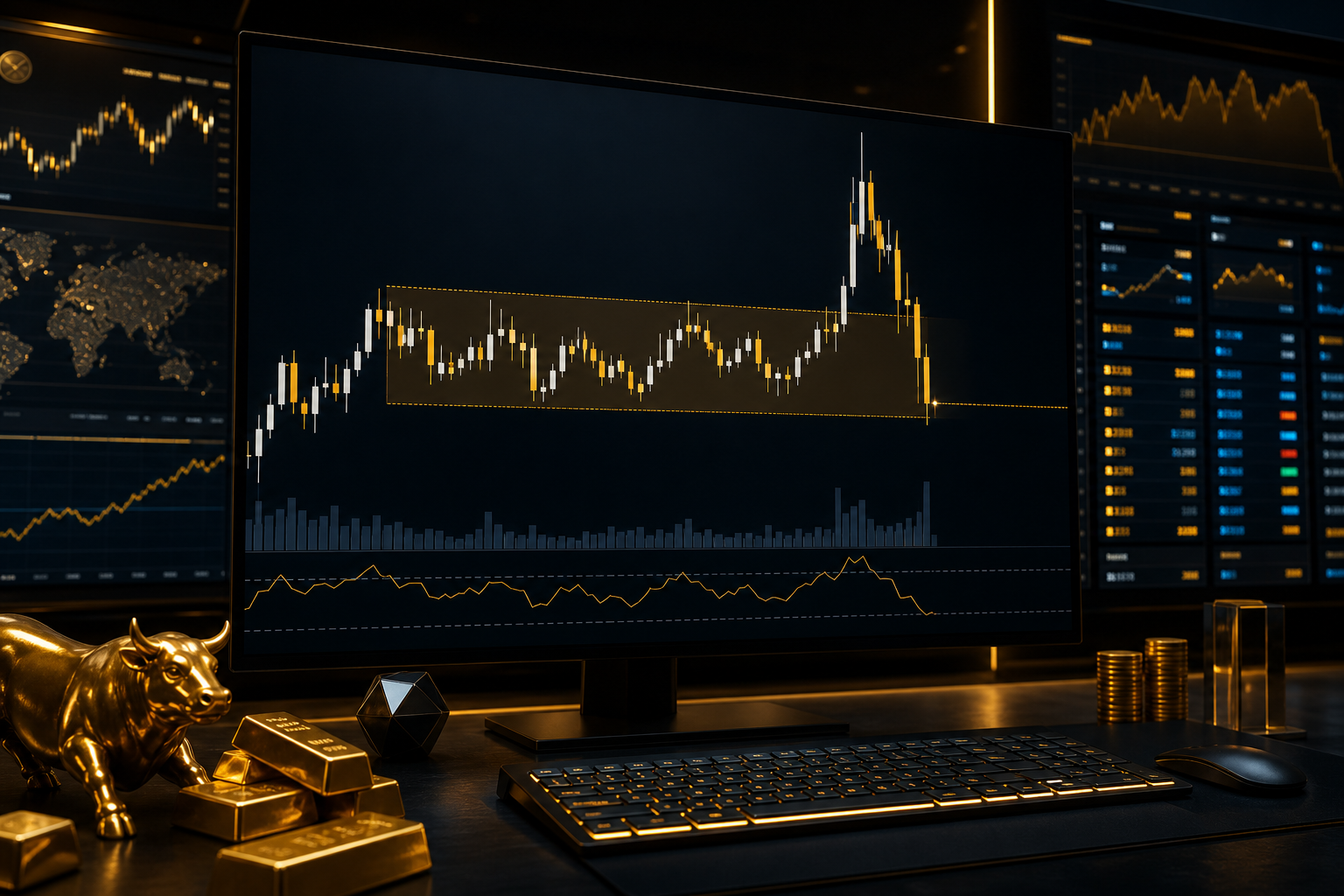
Ever watched gold spike 12–18 dollars in seconds, tag your stop, and then reverse perfectly without you?
If you trade XAUUSD long enough, you’ll see this movie on repeat.
Right now gold is trading near $2650.00 (+0.35% on the day), with the dollar still firm (DXY 106.80) and majors sitting at EUR/USD 1.0520, GBP/USD 1.2680, and USD/JPY 149.50.
In this environment, liquidity is everything.
The cleanest intraday gold entries often appear when price runs the Asian session high or low, grabs stops, and then snaps back during London or New York.
This is the XAUUSD liquidity sweep strategy, and in this guide we’ll turn it into a repeatable playbook you can execute alongside professional signals.
TL;DR: The Asian Range Liquidity Sweep Strategy (Gold)
- Mark the Asian range (typically 00:00–06:00 London time) and treat its high/low as liquidity magnets.
- Wait for a sweep: price wicks above the Asian high or below the Asian low, then fails to hold.
- Use confirmation: displacement candle, rejection wick, market structure shift (MSS), and/or fair value gap (FVG).
- Trigger entries with precision: break-and-retest, FVG mitigation, or a lower-timeframe order block.
- Place stops where the idea is invalidated: typically $10–$25 beyond the sweep extreme; target 1:2 to 1:3 to prior session levels.
- Best results usually come in London open → NY open windows, especially when volatility expands.
Why Asian Range High/Low Runs Matter in XAUUSD Right Now
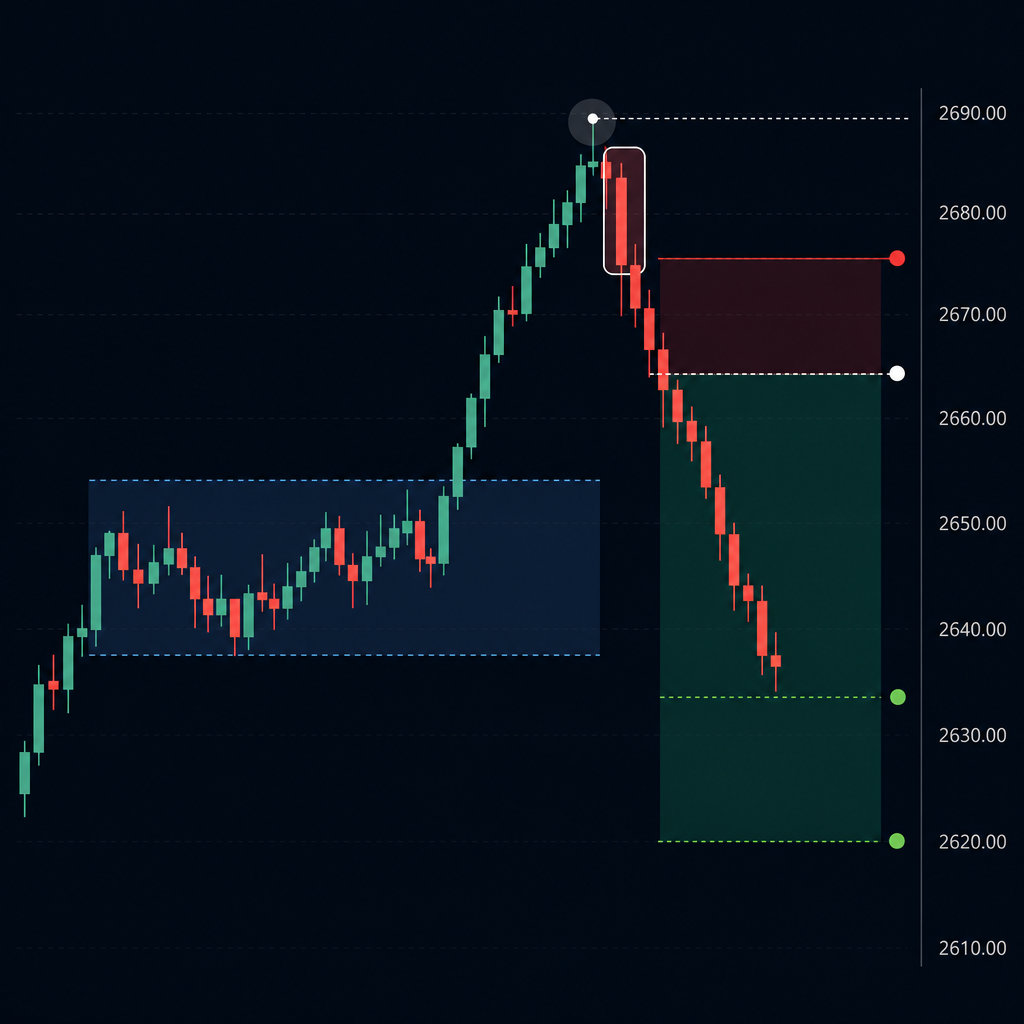
Gold is a liquidity-driven instrument.
Even when fundamentals dominate the bigger trend, intraday moves often follow a simple path: price hunts where orders are clustered, fills large interests, then rotates to the next pool.
The Asian session is a natural place for liquidity to build.
During Asia, XAUUSD often trades in a tighter band compared to London and New York.
That compression creates a clean, visible high and low—levels that many traders use for breakouts, stops, and pending orders.
That’s exactly why those levels get targeted.
What “liquidity sweep” really means (without the buzzwords)
A liquidity sweep is simply a move that pushes beyond a well-watched level to trigger orders, then reverses.
Above the Asian high, you typically find:
- Buy stops from shorts
- Breakout buy orders
- Algorithmic momentum entries
Below the Asian low, you typically find:
- Sell stops from longs
- Breakout sell orders
- Liquidation from over-leveraged positions
Once those orders are triggered, the market often has enough volume to reverse—especially if the breakout lacks follow-through.
Why this pattern is common around London and New York
London and NY sessions bring more participation, more volume, and more incentive to “clean up” obvious levels.
In our current context—gold near $2650 with a firm DXY—intraday swings can still be sharp.
It’s not unusual to see a $18–$30 rotation from a sweep into a mean reversion move.
That’s plenty of room for a structured trade with a $12–$18 stop and a $24–$45 target.
How this fits with United Kings signals
At United Kings, we focus heavily on London and New York session trading because that’s where these liquidity events tend to resolve cleanly.
Our premium Telegram signals provide clear Entry, SL, and TP levels with a historically strong win-rate profile (85%+ reported performance), but the edge multiplies when you understand why a level is chosen.
If you want to see how we structure trades across markets, explore our live signals hub and our dedicated XAUUSD gold signals page.
Asian Session Range for Gold: How to Define It (So You’re Consistent)
Most traders fail with the Asian range because they mark it differently every day.
Consistency is the edge.
You don’t need a perfect definition, but you do need one that you can repeat and backtest.
Recommended Asian range window (practical, not academic)
For XAUUSD intraday, a simple approach works best:
- Start: 00:00 London time
- End: 06:00 London time
This captures most of the “quiet” period before London liquidity ramps up.
If your broker server time differs, convert it once and keep it fixed.
Step-by-step: marking the Asian range on your chart
- Switch to M15 or M30 for clean structure.
- From 00:00 to 06:00 London time, identify the highest high and lowest low.
- Draw a horizontal line at the Asian high and Asian low.
- Optionally draw a box (range) to visualize compression.
- Note the range size in dollars (e.g., $8, $12, $18).
Range size matters because it influences stop placement and follow-through.
A $6 Asian range is easier to sweep and reverse than a $22 range.
What range size is “tradable”?
As a rule of thumb for current volatility near $2650:
- $6–$14: ideal (clean sweeps, tighter invalidation)
- $15–$22: still tradable, but expect deeper pullbacks
- $23+: be selective; it may already be “London-like” volatility
If Asia already moved $25, the day’s main move might be partially spent.
Common mistake: using the “wrong” Asia
Some traders mark Tokyo only, some include Sydney, some include the pre-London drift.
That inconsistency creates random results.
Pick one window and stick to it for at least 30 trading days.
If you’re following a signal, the signal provider’s levels may implicitly reference a specific range window.
That’s why it helps to align your process with a professional framework like the one shared in our educational posts on United Kings blog.
Liquidity Sweep Anatomy: What a Valid Stop-Hunt Looks Like (and What It Doesn’t)

Not every break above the Asian high is a sweep.
Sometimes it’s a true breakout and the trend continues for $30–$60.
The skill is separating “grab and reverse” from “break and go.”
The 3-part sequence of a high-probability sweep
Think of the setup as a three-act play:
- Build: Asia compresses and leaves a clear high/low.
- Run: London/NY pushes beyond the level, triggering stops.
- Reject: price fails to hold above/below and returns inside the range.
That last part—returning back inside—is crucial.
If price breaks above the Asian high and then keeps closing above it, you’re not looking at a sweep.
Valid sweep clues (choose 2–3, not 10)
Here are practical clues you can actually use:
- Wick dominance: M5/M15 candle wicks beyond the level, but body closes back inside.
- Displacement candle: a strong impulsive candle in the opposite direction appears soon after the run.
- Market Structure Shift (MSS): after sweeping the high, price breaks a prior swing low (or vice versa).
- Fair Value Gap (FVG): the displacement creates an imbalance that later acts as an entry zone.
- Time-of-day alignment: the run happens near London open (07:00–09:00) or NY open (13:30–15:30 London).
You don’t need all of them.
Two strong confirmations beat five weak ones.
Invalid sweep signs (when to stand aside)
- Multiple closes beyond the level on M15 with expanding bodies.
- No displacement back inside after the run; price just grinds higher/lower.
- News spike conditions where spreads widen and candles are chaotic.
- Range too large (Asia already moved $25+) and you’re chasing.
If you’re unsure, wait.
Missing one trade is cheaper than taking a low-quality one with a $20 stop.
Comparison: Breakout vs Liquidity Sweep (XAUUSD)
| Feature | True Breakout | Liquidity Sweep (Stop-Hunt) |
|---|---|---|
| Closes beyond Asian high/low | Multiple strong closes beyond level | Closes back inside range quickly |
| Wicks | Smaller wicks, strong bodies | Long wick through the level, weak body |
| Follow-through | Continuation for $20–$60 possible | Reversal rotation back to mid/other side |
| Best entry style | Pullback to breakout level | FVG/OB entry after displacement + MSS |
| Stop placement | Below/above breakout structure | Beyond sweep extreme ($10–$25 typical) |
XAUUSD Liquidity Sweep Strategy Rules (The Repeatable Checklist)
Let’s turn the concept into rules you can follow.
This is where most “smart money” content fails—too much theory, not enough execution.
Below is a practical checklist you can print or save.
Rule 1: Identify the day’s “line in the sand”
Your key levels are:
- Asian High
- Asian Low
- Previous day High/Low (optional but powerful)
- London open price (optional reference)
When gold is near $2650, a typical Asian high might be $2656 and low $2644.
Those become your liquidity magnets.
Rule 2: Wait for the sweep (don’t front-run it)
A sweep means price must trade beyond the level.
For example:
- Asian high at $2656.20
- London pushes to $2663.80 (runs stops)
- Then price drops back below $2656.20
No sweep, no trade.
Rule 3: Demand confirmation (choose your trigger)
Pick one primary trigger and one secondary filter.
Primary triggers:
- MSS trigger: after sweeping the high, price breaks a prior M5 swing low.
- FVG trigger: enter on mitigation of the bearish FVG created by displacement.
- Break-and-retest: price closes back inside range and retests the Asian high from below.
Secondary filters:
- Time-of-day (London or NY window)
- Confluence level (previous day high/low nearby)
- Trend bias (H1/H4 direction)
Rule 4: Define invalidation first (stop placement)
Your stop should sit where the setup is proven wrong.
For a short after sweeping the Asian high, invalidation is usually above the sweep extreme.
Typical gold numbers in current conditions:
- Entry: $2655.80
- Sweep high: $2663.80
- Stop: $2668.80 (about $13 above entry, $5 above sweep)
That’s within the $10–$25 guideline and respects volatility.
Rule 5: Target logical liquidity (not random R:R)
Yes, we want 1:2 or 1:3.
But targets should also make market sense.
Good targets include:
- Asian range midpoint
- Asian opposite side (if conditions support a full rotation)
- Previous day high/low
- Unfilled FVG or prior demand/supply zone
If your stop is $13, a 1:2 target is $26.
From $2655.80 short, that’s roughly $2629.80, which fits our broader $2610–$2690 example band.
Confirmation Tools: Candles, Volume, Structure Shifts, and FVGs
The sweep is the invitation.
Confirmation is your bouncer at the door.
Without confirmation, you’ll short a bullish breakout or buy a bearish breakdown.
1) Candle confirmation that actually works on gold
Gold loves wicks, so don’t overreact to a single wick.
Instead, look for rejection + displacement:
- A clear wick beyond the Asian high/low
- Followed by a strong opposite candle (often an engulfing or large-body candle)
Example near current pricing:
- Price sweeps above $2656 to $2662.90.
- M5 prints a rejection wick and closes at $2655.40 (back inside).
- Next M5 candle drops to $2649.80 with a strong body.
That second candle is displacement.
2) Market Structure Shift (MSS) in simple terms
MSS means the market stops making higher highs/higher lows (bullish) and starts breaking a prior swing low (bearish), or vice versa.
After a sweep above the Asian high, you want to see a lower low form on M5/M15.
This tells you the “breakout buyers” are trapped and price is rotating.
3) Fair Value Gap (FVG): your entry zone, not your religion
An FVG is an imbalance created by fast movement.
On a chart, it often appears when a candle’s move leaves a gap between the prior candle’s wick and the next candle’s wick.
In practice, it’s a zone where price may return to “rebalance.”
For entries, FVGs help you avoid chasing.
Instead of selling the bottom of the displacement candle, you wait for a pullback into the FVG and sell from a better price.
4) Volume clues (useful, but optional)
Spot volume in XAUUSD can vary by broker, but relative spikes still help.
Useful volume behaviors:
- High volume on the sweep wick followed by failure to continue
- High volume on displacement candle confirming reversal intent
Don’t overfit volume.
Use it as a supporting clue, not a trigger.
Best practice: one “hard trigger,” two “soft confirmations”
Hard trigger examples:
- MSS break on M5
- FVG mitigation entry
Soft confirmations:
- Time-of-day window
- Rejection candle
- Previous day level nearby
This keeps you decisive and consistent.
Entry Models: 3 Ways to Execute the Gold Stop Hunt Entry Cleanly
You can spot a sweep and still enter poorly.
Execution is where many traders donate profits back to the market.
Here are three entry models you can choose from based on your style.
Model A: Conservative entry (break back inside + retest)
This is the easiest model psychologically.
You wait for price to re-enter the Asian range, then retest the broken level from the other side.
Short example:
- Asian high: $2656.20
- Sweep: spikes to $2663.80
- Re-entry: closes back below $2656.20
- Retest: price returns to $2656.00–$2656.50 and stalls
- Entry: sell $2655.90
- SL: $2668.90 (13 points)
- TP1 (1:2): $2629.90
- TP2 (1:3): $2616.90
This model reduces false entries but sometimes misses the move if price drops without retesting.
Model B: FVG mitigation entry (balanced)
This model is popular because it offers better price without waiting for a perfect retest of the Asian high/low.
Short example:
- Sweep above Asian high creates bearish displacement from $2658 down to $2648.
- That displacement leaves an FVG around $2652.50–$2655.20.
- Entry: sell inside the FVG at $2654.80.
- SL: $2667.80 ($13 risk).
- TP: $2628.80 (1:2).
You’re letting price come back to you.
That reduces whipsaw and improves R:R.
Model C: Aggressive entry (MSS + micro pullback)
This is for experienced traders who can handle noise.
You enter quickly after MSS, often on a small pullback on M1/M3/M5.
Short example:
- Sweep above $2656 to $2661.70.
- MSS: price breaks below a prior M5 swing low at $2652.40.
- Entry: sell $2651.90 on a micro pullback.
- SL: $2664.90 ($13 risk).
- TP: $2625.90 (1:2).
This often captures the move early, but you must accept occasional stop-outs.
Which entry model should you choose?
If you’re following signals, you’ll often see entries that resemble Model A or B because they’re cleaner for a broad community.
If you’re newer, start with Model A.
If you’re intermediate, Model B is the sweet spot.
Model C is best when you’ve proven consistency and can manage emotions.
Stops and Targets: Building SL/TP Around Sweep Extremes, FVGs, and Session Levels
Most traders obsess over entry and ignore exits.
But in gold, your stop placement and profit-taking plan decide whether the strategy survives drawdowns.
Stop placement rules (practical numbers for XAUUSD)
Use one of these two approaches:
- Sweep-extreme stop: SL goes a few dollars beyond the sweep high/low.
- Structure stop: SL goes beyond the last swing high/low after MSS.
In current conditions around $2650, typical SL distances:
- $10–$15 on clean days with tight Asia
- $16–$25 on volatile days or wider Asia
If you’re using a $30 stop on an intraday sweep, you’re probably trading it wrong or trading during news chaos.
Target logic: where price is likely to go
Liquidity sweep reversals often target:
- Asian midpoint first (partial profit zone)
- Asian opposite extreme next (full rotation)
- Previous day high/low as a magnet
- London/NY session open as an intraday “mean” level
Example: Asia range $2644–$2656 (midpoint $2650).
If price swept $2656 and reversed, the first logical target is $2650.
Second is $2644.
Scaling out: a simple 2-take-profit structure
To reduce emotional pressure, consider:
- TP1: 1:1 or Asian midpoint (bank partial)
- TP2: 1:2 or 1:3 to the next liquidity pool
Concrete example:
- Short entry: $2655.80
- SL: $2668.80 (risk $13)
- TP1: $2642.80 (1:1)
- TP2: $2629.80 (1:2)
- TP3 (optional runner): $2616.80 (1:3)
This approach keeps you profitable even if the market only partially rotates.
Where traders get trapped: moving stops too early
Gold often retests.
After a sweep reversal, price may pull back into the FVG or retest the Asian high/low again before continuing.
If you move your stop to breakeven too early, you’ll be “right” and still lose.
A better rule:
- Only move SL to breakeven after price has reached TP1 or after it breaks a significant structure level in your favor.
If you want a deeper risk framework for signal execution, pair this article with our dedicated guide on risk management when using forex signals (the principles apply directly to gold).
Time-of-Day Playbook: Best London & NY Windows for Asian Range Gold Sweeps
Timing is not a detail in this strategy.
It’s the difference between a clean sweep reversal and a slow grind that chops you up.
Because the Asian range forms during lower volatility, the “run” often happens when the next session injects liquidity.
Window 1: London open expansion (07:00–10:00 London)
This is the classic window.
London desks come in, spreads tighten, and price often probes obvious levels.
What you’ll often see:
- A quick push above Asian high (or below Asian low)
- A sharp rejection
- A rotation toward the midpoint and beyond
If gold is at $2650 and Asia range is $2644–$2656, London might spike to $2662, then rotate to $2646.
That’s a $16 move after the sweep, tradable with a $12–$18 stop.
Window 2: London–NY overlap (13:30–16:00 London)
This is where many of the day’s biggest candles print.
US data releases, equity open flows, and broader risk sentiment can accelerate gold moves.
This window is excellent for:
- Late sweeps of the Asian range if London didn’t run it cleanly
- Second sweeps (a “double tap”) that traps both sides
- Continuation after a morning reversal
But it’s also riskier due to news volatility.
Always check the calendar and avoid entering seconds before major US releases.
For event-day handling, our post on news reactions is useful: how gold signals react to unexpected news events.
Window 3: NY afternoon mean reversion (17:00–19:00 London)
This is more optional.
Sometimes gold mean-reverts after the main move, especially if the day ran stops early.
If you trade this window, reduce size and be picky.
A simple “session filter” you can apply today
- If DXY is strong (like 106.80) and gold is grinding higher, expect more violent sell sweeps (up then down).
- If DXY is weakening and gold is trending up, expect buy-the-dip sweeps (down then up).
This isn’t a rule.
It’s a bias filter to avoid fighting the day’s macro tone.
Realistic Trade Walkthroughs (Using Today’s Price Context Around $2650)
Let’s make this concrete with two walkthroughs.
These are examples, not trade recommendations.
They’re designed to show how the logic fits together: range → sweep → confirmation → entry → SL/TP.
Walkthrough 1: Asian high sweep short (London)
Market context: Gold near $2650, DXY firm at 106.80.
Asian range: High $2656.20, Low $2644.10 (range $12.10).
Step 1 — Sweep: At 08:10 London, price spikes to $2663.80.
Step 2 — Rejection: M5 candle wicks above $2663 and closes back at $2655.40.
Step 3 — Displacement + MSS: Next 10 minutes, price drops to $2649.60 and breaks a prior M5 swing low at $2651.90.
Step 4 — Entry model: FVG mitigation.
- Bearish FVG forms at $2652.80–$2655.10.
- Price retraces into $2654.70.
- Sell entry: $2654.70
Step 5 — Stop: Place SL beyond the sweep extreme.
- SL: $2668.70 (risk $14)
Step 6 — Targets:
- TP1: Asian midpoint around $2650.15 (partial)
- TP2: Asian low $2644.10
- TP3: Extension to $2626.70 (approx 1:2 from entry)
Notice how TP1 and TP2 are structural, while TP3 is R:R-based but still plausible if momentum continues.
Walkthrough 2: Asian low sweep long (NY)
Market context: London chopped, NY brings direction.
Asian range: High $2658.40, Low $2646.30 (range $12.10).
Step 1 — Sweep: At 14:05 London (NY open zone), price dumps to $2638.90.
Step 2 — Rejection: M5 prints a long lower wick and closes back above $2646.30.
Step 3 — MSS: Price breaks above a prior M5 swing high at $2649.70.
Step 4 — Entry model: Break-and-retest.
- Price retests $2646.50–$2647.20 and holds.
- Buy entry: $2647.10
Step 5 — Stop:
- Sweep low: $2638.90
- SL: $2626.90 (risk $20.20)
Step 6 — Targets:
- TP1: Asian midpoint $2652.35
- TP2: Asian high $2658.40
- TP3: $2687.50 (roughly 1:2 if momentum expands)
This is a classic “sell-side liquidity run” that turns into a long.
It’s also why the keyword gold stop hunt entry is so relevant—these moves are designed to force bad exits and late entries.
Common Failure Points (and How to Reduce Whipsaw Risk)
The strategy is simple.
But gold is ruthless about punishing sloppy execution.
Here are the most common failure points and practical fixes.
Failure #1: Trading the first touch of Asian high/low
Price touching the Asian high is not a signal.
It’s just price reaching a level.
Fix: Require a sweep (trade beyond) and a return inside the range.
Failure #2: Entering without displacement
A sweep with no displacement often turns into a slow breakout.
You short the top, and price keeps grinding higher by $25.
Fix: Wait for a strong opposite candle or MSS before entry.
Failure #3: Stops too tight for gold’s wick behavior
Gold can wick $6–$10 easily even in calm conditions.
If your stop is $6 on an intraday sweep, you’re asking to get tagged.
Fix: Use $10–$25 stops depending on range size and session volatility.
Failure #4: Ignoring the higher-timeframe bias
Liquidity sweeps work both ways, but probability shifts with trend.
If H1/H4 is strongly bullish, Asian low sweeps that reverse up may be cleaner than Asian high sweeps that reverse down.
Fix: Use a simple bias: higher highs/higher lows on H1 = bullish preference.
Failure #5: Trading into major news without a plan
On CPI/NFP/Fed headlines, a “sweep” can be a 40-dollar candle that ignores structure.
Fix: Either stand aside, or trade smaller with wider stops and fewer assumptions.
Failure #6: Overtrading multiple sweeps in one day
Some days gold will sweep both sides.
Other days it will fake you three times.
Fix: Limit yourself to 1–2 attempts per session and require higher-quality confirmation after a loss.
How to Combine This Strategy with Gold Signals (So You Execute Like a Pro)
Signals are powerful, but only if you execute them with discipline.
The Asian range sweep framework helps you understand where a signal fits in the day’s liquidity map.
That reduces hesitation and improves consistency.
Step-by-step: using the sweep framework with a Telegram signal
- Before London: mark Asian high/low and note the range size.
- When a signal arrives: ask, “Is this near a sweep zone or after confirmation?”
- Check invalidation: does the provided SL sit beyond the sweep extreme or beyond structure?
- Plan partials: identify midpoint/opposite side as logical TP areas.
- Execute: place orders cleanly, avoid moving SL impulsively.
This is exactly how many consistent traders treat signals: as a decision aid, not a replacement for process.
What “clear structure” looks like in a quality signal
When we send XAUUSD setups in United Kings, we aim for:
- Specific entry price (not vague ranges)
- Logical SL where the idea is invalidated
- Multiple TPs aligned with liquidity/session levels
- Session awareness (London/NY timing)
If you’re comparing providers, you may also like our guide on choosing quality services: forex signal provider checklist.
Where to follow United Kings signals
You can explore our full offering here:
And if you prefer Telegram-first execution, join our community channel: United Kings Telegram signals channel.
Risk Management for the Asian Range Sweep Strategy (Position Sizing Included)
This strategy can be high win-rate when traded selectively.
But it still has losing streaks.
Risk management is what keeps you in the game long enough for probability to work.
Set a fixed risk per trade (the professional baseline)
Choose a percentage you can emotionally tolerate.
For most traders, that’s 0.5% to 1% per trade.
If you’re newer, start at 0.25%–0.5%.
Position sizing example (simple and realistic)
Let’s say your account is $5,000.
You risk 1% ($50) on a gold trade.
Your stop is $15.
Your position size should be set so that a $15 move against you equals $50 loss.
Because brokers differ in contract specs for XAUUSD, calculate based on your platform’s $/point value.
The key principle remains: risk is defined by SL distance, not by lot size guesswork.
Daily loss limit (the anti-revenge rule)
Liquidity sweeps can tempt you into revenge trading because the setup “looks” like it should work.
Set a daily max loss, such as:
- 2R per day (e.g., two full stop-outs)
- or 2% of account equity
Hit the limit and stop.
Gold will be there tomorrow.
When to skip the setup entirely
- Asian range is abnormally large (e.g., $25+)
- Major news is minutes away
- Spread is elevated (thin liquidity)
- You already took two losses in the same session
Professional trading is as much about not trading as it is about trading.
Demo first if you’re new
If you haven’t traded stop-hunt reversals before, demo the strategy for 2–4 weeks.
You’ll learn how gold wicks behave around session opens without paying tuition to the market.
FAQ: XAUUSD Asian Range Liquidity Sweep Strategy
1) What is the best timeframe for the XAUUSD liquidity sweep strategy?
Mark the Asian range on M15 or M30.
Use M5 for confirmation (MSS/displacement) and M1–M3 only if you’re experienced and spreads are tight.
2) How far should my stop loss be on gold for a stop-hunt entry?
In current conditions near $2650, many intraday setups use $10–$25 stops depending on range size and volatility.
Your SL should sit beyond the sweep extreme or beyond structure—where the idea is invalidated.
3) Can this strategy work if gold is trending strongly?
Yes, but be selective.
In strong uptrends, Asian low sweeps that reverse up often outperform.
In strong downtrends, Asian high sweeps that reverse down often outperform.
4) What’s the difference between an Asian range sweep and a normal breakout?
A breakout tends to hold beyond the level with multiple strong closes and continuation.
A sweep tends to fail beyond the level, close back inside the range, and then show displacement/MSS in the opposite direction.
5) Do I need indicators to trade Asian range gold sweeps?
No.
This strategy is primarily price action + session timing.
Volume can help as a secondary clue, but it’s not required.
Risk Disclaimer (Read This Before You Trade)
Forex and gold trading involves significant risk and may not be suitable for all investors. You can lose more than your initial deposit if trading with leverage. Nothing in this article is financial advice or a guarantee of profit. Past performance (including any published win rates) does not guarantee future results. Always use stop losses, manage position size carefully, and consider practicing on a demo account before risking real money.
Join United Kings: Get Premium Gold Signals with Clear Entry, SL & TP
If you want to trade XAUUSD sweeps with more confidence, the fastest path is combining a solid framework with professional execution guidance.
United Kings delivers premium Telegram signals for gold and forex, built around London and NY session opportunities, with clear structure: Entry, SL, and multiple TPs.
We’re also backed by a community of 300K+ active traders, plus educational support so you understand the “why,” not just the numbers.
Choose the plan that fits your goals on our pricing page:
- Starter: 3 Months — $299 (~$100/mo)
- Best Value: 1 Year — $599 (~$50/mo) + FREE ebook (50% savings)
- Unlimited: Lifetime — $999 (pay once)
You’re also covered by our 48-hour money-back guarantee for peace of mind.
Ready to trade gold with structure instead of guesswork? Start with our United Kings gold signals and join the live community on Telegram today.