
What if the first 90 minutes of the London session could become the most “rules-based” part of your trading day?
If you trade forex or gold, you’ve felt it: the moment London opens, spreads normalize, liquidity floods in, and price suddenly “wakes up.”
This is exactly why the London open breakout strategy remains one of the most practical frameworks for short-term traders—especially on EUR/USD (1.0520) and Gold XAUUSD ($2650.00), two instruments that often show clean expansion moves when Europe steps in.
In this guide, we’ll build a repeatable plan for trading the first 90 minutes of London using pre-session range marking, breakout confirmation, invalidation rules, stop placement, time-based exits, and a simple news filter designed to keep you out of the worst fakeouts.
TL;DR: London Open Breakout Rules (EUR/USD + XAUUSD)
- Mark a pre-London range (typically the Asian session box) and only trade a breakout with confirmation.
- Confirm with a close + retest or momentum candle; avoid “wick-only” breaks.
- Use clear invalidation: if price re-enters the range and closes inside, the breakout is suspect—reduce risk or exit.
- Stops should be logical: beyond the opposite side of the range or beyond the retest swing (Gold often $10–$25).
- Time-based exits matter: if there’s no follow-through within 30–60 minutes, treat it as a failed breakout.
- News filter: avoid taking fresh breakouts 15–30 minutes before high-impact releases (CPI, NFP, FOMC speakers), especially with DXY at 106.80 and USD/JPY near 149.50.
Why London Open Breakouts Work (And Why They Fail)

The London session isn’t “magic.”
It’s a structural shift in liquidity, participation, and intent.
During Asia, EUR/USD often trades tighter ranges, especially when there’s no major data. Then London opens, European banks, funds, and corporates execute orders that were held back overnight.
That order flow is why EUR/USD can expand from a 20–35 pip Asian range into a 50–90 pip London move on active days.
Gold behaves similarly, but with extra sensitivity to yields, USD strength, and risk sentiment. With XAUUSD around $2650 (up about +0.35% in the last 24 hours), London can trigger sharp continuation moves or violent reversals—especially when the market is already positioned.
The “range-to-expansion” concept
Most breakout systems fail because they treat every breakout the same.
London open trading works best when you explicitly separate two phases: compression (range) and expansion (breakout + follow-through).
Your job is not to predict direction. Your job is to identify when the market is ready to expand and then participate with controlled risk.
Why fakeouts happen at the London open
Fakeouts aren’t random either.
Common London open traps include:
- Stop hunts above/below the Asian range to grab liquidity, then reversal into the box.
- Spread and volatility spikes in the first few minutes, especially on gold, producing wick breaks.
- News proximity: the market “pre-moves” before data, then snaps back on the release.
- Dollar-driven whipsaw: with DXY at 106.80 and USD/JPY around 149.50, USD flows can dominate both EUR/USD and gold at the same time.
The solution is not to avoid London. The solution is to trade London with confirmation and invalidation rules.
Why EUR/USD and XAUUSD are ideal for this plan
EUR/USD is the most liquid forex pair. That liquidity often creates “cleaner” breakouts once the move commits.
XAUUSD is more volatile, which means bigger opportunity—but also bigger punishment if you’re sloppy with stops and timing.
That’s why this guide gives you a shared framework, plus instrument-specific tweaks.
The First 90 Minutes: Your London Session Trading Map
If you want repeatability, you need a map.
Not a “feel.” Not a “maybe.” A map.
We’ll define the London open window as the first 90 minutes after London liquidity hits (many traders anchor to 08:00 London time, but the “real” liquidity ramp can begin earlier depending on your broker and DST).
In practice, we’ll split the 90 minutes into three decision blocks.
Block 1 (Minutes 0–15): Observation, not action
This is where most traders donate money.
Spreads can widen briefly, algos probe both sides, and wick breaks are common.
Your job in the first 15 minutes is to:
- Confirm the Asian range levels you marked are still valid.
- Watch whether price accepts above/below the range or just spikes.
- Check your news filter (we’ll build it later in this guide).
If you enter in this block, do it only with strict confirmation (close + retest) or with reduced size.
Block 2 (Minutes 15–45): Breakout + retest is most reliable
This is the “sweet spot” for many London breakout traders.
By now, the market often reveals intent: either continuation in one direction or a failure back into the range.
Your highest-quality setups often occur when:
- Price breaks the range with a decisive candle.
- Price retests the broken level (the old high/low becomes support/resistance).
- The retest holds and you enter with defined invalidation.
Block 3 (Minutes 45–90): Manage, scale, or time-exit
By minute 45, you should already be in “management mode.”
If the breakout is real, you often see follow-through by now. If you don’t, you must consider the possibility of a slow failure.
This is where time-based exits are powerful. They protect you from the “nothing happens” trade that slowly bleeds.
How today’s market context changes the map
With gold near $2650 and the USD complex firm (DXY 106.80, USD/JPY 149.50), you should expect:
- Gold to react sharply to any USD impulse; a $12–$20 swing can happen quickly during London.
- EUR/USD to be sensitive to risk-off bursts and yield moves; a 25–40 pip push can occur quickly on breakout days.
That means your plan must include stops that make sense and a news filter that keeps you out of the most chaotic minutes.
Pre-Session Preparation: Marking the Range Like a Pro
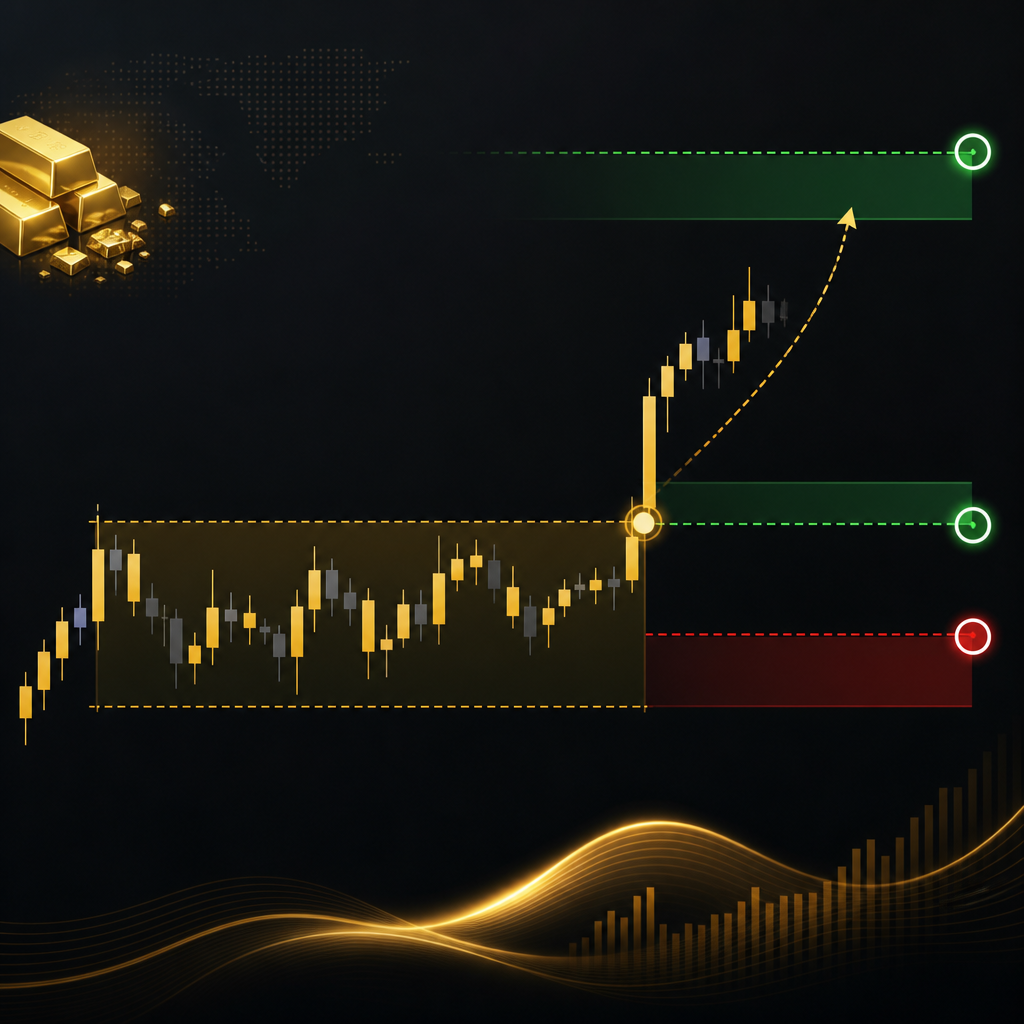
The London open breakout strategy lives or dies in preparation.
If you mark the wrong range, you’ll trade the wrong breakout.
We’re going to keep this simple and repeatable: use the Asian session range as your “box,” then trade the first clean expansion out of it during London.
Step-by-step: How to mark the Asian range
- Step 1: Pick your chart timeframe. For most traders, M15 is ideal (enough detail, not too noisy).
- Step 2: Define the Asian window. A common approach is from the Tokyo open through the pre-London period (your broker time may differ).
- Step 3: Mark the highest high and lowest low made during that window.
- Step 4: Draw a rectangle/box and label it “Asia Range.”
- Step 5: Note the range size in pips (EUR/USD) or dollars (XAUUSD).
Your range size is a filter. If the range is already huge, the breakout edge shrinks.
Range size guidelines (practical, not perfect)
These aren’t rigid rules, but they help you avoid low-quality days.
- EUR/USD: If the Asian range is under 15 pips, breakouts can be clean but prone to stop hunts. If it’s over 40 pips, the move may already be “spent.”
- XAUUSD: If the Asian range is under $6, London can explode (good) but wick you out (bad). If it’s over $18–$22, the day may be choppy.
In today’s volatility environment, with gold holding around $2650, an Asian box of $10–$16 is common on active weeks.
Add two “decision levels” to the box
To make your execution cleaner, add:
- Midline of the range (50%). This helps you spot when price is rotating rather than trending.
- Buffer zone (a few pips or a couple dollars). This prevents you from trading a “touch” instead of a breakout.
A practical buffer: EUR/USD 2–3 pips. For gold: $1.5–$3 depending on spread and volatility.
What you’re looking for before London even opens
Ask two questions:
- Is price already pressing one side of the range (suggesting direction)?
- Is the range tight enough that a breakout could run?
If the market is dead center in the box, you can still trade it—but you’ll demand stronger confirmation.
Breakout Confirmation & Invalidation: The Rules That Save You
Most traders know how to draw a box.
Most traders lose money because they don’t define what counts as a breakout and what proves it wrong.
We’ll use two confirmation models and one invalidation model. You can pick the one that fits your personality.
Confirmation Model A: Close outside + retest (highest reliability)
This is the “wait for proof” model.
Rules:
- Wait for an M15 candle close outside the Asian range (not just a wick).
- Price must then retest the broken level (the range high for longs, range low for shorts).
- Enter when the retest holds and you see rejection (smaller wick, bullish/bearish close, or a micro-structure break).
Example (EUR/USD): Asian high at 1.0530. Price closes M15 at 1.0536. Retests to 1.0531 and holds. Entry 1.0534, stop 1.0524 (10 pips), target 1.0554 (20 pips, 1:2).
Confirmation Model B: Momentum candle breakout (faster, more aggressive)
This is for traders who want earlier entries.
Rules:
- A breakout candle must close outside the range with a large real body (not all wick).
- Volume isn’t always visible in spot FX, so use candle size relative to the last 10 candles.
- Enter on the close or a small pullback, but reduce size because retest may not come.
Example (XAUUSD): Asian high $2642. A strong M15 candle closes at $2648. Entry $2648, stop $2636 ($12 risk), target $2672 ($24 reward, 1:2).
Invalidation Rule: Acceptance back inside the range
This is the line that keeps you from “hoping.”
If you’re long on a breakout above the range, the breakout is invalidated when:
- Price closes back inside the Asian box on M15, and
- Then fails to reclaim the range high on the next push.
For gold, this is critical. A $10 spike above the range that then closes back inside is often a liquidity grab.
One more filter: Avoid the “double break” chop
If London breaks above the range, then immediately breaks below it within 2–3 candles, that’s usually a chop day.
On those days, your best trade is often no trade—or wait for New York to choose direction.
Stops, Targets, and Position Sizing for London Breakouts
A breakout strategy is not a strategy if your risk is inconsistent.
Your stop placement must reflect the structure you’re trading, and your targets must reflect the instrument’s realistic expansion during the London window.
Stop placement options (choose one and stick to it)
Option 1: Stop beyond the opposite side of the range
- Best for: retest entries where the range defines the structure.
- Downside: can be wide if the Asian box is large.
Option 2: Stop beyond the retest swing
- Best for: tight risk, higher R:R.
- Downside: easier to get wicked out.
Option 3: Volatility stop (ATR-based)
- Best for: adapting to changing volatility.
- Downside: more complex; can reduce position size dramatically on volatile days.
Gold stop guidelines (use the market context)
With XAUUSD around $2650, a practical London breakout stop is often $10–$25 from entry, depending on box size and spread.
Example: Long $2652, stop $2639 ($13 risk). If you target 1:2, TP is $2678. If 1:3, TP is $2691 (note: this touches the top of our example range guideline).
EUR/USD stop guidelines
EUR/USD London breakout stops are often 8–18 pips for tight retest entries, or 15–30 pips if you must place beyond the range.
Example: Short 1.0516, stop 1.0531 (15 pips). 1:2 target 1.0486 (30 pips).
Target selection: Use a “session-realistic” approach
Instead of dreaming about 200 pips, anchor your targets to what London typically offers.
- EUR/USD: 20–60 pips is a realistic London expansion on many days.
- XAUUSD: $15–$45 is a realistic expansion on active days.
That’s why 1:2 is often the sweet spot for this plan. 1:3 is possible, but you’ll need either a trend day or a strong catalyst.
Position sizing: the simplest rule that keeps you alive
Risk a fixed percentage per trade (many disciplined traders use 0.5% to 1% per setup).
If your stop is wider today, your lot size must be smaller. That’s not optional.
For a deeper framework, keep a bookmark on our risk guide: risk management strategies when using forex signals.
EUR/USD London Open Breakout Trading Plan (Step-by-Step)
Now we’ll turn the framework into a concrete EURUSD breakout trading plan you can execute in under 10 minutes each morning.
We’ll assume EUR/USD is trading around 1.0520.
Step 1: Mark the Asian box and note the bias
Example Asian range:
- Asian high: 1.0530
- Asian low: 1.0508
- Range size: 22 pips
This is a workable box: not too tight, not too wide.
Step 2: Decide your confirmation model (A or B)
If you’re newer, use Model A (close + retest).
If you’re experienced and can manage faster entries, use Model B on strong momentum days.
Step 3: Define your entry trigger
Long trigger (Model A):
- M15 closes above 1.0530.
- Retest holds 1.0530–1.0528.
- Enter on bullish rejection candle or micro break above retest high.
Short trigger (Model A):
- M15 closes below 1.0508.
- Retest holds 1.0508–1.0510 as resistance.
- Enter on bearish rejection candle or micro break below retest low.
Step 4: Place the stop where the idea is wrong
For a long above 1.0530, a clean stop could be:
- Conservative: below 1.0508 (below the whole range) — wider, safer.
- Balanced: below the retest swing low (often 10–15 pips).
Example: Entry 1.0534, stop 1.0524 (10 pips).
Step 5: Set targets and management rules
Targets:
- TP1 (1:1): +10 pips at 1.0544 (optional partial).
- TP2 (1:2): +20 pips at 1.0554.
Management rule: If price reaches 1:1, you can move stop to breakeven or reduce risk. Don’t do it too early or you’ll get “BE’d” constantly.
Step 6: Time-based exit (the anti-chop rule)
If after entry EUR/USD does not make a new impulse high/low within 30–45 minutes, consider:
- Closing the trade, or
- Reducing size and keeping a small runner.
This one rule alone can dramatically improve consistency because it cuts “slow failures.”
Step 7: Document the outcome in 3 lines
After the session, write:
- Range size (pips)
- Entry model (A/B)
- Result + screenshot
Do this for 20 sessions and you’ll know whether your execution matches the plan.
XAUUSD London Session Signals: A Breakout Plan Built for Gold Volatility
Gold is not EUR/USD with a different symbol.
Gold is a volatility product that reacts to USD, yields, equity futures, and geopolitical headlines—often simultaneously.
So if you want XAUUSD London session signals to work for you, your breakout plan must respect gold’s personality.
We’ll assume XAUUSD trades around $2650, within the $2610–$2690 guideline.
Step 1: Mark the Asian box (but expect wider wicks)
Example Asian range:
- Asian high: $2642
- Asian low: $2630
- Range size: $12
A $12 box is a “tradable” compression for gold. It often leads to a $20–$40 expansion when London commits.
Step 2: Use a slightly larger buffer zone
Gold loves to “tick” levels and reverse.
Use a buffer like $2 beyond the range to qualify a breakout.
- Breakout long qualifies above: $2644
- Breakout short qualifies below: $2628
Step 3: Confirmation (close + retest is even more important)
Because gold wicks are common, we prefer Model A for XAUUSD:
- M15 close beyond the box + buffer.
- Retest of the broken level.
- Rejection candle or micro-structure shift.
Example long:
- Breakout: M15 closes at $2647.
- Retest: price pulls back to $2642–$2644.
- Entry: $2646 on rejection.
Step 4: Stops that survive London noise
Gold stop examples (typical):
- Tight: $10–$14 (only if retest is clean).
- Balanced: $15–$20 (often best for London).
- Wide: $22–$25 (only if the box is large and you reduce size).
Example: Entry $2646, stop $2633 ($13 risk). TP at 1:2 is $2672. TP at 1:3 is $2685.
Step 5: Targets and “London reality”
Gold can do $30 quickly, but not every day.
Use structure-based targets:
- Nearest prior swing high/low from the last 24 hours.
- Round numbers like $2650, $2660, $2675.
- Measured move: Asian range size ($12) projected from breakout point.
Measured move example: Break above $2642 with a $12 range suggests a first objective near $2654, then continuation targets like $2666–$2672 if momentum stays strong.
Step 6: A gold-specific time stop
If gold breaks out and then stalls for 20–30 minutes without making new highs/lows, treat it as a warning.
Gold often either runs fast or fails fast. Slow gold breakouts are frequently traps.
London Open Breakout vs Other Approaches (What to Trade and When)
Not every trader should trade breakouts every day.
Sometimes London is a trend continuation. Sometimes it’s a reversal. Sometimes it’s a liquidity sweep that sets up New York.
So let’s compare the London open breakout strategy to other common session plays, and identify when your breakout plan is the best tool.
| Approach | Best Market Condition | Pros | Cons | Best For |
|---|---|---|---|---|
| London Open Breakout | Asian compression → London expansion | Clear levels, fast outcomes, good R:R | Fakeouts near open; needs discipline | EUR/USD & XAUUSD session traders |
| London Reversal (Sweep & Return) | Stop hunt beyond Asia range then reversal | Great entries when obvious trap appears | Harder to define; can catch falling knives | Experienced price action traders |
| Trend Continuation (Pullback) | Strong higher-timeframe trend | Higher win rate in trending weeks | May miss the move if no pullback | Traders who prefer patience |
| NY Session Momentum | US data days; strong USD impulses | Big moves, especially gold | More news risk; spreads can jump | Traders who can handle volatility |
When to prioritize the breakout plan
Trade London breakouts when:
- The Asian range is clearly defined.
- There is no major high-impact news in the next 30 minutes.
- Price is not already extended far beyond yesterday’s key levels.
When to stand down
Skip or reduce risk when:
- Asian range is extremely wide (EUR/USD 45+ pips, gold $22+).
- High-impact news is imminent (CPI, NFP, central bank decisions).
- Price is whipping both sides of the range repeatedly.
The Simple News Filter: Avoiding London Fakeouts on High-Impact Releases
News doesn’t “ruin” technical strategies.
It changes the probability distribution of outcomes.
In the first 90 minutes of London, the worst fakeouts often happen when traders ignore a nearby high-impact event and treat the chart like it’s a normal day.
Why news matters more right now
With DXY at 106.80 and USD/JPY at 149.50, the market is highly sensitive to USD catalysts.
That sensitivity transmits directly into:
- EUR/USD (USD leg drives direction quickly)
- XAUUSD (USD + yields often drive sharp spikes)
Even if the news isn’t about Europe, USD news can still create a London whipsaw.
Your 3-part news filter (simple and effective)
Filter 1: The “no new trades” window
- No fresh London breakout entries 15 minutes before high-impact news.
- Extend to 30 minutes for gold on major releases (CPI, NFP, FOMC).
Filter 2: Reduce risk on medium-impact clusters
- If there are 2–3 medium events stacked (PMIs, speeches), trade half size or wait for confirmation + retest only.
Filter 3: Post-news “re-acceptance” rule
- After a release, wait for one full M15 candle close before taking a breakout.
How this filter prevents the classic trap
Classic trap: price breaks the Asian high 10 minutes before news, triggers breakout buys, then news spikes down and stops everyone.
With the filter, you simply don’t take that entry. You wait for the market to show acceptance after the event.
If you want a deeper look at how gold behaves when headlines hit, read: how gold signals react to unexpected news events.
Execution Checklist: A Repeatable 10-Minute Routine Before London
Consistency comes from routine.
And routine comes from checklists.
Here’s a practical London breakout checklist you can use daily for EUR/USD and XAUUSD.
Step-by-step London open breakout checklist
- 1) Check spreads on EUR/USD and XAUUSD. If gold spread is unusually wide, reduce size or wait.
- 2) Mark the Asian high/low on M15 and draw the range box.
- 3) Measure the range size (pips or dollars) and decide if it’s tradable.
- 4) Identify nearby structure: yesterday’s high/low, round numbers (XAU 2650/2660, EURUSD 1.0500/1.0550).
- 5) Apply the news filter: any high-impact events in the next 30 minutes?
- 6) Choose confirmation model (A close+retest for most days).
- 7) Pre-plan your stop and calculate your position size (fixed % risk).
- 8) Define your time stop: if no follow-through in 30–45 minutes, exit or reduce.
- 9) Only take A+ setups: close outside + retest + rejection.
- 10) Journal the trade with a screenshot and notes.
A practical “A+ setup” definition
If you want one sentence to keep you disciplined:
A+ London breakout = clean box + candle close outside + retest hold + clear invalidation + no major news nearby.
Where signals fit into this routine
Signals work best when they plug into an existing routine.
When you receive a EUR/USD or XAUUSD idea, you can quickly validate it against your box levels, your news filter, and your time window.
If you’re actively trading with guidance, explore our premium channels: forex signals and gold signals.
How We Trade London + NY at United Kings (Signals + Education)
At United Kings, we focus heavily on London and New York session trading because that’s where liquidity and follow-through are most consistent.
But the real edge isn’t “London.” The edge is process.
That’s why our approach combines:
- Clear signal structure (Entry, SL, TP levels)
- Session timing (when to enter, when to avoid)
- Education alongside signals so you understand the “why”
What a London breakout signal should include
If you’re evaluating any provider, the signal should be more than “buy now.”
A professional London breakout call should include:
- Instrument (EUR/USD or XAUUSD)
- Entry (exact price or entry zone)
- Stop loss (logical invalidation, not random)
- Take profit(s) (TP1/TP2 or scaling plan)
- Context (breakout from Asia range, retest, key level)
That’s the format we use across our premium community of 300K+ active traders, aiming for a disciplined, repeatable experience—not chaos.
Signals are not a substitute for risk management
Even with a strong historical edge, your account can be damaged by:
- Oversizing
- Revenge trading after a stop-out
- Taking every setup instead of the best ones
If you want a practical checklist for choosing a provider and using signals responsibly, read: our forex signals provider checklist for beginners.
Where to follow United Kings signals
You can start with our overview page: United Kings premium trading signals.
If you want direct access via Telegram (where our community is most active), join here: United Kings official Telegram channel.
Common Mistakes in the First 90 Minutes (And How to Fix Them)
Most London breakout losses come from a small set of repeatable mistakes.
Fixing them is often more profitable than “finding a new strategy.”
Mistake #1: Trading wick breaks
A wick above the Asian high is not a breakout.
Solution: require an M15 close outside the range, or use a buffer.
Mistake #2: Stops that are too tight for gold
Gold can move $4–$6 in seconds during the open.
Solution: if your stop is under $10 on XAUUSD, you need a very clean retest entry or you’re likely to get clipped.
Mistake #3: No invalidation rule
Without invalidation, you “hold and hope.”
Solution: if price closes back inside the box and fails to reclaim, treat it as failure. Exit or reduce.
Mistake #4: Ignoring the calendar
Trading a breakout 5 minutes before CPI is not bravery. It’s randomness.
Solution: apply the 15–30 minute no-trade window.
Mistake #5: Overtrading both EUR/USD and XAUUSD simultaneously
On USD-driven moves, EUR/USD and gold can both whip at once.
Solution: if both present setups, pick the cleaner one. Or split risk: 0.5% + 0.5% instead of 1% + 1%.
Mistake #6: Moving to breakeven too early
London loves to retest levels twice.
Solution: only move to breakeven after structure forms (e.g., a new swing high + higher low for longs).
FAQ: London Open Breakout Strategy for EUR/USD & XAUUSD
1) What is the best timeframe for the London open breakout strategy?
For most traders, M15 is the best balance for marking the Asian range and confirming closes. You can refine entries on M5, but keep the “truth” on M15.
2) Does the London open breakout work better on EUR/USD or XAUUSD?
Both can work well. EUR/USD is typically cleaner and more liquid. XAUUSD often offers larger moves but requires wider stops ($10–$25) and stricter confirmation to avoid wicks.
3) How many pips/dollars should I target in the first 90 minutes?
A practical target is often 1:2 R:R. On EUR/USD, that might be 20–40 pips depending on your stop. On gold, that might be $20–$40 depending on your stop and volatility.
4) What if price breaks out but never retests?
That’s common on momentum days. If you missed the retest entry, don’t chase. Either wait for a new structure pullback or skip and preserve discipline.
5) Should beginners trade the London open breakout live?
Beginners should start on a demo account for at least 20 London sessions. Focus on executing the checklist, not on making money first.
Risk Disclaimer (Read Before You Trade)
Trading forex and gold involves significant risk and may not be suitable for all investors. You can lose some or all of your capital. Past performance does not guarantee future results. Signals and educational content are provided for informational purposes only and do not constitute financial advice. If you are new, practice on a demo account and use strict risk management.
Join United Kings: Trade London Breakouts With Clear EUR/USD & XAUUSD Signals
If you want to trade the London session with structure—clear entries, SL, and TP levels—we built United Kings for exactly that.
We deliver premium Telegram signals for forex and gold with a disciplined session approach, supported by educational context so you understand the setup—not just the direction.
Explore our full offering here: premium trading signals, including dedicated XAUUSD gold signals and forex signals.
When you’re ready to start, review our 3 plans on the pricing section: United Kings pricing (Starter 3 Months $299, Best Value 1 Year $599 with 50% savings + FREE ebook, Unlimited Lifetime $999).
And to get signals and updates directly, join our Telegram community here: United Kings on Telegram.
Remember: we offer a 48-hour money-back guarantee so you can evaluate the service with confidence—while still trading responsibly and managing risk.