
Ever taken a “perfect” signal… only to watch your entry fill 1–3 pips worse, your stop get clipped, and then price run straight to target without you?
If you’ve traded EUR/USD around 1.0520, GBP/USD near 1.2680, or USD/JPY around 149.50, you’ve seen how the same setup behaves completely differently depending on when you execute it.
This is why the London New York session overlap matters. It’s not a buzzword. It’s a liquidity event that changes spreads, slippage, and stop-hunt behavior in ways you can plan for—especially when you’re trying to execute forex signals with low slippage.
TL;DR: London–New York overlap execution plan
- Best time to trade forex signals on majors is often the London–New York overlap (roughly 13:00–16:00 London time / 8:00–11:00 New York time), when liquidity is deepest and spreads are usually tight.
- To reduce slippage, avoid entering on the first spike after NY open; wait for the first pullback or a confirmed break-and-retest.
- Use a pre-trade spread check: if EUR/USD spread is inflated (example: 1.2–2.0 pips) versus normal (0.2–0.6), delay execution or reduce size.
- Place stops where liquidity sweeps are less likely: use structure + buffer, not “round-number stops” (e.g., 1.0500, 1.2700, 150.00).
- During overlap, manage positions with partial take profit + break-even rules to survive volatility without choking upside.
- News-aware execution matters: high-impact US data can turn overlap liquidity into whipsaw liquidity grabs.
Why the London–New York overlap changes everything (liquidity, spreads, fills)

The overlap is when two of the world’s largest FX dealing centers are active at the same time. That means more banks quoting prices, more institutional orders hitting the tape, and more two-way flow.
In practice, this usually creates tighter spreads and better order matching. For signal traders, that’s the difference between a clean entry and a frustrating fill.
Let’s be specific. On a typical day with DXY around 106.80 and majors trading actively, you might see:
- EUR/USD spread near overlap: 0.2–0.6 pips on good brokers
- GBP/USD spread near overlap: 0.5–1.0 pips
- USD/JPY spread near overlap: 0.3–0.8 pips
Outside peak liquidity (late NY, pre-Asia, or during random micro-lulls), those spreads can widen. That widening is where slippage sneaks in, especially with market orders or aggressive stop entries.
Now add volatility catalysts. If US yields move, or a surprise headline hits, liquidity can “thin” for seconds even during overlap. You’ll see a fast wick, then a snapback. That’s not random. It’s order-book behavior.
Here’s the key idea: slippage is not just broker “quality.” It’s also a timing problem. If you execute when liquidity is deep and spreads are stable, your fills improve. If you execute into the first wave of NY volatility, you’re often paying the spread plus the panic premium.
And if you also trade gold (XAU/USD around $2650, up about +0.35% on the day), you’ll notice the overlap can amplify moves when USD reacts. Gold can swing $8–$20 quickly in those windows, which is why our community treats overlap execution as a skill, not a guess.
If you’re new to signals execution, you’ll also want to keep our broader resources bookmarked via the United Kings blog—but this article is focused on one thing: a repeatable plan for overlap entries with lower slippage.
Session anatomy: London, New York, and the overlap (what actually changes)
Most traders define sessions by clock time. Professionals define sessions by behavior: who is active, what orders dominate, and where liquidity pools sit.
Let’s break down the three key phases you’ll feel on EUR/USD 1.0520 and GBP/USD 1.2680.
London session: the “structure builder”
London often sets the day’s initial directional bias. You’ll commonly see a range expansion, then either continuation or reversal after liquidity is collected.
Spreads are usually decent, but the first 15–45 minutes after London open can still be jumpy. That’s when stop-hunts around the Asian range are common.
Signal implication: if you get a signal during early London, the setup may be correct but timing matters. You want confirmation that the first sweep is done.
New York session: the “decision maker”
New York brings US data, US equity flows, and bond market reactions. With DXY at 106.80, any repricing in rate expectations can hit EUR/USD and USD/JPY hard.
NY open can produce sharp moves that look like breakouts but are actually liquidity grabs. This is where traders get slipped: they chase, get filled late, and then price mean-reverts.
Signal implication: treat NY open as a high opportunity / high trap zone. We’ll define safe entry windows below.
The overlap: the “execution sweet spot” (when done right)
The overlap often offers the best combination of liquidity and movement. This is why many premium signal providers—including us at United Kings—focus on London and NY hours.
But overlap doesn’t mean “enter instantly.” It means you have the best conditions to execute after the market shows its hand.
Think of overlap as a stadium filling up. The game is better, but the first rush through the gates is chaotic. Wait for the crowd to settle, then move.
Spreads, slippage, and stop-hunts: what you’re really fighting
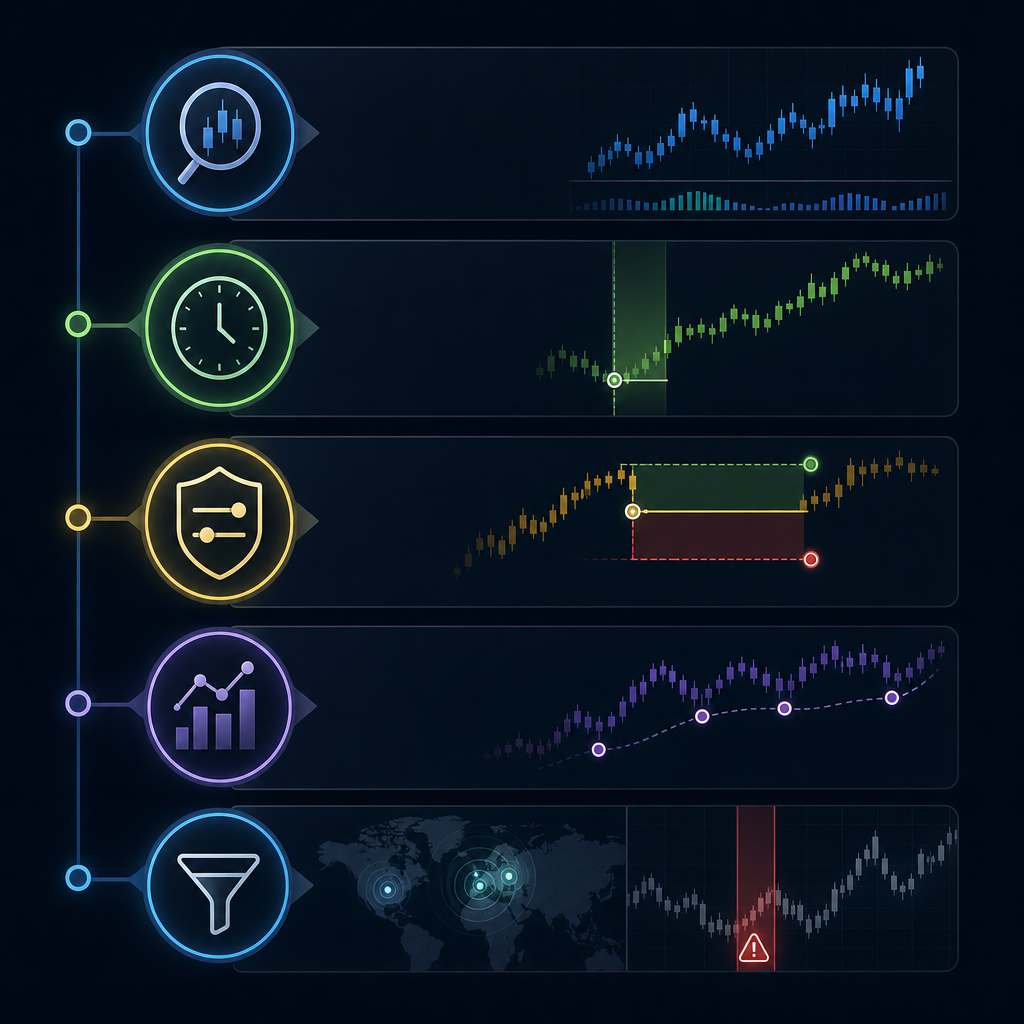
Slippage is the difference between your expected fill price and your actual fill price. It’s not always negative, but for most retail traders it usually is.
During overlap, spreads can be tight—yet slippage can still happen if volatility spikes. So we need to separate three issues:
- Spread cost: the visible bid/ask difference
- Execution slippage: the fill occurs at a worse price than requested
- Stop-hunt / liquidity sweep: price intentionally (or mechanically) runs into obvious stop zones before reversing
Here’s a realistic scenario on GBP/USD around 1.2680. Your signal says:
- Buy 1.2682
- SL 1.2667 (15 pips risk)
- TP 1.2712 (30 pips reward, 1:2)
If you enter during a stable overlap window with 0.6 pip spread, you might get filled 1.2682–1.2683. Great.
If you enter during a NY open spike and spread temporarily widens to 1.8 pips, you might get filled at 1.2685. Now your stop is effectively 18 pips away and your RR deteriorates.
Worse, if the market sweeps liquidity to 1.2665 (two pips beyond your SL), you’re stopped, then it rallies to 1.2712 without you. That’s not “bad luck.” That’s where stops sit.
Stop-hunts often target:
- Asian session highs/lows
- Round numbers (1.0500, 1.2700, 150.00)
- Previous day high/low
- Obvious trendline touches everyone can see
Your job isn’t to “avoid all stop-hunts.” Your job is to place stops where the trade idea is invalidated, not where the crowd places stops by habit.
And your job as a signal follower is to execute in windows where your broker can actually fill you close to the intended entry. That’s why the next sections are operational, not theoretical.
London vs New York vs Overlap: quick comparison table for signal traders
Before we go tactical, here’s a clean comparison you can use as a decision filter when a signal arrives.
| Session phase | Typical liquidity | Spread behavior (majors) | Common “trap” | Best signal execution style |
|---|---|---|---|---|
| Early London (first 30–60 min) | Rising fast | Tightening but can flicker | Asian range sweep | Wait for sweep + confirmation; avoid chasing first candle |
| Mid London | High | Usually stable and tight | False breakouts at range edges | Break-and-retest entries; scale-in allowed |
| NY open (first 15–45 min) | Very high but volatile | Can widen briefly during spikes | Liquidity grab + snapback | Let the first impulse complete; enter on pullback |
| London–NY overlap (after first impulse) | Peak | Tightest conditions for fills | Stop runs around key levels | Execute signals with limit/stop rules + confirmation |
| Late NY | Falling | Spreads can widen | Slow bleed / random spikes | Manage positions; avoid fresh entries unless A+ setup |
Step-by-step: the pre-trade spread and liquidity checklist (do this every time)
If you want lower slippage, you need a repeatable process. This checklist is what we teach our community to run in under 90 seconds before executing a signal.
Step 1: Check live spread vs your “normal” benchmark
Open your broker’s watchlist and note the current spread. Compare it to what you usually see in stable overlap conditions.
- EUR/USD: if you normally see 0.3–0.6 and you see 1.2+, pause.
- GBP/USD: if you normally see 0.6–1.0 and you see 1.8+, pause.
- USD/JPY: if you normally see 0.4–0.8 and you see 1.2+, pause.
Pausing doesn’t mean ignoring the signal. It means you wait for execution conditions to normalize or you adjust size and entry method.
Step 2: Identify the nearest “obvious stop” level
Mark round numbers and session highs/lows. On EUR/USD at 1.0520, the obvious magnets are 1.0500 and 1.0550. On USD/JPY at 149.50, it’s 149.00 and 150.00.
If your signal entry is right into an obvious magnet, you may face a sweep first. That doesn’t invalidate the signal—just changes how you execute it.
Step 3: Check the 15-minute candle structure (not indicators)
Ask two questions:
- Are candles clean and trending, or are they wick-heavy and mean-reverting?
- Did price just spike 20–40 pips in one candle (majors) right before your entry?
If you see a fresh spike, the risk of slippage and snapback is higher. That’s where limit entries or delayed entries can outperform instant market orders.
Step 4: Confirm there isn’t a high-impact release in the next 15 minutes
You don’t need to be a macro analyst to avoid bad timing. If CPI, NFP, FOMC, or a surprise central bank headline is imminent, spreads can widen even in overlap.
If you trade gold alongside FX, remember XAU/USD at $2650 can jump $10–$25 in minutes on USD repricing. A $15 stop becomes fragile if you enter right before a red-folder event.
Step 5: Choose the right execution type (market vs limit vs stop)
- Market order: best when spread is normal and momentum is steady.
- Limit order: best when you expect a pullback into a level (reduces slippage, but may miss trades).
- Stop order: best for confirmed breakouts, but highest slippage risk if placed too close to the breakout line.
This is the part most signal traders skip. They treat every signal like a market order. Professionals don’t.
Optimal entry windows during the overlap (timing rules that reduce slippage)
The overlap is not one uniform block. It has micro-phases. If you time entries inside the overlap, you can often reduce slippage and avoid the worst stop-hunts.
Window A: “Stabilized overlap” (your primary execution window)
This is typically after the NY open impulse settles. Liquidity is deep, spreads are tighter, and price often respects technical levels better.
What it looks like on chart:
- A strong move happens (up or down).
- Then price pulls back 30–60% of that move.
- Then it either continues or forms a range for a breakout.
Signal execution tactic: enter on the pullback or on a break-and-retest. Your fill quality is usually better than chasing the first candle.
Window B: “First impulse” (high reward, high slippage risk)
This is the first burst of NY participation. It’s where you see 10–25 pip candles on EUR/USD and 15–35 pip candles on GBP/USD.
If you enter here, you’re often competing with fast money. Slippage risk increases, especially if your broker routes orders slowly or if spreads widen for a few seconds.
Signal execution tactic: if the signal triggers in this window, consider:
- Reducing size by 25–50%
- Waiting for a 5–15 minute close beyond the level
- Entering on the retest instead of the breakout print
Window C: “Late overlap” (great for management, selective for new entries)
As London approaches the end of its day, liquidity can remain high but directional conviction may fade. You’ll often see profit-taking and mean reversion.
Signal execution tactic: prioritize managing open positions—partials, trailing stops, or break-even—over initiating brand-new trades unless the setup is A+.
A simple timing rule you can actually follow
If a signal arrives during a fast spike, don’t execute instantly. Wait for either:
- a pullback to the entry zone with spread normalized, or
- a candle close confirmation + retest.
This one rule alone reduces “entered at the top/bottom” pain for most traders.
Pair-by-pair execution rules for majors (EUR/USD, GBP/USD, USD/JPY)
Majors don’t behave the same in overlap. Each pair has its own “personality,” and your execution rules should reflect that.
EUR/USD (around 1.0520): cleanest overlap fills, but fakeouts happen
EUR/USD is typically the most liquid major. That’s good for low slippage—especially in overlap. But it also means it can “engineer” very clean liquidity sweeps around obvious levels.
Practical rule: if your signal is targeting a breakout above 1.0525, don’t place a stop-entry at 1.0526 with a tight stop. That’s where you get slipped and wicked.
Example execution plan:
- Signal: Buy 1.0520–1.0523
- Safer execution: wait for a dip into 1.0521 with spread normal, or a retest after a break above 1.0530
- SL: 1.0508 (12–15 pips depending on structure)
- TP1: 1.0546 (about 2R), TP2: 1.0560 (about 3R)
Notice the logic: stop below structure, targets aligned with realistic overlap range expansion.
GBP/USD (around 1.2680): wider swings, more stop-hunts
GBP/USD moves more aggressively. That’s great for hitting 30–60 pip targets, but it also means your execution has to respect volatility.
Practical rule: give GBP/USD more breathing room. If you use the same stop distance as EUR/USD, you’ll get clipped more often.
Example execution plan:
- Signal: Sell 1.2680–1.2685
- Execution: prefer limit near 1.2684 after a spike, not a market sell at 1.2677
- SL: 1.2702 (17–22 pips, above a swing)
- TP: 1.2640 (40+ pips, roughly 1:2)
This reduces slippage because you’re not chasing. You’re letting price come to you in a liquid window.
USD/JPY (around 149.50): watch yields, respect round numbers
USD/JPY is heavily influenced by US yields and risk sentiment. During overlap, US data can move it fast.
Practical rule: avoid placing stops or entries right on 150.00 or 149.00. Those levels attract liquidity runs.
Example execution plan:
- Signal: Buy 149.40–149.55
- SL: 149.18 (22–37 pips depending on structure)
- TP: 150.05 (50–65 pips, but consider partial before 150.00)
Position management matters here: take partial profit ahead of the round number, then let the rest run if momentum holds.
How to execute signals with limit orders (the “lower slippage” approach)
If your goal is lower slippage, limit orders are one of your best tools—when used correctly. The mistake is placing limits randomly and then blaming signals when you miss trades.
Here’s a structured way to do it during the London–NY overlap.
Step 1: Define the “execution zone,” not a single price
Instead of “Buy 1.0520,” think “Buy 1.0518–1.0522.” This accounts for spread fluctuations and small wicks.
On GBP/USD, your zone might be 1.2680–1.2686. On USD/JPY, 149.40–149.55.
Step 2: Place the limit where liquidity is likely to return
During overlap, price often returns to:
- the midpoint of the impulse candle
- a broken level (support/resistance flip)
- VWAP area (if you track it)
You don’t need fancy indicators. You need a logical place where pullbacks commonly land.
Step 3: Use a “time stop” for unfilled orders
If price never pulls back, your limit won’t fill. That’s fine—missing a trade is cheaper than entering with terrible slippage.
Rule: if your limit isn’t filled within 60–120 minutes (depending on the signal style), cancel it. The market regime may have changed.
Step 4: Adjust stop placement to avoid the obvious sweep
Stops should go beyond structure with a buffer. If EUR/USD is holding 1.0515 and you buy 1.0520, a stop at 1.0514 is asking to be swept.
Better: 1.0508 or 1.0505 if structure supports it. Yes, that’s a wider stop. But if you keep your risk per trade fixed, you can reduce lot size and keep the same account risk.
Step 5: Keep risk-reward intact (don’t “stretch” entries)
Limit entries help your RR. But only if you don’t move targets further just because you got a better fill. Take the planned TP at 1:2 or 1:3.
Consistency is what compounds.
Position management rules for overlap volatility (partials, BE, and trailing)
Overlap trading can deliver fast profits. It can also deliver fast reversals. This is where management rules protect your equity curve.
Rule 1: Take partial profit at 1R or at the nearest liquidity magnet
If your risk is 15 pips on EUR/USD, 1R is 15 pips. If price hits +15 pips during overlap, consider taking 30–50% off.
On USD/JPY, if your target is 150.05, consider partial at 149.90–149.95 because 150.00 is a magnet for reactions.
Rule 2: Move stop to break-even only after structure confirms
The biggest execution mistake is moving to break-even too early during overlap. You get tapped out, then price runs.
Better rule: move to BE only after:
- a 15-minute close in your favor beyond a key level, or
- a higher low / lower high forms after your entry.
This keeps you in the trade long enough for the overlap trend to pay you.
Rule 3: Use a “soft trail” instead of a tight trailing stop
Tight trailing stops get hit constantly during overlap. A soft trail means you trail behind structure, not behind every candle.
Example on GBP/USD: if you’re short from 1.2684 and price drops to 1.2650, you can trail above the last 15-minute swing high (maybe 1.2665) rather than a fixed 10-pip trail.
Rule 4: If spread widens suddenly, don’t panic-close
Spreads can widen briefly around headlines. Panic closing often locks in the worst possible fill.
Instead, monitor whether the widening is temporary and whether your trade thesis is still valid. This is also why we recommend trading with a broker that has stable execution during peak sessions.
Realistic overlap examples (EUR/USD, GBP/USD, plus a gold cross-check)
Let’s tie this to the current market context: EUR/USD 1.0520, GBP/USD 1.2680, USD/JPY 149.50, DXY 106.80, and gold XAU/USD around $2650.
Example 1: EUR/USD overlap continuation with low slippage execution
Scenario: London pushes EUR/USD from 1.0495 to 1.0525. NY opens and spikes to 1.0532, then pulls back.
Bad execution: buy market at 1.0531 during the spike. Spread flickers to 1.4 pips. You get filled 1.0533.
Better execution:
- Wait for pullback into 1.0522–1.0524
- Place a buy limit at 1.0523
- SL at 1.0510 (13 pips)
- TP at 1.0549 (26 pips, 1:2)
Result: you avoid the spike fill, reduce slippage risk, and keep RR clean.
Example 2: GBP/USD stop-hunt avoidance during overlap
Scenario: GBP/USD is ranging 1.2665–1.2695 in London. NY opens, spikes above 1.2700 to 1.2708, then falls back below 1.2700.
This is a classic liquidity sweep above the round number.
Execution plan:
- Signal bias: sell after sweep confirmation
- Entry: sell limit 1.2696–1.2699 after price returns under 1.2700
- SL: 1.2718 (19–22 pips)
- TP1: 1.2660 (about 1:1.6), TP2: 1.2650 (about 1:2.1)
Key point: you’re not selling the first drop. You’re letting the market show that the sweep is done.
Example 3: Gold as a confirmation tool (XAU/USD around $2650)
Even if you’re focused on FX signals, gold can act as a “risk barometer” during overlap—especially when USD is moving.
Scenario: DXY pops from 106.70 to 106.90 on a data surprise. USD/JPY jumps. Gold reacts by dropping from $2658 to $2646, then rebounds to $2653.
That rebound can signal that USD strength is being absorbed. If you’re executing an EUR/USD buy signal, seeing gold stabilize can add confidence that the USD spike may fade.
And if you trade gold signals too, realistic execution examples in this regime might look like:
- Buy XAU/USD 2648–2652
- SL 2635 (about $13–$17 risk)
- TP 2678 (about $26–$30 reward, 1:2)
Gold moves faster than majors. That’s why overlap timing and spread checks matter even more on XAU/USD. If you want dedicated gold setups, our premium gold signals are built specifically around these high-liquidity windows.
Common mistakes signal traders make during overlap (and how to fix them)
Most slippage problems aren’t “bad luck.” They’re execution habits. Here are the big ones we see—especially among traders who follow Telegram signals but don’t have an execution plan.
Mistake 1: Treating every signal as “enter now”
Signals provide levels and bias. Execution is your job. If you always market-enter instantly, you’ll enter at the worst micro-moments of overlap volatility.
Fix: use the checklist and prefer pullback entries when the first impulse is still printing.
Mistake 2: Placing stops at obvious round numbers
Stops at 1.0500, 1.2700, and 150.00 are magnets. Liquidity sweeps love those zones.
Fix: put stops beyond structure with a buffer. If the stop must be wider, reduce position size to keep risk constant.
Mistake 3: Ignoring spread conditions
Even in overlap, spreads can widen around news or sudden volatility. If you don’t check, you can pay 2–3x your normal transaction cost.
Fix: set a personal “max spread rule” per pair. If exceeded, delay entry or use a limit order.
Mistake 4: Moving to break-even too early
Overlap candles have wicks. If you move to BE at +5 pips, you’ll get clipped repeatedly.
Fix: move to BE after structure confirms (15-minute close beyond a level or a swing formation).
Mistake 5: Trading every overlap day the same
Some overlap days are trend days. Some are range days. If you try to force trend management in a range, you’ll churn.
Fix: read the day’s context: DXY direction, US data schedule, and whether London already made a large move before NY arrived.
If you want a broader framework for protecting your account while following signals, pair this guide with our risk-focused resource: risk management strategies when using forex signals.
How we structure United Kings signals for overlap execution (what to follow, what to confirm)
At United Kings, we design signals to be executable in real market conditions—not just “pretty chart ideas.” That’s why our Telegram community (300K+ active traders) focuses heavily on London and NY sessions.
When you receive a signal from us, you’ll typically see:
- Clear Entry zone (not just one number)
- Stop Loss placed beyond invalidation
- Take Profit levels mapped to realistic session liquidity
We also emphasize execution discipline because even an 85%+ historical win-rate approach can be damaged by poor fills, oversized positions, and revenge trades. Execution is what turns “good analysis” into “good results.”
Here’s how to align with our overlap approach:
Follow the level, not the emotion
If EUR/USD is 1.0520 and the entry is 1.0518–1.0522, you don’t need to chase 1.0528 because you’re afraid of missing out. Overlap gives you pullbacks more often than you think.
Respect the session logic
If London already ran 80–120 pips on GBP/USD (rare but possible on big days), expect NY to either continue strongly or mean-revert sharply. Your job is to wait for confirmation before committing full risk.
Use our education alongside signals
Signals are more powerful when you understand why they work. If you’re building your routine, you’ll find more execution-focused guidance across the forex signals page and our educational posts on /blog/.
Where to get the signals
We publish premium setups via our Telegram channel. Join the live feed here: United Kings Telegram signals channel.
Actionable overlap execution checklist (copy/paste before every trade)
Save this section. Screenshot it. This is the “do it every time” list for cleaner overlap execution.
Pre-entry (60–90 seconds)
- Is this within the London–NY overlap or near it?
- Is the spread within my max rule? (EUR/USD < 0.8, GBP/USD < 1.3, USD/JPY < 1.0 as a practical example)
- Did NY just print a spike candle? If yes, wait for pullback/retest.
- Mark the nearest obvious liquidity magnets (round numbers, session highs/lows).
- Check if a high-impact US release is within 15 minutes.
Entry decision
- If conditions stable: market entry is acceptable.
- If spike/volatility: use limit entry at the zone or wait for confirmation.
- If breakout signal: prefer break-and-retest over first-touch entries.
Stop and target rules
- Stop goes beyond structure + buffer (avoid round numbers).
- Target at least 1:2 RR unless the signal specifies otherwise.
- Plan partials: 30–50% at 1R or before a major magnet.
Management during overlap
- Don’t move to BE until a 15-minute close confirms.
- If price hits TP1 fast, reduce exposure and let the rest run.
- If spreads widen suddenly, avoid panic closing; reassess thesis.
If you want a broader “provider selection + execution” checklist, we also recommend: forex trading signals provider checklist for beginners.
FAQ: London–New York overlap and low-slippage signal execution
1) What is the London New York session overlap in forex?
It’s the time window when both London and New York markets are active simultaneously. Liquidity is typically highest, spreads often tighten, and volatility can increase—creating strong opportunities for major pairs.
2) Is the overlap always the best time to trade forex signals?
Often, yes for majors—because liquidity improves execution. But it’s not automatic. NY open spikes and major US news can cause whipsaws and temporary spread widening, so timing inside the overlap matters.
3) How do I execute forex signals with low slippage?
Use a pre-trade spread check, avoid chasing the first impulse candle, prefer pullback/retest entries, and choose the right order type (limit orders reduce slippage but may miss trades).
4) Which pairs benefit most from overlap liquidity?
EUR/USD typically shows the cleanest fills due to deep liquidity. GBP/USD offers strong movement but more stop-hunts. USD/JPY can move fast on yield shifts, so round-number management is crucial.
5) Should beginners trade overlap sessions or practice first?
Beginners should practice on a demo first. Overlap provides opportunity, but the speed can punish mistakes. Demo execution helps you learn spread behavior and timing without financial pressure.
Risk disclaimer (read before you trade)
Forex and gold trading involves significant risk and may not be suitable for all investors. Spreads can widen, slippage can occur, and losses can exceed expectations if risk is not controlled. Past performance does not guarantee future results. Nothing in this article is financial advice. If you are new, consider using a demo account first and always use proper position sizing and stop losses.
Join United Kings: trade the overlap with a real plan (and a real community)
If you’re serious about executing signals with lower slippage, you need two things: high-quality setups and professional execution rules.
United Kings delivers premium Telegram signals for forex and gold with clear Entry, SL, and TP levels—built around London and New York session liquidity. You also get education alongside signals, plus a 48-hour refund window (conditions apply—see refund policy).
- Explore all signal services: United Kings signals
- For FX-only focus: premium forex signals
- See plans and choose your tier: Monthly ($199/month), Lifetime ($499 one-time with FREE ebook)
- Join the live Telegram feed now: United Kings on Telegram
Your next step: join the community, follow the overlap checklist for 20 trades, and track your slippage and fill quality. Most traders are shocked how much performance improves when timing and execution finally match the signal.


