
Ever copied a forex signal, watched price move 20–30 pips in your favor… and still ended the day confused or negative?
If you’re new, it’s not because you “can’t trade.”
It’s usually because nobody taught you how to use forex signals like a process: selection, execution, risk, and review.
This is the definitive forex signals guide for beginners, built for real market conditions right now: EUR/USD around 1.0520, GBP/USD around 1.2680, USD/JPY around 149.50, and a firm Dollar Index near 106.80.
We’ll also use gold (XAUUSD) examples near $2650 because many beginners trade both forex and gold signals together.
TL;DR: Forex Signals for Beginners (The Practical Takeaways)
- Signals don’t replace risk management. Your lot size and stop-loss discipline matter more than the entry.
- Pick providers with transparent structure: entry, SL, TP(s), timeframe, and a clear reason (not just “BUY NOW”).
- Execute like a checklist: spread, session (London/NY), news risk, and correct order type.
- Use fixed risk per trade (0.5%–2%). Beginners should start at 0.5%–1% until consistent.
- Track every signal. Consistency comes from review: slippage, late entries, rule breaks, and emotional mistakes.
- Start on demo, then go small live. “Same rules, smaller size” beats jumping in full risk.
What Are Forex Signals (And What They Are Not)?
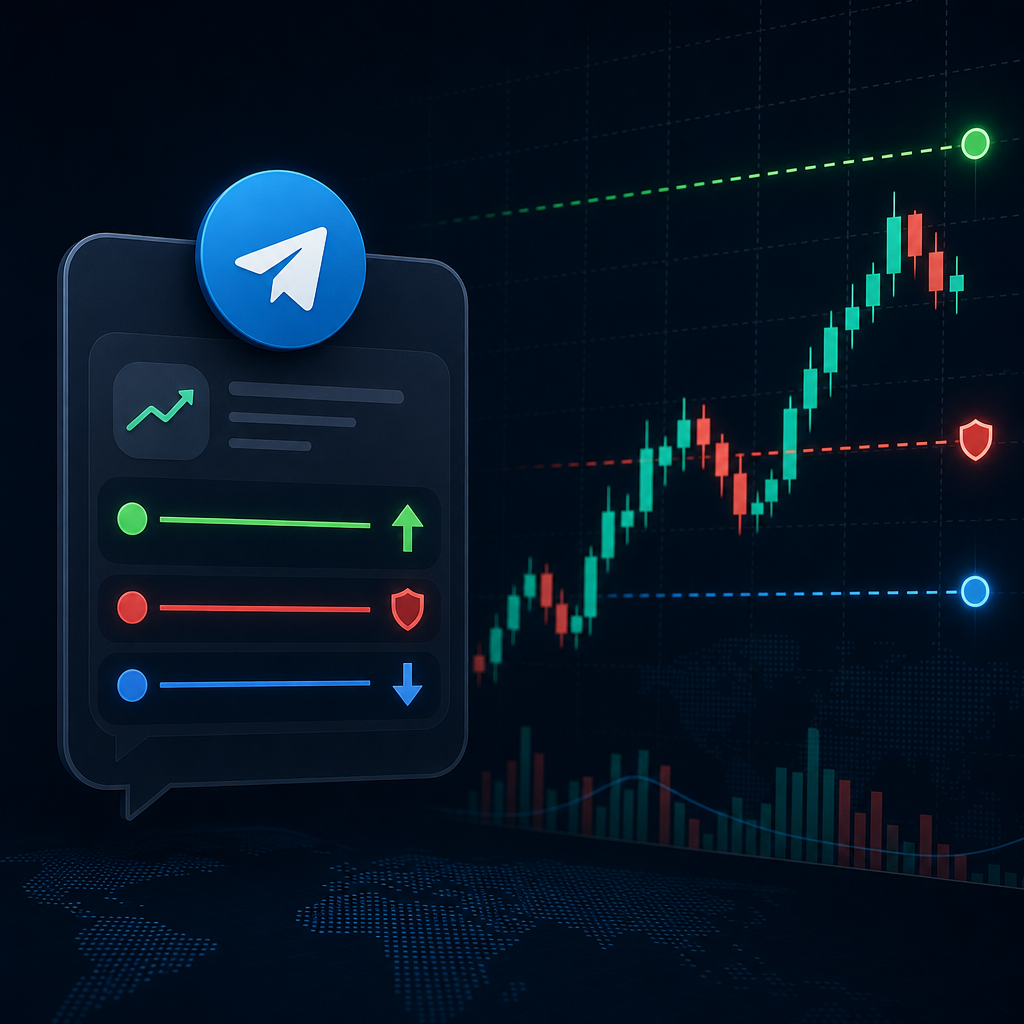
A forex signal is a trade idea delivered to you with specific instructions.
At minimum, a high-quality signal includes: instrument (e.g., EUR/USD), direction (buy/sell), entry, stop loss, and take profit.
Many providers also add partial take-profits, a breakeven rule, and a short explanation of the setup.
Signals are a framework, not a magic button
Beginners often think signals are “guaranteed wins.”
They’re not.
A signal is a probability bet based on a strategy that historically performs well under certain market conditions.
Why beginners love signals (and where they get hurt)
Signals solve the hardest early problem: “What trade should I take?”
But they can create a new problem: “I took the trade… why did I still lose?”
Common reasons include entering late, using the wrong lot size, ignoring news, or moving the stop-loss.
Forex vs gold signals (quick clarity)
Forex pairs like EUR/USD often move in cleaner intraday swings of 20–80 pips.
Gold (XAUUSD) can move $10–$30 quickly, especially around U.S. data or geopolitical headlines.
With gold near $2650 (+0.35% on the day), a “normal” intraday push can be $8–$18, which is why gold signals usually use stops around $10–$25.
If you want to see how we structure our trade ideas across markets, explore our full signal hub at United Kings Signals.
Types of Forex Signals: Manual vs Automated, Free vs Premium
Not all signals are built the same.
As a beginner, your job is to choose a signal type that matches your schedule, personality, and risk tolerance.
Manual signals (human analysis)
Manual signals are generated by traders using price action, indicators, fundamentals, or a blend.
You receive the idea and place the trade yourself.
This is powerful because you learn execution and discipline.
Automated signals (algorithms and bots)
Automated signals come from systems that scan markets and output entries.
They can be fast and consistent, but they can also overtrade or fail when market regimes change.
For beginners, automation can hide the “why,” which makes it harder to improve.
Free signals vs premium signals (the real difference)
Free signals can be useful for practice.
But they often lack structure, risk guidance, and accountability.
Premium signals typically include clearer levels, better timing, fewer low-quality trades, and ongoing support.
| Signal Type | Pros | Cons | Best For |
|---|---|---|---|
| Free Telegram Signals | Easy access, good for demo practice | Inconsistent quality, unclear SL/TP, hype marketing | Testing basics without pressure |
| Premium Telegram Signals | Structured entries/SL/TP, fewer random trades, community support | Subscription cost, still requires discipline | Beginners who want a guided process |
| Copy Trading | Hands-off execution | Less learning, risk of over-leverage, provider risk | Busy traders who accept less control |
| EA / Auto Bots | Fast, systematic | Can fail in news/volatility, requires monitoring | Experienced traders with testing skills |
If you specifically want curated, structured trade ideas, see our dedicated Forex Signals page and how we deliver entries, SL, and TP in a clean format.
How to Choose a Forex Signal Provider (Beginner Checklist)

Choosing a provider is the highest-leverage decision you’ll make.
Pick wrong, and you’ll spend months learning bad habits.
Pick right, and you’ll learn a repeatable process while you trade.
The beginner checklist that filters out 80% of scams
Use this as a non-negotiable list.
- Clear structure: instrument, entry, SL, TP(s), timeframe, and whether it’s market or limit.
- Risk language: they talk about risk per trade, not “guaranteed pips.”
- Realistic win rate claims: anything that screams 95–100% is a red flag.
- Consistency: signals align with specific sessions (London/NY) and don’t spam 30 trades/day.
- Education: you get context (why the trade exists) and post-trade review.
- Community + support: you can ask questions and learn execution.
What “transparent performance” should look like
Good providers show a track record in a way that can be audited: timestamps, entries, and outcomes.
They also acknowledge losing streaks and explain what changed in market conditions.
With DXY around 106.80, for example, USD strength can pressure EUR/USD and lift USD/JPY.
A provider should adapt trade selection to that context, not trade the same way every day.
Where United Kings fits (and why beginners stick)
United Kings is built for traders who want a premium, structured approach on Telegram.
We focus on London and New York sessions, where liquidity is high and spreads behave better.
We also publish clear Entry, SL, and TP levels and support execution discipline inside the community.
To see the exact criteria we recommend before subscribing anywhere, use our beginner-friendly checklist resource: Forex Trading Signals Provider Checklist for Beginners.
How to Read a Forex Signal Like a Pro (Even If You’re New)
Most beginners don’t lose because the signal is “bad.”
They lose because they misread it.
So let’s decode the signal format you’ll see most often.
The 5 core parts of a signal
- Pair: EUR/USD, GBP/USD, USD/JPY, XAUUSD, etc.
- Direction: BUY or SELL.
- Entry: market entry now, or a limit/stop pending order.
- Stop-loss (SL): the price where the idea is invalid.
- Take-profit (TP): one or multiple targets.
Market order vs limit order (the beginner trap)
If a signal is designed as a limit order, it assumes price pulls back to a level.
If you enter at market after price already moved, your risk-to-reward can collapse.
Example: EUR/USD at 1.0520.
A provider might send: “BUY LIMIT 1.0505, SL 1.0475, TP 1.0565.”
If you buy at 1.0520 instead, you’re 15 pips worse.
Your SL becomes closer, your TP becomes smaller, and your edge shrinks.
Understanding risk-reward with simple numbers
Let’s say GBP/USD is 1.2680.
A signal: “SELL 1.2680, SL 1.2720 (40 pips), TP 1.2600 (80 pips).”
That’s a clean 1:2 risk-reward.
If you move the stop to 1.2740 “to avoid getting stopped,” you just doubled your risk and changed the math.
Gold signal reading example (XAUUSD)
Gold near $2650 is active.
A realistic signal might be: “XAUUSD BUY 2648, SL 2633 (15), TP 2678 (30), TP2 2693 (45).”
That’s roughly 1:2 to TP1 and 1:3 to TP2.
Beginners should love this structure because it tells you exactly what to do.
If you want a Telegram-specific walkthrough, this guide complements what you’re reading: Forex Signals Telegram for Beginners Guide.
Step-by-Step: How to Execute Forex Signals (Without Late Entries)
Execution is where beginners either become consistent… or become frustrated.
We’re going to turn execution into a repeatable checklist you can follow in 60 seconds.
Step 1: Confirm the session and spreads
Most clean moves happen in London and New York.
During quiet hours, spreads widen and signals can fail more often.
For example, USD/JPY around 149.50 can spike on thin liquidity, hitting stops that would survive in NY.
Step 2: Check the economic calendar (news risk)
Before placing the trade, look for high-impact events: CPI, NFP, FOMC, BOE, ECB.
If EUR/USD is near 1.0520 and U.S. CPI is in 20 minutes, your “normal” 25–40 pip stop can get swept in seconds.
Beginners should either skip the trade or reduce risk before major news.
Step 3: Match the order type
- Market: enter now at best available price.
- Limit: wait for a better price (pullback).
- Stop: enter on breakout confirmation.
Don’t convert a limit setup into a market entry just because you feel FOMO.
Step 4: Set SL and TP immediately (no exceptions)
Place SL and TP at the same time as the entry.
This protects you from internet drops, platform freezes, and emotional decisions.
On gold at $2650, a $15 stop is common.
If you “trade naked” without an SL, a $25 spike can happen fast and do real damage.
Step 5: Screenshot and journal the trade
Beginners improve fastest when they track execution quality.
Record: entry time, spread, slippage, and whether you followed the plan.
After 30 trades, you’ll see patterns like “I lose when I enter late” or “I overtrade during Asia.”
For an execution deep-dive, our broader library is available at United Kings Blog, where we break down real trading workflows.
Risk Management for Beginners Using Forex Signals (The Non-Negotiables)
If you only master one skill, make it risk management.
Signals can give you entries.
Only risk management keeps you in the game long enough to build consistency.
Choose a fixed risk per trade (0.5%–2%)
Beginners should live in the 0.5%–1% range.
At 1% risk, a 10-loss streak is painful but survivable.
At 5% risk, a 10-loss streak can wipe you out.
Position sizing: the simple method
Here’s the beginner formula:
- Account size: $1,000
- Risk per trade: 1% = $10
- Stop size: 40 pips on GBP/USD
- Allowed loss: $10 → $10 / 40 pips = $0.25 per pip
You then choose a lot size that equals about $0.25/pip.
Your platform or a position size calculator can do this instantly.
Gold risk example with realistic levels
Gold at 2650 with a $15 stop (e.g., SL 2635) is common.
If your account is $2,000 and you risk 1% ($20), your position size must be small enough that a $15 move equals $20 loss.
This is how you stop one trade from becoming a week’s setback.
Don’t “average down” as a beginner
Adding to a losing trade is one of the fastest ways to blow an account.
Signals are built with an invalidation point (the SL).
If price hits it, the idea is wrong for now.
Use a weekly drawdown limit
Set a rule like: “If I’m down 3% this week, I stop trading until Monday.”
This prevents revenge trading.
It also gives you time to review execution mistakes.
For a full framework, read our dedicated guide: Risk Management Strategies When Using Forex Signals.
Building Consistency: A Beginner Routine That Actually Works
Consistency is not about winning every day.
It’s about repeating a high-quality process regardless of yesterday’s result.
Signals make this easier, but only if you build a routine around them.
The 15-minute pre-session routine
- Check the calendar: identify red-flag news times.
- Mark key levels: previous day high/low, session ranges.
- Check DXY context: with DXY ~106.80, bias can favor USD strength.
- Decide your max trades: e.g., 1–3 trades per session.
This routine stops you from taking random trades just because you’re bored.
The “one good trade” rule
Beginners often try to make money fast.
They take 6–10 trades in a day and end up emotionally exhausted.
Instead, aim for one well-executed trade with correct sizing.
Even a 30–50 pip move on EUR/USD or a $20 run on gold is enough when risk is controlled.
Post-trade review in 5 questions
- Did I enter at the planned price?
- Did I keep the original SL?
- Was there major news I ignored?
- Did I follow my risk % rule?
- What would I do differently next time?
After 20–30 trades, your mistakes become obvious.
That’s when your results start stabilizing.
Use community to shorten your learning curve
Trading alone makes beginners second-guess everything.
In a structured community, you can compare execution and learn faster.
United Kings has a large active community and focuses heavily on London/NY execution discipline.
If you also trade gold, our Gold Signals page explains how we handle XAUUSD volatility and structured targets.
Real Market Examples: Using Signals on EUR/USD, GBP/USD, USD/JPY, and Gold
Let’s ground this guide in realistic examples using current market levels.
These are not promises of outcomes.
They’re templates showing how a beginner should think and execute.
Example 1: EUR/USD continuation idea near 1.0520
Context: DXY is firm near 106.80.
That often pressures EUR/USD, especially if U.S. yields are rising.
Signal template:
- EUR/USD SELL 1.0520
- SL 1.0550 (30 pips)
- TP1 1.0460 (60 pips)
- TP2 1.0430 (90 pips)
Beginner execution: risk 1%, place SL/TP instantly, and don’t close early because price retraces 10 pips.
Example 2: GBP/USD pullback sell near 1.2680
GBP/USD can be more volatile than EUR/USD.
That means wider stops and fewer impulsive entries.
Signal template:
- GBP/USD SELL LIMIT 1.2700
- SL 1.2745 (45 pips)
- TP 1.2610 (90 pips)
Beginner rule: if price never hits 1.2700, you don’t chase it at 1.2680.
Example 3: USD/JPY trend trade near 149.50
USD/JPY can trend hard when rate differentials dominate.
It can also spike on BOJ headlines.
Signal template:
- USD/JPY BUY 149.50
- SL 149.10 (40 pips)
- TP 150.30 (80 pips)
Beginner rule: avoid holding through major BOJ statements if you don’t understand the risk.
Example 4: XAUUSD momentum trade near $2650
Gold is sensitive to USD moves, yields, and risk sentiment.
With gold around $2650 (+0.35% in 24h), intraday momentum can be clean during NY.
- XAUUSD BUY 2652
- SL 2637 ($15)
- TP1 2682 ($30)
- TP2 2697 ($45)
Beginner rule: don’t widen SL to $30 because “gold always comes back.” Sometimes it doesn’t.
Common Beginner Mistakes With Forex Signals (And How to Fix Them)
Most signal “failures” are execution and behavior failures.
If you fix these, your results can improve dramatically without changing providers.
Mistake 1: Entering late (the silent account killer)
Late entries destroy your risk-to-reward.
If the signal is a 1:2 setup, entering 15 pips late can turn it into 1:1 or worse.
Fix: use pending orders when appropriate, and set alerts.
Mistake 2: Moving stop-loss after entry
Beginners move SL because they want to avoid being wrong.
But the SL is the “line in the sand” that makes the trade mathematically valid.
Fix: decide before entry that the SL is final unless the signal explicitly says “move to breakeven at +X pips.”
Mistake 3: Overleveraging to “make it worth it”
Many beginners think small lot sizes are pointless.
But small size is how you survive long enough to learn.
Fix: use 0.5%–1% risk until you have at least 60–100 trades of data.
Mistake 4: Trading every signal on every pair
More trades doesn’t mean more profit.
It often means more mistakes.
Fix: choose 2–3 instruments you can focus on (e.g., EUR/USD, GBP/USD, XAUUSD).
Mistake 5: Ignoring market context
With DXY near 106.80, USD strength can dominate.
That context matters for EUR/USD and gold.
Fix: build a 2-minute “context check” into your routine: DXY direction, major news, and session liquidity.
If you want to compare reputable providers and what “good” looks like, you can also review: Best Forex Signals (Updated List).
How to Start Using Forex Signals as a Beginner (A 14-Day Plan)
Beginners do best with a short, structured onboarding plan.
Here’s a realistic 14-day path that builds skill without overwhelming you.
Days 1–3: Set up your trading environment
- Create a demo account with realistic leverage.
- Set chart templates for EUR/USD, GBP/USD, USD/JPY, and XAUUSD.
- Install Telegram and organize signal channels.
- Prepare a position size calculator or app.
Your goal is speed and clarity, not fancy indicators.
Days 4–7: Execute only 1 signal per day (demo)
Take one high-quality signal and execute it perfectly.
Log your entry time, spread, and whether you followed the SL/TP rules.
Don’t “fix” losing days by adding more trades.
Days 8–10: Add rules for partial profits and breakeven
A simple beginner rule:
- At 1R (profit equal to your risk), consider moving SL to breakeven only if the signal plan supports it.
- Optionally take partial profit at TP1 and leave the rest for TP2.
This reduces emotional pressure and builds consistency.
Days 11–14: Go live with micro risk
Move to a small live account or smallest lot size available.
Risk 0.5% per trade.
The goal is to practice emotional control, not to “make income” yet.
If you want a broader path from practice to consistency, explore our educational resources through UnitedKings.net and our updates on the blog.
Why Telegram Signals Work So Well for Beginners (When Done Right)
Telegram is fast.
It’s simple.
And it fits how markets move in real time.
But the same speed that helps you can also hurt you if the channel is noisy or unstructured.
What a high-quality Telegram signal looks like
- Clear formatting: Pair, direction, entry, SL, TP1/TP2
- Updates: “TP1 hit,” “move SL to BE,” “close trade”
- Session awareness: London/NY timing, not random midnight alerts
- Risk guidance: suggested risk % and warnings around news
How beginners should manage Telegram notifications
Turn on notifications only for the provider you trade.
Mute everything else.
Too many channels create FOMO and overtrading.
United Kings Telegram experience
United Kings delivers premium forex and gold signals via Telegram with a structured format and clear levels.
We also share educational notes so you learn why the trade makes sense, not just what to copy.
If you want to join the live channel directly, use our official Telegram: United Kings Telegram signals channel.
Community matters more than beginners think
When you’re new, you don’t just need signals.
You need feedback loops: execution review, Q&A, and examples of correct discipline.
That’s why serious providers invest in community, not just trade calls.
Pricing, Plans, and What Beginners Should Actually Pay For
Let’s talk money in a practical way.
Beginners often either go ultra-cheap (and get low quality), or overspend before they even know how to execute.
The right approach is to pay for structure + support + consistency, not hype.
What you should expect from a paid plan
- Consistent signal format with SL/TP
- Reasonable frequency (quality over spam)
- Session-based timing (London/NY)
- Updates and trade management guidance
- Education that improves your independent skills
United Kings plans (3 options)
We keep it simple with three plans on our pricing section: United Kings pricing plans.
- Starter (3 Months): $299 (about $100/month)
- Best Value (1 Year): $599 (about $50/month) with 50% savings + FREE ebook
- Unlimited (Lifetime): $999 (pay once, access forever)
How to choose as a beginner
If you’re brand new, 3 months is enough time to build routine, journal trades, and see if signals fit your lifestyle.
If you already understand execution basics, the 1-year plan is typically the best value because consistency takes time.
Lifetime is for traders who already know they’ll be active long-term and want to remove monthly decision fatigue.
Don’t ignore the guarantee and support
Beginners benefit from a provider that stands behind the service.
United Kings includes a 48-hour money-back guarantee so you can evaluate fit and structure with less stress.
FAQ: Forex Signals for Beginners
Are forex signals good for complete beginners?
Yes, if they’re structured and you use strict risk management.
Signals help you avoid random trades while you learn execution, discipline, and journaling.
How many signals should a beginner take per day?
Start with 1 trade per day or even 3–5 per week.
Your goal early is perfect execution, not maximum frequency.
What risk percentage should beginners use with signals?
Most beginners should use 0.5%–1% risk per trade.
Move to 1%–2% only after you have consistent results over 60–100 trades.
Can I use the same approach for gold (XAUUSD) signals?
Yes, but respect volatility.
With gold around $2650, stops are commonly $10–$25, and moves can be fast around U.S. news.
If you trade gold often, use a dedicated source like our XAUUSD gold signals rather than random channels.
What’s the biggest reason beginners fail with signals?
Execution errors: late entries, wrong order type, oversized lots, and moving SL.
Fixing those four issues often improves results more than switching providers.
Risk Disclaimer (Read This Before You Trade)
Forex and gold trading involves significant risk and can result in the loss of your capital. Signals are trade ideas, not financial advice, and no provider can guarantee profits. Past performance does not guarantee future results. Spreads, slippage, news volatility, and execution delays can change outcomes. If you are a beginner, consider practicing on a demo account first and use small risk when transitioning to live trading.
Final Call: Get Premium Forex & Gold Signals With Clear Levels
If you’re serious about learning the right way, you don’t need more random indicators.
You need a repeatable process, structured trade ideas, and a community that keeps you disciplined.
Join United Kings for premium Telegram forex and gold signals with clear Entry, SL, and TP levels, an active global community of traders, and education alongside the calls.
- Explore our full service: United Kings Signals
- Start with currencies: Premium Forex Signals
- Add XAUUSD setups: Gold Signals (XAUUSD)
- Choose a plan: See the 3 pricing plans
- Join the official channel now: United Kings on Telegram
Your next step: pick one pair (EUR/USD), follow one signal at a time, risk 0.5%–1%, and journal everything for 14 days. Then scale only what you can repeat.