
You just got a forex signal on Telegram: “EUR/USD BUY 1.0520, SL 1.0485, TP 1.0590.”
Your heart rate jumps. You can almost hear the cash register.
But then the real beginner questions hit: Do I enter now or wait? What lot size? What if spreads widen? What if price spikes because DXY is moving at 106.80 and USD/JPY is pressing 149.50?
This is the ultimate forex signals guide for beginners—built to help you follow signals like a professional, not like a gambler.
TL;DR — Forex Signals for Beginners (Read This First)
- A forex signal is a trade plan (pair + direction + entry + SL + TP), not a guarantee.
- Your results depend more on execution and risk than on the signal itself—especially during London/NY volatility.
- Start with 0.5%–1% risk per trade, and never “double down” after a loss.
- Choose providers with transparency: clear entries, SL/TP, session context, and performance reporting.
- Use a repeatable checklist before every trade: spread, news, entry type, and position size.
- Beginners should demo first and then go small live—consistency beats excitement.
1) What Forex Signals Are (And What They Are Not)
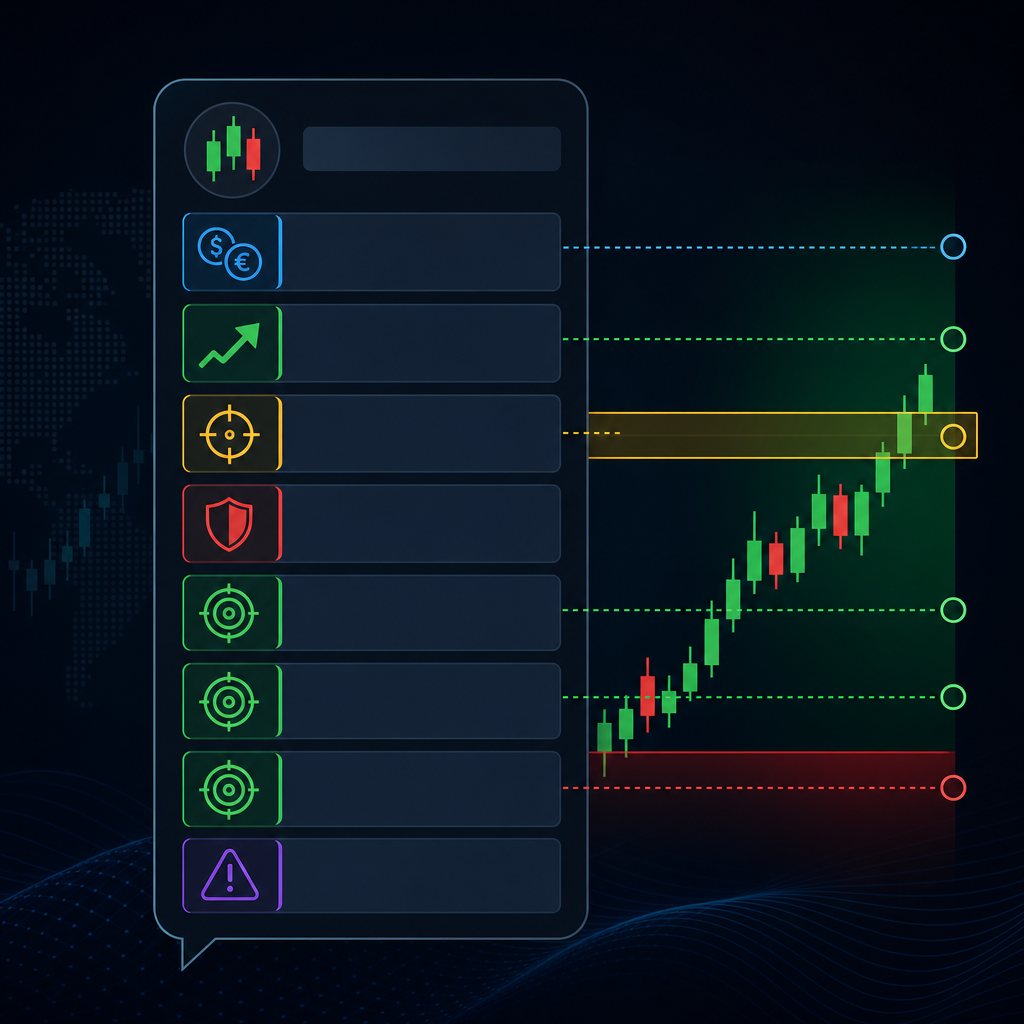
Forex signals are trade ideas shared by an analyst, algorithm, or team.
A proper signal tells you what to trade, where to enter, where to exit if wrong, and where to take profit if right.
For beginners, the most important shift is mindset: a signal is a structured plan, not a magic button.
What a “complete” forex signal includes
When we talk about “high-quality” signals, we mean the message contains enough information to execute the trade without guessing.
- Instrument: EUR/USD, GBP/USD, USD/JPY, or sometimes gold (XAU/USD).
- Direction: Buy or Sell.
- Entry: a price or a zone (example: “Buy 1.0515–1.0525”).
- Stop Loss (SL): the invalidation level (example: “SL 1.0485”).
- Take Profit (TP): one or multiple targets (TP1/TP2/TP3).
- Context: session timing (London/NY), trend bias, key levels, or news risk.
What signals are NOT
Signals are not “guaranteed wins.”
Even a strong provider with an 85%+ win rate can have losing streaks, because markets are probabilistic.
Signals are also not a replacement for learning.
If you don’t understand spreads, lot sizes, and how to place SL/TP correctly, you can turn a good signal into a bad trade.
A quick market-context example (why timing matters)
Right now, the market environment is USD-sensitive: DXY around 106.80, EUR/USD near 1.0520, GBP/USD around 1.2680, and USD/JPY near 149.50.
In a USD-driven tape, a single US data surprise can move EUR/USD 40–80 pips quickly.
That’s why the best beginner approach is not “follow everything.”
It’s “follow the right signals, at the right time, with controlled risk.”
2) The Main Types of Forex Signals (Manual vs Automated vs Copy)
Not all signals are created the same, and beginners often pick the wrong type for their personality.
To use forex signals effectively, you need to know how the signal is generated and how you’re expected to execute it.
Manual signals (analyst-driven)
Manual signals come from traders who read price action, indicators, and fundamentals.
They’re often best for beginners because the provider can explain the “why,” not just the “what.”
That explanation matters when price doesn’t move immediately, or when spreads widen around London open.
Automated signals (algorithm-driven)
Automated signals are generated by rules or AI models.
They can be fast and consistent, but they can also be blind to unusual context.
Example: an algo might trigger a breakout entry right before a major speech, when slippage risk is elevated.
Copy trading (account mirroring)
Copy trading mirrors positions from a master account.
It feels “hands-off,” but beginners underestimate the hidden variables: execution speed, broker differences, and risk scaling.
If the master uses 3% risk and you copy at 3% risk, a normal drawdown can become emotionally unbearable.
Comparison table: which signal style fits beginners best?
| Signal Type | Best For | Pros | Cons | Beginner Tip |
|---|---|---|---|---|
| Manual (Telegram) | Learning + controlled execution | Context, education, adaptable | Requires you to place trades | Use a checklist before entry |
| Automated alerts | Rule-based systems | Fast, consistent, scalable | Can ignore news/session nuance | Avoid trading into major events |
| Copy trading | Hands-off followers | Convenient, minimal decisions | Execution mismatch, risk mismatch | Cap risk at 0.5%–1% per trade |
| Hybrid (Manual + education) | Serious beginners | Best balance of learning + results | Needs attention during sessions | Journal every trade for 30 days |
At United Kings, our edge is the hybrid approach: premium Telegram signals with clear Entry, SL, and TP levels, plus education so you can grow beyond dependency.
3) How to Choose a Forex Signal Provider (Beginner Checklist)

Choosing a provider is the most important decision you’ll make as a signal follower.
Beginners often choose based on hype: screenshots, Lambos, or “100% win rate” claims.
Professionals choose based on process, transparency, and risk control.
Start with the non-negotiables
Before you pay for anything, confirm the provider does these basics consistently.
- Clear trade structure: Entry, SL, TP (not vague “buy now”).
- Risk language: mentions SL discipline and position sizing.
- Session awareness: London and NY session context, not random hours.
- Performance transparency: realistic reporting, not cherry-picked wins.
- Community and support: you can ask questions and get clarity.
Red flags beginners should run from
If you see these, you’re not looking at a signal service—you’re looking at marketing.
- “Guaranteed profit” or “can’t lose” language.
- No stop loss provided.
- Martingale advice (“add more lots to recover”).
- Pressure tactics (“buy now or you’ll stay broke”).
- Unverifiable results with no methodology.
A practical provider evaluation workflow (step-by-step)
- Observe for 7 days: watch how signals are posted and managed.
- Check signal completeness: are entries and SL/TP consistent?
- Compare to live charts: do trades respect key levels or look random?
- Track 20 signals on demo: measure execution, slippage, and your own discipline.
- Assess communication: do they update trades, partial profits, or invalidations?
If you want a ready-made checklist, we’ve built one specifically for beginners: Forex trading signals provider checklist for beginners.
Where United Kings fits (and why beginners like it)
United Kings is designed for traders who want clarity and structure.
We focus heavily on London and New York sessions, where liquidity is highest and spreads are typically more stable.
We also have a 300K+ active trader community, which matters more than you think when you’re learning and need quick feedback.
You can explore our full offering on the United Kings signals page, or go directly to our premium forex signals if FX is your main focus.
4) How to Read a Forex Signal Like a Pro (Even If You’re New)
Most beginners don’t lose because the signal was “bad.”
They lose because they misread the signal, enter late, ignore the stop, or take profit too early.
So let’s break down how to read a signal message correctly.
The anatomy of a clean signal (example)
Imagine you receive:
- GBP/USD SELL
- Entry: 1.2680–1.2690
- SL: 1.2720 (30–40 pips depending on entry)
- TP1: 1.2620
- TP2: 1.2580
This is a complete plan.
Your job is not to “improve” it emotionally.
Your job is to execute it correctly, with correct risk.
Entry types beginners must understand
- Market entry: you enter immediately at current price. Best when timing is critical.
- Limit entry: you set a better price and wait. Best when the signal is a pullback idea.
- Stop entry: you enter only if price breaks a level (breakout confirmation).
If the signal gives a zone like 1.2680–1.2690, it’s telling you the provider expects a reaction in that area.
If you enter at 1.2705 because of FOMO, you’ve changed the trade.
Now your SL is tighter in real terms, your RR is worse, and the idea may fail even if the original plan worked.
Stop loss is not “optional”—it’s the cost of information
Think of SL as the price you pay to find out if you’re right.
In a market where EUR/USD can jump 20 pips in minutes during NY open, not having an SL is like driving without brakes.
Beginners often say, “I’ll close manually.”
But manual closing fails when volatility spikes or when you’re away from the screen.
Take profit: how pros think about exits
Professional signal execution is about risk-reward and trade management.
Example: EUR/USD buy at 1.0520, SL 1.0485 (35 pips risk).
A 1:2 target is 70 pips, so TP could be near 1.0590.
A 1:3 target is 105 pips, so TP could be near 1.0625.
Even if your win rate is only 45%–55%, strong RR can still produce consistent growth—if you stick to the plan.
5) How to Use Forex Signals Step-by-Step (Execution Blueprint)
If you want consistent results with forex signals for beginners, you need a repeatable workflow.
Not a “vibe.” Not a guess. A process you can follow on your best day and your worst day.
Step 1: Check the session (London/NY matters)
Liquidity and volatility are not evenly distributed across the day.
Most clean moves happen during London and New York overlap.
That’s why United Kings focuses on those windows: execution quality is typically better, and spreads are usually tighter.
Step 2: Check spread and broker conditions
Before you place the trade, look at the spread.
On majors like EUR/USD, a typical spread might be 0.5–1.5 pips on a good broker.
But around news, spreads can widen dramatically, turning a good entry into a poor fill.
For beginners, a simple rule works: if spread is unusually high, skip or reduce size.
Step 3: Confirm the entry type and set the order correctly
- If the signal says “buy now,” use a market order.
- If the signal gives a zone below current price for a buy, use a buy limit.
- If the signal is a breakout above a level, use a buy stop.
This sounds basic, but it’s a common beginner mistake.
Wrong order type leads to wrong entry, and wrong entry leads to emotional decisions.
Step 4: Place SL and TP immediately
Don’t “add them later.”
Add SL and TP at the moment of entry so your risk is capped from second one.
If you’re trading from a phone, double-check the number of digits (especially on JPY pairs).
Step 5: Record the trade (yes, even as a beginner)
Open a simple journal: date, pair, entry, SL, TP, outcome, and notes.
After 30 trades, you’ll see patterns in your execution.
That’s where most beginners find their biggest improvement.
Step 6: Follow the management rules, not your emotions
If the provider says “move SL to breakeven after +30 pips,” do it.
If the provider says “partial at TP1,” follow it.
Signals work best when you treat them like a system, not like entertainment.
If you also trade metals, our gold signals follow the same structure—Entry, SL, TP—because execution discipline is universal.
6) Risk Management for Signal Followers (The Beginner Framework)
Risk management is the difference between a beginner who survives and a beginner who disappears.
You can have the best signal provider in the world and still blow an account with poor sizing.
So let’s make this practical and numbers-driven.
The 1% rule (and why it works)
If you risk 1% per trade, you can take a normal losing streak without emotional collapse.
Example: $1,000 account.
1% risk = $10 per trade.
If your SL is 35 pips on EUR/USD, your position size is based on $10 / 35 pips.
You don’t need to be perfect—you need to be consistent.
Position sizing step-by-step (simple version)
- Pick risk per trade: 0.5%–1% (beginners).
- Measure SL distance: in pips (forex) or dollars (gold).
- Calculate lot size: so SL equals your chosen $ risk.
- Round down: always round down, never up.
Gold example (XAU/USD) to make risk real
Gold is trading around $2650 (+0.35% on the day), which is a realistic zone for active intraday moves.
Say you receive a gold signal:
- XAU/USD BUY 2650
- SL 2638 (12 dollars risk)
- TP 2674 (24 dollars reward = 1:2)
If you risk $10 on the trade, you size so a $12 move against you equals $10 loss.
That’s how you stop “random lot sizing,” which is one of the fastest ways beginners blow up.
Drawdown rules beginners should adopt
- Daily loss limit: stop after -2% in a day (or 2 losses).
- Weekly loss limit: stop after -5% in a week.
- No revenge trades: if you break this rule once, you’ll break it again.
These rules protect your psychology.
And in signal trading, psychology is often the true edge.
For a deeper framework, bookmark this guide: risk management strategies when using forex signals.
7) Understanding Market Context: News, DXY, and Volatility (Beginner Edition)
Signals don’t exist in a vacuum.
They exist inside a market that reacts to central banks, inflation prints, employment data, and geopolitical headlines.
If you ignore context, you’ll blame signals for what is actually normal volatility.
Why DXY matters to beginners
The US Dollar Index (DXY) is a broad measure of USD strength.
With DXY around 106.80, USD is relatively firm.
That can pressure EUR/USD (near 1.0520) and influence GBP/USD (near 1.2680).
When DXY is trending strongly, counter-trend signals require more patience and tighter execution.
USD/JPY as a volatility indicator
With USD/JPY around 149.50, traders are also watching rate differentials and potential policy commentary.
JPY pairs can move fast, and spreads can widen during sudden headlines.
If you’re a beginner, treat JPY signals with extra caution and smaller size until you’re comfortable.
News timing: what you should do before entering any signal
You don’t need to become a macro expert.
You do need one habit: check whether a major release is imminent.
- If major news is within 15–30 minutes, consider waiting.
- If the signal is specifically a news trade, expect slippage and plan smaller size.
- If spreads are widening, your broker is warning you—listen.
Gold context (safe haven behavior)
Gold around $2650 can react sharply to risk sentiment, yields, and USD moves.
In a risk-off moment, gold can spike $15–$30 quickly.
That’s why gold signals typically use SL distances like $10–$25, and why you must size correctly.
If you want to see how signals behave when the unexpected hits, read: how gold signals react to unexpected news events.
8) Common Beginner Mistakes When Following Forex Signals (And Fixes)
If you want to shortcut your learning curve, study mistakes.
Not theoretical mistakes—real ones that happen every day in Telegram groups.
Mistake #1: Entering late (and pretending it’s the same trade)
A signal says buy EUR/USD 1.0520 with SL 1.0485.
You enter at 1.0532 because you were busy.
Now your risk is effectively larger, and your reward is smaller.
Fix: if you miss the entry zone, skip the trade or wait for a new setup.
Mistake #2: Moving the stop loss “just this once”
This is the account killer.
One widened SL turns into two, then five, then a margin call.
Fix: decide your SL is final before you enter. If you can’t accept the SL, you can’t afford the trade.
Mistake #3: Over-leveraging because the provider has a high win rate
Even strong providers lose.
If you risk 10% per trade, two losses can put you into panic mode.
Fix: cap risk at 0.5%–1% until you have 60–100 trades of history.
Mistake #4: Taking profit too early and letting losses run
Beginners often grab +10 pips, then take -35 pips.
That math doesn’t work, even with a good win rate.
Fix: follow the TP plan or use partials: take some at TP1, let the rest run.
Mistake #5: Signal hopping (switching providers every week)
Every system has drawdowns.
If you quit during a drawdown, you never experience the recovery phase.
Fix: commit to a provider for a measured sample size (e.g., 50 signals), then evaluate.
If you want a signals community designed to reduce these mistakes, our forex signals Telegram beginner guide explains how to follow alerts with structure.
9) Building Consistency With Forex Signals: A 30-Day Beginner Plan
Beginners often ask, “How fast can I become profitable with signals?”
The better question is: “How fast can I become consistent?”
Consistency is what makes profitability possible.
Week 1: Demo-only execution training
Your goal is not profit.
Your goal is perfect execution.
- Take 10–15 signals on demo.
- Place SL/TP instantly.
- Record screenshots and outcomes.
- Note spread at entry and any slippage.
Week 2: Add a pre-trade checklist
Now you slow down slightly to speed up long-term.
Before each trade, confirm:
- Is this London or NY session (or overlap)?
- Is major news within 30 minutes?
- Is spread normal?
- Did I calculate lot size for 0.5%–1% risk?
- Am I entering inside the zone?
Week 3: Go live with micro size (if demo discipline is solid)
Going live changes everything emotionally.
That’s why you go small.
Even $2–$5 risk per trade is enough to feel the psychology while protecting capital.
Week 4: Review, refine, and specialize
At the end of 30 days, review your journal.
Look for execution errors, not “bad signals.”
- How many trades were late entries?
- How many times did you move SL?
- Did you follow TP rules consistently?
- Which pairs fit you best (EUR/USD vs GBP/USD vs USD/JPY)?
This is also where many beginners decide whether they prefer forex-only or a mix of forex and metals.
If you want both, United Kings offers structured alerts on forex signals and gold signals under one ecosystem.
10) Realistic Trade Examples Using Current Market Levels (Forex + Gold)
Let’s make the “how to use forex signals” concept concrete with realistic examples around current prices.
These are educational examples, not promises.
The goal is to show you how to think about entries, stops, and targets.
Example A: EUR/USD continuation idea (around 1.0520)
Market context: DXY near 106.80 suggests USD strength is still a factor.
Signal structure (example):
- EUR/USD SELL 1.0520–1.0530
- SL 1.0560 (30–40 pips)
- TP1 1.0460 (60–70 pips = ~1:2)
- TP2 1.0420 (~1:3)
Beginner execution tip: if your broker spread is 1.8 pips when it’s usually 0.8, consider waiting.
That spread difference can be the line between a clean fill and an early stop-out.
Example B: GBP/USD pullback buy (around 1.2680)
Market context: Cable can be volatile in London, especially around UK headlines.
Signal structure (example):
- GBP/USD BUY 1.2665–1.2680
- SL 1.2625 (40–55 pips)
- TP 1.2760 (80–95 pips = ~1:2)
Beginner execution tip: use a limit order if price is above the zone.
Chasing price is how beginners turn 1:2 trades into 1:1 trades without realizing it.
Example C: USD/JPY momentum trade (around 149.50)
Market context: USD/JPY can spike on policy commentary.
Signal structure (example):
- USD/JPY BUY 149.40–149.60
- SL 148.90 (50–70 pips depending on entry)
- TP 150.60 (100–120 pips = ~1:2)
Beginner execution tip: reduce risk (0.5%) on JPY pairs until you’ve traded them through a few news cycles.
Example D: Gold (XAU/USD) intraday long (around $2650)
Market context: Gold at $2650 is active and can move quickly when USD shifts.
Signal structure (example):
- XAU/USD BUY 2648–2652
- SL 2635 (13–17 dollars)
- TP1 2674 (22–26 dollars = ~1:2)
- TP2 2686 (34–38 dollars = ~1:3)
Beginner execution tip: gold spreads can widen during spikes; if you see abnormal spread, wait for stabilization.
If you want these kinds of structured setups delivered in real time, explore United Kings premium signals and choose the market you want to focus on.
11) Free vs Premium Forex Signals: What You Really Pay For
Beginners love free signals.
That makes sense—until you realize what “free” often costs: inconsistency, lack of updates, and zero accountability.
Premium isn’t about paying for a message.
It’s about paying for a repeatable process, disciplined risk framing, and community support.
What free signal channels usually lack
- Trade management: no updates when conditions change.
- Consistent SL/TP structure: vague targets, missing stops.
- Transparency: only winners posted, losses deleted.
- Education: you stay dependent and confused.
What premium signals should include
- Clear Entry, SL, TP every time.
- Consistency: a defined trading style (scalp/day/swing).
- Session strategy: London/NY focus where execution is cleaner.
- Performance culture: realistic expectations and reporting.
- Support: ability to ask questions when you’re unsure.
United Kings value props (what beginners typically care about)
We built United Kings for traders who want premium structure without the noise.
- Premium Telegram signals for forex and gold with clear Entry, SL, TP.
- 85%+ win rate as a performance target with disciplined execution (no profit guarantees).
- 300K+ active traders in our community.
- Education alongside signals so you become independent over time.
- 48-hour money-back guarantee for peace of mind.
Pricing that matches different commitment levels
We keep it simple with three plans on our pricing page:
- Starter (3 Months): $299 (~$100/month)
- Best Value (1 Year): $599 (~$50/month) + FREE ebook (50% savings)
- Unlimited (Lifetime): $999 (pay once, access forever)
If you also diversify into crypto, we offer that too via crypto signals, but beginners should master one market first.
12) FAQ: Forex Signals for Beginners
Are forex signals good for beginners?
Yes, if you treat signals as a structured learning tool and follow strict risk management.
They’re especially useful when the provider includes clear Entry/SL/TP and explains the reasoning.
How many signals should I take per day as a beginner?
Start with 1–3 trades per day maximum, or even fewer.
Your goal early on is execution quality, not trade quantity.
What risk percentage should beginners use with signals?
Most beginners should risk 0.5% to 1% per trade.
If you’re emotional or new to live trading, start at 0.25%–0.5%.
Should I use forex signals during major news?
You can, but you must understand that spreads and slippage can increase.
Beginners should either avoid trading within 15–30 minutes of major releases or reduce position size significantly.
How do I know if a signal provider is legit?
Look for consistency, transparency, complete trade plans (Entry/SL/TP), and realistic communication around losses.
Avoid anyone promising guaranteed profits or refusing to show risk controls.
Risk Disclaimer: Forex and gold trading involves significant risk and may not be suitable for all investors. You can lose more than your initial deposit when trading with leverage. Signals and educational content are provided for informational purposes only and do not constitute financial advice. Past performance does not guarantee future results. If you are a beginner, practice on a demo account first and trade only with money you can afford to lose.
Ready to Follow Forex Signals the Right Way?
If you’re serious about learning how to use forex signals with discipline, structure, and professional risk control, join the United Kings community.
We deliver premium forex and gold signals with clear Entry, SL, and TP levels, optimized for the London and New York sessions.
- Explore our full offering: United Kings premium signals
- Focus on currencies: Forex signals
- Trade metals with structure: Gold signals
- Join our Telegram now: United Kings Telegram channel
When you’re ready, choose the plan that fits your commitment level on our pricing page (Starter 3 Months $299, Best Value 1 Year $599 with FREE ebook, or Lifetime $999).
Build consistency first. Profits come second.


