
Ever entered a “London open breakout” on XAUUSD… only to watch gold spike 6–10 dollars, tag your stop, then run 25 dollars in the original direction?
If you trade gold (XAUUSD) around the London session, you’ve felt that sting.
At current levels near $2650 (+0.35% on the day), gold is liquid, reactive, and sometimes brutally deceptive in the first 30–90 minutes of London.
This guide is built to fix that, using a simple but strict framework: mark the Asian range, confirm volatility with ATR, and avoid low-quality entries by checking real-time spread + liquidity conditions.
TL;DR — The London Open Breakout Filter (XAUUSD)
- Define the Asian range: mark the high/low from roughly 00:00–06:00 London time (adjust to your broker time) and treat it as your breakout box.
- Use ATR as a volatility “permission slip”: if 14-ATR on M15 is too low, skip the breakout—gold won’t follow through.
- Spread is a trade filter, not a nuisance: if spread widens beyond your threshold (e.g., >$0.35–$0.60), your R:R collapses—no trade.
- Entry trigger = close + retest: prefer a candle close beyond the Asian high/low, then a retest that holds (reduces fakeouts).
- Stops and targets must be mechanical: SL typically $10–$25 from entry, TP at 1:2 or 1:3 (example: risk $12 to make $24–$36).
- Validate Telegram/MT4 signals with a checklist: session context, ATR, spread, distance to liquidity, and news risk before executing.
Why the London Open Breakout Works on XAUUSD (and Why It Fails)
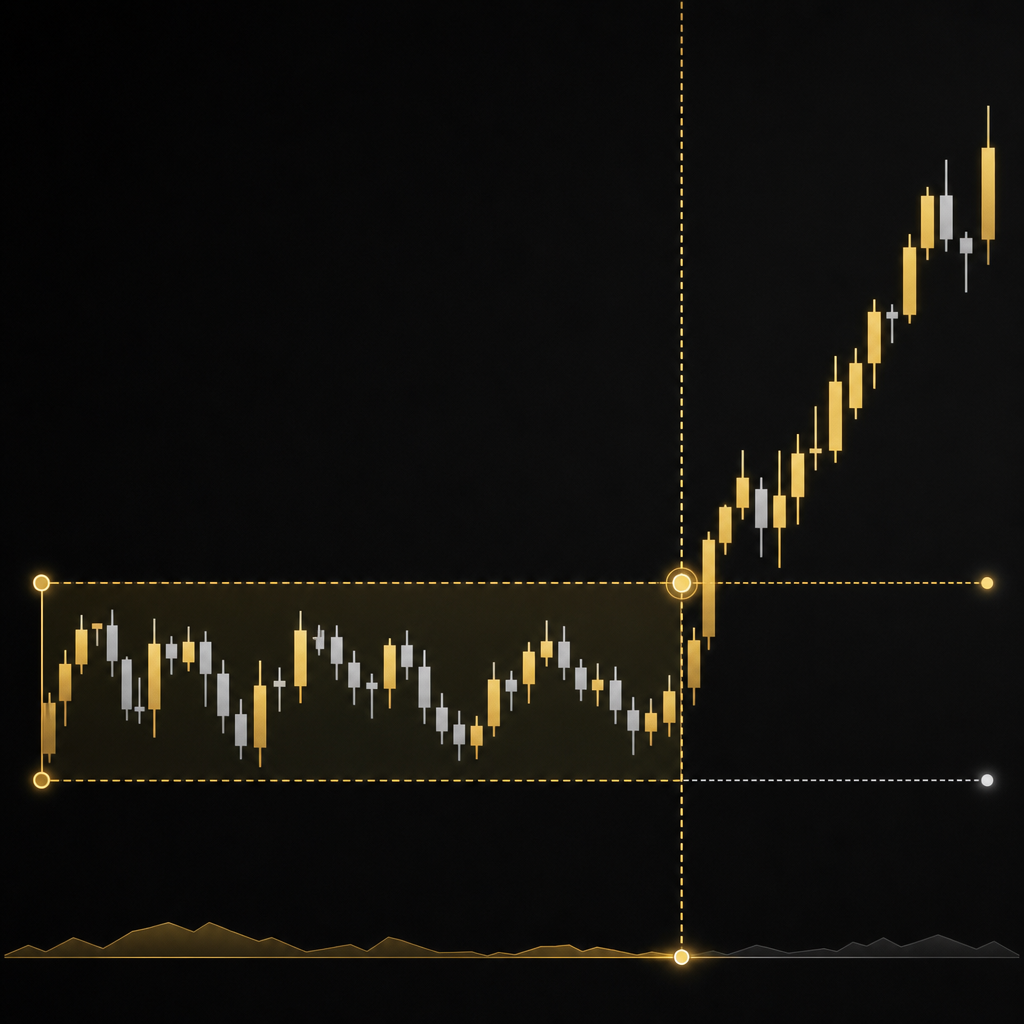
The London open is one of the few daily windows where gold can shift from “range mode” to “trend mode” fast.
That shift is driven by a real change in participation: European liquidity joins the market, spreads tighten, and orders that were parked during Asia get triggered.
When it works, it’s clean: Asia forms a tight box, London breaks it, and price runs 20–50 dollars with minimal pullback.
When it fails, it usually fails for predictable reasons.
The 3 common failure modes
- Low volatility: Asia range is tiny and ATR is compressed. London “breaks” it by $2–$4, then stalls.
- Spread/liquidity distortion: around the open or around data, spread balloons and your entry is effectively worse than your chart shows.
- Liquidity sweep: London runs stops above the Asian high (or below the low), then reverses hard. This is common on days when DXY is firm (currently 106.80) and gold is fighting macro flows.
The solution is not to abandon the setup.
The solution is to trade it like a professional: with filters.
At United Kings, our gold traders focus heavily on London and NY sessions because that’s where the best follow-through and cleanest signal execution tends to happen.
But we also know the truth: the same session that creates opportunity also creates traps.
How today’s broader market context affects the setup
With USD/JPY near 149.50 and DXY at 106.80, the dollar is not weak.
That matters because gold’s London breakout often turns into a tug-of-war between momentum traders and macro flows.
Meanwhile, EUR/USD at 1.0520 and GBP/USD at 1.2680 suggest risk sentiment is mixed rather than euphoric.
In mixed conditions, your breakout method must be strict about confirmation, or you’ll end up trading noise.
Define the Asian Range for Gold: The Only Box That Matters
The Asian range is your map.
Without it, “London breakout” is just a vibe.
With it, you have a measurable structure: a high, a low, and a midpoint that tells you where liquidity sits.
Step-by-step: how to mark the Asian session range
- Pick a consistent time window: a common approach is 00:00–06:00 London time. If your broker server time differs, convert it and stick to one rule.
- Use M15 or M30: M15 gives precision; M30 reduces noise. For most signal followers, M15 is a sweet spot.
- Mark the high and low of that window with horizontal lines.
- Measure the range size (in dollars). Example: Asian high $2646.80, Asian low $2636.40 → range = $10.40.
- Mark the midpoint: ($2646.80 + $2636.40) / 2 = $2641.60. This often acts like a magnet on fakeout days.
What a “good” Asian range looks like for XAUUSD
Gold is not EUR/USD.
It needs room to breathe.
In the $2610–$2690 environment, a practical guideline is:
- Too small: under ~$6–$8 range → often leads to whipsaw unless ATR confirms expansion.
- Healthy: ~$9–$18 range → often provides clean breakout structure.
- Too large: above ~$22–$25 range → London may be “late to the party” and you risk chasing.
This is not a rigid law.
It’s a framework that becomes powerful when combined with ATR and spread filters.
Where most traders go wrong
They redraw the box to fit the story.
They see a breakout and then “adjust” the Asian high by $1.20 to justify entry.
Don’t do that.
Use fixed rules so you can judge performance and improve.
If you want a broader foundation on gold behavior and session timing, pair this with our educational resources inside United Kings Gold Signals, where we share structured entries with clear SL/TP and the context behind them.
ATR Filter for Gold Signals: When Volatility Gives You Permission
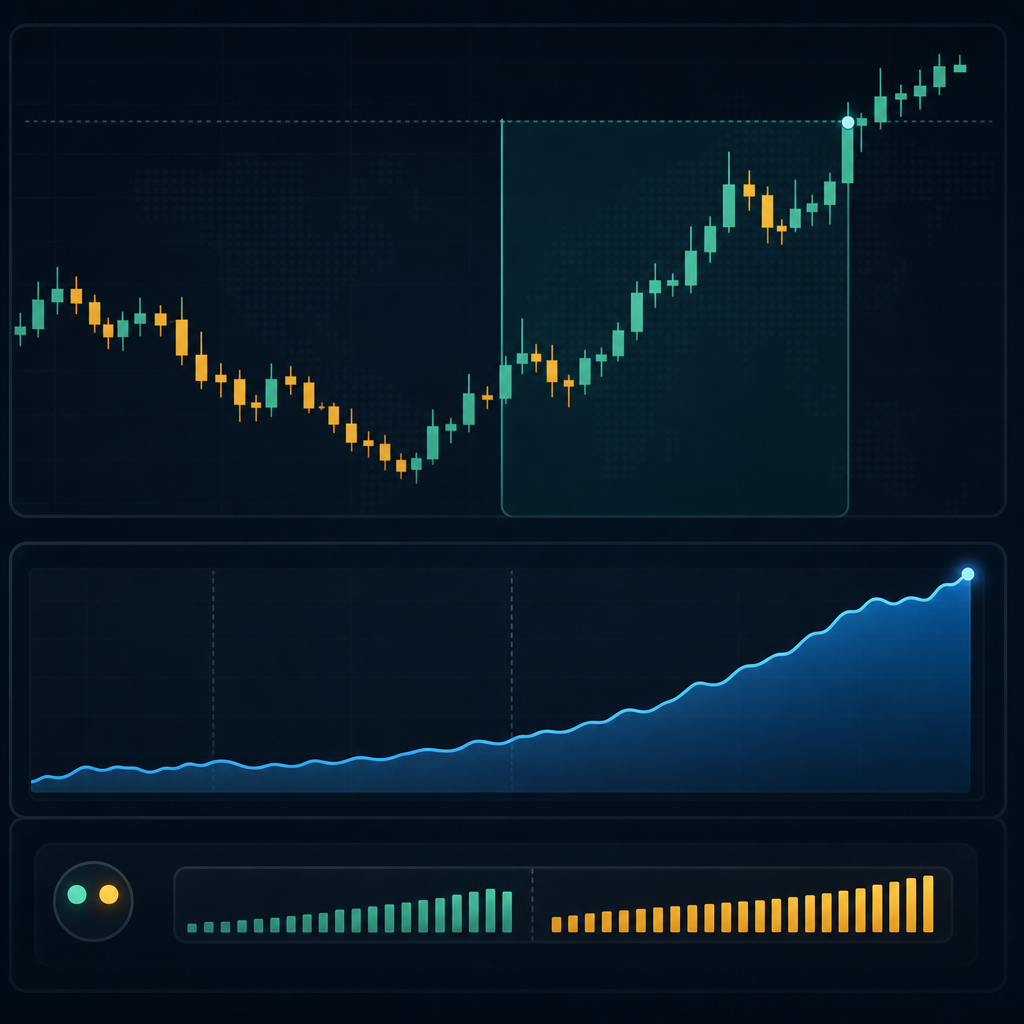
ATR (Average True Range) is the simplest “reality check” indicator in trading.
It doesn’t predict direction.
It tells you whether the market is moving enough to justify a breakout trade.
Why ATR matters specifically at the London open
London open is a volatility event.
But not every day delivers the same expansion.
On quiet macro days, gold can open London and still remain sticky inside the Asian box.
On high-energy days (news risk, yields moving, strong USD flows), gold can expand violently.
ATR helps you avoid forcing trades on “quiet London” days.
Step-by-step: the ATR setup we recommend
- Timeframe: M15 (for execution) and H1 (for context).
- Period: ATR(14) is standard and stable.
- Read ATR in dollars: if ATR(14) on M15 is 4.5, that means the average M15 candle range is about $4.50.
Practical ATR thresholds (use these as a starting point)
Because gold volatility changes over time, we use relative thresholds rather than pretending one number fits all years.
Still, with XAUUSD around $2650, these are realistic working bands:
- Low volatility: M15 ATR(14) below ~$3.2 → breakout follow-through is less reliable.
- Tradeable: M15 ATR(14) ~$3.2–$5.8 → best zone for structured breakouts.
- High volatility: M15 ATR(14) above ~$5.8 → breakouts can run, but SL placement and spread discipline become critical.
ATR + Asian range: the simple “expansion logic”
Here’s the key relationship:
- If the Asian range is $10 and M15 ATR is $2.5, London may not have enough “fuel” to break and continue.
- If the Asian range is $10 and M15 ATR is $4.5, a breakout candle can clear the range and still have room to extend.
A clean rule you can test:
- Only trade the breakout if M15 ATR(14) is at least 30–45% of the Asian range size.
Example: Asian range = $12.00.
Minimum ATR threshold (35%) ≈ $4.20.
If ATR is $3.0, you skip or you wait for ATR to rise after the open.
How we use ATR to validate signals
When you receive a Telegram signal (or an MT4 alert), ATR is one of the fastest filters.
If a “breakout buy” is sent but ATR is compressed and price is still inside the Asian box, that’s a yellow flag.
Inside our community of 300K+ active traders, this is one of the simplest shared habits that improves execution quality.
Spread and Liquidity Filter: The Hidden Cost That Destroys R:R
Most traders treat spread like weather.
They complain about it and then trade anyway.
But spread is not just a cost.
Spread is information about liquidity conditions at the exact moment you’re trying to break out.
Why spread matters more on XAUUSD than most pairs
Gold can move $5 in a minute.
That makes traders careless with a $0.40 spread.
But your stop on gold might be $12–$18.
If you pay $0.60–$1.20 spread during a liquidity wobble, you just donated 3–10% of your risk budget before the trade even breathes.
Realistic spread thresholds for London open trading
Spreads vary by broker, account type, and market conditions.
So you need a rule that fits your environment.
As a starting point for many retail feeds:
- Green light: spread ≤ $0.25–$0.35
- Caution: spread $0.35–$0.60 (only trade if setup is A+ and ATR supports)
- No trade: spread ≥ $0.60–$0.80 (your entry becomes a coin flip)
If your broker typically shows $0.18 and suddenly prints $0.55 at the open, that’s a clue.
Liquidity is unstable, and “breakouts” are more likely to be stop runs.
How spread ruins your stop placement (a quick math example)
Assume you buy XAUUSD at $2652.00 with a $0.50 spread.
Your chart shows 2652.00, but your actual fill might be 2652.25–2652.50 depending on execution.
If your SL is at 2640.00 (risk $12), your effective risk might be closer to $12.50–$13.00.
Your 1:2 target at 2676.00 is now a smaller true multiple.
That’s how a strategy that “works on paper” collapses in real trading.
Liquidity filter: the “first 3 minutes” rule
One of the simplest filters we teach is timing-based:
- Avoid placing market orders in the first 1–3 minutes of the London open unless spread is stable and your broker execution is proven.
Let the first burst print.
Then execute on a retest with controlled spread.
If you want a deeper breakdown of how spreads impact gold trading decisions, our related education piece United Kings Blog includes practical execution guidance, and our signal room often calls out “spread conditions” explicitly before entry.
The London Open Breakout Framework for XAUUSD (Rules You Can Follow)
Let’s turn the idea into a rule-based playbook you can execute consistently.
The goal is not to predict the day’s high.
The goal is to capture the cleanest 1–2 moves that London often provides.
Core concept
- Asian session builds the trap.
- London session triggers the move.
- NY session either extends it or reverses it.
Step-by-step rules (base model)
- Mark Asian high/low (your breakout box).
- Check M15 ATR(14) is in your tradeable zone.
- Check spread is within your threshold.
- Wait for a candle close outside the box (not just a wick).
- Enter on retest: price returns to the broken level and holds.
- Place SL beyond structure (usually beyond the opposite side of the retest or beyond the midpoint).
- Target 1:2 first, then consider 1:3 if momentum and ATR expansion continue.
Breakout buy example (realistic numbers near current price)
Assume Asia prints:
- Asian high: $2648.60
- Asian low: $2638.40
- Range: $10.20
At London, M15 ATR(14) is $4.3 and spread is $0.28.
Price closes above the Asian high at $2650.20.
Retest pulls back to $2648.80–$2649.10 and holds.
- Entry: Buy $2649.20
- Stop: $2637.80 (risk $11.40) or a tighter structural stop like $2640.80 (risk $8.40) if the retest is clean
- TP1 (1:2): $2672.00 (approx +$22.80 on $11.40 risk)
- TP2 (1:3): $2683.40 (approx +$34.20 on $11.40 risk)
Notice the logic: targets are not random.
They are risk multiples in a volatility window where gold can realistically travel $20–$35 if momentum is real.
Breakout sell example
Assume Asia prints:
- Asian high: $2661.20
- Asian low: $2650.90
London sweeps above $2661.20, fails, then closes below the Asian low at $2650.40.
- Entry: Sell $2650.30 on retest
- Stop: $2664.80 (risk $14.50)
- TP1 (1:2): $2621.30
- TP2 (1:3): $2606.80 (only if volatility supports; otherwise take partials)
If you’re following professional alerts, our United Kings Signals focus on sending entries with clear SL/TP so you can map trades like the examples above without guessing.
Retest vs Market Entry: The Execution Choice That Saves Accounts
Most retail traders lose money on breakouts for one reason: they buy the top of the breakout candle.
On gold, that candle can be $6–$12 tall.
Buying the top means your stop must be wider, your R:R gets worse, and you become exit liquidity on the retest.
Why “close + retest” beats “instant market buy”
- Filters fakeouts: a close outside the range shows commitment.
- Improves price: retests often offer $1–$4 better entry on XAUUSD.
- Tighter stops: you can tuck SL beyond the retest swing instead of beyond the whole range.
- Better psychology: you’re not chasing; you’re executing a plan.
Step-by-step: how to trade the retest properly
- Wait for the breakout close beyond Asian high/low on M15 (or M5 if you’re experienced).
- Mark the broken level (e.g., Asian high at $2648.60).
- Wait for price to revisit $2648.60–$2649.20.
- Look for hold confirmation: small rejection wick, bullish/bearish engulf, or simply inability to close back inside the range.
- Enter with a limit or tight market execution when spread is stable.
Two retest styles (and when to use each)
- Soft retest: price taps the level and bounces quickly. Use when momentum is strong and ATR is expanding.
- Deep retest: price dips $2–$5 back into the range before reclaiming. Use only if the breakout structure remains valid and the close reclaims the level.
Deep retests are where many traders panic.
But deep retests can be the best entries—if your rules say the setup is still alive.
When to skip the retest trade
- Spread widens during the pullback (liquidity instability).
- Price closes back inside the Asian range twice (breakout failed).
- ATR collapses immediately after the breakout candle (no follow-through).
This is also why our Telegram delivery matters: we don’t just send “BUY NOW.”
We send structured levels so you can execute with patience, especially around the open on a fast product like gold.
Stop-Loss Placement on XAUUSD Breakouts (Without Getting Wicked Out)
Gold loves to wick.
If you place stops at obvious levels, you will feel personally targeted.
You’re not targeted—your stop is simply where liquidity lives.
The three most practical SL models for this strategy
1) Opposite side of Asian range
- Best for: conservative traders, wider swings, higher win stability.
- Cost: larger stop, smaller position size.
Example: Asian low $2638.40, breakout buy entry $2649.20 → SL $2637.80 (risk $11.40).
2) Retest swing low/high
- Best for: clean retests with tight structure.
- Risk: more likely to be wicked if volatility spikes.
Example: retest swing low forms at $2642.30 → SL $2640.80 (risk $8.40).
3) ATR-based stop (volatility stop)
- Best for: adapting to changing volatility day-to-day.
- Method: SL distance = 2.0–2.5 × M15 ATR(14) from entry, adjusted to structure.
If ATR is $4.3, 2.5×ATR ≈ $10.75.
That aligns perfectly with the “typical $10–$25” stop range for gold in this environment.
Stop placement rules that reduce random losses
- Never place SL exactly on the Asian high/low. Give it breathing room ($0.80–$2.50 depending on volatility).
- Respect round numbers: $2650, $2660, $2670 often act like magnets. Stops too close to them are easy targets.
- Don’t tighten SL just to increase lot size. That is a psychological trap disguised as “risk management.”
Position sizing quick guide (so SL makes sense)
Gold position sizing depends on your broker’s contract specs.
But the principle is universal: decide your account risk first, then calculate size.
If you risk 1% of a $5,000 account = $50, and your stop is $12, you need a position size where $12 move equals $50 loss.
This is exactly why we recommend reading our risk framework at risk management strategies when using signals before scaling London session trading.
Take-Profit Targets: 1:2 and 1:3 That Match London Volatility
London open breakouts can run far.
But they can also snap back quickly.
Your take-profit plan must be realistic and systematic.
Why fixed targets beat “I’ll watch it” for most traders
Watching gold tick-by-tick turns trading into gambling.
It also increases the chance you’ll close winners early and let losers hit full SL.
Fixed targets keep you consistent, especially if you’re following signals from a Telegram channel.
The simplest TP model: scale out at 1:2, hold runners to 1:3
- TP1: 1:2 R:R (take 50–70% off)
- TP2: 1:3 R:R (leave 30–50% as a runner)
- Move SL: after TP1, consider moving SL to entry or just behind structure (not instantly—avoid getting tagged on noise)
Example with realistic gold numbers
Buy entry: $2653.40
Stop: $2641.40 (risk = $12.00)
- TP1 (1:2): $2677.40
- TP2 (1:3): $2689.40 (still inside the $2610–$2690 guideline)
If gold is trending and liquidity is strong, $36 move is realistic in a session.
If gold is choppy, TP1 is often the smarter “paid quickly” outcome.
Use session levels to refine targets
Risk multiples are the base.
But you should also respect where price is likely to react:
- Prior day high/low
- NY open levels
- Obvious liquidity pools above $2660/$2670 or below $2640/$2630
Example: if your 1:3 target lands at $2689.40 but yesterday’s high is $2687.80, you may take profit slightly earlier.
That’s not fear.
That’s professional execution.
Comparison Table: Breakout Entry Styles for London Open XAUUSD
Different traders execute the same idea differently.
Here’s a practical comparison so you can choose the method that matches your personality and broker conditions.
| Entry Style | Trigger | Pros | Cons | Best For |
|---|---|---|---|---|
| Instant Market Breakout | Buy/sell the moment price breaks Asian high/low | Captures fast moves; no missed trades | Worst fills; spread risk; higher fakeout rate | Experienced scalpers with tight spreads |
| Candle Close Confirmation | M15 close outside the range | Reduces fakeouts; clearer structure | Late entry on explosive days | Most traders; signal followers |
| Close + Retest (Recommended) | Close outside + retest holds | Best R:R; better stop placement; calmer execution | Sometimes no retest (missed move) | Consistent traders focused on quality |
| Stop Order Above/Below Range | Pending buy stop/sell stop beyond the range | Automates entry; avoids hesitation | Can trigger on spread spikes; vulnerable to sweeps | Traders with strict spread filters |
Signal Validation Checklist: How to Filter Telegram/MT4 Alerts Before You Enter
A premium signal is not just “direction.”
It’s a structured trade idea with context.
Even then, your execution environment (spread, slippage, timing) can turn a good signal into a bad trade.
The London open breakout validation checklist (copy/paste this)
- 1) Session context: Are we at London open or already 90+ minutes late?
- 2) Asian range marked: Do I clearly see the high/low box?
- 3) Range size: Is the Asian range in a reasonable band (roughly $9–$18) or extremely small/huge?
- 4) ATR filter: Is M15 ATR(14) supportive (not compressed)?
- 5) Spread filter: Is spread stable and under my threshold right now?
- 6) Trigger quality: Was there a candle close outside the range (not just a wick)?
- 7) Retest behavior: Did price hold the broken level, or did it close back inside the box?
- 8) News risk: Any high-impact event in the next 30–60 minutes?
- 9) Distance to obvious liquidity: Is the entry too close to a major level (e.g., $2660) where reversals are common?
- 10) My risk is fixed: Lot size calculated from SL distance (not emotion).
How this helps you follow signals like a pro
Most traders treat signals like a remote control.
Professionals treat signals like a pilot treats a checklist.
The checklist doesn’t replace skill—it prevents avoidable mistakes.
Where to learn more about choosing and validating signal sources
If you want a broader framework beyond this London-open setup, read our guide on how to evaluate a signals provider with a checklist.
And if you’re new to Telegram execution specifically, our beginner-friendly breakdown at how Telegram forex signals work for beginners will help you avoid the common copying mistakes.
Timing, News, and “Do Not Trade” Conditions Around London Open
Even the best breakout system needs a “no trade” rule.
Because some mornings are engineered for whipsaws.
Gold is especially sensitive to sudden headlines, yields, and dollar spikes.
The best timing window (realistic and repeatable)
- Primary window: first 30–90 minutes after London open
- Secondary window: London–NY overlap (if the morning range breaks again)
Outside those windows, breakouts can still happen.
But the “London open edge” fades, and you’re back to generic intraday trading.
News filter: when to stand down
Gold can move $15–$30 in seconds on the wrong headline.
So you need a simple policy:
- No new breakout entries within 10–15 minutes before high-impact USD news.
- Be cautious around central bank speakers and surprise geopolitical headlines.
For a deeper look at how signals react when news hits unexpectedly, read how gold signals react to unexpected news events.
“Do not trade” conditions (the ones that save you money)
- ATR is compressed and Asian range is tiny: you’re trading noise.
- Spread is unstable (spiking up and down): execution risk is too high.
- Price breaks both sides of the Asian range within 30 minutes: classic chop day.
- You missed the move: price already ran $18–$25 from the breakout point and you’re chasing.
A realistic “chop day” story
Gold is at $2650.
Asia range is $6.80 (tight).
London opens, price wicks above the high by $3.20, then dumps below the low by $4.10.
Both breakouts “trigger,” both fail.
That’s not bad luck.
That’s a day your filters were designed to avoid.
Putting It All Together: A Complete Step-by-Step London Open Breakout Playbook
This is the full workflow you can follow every trading day.
Print it, save it, or turn it into a note on your phone.
Consistency is where the edge lives.
Step 1: Pre-London preparation (10 minutes)
- Open XAUUSD chart on M15.
- Mark Asian high/low and midpoint.
- Note prior day high/low.
- Check M15 ATR(14) value.
- Check calendar for high-impact news.
Step 2: London open execution rules (30–90 minutes)
- Watch for a candle close outside the Asian range.
- Confirm spread is within threshold.
- Wait for a retest of the broken level.
- Enter only if the retest holds and price doesn’t close back inside the box.
Step 3: SL/TP placement (mechanical)
- SL: $10–$25 depending on structure and ATR.
- TP1: 1:2 R:R.
- TP2: 1:3 R:R if momentum continues and spread remains stable.
Step 4: Trade management (keep it simple)
- If TP1 hits, consider partial close and protect the trade.
- If price returns inside the Asian range and closes there, treat it as a failure signal.
- Don’t revenge trade the opposite breakout without a fresh structure.
Step 5: Post-trade review (5 minutes)
- Screenshot entry/exit.
- Record ATR, spread, and range size.
- Grade the setup (A/B/C).
This is exactly the kind of structured thinking we reinforce inside our Gold Signals service—signals plus education, so you’re not just copying trades, you’re building skill.
FAQ: XAUUSD London Open Breakout (ATR, Spread, Asian Range)
1) What time is the London open for XAUUSD trading?
London FX session typically “opens” around 08:00 London time, but liquidity often starts building 30–60 minutes earlier. Use your broker time conversion and keep it consistent.
2) What’s the best timeframe for the Asian range breakout on gold?
Most traders do best marking the Asian range on M15 or M30. For entries, M15 with a close + retest trigger is a strong balance of clarity and precision.
3) What ATR setting should I use for the ATR filter?
ATR(14) on M15 is a reliable standard. Use it as a volatility filter rather than a direction tool, and compare it to your Asian range size.
4) How wide should my stop loss be for London open gold breakouts?
In the current volatility environment around $2650, many breakout trades use $10–$25 stops depending on structure and ATR. Your position size should adjust to your stop—not the other way around.
5) Can I use this strategy when spread is high?
You can, but it usually turns a good setup into a low-quality trade. If spread is above your threshold (often $0.60+ for many retail feeds), it’s smarter to wait for stabilization or skip the trade.
Risk Disclaimer (Read Before You Trade)
Trading gold (XAUUSD) and forex involves significant risk and is not suitable for all investors. You can lose more than your initial deposit depending on your broker and account type. Past performance does not guarantee future results. This article is for educational purposes only and does not constitute financial advice. If you’re a beginner, we strongly recommend practicing on a demo account before trading live, and using strict risk management on every position.
Join United Kings: Premium London & NY Session Signals (Gold + Forex)
If you want this London open breakout framework applied in real time—with clean entries, structured SL/TP, and session context—our community is built for that.
United Kings delivers premium Telegram signals for gold and forex with a documented approach, an education-first mindset, and a community of 300K+ active traders.
- Gold + forex coverage via United Kings Signals
- Dedicated access to Gold Signals and Forex Signals
- Focused on London and NY session trading
- Clear Entry, SL, TP levels and execution guidance
- Educational support alongside signals
- 48-hour money-back guarantee
Choose your plan (3 options)
- Starter (3 Months): $299 (~$100/mo)
- Best Value (1 Year): $599 ($50/mo) — 50% savings + FREE ebook
- Unlimited (Lifetime): $999 (pay once, access forever)
See the full details on our pricing page, then join our official Telegram to get started: United Kings Telegram channel.
Your next step: trade London open gold with rules, not impulse. We’ll help you do it with structure.