
Gold is at $2650.00, the Dollar Index (DXY) is hovering near 106.80, and you’re watching XAUUSD print $5–$15 candles that feel like they’re moving “too fast” to trade safely.
If that sounds familiar, you’re not alone.
This xauusd trading guide is built to take you from “I don’t know why gold moves” to “I have a repeatable plan with defined risk, session timing, and clear entries.”
TL;DR: The fastest path to consistent XAUUSD execution
- XAUUSD is a USD-driven, macro-sensitive market: DXY (106.80), real yields, and risk sentiment often explain the “why” behind the move.
- Trade gold during the right hours: London and New York sessions typically offer the cleanest liquidity and follow-through.
- Use gold-specific risk rules: many traders do best with $10–$25 stops and 1:2 to 1:3 targets, sized correctly.
- Build confluence, not predictions: combine structure (support/resistance), momentum, and a catalyst (session/open/news).
- Correlations are a filter: gold often moves opposite DXY; USD/JPY at 149.50 can signal risk-on/risk-off shifts.
- Consistency comes from process: a checklist, journaling, and disciplined execution matter more than “secret indicators.”
Quick market snapshot (so our examples stay realistic)
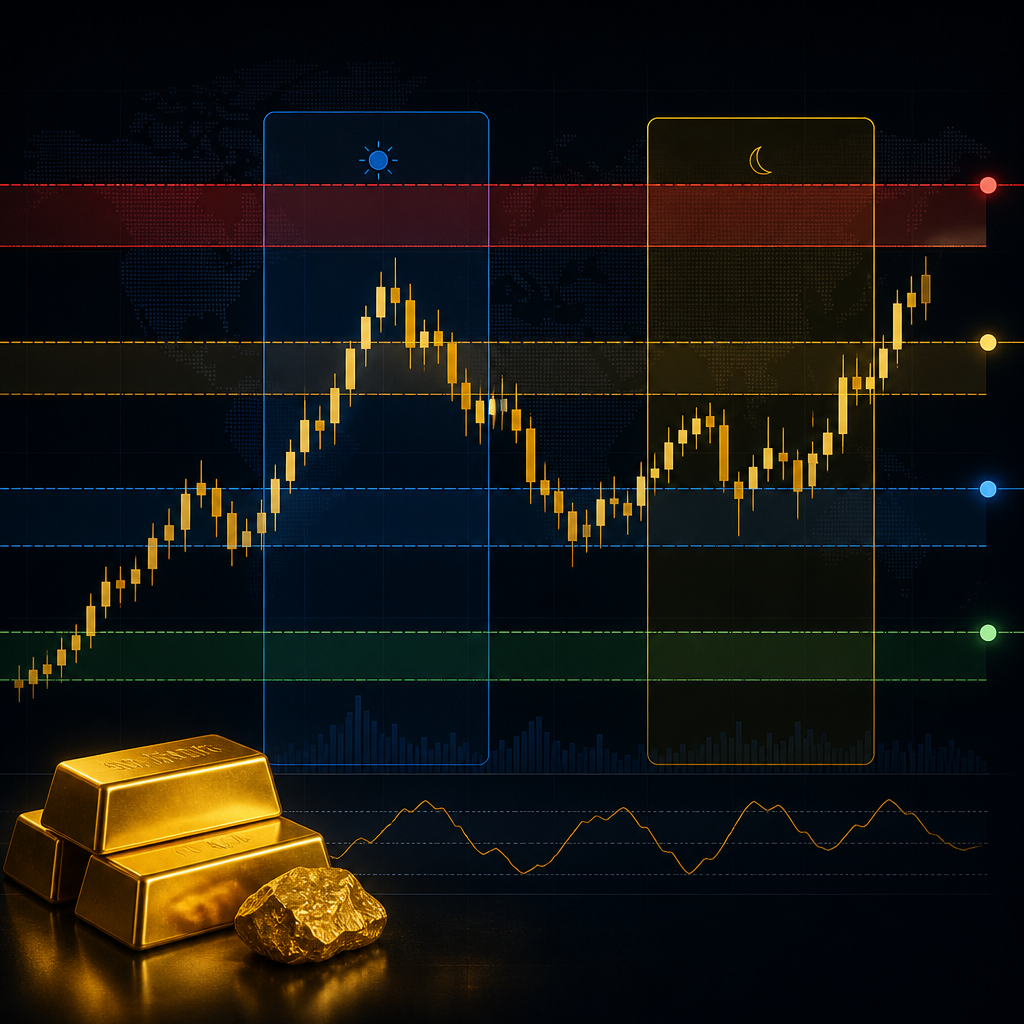
We’ll reference current, realistic levels throughout the guide so the examples feel like real trading, not textbook theory.
- Gold (XAUUSD): $2650.00 (24h: +0.35%)
- EUR/USD: 1.0520
- GBP/USD: 1.2680
- USD/JPY: 149.50
- DXY: 106.80
For gold trade examples, we’ll stay within $2610–$2690 and use typical stops of $10–$25 with targets aligned to 1:2 or 1:3 risk-reward.
Gold vs forex pairs: what makes XAUUSD unique?
Gold trades like a currency, but it behaves like a macro asset.
That’s why new traders get confused: they apply EUR/USD logic to XAUUSD and suddenly their stops feel “randomly hunted.”
In reality, gold is often reacting to USD liquidity, rates expectations, and risk sentiment—sometimes all at once.
Why gold “moves differently” than EUR/USD
EUR/USD is primarily a relative value trade between two economies.
Gold is more like a global barometer for real yields, inflation expectations, fear, and USD strength.
When DXY rises toward 106.80 and yields firm up, gold often struggles unless there’s a strong safe-haven bid.
Gold’s volatility is a feature, not a bug
XAUUSD can move $10–$30 in a session without breaking structure.
That means your strategy must be built around volatility, not surprised by it.
For many traders, a $12 stop on gold is “tight,” while a $25 stop can be perfectly normal—if position size is correct.
Gold can trend hard, then snap back
Gold often trends cleanly during high-liquidity windows, then mean-reverts during low liquidity.
This is why session timing matters so much: you want to trade when the market can actually follow through.
Comparison table: XAUUSD vs major forex pairs (practical differences)
| Feature | XAUUSD (Gold) | EUR/USD | GBP/USD | USD/JPY |
|---|---|---|---|---|
| Primary drivers | USD, real yields, risk sentiment, geopolitics | ECB vs Fed expectations, EU/US data | BoE vs Fed, UK data, risk sentiment | US yields, BoJ policy, carry flows |
| Typical “clean” trading hours | London + NY overlap | London session | London session | Asia + NY |
| Volatility feel | Fast, impulsive bursts; frequent $5–$15 candles | Smoother intraday | More spiky than EUR/USD | Yield-driven, can gap on policy headlines |
| Stop sizing (common retail range) | $10–$25 (strategy dependent) | 15–40 pips (varies) | 20–60 pips (varies) | 20–60 pips (varies) |
| Best beginner approach | Structure + session + strict risk | Trend + pullback | Breakout + pullback | Range + yield/news filter |
How the gold market really works (and why price reacts “instantly”)

To trade gold profitably, you need a realistic mental model.
Not “gold goes up when people are scared,” but a framework that explains day-to-day movement.
Spot gold vs futures vs ETFs (what you’re actually trading)
Most retail traders trade XAUUSD (spot) via CFDs.
But spot pricing is heavily influenced by COMEX futures liquidity and institutional hedging flows.
That’s why gold can react in seconds to a US data print or a Fed speaker headline.
The USD effect: why DXY matters at 106.80
Gold is priced in dollars.
So when the dollar strengthens broadly, it often creates headwinds for gold because it becomes “more expensive” globally.
With DXY near 106.80, you should expect gold rallies to face tougher selling unless there’s a strong catalyst supporting the move.
Real yields and rate expectations: the quiet driver
Gold doesn’t pay interest.
So when real yields rise (nominal yields minus inflation expectations), holding gold becomes less attractive relative to yield-paying assets.
This is why gold sometimes drops even when inflation headlines look supportive—because the market cares about the path of rates.
Risk sentiment and “flight to quality”
Gold can rally when equities wobble and traders de-risk.
But it’s not guaranteed.
Sometimes the immediate response to risk-off is USD strength first (DXY up), which can temporarily push gold down before it finds a bid.
Practical takeaway
In your trading plan, treat gold as a market that reacts to USD strength + rates + risk sentiment.
When two of those align, you often get the cleanest trends.
XAUUSD session timing: when to trade gold (and when to stay out)
Session timing is one of the biggest edges most retail traders ignore.
You can have a great strategy, but if you trade it at the wrong time, you’ll feel like gold is “random.”
London session: structure, breakouts, and trend continuation
London is where gold often chooses direction.
Liquidity improves, spreads typically tighten, and stops above/below Asia ranges get targeted.
A common pattern: gold ranges in Asia, then breaks during London with follow-through toward a key level like $2658 or $2632.
New York session: the real move (and the real traps)
New York brings US data, Fed speakers, and the deepest USD liquidity.
This is where gold can run $15–$30 quickly, especially when DXY and yields shift.
But NY also brings false breaks around major numbers—especially if you trade right into CPI, PPI, or NFP.
London–New York overlap: the sweet spot
If you can only trade one window, focus here.
This overlap tends to offer the best combination of liquidity and directional follow-through.
It’s also where many professional signal providers focus execution, including our London/NY session emphasis at United Kings.
When to avoid trading gold
- Low-liquidity hours: spreads widen and levels get wicked.
- Right before major US news: you can be “right” and still get stopped by a spike.
- After an extended impulsive move: chasing late often leads to buying the top or selling the bottom.
Step-by-step: a simple daily session routine
- Mark Asia high/low and yesterday’s high/low on XAUUSD.
- Identify the bias using DXY direction (106.80 context) and current gold structure around $2650.
- Wait for London to show intent: break + retest or rejection at a key zone.
- Only take A+ setups during London/NY overlap if you’re new.
- Journal the trade: entry, stop, target, reason, and session notes.
Core technical analysis for gold: structure first, indicators second
If you want a durable xauusd strategy, build it on price structure.
Indicators can help, but structure tells you where the real decisions happen.
Support and resistance zones (gold loves “zones,” not single lines)
Gold respects areas because it trades with heavy institutional participation.
Instead of drawing a single line at $2650.00, mark a zone like $2647–$2653.
This reduces the frustration of getting wicked out by $1–$2 noise.
Market structure: higher highs, lower lows, and the “break of structure”
In an uptrend, you want higher highs and higher lows.
A break of structure (BOS) is when price breaks the last higher low (or lower high) with momentum.
Example: if gold rallies from $2620 to $2665, then pulls back to $2642, a clean break below $2642 can signal a shift toward $2630 or $2618.
Candlestick confirmations that actually matter
- Strong rejection wicks at a key zone (e.g., spike to $2685 then close back below $2678).
- Engulfing candles that break a local structure point.
- Compression then expansion: tight range near $2650 followed by a decisive breakout.
Indicators worth using (keep it simple)
Many profitable gold traders use one or two indicators max.
- ATR (Average True Range): helps you size stops realistically. If ATR is high, a $10 stop may be too tight.
- Moving averages (20/50): not for “signals,” but for trend context and dynamic support/resistance.
- RSI: best used for divergence and momentum shifts, not “overbought/oversold” by itself.
A practical structure map around $2650
In the current context, you might map:
- Support zone: $2630–$2636 (prior swing + psychological level)
- Mid pivot: $2650 (round number, frequent reaction point)
- Resistance zone: $2678–$2685 (prior highs and breakout area)
Your job is not to predict.
Your job is to wait for price to react at these zones during the right session, then execute with defined risk.
Fundamentals for XAUUSD traders: what to watch weekly (without overload)
Most beginners either ignore fundamentals or drown in them.
We want the middle path: track the few drivers that consistently move gold.
The US calendar that matters most for gold
- CPI / Core CPI: inflation expectations and rates repricing can move gold $20+ fast.
- NFP (jobs): impacts USD, yields, and risk sentiment all at once.
- Retail Sales: demand strength can shift rate expectations.
- Fed decisions and speeches: guidance matters as much as the rate itself.
How to use fundamentals as a trade filter
Don’t trade gold because “CPI is coming.”
Trade gold because your technical setup is valid and the fundamental backdrop supports follow-through.
Example: If DXY is firm at 106.80 and the market expects hawkish Fed commentary, you may treat gold rallies into $2680–$2685 as potential sell zones—but only if price action confirms.
Geopolitics and surprise headlines
Gold reacts to geopolitical risk quickly.
But the first move can be messy, with spreads widening and whipsaws.
If you trade signals or structured setups, it helps to have a news survival plan. (We break this down in our guide on how gold signals react to unexpected news events.)
Weekly prep (simple and effective)
- Check major US events: CPI, NFP, Fed, and any high-impact speakers.
- Mark key gold levels: last week high/low and current week open.
- Note DXY trend: is 106.80 breaking higher or rolling over?
- Decide your risk mode: normal risk in quiet weeks, reduced risk in headline-heavy weeks.
Correlation analysis: using DXY, USD/JPY, and EUR/USD to filter gold trades
Correlation won’t give you entries.
But it can stop you from taking low-quality trades that “look good” on the gold chart alone.
XAUUSD vs DXY (often inverse)
Gold often moves opposite the dollar.
So if you’re looking to buy XAUUSD at $2640, but DXY is breaking higher above 106.80 with momentum, you should be cautious.
That doesn’t mean gold can’t rise.
It means your buy needs stronger technical confirmation and probably faster profit-taking.
XAUUSD vs USD/JPY (149.50 context)
USD/JPY is a proxy for yield differentials and risk appetite.
When USD/JPY pushes higher (like 149.50 grinding up), it can reflect higher US yields—often a headwind for gold.
When USD/JPY drops sharply, it can signal risk-off or yield compression, which can support gold.
EUR/USD and GBP/USD as USD sentiment gauges
With EUR/USD around 1.0520 and GBP/USD near 1.2680, you can often read broad USD strength by whether these pairs are trending down (USD strong) or bouncing (USD soft).
It’s not perfect.
But if EUR/USD is breaking down while gold is trying to rally, your gold long may face resistance unless a safe-haven bid overrides USD strength.
Step-by-step: a simple correlation checklist before entering XAUUSD
- Check DXY: trending up, down, or ranging near 106.80?
- Check USD/JPY: impulsive move or stable?
- Check EUR/USD: confirming USD strength/weakness?
- Decide trade type: trend trade if correlations align; scalp/quick target if they conflict.
Beginner-to-pro XAUUSD strategies (with realistic trade examples)
Let’s turn the concepts into repeatable setups.
Below are three strategies that scale from beginner-friendly to advanced—without relying on “magic indicators.”
Strategy 1: London breakout + retest (beginner-friendly)
Idea: Asia forms a range. London breaks it. You trade the retest with structure.
Example: Asia high at $2652 and low at $2638. London breaks above $2652 and runs to $2662, then retests $2652–$2650.
- Entry: Buy $2653 on bullish rejection
- Stop loss: $2641 (risk $12)
- Take profit 1: $2677 (reward $24, 1:2)
- Take profit 2: $2689 (reward $36, 1:3)
Why it works: you’re trading with liquidity and momentum, not guessing a top/bottom.
Strategy 2: NY pullback continuation (intermediate)
Idea: Identify a trend, then enter on a pullback into a demand/supply zone during NY.
Example: Gold trends up from $2618 to $2668. It pulls back into $2650 during NY open while DXY stalls.
- Entry: Buy $2651 after a higher low forms
- Stop loss: $2636 (risk $15)
- Take profit: $2681 (reward $30, 1:2)
- Stretch target: $2696 (reward $45, 1:3) if volatility expands
Execution tip: if price chops at $2650 for 30–60 minutes, reduce size or wait. Choppy pullbacks are where traders bleed.
Strategy 3: Liquidity sweep + reversal at a key zone (advanced)
Idea: Gold often runs stops above obvious highs/lows, then reverses hard.
Example: Price spikes above $2685 (previous high), prints $2688, then closes back below $2682 with a strong bearish candle during NY.
- Entry: Sell $2680 on retest/rejection
- Stop loss: $2694 (risk $14)
- Take profit: $2652 (reward $28, 1:2)
- Extended take profit: $2638 (reward $42, 1:3)
Key rule: don’t short just because price touched $2685. Wait for the sweep + confirmation close.
Where signals fit in (without losing your skill)
If you want to speed up execution, premium signals can help—as long as you still follow risk rules.
At United Kings, our premium Telegram signals include clear Entry, SL, and TP levels and are designed around London and NY sessions.
If you want to see how we structure our setups, explore our XAUUSD gold signals and broader all trading signals coverage.
Risk management for gold: the difference between surviving and scaling
Most traders don’t fail because their entries are bad.
They fail because their risk is inconsistent.
Gold magnifies this because volatility punishes oversized positions fast.
Gold stop loss sizing: why $10–$25 is common
On XAUUSD, a $5 stop can be noise.
A $10–$25 stop often gives the trade room to breathe—but only if your lot size matches your account size.
If you can’t emotionally handle a $15 stop, your position size is too big.
Position sizing (simple and practical)
Pick a fixed risk per trade, like 1% (or 0.5% if you’re new).
Then calculate lot size based on stop distance.
Example: $1,000 account, risk 1% = $10 risk.
If your stop is $15 on gold, you must size so that a $15 move equals $10 loss.
This is how you stay consistent even when volatility changes.
Risk-reward: why 1:2 is a gold standard (literally)
If you target 1:2 and win 50% of the time, you can still be profitable.
That’s why many gold traders focus on 1:2 as the baseline, then use partial profits or trailing stops for 1:3 when conditions are trending.
Drawdown rules that keep you in the game
- Daily loss limit: stop after -2R or -3R in a day.
- Weekly loss limit: reduce size after a -5R week.
- No revenge trades: if you feel urgency, you’re not in a decision-making state.
If you trade signals: the “copy-paste” trap
Signals work best when you execute them like a professional.
That means: correct lot size, no moving SL wider, and no taking entries late.
If you want a practical framework, pair this guide with our educational content across the United Kings blog and our risk-focused resources like risk management strategies when using forex signals.
Step-by-step: building your personal XAUUSD trading plan (that you can actually follow)
A trading plan is not a PDF you write once.
It’s a set of rules you can follow on a random Tuesday when gold is chopping at $2650 and your emotions want action.
Step 1: Define your trading window (sessions)
Choose one primary window: London, NY, or overlap.
If you trade all day, you’ll overtrade.
Gold rewards patience more than screen time.
Step 2: Define your setup(s)
Pick one breakout setup and one pullback setup.
Write the rules in plain language.
- What must happen first (range, trend, key level)?
- What confirms entry (close, rejection, BOS)?
- Where is the invalidation (stop)?
- Where is the logical target (next zone)?
Step 3: Define risk rules (non-negotiable)
- Risk per trade: 0.5%–1%
- Max trades per day: 1–3
- Daily loss limit: -2R to -3R
- No trades during major news (unless your plan includes it)
Step 4: Build a pre-trade checklist (print it)
- Is price at a pre-marked zone ($2630–$2636, $2650, $2678–$2685)?
- Is this during my session window?
- Do DXY and USD/JPY confirm or conflict?
- Is there high-impact news within 30–60 minutes?
- Is the stop $10–$25 and position size correct?
Step 5: Post-trade review (where profits are built)
After every trade, record:
- Screenshot of entry and exit
- Session and volatility notes
- Whether you followed rules
- One improvement for next time
This is how you go from “random wins” to a measurable edge.
Psychology and discipline: the hidden edge in gold trading
Gold is emotional.
Not because the chart is scary, but because the speed forces decisions.
If you don’t train discipline, you’ll exit winners early and hold losers too long.
The most common emotional mistakes in XAUUSD
- Chasing breakouts late: buying $2668 after the move started at $2652.
- Moving stops: turning a $15 planned loss into a $45 surprise.
- Overtrading chop: giving back profits when gold ranges around $2650.
- FOMO after a signal: entering after the ideal entry is gone.
A quick story (you’ve probably lived it)
You see gold spike from $2648 to $2660 in minutes.
You buy at $2659 because “it’s going to $2685.”
It pulls back to $2650, tags your tight stop, then rallies to $2685 without you.
The problem wasn’t the market.
The problem was entering without a level, without a retest, and without a volatility-aware stop.
Rules that reduce stress immediately
- Trade only at levels: no level, no trade.
- One setup at a time: mastery beats variety.
- Accept the loss before you enter: if you can’t, reduce size.
- Partial profits: take 50% at 1:1, then aim for 1:2 or 1:3 when trending.
Signals + psychology: using structure to stay disciplined
Many traders find that structured signals help reduce impulsive decisions.
When you receive a clean Entry/SL/TP plan, you can focus on execution and risk.
If you’re building that discipline, our educational-first approach alongside signals is designed to help you grow, not just copy trades.
How to use gold signals responsibly (and what “premium” should include)
Signals can be powerful, but only if you treat them like a professional tool.
The goal is not dependency.
The goal is faster learning and cleaner execution while you build your own market understanding.
What a high-quality gold signal should include
- Exact entry (or entry zone)
- Stop loss (clear invalidation)
- Take profit levels (TP1/TP2/TP3)
- Context: session, level, and setup type
- Updates: break-even moves, partials, or invalidation notes
How to execute a signal step-by-step (without blowing your account)
- Check timing: is it London/NY session, or low liquidity?
- Check spread: avoid entering when spreads widen unexpectedly.
- Set position size first: based on SL distance ($10–$25 typical).
- Place SL and TP immediately: remove emotion.
- Don’t “improve” the trade by moving SL wider.
Where United Kings fits
United Kings is built for traders who want premium Telegram signals across forex and gold, with a strong focus on London and NY session trading.
We’re known for a disciplined approach, clear levels, and a large community of 300K+ active traders who share execution feedback and learning.
If you want to compare signal styles and what beginners should look for, you can also review our educational post on choosing a signals provider checklist and our beginner-focused overview at forex signals on Telegram for beginners.
Explore our coverage by market
Common XAUUSD mistakes (and the exact fixes)
This section will save you months.
Because most gold losses come from a handful of repeatable mistakes.
Mistake 1: Trading gold like it’s EUR/USD
Symptom: tight stops, frequent stop-outs, frustration.
Fix: use ATR-aware stops and trade zones, not lines. Accept that $10–$25 stops are normal when sized correctly.
Mistake 2: Ignoring session timing
Symptom: you trade during dead hours and get wicked out.
Fix: restrict trading to London/NY overlap until you’re consistently profitable.
Mistake 3: Entering without confirmation at key levels
Symptom: you buy resistance or sell support.
Fix: require a close, rejection, or break/retest before entry.
Mistake 4: No plan for news volatility
Symptom: CPI spike hits your stop, then price goes your way.
Fix: either avoid trading 30–60 minutes around major news or trade reduced size with predefined rules.
Mistake 5: Oversizing because gold “pays more”
Symptom: big wins, then bigger losses, then account damage.
Fix: risk a fixed % per trade and respect daily loss limits.
FAQ: XAUUSD trading guide (gold trading questions traders ask daily)
1) What is XAUUSD and why is it called “gold vs USD”?
XAUUSD is the symbol for spot gold priced in US dollars. If XAUUSD is $2650, it means one ounce of gold is priced at $2650 in USD terms.
2) What is the best time to trade gold?
Many traders prefer the London session and the London–New York overlap because liquidity is higher and moves tend to follow through more cleanly than in low-liquidity hours.
3) How much should my stop loss be on gold?
It depends on volatility and your strategy, but many retail gold trades use stops around $10–$25 from entry. The key is to size your position so that the dollar risk stays consistent.
4) Is gold negatively correlated with the dollar (DXY)?
Often, yes—gold and DXY frequently move inversely. But correlations can weaken or flip in risk-off moments, so use DXY as a filter, not a guarantee.
5) Can beginners trade XAUUSD using signals?
Yes, but beginners should start on a demo account, use small risk (0.5% or less), and focus on learning execution: entries on time, SL/TP discipline, and avoiding overtrading.
Risk disclaimer (read this before you trade)
Trading forex and gold involves significant risk and is not suitable for every investor. You can lose some or all of your capital. Past performance does not guarantee future results. Signals and educational content are provided for informational purposes only and do not constitute financial advice. If you’re new, consider practicing on a demo account and using conservative risk before trading live.
Join United Kings: get premium XAUUSD signals with clear levels
If you want to trade gold with more structure and less guesswork, join the United Kings community and get premium Telegram signals built around London and NY session opportunities.
We provide Entry, SL, and TP levels, educational guidance, and a community of 300K+ active traders focused on disciplined execution.
- Explore our full signals offering: United Kings trading signals
- Focused XAUUSD coverage: premium gold signals for XAUUSD
- Need forex too? forex signals for major pairs
- See our 3 plans and choose what fits: Starter (3 Months $299), Best Value (1 Year $599), Unlimited (Lifetime $999)
- Join our Telegram now: United Kings Telegram trading room
Bonus: We offer a 48-hour money-back guarantee so you can evaluate the experience with confidence.
Ready to trade XAUUSD with a real plan? Join United Kings today and start executing gold setups with clarity and discipline.